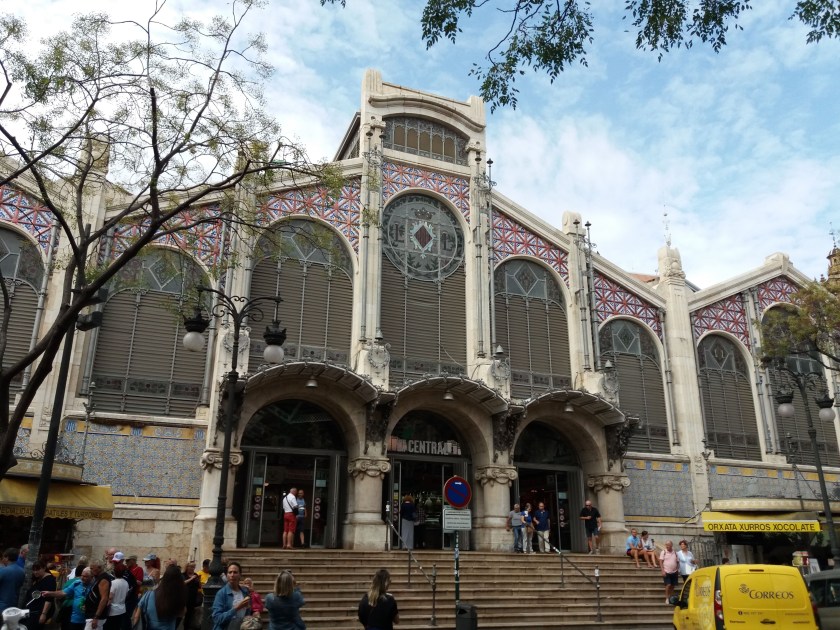
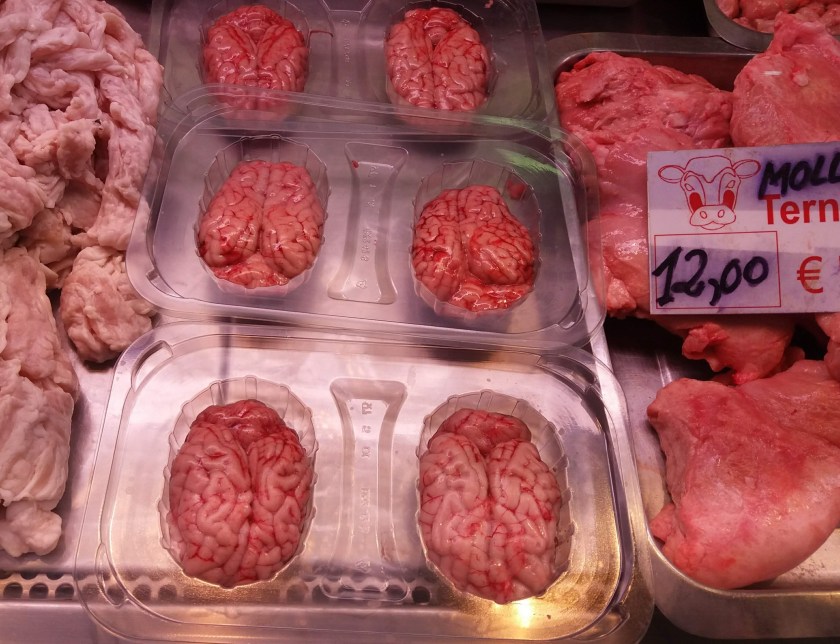
Valencia has the biggest and best indoor market in Spain, the Merkat Central. It is housed in a beautiful cast-iron building in the middle of the old town. There are hundreds of stalls selling meat, vegetables, fruit, and fish. And brains, and barnacles and other things I couldn’t recognize. It’s the best market I have ever visited for size, quality and variety of unusual foods that I didn’t recognise. I didn’t fancy the weird barnacles or brains very much.
Merkat CentralMmm – brains!
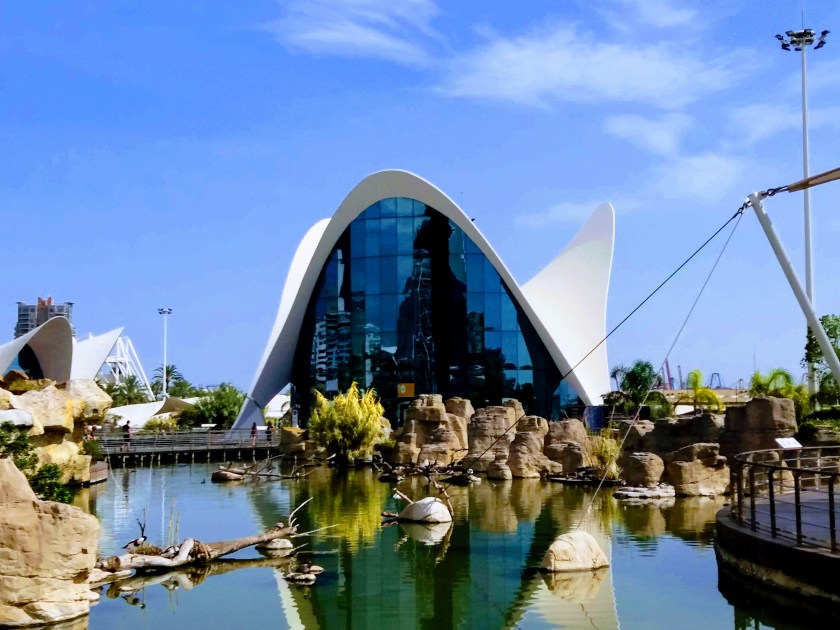
After lunch on our terrace, we took the 95 bus to the Oceanographic, the biggest aquarium in Europe and part of the City of Arts and Sciences. It has zones for different marine environments and is quite awesome. There are several glass tunnels that allow you to walk through huge tanks so you have big sharks swimming overhead. The engineering needed to build them is quite astounding. There is an arctic section with Beluga Whales, Walruses and penguins in an enclosure that drops snow onto them!
Oceanographic
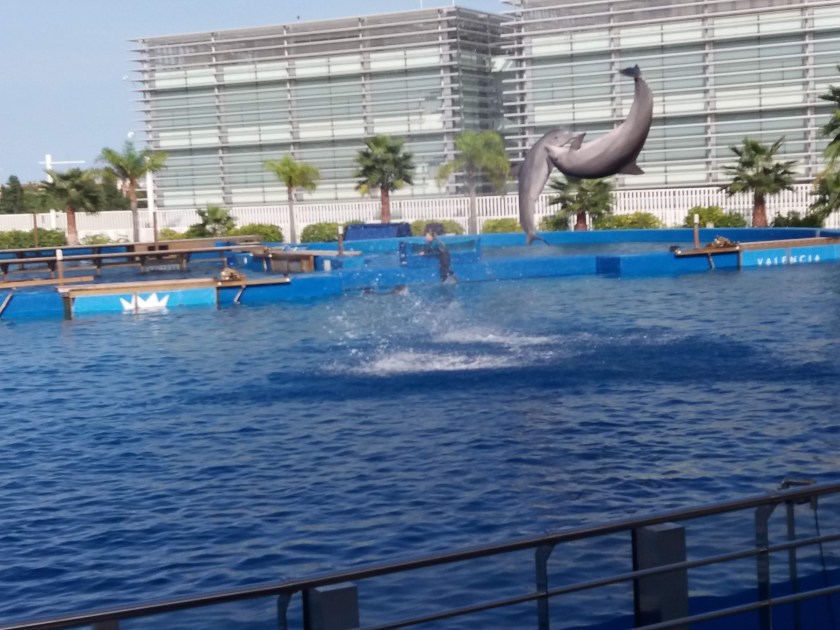
The finale to the visit was the Dolphin Show in an outdoor theatre like you see in adverts for holidays in Florida. Six good-looking young trainers were paired up with six good-looking young Dolphins and performed tricks. It was fun and entertaining, and I will never eat a Dolphin steak again.
Ally oop!
Joke! I never have eaten Dolphin steak.
Or have I?
On our final evening we couldn’t be arsed to go out, our terrace was so damn nice and we were tapas’d-out. I bought some really crappy burgers from the supermarket and fried them up. The sunset over the Valencia rooftops and we watched flocks of noisy parakeets fly overhead to their evening roosts.
I would really recommend a tour of Spanish cities by train or coach. If you do so, make sure you get accommodation close to the city center if you can. It’s fun being where the action is and close to buses and metro stations. Spain has a huge amount of culture to enjoy, as well as beautiful beaches. As long as you can order “dos vino blanco per favor”, you will be fine.
In Carrer Serrano, just around the corner from our apartment, we hired some bikes and then pedalled gently through the Turia park towards the City of Arts and Science. There are several old stone bridges that we passed beneath, which look very similar to the Roman bridge that we saw in Rimini.
Bridge over the park by Serrano Gate
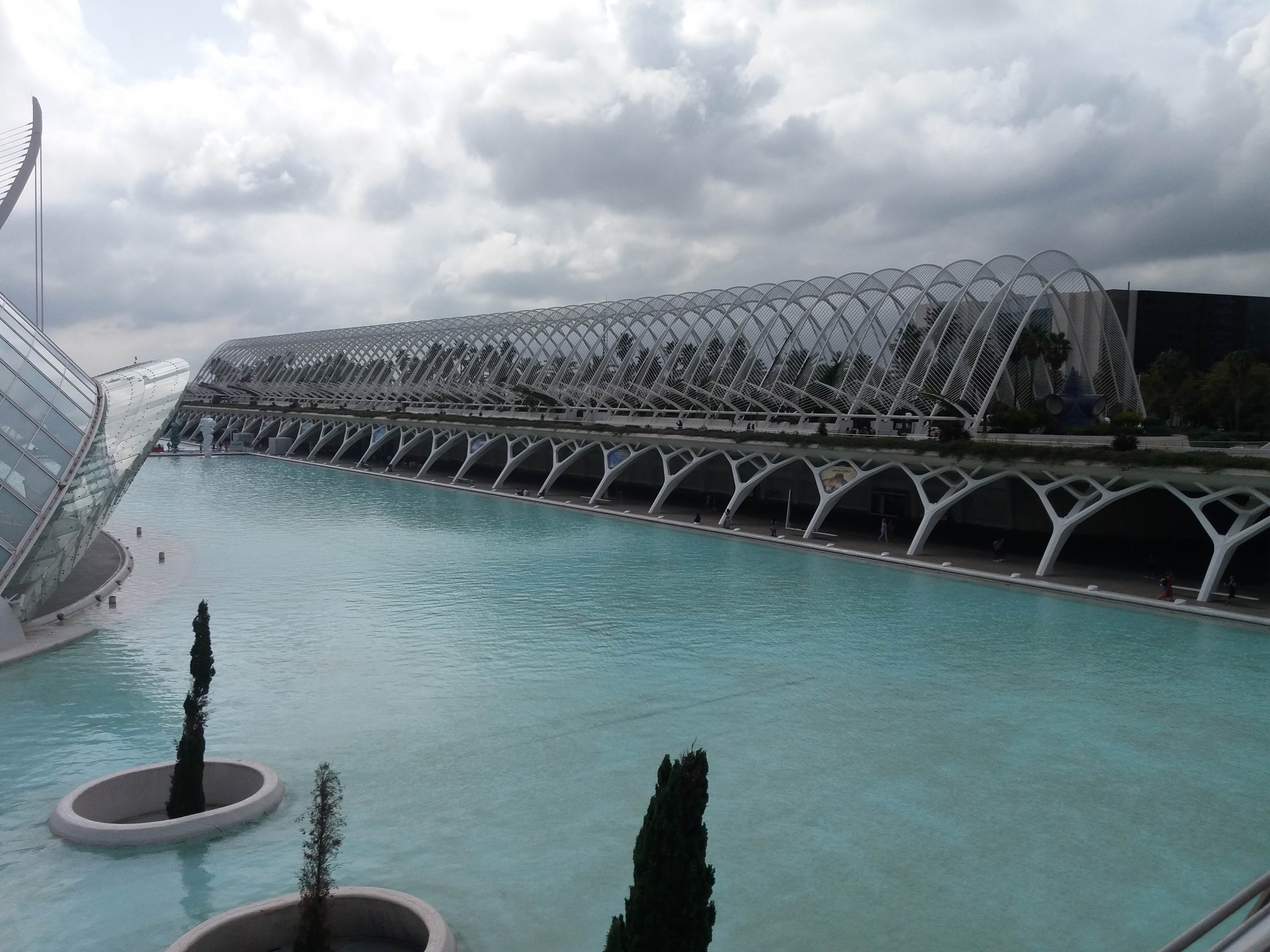
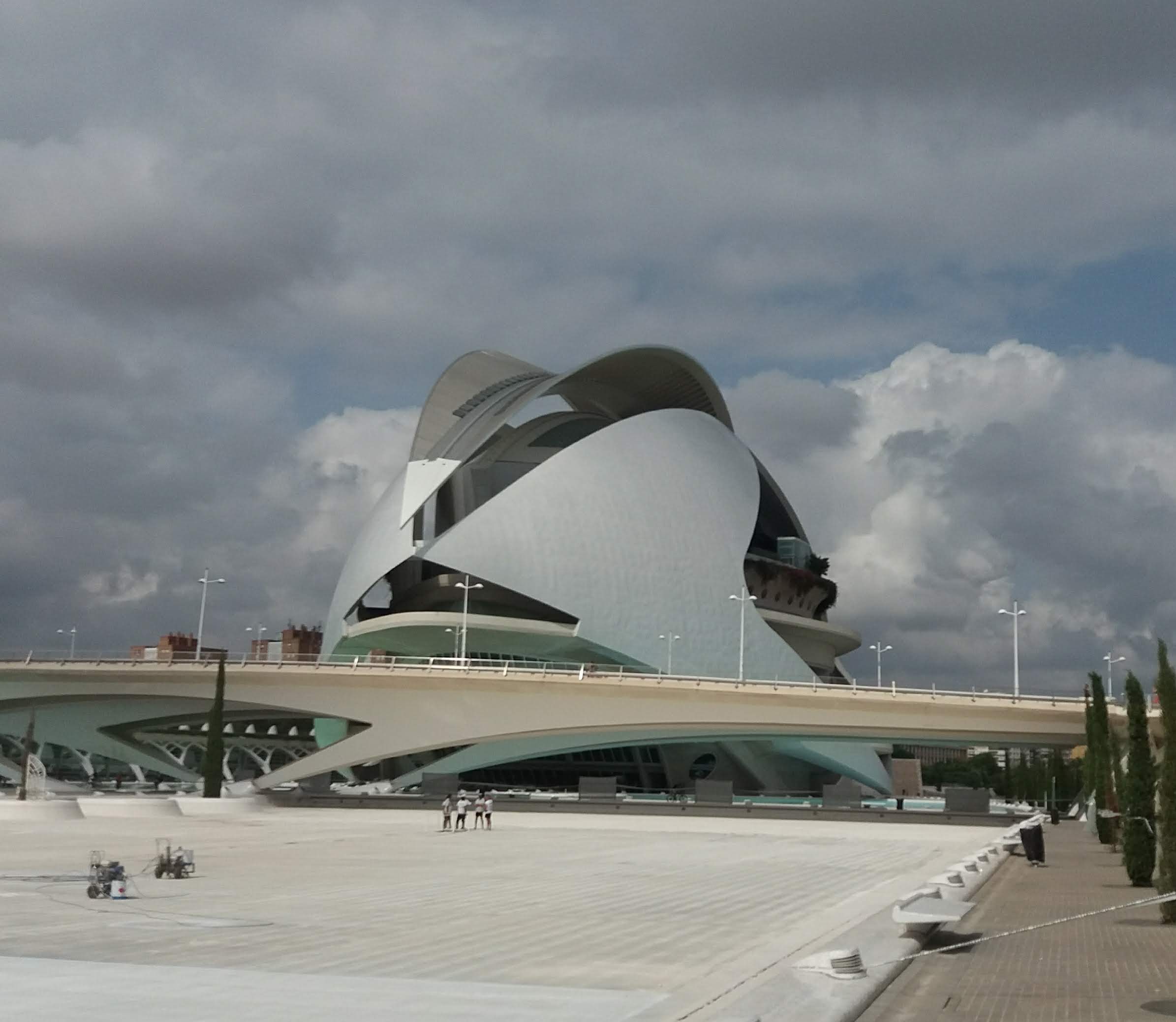
The City of Arts and Science is the most popular destination in Valencia, for good reason. It was designed by Santiago Calatrava and Felix Candela and is a modern masterpiece of architecture and structural engineering. There are eight different structures, including a cable-stayed bridge and L’Umbracle, which is an open structure with a garden inside. It is like a very big conservatory where they forgot to put in the glass. L’Hemisfèric is an Imax cinema and planetarium and El Palau de les Arts Reina Sofía is an Opera house.
L’Umbracle
The structures are all white and look like giant sculptures. Anyone of them on its own would be impressive, but there are seven different attention-grabbing constructions.
L’Hemisfèric
We went into the Science Museum but didn’t visit the exhibition. Reviews that we had read said it more for entertaining children rather than being a serious science museum.
El Palau de les Arts Reina Sofía
We continue cycling until the park finished, and continued along cycle paths past the marina to the beach. A film crew was filming some very saucy sculptures by the marina, and I was asked on camera what I thought of them My response was a diplomatic “Interesting, but they wouldn’t erect them in London” Perhaps erect was a poor choice of words.
Sculpture in the marina – you won’t find this in Hyde Park
The beach is very big, many miles long and hundreds of metres wide. The weather was a little overcast, so good weather for Julie to read while I went for a swim in the Mediterranian. It was wavey and warm, but not as much fun as San Sebastian when I went swimming with my daughter Josie. Spending a long time on the beach is not our thing, so we went on to explore the marina.
On the beach in my Tintin shirt
At the marina, saw some Super Series 52 racing yachts which had just been racing out in the bay. Valencia is a good place for yacht racing because of it variable winds. Nearby in the marina is the HQ for the Americas Cup, which will next be competed for in 2021.
Super Series 52 Yachts – that one’s a Brit!
Also in the marina was Charles Simonyi’s private motor yacht Skat, which is 233 feet long and has a crew of sixteen. Man – has he got money! Mr. Simonyi headed-up the Microsoft Application Development Group, so when you are slaving over Word, Excel or Powerpoint, he’s the man to blame. Skat is grey, so looks like a naval vessel from a distance.
Skat – Microsoft Office on water
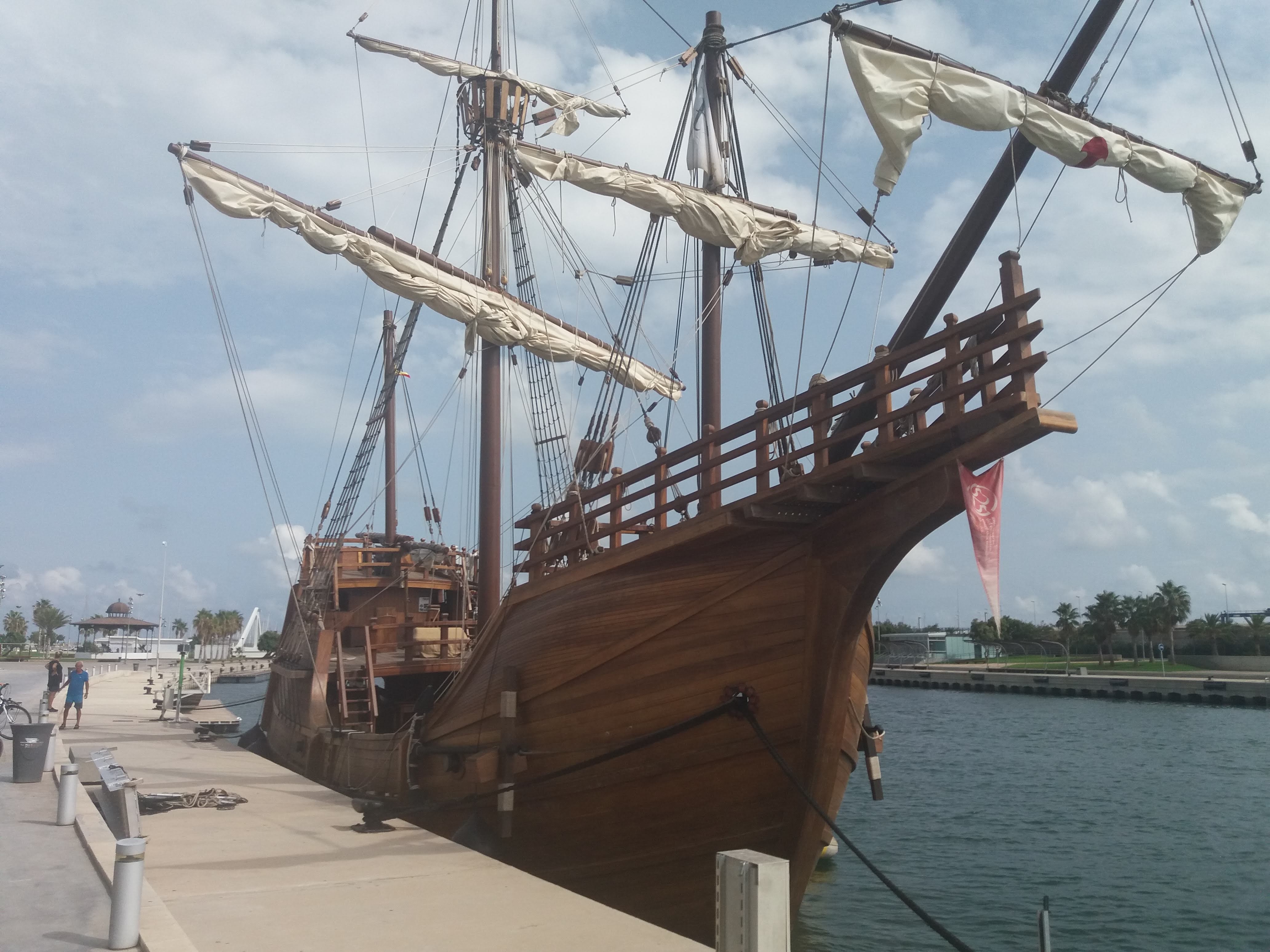
In another part of the marina, a wooden ship was moored. It was a replica of the Santa Maria, one of the ships that Christopher Columbus sailed to the Caribbean. The Caribbean was named after the Carib people that Columbus enslaved and ultimately wiped out.
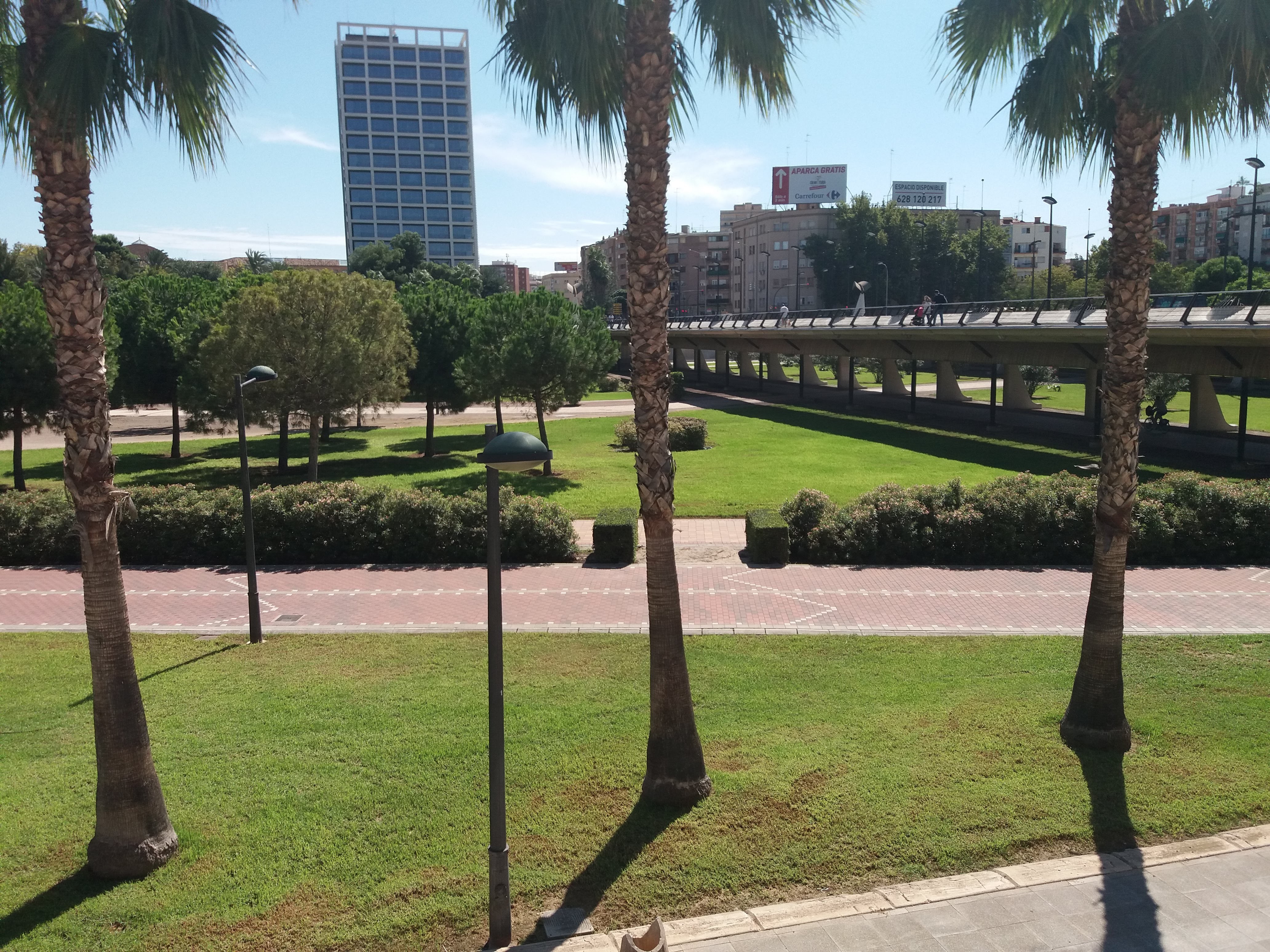
About a hundred metres from the flat and just beyond the Serrano Gate is the course of the Turia river. The river would regularly and disastrously flood, so in 1957 the city authorities decided to divert the river away from the city centre. The river bed was turned into a nine kilometre linear park that goes out most of the way to the coast. It has walking, cycling and running tracks, and is a mixture of sports fields and parkland, a great asset to the city and a green lung at its centre.
Turia park
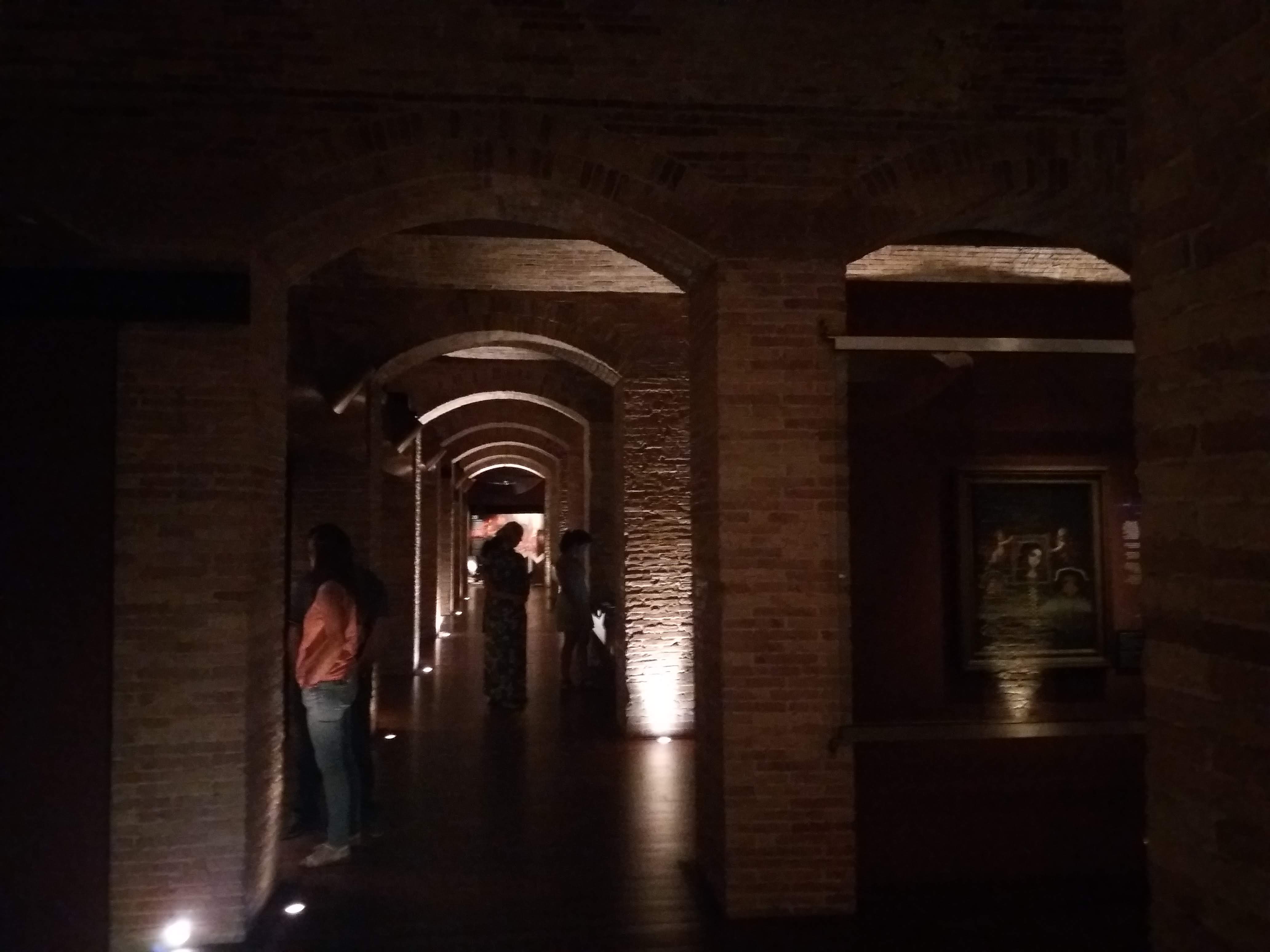
We walked west through the park to the Valencia History Museum. It is housed in a converted Victorian water cistern, constructed with a vaulted brick roof and brick columns, similar to Byzantine cisterns I had seen in Istanbul. The museum is divided into about fifty sections, some containing artifacts and others contain screens where short films are projected. The films have a small cast in costume who act out stories about historical events in Valencian history. The whole museum is dark, and the signs are only in Spanish and Valencian, so I didn’t find it as accessible as the Madrid history museum.
Valencia History Museum – it’s a bit gloomy
It was Sunday, so we couldn’t find a cafe that was open for lunch. Using trusty old Google Maps I found a vast Carrefour hypermarket with a cafe, so we had lunch with the shoppers. and bought some food chorizo sausages for our dinner.
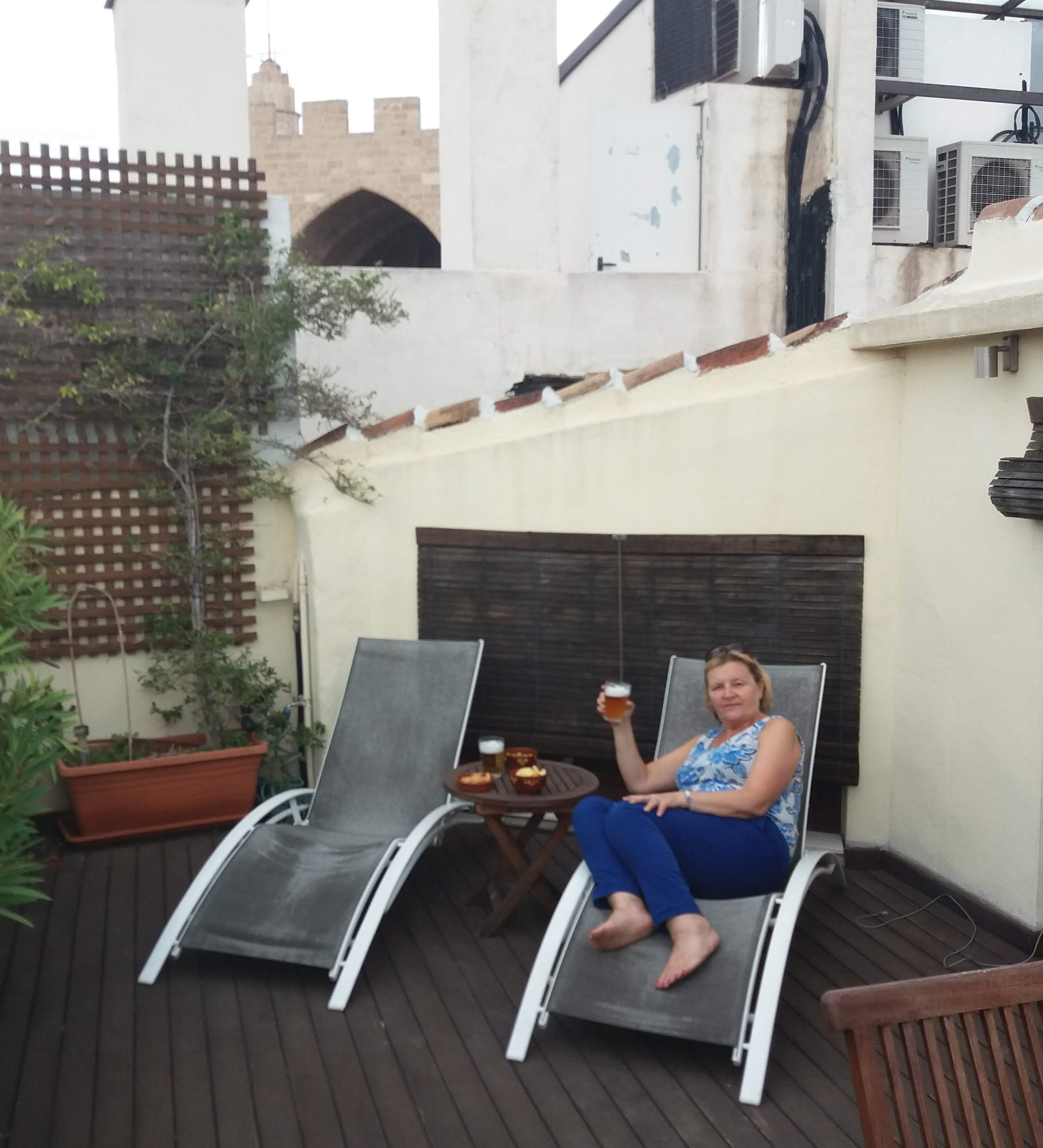
Our afternoon was spent relaxing on our lovely terrace in the sunshine, where the only thing higher than us were tourists on the Serrano towers taking pictures. I’m probably in someone’s album by now. I cooked the sausages with salad and potatoes, washed down with Carrefour beer and white wine.
Lazy afternoon on the terrace
After dinner, we walked through the lovely old town to the Cafe de Lisboa, which our host Francisco recommended for a local cocktail called Agua de Valencia. It should be Orange juice, Cava, gin and vodka. What we were given by the weasels tasted just like orange juice, so I complained. Their second try had some booze in it but was suspiciously unfizzy considering it should have Cava in it. DON’T GO TO THE CAFE DE LISBOA.
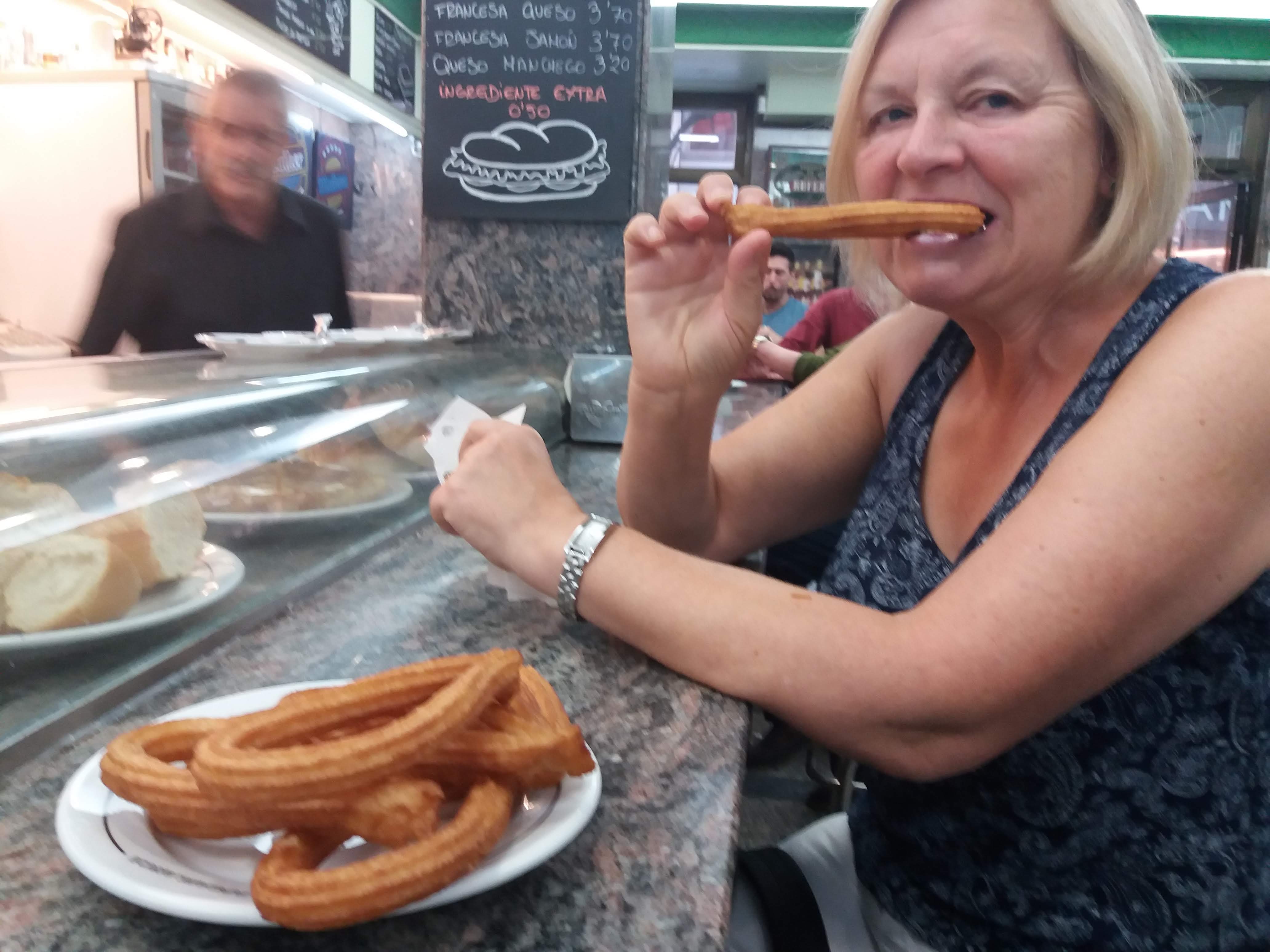
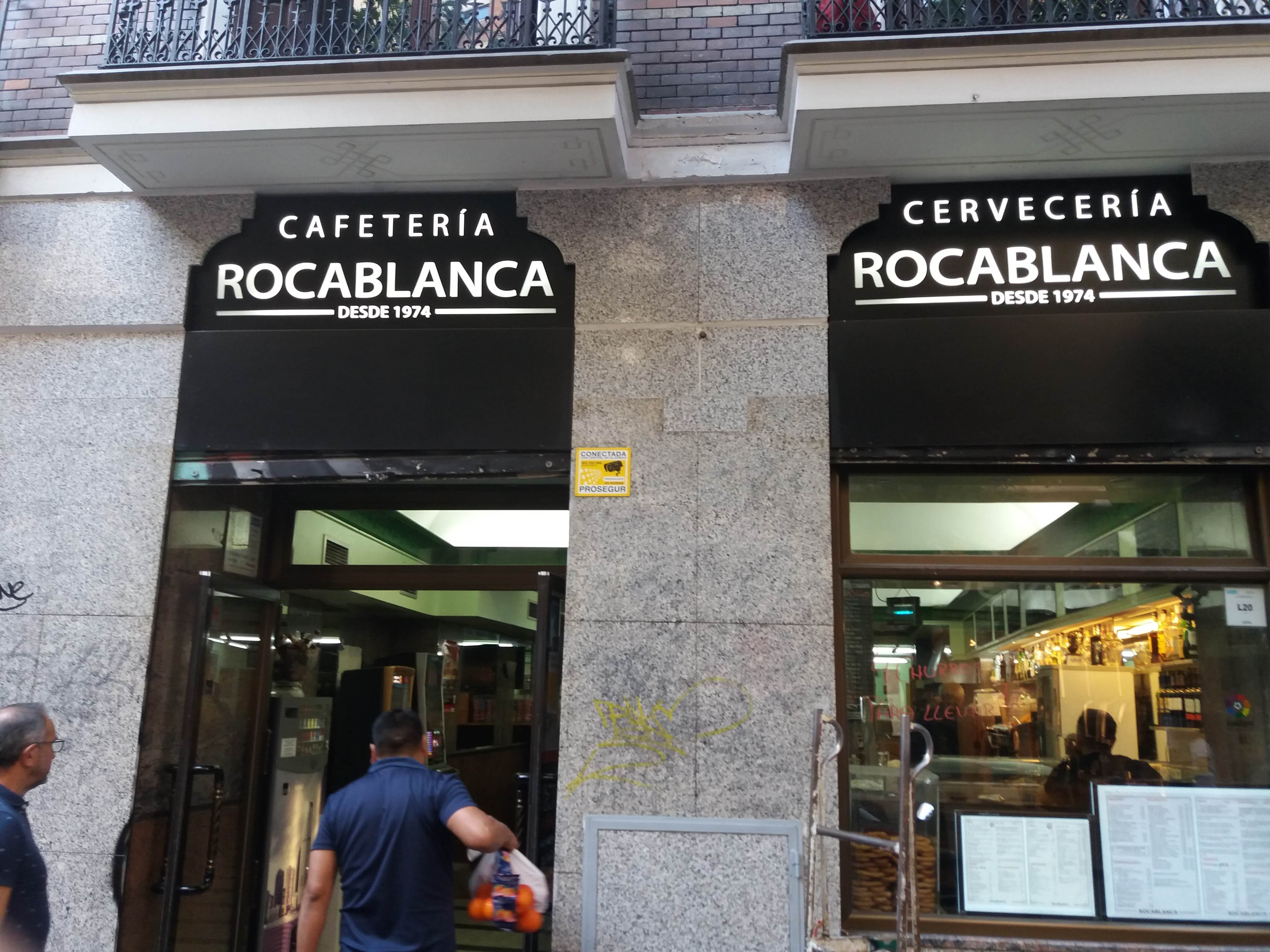
It was time to go on the next leg of our trip to Valencia, a city that I knew nothing about, apart from my mate Dave saying that it was “nice”. We had breakfast in the wonderful Roccablanca, and had churros and coffee, a breakfast that is both bad and good at the same time.
They are “Diet Churros”, honestly!
The train journey was dull, but I had a great book called “10% human” which is about all the bacteria that live inside of us. It wasn’t a page turner, and will never be made into a film starring Jennifer Lawrence, but it’s the nerdy kind of science book I (and a handful of other geeks) enjoy. I kept saying to Julie “did you know that..” and see her eyes roll ready for the next dull fact about gut bacteria.
From Sorolla station, we got a 27 bus to the Central Market and then found our way (using Google Maps) to our apartment at 12 Carrer de Naquera. In Madrid, the streets are called “Calle” in Valencia they are called “Carrer” because the local language is Valencian, which is a dialect of Catalan. Francisco, the owner, met us outside the flat and showed us up the ninety five steps up in the loft of a Victorian building. I think the phrase “bloody lovely” would be enough to cover the description. It was furnished tastefully from Ikea, had a big comfy bed, an induction hob in the kitchen and a fabulous roof terrace overlooking the Torres de Serrano, a fortified gate to the old city.
View from the terrace and Seranno Gate
We had a late lunch in a restaurant, an indifferent paella containing chicken legs and sea snails of some sort. Valencia is the home of paella because the rice is grown close by, but it isn’t that great in cheap restaurants. The rest of the afternoon was spent chillin’ on the terrace and watching the mortals below.
Since the flat had a kitchen we decided to dine in and got a pizza in the local Carrefour Express, which is like a Tesco Express with more jamon and fewer biscuits. I made us a nice tomato and leaf salad to go with it, but the discovered a basic flaw, in my plan, there was no oven. So I fried the pizza in a griddle pan, which worked until I had to turn it over and the topping welded to the pan. I scraped it off and put it back on again, but Jamie Oliver would have been outraged. The end result was sort-of OK, but I don’t want to eat it again.
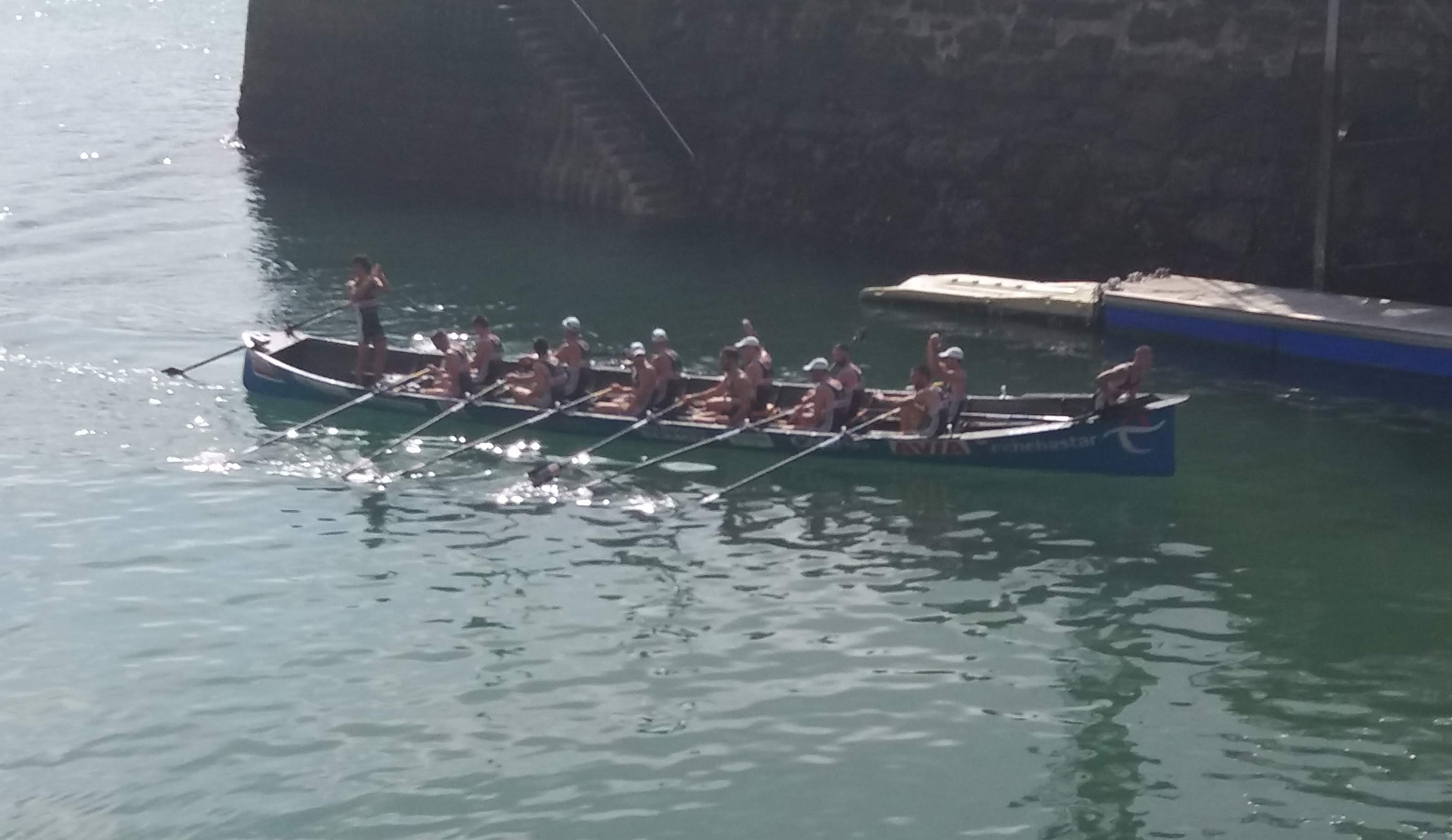
On Sunday morning we had a lazy breakfast in the flat of scrambled eggs, bread, Serrano ham and yoghurt, very tasty. On our walk to the beach, we saw lots of people heading towards the cathedral. I assumed they were all good Catholics going to the Sunday Mass. But they walked past the cathedral to the seafront, where we joined thousands of people on the promenade. The big event was a regatta for traineras, twelve metre long boats with thirteen rowers and a cox steering with a big oar stood at the back. The coastal towns of the Basque Country compete against each other, and with thirteen oars in a carbon fibre boat, they can really make them shift. The course is 5.5 km long and the prize is a flag called a Bandera. The Kontxaco Bandera in San Sebastián was founded in 1879 and is the most prestigious in the Basque Country. This year the Bandera was won by a crew from Hondarribia.
A trainera and a tired crew
Weaving our way through the crowds celebrating/ commiserating outside bars, we walked through the old town and took a steep zig-zag path to the top of Mount Urgull. It was fortified against the horrible English and there are several old batteries where cannon would protect the port.
View from Mount Urguell over la Concha
At the top, there are more great views over the beaches and the town, with Mount Igeldo at across the bay. Josie ascended the steep path in her Birkenstock sandals, which are not suited for walking uphill, and she let us know that she wasn’t happy. At all. Not a bit. Fortunately, we found a quicker way down and crossed the bridge over to the Gros district of town behind the Zurriola beach and found somewhere for lunch.
After all that fresh air we were (to quote Monty Python) tired and shagged out after a long squark. So I got some food at the supermarket and made a paella for dinner at our flat. We managed to connect up the TV to my Google Chromecast and watched clips from Withnail and I, one of my favourite films.
Our tourist guidebook in Madrid was an excellent Dorling Kindersley, they are beautifully illustrated books that are a pleasure to read. Other guides have lots of information on restaurants and hotels, which is often out of date by the time you visit a city. The guidebook recommended the Madrid Historical Museum, which was on Calle Fuencarrel near the Tribunal Metro stop. Conveniently, the Roccablanca cafe was on the way, so we stopped for breakfast.
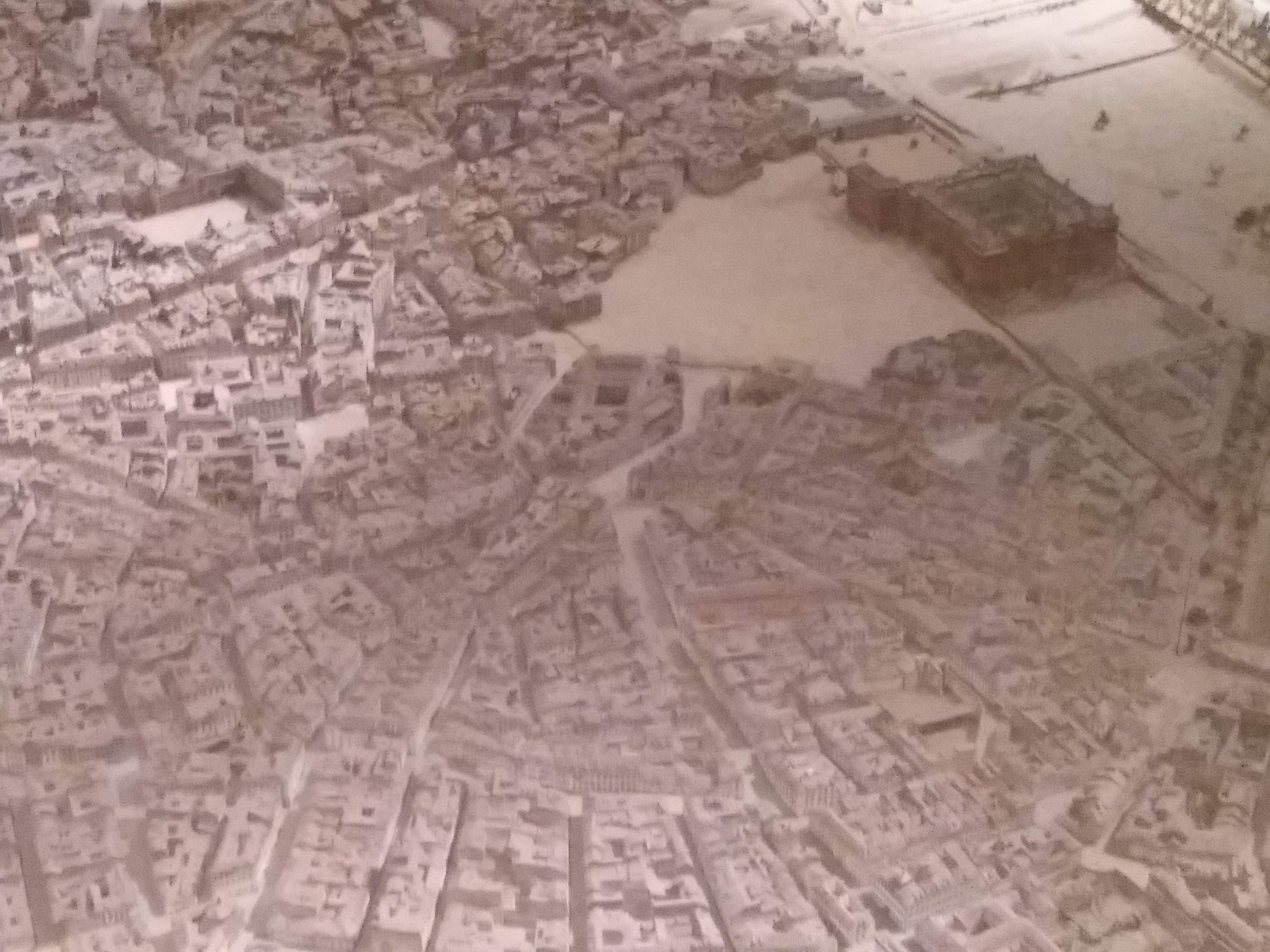
The museum is in an old Baroque hospice, and is a real gem. It was almost empty when we arrived and was lovely and spacious and cool. It shows the history through paintings and maps and is the highlight is in the basement where there is a huge model of Madrid as it as in the 19th century. It is a fantastic work of art and a historical record of the old city.
model of old Madrid
Our next stop was the huge Retiro Park, which is behind the Prado gallery was a former hunting ground of the kings. It is now a great municipal park with strollers, cyclists and people on hired electric scooters. African men sell bags and sunglasses from blankets whilst holding onto ropes tied to each corner. If a police van appears they quickly pull on the ropes to pick up their goods and move to a different spot.
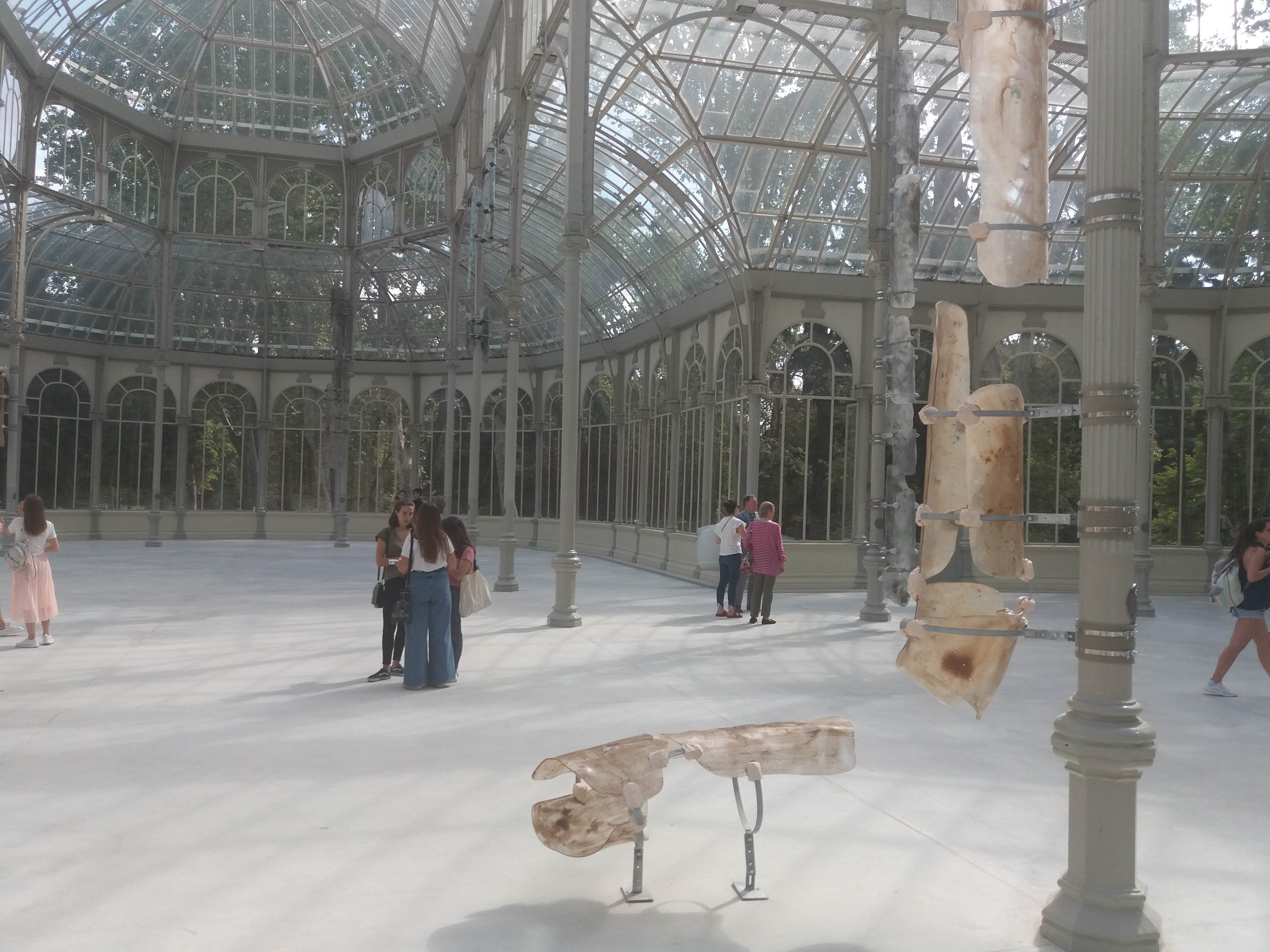
We ate a picnic lunch and watched the world and his wife and children pass by contentedly. The park has its own Crystal Palace, which I guess at one time was a conservatory for plants, but is now empty apart from some glass sculptures which looked like orthopedic splints.
Crystal Palace in Retiro Park
At the far end of the park, we walked to Atocha station, which was the scene of a terrible Islamist bomb campaign in 2004 which killed 197 people and injured around 2,000. We took the Metro from there to Iglesias station and went to the Sorolla Museum.
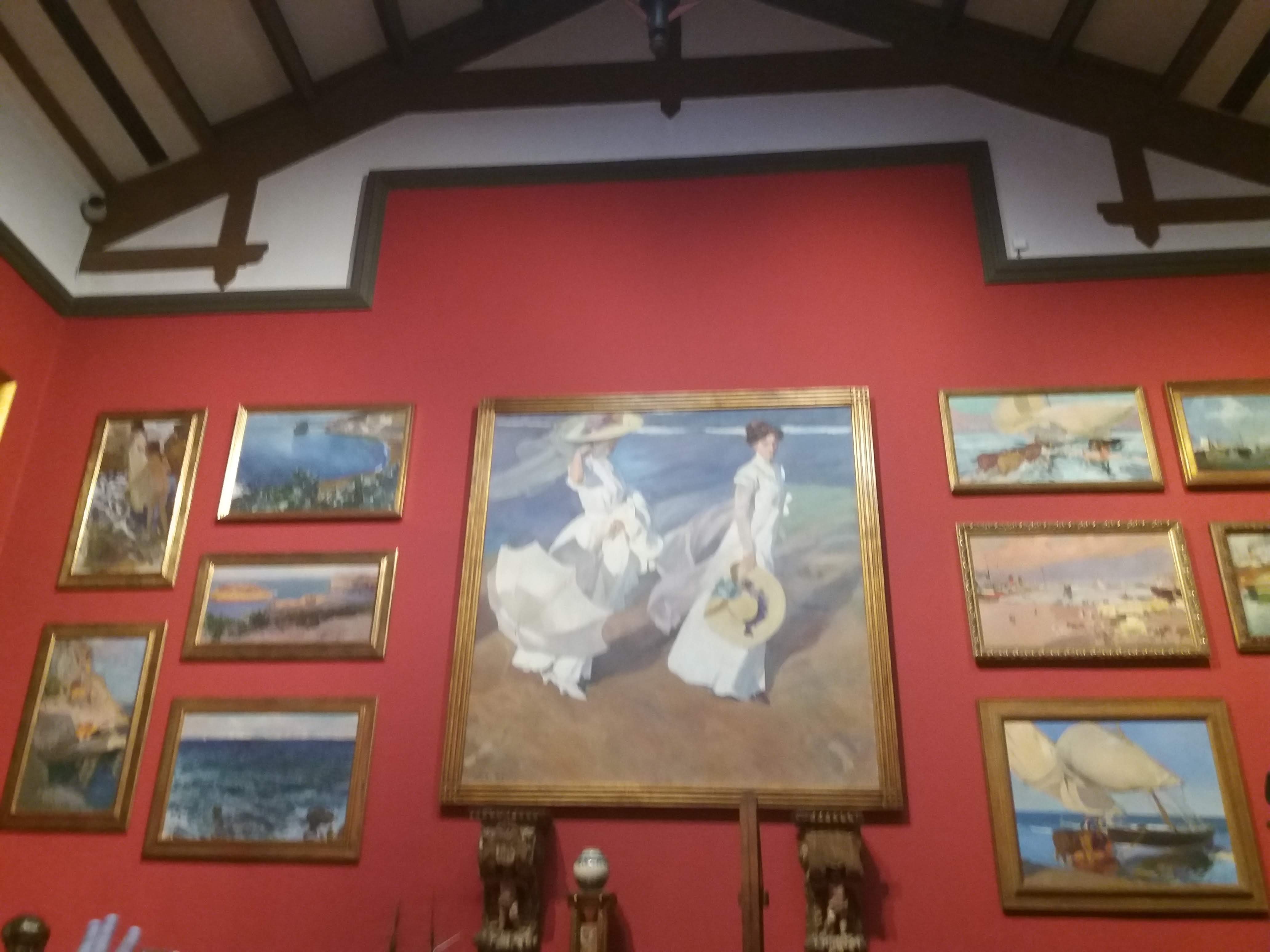
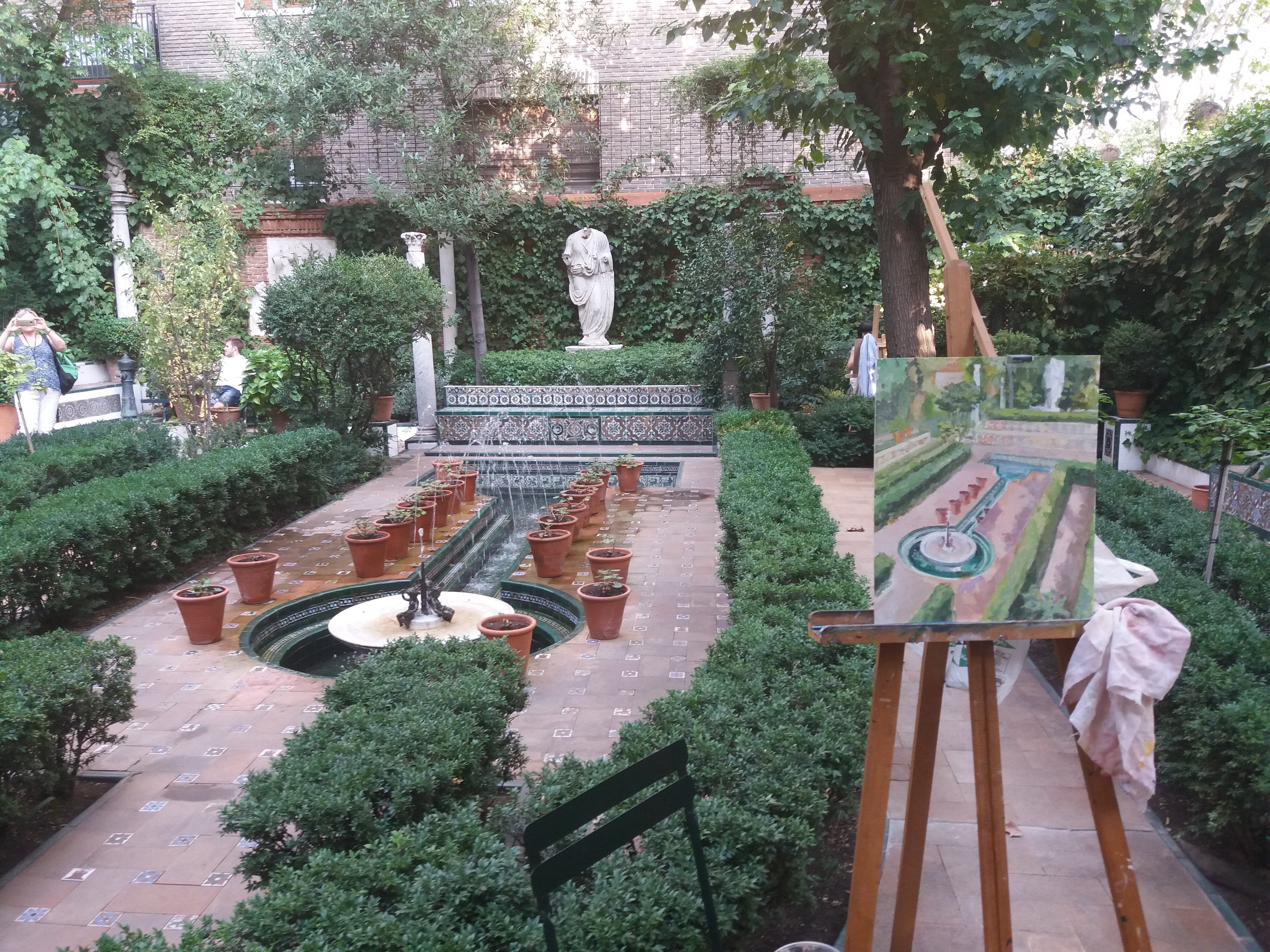
I had never heard of Joaquin Sorolla, but he is so popular in Spain that they named a railway station in Valencia after him. He painted many portraits of his family, and his love for them pours out of the pictures. The Prado left me unmoved, I couldn’t connect with the religious art. But Sorolla’s paintings of children playing on the beach and his daughters in long white dresses really touched me, I even BOUGHT A PICTURE! I am very careful with my money but wanted a Sorolla so much I paid seven Euros for a print. The frame will cost me another twenty quid, but to hell with the expense.
Sorolla Museum – I bought a copy of the big picture!
Our final dinner in Madrid was at Puerta Rico in Chinchilla street, a short walk up the Gran Via It was very busy because it’s good food and “very reasonable”, a winning combination in my books. To be honest, I can’t remember what I had, but it was definitely Spanish and I had some wine with it.
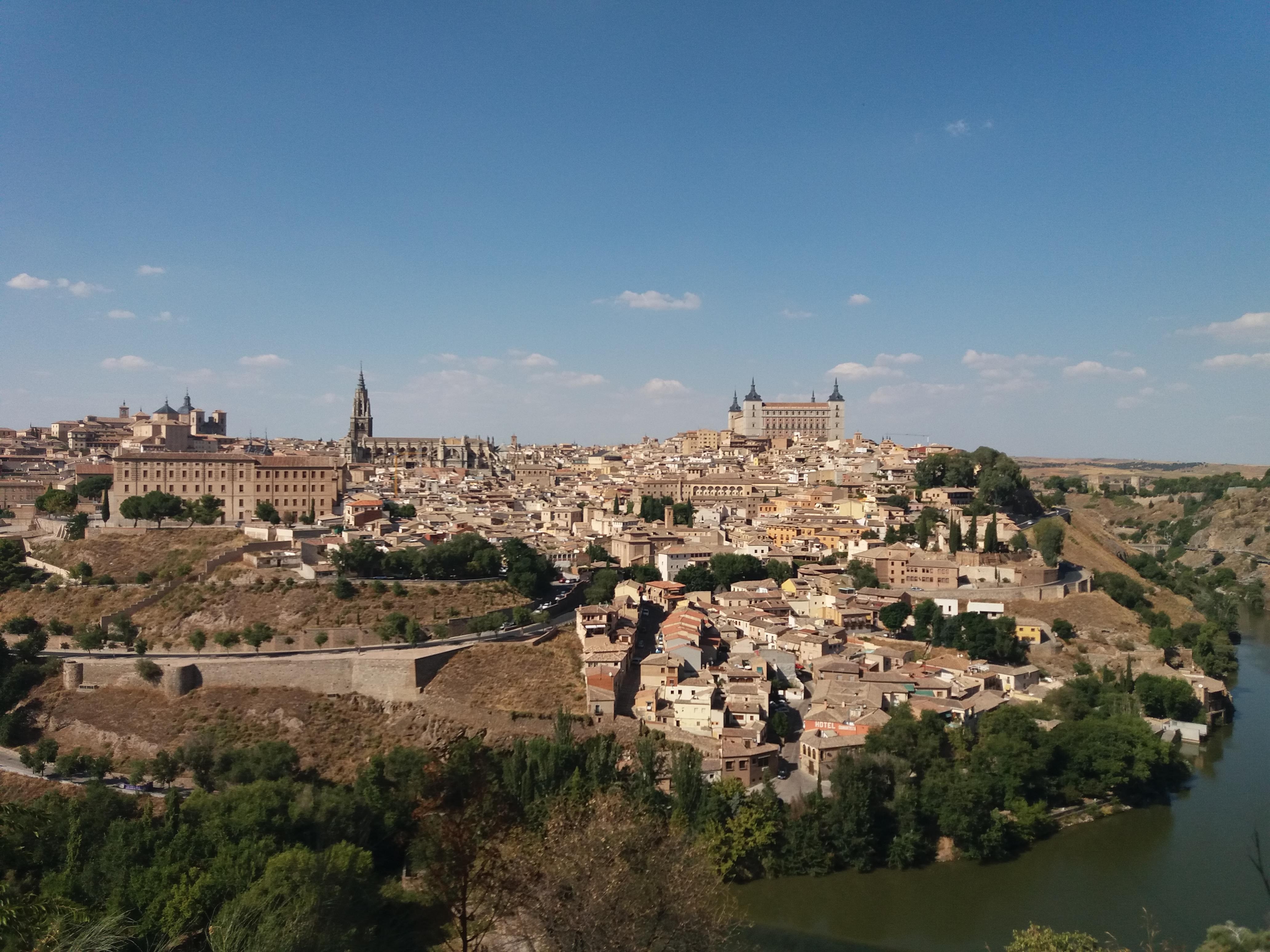
Toledo is the old capital of Spain and is about an hour on a coach south of Madrid. It’s known as the frying pan of Spain, and it deserves the title, it was scorchio! The city centre is at the top of a hill in a loop in the river Tagus, which is why the Visigoths chose it for their capital. The Visigoths were a Germanic tribe (the Western Goths) who took over Spain after the Roman empire collapsed, and in turn, were replaced by the Arabs. To get to the city centre from the coach park there are six escalators to take you up to the top of the hill, otherwise, half the tourists would expire during the ascent.
It is a beautiful ancient city of narrow winding streets and endless cafes and souvenir shops. It reminded me of York, Dubrovnik, and Carcassonne, which are all exceptionally beautiful cities but are a bit spoiled by their success.
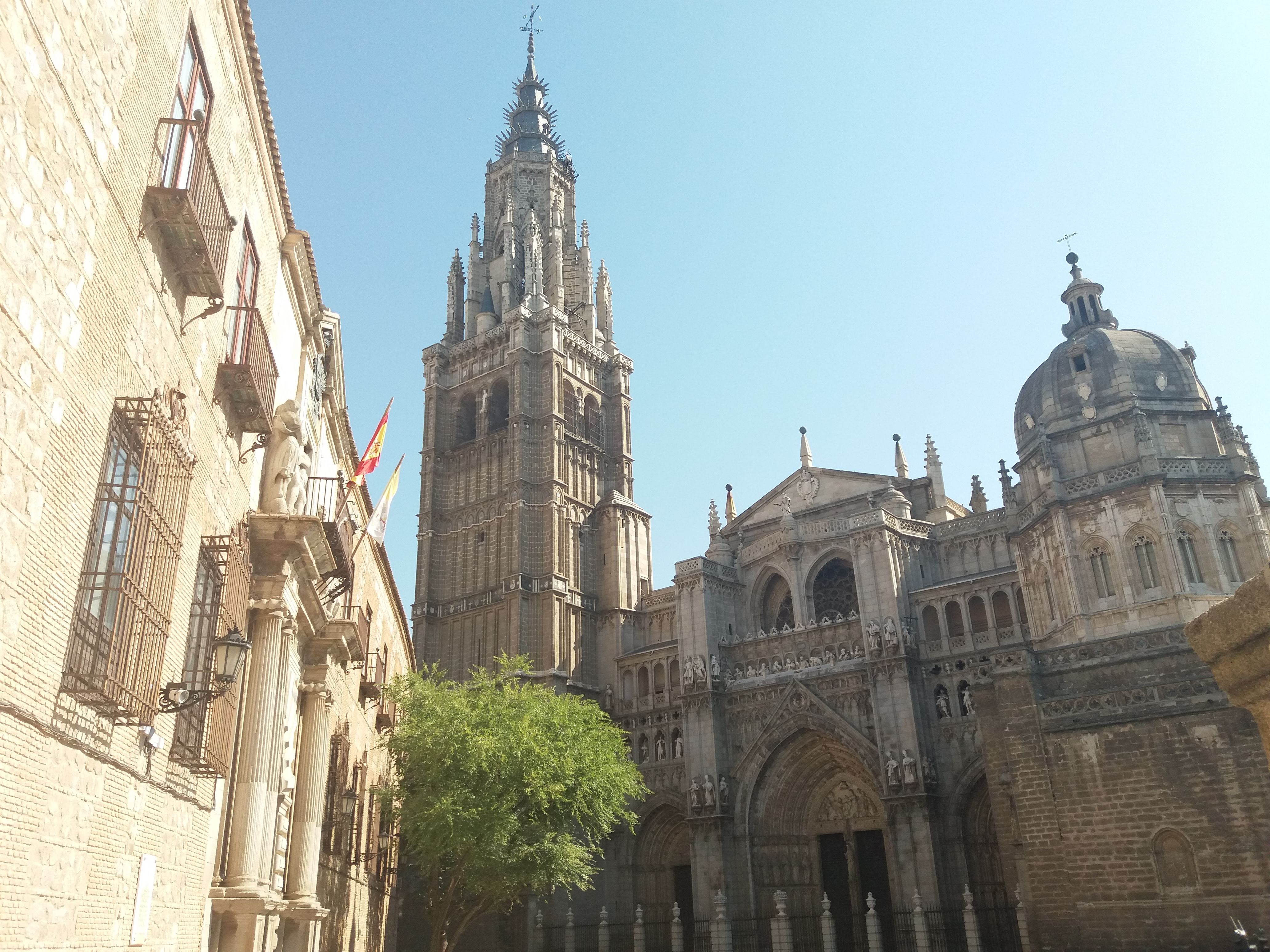
Toledo Catheral
The temperature was about 35 degrees, so lunch in the shade with a glass of cold vino Blanco was a very attractive prospect. We chose the menu del dia at El Cafe de las Monjas, which was a real belt buster.
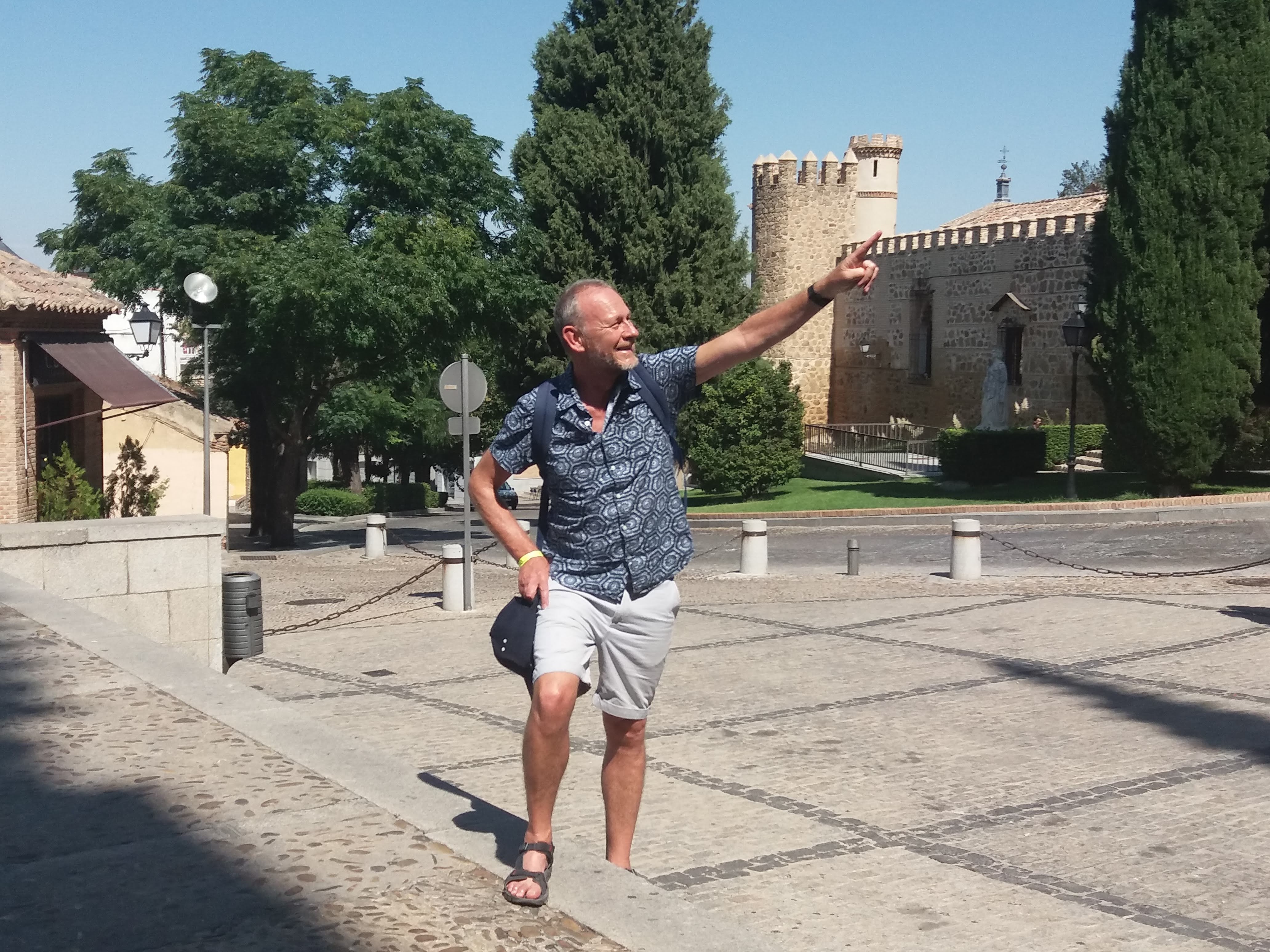
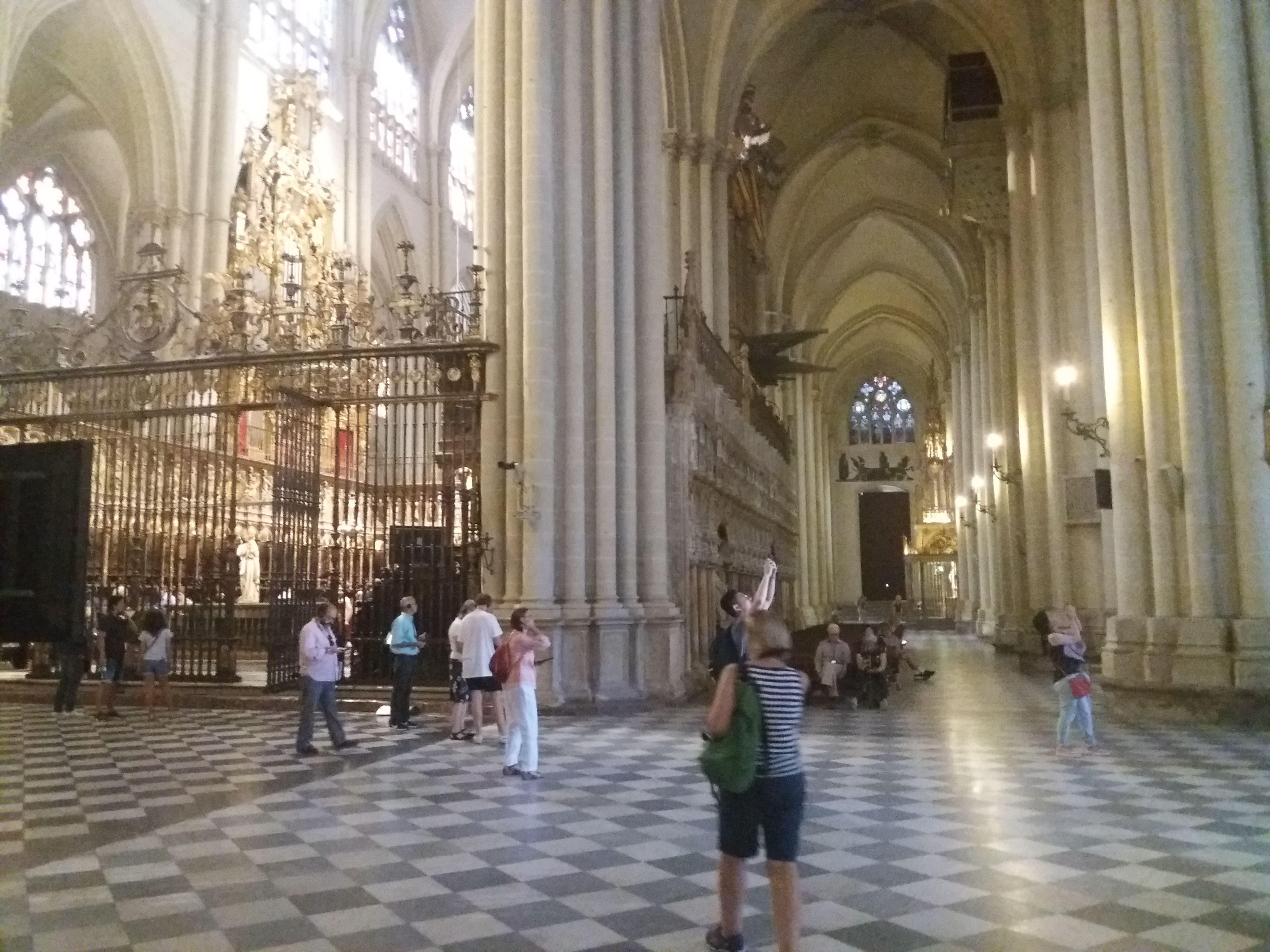
Tim spotting a flying buttress
The Spanish love their potatoes boiled fried and in omelettes, and have bread with everything, yet most of them are slim and fit looking. It must the magical Mediterranean diet, which so far hasn’t worked on me.
Toledo
The cathedral is the primary one in Spain and is very big and very Gothic. It has twenty-four chapels around the inside and huge columns supporting a massive roof. There are religious paintings everywhere, in the Middle Ages that was just about the only type of painting people wanted. The interior was quiet and cool, a great place to go during the heat of the afternoon.
Julie contemplating her next G&T
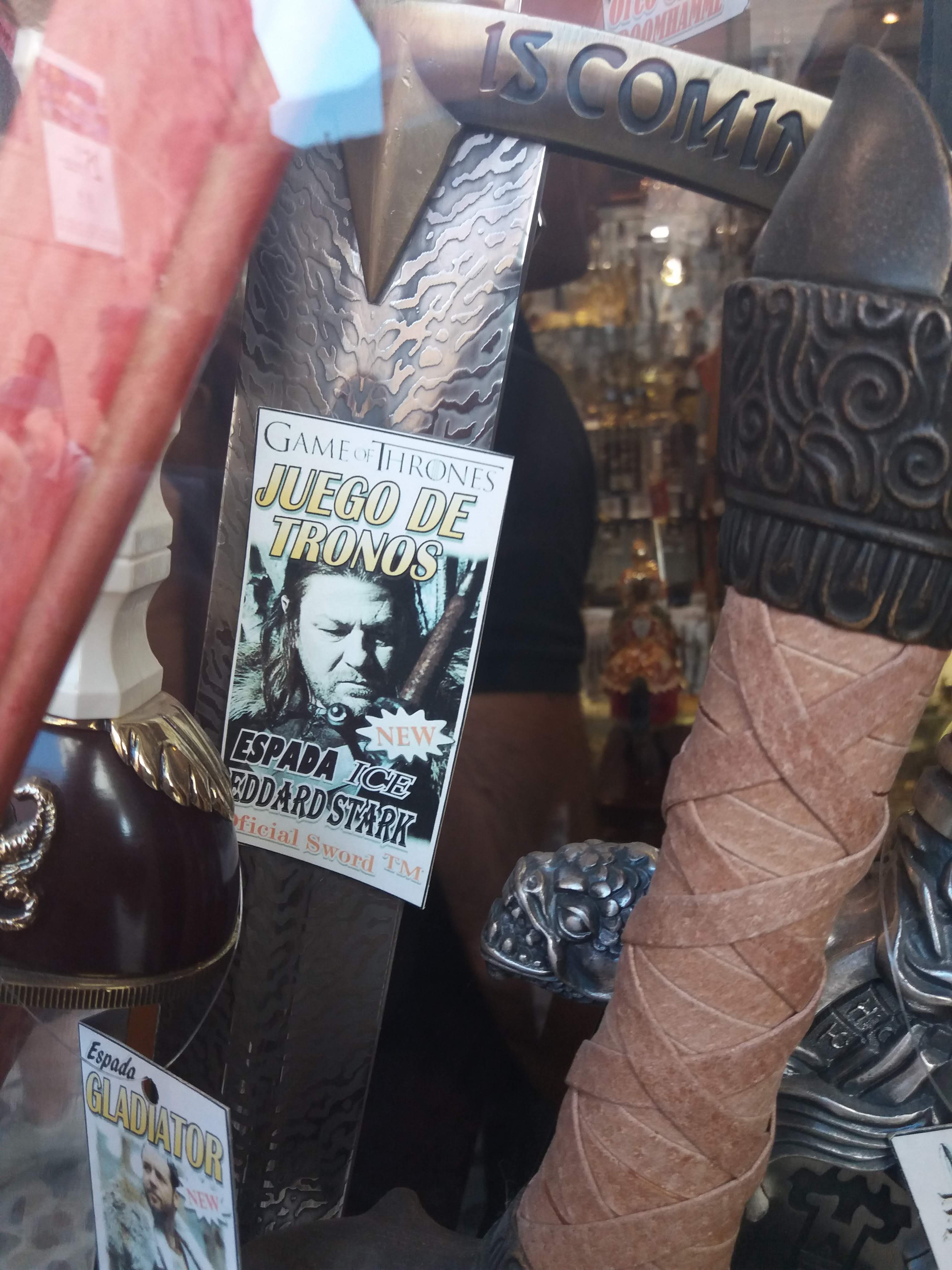
There are two main souvenirs available in Toledo, Damascus steelwork and swords. The Damascus steel is black plates, jugs, and jewelry inlaid with gold pattern, very pretty. Toledo steel was the best in the world in the Middle Ages, which is how Cortez and Pizarro conquered South America. These days the shops are full of reproduction swords to hang on your walls, of all shapes and sizes: Spanish swords, cutlasses, Orc swords, Elf swords, Game of Thrones swords. Then there are folding knives and sheath knives of every description and size. I found it all very weird that all that lethal hardware was openly on sale, it was like going to a Walmart in Wisconsin.
Eddard Stark sword -Winter is Coming (in a Sheffield accent)
Back in Madrid in the late afternoon, we explored the area near our accommodation. Calle Fuencarrel was full of young people trying to get bargains in sales at the many fashion shops that line the street. In the middle of the throng was a haven of beer and tortilla, the Rocablanca cafeteria. It is a very good ordinary bar, nothing trendy about it, just perfect at what it does. The three staff work at lightning speed with practiced efficiency, pouring drinks, slicing tortilla and serving tapas. We drank the ubiquitous Mahou beer with some tortilla and fried squid, it was just perfect. Two of the staff were having a good old row while serving customers, it was street theatre of the finest sort!
Madrid is a much much smaller city than London, the whole of the historic centre is quite walkable. The city only became the capital of Spain in 1561 when Philip II moved from Toledo to what was then a town centred on an old Arab alcazar (fortress) on a hill in central Castille. The city rapidly grew in importance, and the enormous wealth flowing in from the American colonies enabled the Spanish Kings to build lavishly.
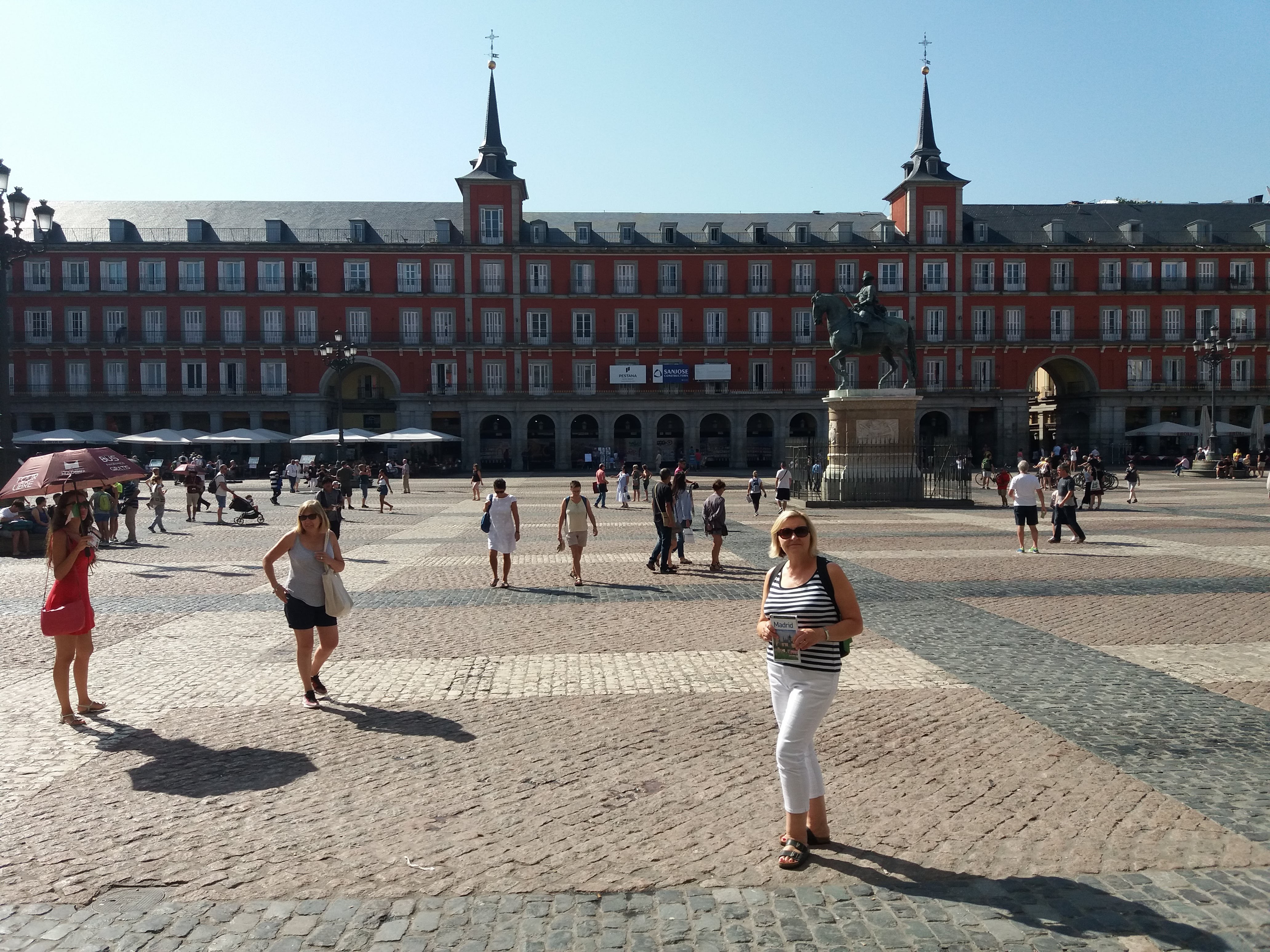
In the cetre of the oldest part of Madrid is the Plaza Mayor, a 17th-century square that looks similar to the Place de Voges in Paris and Covent Garden in London. It was used for bullfights and executions during the Inquisition but is now an empty square lined with cafes and tacky souvenir shops. It is well preserved, but not interesting enough to keep me for more than half an hour.
Julie in Plaza Mayor
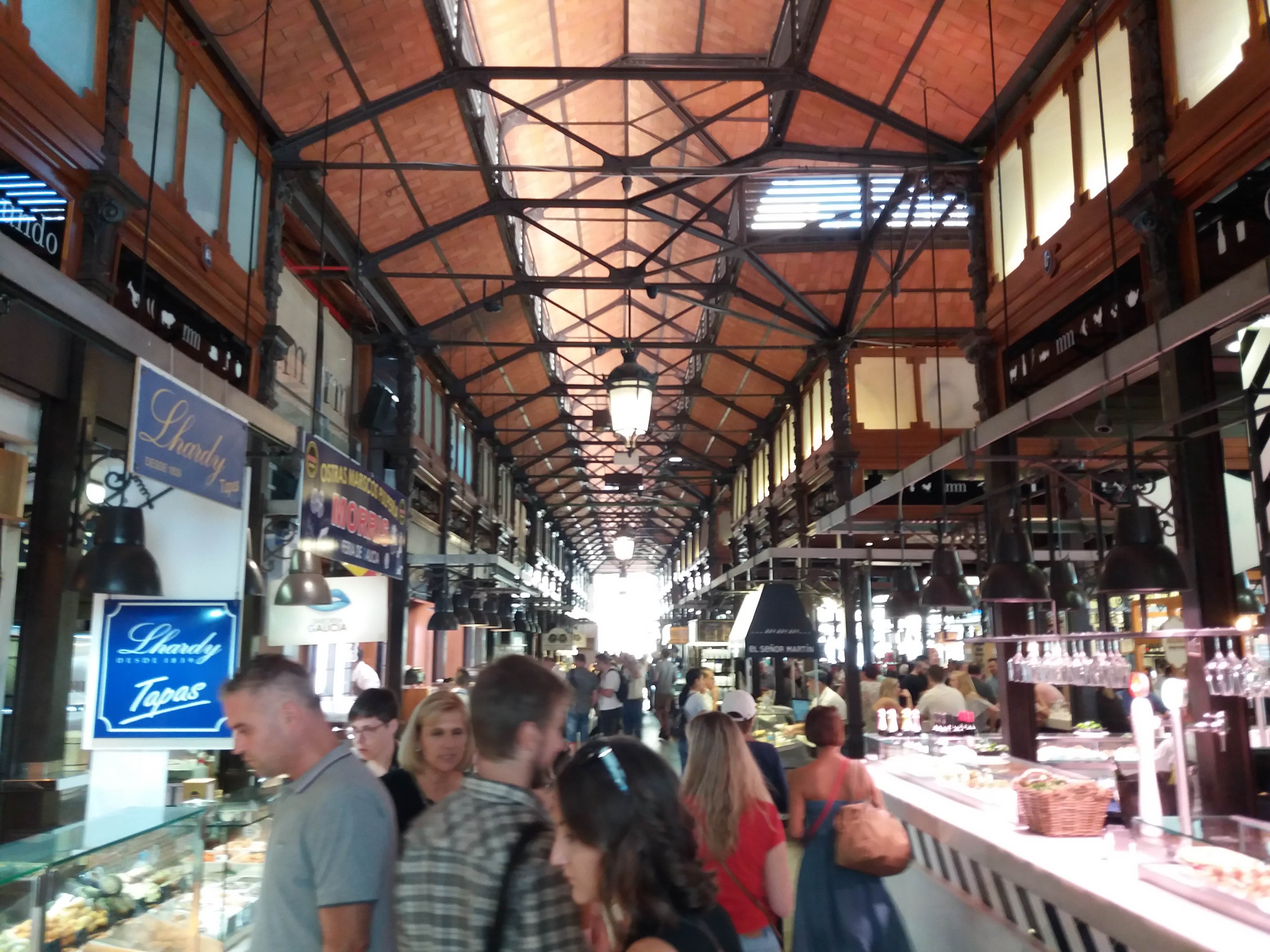
Close by the Plaza Mayor is Mercado San Miguel which is like Borough Market in London. It full of stalls selling all manner of delicious Spanish food and wine, and we could have spent a long time there, but we were on a mission to see the sights of old Madrid. Madrid has a mix of architectural styles that depend on who was ruling at the time. The oldest parts were built during Habsburg rule, so have a Germanic look to them, whereas the eighteenth and nineteenth-century buildings are under Bourbon rule and look more French.
Mercado San Miguel
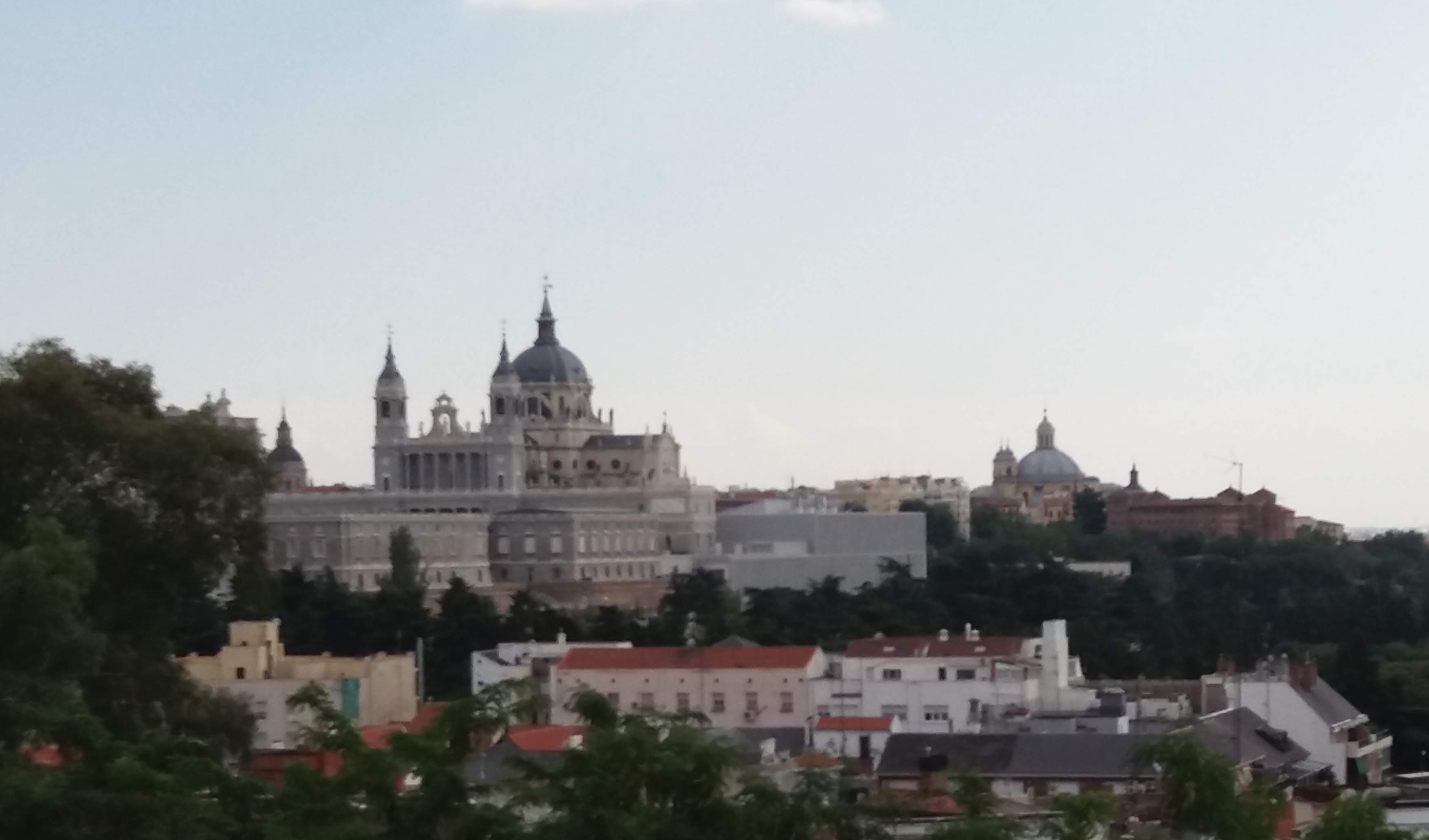
The Almudena Cathedral looks Baroque and constructed in the 17th century, but in fact, was started in 1883 and finished in 1992. It is lovely inside without being over-decorated, which is often the case with Spanish cathedrals. It has a modern painted ceiling and stained glass windows, and is free to get in.
Almudena Cathedral
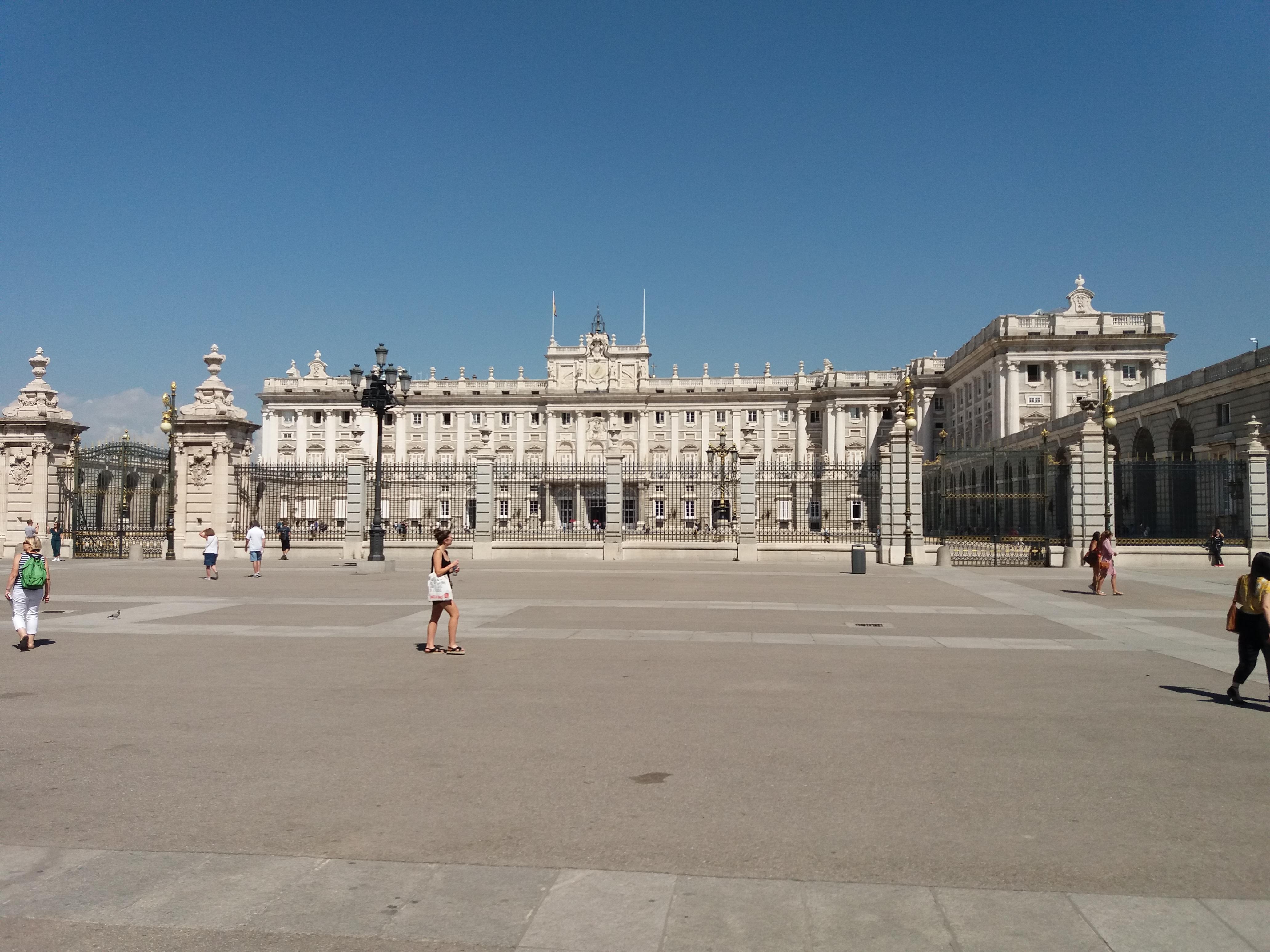
The Palacio Real is very very big, a fitting centre of power for what was the biggest and richest empire in the world. Spain imported shiploads of gold and silver from their Peruvian mines, and a good proportion was spent by the King. The palace stands on a hill overlooking the Manzanera river where the original Arab alcazar stood. At the front of the palace is a huge plaza, the size of the Horseguards Parade.
Palacio Real
The enormous state rooms inside are sumptuous to the extreme, every surface is covered in gold, silk, carved wood or porcelain. There is one room where every square centimeter is covered in elaborate porcelain created in special royal factories. Indeed for hundreds of years, the only factories in Spain were those producing luxury goods for the King. Philip II was married to Queen Mary, daughter of Henry the Eighth. So for a few years, Philip was the King of England – sort of.
During my travels, I have been to more palaces, castles, stately homes and cathedrals than you can shake a stick at. So I feel a bit like the Queen when she is opening her presents on Christmas morning, “not another diamond tiara”. Basically, I’m not so impressed by unlimited riches anymore and enjoy the contrast of clean modern designs. I think Spanish Royalty might enjoy a trip to Ikea to pick up a Billy Bookcase and some Tea Lights for the chandeliers.
I thought that the Royal Armoury was very impressive, with enough armour, guns and swords to kit out a battle in Game of Thrones. All that heavy metal gave us an appetite, so we had the Menu Del Dia in the Palacio caff, which was very tasty and good value for ten euros.
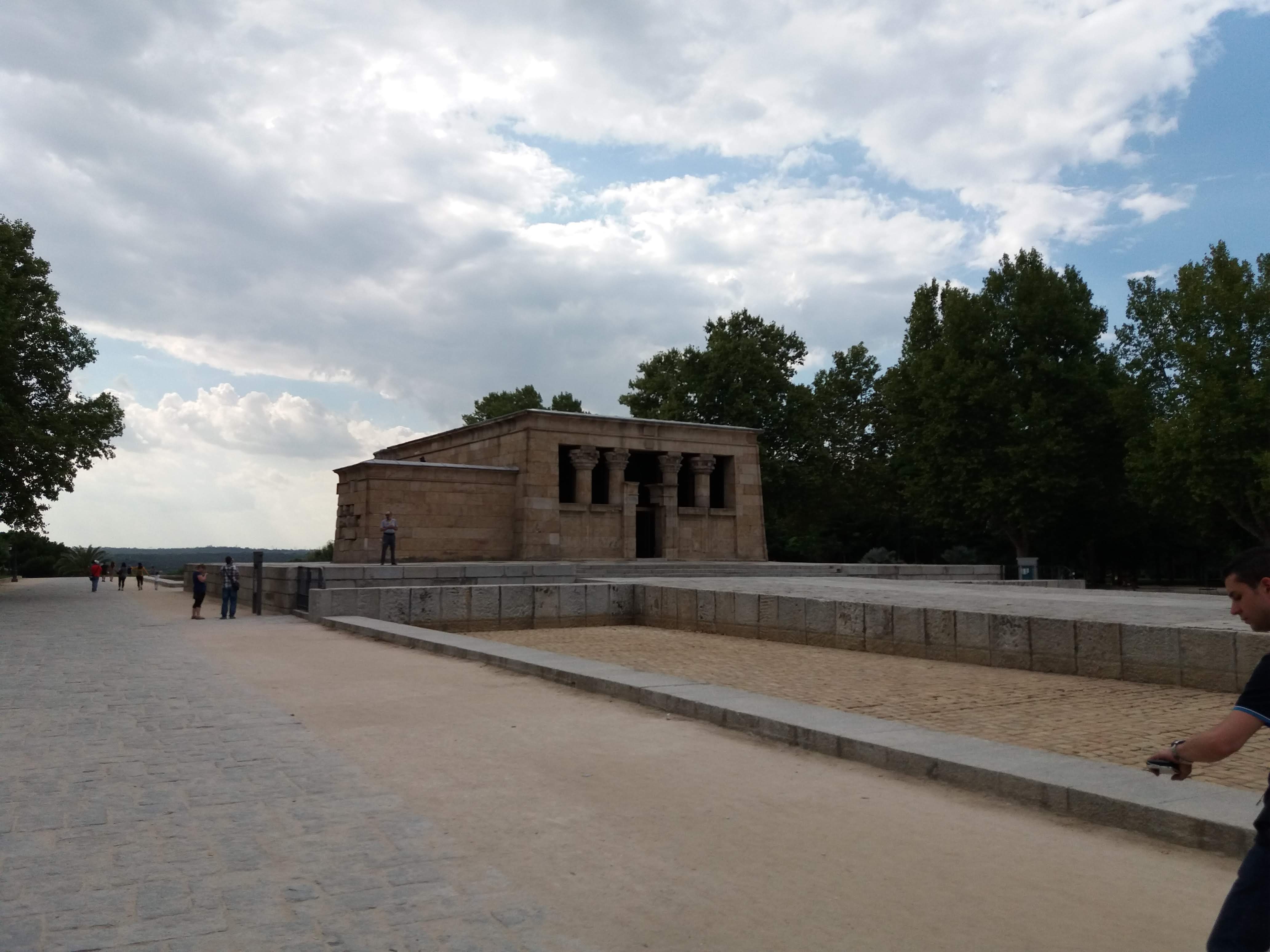
Over the road from the palace is the Temple of Debod, an actual Egyptian temple given to Spain in gratitude for the help they gave in moving the Aswan temples. There are so many temples in Egypt they can afford to give them away, especially a temple that will end up under a hundred feet of Lake Nasser. It does look like a municipal ice cream kiosk, it isn’t one of the better-looking temples.
Temple of Debod – ask for a 99
After a hot and sweaty walk down Gran Via, we had tapas in the San Anton market, a multi-story building filled with foodie outlets. We shared a table with a retired professor of English from Kansas City, Missouri. He had traveled a huge amount, mostly on cheap cruises without his wife, and recommended the Baltic cities; Riga, Tallin, and St Petersburg. Julie asked if he had been to South East Asia and he hadn’t been to Asia at all!








 timharnesstravels