London to Paris – Tuesday 7 June
The day before we were due to travel on the 7th June, there were storms in northern France which caused the cancellation of serveral Eurostar trains. Oh dear, slightly anxious. There was also an RMT strike which meant there were no Tube trains from Waterloo. Not reassuring either.
In the event we got a bus easily enough from Waterloo to St Pancras and the Eurostar was scheduled normally.
The terminal at St Pancras is packed with travellers going through security scanners and two passport checks for UK and France, so there are not enough seats for the hundreds of travellers plus all thier luggage. We found our seats on the 08.03 and charged through Kent and the tunnel, and were very soon in France. It only takes two and a half hours to get to the Gare du Nord in Paris, quite amazing really. The cafe on the train sold us a carnet of ten metro tickets for £15, tiny thin white tickets that I was warned not to put next to a mobile phone because it can wipe the magnetic strip. Not very convenient since tickets and phone are often co-located in ones trouser pocket.
From Gare du Nord we took the metro to Gare du Lyon, a double-decker train which only took ten minutes. Then we trailed our suitecases a few hundred metres to our hotel in Rue d’Austerlitz, the appropriately named Timhotel. The room had three beds in it, a tiny shower room and about three square metres for everything else. I reckon you would get more space in Solitary Confinement. But it was clean and convenient.
So we got our phones out and used Google maps to find the Seine and walked there in ten minutes. The weather was warm and sunny and we were in Paris!
Ile de la Cite
I first visited paris in 1975 on a hitchhiking expedition with my school friend Peter Cotterill. We camped in the Bois de Boulogne, got extremely drunk on very cheap red wine and threw up in the tent. My rucksack was stained pink for many years after that. Paris is a very different place to what it was then. The biggest hazard then was getting pranged by a battered 2CV when looking in the wrong direction crossing the road. It was likely that the 2CV would come off worse because they are made of cheese and run on olive oil.
Today you need to look out for cars, vans, electric sooters, electric bikes and nutters on electric unicycles listening to their phones. We are not in Kansas now Toto!
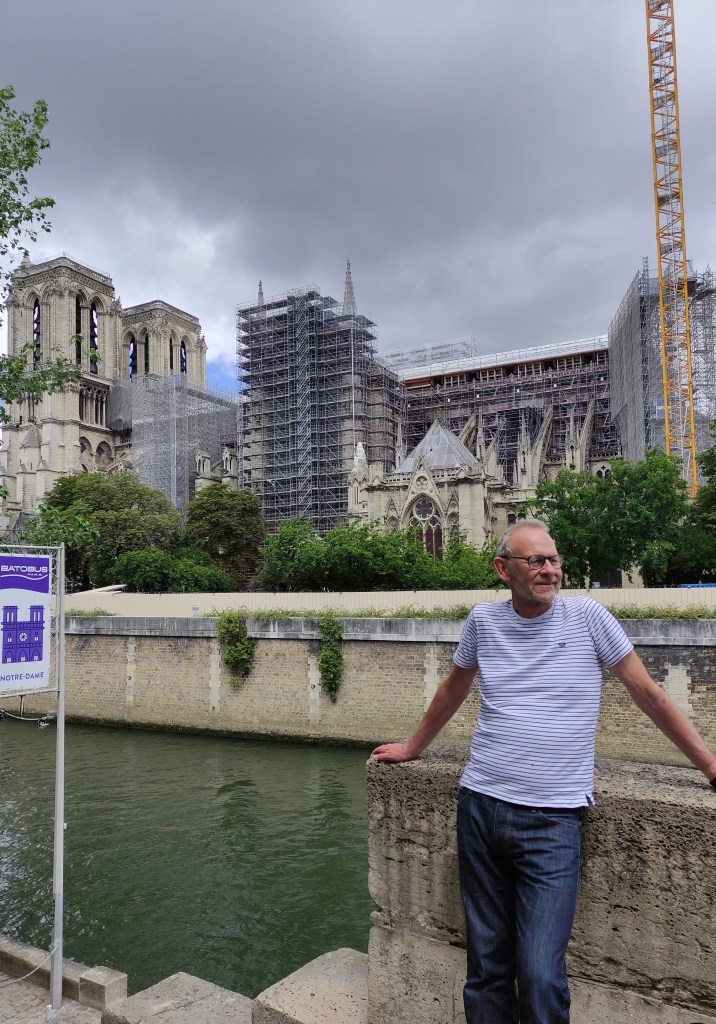
We walked up the Seine and soon reached the Ile de la Cite and the Notre Dame. The old lady was clad in a garment of scaffolding and hoardings, and rang with the noise of hammers and drills. Hundreds of workers are working to restore the cathedral by the 2024 Paris Olympics, which I think is a very ambitious target. But Mr Macron has said it will happen and possibly the guillotine awaits the project manager if he doesn’t deliver.
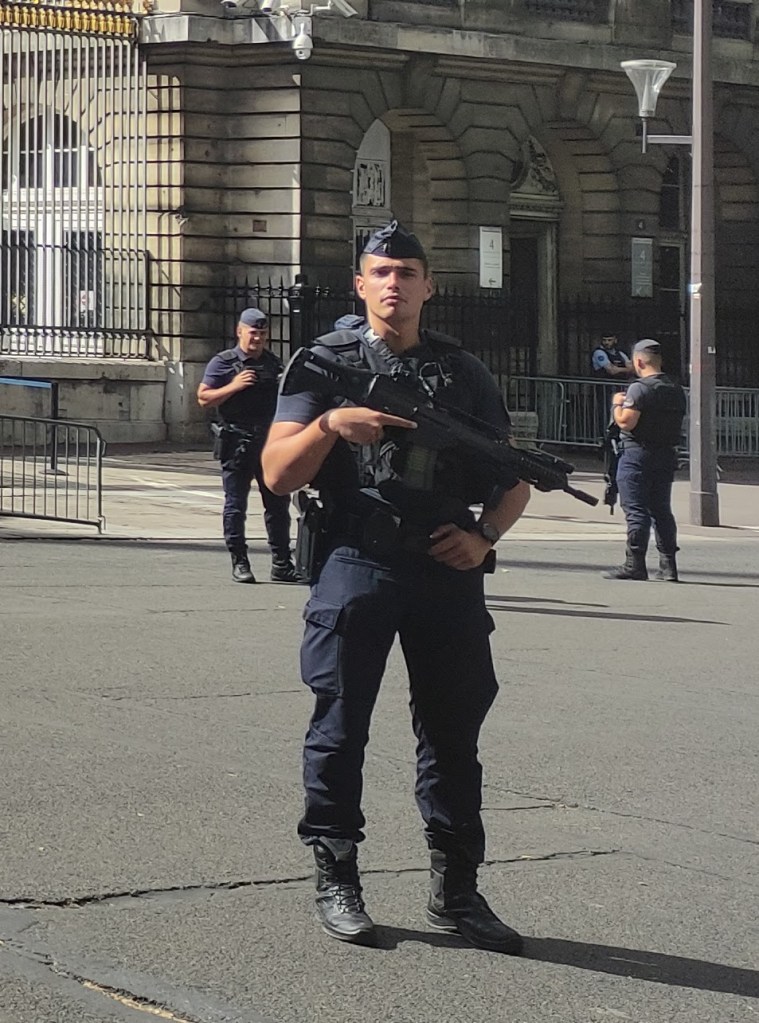
Opposite Notre Dame in the Palace de Justice, and imposing edifice guarded by CRS cops in black combat gear holding machine guns. On the northern side the building still has the medieval towers from when it was a stronghold of the French kings.
The Ile as a few tiny residential streets. The Rue Chanoinesse has cafes and pretty houses, and no doubt it is a very exclusive address.
Latin Quarter
We crossed over the river and went into the Latin Quarter and found a corner cafe to get some lunch.
At the time we didnt know we were in the Latin Quarter. We were still in the Wherethefuckarewe stage of exploring Paris, and knackered from getting up before the millkman and the breakfast news presenters.
I had a Salad Nicoisse for lunch, which is French for rabbit food, with tinned fish. It was tasty but insubstantial, so I followed it rapidly with a caramel flovoured icecream in a cone from another cafe.
I kept trying to speak the French, which I learned when I was twelve, but everyone just replied in English.
“Un glace with caramel mercy monsieur”
“Would you like that in a cup or a cone?”
“ err.. a cone, mercy”
I got out my Dorling Kindersley Guide to Paris and figured out where we were and found out it was a hub for revolting students in 1968. No doubt they are all grey-haired grandparents who enjoy a quiet joint in the garden. Now it is a lively area full of cafes , bistros and bars (although don’t ask me to define what the difference is between them).
At the top of the hill is the Pantheon, and massive domed mausoleum for the good and the great. Napoleon wasn’t enthusiastic about the Catholic church, but did enjoy being the Emperor of Europe and all the Roman style trappings that went with it. So the Pantheon looks like a church, but it ain’t a church, it’s a temple to all the gods. Nonetheless it looks splendid and there is a view from there to the Eiffel Tower in the distance.

We walked back to the Siene through the Sorbonne and many more busy cafes full of hungry tourists.
Marais
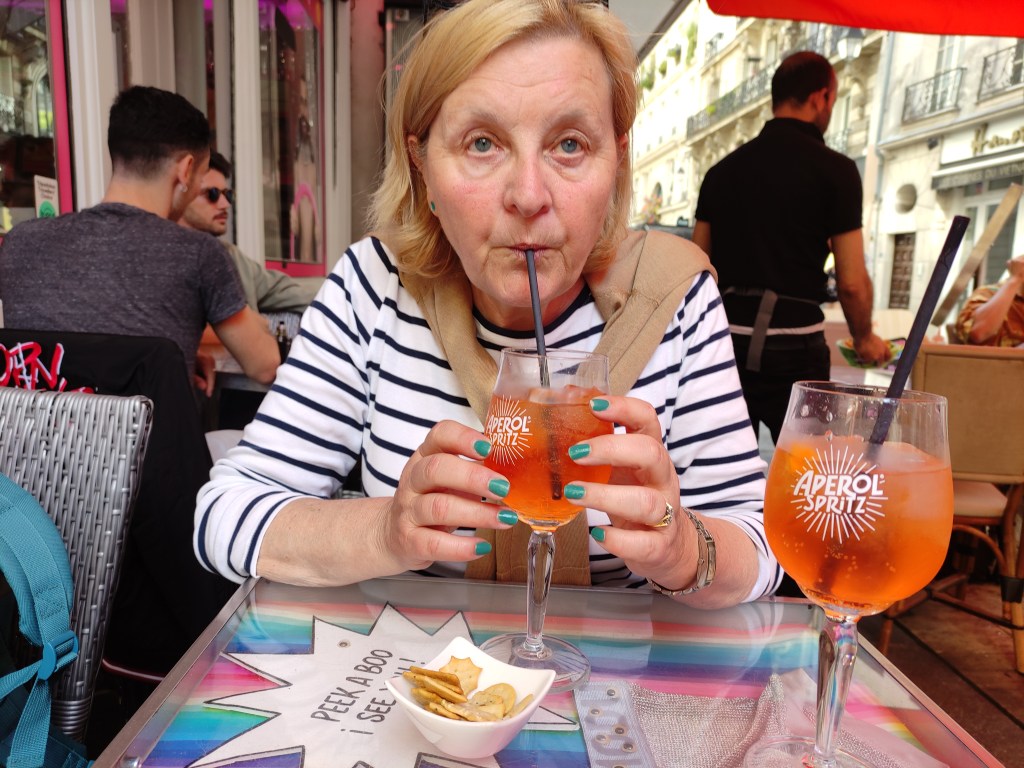
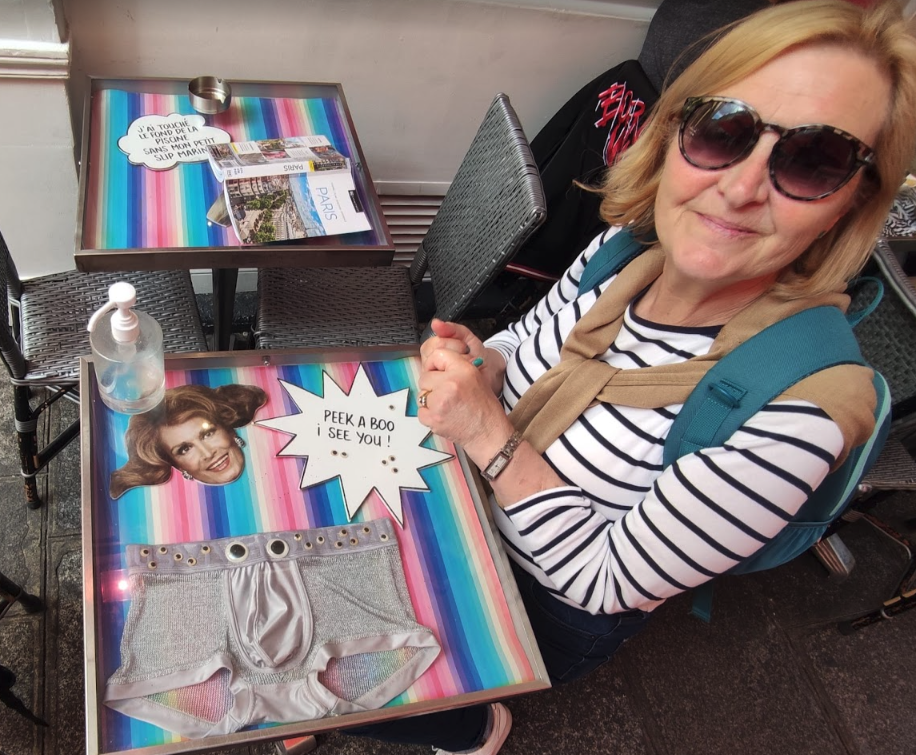
Crossing back to the north side of the river we walked past the tres grande Hotel d Ville and diverted form out route back to Timhotel to see the Pompidou Centre. It looks a bit scruffy and unloved now, not the cutting edge inside-out innovation it was in the Eighties. But the diversion took us through a colourful part of Marais which is very lively. I spotted a bar selling Aperol Spritz for six Euros, so we sat down, I love a bargain! It had a pair of silver underpants underneath the glass on the table, which I haven’t seen before. The clientele had little fluffy dogs and tight crop-tops, a refreshing change from the Sussex Arms in Twickenham. It was good to take the weight off our feet, enjoy a cocktail and watch the interesting people. One of the little dogs had its tail curled up in the air with an exposed bottom, so it looked like a walking pencil sharpener.
Julie had found a restaurant that was recommended by the Guardian. I cant’t remember its name, my brain is trying to wipe out the memory because it was SO SHIT!
We had a reservation but it wasn’t necessary because it was deserted. They didn’t have a menu, the waiter (who was very friendly in a devilish way) brought over the blackboard with a list of dishes. I had the poulet roti and chips, Julie ordered a poke bowl with salmon.
My food was adequate, Julie’s had a nominal amount of salmon in it, the bloody bastards! The waiter offered me a choice of about three beers and I chose the one that I had heard of, Leffe Blonde. When we got the bill I found it was the most expensive pint I HAD EVER BOUGHT at 11.50 Euros, the bloody thieving bastards. I’m just going to pretend it never happened and forget it now.
I was so annoyed I had to go to a supermarket and buy some wine (at a reasonable price). Of course they all had corks in since the French dont like screw caps, and I had to buy a cork screw to get at the wine.
At about 10pm we got the metro back to Gare du Nord and met Josie off the Eurostar, and we all squeezed in to our bijou hotel room together. It was hot and fragrant.
Place de Voges – Wednesday 8 June
On Wednesday it was drizzling when we awoke and worse weather was forecast. Consequently Josie was a little grumpy, she wasn’t going to get to wear the shorts she had brought with her and get her legs brown. I suggested we walk to the Place de Voges, which I remembered as being a good place to visit from the last time we went to Paris, sixteen years ago.
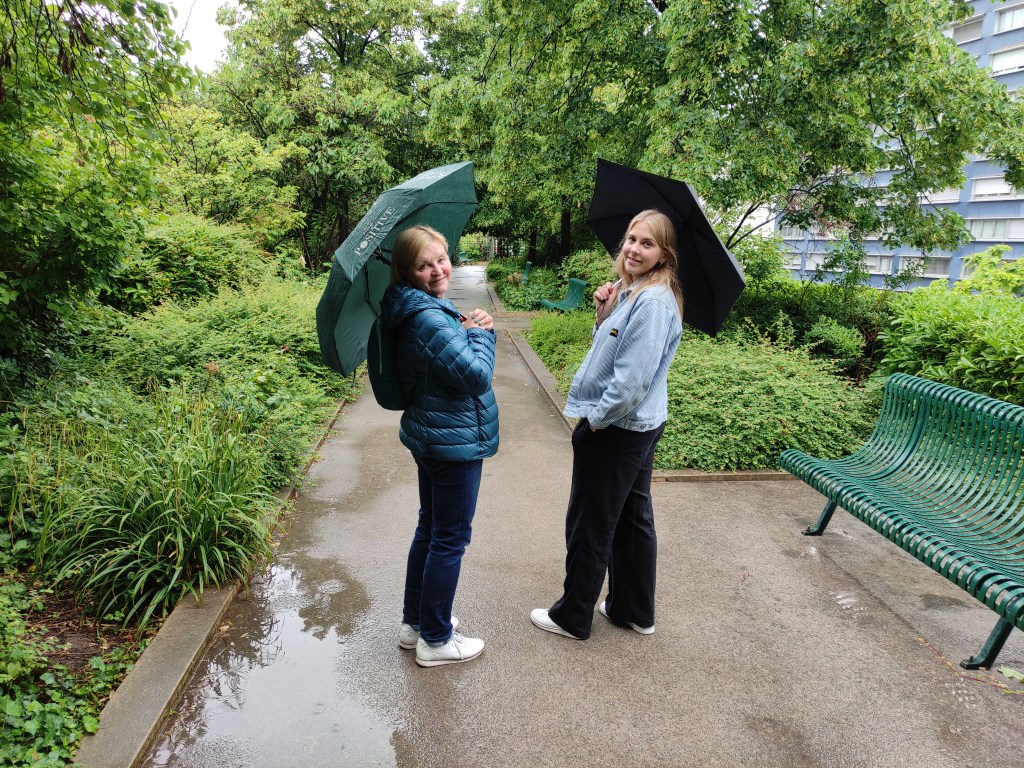
En route to the Place we stopped off at Coulee Vert Rene Dumont, very close to the Rue de Lyon. It is a former elevated railway track that has been converted into a linear park, and it is very lovely. We walked a short way along it, but it wasn’t going in the right direction for us.
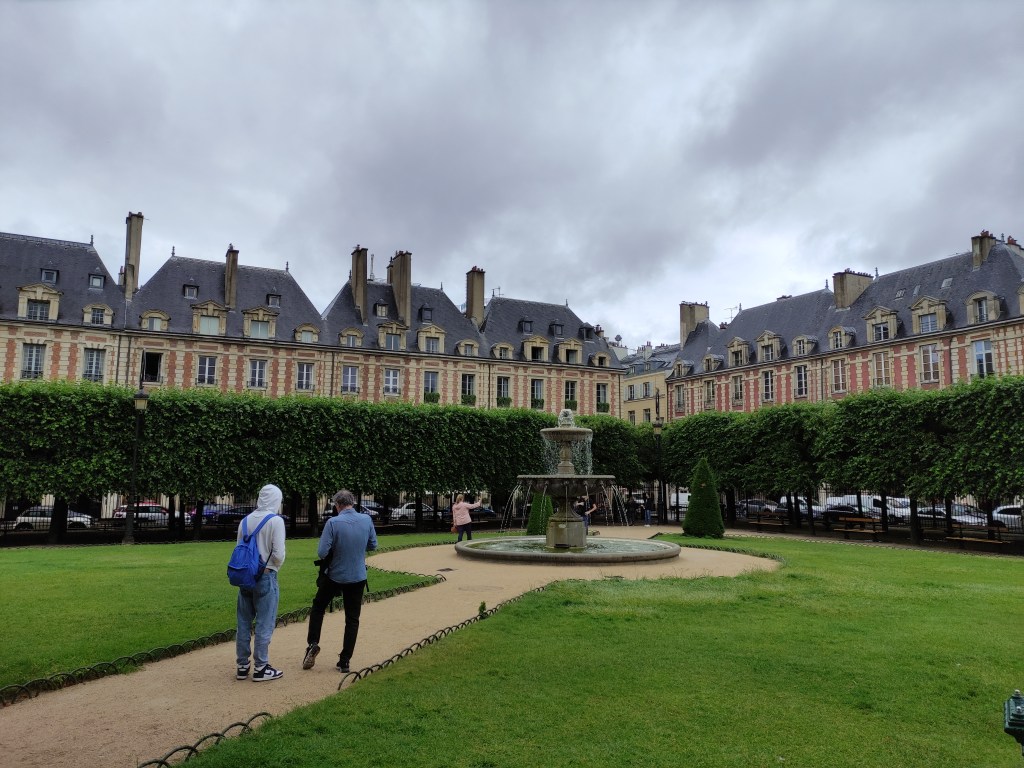
By the time we got there the drizzle had stopped and the sun was out which lifted our moods. The Place de Voges is beautifully complete and symmetrical, thirty six houses of elegance and style, nine on each side of the square with a garden in the middle. The original Covent Garden in London was built in the same way, but only remnant are left now. Beneath the houses is a colonnade filled with galleries selling contemporary art, which was colourful and original. At Number 6 is the final home of Victor Hugo, the giant of French literature best know for Les Miserables and the Hunchback of Notre Dame. It is a lovely little museum dedicated to his memory, with a cafe in a small garden.
On the way out of the Place some young people were handing out boxes of salad. At first we thought they were selling them, then we realised they were free, so we went back PDQ and got some for out lunch later on.
The French have gone right up in my estimation, not only do they speak English now, but they give away free food! But I still haven’t forgiven the charming waiter who used his magic on me and made me buy a pint for ten quid!
Louvre
It was a direct walk from the Place to the Louvre down the Rue de Rivoli, which has a great number of shoe shops, and Josie stopped to look at many of them. She is going to a wedding in September and wants to be well shod.
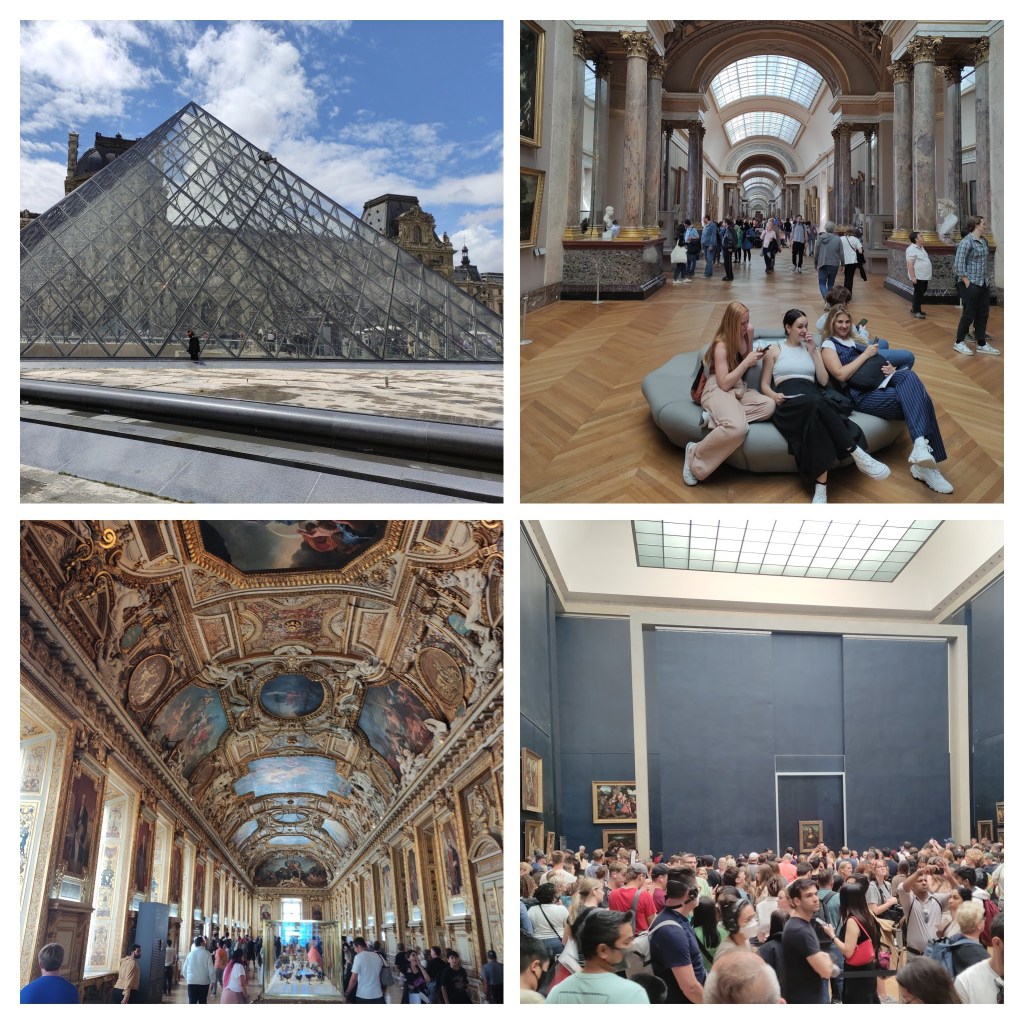
I have read in guides that the Louvre is big, but it isn’t big it’s absolutely vast. It was originally a mediaeval castle, then a royal palace and later an imperial palace. Now it is the most famous museum in the world, and its accolades are well deserved.
We went through airport style security on the way in, which did not stop someone getting through with cream cakes which were flung at the Mona Lisa last week. At first we were quite confused by the multiple wings and multiple floors, and so chose the nearest wing to the entrance and went in there. A corridor led to the footings of the original castle walls, and we stood where the bottom of the moat would have been originally. Walking in a rather aimless fashion we went into many rooms of Egyptian antiquities, followed by Greek and Roman stuff. There was enough to supply the national museums of numerous countries. When Napoleon conquered Egypt, he came home with a huge bag of loot.
After a few normal sized galleries of paintings we reached a wing which was simply goddamned enormous, hundreds of metres long and containing thousands of paintings. It was quite gobsmacking (a word I used very rarely) in its extent and riches.
Some of the pictures took up an entire wall, such as Jesus at the Wedding in Cana, where he did his water into wine tricks.
Because we were in the vicinity Josie and I nipped in to see the Mona Lisa. We stood at the back of a huge crowd in front of a small painting of a bored looking Italian woman. I saw it at a distance but now have boasting rights, and that’s OFFICIAL.
After a few hours we escaped from the Louvre with culture literally dripping out of our ears, gushing in fact, like a river of cleverdickyness. The Arc de Triomphe was a mile or so away and we started walking towards it, but Julie had a much better idea and suggested going to the Galeries Lafayette on Boulevard Hausman to see the view from the top.
The route took us close to the Elysee Palace, which was swarming with scary looking CRS toting mean-looking machine guns. Not long after we passed L’eglise de la Madeleine which is sodding huge church that looks like a copy of the Acropolis, but is on a street in Paris. It deserves to be on the top of a hill like the Pantheon, but is tucked away.
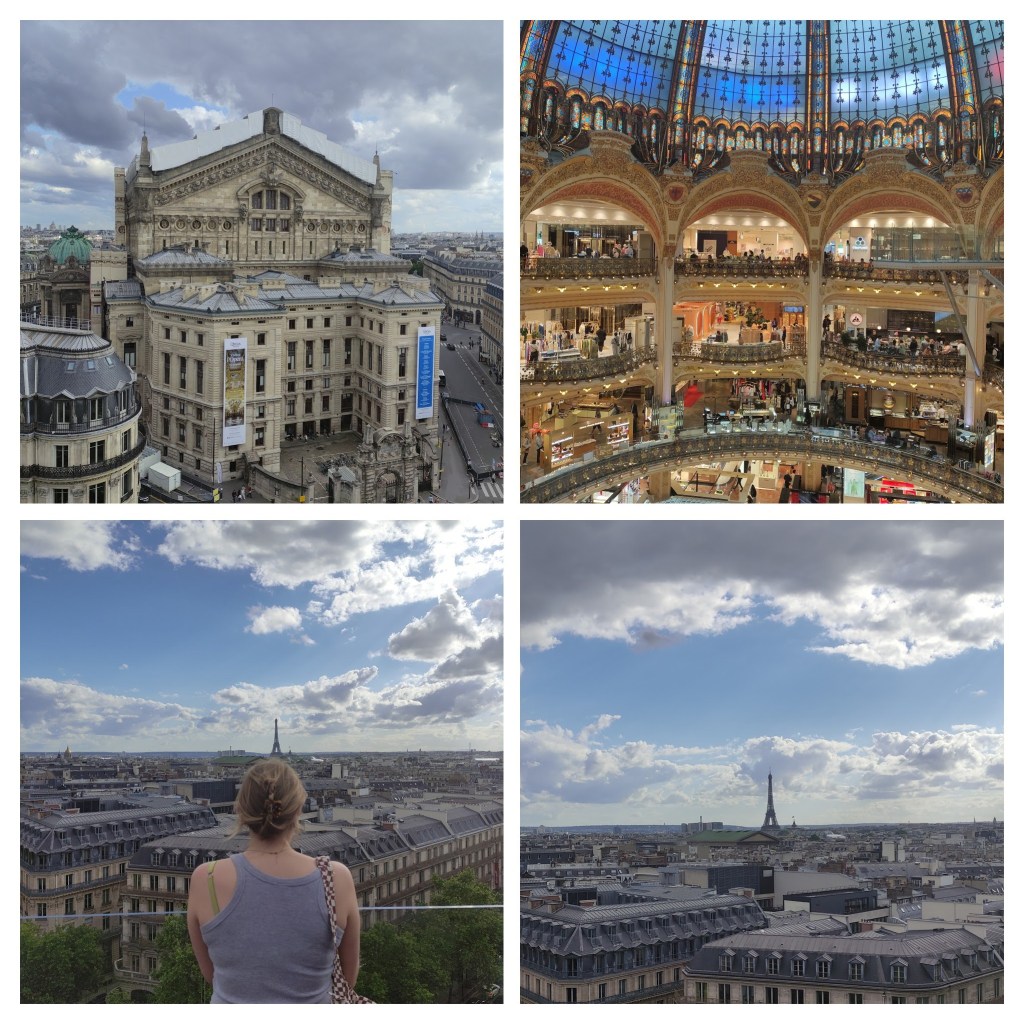
After a bit of hunting on Google Maps we got to Galeries Lafayette, a big smart department store like Selfridges . After travelling up seven escalators we reached a terrace on the roof with the most splendid views of Paris, it really is breathtaking. And free. That’s the really good part, since the Eiffel Tower was fully booked and it’s about eighteen Euros to go up the Arc de Triomphe.
We dined in the Bouillon Chartier in Montmartre, a place that Paola Guruchaga had recommended. It was packed like a Spoons on a match day, heaving with hungry Parisians. I had herring to start followed by steak and chips, which was slightly chewy, but tasty. The service was a bit brusque, but efficient. When we ordered the waiter wrote on the paper tablecloth what we had ordered, and added it all up at the end.
Versailles – Thursday 9 June
Julie and I weren’t going to visit Versailles, because we had visited many royal palaces during our travels over the years in France, Spain, Germany, Italy, Sweden, Austria and Portugal. But Josie really wanted to go, so we did!
We got the train from Austerlitz station, just across the river from where we were staying. It takes about forty minutes along the Seine and though the suburbs to reach Versailles., which is quite a pretty town in itself.
The palace of Versailles is the biggest in Europe, and makes Hampton Court look like a country cottage. It was originally built as a hunting lodge by Louis XIII, but it was his son Louis XIV who expanded it massively. At one time there may have been up to 10,000 people living there, many of them were the nobility that Louis liked to keep close to him. He was absolute monarch and could do whatever he liked.
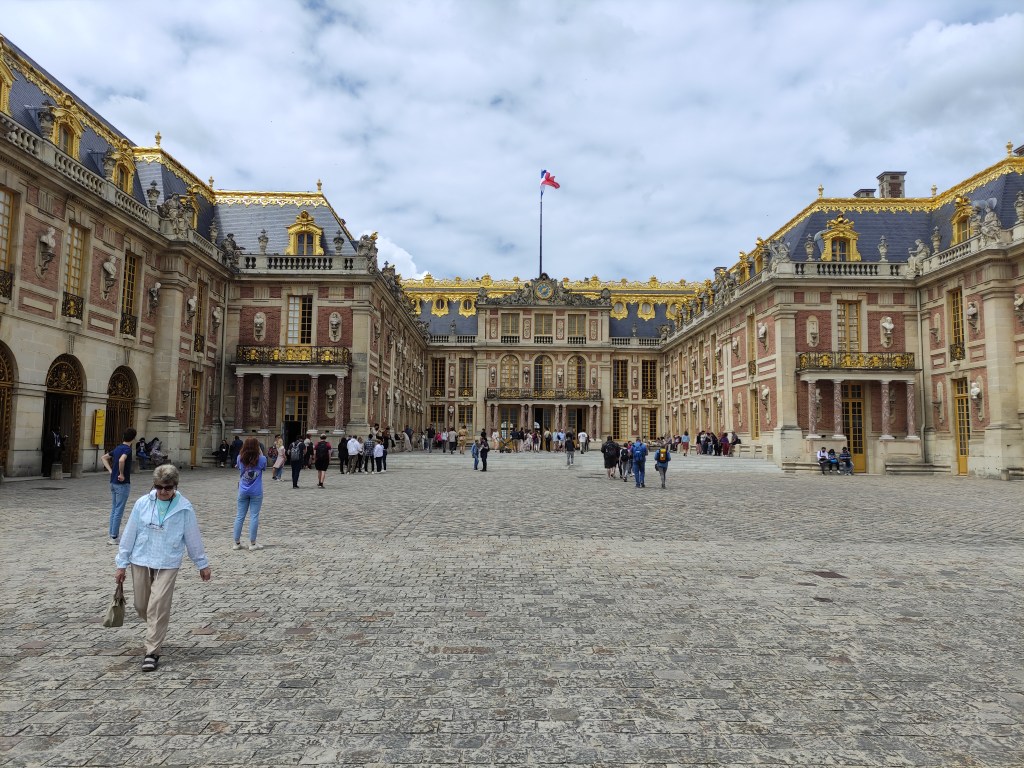
Touring the palace is often a shuffle through the many state apartments and royal apartments. They are all sumptuously furnished and decorated, and there are many of them. Louis XIV liked to style himself The Sun King, that is the centre of the universe. He had a gigantic ego, and there are very many statues and paintings of him, all over the place.
After shuffling from room to room behind a lively party of school kids, it does get a bit tiring. There is only so much gold, silk and marble you can take.
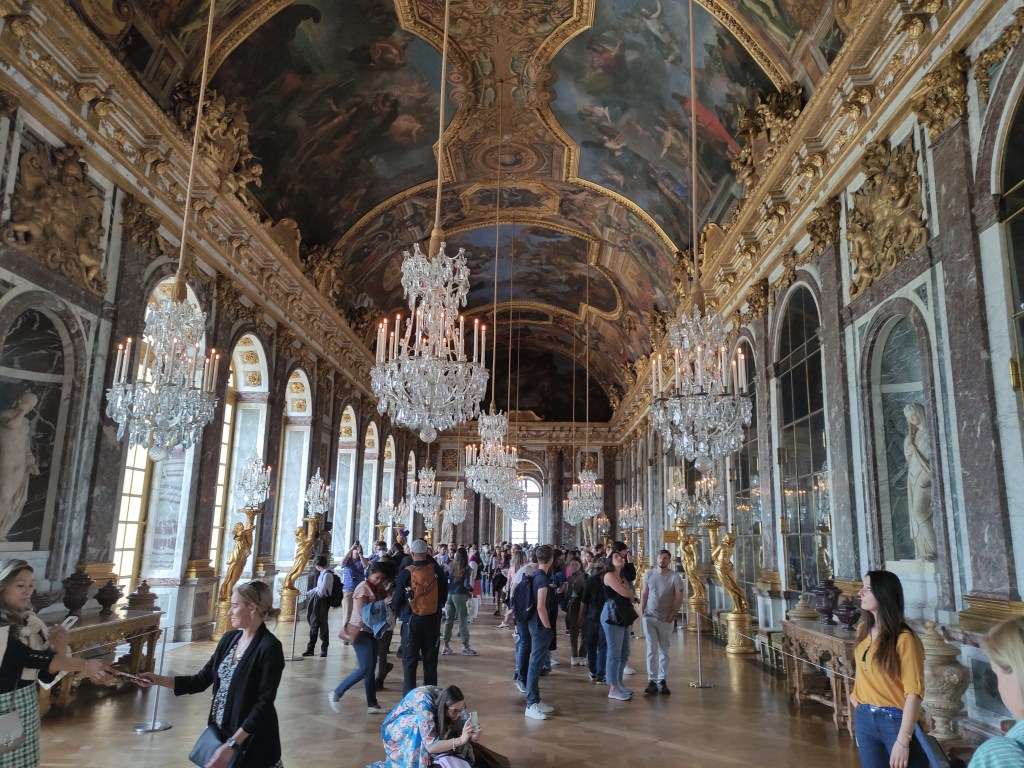
The Hall of Mirrors is impressive, a long gallery lined with, er, mirrors. Louis persuaded some mirrors makers to come from Murano in Venice, where the secret had been held for many years.
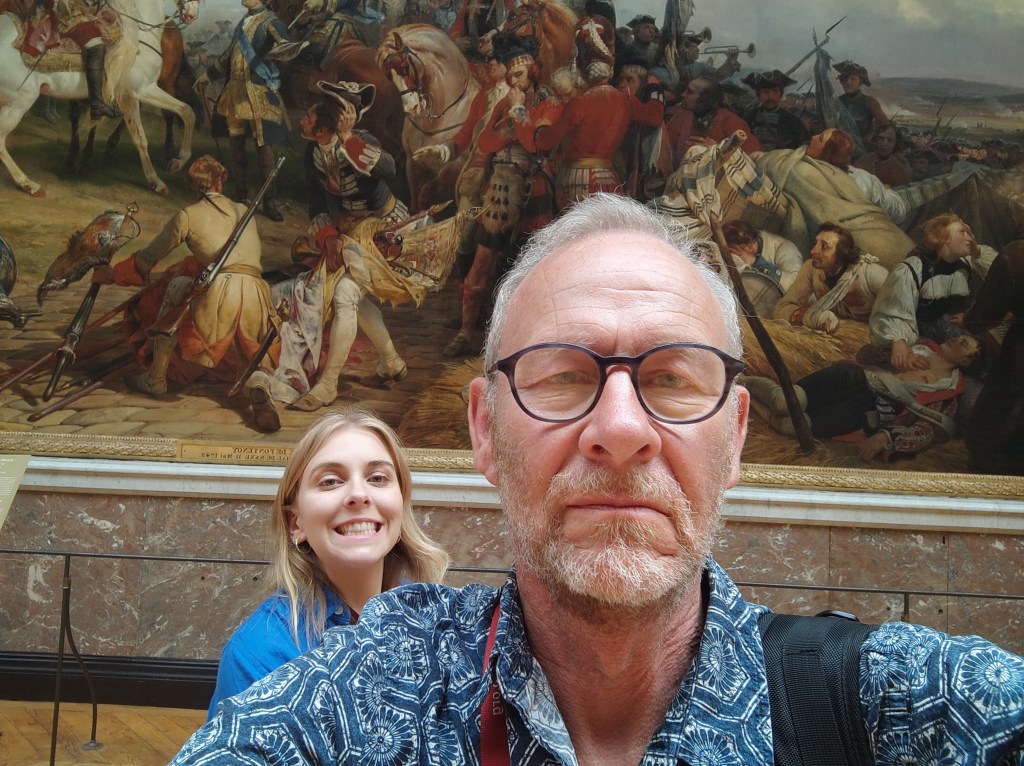
I was very pleased to see some pictures of former Twickenham resident Louis Philipe, who was made King of the French in 1830, the boy done well. He created a museum inside the place, mostly glorifying Napoleonic victories.
The gardens are also enormous, and they were designed by Louis’ gardener Andre le Notre. They are mostly formal parterres and ponds with fountains. Since Versailles is on a hill, supplying it with water was an enormous feat of engineering.
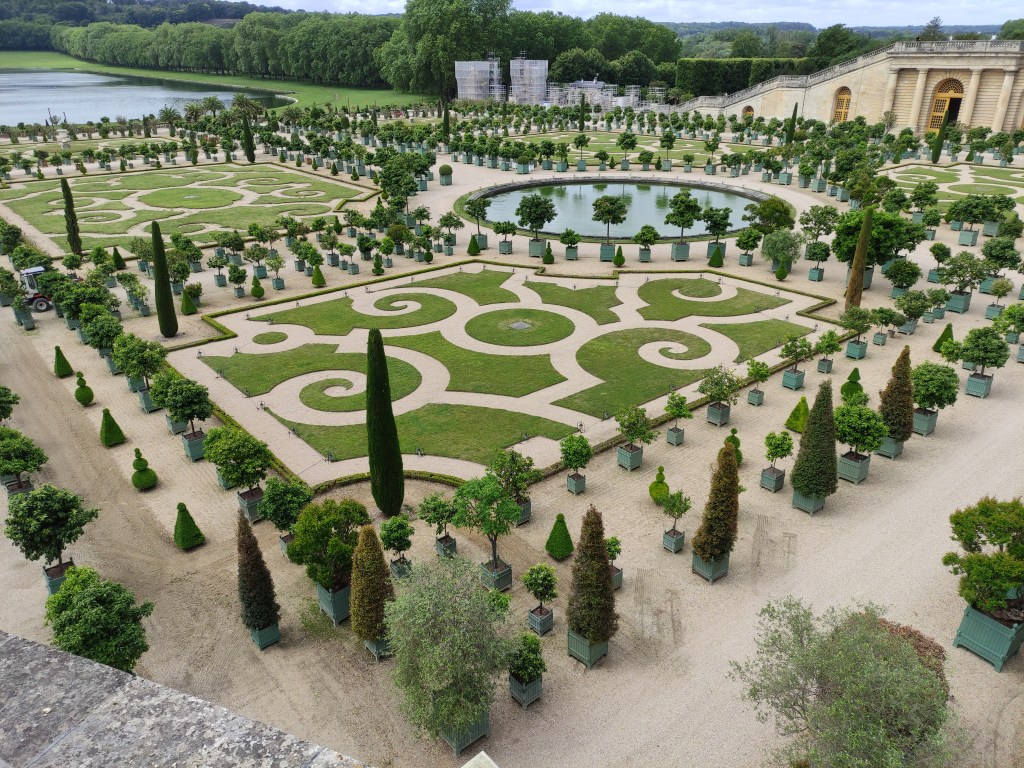
In the evening after tramping round the palace and having another massive dose of culture, we were knackered. So we went to almost the closest restaurant to the hotel and I had excellent fish and chips and a beer. Typical French food.
Nice – Friday 10 June
Friday was another early start, the alarm went off at 6am. We dragged our tired arses and out bags to the Gare de Lyon to get the Ouigo TGV to Nice. Ouigo is the cheap no-frills train to the south. Its cheap, but extra for bigger bags and choice of seats, and no catering on the train, so we stocked up from Pret at the station in advance.The train was actually more comfortable than Eurostar, a double decker which was spacious and with room under the seats to stash small bags.
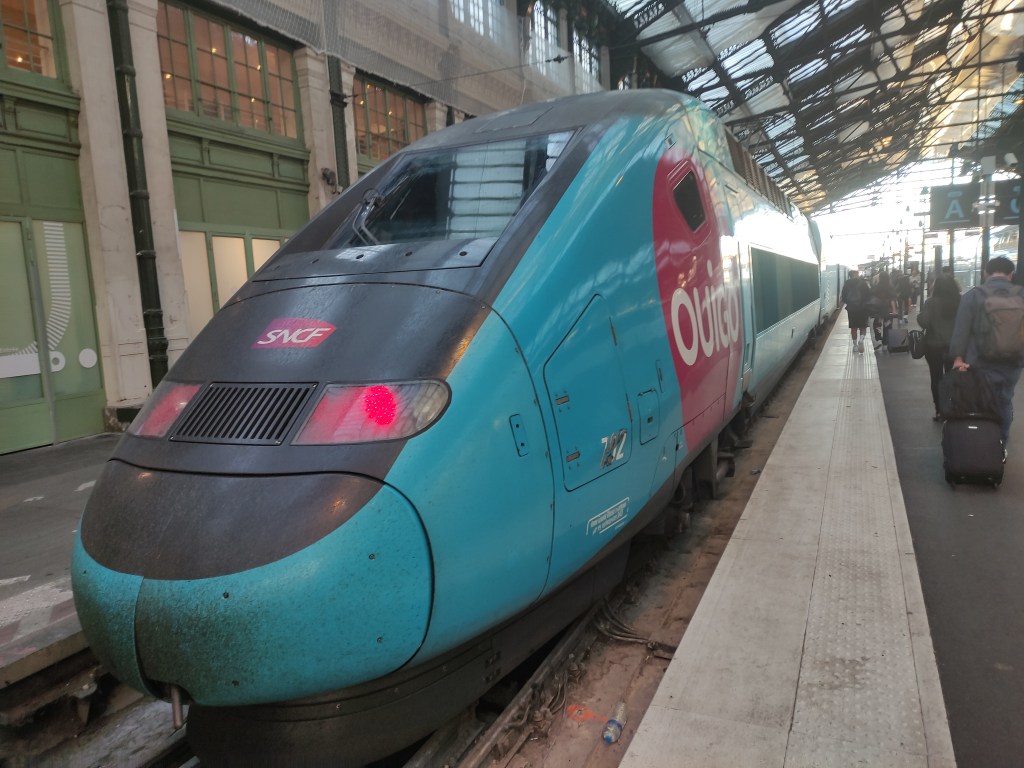
The train travelled extremely fast, about two hours to Lyon and three hours to Marseilles. Between Marseilles and Nice it was relatively slow, but the views of the Med were stunning. It took just under six hours to get to Nice, not as fast as flying but not as Earth destroying either.
It was hot and sunny when we arrived, and has remained that way ever since. Our AirBNB apartment is on Boulevard Deboucharge, an attractive tree lined street of nineteenth century mansion blocks. It is on the sixth floor, and has a big balcony with views of the ruins of the castle in the distance and views of the rooftops of the old town.
By the way I Googled Deboucharge and it means uncorking or unblocking. You can get a deboucharge service to unblock your toilet. Interesting, eh?
The flat had a washing machine and a big terrace, so we did all our laundry, domestic bliss in Nice.
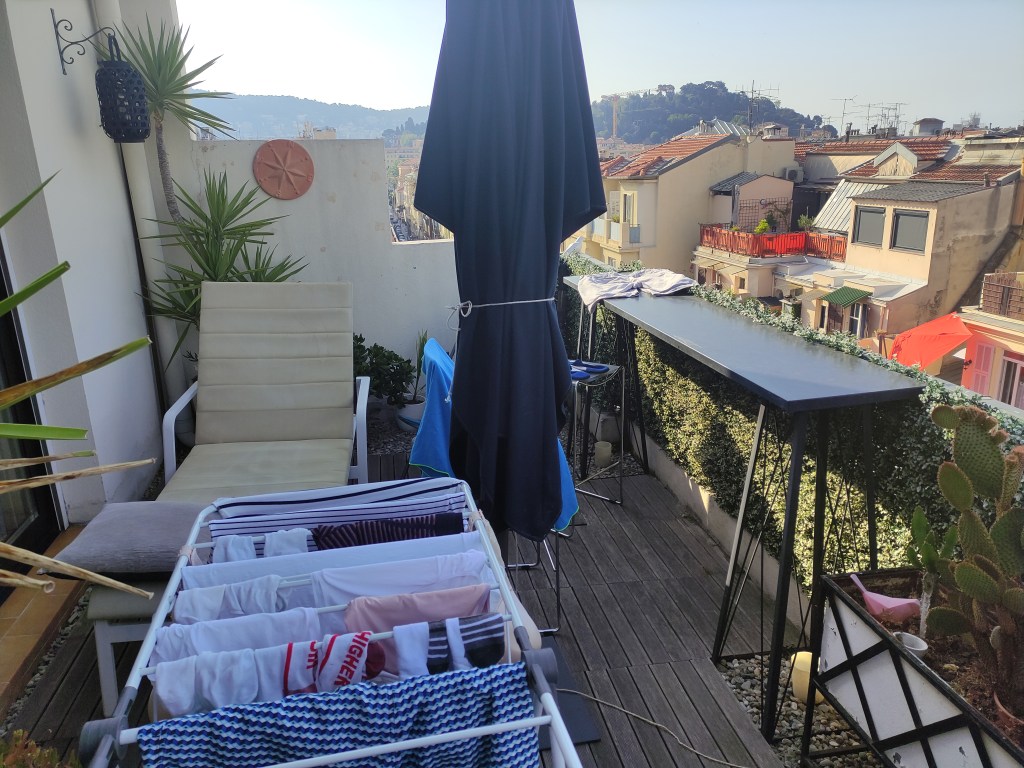
The flat is owned by a designer, so it’s full of tasteful furnishings and objects, very different from the cheap and practical Ikea furnishings we have experienced in Spain.
After a drink on the balcony we found the nearest Carrefour supermarket to do some shopping. I now know that they come in different sizes, City, Express and Market, like Tesco. We were happy to cook our own food, since we had eaten out for dinner every night in Paris. I fried some Merguez sausages that we ate with green beans and salad and a bottle of local Rose wine, very tasty.
The flat has rolling shutters on the lounge and bedroom window, so we could get the room really dark at night and keep the rooms darker and cooler in the day when we are out.
Too knackered to do much that evening, so we stayed in and watched Rocketman on the TV. Ive seen it three times now, and it’s a great film.
Vieux Nice – Saturday 11 June
The old town of Nice is a fifteen minute walk south of the flat, at the foot of the hill where the castle once sat. It has belonged to France, Italy, Sardinia Piedmont and Savoy at various times in its history. It looks like a small Italian town, with narrow winding roads and alleys and steps leading up to the castle hill. It is vividly painted in terracotta, yellow and white, and crammed with eating places and souvenir shops. There is no question that it is very pretty, but it’s also a bit tacky in places. It has a similar vibe to other tourist hot spots like Dubrovnik and Carcassone, the rich history draws visitors in a spoils it a little as well.
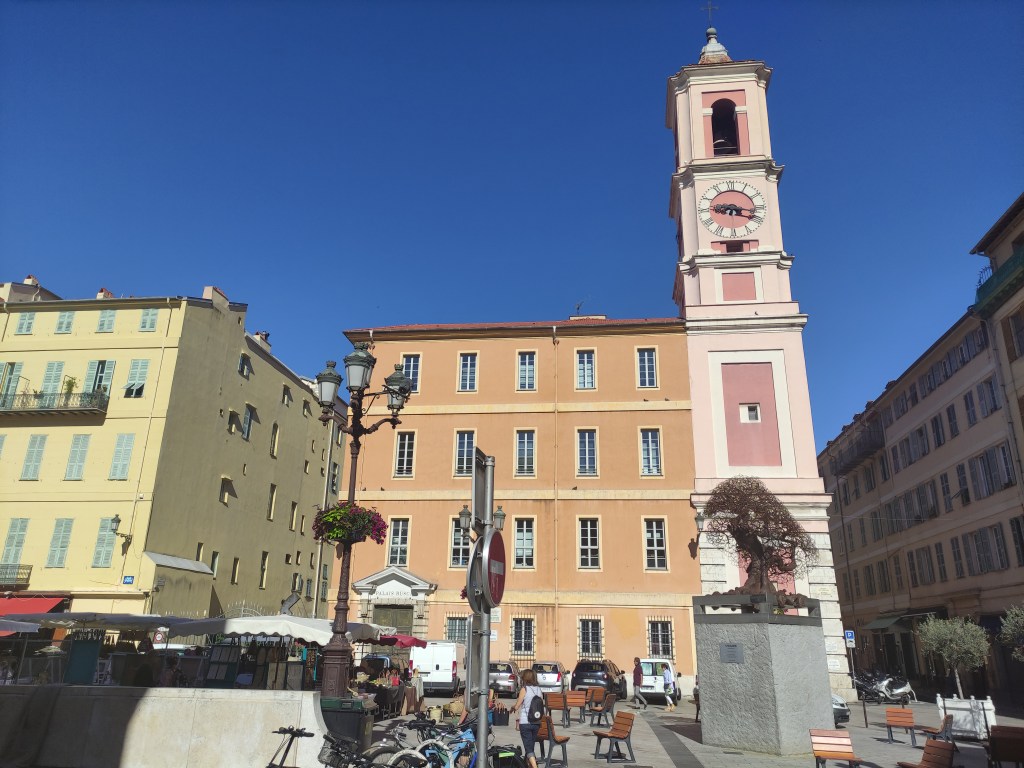
Vieux Nice is gorgeous, and away from its centre it still feels like a small Mediterranean town.
To reach the old town we walked along the Parc du Paillon, a longitudinal park where the River Paillon once flowed. It has petanque courts, children’s playgrounds with climbing frames in the form of animals, and a huge water play area with about ninety fountains squirting up from a massive paved area. It was occupied by swarms of small children running around in the water having a helluva good time. I wanted to join in, but Julie wouldn’t let me.

The old town is quite small, about a kilometre square, but densely packed with shuttered 17th and 18th century block of flats, cafes, bars and churches. Near the seafront is the Cours de Saleya which has a market selling fruit, vegetables and flowers. But you wouldn’t want to go there to feed your family, it makes Waitrose look like a bargain.
We had a cafe creme and explored many of the narrow streets. I bought a new man-bag because the one I bought six years ago was worn out and looked a bit embarrassing in chic Nice. I like to have one for my phone and bottle of water, also somewhere to put my hat when I go in a cafe.
There is a small cathedral dedicated to Saint Reparate, a teenaged girl from Palestine who was beheaded as a martyr. Her body was put into a boat which was blown by angels breath to Nice, and she became the patron saint. An unlikely story, but our national saint slayed a dragon didn’t he? It is a lovely building to visit, and very peaceful in the busy Place Rossetti.
We had lunch in the Restaurant la Claire Fontaine, a damned fine pizza.
After lunch we ascended the hill to see the ruins of the castle, which Louis XIV had knocked down. There are wonderful views over the old town on one side and the port on the other. There is also a cafe that sells cold beer, mmmmm.
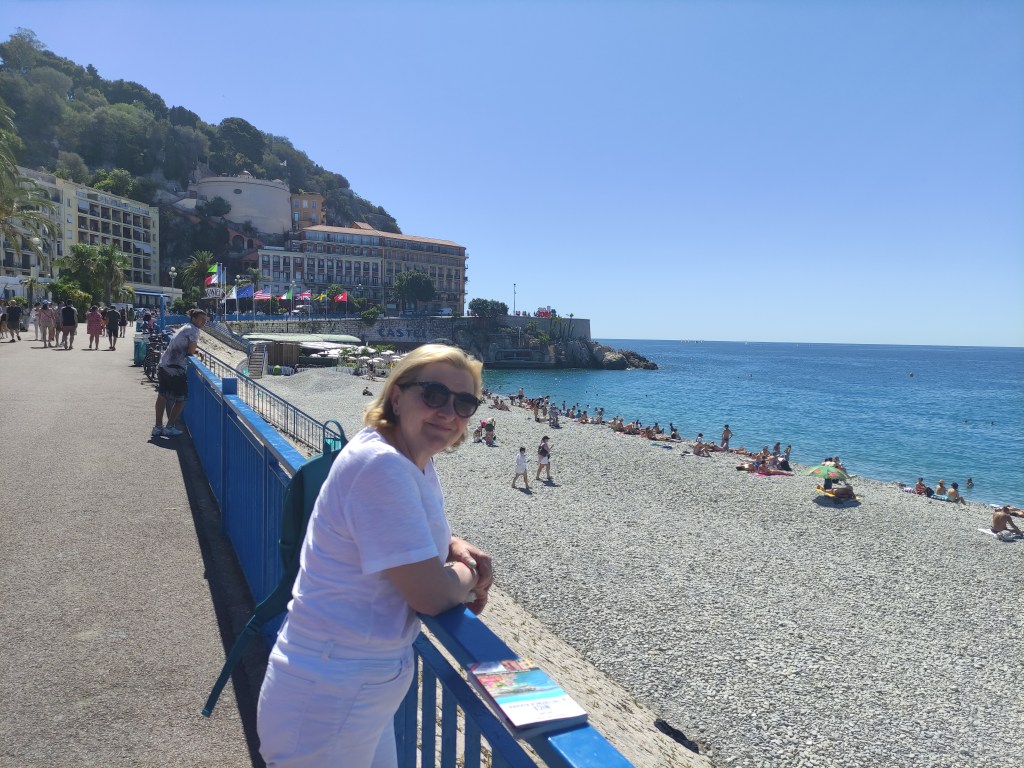
I cooked dinner at the flat and in the evening walked along the Promenade des Anglais on the seafront. It is a seven kilometre promenade which was started in 1822 by the Reverend Lewis Way, an English vicar who was one of the many ex-pats living in Nice for the winter. It has been widened and lengthened over the years, and is a wonderful place to stroll in the cool of the evening and watch people.
Cimiez – Sunday 12 June
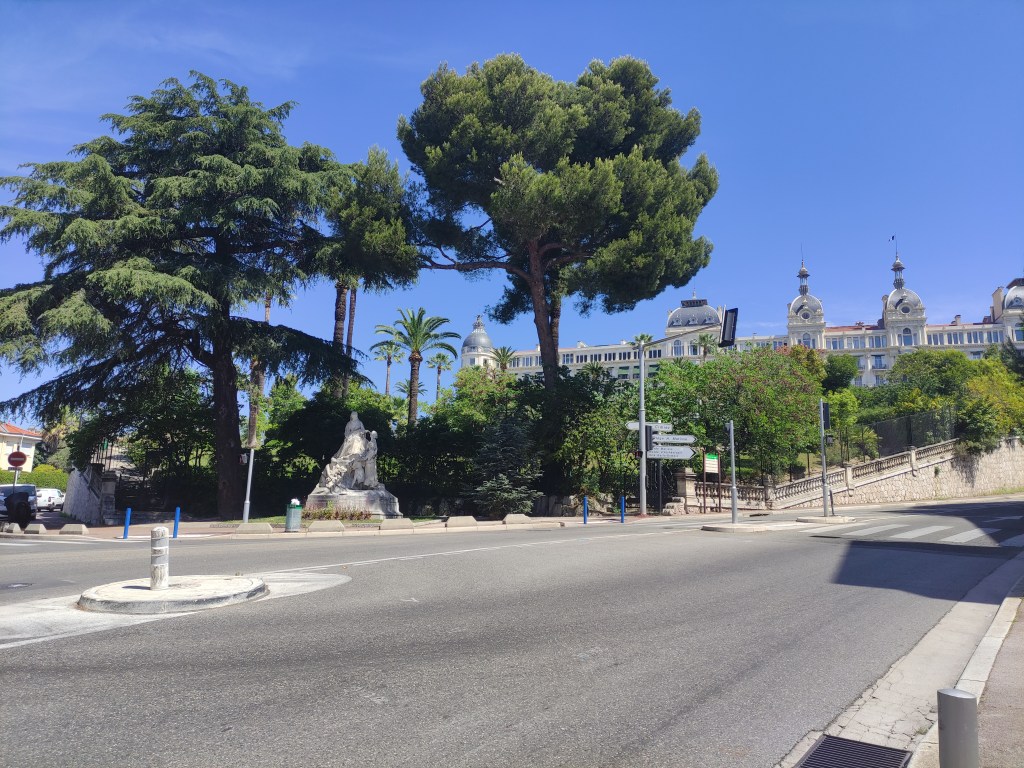
English tourists “discovered” Nice in the nineteenth century, visiting in the winter when the weather was much better than in England. They didn’t want to stay near the coast when it may be stormy, so went up hill to the district of Cimiez. It is a district of Belle Epoque villas and grand hotels, now turned into apartments. It’s a pretty area but up a substantial hill, hard work in the hot sun.
The grandest hotel was the Regina Excelsior where Queen Victoria stayed for five winters in the 1890’s. She called herself Lady Balmoral, and took over a complete wing for her one hundred staff including Indian soldiers and kilt-wearing bagpipe Scots Guards.
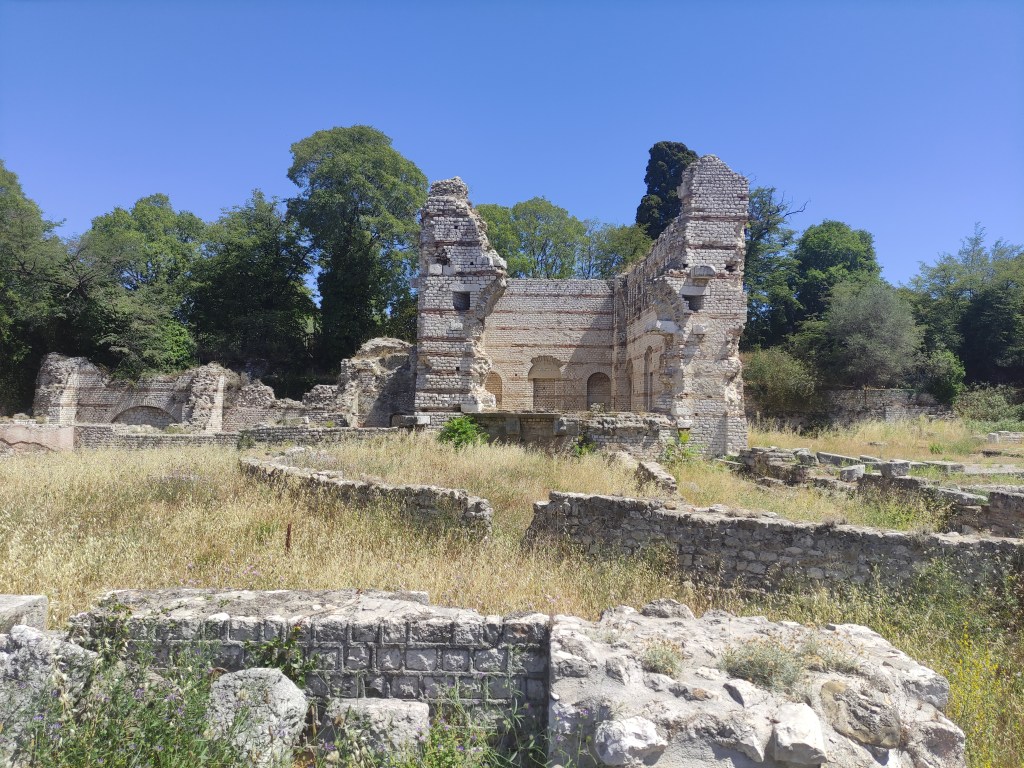
We went up to Cimiez to see the Roman remains and the Matisse museum, which are both in Jardins des Arenes de Cimiez. The Roman ruins are the remains of Cemenelum, a city which was the capital of the Alpes Maritime province for a while. Mostly it is just foundations that are visible, but there is a big part of a bathhouse still standing after 1700 years. It didn’t take long to look round the ruins, and there is also a museum of artefacts found in digs. All the captions are in French, and they aren’t very exciting. I have been to much better Roman museums, such as the one in Arles.
The Matisse Museum is really good, a modern concrete structure that joins into a seventeenth century villa which was originally called the Villa Gubernatis. Matisse lived in Nice from 1917 until he died in 1954. In his later years he was bed-bound, and would paint using a brush on the end of a long stick.
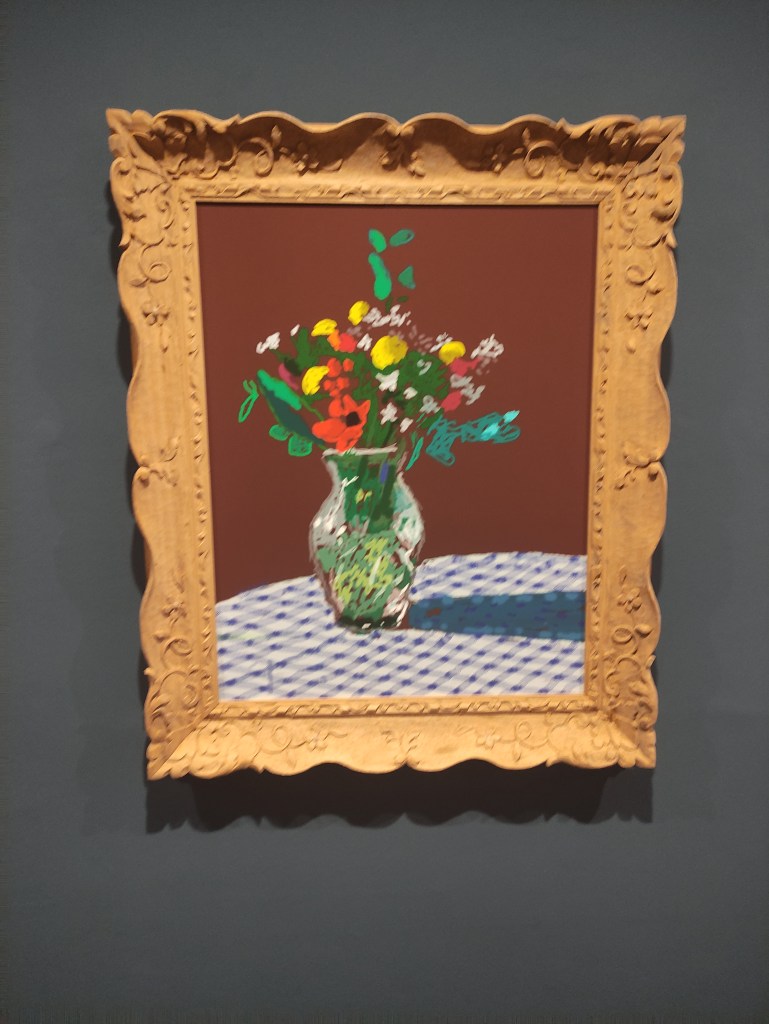
It has a big collection of his paintings, drawings and sculptures from all stages of his long career. We were very lucky that a new exhibition opened two days earlier showing pictures by David Hockney side by side with similar pictures by Matisse. It is a superb collection of pictures, both artists are masters of their craft and have a similar way of looking at the world.
Hockney draws using an iPad very skilfully, and many of his pictures of vases of flowers were on display.
We had dinner at the flat, merguez sausages (again) and salad, very tasty.
Later on we walked through the old town to the promenade, and then round the castle hill to the port. This was dug out in the nineteenth century, before that fishermen just pulled their boats up the beach. It is full of motor yachts, a couple of naval boats and a few fishing boats.
Monaco – Monday 13 June
Monaco is the next city east towards Italy, so we had to go. Every Englishman should visit Monte Carlo at least once and pretend to be James Bond.
We walked to the Port and looked for the bus stop for the 100 bus. There was a big queue when we arrived, so didn’t get on the first bus, but got on the next fifteen minute later. It was a big bendy bus, and it was full.
The bus route is very beautiful, especially going past the bay where Villefranche sur Mer sits. It fulfils all the images of the Cote D’Azur, with terracotta roofs, palm trees, sandy beaches, yachts and a cruise liner in the bay.
It takes about forty five minutes to reach Monaco, round lots of bends along the coast, but there were some extraordinary views of the coast. Once you are here you can understand that it is the playground of the rich.
We got off the bus at Place d’Ames bus stop and walked to a small square called Condamine for a coffee (too milky and too expensive). There is also an indoor market where we bought reasonably priced rolls for lunch. From there we walked up a footpath to the Prince’s palace at the top of the hill. The entire state covers 0.8 of a square mile, and is the most densely populated state in the world. It’s like Hong Kong on the Med, with many apartment blocks going up the hills surrounding town centre. The state has expanded by 20% dues to land reclamation, and there is more going now.
Monaco has been ruled by the Grimaldi family since 1297, who later founded the town of Grimsby famous for its fishing port. Nah only joking! They were from Genoa in Italy. The present ruler in Albert II whose mum was Holywood actress Grace Kelly.
Monaco is so attractive to rich people because there is no income tax. The Rich do need to have $500,000 in “liquid assets” to qualify for residency, so they need half a mill just sitting in their account to stay. Albert and his buddies make their money from 20% VAT, and those rich folk do spend a lot of money.
The Prince’s palace is a mansion which has had a Gothic work over with some castellations added to it. We got there just in time for the changing of the guard, which wasn’t spectacular. There was a small band and about a dozen white uniformed guards who marched in and changed places with the other guards.
I nipped into a shop to buy a Coke and got a decent fridge magnet for a Euro. Monaco is cheap for fridge magnets!
The Port Hercule is where all the superyachts dock. One of the swankiest is Lionheart which is owned by millionaire tax evader Philip Green. It is huge and ostentatious, like the man himself. We walked around the harbour and saw workers taking down the stands for the Grand Prix. I’m told it is boring because there is no room for cars to overtake each other.
The town is built on the side of a hill, so there are public lifts and escalators for getting between levels.
The casino is in the Monte Carlo district of the town, and it was designed by Garnier who build the Opera in Paris. It’s a grand confection of marble and gilding, Louis XIV would feel very at home. You can go in the foyer and take pictures, but it’s ten Euros to enter the actual casino to waste your money.
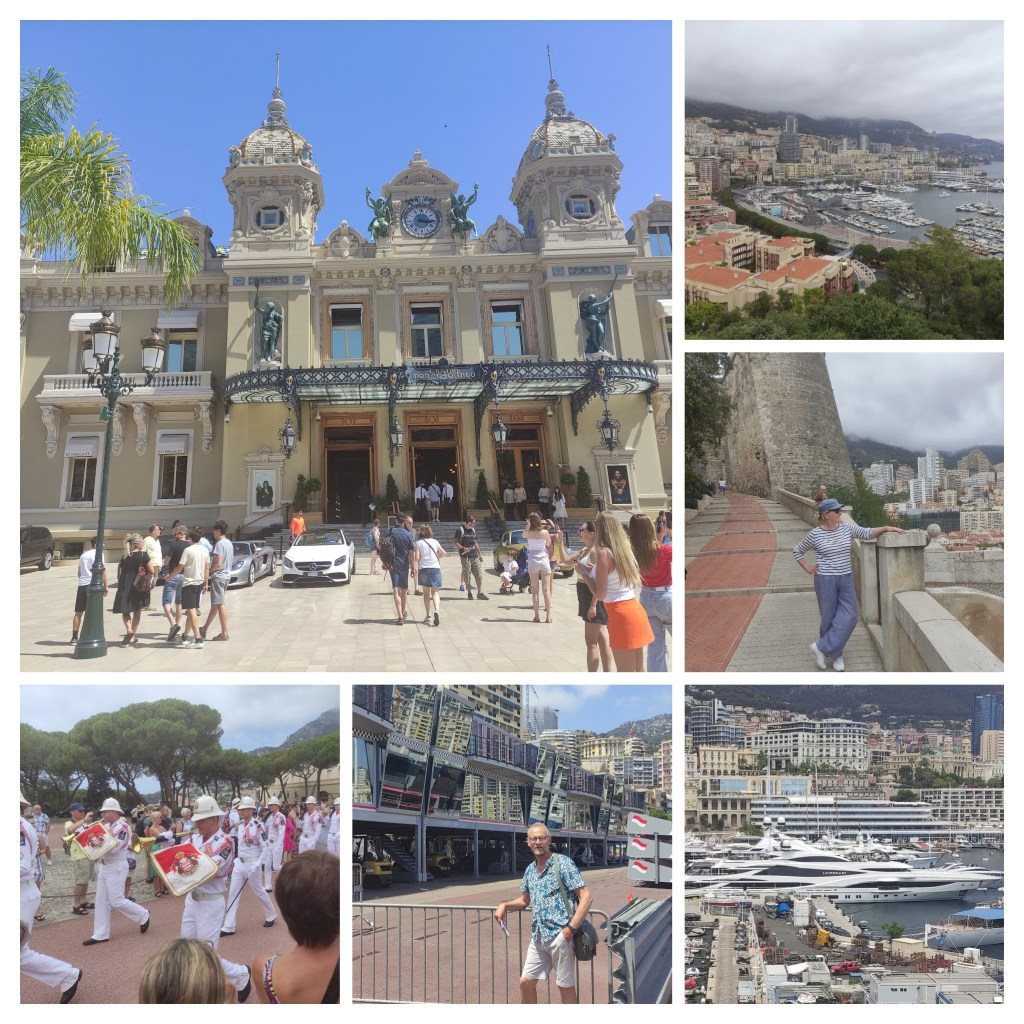
We took the train back to Nice, which was very busy, but it only took fifteen minutes.
That night it was the Strawberry Moon, an extra large full moon. It looked beautiful rising over the castle hill.

Villefranche Sur Mer – Tuesday 14 June
The French have great double-decker trains, but its really bloody hard to get a ticket! At Nice station this morning I could not buy a ticket from an actual person, only from a machine. Some of the machines are ancient, complicated, and take ages. I had French people asking me how to use those electronic heaps of crap.
I got QUITE ANNOYED with the ticket machines, Julie calmly bought tickets using the Trainline app. She is a miracle, my wife. But once you get on the French train they are very comfortable.
We only went about three miles and two stops to Villefranche Sur Mer, which is like Kylie Minogue, small and very pretty. The town sits at the end of a bay between the Cape of Nice and Cap Ferat, where the water is ninety five metres deep. So it has been a harbour for everyone passing by in a ship, Greeks, Romans, Arabs, Genoese, French, Italians and so on. The US Sixth Fleet anchored there until De Gaulle took France out of Nato.

There is a sandy beach, which Nice doesn’t have, and a pretty harbour lined with cafes. I had a swim, while Julie sat on a bench in the shade, she doesn’t like sand!
The town looks quite Italian, with tall yellow and terracotta houses with shuttered windows, like Old Nice. It is very photogenic, great photo shots around every corner.
We descended into the Rue Obscure, which is a very old street that got built over, and is now a tunnel beneath houses.
On the way back to Nice we stopped at the Museum of Modern and Contemporary Art. I felt the same about that as I do about the Tate Modern and the Guggenheim in Bilbao, love the building, but don’t like the art. It appears to me that you don’t need talent to create art in that genre, just lots of confidence to convince people that what you have created is art. Like Marcel Duchamp’s urinal.

There is a very good roof terrace on the museum roof, which makes it worth the visit. I reckon I can do art, so I took some pictures of us in various daft poses. As Paul Calf probably said “modern art – it’s a bag ‘o shite”.
Antibes – Wednesday 15 June
Another train trip, going west this time to Antibes. Like Nice, it is an ancient settlement, founded by the Phoenicians. Today it is a very popular tourist destination with excellent beaches and a vast marina called Port Vauban.
Our first stop was at Boulangerie de le Gare for a really really good coffee and a delicious Pain au Raisin, (the only sort of pain I enjoy). Then we walked through town to the Plage du Ponteil, which was almost perfect. It has soft sand sloping gently into a calm sea, and plenty of space for me to lay down my towel and poke my sun umbrella into the sand.
Julie doesn’t like sand, so she found a bench in the shade very close by and listened to Music for the Cote D’Azure on Spotify.
It was heavenly.
I bobbed around in the warm sea for a while, and contemplated on my good fortune.
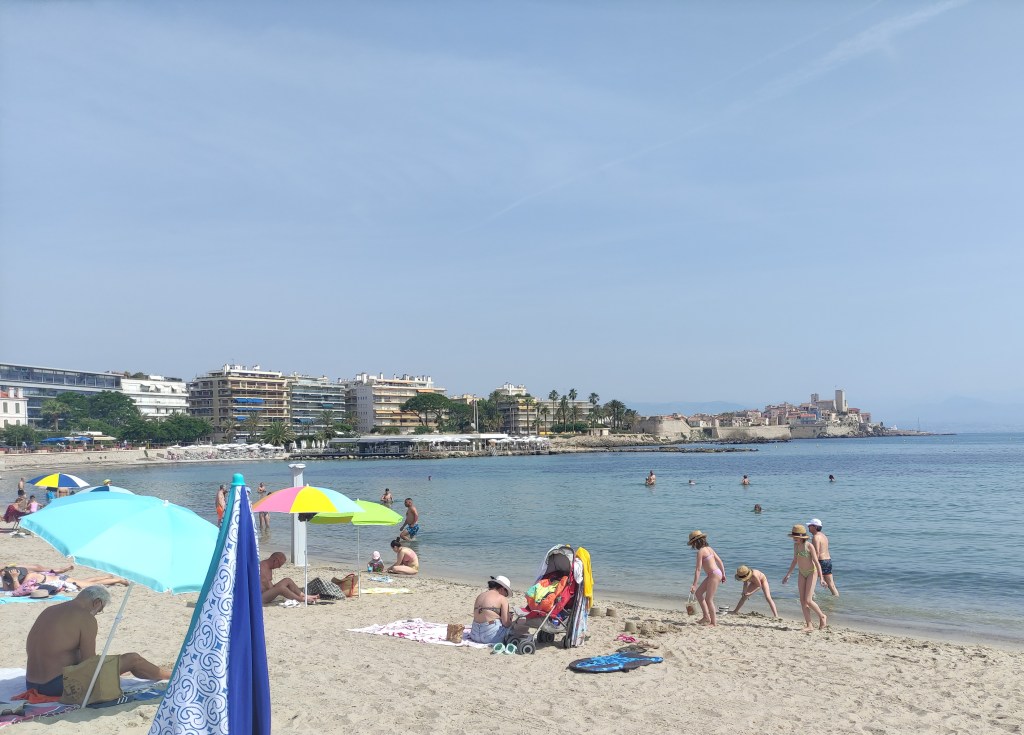
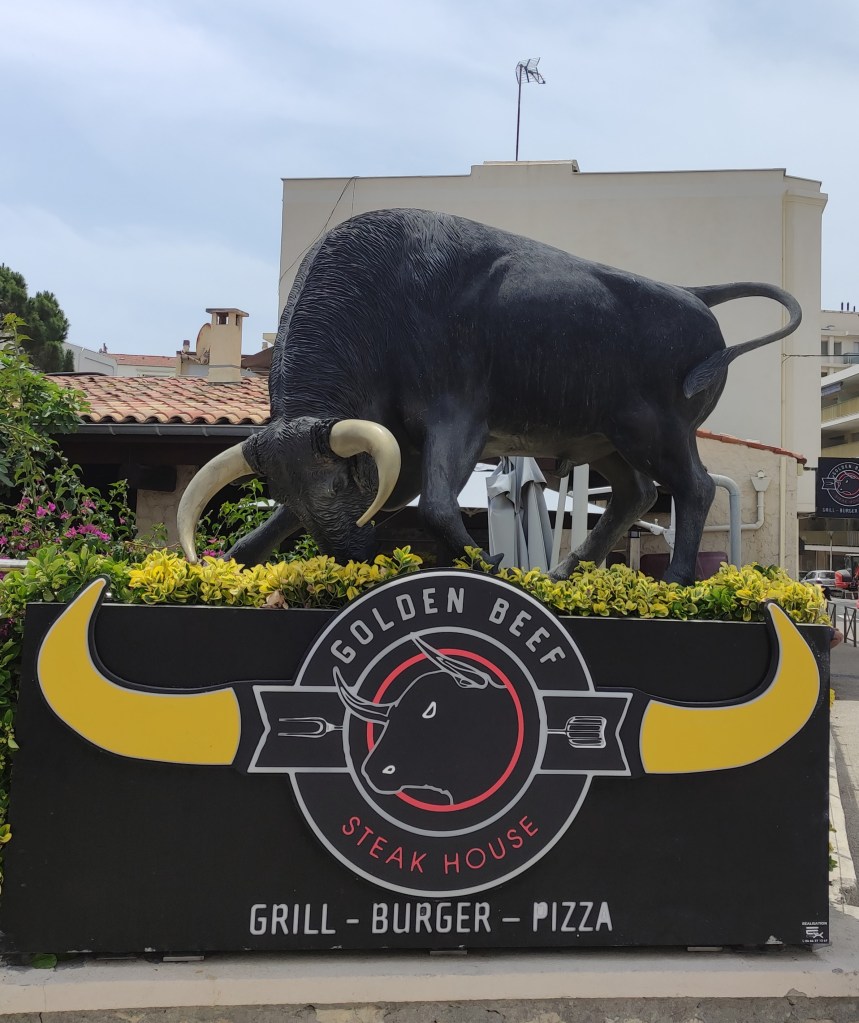
We went for lunch to the Golden Beef Steak House. It sounds like a steak restaurant on the M6, but actually the food was superb. The Plat de Jour was Brochettes de Boeuf, which is beef on a skewer. The beef was tender, juicy and very flavoursome, and went down very well with a glass of Rose for 15.80 euros.
After lunch Julie went to the Picasso museum and I didn’t, as I have said earlier Modern Art doesn’t work for me. So I had a wander around the town and failed to understand how to buy tomatoes in the supermarket. I had to weigh the tomatoes and put a sticker on them, but couldn’t figure that out. I thought “fuck it, i can do without them tonight”
Port Vauban is just outside the mighty town walls of Antibes, named after Louis XIV architect who designed the fortifications of the town. The port is full of yachts, motor yachts and super yachts. The biggest are ostentatious displays of wealth that mostly just sit there doing bugger all while their owners make money out selling snake oil.
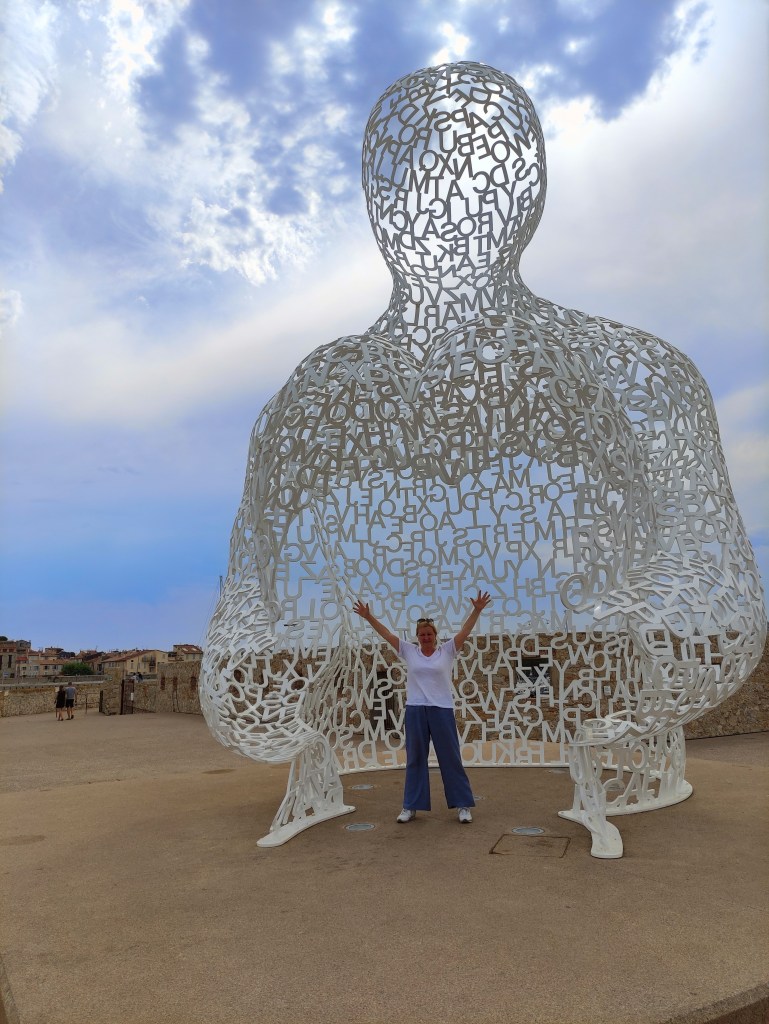
But the port does have a very cool sculptor of a seated figure made out of letters of the alphabet welded together.
Antibes also has many beautiful squares full of lively restaurants, it’s a very attractive town.
Nice (again) – Thursday 16 June
Having spent almost a week in Nice, I now have a grasp of the basic geography and can find my way round the patch of Nice where we are staying. Before smart phones I got hold of a map and found my way round, and my mental map was soon developed.
We walked through the Promenade du Paillon, which used to be the main river of Nice before it became unsanitary and was paved over. It is now an attractive longitudinal park, like the long park in Valencia which was a river.
The Paillon leads down to the Promenade des Anglais, which runs along the shoreline, and is the perfect place for flaneaurs (wanderers) enjoyed the sea view. The beach is shingly, like Brighton, but the water is much much warmer than the English channel. Sun-lovers had their beach towels at at 10am on the public sections. There are also private sections where you pay thirty Euros to get for your lounger and umbrella, and then have to buy their food and drink. A luxury option my pocket did not stretch to.
Luxury hotels line the Promenade, and the poshest is the Negresco with liveried doormen looking after clients big cars. Next to the hotel is the Villa Massena Museum, which we read about and thought didn’t sound very interesting, but decided to give it a try. It was very hot and it would be nice to go somewhere cool. In actuality the museum was very good and worth the visit. It was built in th 1890’s for the grandson of Marshall Massena, a hero of the Napoleonic wars, and became a museum in 1921 . The ground floor preserves the original Second Empire decoration and furnishings, with huge portaits of battles and muilitary figures. The upper floors are a museum of Nice life. I enjoyed the prints of old Nice showing fishing boats on the short and the bridge over the Paillon river. From the 1820s Nice became a very popular winter resort for nobility from all over Europe, and they had plenty of money for palatial villas and grand hotels.
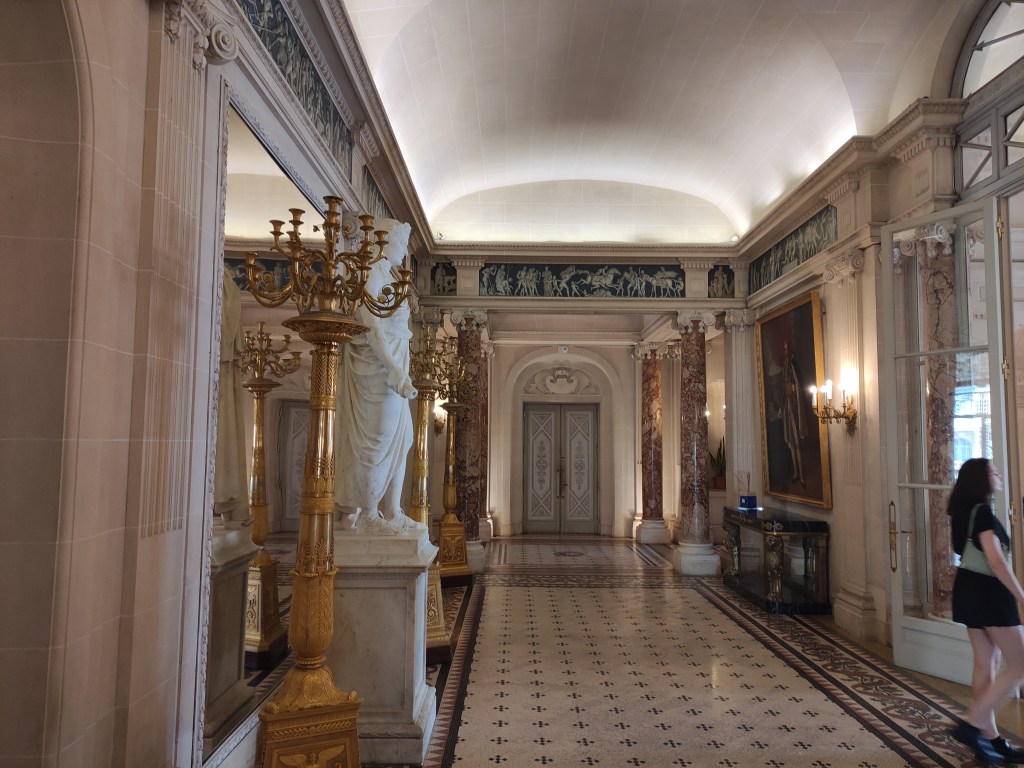
The museum also has beautiful gardens with palm trees, yer don’t get them at the V&A!
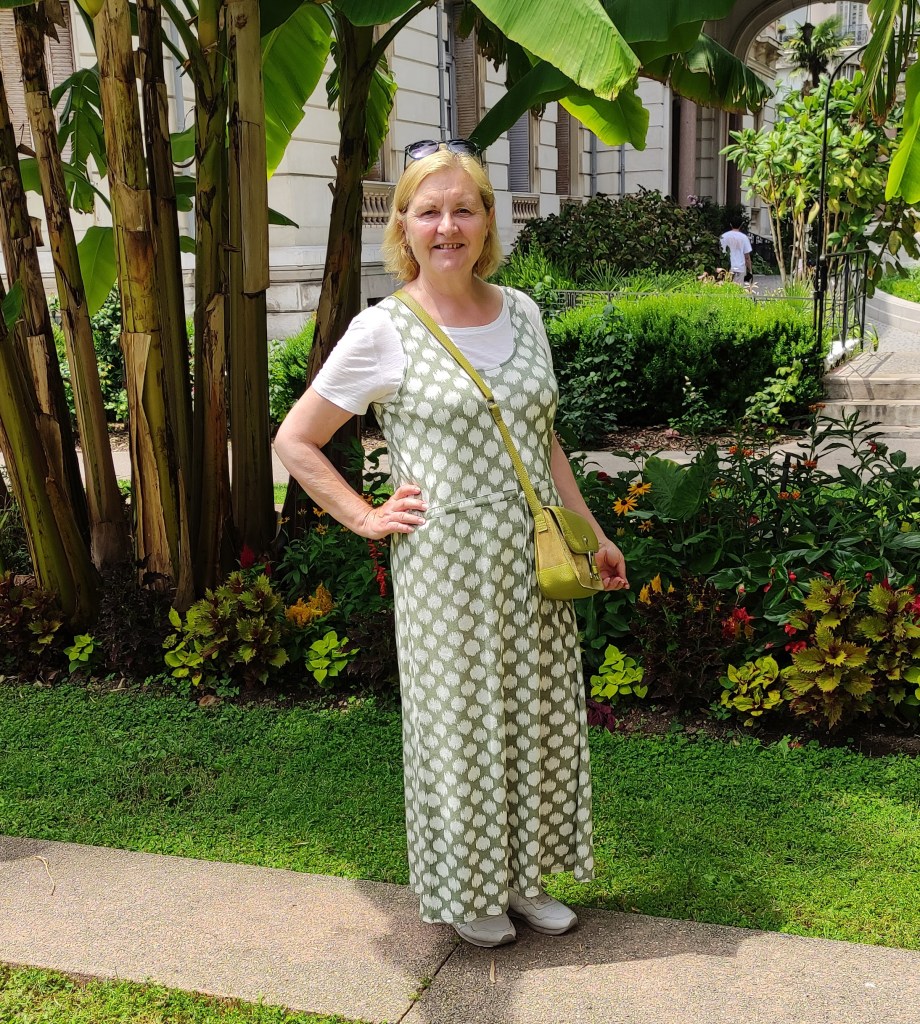
Later in the afternoon I went down to the sea near the old town and went for a swim. I wore my water shoes so I could walk on the cobbles without discomfort. The sea was warm and calm and very refreshing.
Nice is a very beautiful city due to its warm climate, its coastline and its extravagant belle epoque architecture. It is an expensive place to visit, but its worth it.
I saw this public toilet in the old town, the graffiti made me smile “I piss therefor I am”.

Avignon – Friday 17 June
We took the 08.40 from Nice Ville to Marseilles, and the train was almost full since it runs through the seaside towns of Antibes and Cannes. It takes three hours to reach Marseilles, where we waited half an hour for the train to Avignon.
Avignon is on the River Rhone and has a medieval old town surrounded by walls. It is most famous (to ignoramuses like me) for its bridge because of the popular children’s song. Our AirBnb was a short walk from the station on the Boulevard de Replais, quite close to the city walls. These are very high and mostly intact, but you can’t walk along them like York or Chester.
It was 37 degrees centigrade when we arrived at the flat, too hot to do anything much, so we sat in the shade in the lovely patio which is planted with palms, yucca and lemon trees.
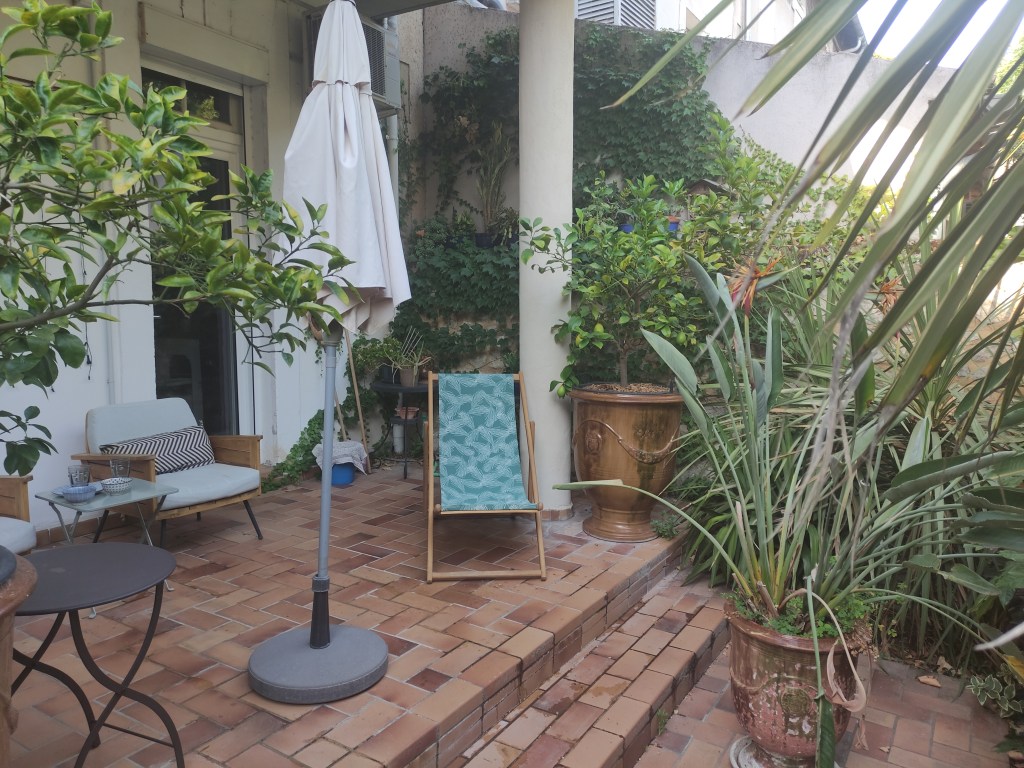
Our friend Bernard arrived on his BMW motorbike after riding down from Twickenham with an overnight stay in Troyes. We went out to dinner in Place l’Horloge in the centre of the old town. It is a long rectangular area with many restaurants to choose from. They all had big umbrellas with water misters clouding cool water over the diners.
I chose Cassoulet, which was extremely underwhelming. Instead of being a rich casserole of Toulouse sausage, duck and haricot beans, it tasted like a tin of beans with a small sausage and lump of duck shoved in it. Pah! It filled a gap but wasn’t good.
The old town has many winding pedestrianised streets full of cafes, bistros and restaurants. Don’t ask me to define what they are, I don’t know, they are all French eating houses. We had drinks in the Pipeline, a pub on Rue Jean Jaures that has a very good variety of beers; French, German and English at reasonable (compared to Paris and Nice) prices.
Saturday – 18 June
It’s another 33 degree centigrade day in Avignon! Luckily our flat has thick walls and has air conditioning. There is a Tourist Information office in Jean Jaures, and the charming lady there gave us a map of Avignon with interesting things on it. So we followed a route around the old town, which was very pretty and very quiet, considering it was Saturday morning.
The Rocher Des Doms is a small hill overlooking the Rhone with a pretty park called Jardin des Doms at the top. It has a perfectly located cafe next to a pond that sold cold beer. After a few hours in the heat it was very welcome. We liked it so much we stayed for lunch and had quiche and salad for lunch.
Earlier we had bought tickets to the Palais des Papes for 13.30, so we walked down the hill into the square in front of the Palais. The Palais is a massive gothic building, more like a castle than a palace. It was built for the French Popes who ruled over the Catholic Church from Avignon between 1309 and 1377, and cost a large part of their annual income to construct. It has huge chapels, refectories and a treasury, and was where the Pope met heads of state from all over Christendom.

We had fancy electronic audio guides which looked like tablets, that told us all about the different rooms. Its a huge place, so there were lots of steps to go up and down. It is very impressive, and it was quite a relief being out of the sun.
The Palais is close to the bridge, the Pont Saint Benezet. Except it isn’t a bridge because it does not reach the other side of the river Rhone. It was started in 1234, and originally had twenty two stone arches. The Rhone is split by an island, so the bridge had two sections to cross both parts of the river. But it kept falling down during floods, and was not rebuilt after 1644.
So we walked down the bridge at the hottest part of the day, grateful for the breeze but holding on to our hats because of the strong wind.
Nimes – Sunday 19 June
Julie was looking at the Trainline app and got us train tickets to Nimes for one Euro for each journey, a very good deal! We left at 08.30 and it took about forty minutes travelling through the scorched Provence countryside.
Nimes is a beautiful small city, with a very rich Roman history. It was a Roman colony (like Lincoln) and had a seven kilometre wall around it built by the Emperor Augustus. Not him personally, he wasn’t that handy with a hammer and chisel. The city is full of graceful boulevards lined with shady plane trees.
I found the Tourist Information and got a map with the major attractions. The biggest and closest was the amphitheatre. This Roman arena is in remarkably good condition with complete walls, which the Colosseum does not. We paid for a tour and were given a plan of the amphitheatre plus a fat electronic pen. When we reached a particular numbered location, I would put the tip of the pen over the corresponding number on the plan, and the pen would talk to me! At each location there was a continuing story about the place read out by actors, it was all about the gladiatorial games and different types of gladiator.
When we visited there were technicians setting up a stage for a pop music performance in the arena that evening. Later on in the season Sting and Deep Purple were performing, in a stadium over two thousand years old!
The town centre is very pretty, built of pale limestone with pale green shutters. There is an excellent indoor market, Les Halles with beautiful fruit, vegetables, fish cheese and charcuterie stalls.
We bought a picnic lunch and walked to the Maison Carree, which is a complete Roman temple that is still standing. It is in unbelievably good condition, and stands on a tall plinth in the midst of a square. When we arrived there was a large group of people dressed in bedsheet togas sitting on the steps. I don’t know what they were doing, but it looked like fun!

The Jardins de la Fontaine is one of the first municipal gardens built in France. The lower sections are formal gardens like those of a chateau, with plane trees shading stone benches. Then it rises up a hill with winding paths through woodland.
At the top is the Tour Magna, a ruined Roman tower may have been a watch tower, but no-one knows for sure. It has a modern staircase to the top and splendid views of Nimes.
On the way to the station I spotted a scooter called a Kisbee, so I took a picture with Bernard Kisby.
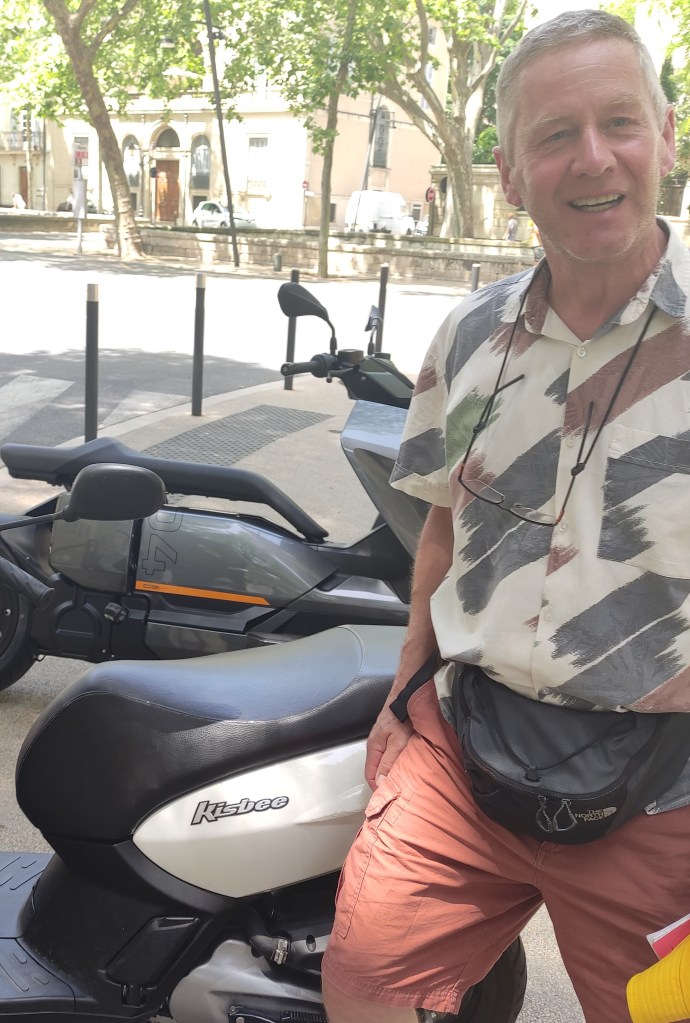
We got the 15.30 train back to Avignon and then slumped in the garden, it was still very hot!
Villeneuve Lez Avignons – Monday 20 June
On the last day in Avignons we didn’t want to travel far, so we walked over the Rhone to Villeneuve (new town) les Avignons. The village built up at the opposite side of the mediaeval bridge from Avignon, and was originally in the Kingdom of France, whereas Avignon was in the Papal States.
At the place where the bridge formerly terminated on the “French” side there is a big stone tower called the Tour de Bel Philippe, Philip the Fairs Tower. A short walk from the tower is the village of Villeneuve. It is postcard pretty, with narrow streets and a square with cafes and a big church. The church has a cloister, so perhaps it was an abbey.
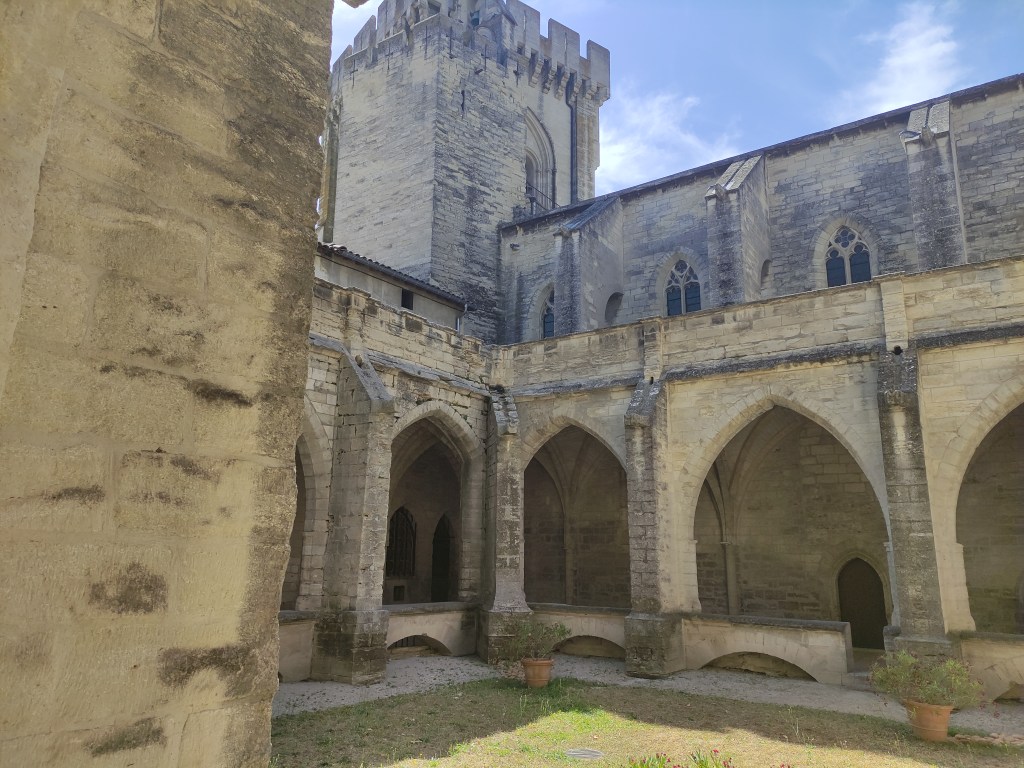
Just out of the village centre we saw a sign for the Chartreuse, so we followed it in. A cobbled approach leads to a Carthusian monastery. Not a ruin, like all those in Britain, but a complete monastery within all the buildings intact.
The Carthusian order was founded in 1084 by Bruno of Cologne in the Chartreuse mountains of France. The name Carthusian comes from Chartreuse, as does the English name for the order, Charterhouse.
The old monastery was a great place to wander around on a very hot day and see the church, refectory, monks’ cells, laundry and other parts of the community.
The is a big castle on a hill above the monastery called Fort St Andre also founded by Bel Philipe, but we couldn’t summon the energy or motivation to visit it.

So we walked over the bridge to the Ile de Barthelasse, past the campsite and took the free foot ferry back to Avignon. We shared the boat with a group of very excited school children. We got a very good view of Avignon pier, well it ain’t a bridge is it?

Julie and Bern went back to the flat, and I walked to the Petite Palais Musee which is coles to the Palais de Papes. The paintings were all mediaeval religious images, which I’m not interested in, so I had a quick tour round and then went back to the flat for a cold beer.
Avignon to London – Tuesday June 21
The alarm went off at 05.15 after a bad night’s sleep” in a hot bedroom. Our Airbnb host booked a taxi for us, which arrived on the dot at 06.00. It took five minutes to reach the TGV station, so we had loads of time before our Oiugo train arrived at 06.50.
The trip to Lille was uneventful and extremely fast, just under five hundred miles in just under four hours. We spent a couple of hours in Lille, which is interesting but I wouldn’t call it beautiful. The paving is all stone sets, so it was very noisy pulling a trolley case. The cathedral was completed in the 1990’s and is huge and very plain. I think they ran out of money at the end of the building process.
The train to St Pancras took less than ninety minutes, and it was hot in London when we arrived on the day of a train strike. So instead of taking an hour or so to get home, it took almost three hours, via the London Overground and a bus from Richmond.
So what’s it like going to the south of France by train?
If you want to be kind to the Earth and not take a flight, the train is a great way to travel. We also found that the local train network in the south is excellent and easy to get around.
My lovely wife/travel agent organised all the different legs of the journey several months in advance, so we got good deals on the Eurostar and Ouigo trains.
Our Trainline app was very useful for buying SNCF tickets while we were there, much easy than using the machines. We used Google maps a huge amount, and it enables us to have long walks every day without getting lost.
The long distance journeys took four or five hours, but the seats were comfortable and there was space for our bags.
So far this year we have been to Edinburgh, Amsterdam and France by train. Lots of travel without damaging the climate, smugtastic!
The Riviera is a very beautiful place to visit. The towns are perfect and the weather is always ‘ot. I loved all the history in every town I visited, I practically had culture running out of my ears.
I enjoy cooking, so we ate in quite a lot. It also saved us a great deal of money. It is possible to spend a huge amount on eating out if you want to, and the food is some of the best in the world.
I will go back again.
 timharnesstravels