This is what I found out during my Interrail trip in September – October 2023. You might find it useful, you might think it very tedious.
Wheelie Bag or Rucksack?
I know you are dying to know the answer to this big question.
We decided on small wheeled suitcases that we usually use as cabin luggage. They were perfectly good for our needs, which are modest
We packed carefully fitted most of our stuff in our wheelies. We both took small rucksacks to put out valuables (phone, passport, Chromebook) and food in so we could have them with us on the train. Its a well know fact foreigners will try and steal your bags if given the opportunity. Its best to sleep with one eye open.
Often we could put our wheelies above us on luggage racks, sometimes they went on racks at the end of the carriage. We secretly laughed at people with bags bigger than themselves that they could barely drag down the corridor. Ha ha ha you fools!
We never wished we had big rucksacks, they are heavy and needless. This isn’t Thailand in 1984, its Europe in 2023 where we have proper paving (mostly).
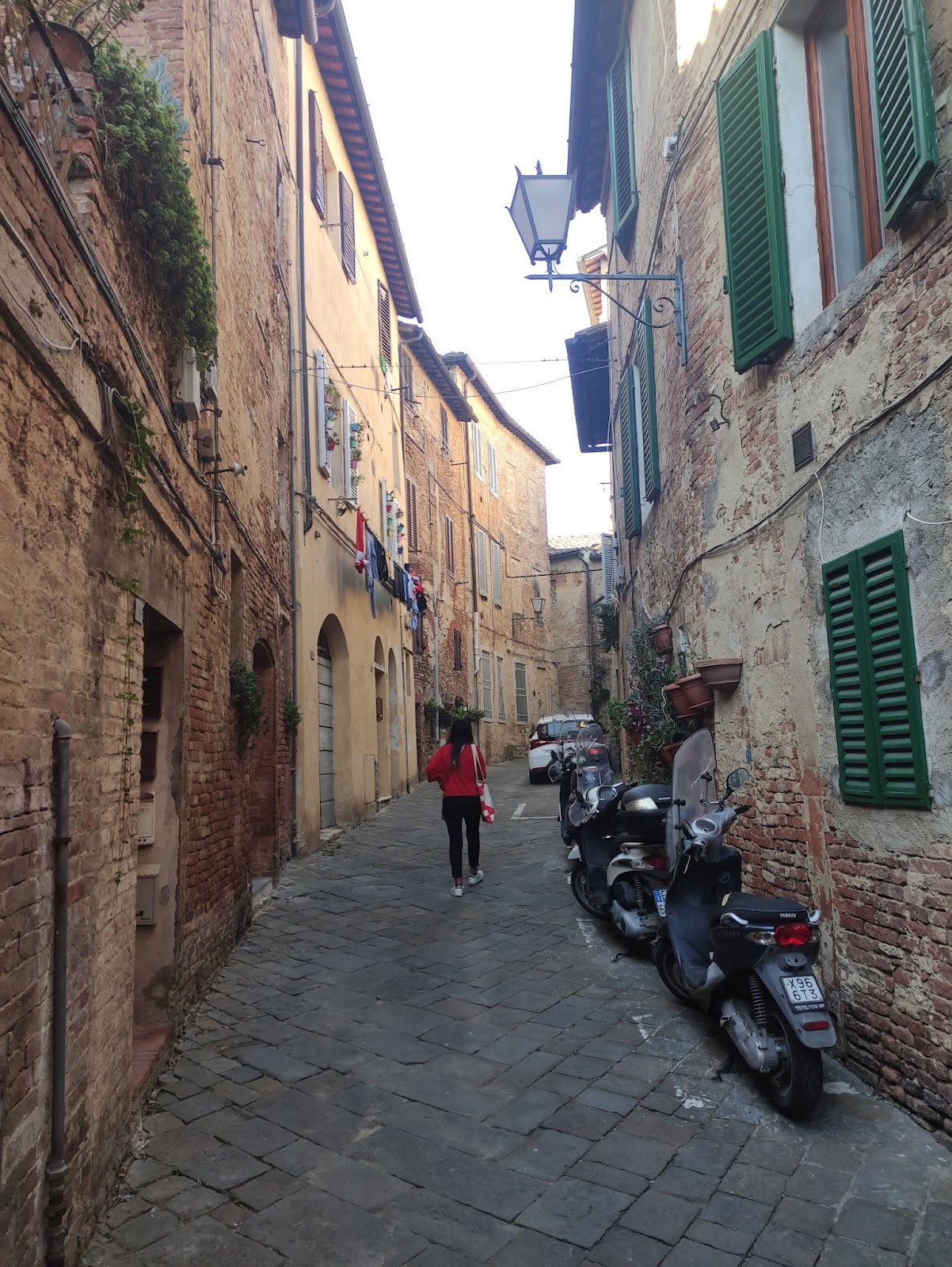
Wheelies are noisy on cobbled streets, and you have to be careful on kerbs. Julie lost a wheel from her wheelie and had to buy another one in Siena
What clothes to take?
Travelling in early Autumn in Europe I had clothes for 2 seasons, because I thought it would be cool in October. But it was hot all the time!
4 tee shirts – wore them all. The blue stripy one was my favourite
2 shorts – wore most of the time
4 pairs socks – wore occasionally with trainers
2 thin jumpers – wore very rarely
5 pants
1 jeans
1 hiking trousers – wore once in the rain
2 long sleeve shirts – for evenings out, wore rarely
I pair hiking sandals – wore constantly and they got stinky
2 pair trainers – wore occasionally
I pair swimming shorts
I microfiber towel – very good for the beach
Sun lotion
Bug repellent
Corkscrew – no screw caps on bottles in France
Earbuds
Hat/cap – i had to wash it after a month
Sunglasses
Battery pack for mobile – using Google maps uses lots of power
We stayed in small apartments, often (not always) with washing machines. Occasionally I would shower with my smalls on the floor and stomp them with shampoo.
This was enough because I could regularly wash stuff.
Food
We decide that we would rather have extra days on holiday rather than have lots of meals out. So we had occasional moderately priced meals out, but mostly cooked in our flat.
A baguette in France costs 1 Euro, which is a bargain.
Navigation
The Interrail app is fantastic for finding the train you want and getting the ticket as a QR code. It made planning our route quite straightforward.
The best source of advice is the website “The Man in Seat 61”. He has been everywhere in Europe and his train travel website is amazingly comprehensive.
The view Interrail app doesn’t show all the small regional stations in Italy when you look for stations between cities.
So I used the Trenitalia app (available in English) to find the trains I wanted.
Accomodation
We used Airbnb or Booking.com to find self catering flats. Paris (of course) was most expensive and Golfe Juan was the cheapest. Its a small beach town between Cannes and Antibes. We got a small flat with a swimming pool for £56 a night!
With an Interrail pass you can get cheaper accommodation by being close to a station away from the centre, which we did in Salzburg and Munich.
Eurostar Connection
With Interrail you are allowed one travel day from your home to Europe, so we booked a journey from Whitton ( our local station) to Paris (via St Pancras). To take Eurostar it a £30 surcharge each way and places are limited, so book early.
Sleeping
Take a sleep mask for accommodation with thin curtains.
New City
Find the Tourist Information office for free maps and finding out about places to see. It’s also useful to find where to buy bus/tram/metro tickets.
DON’T put Paris Metro tickets next to your phone, it wipes them out!
CityMapper is available in some big cities and is a useful alternative to Google Maps
Paying for stuff
I have my bank cards in Google Wallet on my Android phone that uses NFC. I used it all the time and it never failed.
We had some Euros to pay for toilets in stations and some small items.
We left our flat in Golfe Juan at 7.30 ish this morning and got to our hotel in Lyon at 3pm, changing trains twice on the way at Cannes and Marseilles.
The first leg along the south coast takes ages, then it was fast on the TGV from Marseilles to Lyon. Fortunately it all went smoothly and we settled into a proper hotel for the first time! It cost twice as much per night as we paid in our last place, but it’s delicious having some luxury.
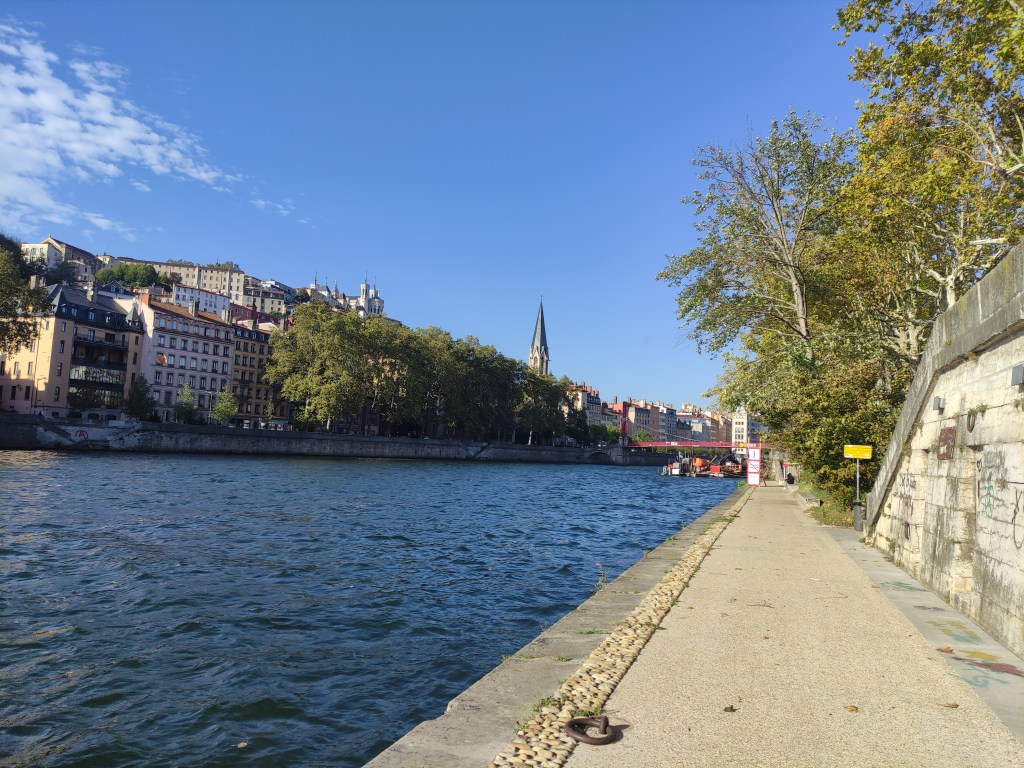
We stayed the Hotel Charlemagne on Cours Charlemagne, which is close to the confluence of the Rhone and Soane rivers in central Lyon. I grabbed a map in the hotel reception and we walked along the banks of the Soane in the direction of the Old Town.
The Soane is a big river, the size of the Seine or the Danube. The old town of Lyon is at the foot a a hill where the Roman settlement of Lugdunum was, and where its ruins remain. Lugdunum was the birth place of the Emperor Claudius. the Emperor who would conquer Britain.
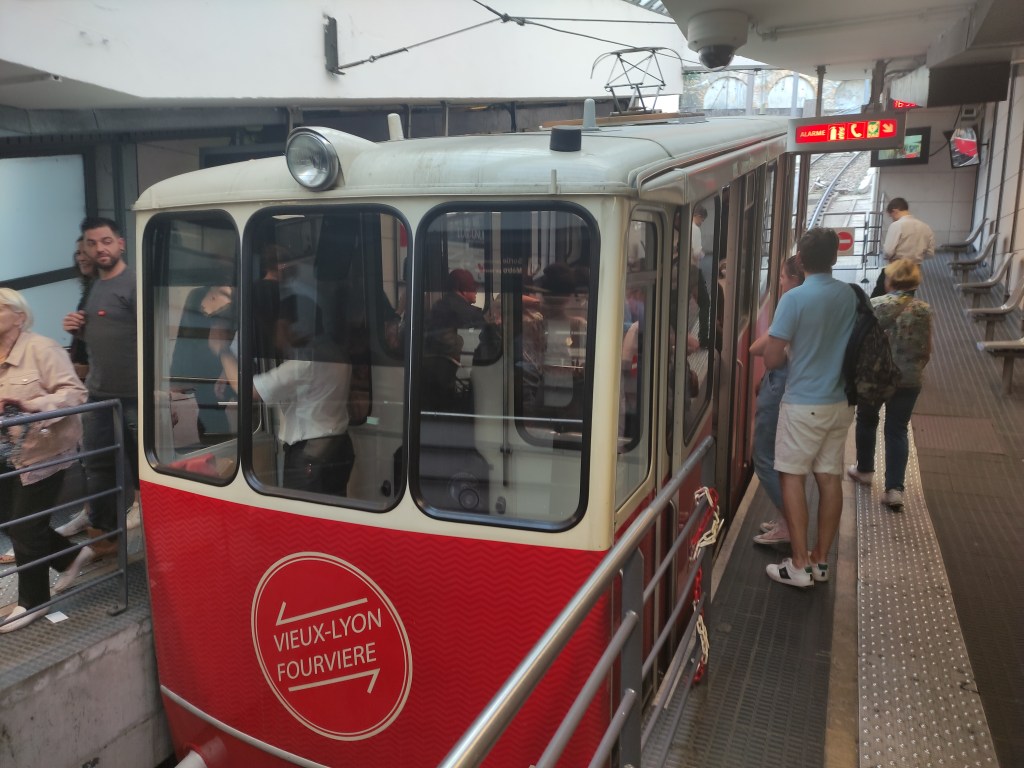
It is a bloody great hill, and neither of us fancied the hike on a warm afternoon. Fortunately there is a funicular railway going up, which is integrated into the metro system. It was well worth the 2 euros to reach the Fourviere stop at the top. Fourviere is on the site of the old Roman town centre, and the name comes from Forum Vieux, old forum in English.
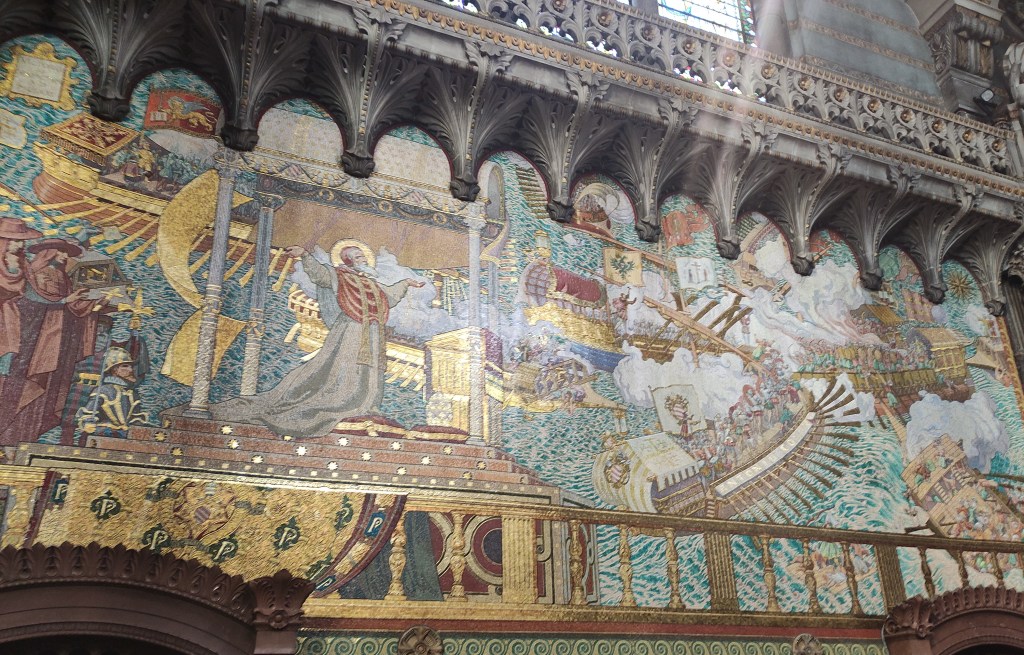
On leaving the station you are right next to the Fourviere Basilica, a magnificent white stone church completed in 1895. The interior is stunning, with huge mosaics highlighted in gold depicting biblical stories and the battle of Lepanto with the French fighting Turks in galleys.
I’m sure you are asking yourself what is a basilica? Well its a Catholic church given special privileges by the Pope. Often they are notable shrines and pilgrimage sites. They attract pilgrims and make more money for the church.
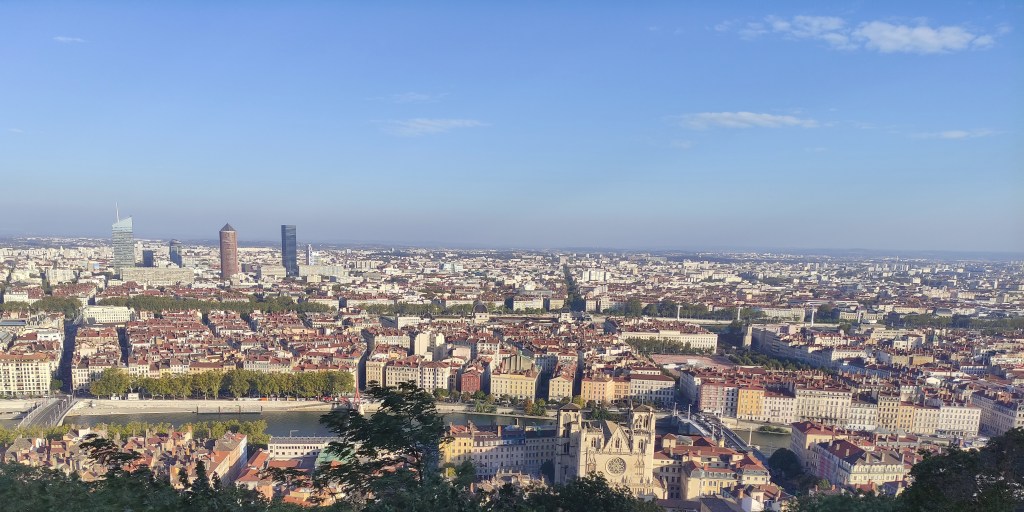
The view of the city from Fourviere is marvellous, it’s the third largest city in France and spreads out for many miles.
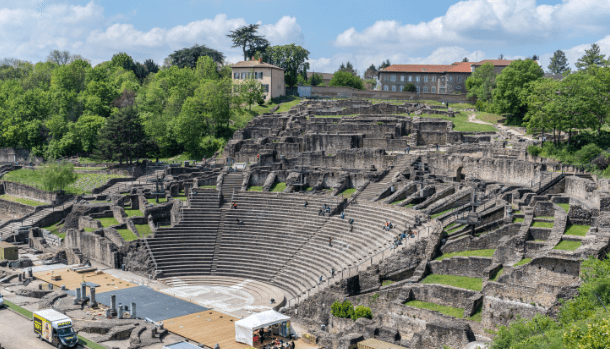
Not far from the basilica are the ruins of Roman amphitheatre. Part of the seating has been restored so it can be used as an auditorium. On the day we were there it was closed for filming, so I stole an image of the internet.
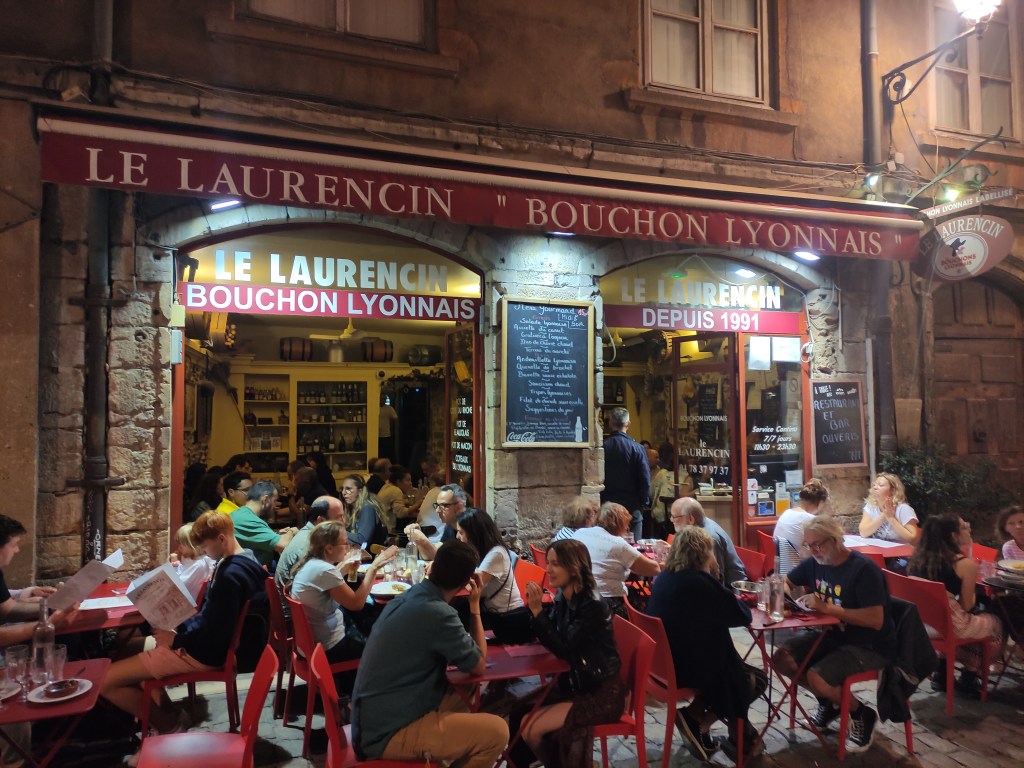
We walked down hill to the old town, which is very steep with lots of steps. Like all the old towns we have been to there were lots of restaurants, all competing for customers. Being a tight bastard someone who enjoys value for money I found a place offering 3 courses for 15.90 euros. So we sat down at Le Laurencin and had the best meal on our entire trip! I had pork terrine and salad, braised beef and daufinois potatoes followed by creme brûlée. Bloody hell it was good!
14 October 2023
It was our last day in Lyons, and I was not feeling great. My cold was starting to get the better of me. After coffee and a cake at a patisserie, I gained some energy and felt my waist expand. There are a ridiculous amount of patisseries and boulangeries in France, and it is very hard to resist them.
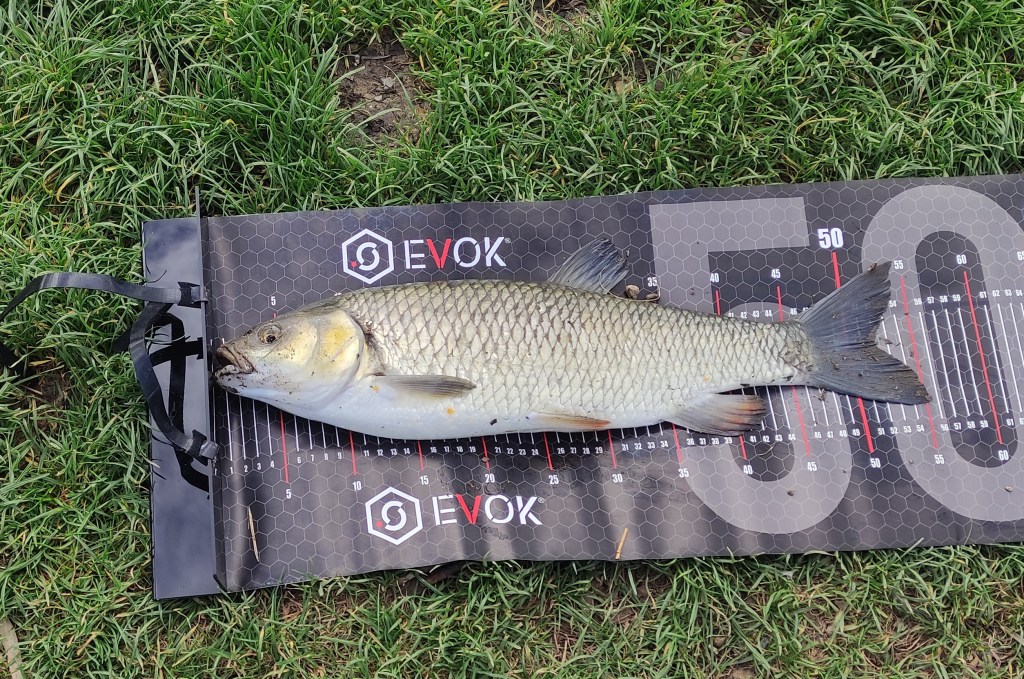
We walked to down Cours Charlemagne to the Confluence. This is where the Soane and Rhone join together. At the pointy end there was a man fishing, and he had just caught a large Chub, 55cm long. He measured it, photographed it and threw it back in the river.
The major attraction at the Confluence is the museum with the same name. It looks as if a space ship from a Ridley Scott film has landed on Lyon. Its a shame that some vandal had drawn a cock on the big Lyon sign, it spoiled it somewhat.
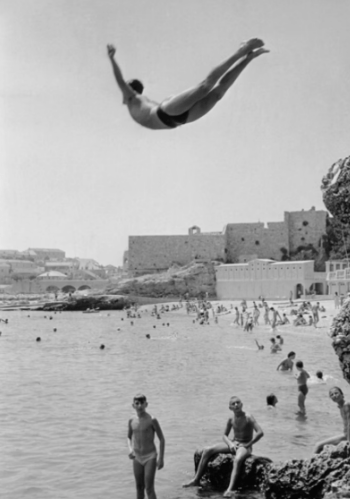
The website for the museum didn’t properly explain whet was in it, but it was actually a really good modern museum. It has themed rooms about living animals, prehistoric animals, technology and geology. The signs are in English as well as French which helped a lot. We spent a couple of hours looking around but could have spent a lot longer. There was an exhibition about a photographer called Marc Riboud who took photos in Africa and Asia in the 50’s and 60’s. this photo was taken in Dubrovnik.
Then we took the T1 tram and A metro to Place Bellecour an enormous square in the city centre. We discovered the Hotel Dieu, a huge 18th century building that used to be a hospital until 2010. It is now an Intercontinental Hotel, shops and restaurants. It is vast, the size of Les Invalides in Paris.
My cold was getting the better of me by then so we went back to the hotel for a rest. Our last evening out was at Tasty Pizza, a fast food place very close to the hotel. I’m very pleased to say it lived up to its name, but it wasn’t Claridges.
15 October 2023
Our last day of travels in Europe. We caught the 11.00 TGV to Lille, arriving at 14.30. After a quick coffee, we were soon queuing to go through Border Control and security for Eurostar. Our last 10 euros were invested in 2 small bottle of wine for the short trip to St Pancras. We got into London on time at 15.30 (London time is an hour ahead of France) and we were home about 16.45.
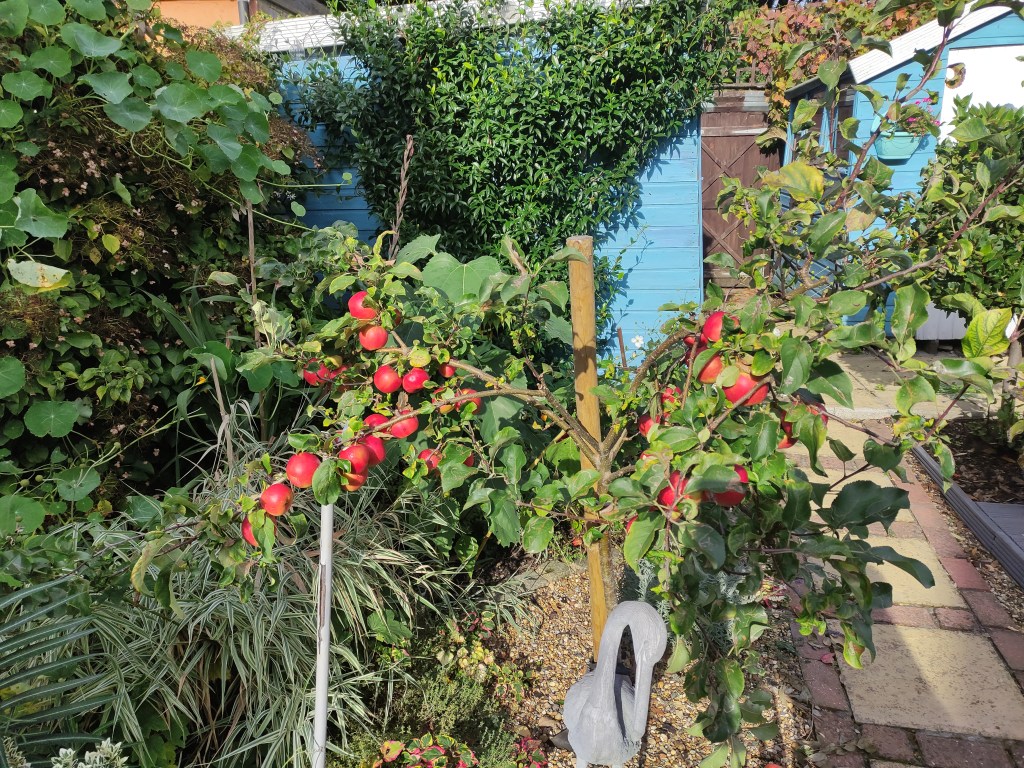
I was pleased to see that the apples in my garden had ripened nicely 🙂
The final statistics are:
5,135 KM (3,190 miles) of travel, on 50 trains to 38 places.
We spent 2 days 8 hours 8 minutes on the train over 40 days of travel
I ate 5 metres of baguettes (possibly)
Final Thoughts
Before you ask, yes I did have a good time. It only rained twice in Munich and when we changed trains at Innsbruck on the way from Salzburg to Verona.Other than that it was hot and sunny all the time!
Some of the journeys were long, 7.5 hours from Munich to Budapest though Germany, Austria, Slovakia and Hungary. But I had my phone and Kindle, som plenty to keep me occupied.
Yes I did drink alcohol every day. I was in holiday frame of mind and I know its not good for me. It would be no fun going to a beer festival in Salzburg and drinking a coke. I also ate a lot of croissants for breakfast, and every one was delicious.
How much did we spend? Well accommodation was between £50 and £100 a night, Paris was stupidly expensive, Budapest was very reasonable. Eating and drinking out is always expensive. You can get an Aperol Spritz for 6 euros in Italy, but its at least 8 in France. Food in supermarkets was generally more expensive than at home.
So we did spend a lot, but it was worth it.
Travelling by train is great, you arrive in the middle of the city, and generally don’t have to show any passports or go through security once you are in Europe.
Did we meet any interesting people? Not really, travelling as a couple we didn’t meet any other people.
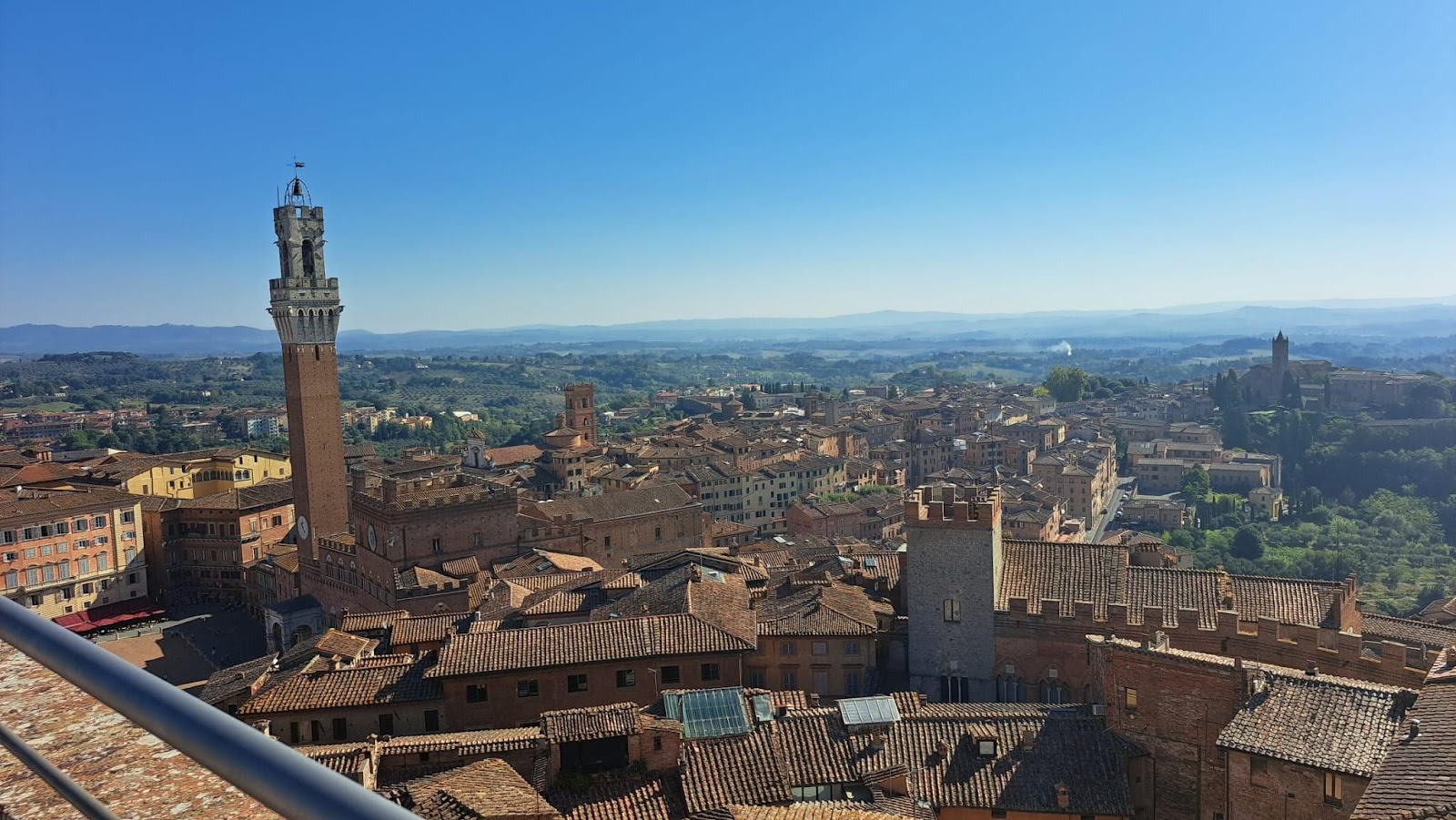
Siena was mostly built between the 11th and 14th century, then the Black Death hit in 1348 which arrested its development. It is situated on top of a hill, 320 metres above sea level in the midst of stunning Tuscan countryside. On our first full day we wandered around the narrow streets, awestruck by the beauty of the city. All of the buildings are brick or stone, and range from artisan’s apartment blocks to palazzos on piazzas and some enormous basilicas. I have seen a lot of old cities in Europe, and Siena is the most awesome I have seen so far. The centre is entirely medieval, and the it’s like walking through a film set. There are no footpaths, just roads paved with black stone, so you regularly have to pin your back to the wall as a taxi or rubbish truck comes through.
The rubbish trucks and buses are small so that they can get round the tight corners and along the narrow streets.
We bought the bumper bundle ticket for the cathedral, which would let us visit several different parts of it over 3 days.
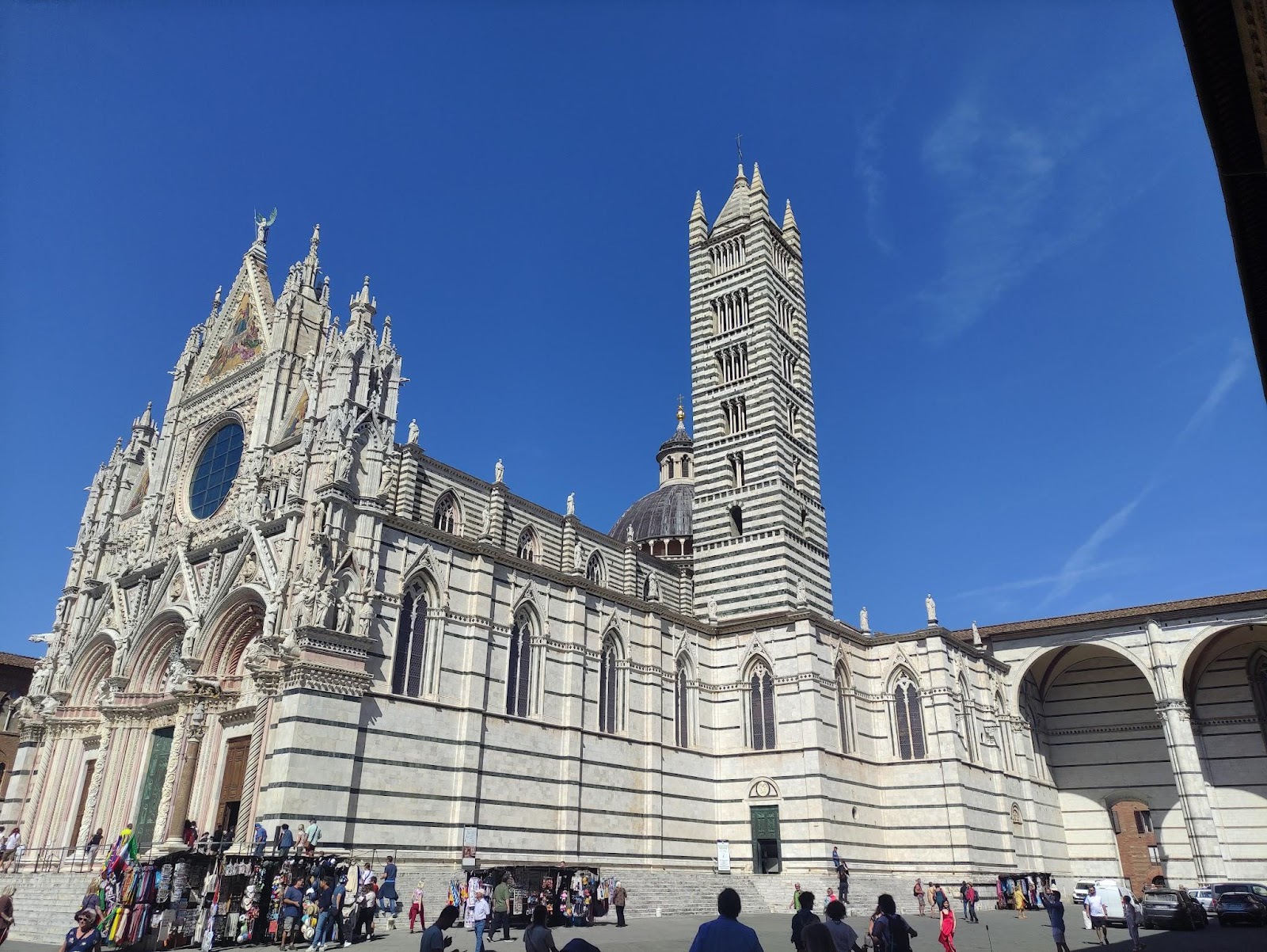
The Duomo is clad in black and white striped marble, whereas the Florence Duomo is green and white and bigger. The interior is sumptuously clad with marble, gold and rich frescoes on the walls. The floors are patterned in marble as well, I don’t know how they did that 700 years ago, they were very clever people!
After a shit-load of culture what you do? You have a drink right behind the cathedral in the sunshine.
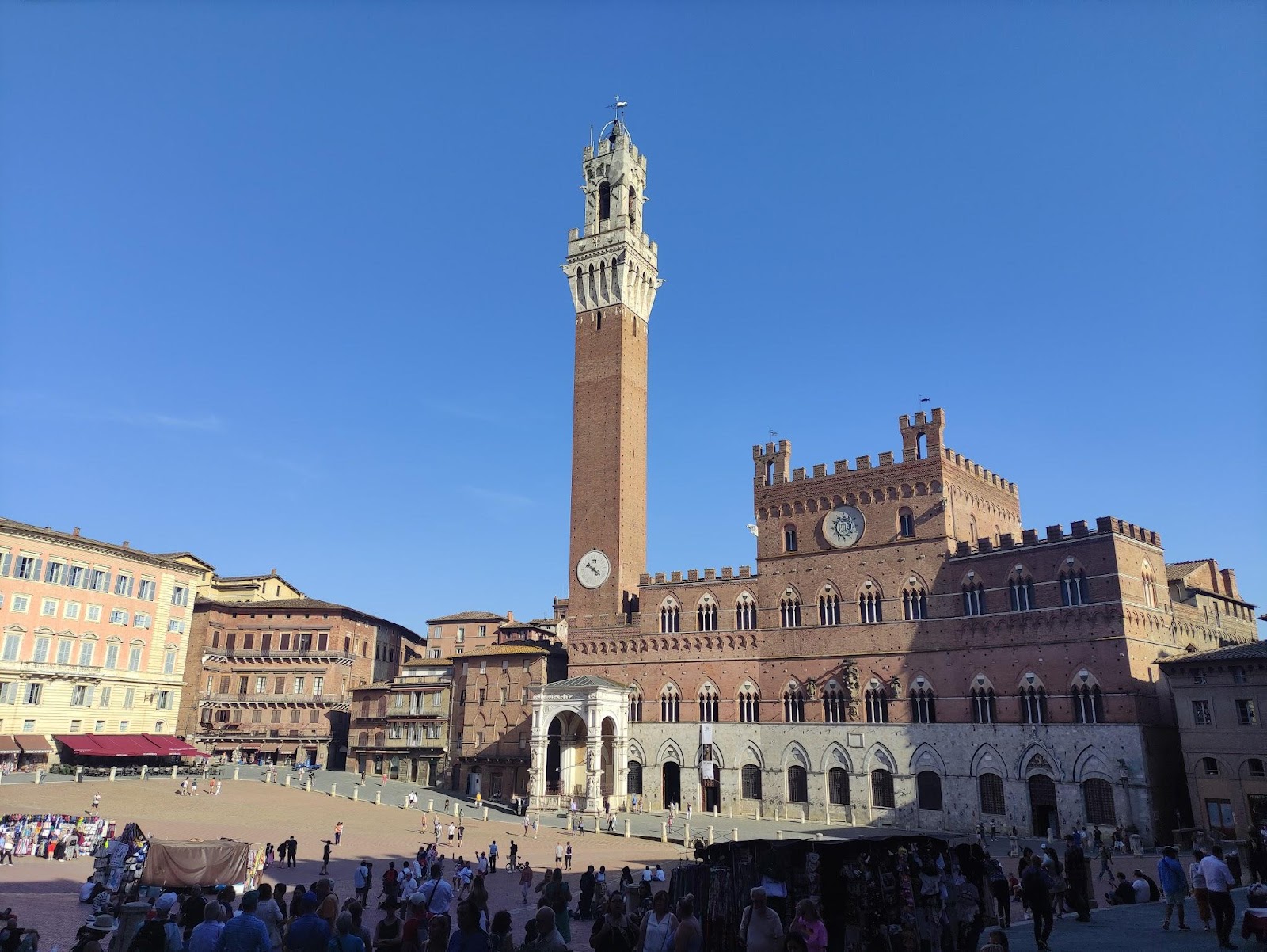
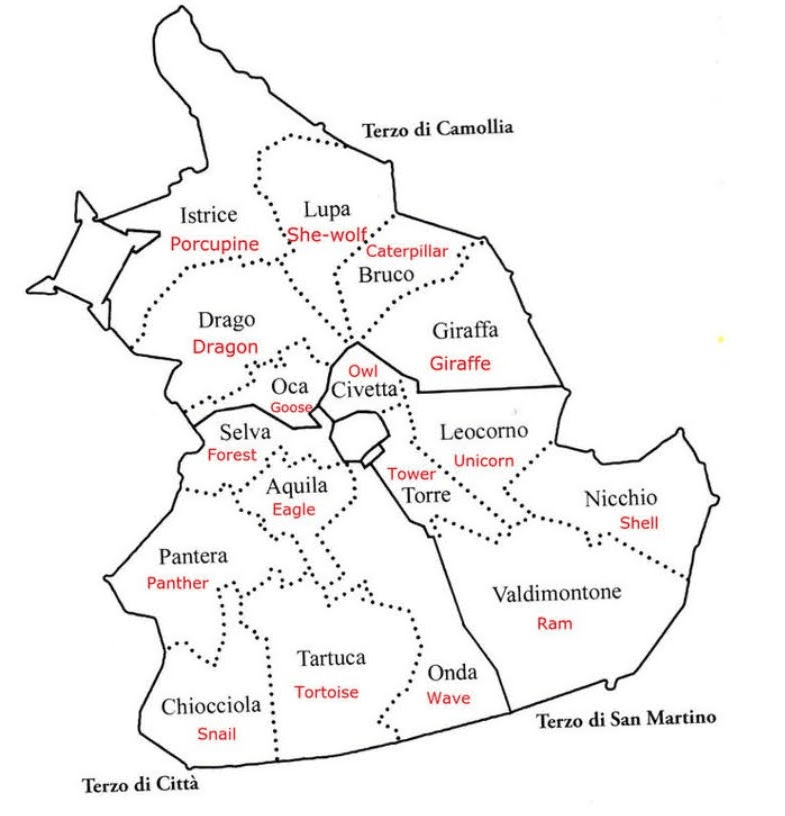
The Piazza del Campo is the central “square” in Siena, overlooked by the town hall with its great tower, the Torre del Mangia. The Campo is where the Palio horse race takes place every year on the 2nd July and 16 of August. Old Siena is divided into 17 contrada which compete for a silk flag. Out of the 17, only 10 are chosen by lottery to get a horse in the race.
The horses that the contrada get are also decided by lottery, so the competition is extremely intense. Have a look at the BBC Reel video on YouTube, it’s very exciting.
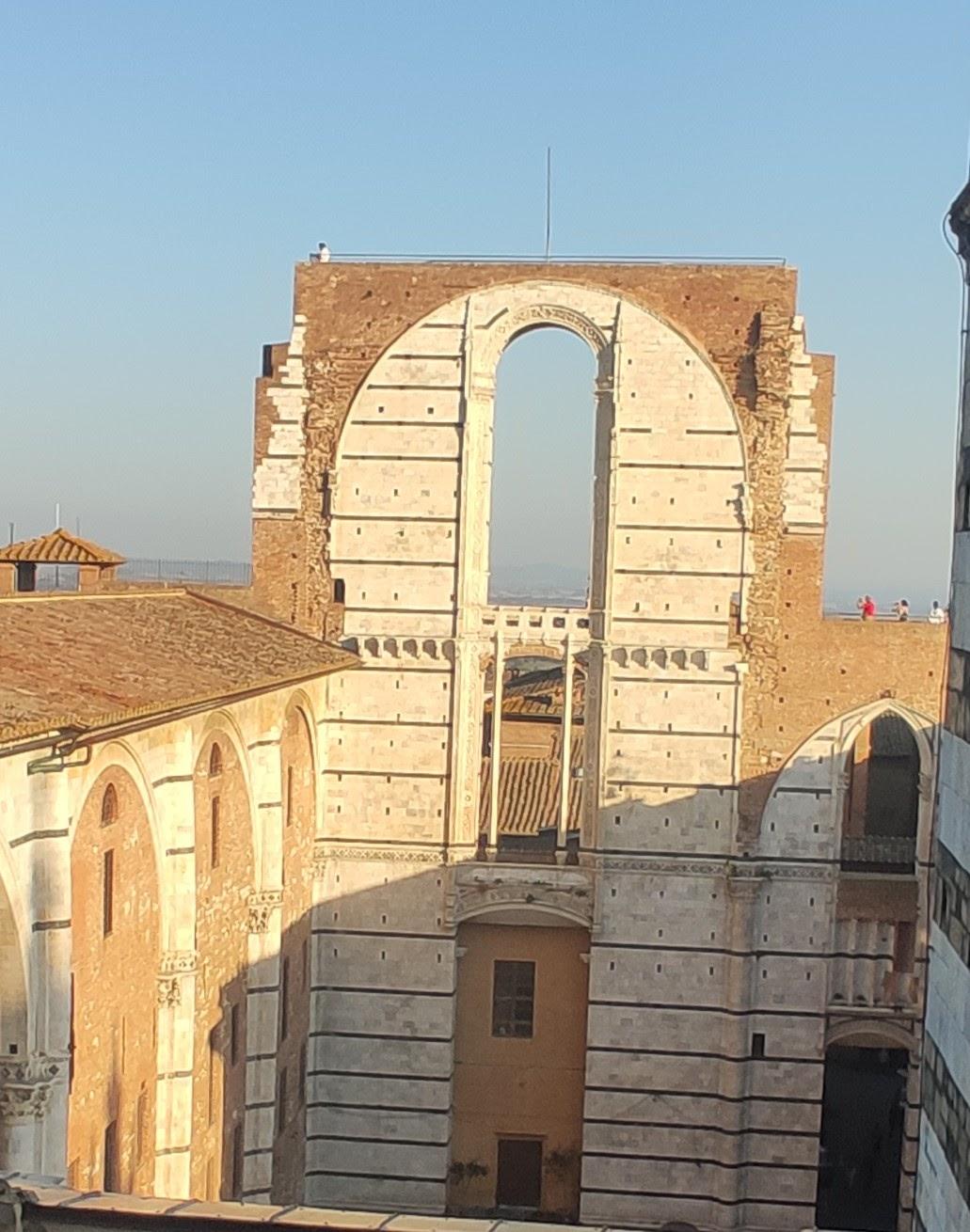
The second part of our Duomo trip was up just under the roof and below the bottom of the dome. We could see inside the cathedral, and had a splendid view of the city and the Facciatone. This was an extension to the cathedral, then the Black Death came along and the builder found a better paying job somewhere else, leaving one big wall.
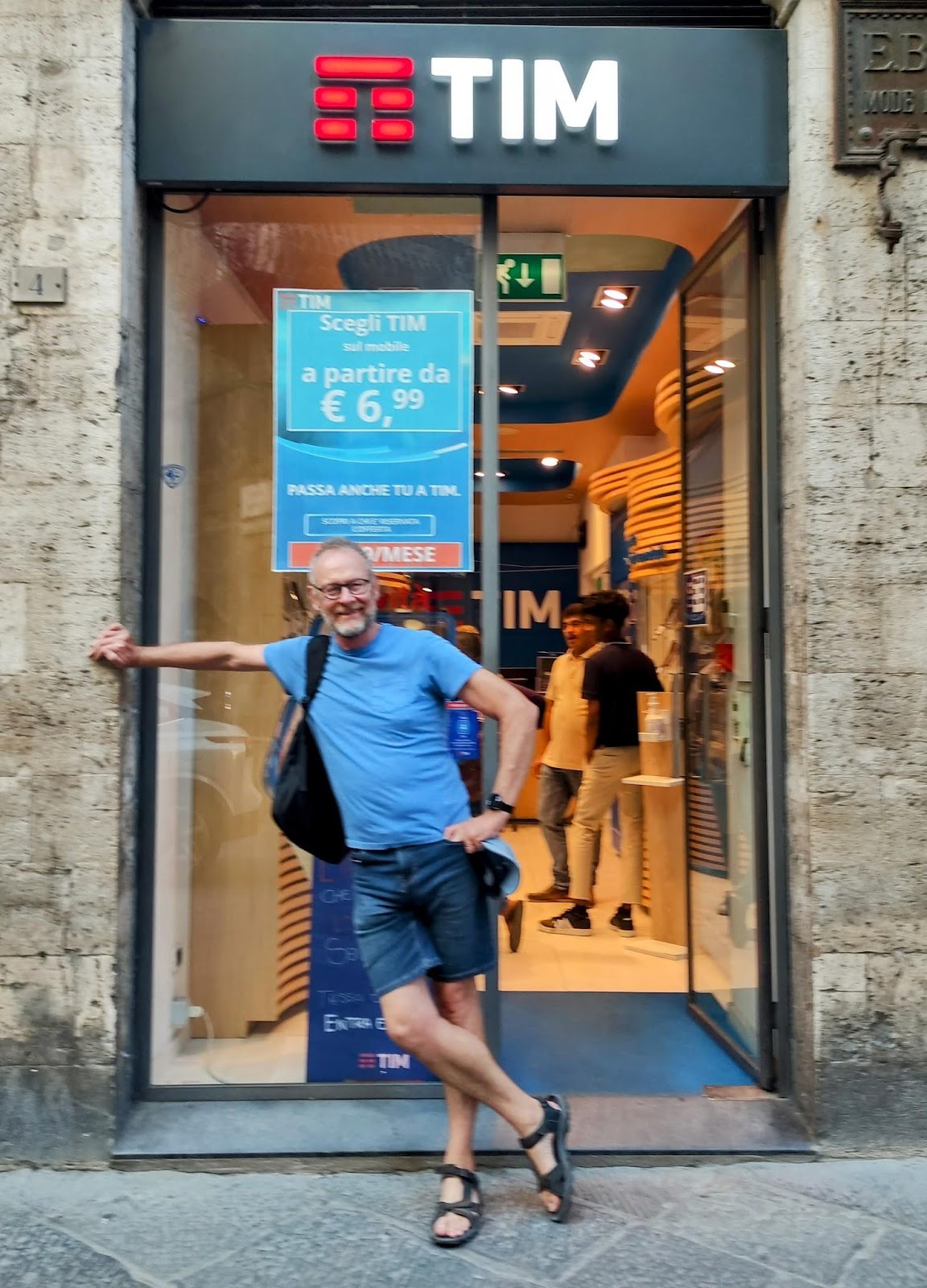
I managed to find a shop names after me. FACT I once stayed in TIM Hotel in Paris. I’m very popular.
Thursday 28 September
San Gimignano
San Gimignano came up on Google as a good place for a day trip from Siena by train, but it turned out to be simpler to go by bus.
The bus took us through some lovely Tuscan countryside to a hilltop village taken straight from a Chianti bottle label, I expected some men in tights to ride out of the gates on horseback.
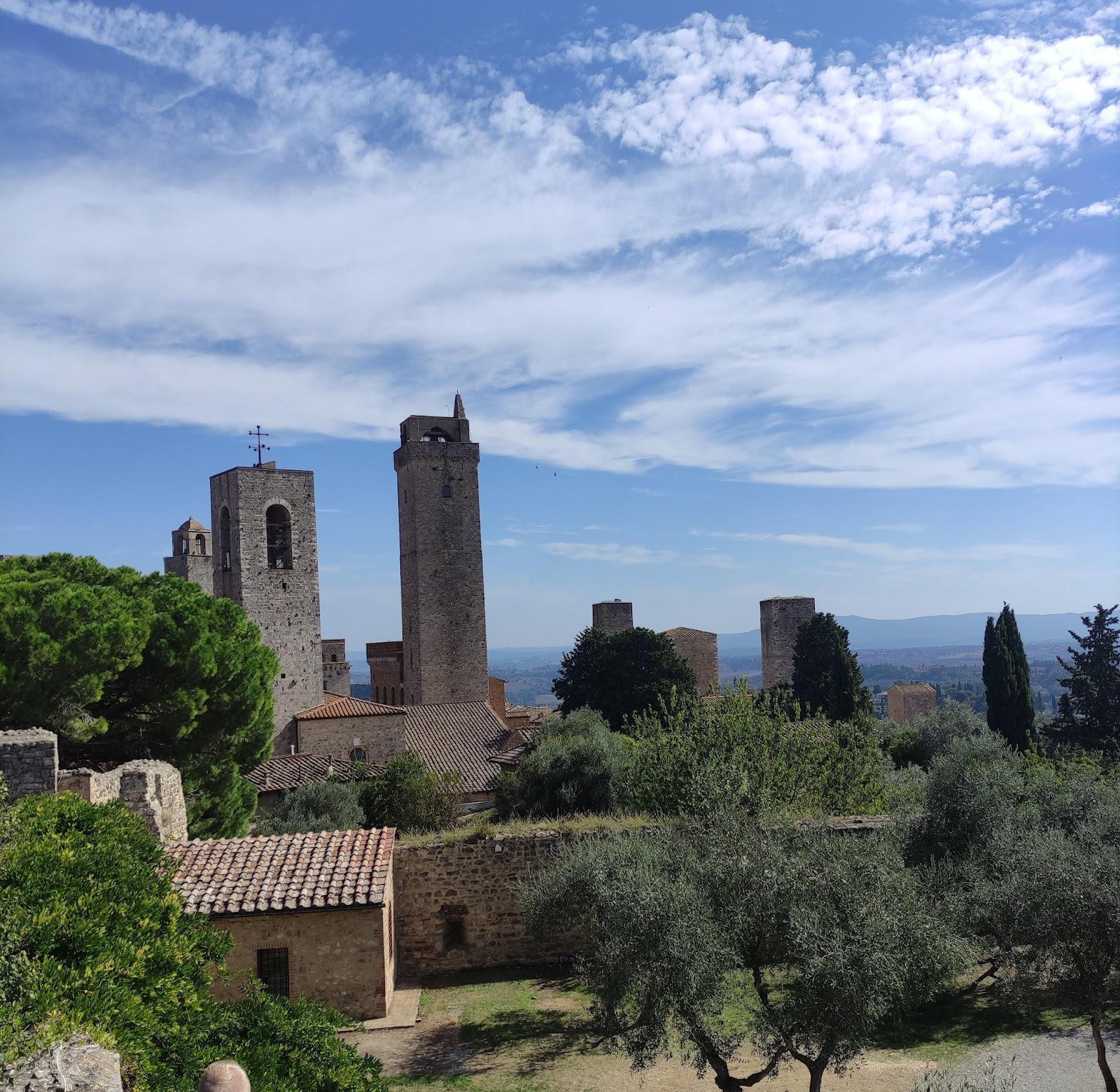
The town was doing well and thrived until the Black Death in 1348, then its development was stopped. It still has 7 great stone towers built by rival families in the town, and a good selection of Gothic churches. Because it is so remarkably pretty, it was swarming with other day trippers getting dinner party boasting points; “Have you been to San Gimignano? It’s absolutely fabulous, and the pasta with truffles is to die for’.
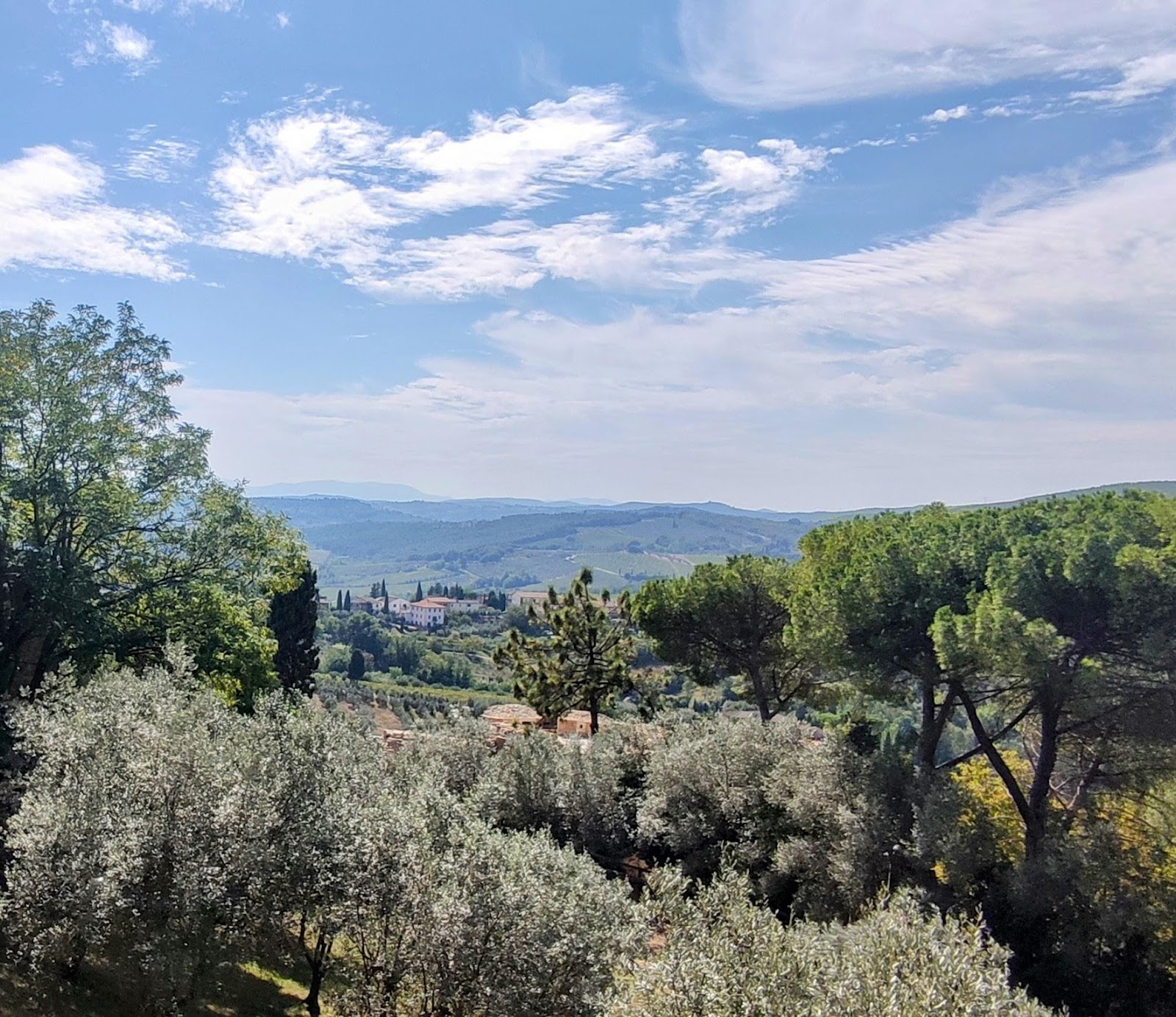
We wandered the narrow streets and admired the old houses and churches. There is a panoramic view over Tuscany which looked like the scene in Gladiator where Maximus is remembering his farm.
We watched it on Netflix the other night, it’s still a great film.
There was a market selling all the usual stuff; bags, hats, “truffle oil”, olive wood salad servers. But also a van selling pork sandwiches, which he carved from a large joint of rolled roasted pork. So we literally pigged out.
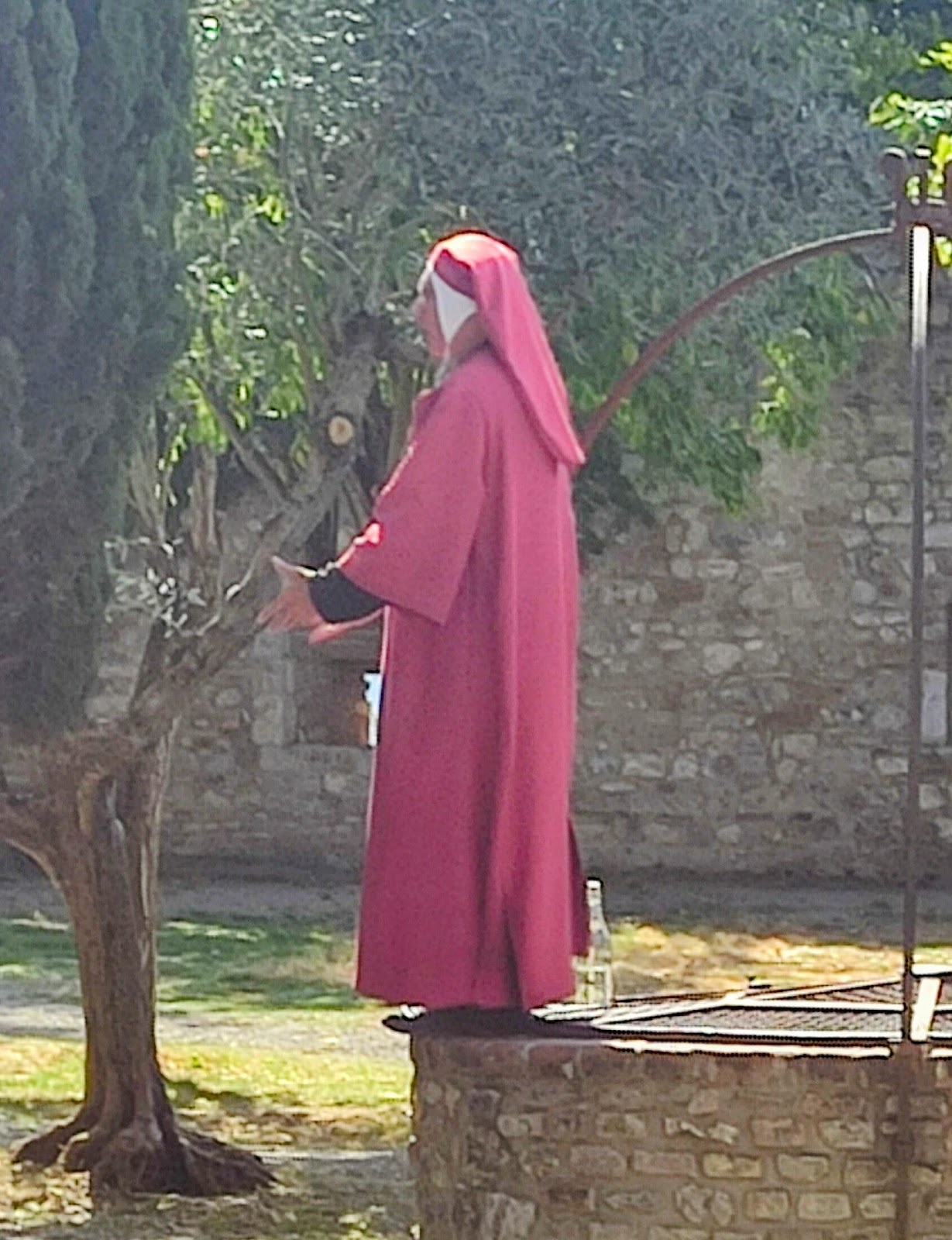
In the remains of a castle at the top of the town was a man dressed as Dante giving a speech from the Divine Comedy. He had the confident voice of a stage actor, but sadly his audience was almost non-existent.
Every other night we cooked in the flat. Often there would be a simple 2 ring electric hob, which was adequate for simple meals, usually featuring pasta and tuna. There was always wine with our meals, we are in Italy and it would be rude not to.
Friday 29 September
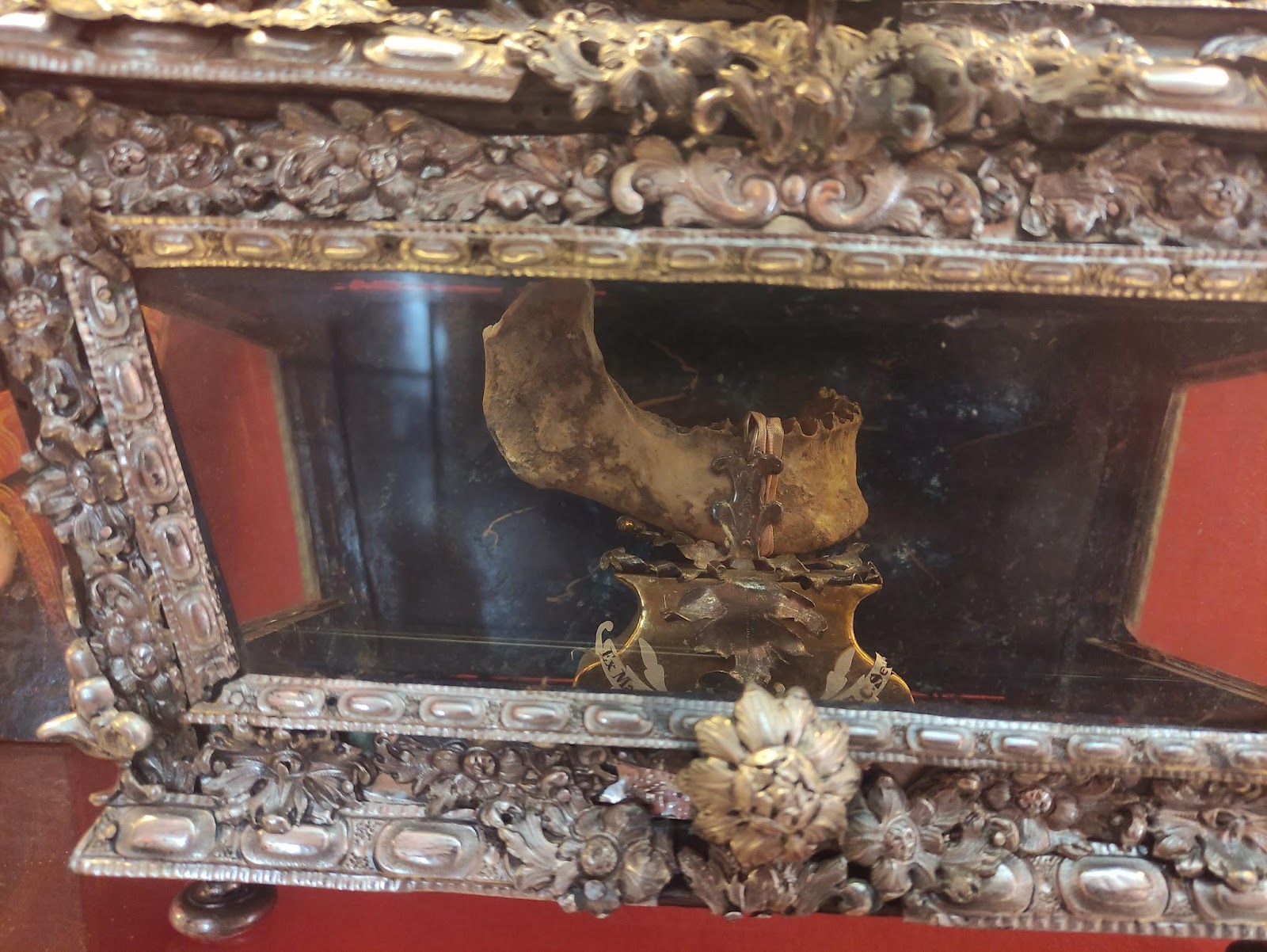
On our last day in Siena we used up the last parts of our Duomo ticket, which was valid for three days. The first part was a museum of treasures from the cathedral; paintings, sculptures, chalices and reliquaries. Reliquaries are just weird, they are fancy silver boxes that contain bits of dead saints; bones, teeth, jawbones, even complete skulls. Pilgrims would travel hundreds of miles to see a reliquary, and they made a lot of money for the churches.
This is the jawbone of a dead saint, I think it’s revolting, but I’m not a Catholic.
The treasures are very limited in scope; Jesus, Mary, saints and the occasional bishop. Some of the statues had a very peculiar posture, but they were designed to be on the top of the cathedral looking down on the pilgrims below.
The “highlight” of the tour was the climb to the top of Facciatone, the very tall wall of unfinished cathedral extension. The last climb was up a narrow spiral staircase designed for people with smaller feet than me. Then when we got to the top the view was fantastic BUT the wall only came up to my waist. I did not like that at all, my guts were churning and my balls were tingling, so I sat down and hung onto the rail. The guide could see the fear in my face and kindly told me about what was in view. Julie took these photos, I didn’t want to let go of the rail!
There are many ancient winding streets in the old town, which have hardly changed in 700 years. On many of the walls are large iron rings, which I guess are used for tethering horses. On many streets there are flags on the wall signifying the different contrada. They are a vital part of the community and organise social events all year round for their members. We were staying in Selva, and the flag has an oak tree on it.
Genoa was much more interesting than I anticipated, but it was time to head west towards France. Liguria, where Genoa is the biggest city, is squeezed between the mountains and the sea. The flat land is never more than a few miles wide, but is where the resorts of the Cinque Terre and Italian Riviera are.
The railway runs along the narrow corridor and is frequently either close to the sea or passing through a tunnel.
To get to France we had to take the train to Ventimiglia close to the border, and then change onto a French train. Just before the actual border two Border guards came down the carriage and spoke to the only black people. They asked for passports to get into France, but they didn’t have any with them, so they were told to leave the train. No white people were asked for their passports.
Once in France, the train stopped at every station, so it was very slow. We eventually arrived at Golfe Juan – Vallauris station, half way between Cannes and Antibes. After getting a bit lost (Google Maps was wrong) we found Didier, our host, outside the gates of the apartments where we were staying. The flat is tiny, but has everything we need, plus a balcony overlooking attractive gardens and a swimming pool.
There is a Super U market close by, so we stocked up and had salmon, potatoes and green beans for dinner. It made a change from Italian food and was cooked to perfection. By me.
Thursday 5 October
Another day in paradise! It’s great to sit on the balcony for coffee in the sunshine and look at palm trees. I used to do that in my garden at home, but the palm tree was growing a foot a year so I had it cut down.
I have booked 6 nights here, so we can explore all the local towns along the Cote D’Azur and enjoy some seaside time.
The marina at Golfe Juan is huge, and full of ostentatious superyachts, one of them even had a helicopter on the back of it. Just beyond the marina is Pablo Picasso beach.
The man himself was a resident from 1946 to 1951. It is a lovely sandy beach with warm(ish) water. I did my usual bob around in the sea looking for fish, of course I couldn’t see any. It was fairly quiet since it is October, well out of season, but with summer weather:freaky.
We went back to the flat for lunch of smoked salmon on blinis, rillette on baguette and salad. Then we lounged around for the afternoon at “our” pool, it doesn’t come much better than that.
In the evening we walked into town and went for dinner in a little Asian cafe. It was great to have Pad Thai with a pichet of rose wine.
Friday 6 October
Time for a bit of glamour. The bus goes right past our flats, so we caught it into Cannes, a few miles west of here. It took us to the SNCF station,and we walked through the busy town centre to the sea front. There’s a big marina at the front, but not as many superyachts as in Golfe Juan, it’s probably too expensive to moor there. Just beyond the marina is the small “old town” called Suquet, more of a village really. There is a hill with the remains of a castle and a rather plain church, but great views over the centre of Cannes.
There are a few narrow streets with some lovely pastel coloured houses and pricey restaurants. Being British, we had brought some sandwiches with us, thus saving about 50 Euros. BTW our accommodation is about 70 euros a night, so it’s worthwhile being stingy with meals.
After our picnic lunch we walked along the Croisette (the promenade) past all the private beaches where you can pay 500 euros for a bottle of champagne if you wish. Beyond those are the public beaches where I went for a swim, and Julie read a book (on her phone).
I thought Cannes was beautiful, but a bit too, yer know, posh.
So we walked back to the station and caught the 16.08 train to Juan le Pins, which took a modest 8 minutes. It is a much smaller scale resort, but still quite upmarket with lots of private beaches. The public beach was fine and I took another dip with the other paupers. Once again, Julie sat under a tree and declined to dip.
Once I had dried off in the hot sun we walked west back to Golfe Juan to our flat for a well earned beer (Heineken) salad Nicoise and Vigonier wine, all from our fridge.
It is very nice here, I can see why it attracts all the super wealthy. But you can visit on the cheap, if you pick the right place to stay and don’t eat out much.
Saturday 7 October
The great thing about the Interrail pass is that we can get on the train anytime we fancy it. Just find it on the app, flick a digital switch and the ticket is generated.
Golfe Juan (pronounced Golfa Jzooan) is on the line along the Cote d’Azur that runs through all the seaside towns, so it’s easy to get along the coast
Today we got the train to Grasse, which is in the hills north of Canne. It is the home of the French perfume industry. They started off making (honestly) scented gloves for the court of Louis XIV, and then developed the perfume side of the business big time in the 18th century.
The old town is at the top of a hill, so it’s a 15 minute walk up steps to the little Romanesque cathedral. The old town is full of narrow streets with the houses painted in yellow, pink and orange. The main shopping streets are decorated with hanging pink umbrellas. It is very pretty, and there are great views down towards the sea at Cannes.
Growing flowers for perfume used to be a huge local industry. We visited the former Fragonard factory, which is a museum now full of perfume bottles and antique distilling equipment. Of course the perfume shop is huge, but I naturally smell delightful so I don’t need any perfume.
The narrow winding streets with old doors and shutters make Grasse look like a film set. It is not a big place but great to visit for half a day.
There was a marvellous artwork on the rendered end wall of a house. A pioneering photographer called Charles Negre came from Grasse and his image has been reproduced by hitting the render with a hammer to make marks on it.
The direct train from Golfe Juan to Grasse only takes 40 minutes, so it’s an easy place to visit.
For dinner we had homemade ratatouille with a can of Super U cassoulet, which was a winning combination.
Sunday 8 October
Last night we decided to stay another 3 nights in Golfe Juan, it’s a great place and costs us only £56 a night.
Today we took the train east a few stops to Nice. It is the ”le weekend”, the weather is hot, so it was very busy. I was feeling less than my perky self and had a runny nose, so I probably got a virus from someone French, the filthy beasts.
It was very hot at the station waiting for the train, Julie retired beneath her hat.
The charm has worn off a bit since we came last year, but the sea is still very blue.
The old town is full of restaurants, and none of them are cheap! Trouble is I am cheap and don’t want to pay more for a meal than I do for my accommodation.
But the views from the top of the old fortifications down the Promenade Anglais are quite wonderful.
Monday 9 October
I was still feeling a bit yukky this morning, so we made the very easy decision to do bugger-all.
We walked to the the big Super U on the main road to Antibes, and bought more supplies. The food is noticeably more expensive than at home, one big onion costs a Euro! Bloody hell in 1974 I could go out and get pissed on Courage Best for that much (15p a pint in the Students Union).
Exhausted from carrying beer and wine back to the flat, we had to lay by the swimming pool and read . We dined royally on our balcony (renamed by me the balconioni) and rehydrated with lager.
After a little rest we walked for 5 minutes down to the little beach squeezed between the main line to Nice and the sea, it was heavenly. I made myself a backrest from a heap of sand and settled down to read The Martian again. It’s the second time I have read it, so I’m now a fully qualified astronaut, NASA I’m waiting for your call.
Monday 10 October 2023
If its Monday it must be Antibes, which is just 6 minutes away on the train. We could walk there in about an hour, but I’m feeling wishy washy again, and let the train take the strain.
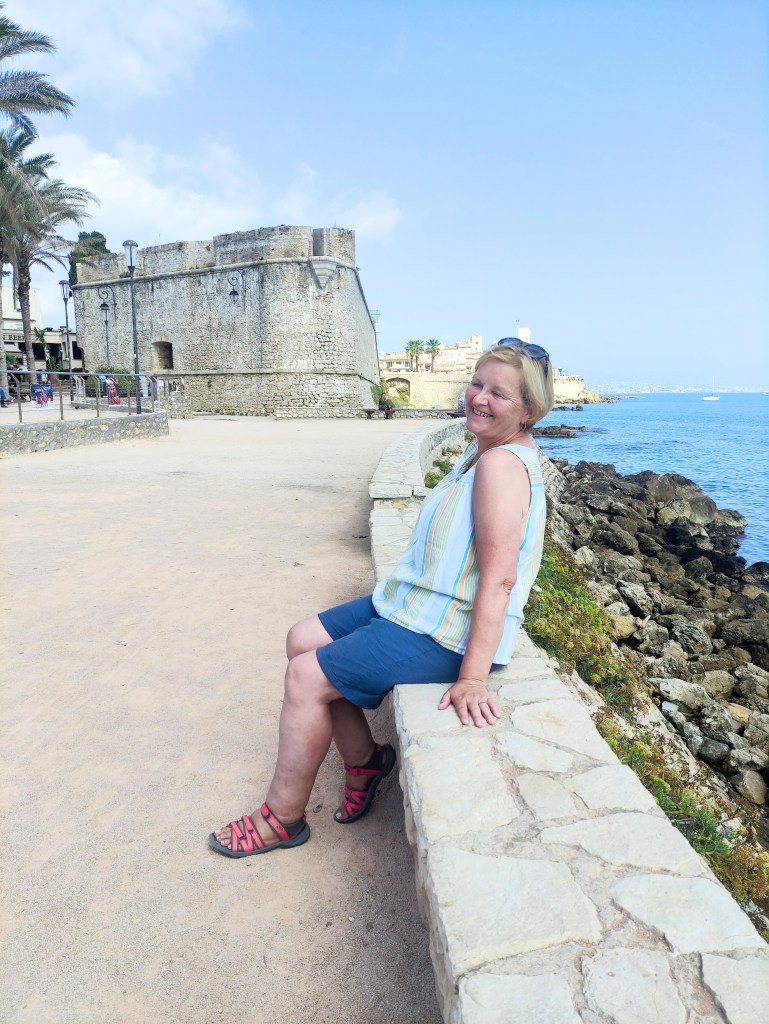
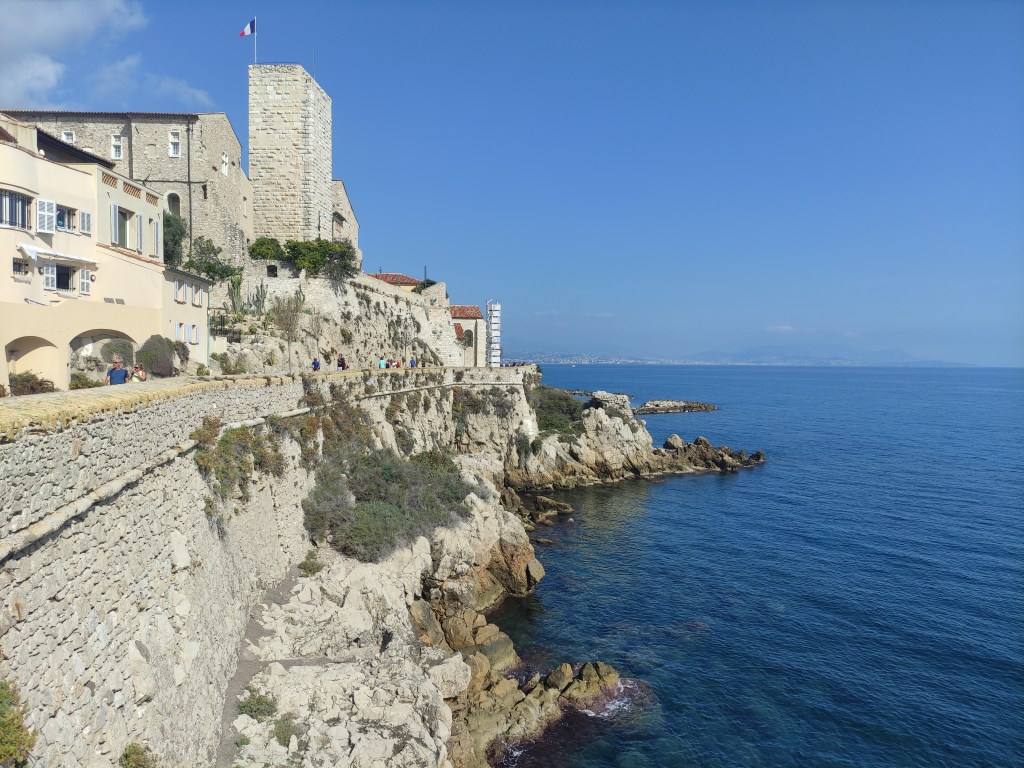
Antibes was a border town between France and Italy, when Nice belonged to the Holy Roman Empire. Its a complicated story, but Nice became French only 150 years ago. Consequently there are some big walls and a huge fortress and port built by Vauban, who you may remember built a dam in Strasburg.
The old town is very pretty with narrow streets and colourful shutters like in Nice and Cannes. I think it is a better place to visit than both of them, it’s less busy and has some lovely beaches with benches in the shade. So I could go for a swim while Julie read in the shade.
Early this morning I went to the boulangerie 10 minutes away from our flat, so we could have baguettes for our lunch while sitting outside the Picasso Museum. Needless to say he spent a lot of time in Antibes as well, probably working his way through ladies of the town.
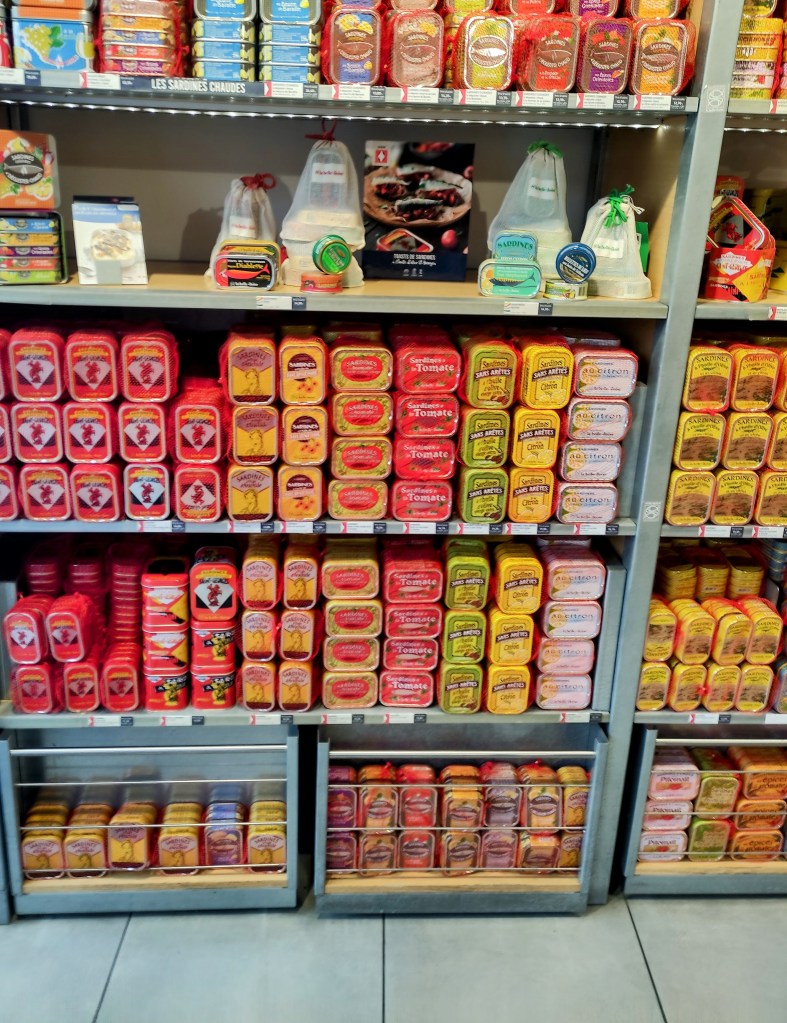
The old town had lots of arty shops selling pottery, prints, jewellery and tinned sardines. I think sardines must be in fashion, probably because of the colourful cans rather than the fish.
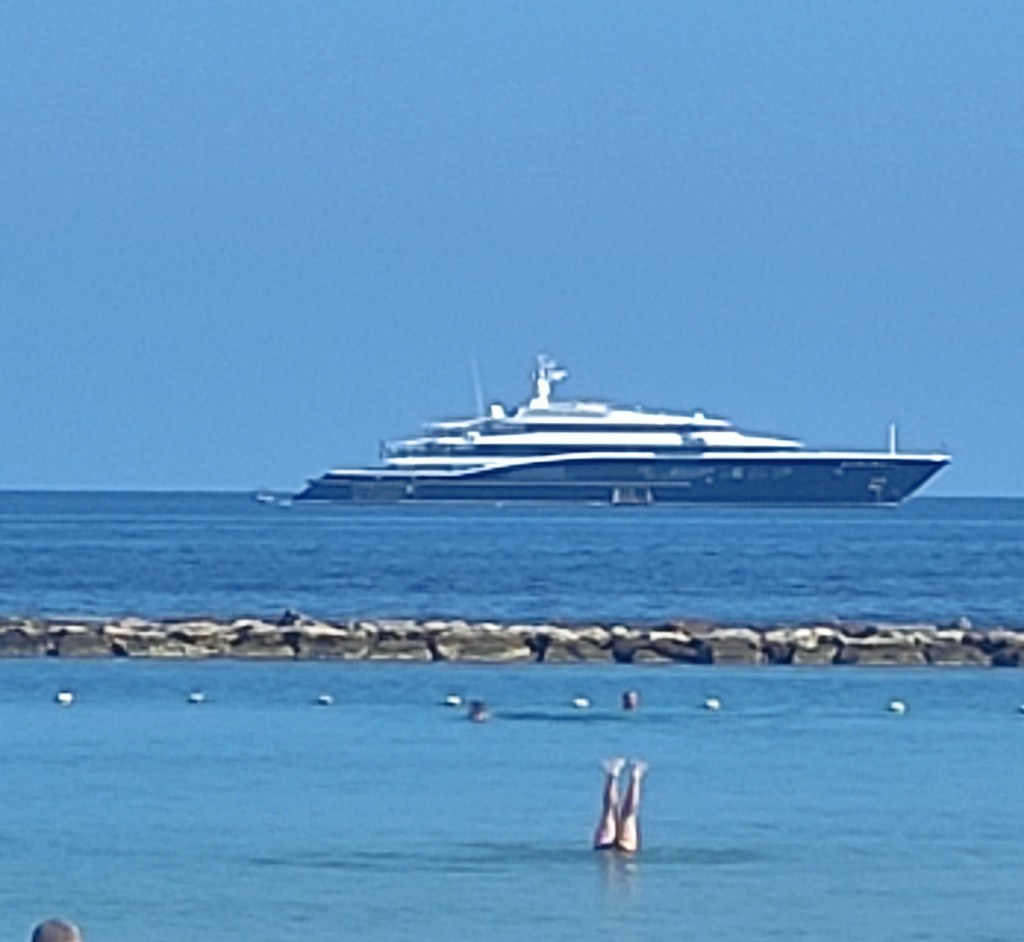
When we were sat on the beach I spotted a very big superyacht. I took a picture and used Google Lens to identify it, it was Symphony belonging to Bernard Arnault who is the wealthest man in Europe and paid for the museum we went to in Paris. Its 101.5 metres (333ft) long, and is designed to carry 20 passengers with 38 crew.
Luckliy I also got a photo of a man in flippers doing a hand stand!
October 11 2023
Go East, the great pop song the Pet Shop Boys never recorded, but the theme song for our trip today. We took the riviera train through Antibes, Nice and Monaco to Menton, very close to the Italian border.
Our destination was a botanic garden called Val Rahmeh which was founded by and Englishman called Lord Percy Radcliffe in 1905. It is small but stunning, with many species of tropical plants from all over the world growing outside. It is supremely relaxing and peaceful, all it needs is a National Trust tea shop with a good selection of hot beverages and baked goods.
After eating our packed lunch (saving money to buy a Spritz later) we walked down to the beach. As per usual, Julie listened to her audio book and I went for a dip in the briny and then stared out to sea.
The old town of Menton is on a hill overlooking the beach. Once again (like the other old towns) it had narrow steep streets and ochre coloured 5 and 6 story houses. IThey must have planning regulations which tell them to use only yellow, pink and orange muted colours. It is also very well maintained, a definite feeling of civic pride that I haven’t seen as much in other towns. There’s a lovely baroque basilica which is newly painted on the outside with Farrow and Ball colours.
At the top of the town is the old cemetery where William Webb Ellis is buried, and a statue to commemorate him. He has the ultimate accolade in Twickenham, a ‘Spoons named after him.
After enjoying the dead centre of Menton (geddit?) We walked towards the station. But a reasonably priced Aperol Spritz caught our eyes, so we stopped for a swifty.
The town centre is very pretty, with some colourful “Belle Epoque” grand hotels, and the only town hall I have seen with banana trees outside.
Menton is delightful, definitely a more classy resort than any of the others we have visited.
On the train back to Golfe Juan our tickets were checked twice by inspectores who had their own guards. There were also lots of beefy cops on the train, I suppose they are after illegal immigrants.
October 12
Our last full day on the Cote D’Azur, and we took another short train ride to Cagne Sur Mer. The original town is on top of a hill with the Chateau Grimaldi at the top. The Grimaldi family still rule Monaco, which is only about 10 miles east along the coast.
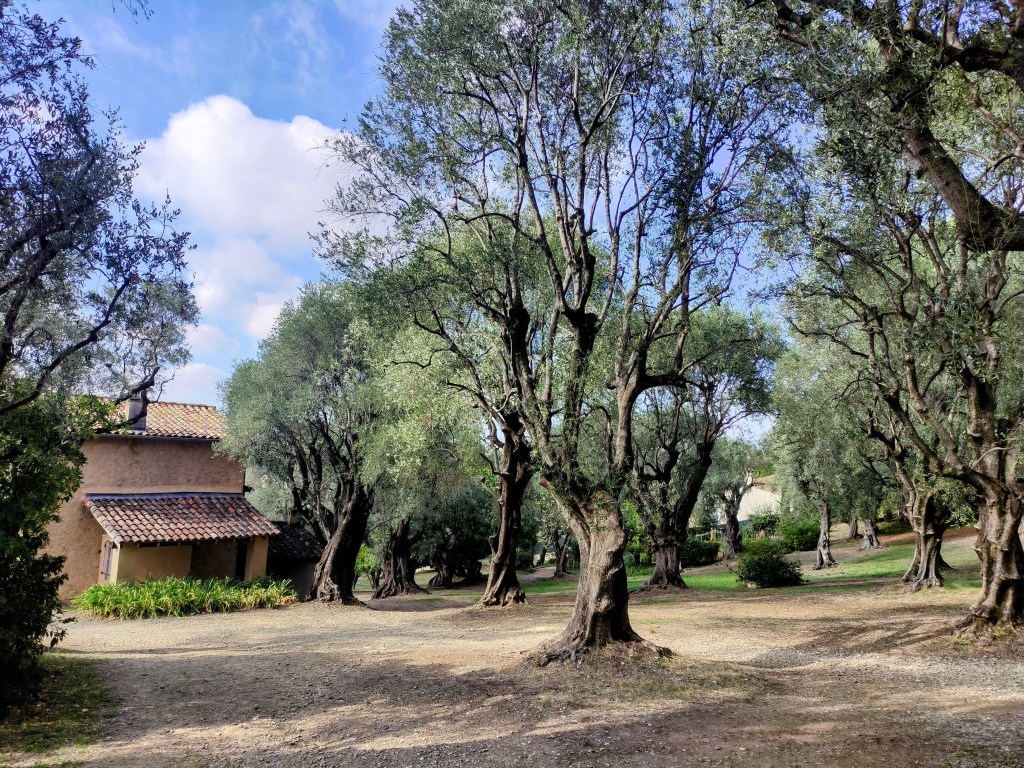
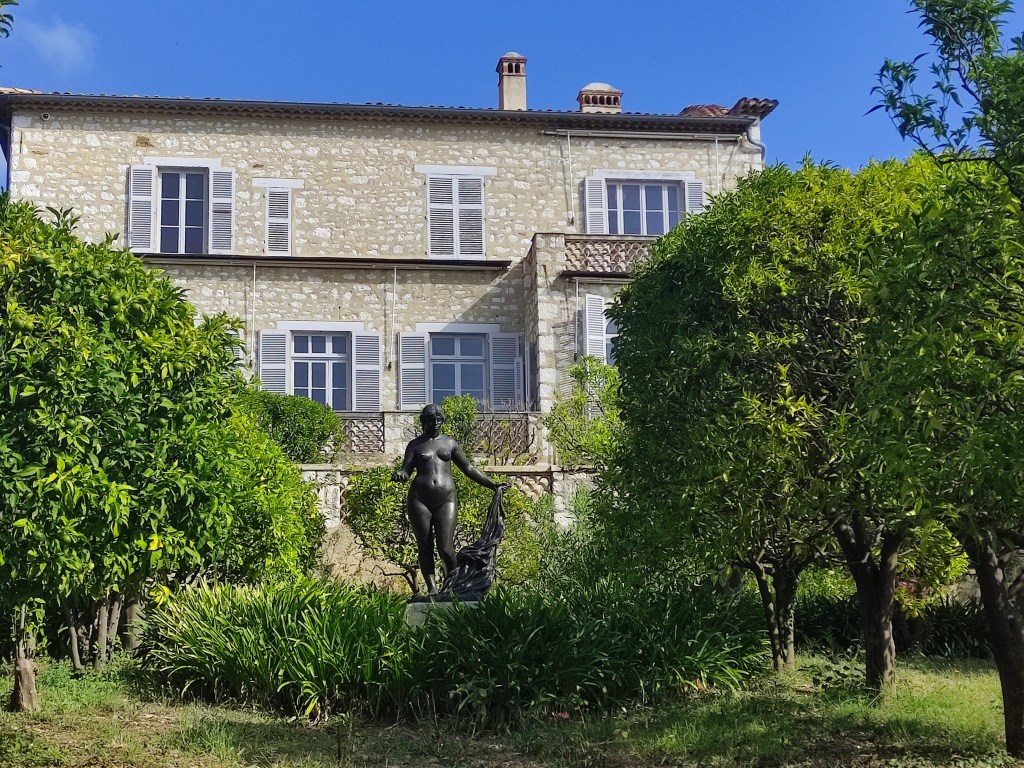
Our destination was the Renoir Museum, the home of Renoir in his later years. It is a former farm called Les Collettes, set amongst ancient olive trees, overlooking the sea and the old town. The setting is stunning, but the museum itself is a bit… sparse.
There are a few lovely paintings by Pierre-August Renoir, but more by artists of the same school and his assistants. He was able to take up sculpture with the assistance of a young artist called Richard Guino, who slapped around the clay under Renoir’s direction. There are some lovely paintings and some furniture, but you can see it all in about 45 minutes.
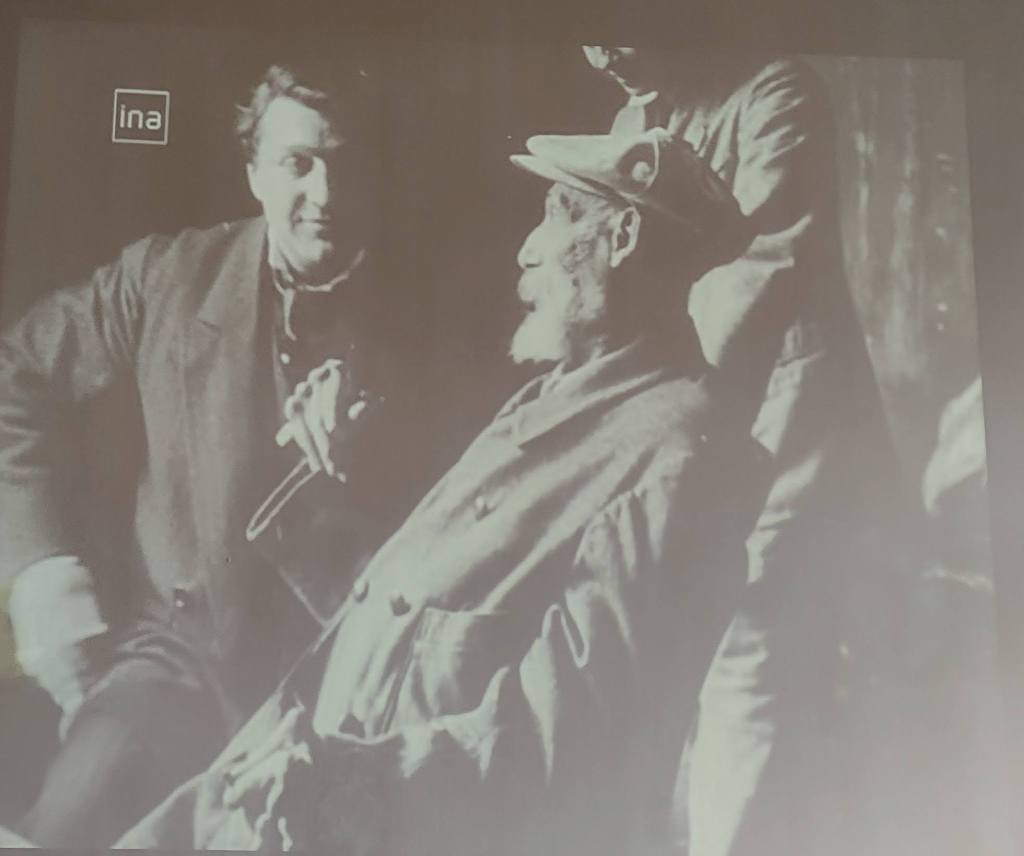
In one of the farm buildings there was a silent film running of Renoir and an assistant (his son possibly) sitting in his wheelchair painting. His assistant charges his brush, and he paints a canvas, while smoking like a chimney.
In the afternoon we returned to Golfe Juan and lazed on the beach for a few hours. The beach is sandy, the sea is warm (warm for me, icy to Julie) and there are lots of yachts to watch. The beach is populated mostly by retired people who are filly equiped with loungers, cool boxes and umbrellas that they trundle down to the beach on trolleys
I listened to my favourite podcast “the Rest is History” with Dominic Sandbrook and Tom Holland. They are a first class double act who are entertaining as well as knowledgeable. It was about the Ummyad and Abbasid dynasties that ruled the Islamic Caliphate in the 7th and 8th centuries.
I’ve lost you now haven’t I? All the brain space that most people devote to sport, I devote to science and history. That’s why I’m so fascinating 😉
So farewell Salzburg, home of the Von Trapps and Mozart. The Von Trapps were a real family choir, but there story was embroidered considerably. But I did find a lonely goat turd high on a hill.
I’m now on the train between Innsbruck and Brenner. It’s cool and rainy with very low cloud, which justifies us skipping Innsbruck and going straight to Verona.
The first leg of the journey was east to Innsbruck, then we changed trains and headed towards Verona through the Brenner Pass. This is a combination of river valleys and long tunnels through the Tyrol Alps, lands which are the border between the German and Italian speaking world and have been fought over for thousands of years. We were well into what is now Italy before the houses lost their alpine appearance, and cypress trees and vineyards appeared that gave the land an Italian look.
At Porto Nuovo station in Verona, Julie found our new accommodation on Google Maps, and we dragged our trolley bags through the city centre. Verona has existed for well over 2,000 years, and has buildings from every era. It was a 40 minute walk through the old city centre past the Roman arena.
Our accomodation was on the other side of the Adige river, which is the same raging torrent that goes through the Brenner pass.
After settling into our apartment on the second floor on a 16th century house, we walked back across Ponte Nuovo to find somewhere to eat at the nearest supermarket. Rounding a corner I heard someone shout
“Tim!”
It was my mate Steve Lenczner from Fulham. I knew he was going to be in Verona, and it was pure chance that he was standing on his balcony as we walked past.
So we all went to Piazza del Erbe around the corner from Steve’s flat and had Aperol Spritz, risotto and a little too much wine. A fantastic evening in a stunning location on a warm evening in Verona.
Saturday 23 September
Bloody hell I felt a bit rough in the morning, I think I have an overdose of fun (or red wine). Verona is all I had hoped it would be, a city that was one of the richest in Europe in the middle ages, that has mostly preserved its medieval city centre. The centre is made up of red brick palazzos and piazzas, and of course swarms of tourists. I wore shorts and a teeshirt and wore a cap to cover up my tender bonce, my appearance cried out TOURIST. I couldn’t compete with the local men in skinny legged suits, crisp white shirts and black ties. Even the coppers looked cool.
The Castellvecchio is a castle built by Cangrande della Scalla, the local warlord, in the 13th century. It was built next to the Adige river, and the bridge was also fortified to give him an escape route if the ungrateful locals rose up against him. The bridge stood for 600 years until retreating Nazis blew it up in 1945. A local architect Libero Cecchini masterminded the reconstruction which was completed in 1951, and it looks perfectly like the original.
I was fascinated (to a nerdy extent) by the construction of the walls of buildings, which were made of brick, old stone, rubble and river stones. But clearly they last longer than most modern buildings.
Crossing over the San Pietro bridge we could see that the Adige was in full turbulent flow beneath the bridge, no wonder there were no boats at all on the river.
Sunday 24 September
Close to where we were staying was a viewing sport called Castel San Pietro. The castel was an Austrian barracks from the first half of the 19th century when Austria ruled most of northern Italy. We walked up the steps rather than ride the funicular up the hill. I am a skiffer, not a softie! There was a fantastic view over old Verona, a vista of red brick, tiled roofs and bell towers. The Austrians chose a good spot to house their soldiers.
On almost every corner there is a lovely palazzo or basilica to look at. There are many churches that you can walk in to enjoy the Renaissance art that covers the walls, and of course, the cool shade and peace.
In the afternoon we visited the Giardino Giusti, a 16th century palazzo and its gardens. It is still owned by the Giusti family, but its open to the public. It had 7 or 8 rooms full of old furniture and paintings, some going back to when it was built in the 16th century when the Scaglia and Hapsburgs dripped by to visit. One of the pictures on the wall was an old print of a 19th century regatta in France. I was amazed to see that it had skiffers on it wearing hooped shirts, like the ones we wear today at the Skiff Club
It has its original gardens, which are quite rare in fortified cities, no doubt it was a lovely place for passing aristos to enjoy a spritz on a hot afternoon. The gardens rise above the house, a great spot for a selfie with the palazzo behind us.
I wanted to see the city walls, and Julie didn’t. So I hiked up behind Giardino to the massive Austrian fortifications that surround the city. Only when I got there I found there are two walls, and I was walking between them, so for most of my walk I just saw walls. Not so interesting, but a good walk.
In the evening we went to the Tosca Bistrot and I chose Pastisado de Caval, horse stew. Well you don’t see it in London do you? It was just like beef stew, on a slab of polenta, tasty but unremarkable. Luckily it didn’t give me the trots..
Monday 25th September
Verona is very close to Lake Garda, which has got to be one of the most beautiful lakes in the the world! We got the train to Peschiera del Garda, a former fortress town at the bottom of the lake with huge walls. Those Austrians loved a big wall.
The town itself was very busy, so we walked up the shore to find a shady bench and just chill and enjoy the views to the mountains and towns on the opposite shore. I was a bit tempted to have a swim, but the water was a bit murky, and the beach was stoney and hard to walk on.
The place was so exceptional, watching the lake was enough for most of the day. We did have a trip to Lidl to get lunch, boy do I love a good Lidl. Later on in the day we had a drink in a cafe and did more serious gazing over the lake.
In the evening we ate dinner in the flat, tuna salads feature regularly in our diet, followed by fruit and yoghurt and a bit of chocolate.
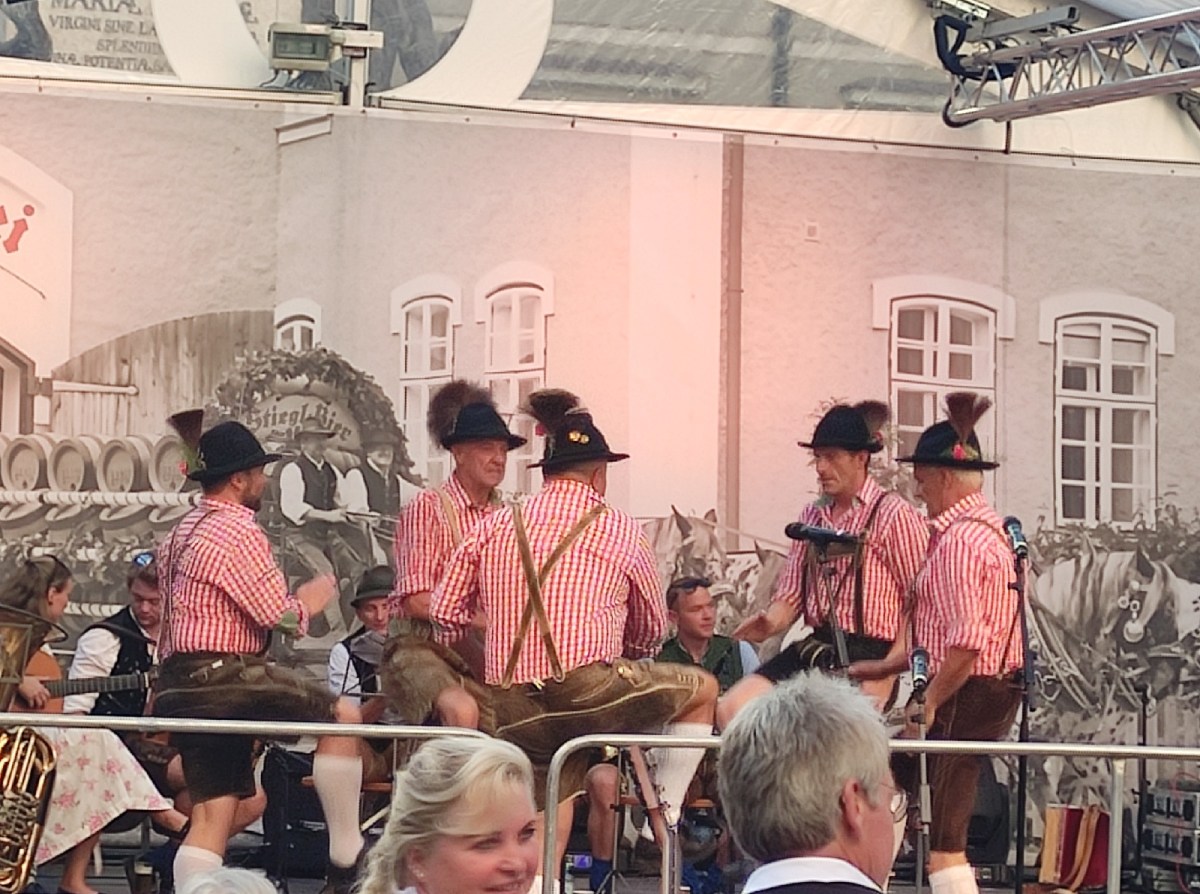
I’m on the train to Salzburg whizzing through Austria. This train goes to Munich so there were a couple dressed in Bavarian outfits selling beer. Yes bloody please!
A bit out of focus, I was excited
We got to Salzburg at 3 ish and put our bags in a locker and sent to explore. It is a very neat, tidy and attractive city, as befits the home of Mozart and the Sound of Music. We passed a trio of nuns (honestly) and I wanted to ask “how do you solve a problem like Maria?” but Julie wouldn’t let me.
There’s a festival on at the moment called Rupertikirtag in honour of St Rupert. It’s like a mini Octoberfest with food and beer stalls and a funfair. Lots of people were dressed in lederhosen and dirndls, even the kids! It was very colourful and fun.
Horny men in leather shorts – normal for Austria
There was even a group of men doing the knee slapping dance I have only seen in The Two Ronnie’s
Our accommodation is in Hallein, a few stops down the line, Salzburg is too expensive. The Sommeraur Pensione cost us as much for 2 nights as we paid for 4 nights in Budapest. But the breakfast was enormous and the coffee excellent.
Thursday 21 September
This morning we got the 9.16 train from Hallein into Salzburg. Hallein had salt mines, which were the basis of Salzburg’s (salt town) great prosperity. The salt was shipped down the river into Italy and wine came back, a very good deal.
We walked up to the Hohensalzburg, the huge castle above the town on a crag. We could have taken the funicular, but I’m a Skiffer not a softie! Neither is Julie. The castle is honestly one of the best I have ever visited. It was founded in 1180, and improved all the way up to 1803 when Napoleon marched in.
The massive castle has amazing views over the city and nearby Alps. The weather was hot and sunny, so it was perfect. There are several museums inside about the castle and military history which are very modern and well laid out.
The funicular is free to go down and takes about a minute. Skiffers also enjoy a bargain.
In the square at the bottom Rupertikirtag is in full swing, with many stalls selling pretzels of various types, cream cakes and sweets. We went into a marquee with an oompah band and I had a beer, 6.2 Euro for half a litre. Expensive, but not outrageous.
🎶 I like lager und bratwurst und cabbage
The city centre is fairly small, but is all beautiful 17th and 18th century Baroque buildings, including several where Mozart lived. Mozart was the Harty Styles of his day, but wrote his own tunes.
The huge ancient abbey of St Peter was very impressive, with a highly decorated church and a restaurant that claims it was founded in 803. That’s 1220 years ago, before King Alfred beat the Vikings (for you history nerds out there).
Austrian cuisine is …limited in scope, but we thought we should try it. The Zipfer Bierhaus is a traditional pub on one of the central squares. I had sausage, potatoes and sauerkraut, Julie had schnitzel and potatoes. It was fine.
The Octoberbrau I had was really delicious, so I was a happy boy.
Saurkraut is ok, but baked beans is much better with sausages.
We didn’t decide to visit Budapest until last week, when we were in Strasbourg. It was on our itinerary back in August, then we took it off again. Our reluctance is due to it being 6.5 hours from Munich on the train. Then I started reading The Places In Between, which is about Rory Stewart’s walk across Afghanistan during the winter. That made me feel like a big softy, and a long journey on a comfy train isn’t too much of a hardship. I’m a big fan of Rory Stewart, an incredibly tough polymath and the only Tory politician I respect.
As I write I’m in a reserved seat on a packed train on our way through Hungary near Mosonmagyrovar on the Pannonian basin. It’s flat all the way to the Carpathian mountains, and is studded with windmills.
Well we are here now, in a small but perfectly formed studio flat in Pest, which is on the eastern bank of the Danube which is (so Google tells us) the cooler part of town.
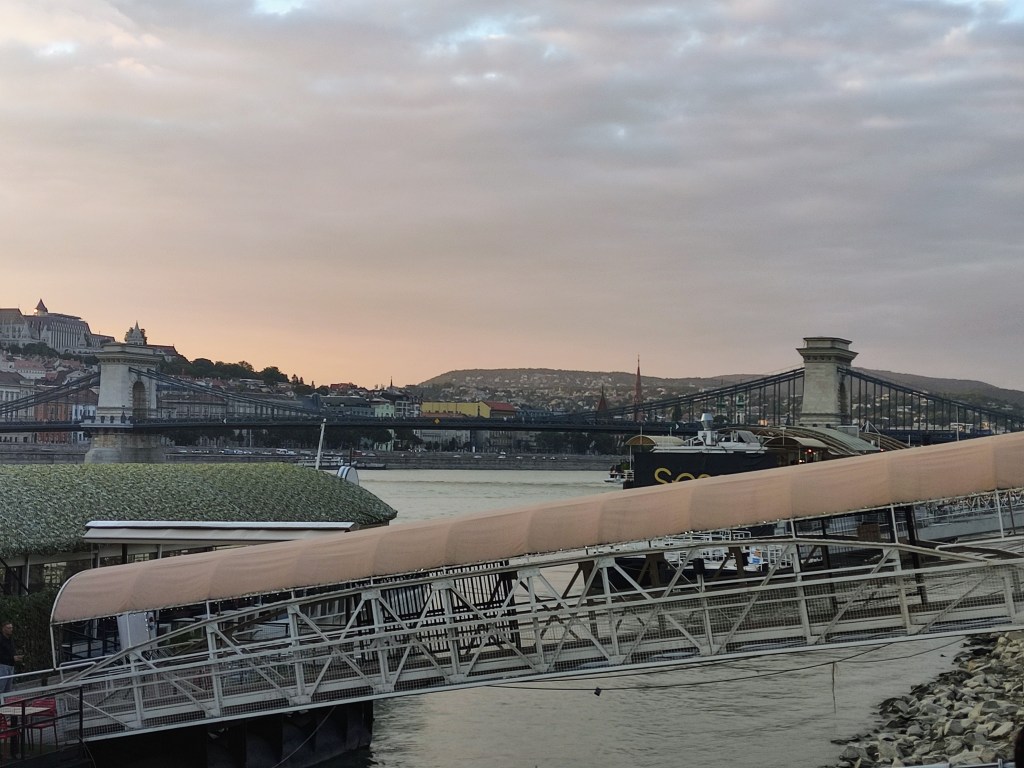
Having spent 9 hours travelling from our flat in Munich, we were feeling a bit err… shit… when we arrived. so after struggling with 2 digital keypads to get in, we soon went out to the Danube river bank a few hundred metres away for a drink at sunset. The Viaduckt bar is a bar under the viaduct for the tram running down the river bank. We had great views of Buda and the Chain Bridge and chilled there for a bit with a beer.
Julie found the Parisi6 restaurant close by, which was fantastic, I had a slow cooked pork steak and Julie had beef neck, those animals did not die in vain. The waiter liked what we said about his food and gave us a free shot, Which was nice.
On the way home we found a Lidl to get emergancy rations of red wine and chocolate. Well it’s just common sense.
Sunday 17 September
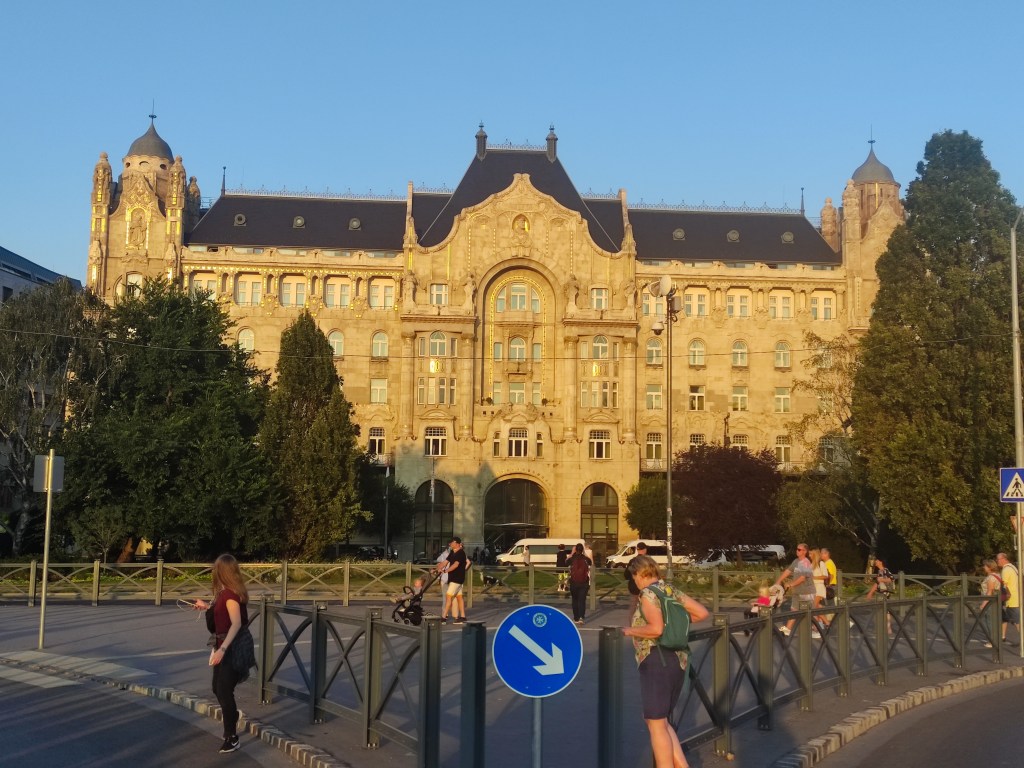
I had very few preconceptions about Budapest before I arrived. I knew that it had Buda and Pest with the Danube in between, and a collection of castles and museums, the usual kind of European capital stuff. But I have been blown away by how beautiful it is. Some of it looks like Paris, some of it like Vienna and there are even parts that look like Disneyland! The architecture is amazing, there are some gorgeous late 19th century art deco buildings and Victorian neo-gothic with a touch of Ottoman thrown in.
The first 3 hours of the day were Interrail Admin (boring but vital) so it was past 11 before we got out of the flat in Pest. Beautiful sunshine after mixed weather in Munich.
We found the Tourist Info to get some paper maps and general orientation, then walked down to the Danube. There was a lovely Victorian building that looked like something cultural, so we went in. It was called Vigado, a concert hall and exhibition centre that is stunningly beautiful. Its interior is quite palatial, the equal of palaces we have visited in other capital cities. On the 6th floor there was a design exhibition of leatherware, glassware, sculptures and other superb local crafts. There was also a roof terrace with wonderful views over the Danube to the castle district.
It’s a well known fact that culture makes you hungry, and we found Vapiano, a fast Italian food chain recommended by our neighbour Ruth. I had fusili Bolognese and Julie had a Cesare salad, both very good.
To get to Buda we crossed the chain bridge, a 19th century suspension bridge that looks like Marlow Bridge but is much bigger. It has just (like yesterday) been reopened after
renovation, and is like new. They have banned traffic, so just pedestrians and cycles were going across.
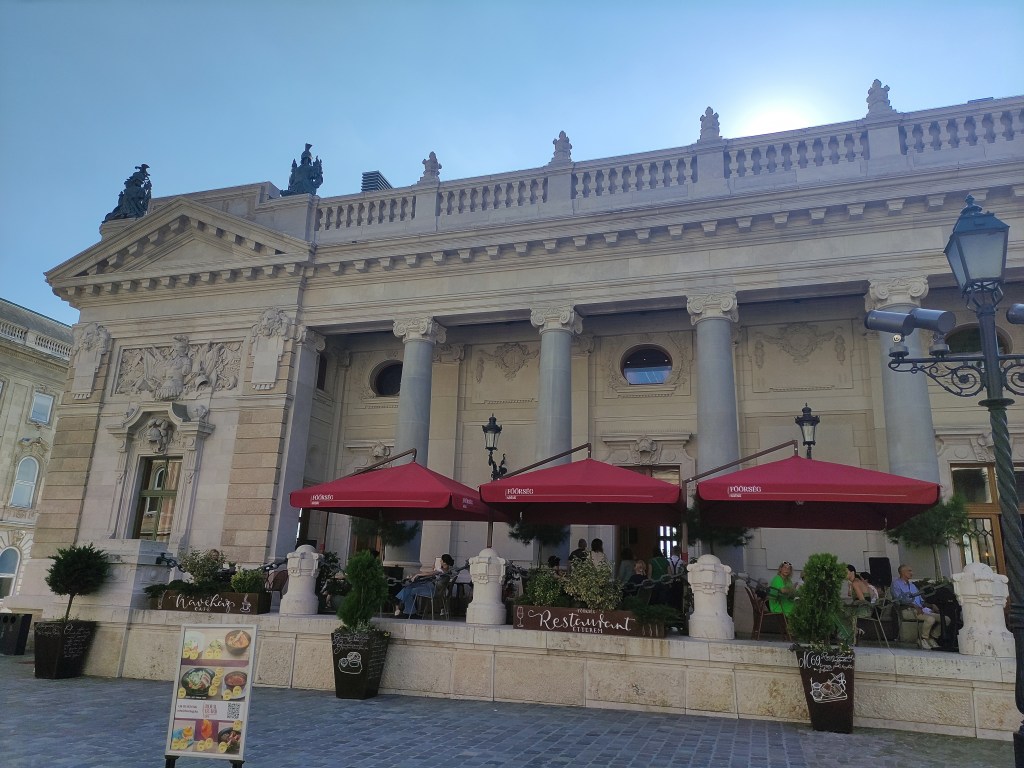
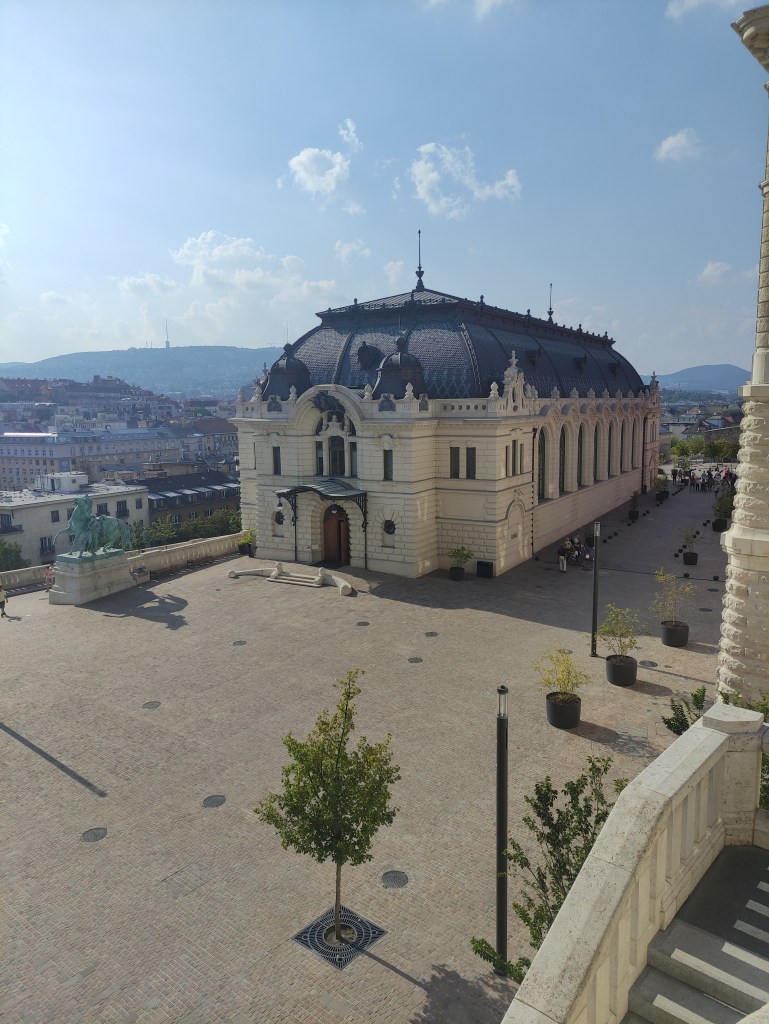
On the Buda side we walked up the steep hill to the castle district. It isn’t a medieval castle, but a collection of impressive 18th and 19th century buildings constructed for the Hapsburg Emperors of Austria Hungary. The amazing fact is that some of the buildings that look old are in fact very new and were built to replace demolished buildings.
Short History Lesson
Hungary started off in WW2 on the German side. They were getting thrashed by the Allies, so started negotiations to change horse mid-race. The Nazis didnt like that so invaded and treated the country extremely badly (it’s a grim story you can read on Wikipedia). At the end of the war many of the buildings on castle hill were badly damaged, but still standing. In 1971 the Communist government demolished several of them.
Those buildings are now being rebuilt as perfect copies of the old ones, and they are stunning. It shows that the old crafts are not dead.
These 2 are new buildings
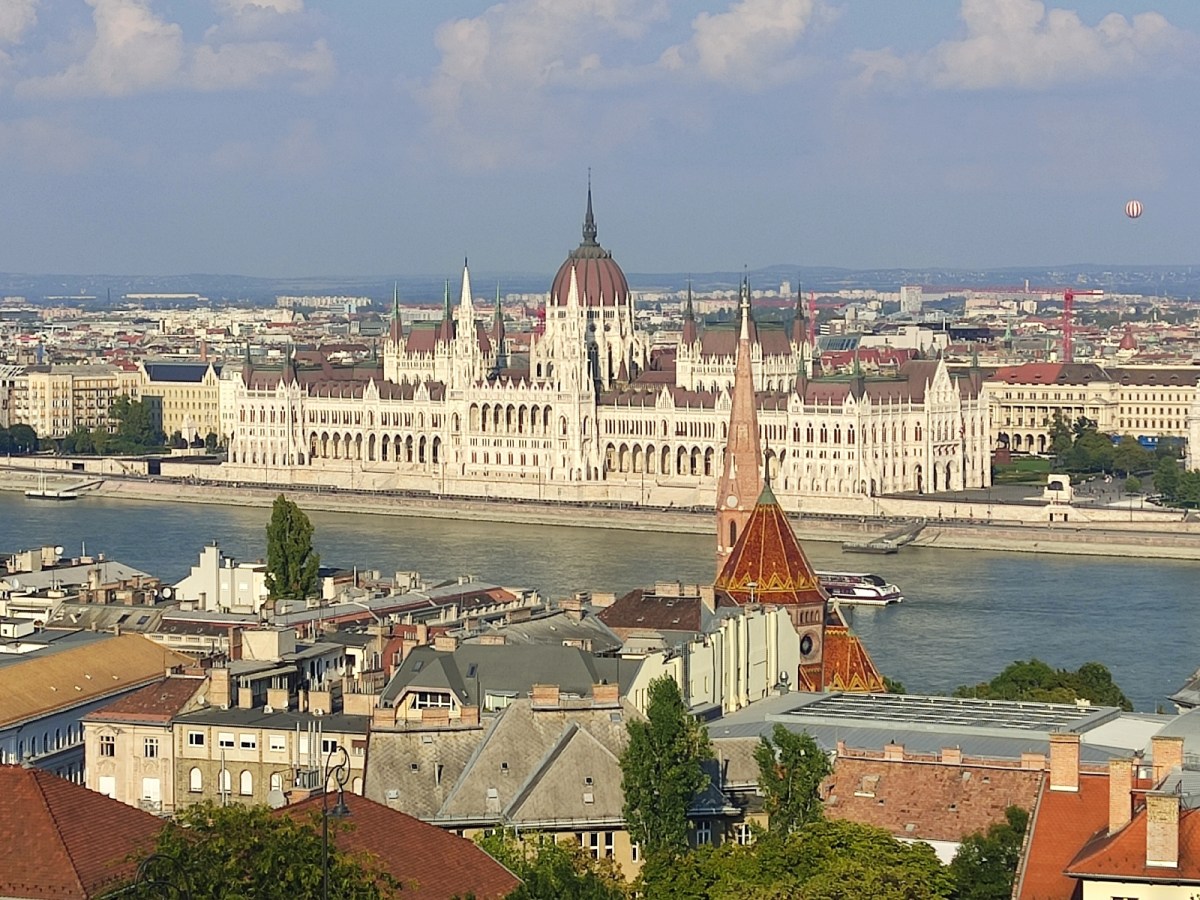
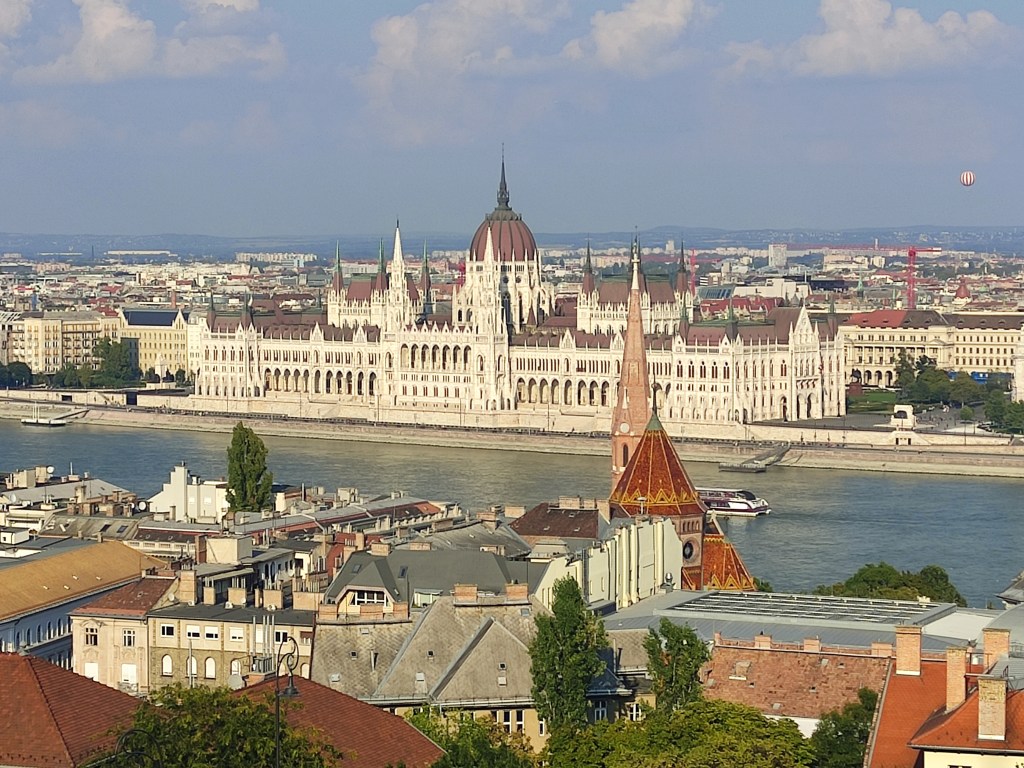
At the northern end of the castle hill is Fishermans Bastion, which was built at the end of the 19th century as a panoramic look-out spot. It rivals some of those castles in Bavaria for its fairy tale castle look.
The views across the Danube are stunning, especially as the Parliament building catches the setting sun.
Culture makes you thirsty as well, and we found a cafe half way down the hill for a glass of wine.
FACT
Hungarian wine tastes pretty much like any other wine, nice.
Interrail Admin
Interrail isn’t all site seeing and drinking wine you know. we also have to book rail trips and find accommodation. Having gazed at our Rail Map of Europe and deciding which city next, we find a train to get there. That is fairly easy using the Interrail app on our phones that also creates the QR code ticket. For long distance journeys we also make a separate Seat Reservation. For Germany, Austria and Hungary we use the Deutche Bahn website, which is quite good (but not perfect).
The most difficult job is finding accomodation on Booking.com and AirBnB which is in the right place and fits our budget. We prefer a kitchen and washing machine so we dont have to eat out and have clean undies.
All this took 3 hours and lots of swearing this morning. Then the knob-end we booked with in Salzburg said his flat was no longer available. Grrrrrrrr!!!
Monday 18 September
This morning we took a “free” walking tour of Pest with Matt. Free means you give what you think it’s worth at the end of the tour. Pest (pronounced Pesht) was undeveloped until the Chain Bridge was opened in 1849. It was designed by British engineer James Tierney Clark and is a scaled up version of his design for Marlow Bridge.
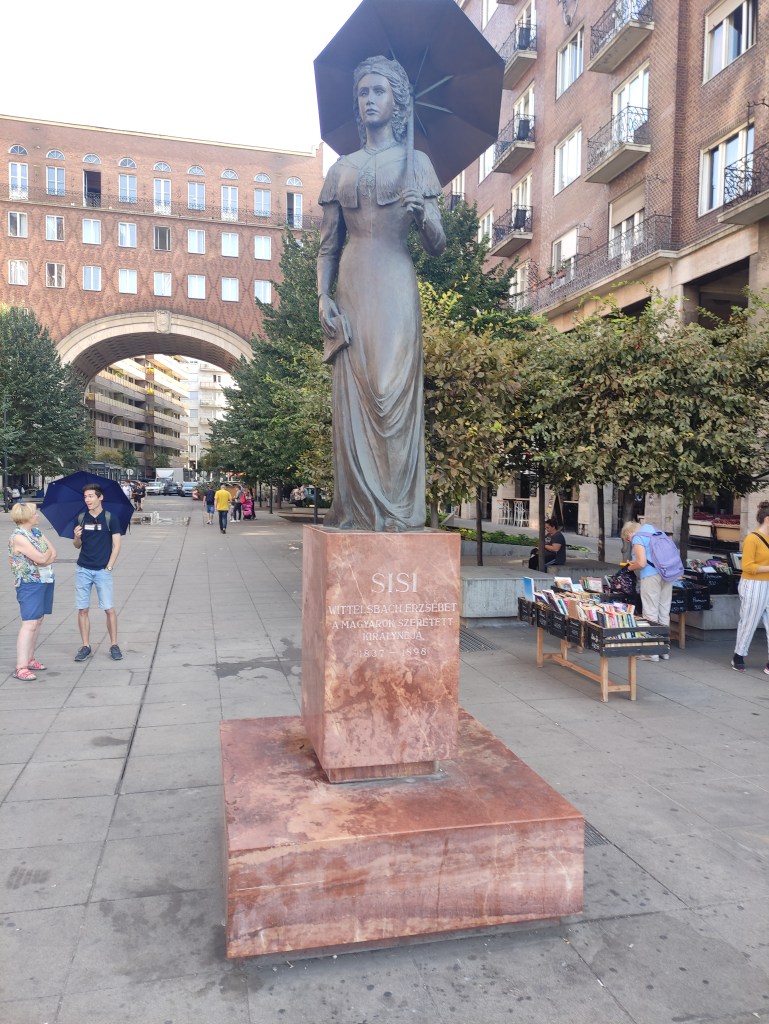
The nice bits of Pest are all late 19th century buildings when Buda had joined with Pest to make a single city. The Hapsburg Empress loved Budapest and influenced Emperor Franz Joseph to improve the capital. She was known as Sisi, and has a similar status to Princess Diana in Austria and Hungary. There have recently been a Netflix series and a film about her, she was quite a live wire compared to her rather conservative husband.
Sisi
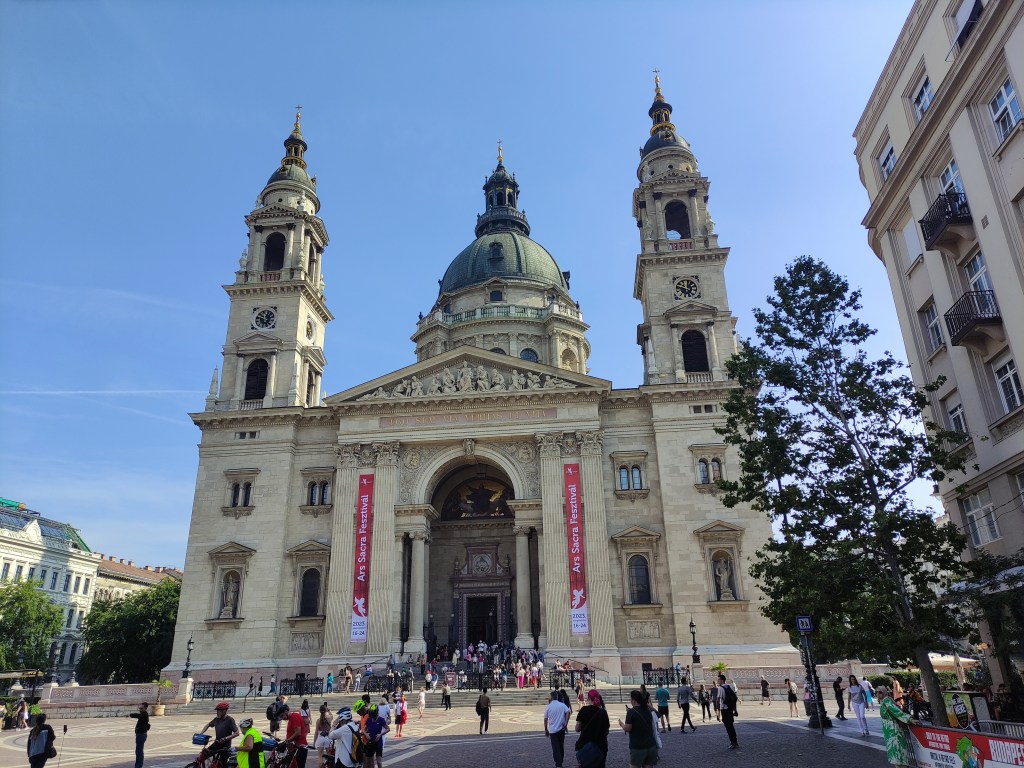
Matt took us to St Stephen’s church, which is built in a Baroque style like St Pauls in London but wasn’t finished until 1905. Parts of it collapsed twice, killing two of the architects. Quite Darwinian really, it prevented them from designing any more terrible buildings,
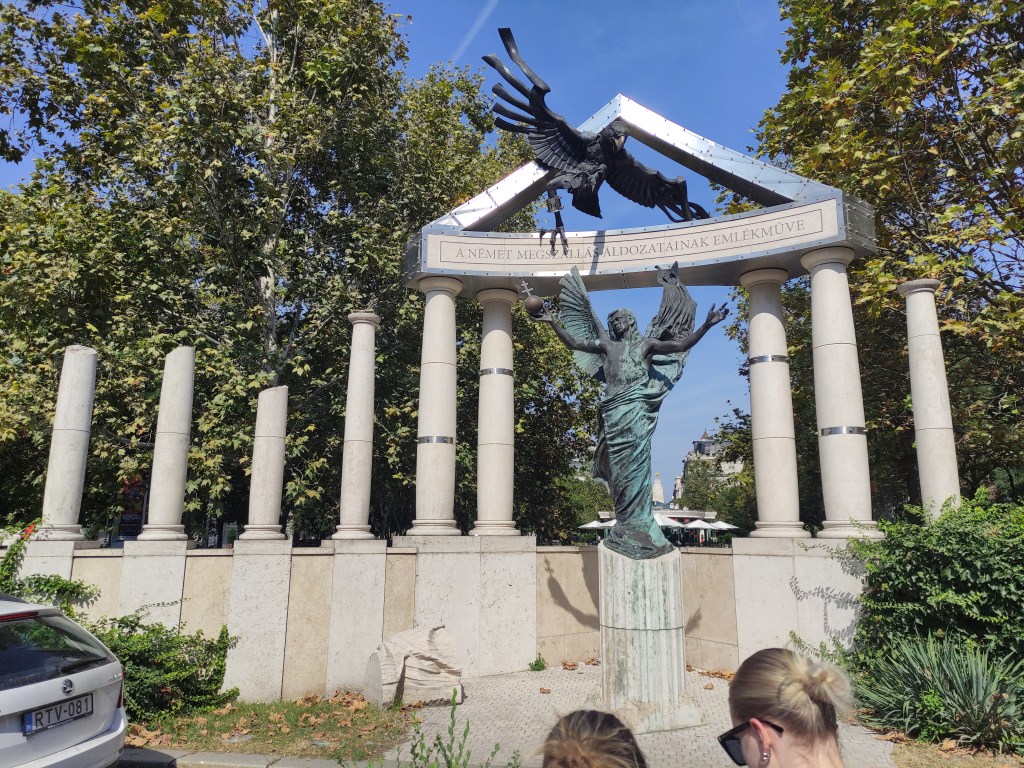
Matt showed us the “Statue of Liberty”, an eagle (the Nazis) attacking an angelic figure (Hungary). It was put up over night under police protection. The memorial is controversial since it show Hungary as a victim of the Nazis. In fact they joined the war as Nazi partners, 80,000 died in a day in Stalingrad. They tried to change sides in 1943 and were then occupied by the Nazis, who sent 400,000 Jews and minorities to Ausweitz. In 1945 they were occupied by the Soviets who controlled Hungary until 1989, and they are still recovering from it.
The walk ended at the Parliament Building, which is “the third largest Parliament in the world”. Its very impressive, and looks better from the Fishermens Bastion.
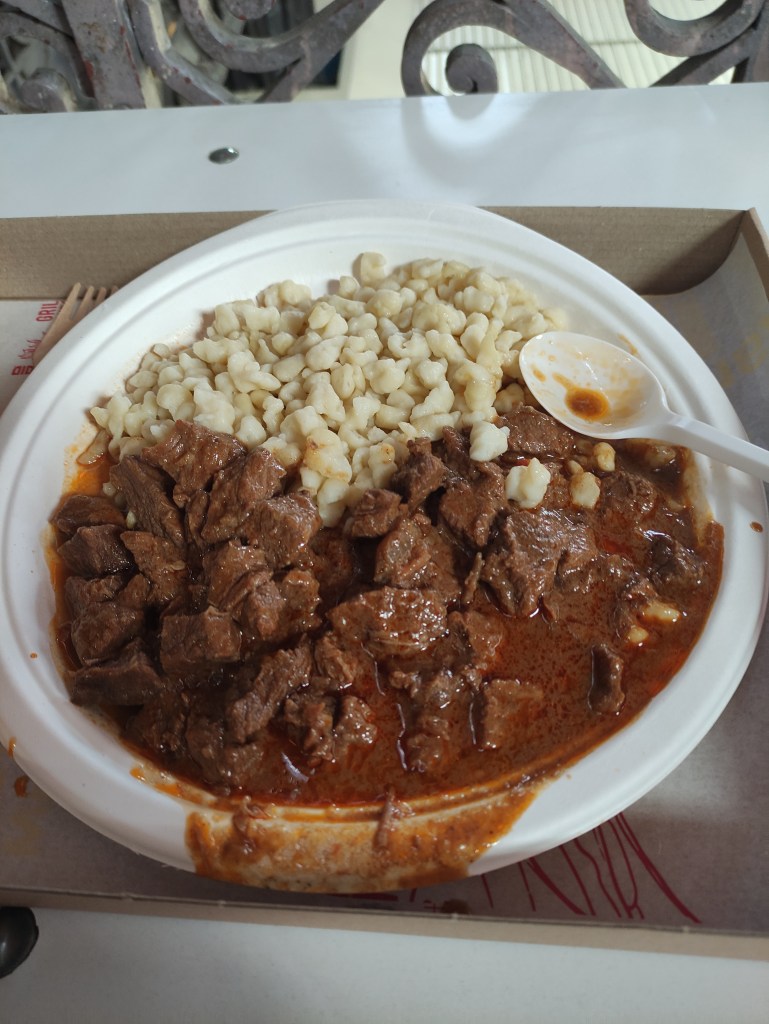
In the afternoon we walked down to the huge Central Market, a huge cast iron shed, similar to those in Leeds and Newcastle. On the first floor are lots of stalls selling Hungarian food. I had Beef Goulash, with noodles. It was huge, very tasty and good value, about £9 for the best beef stew I have eaten. Possibly.
On the way back to the flat for a serious sit down, we bought a Chimney Cake. These are cyclindrical spirals of dough, cooked to golden brown. They taste like a Cinnamon Roll and are bloody gorgeous. Honestly, better than good.
I washed my smalls in the sink and hung them off the lighting to make a tasteful mobile called “Pants in Motion”.
It’s art, init?
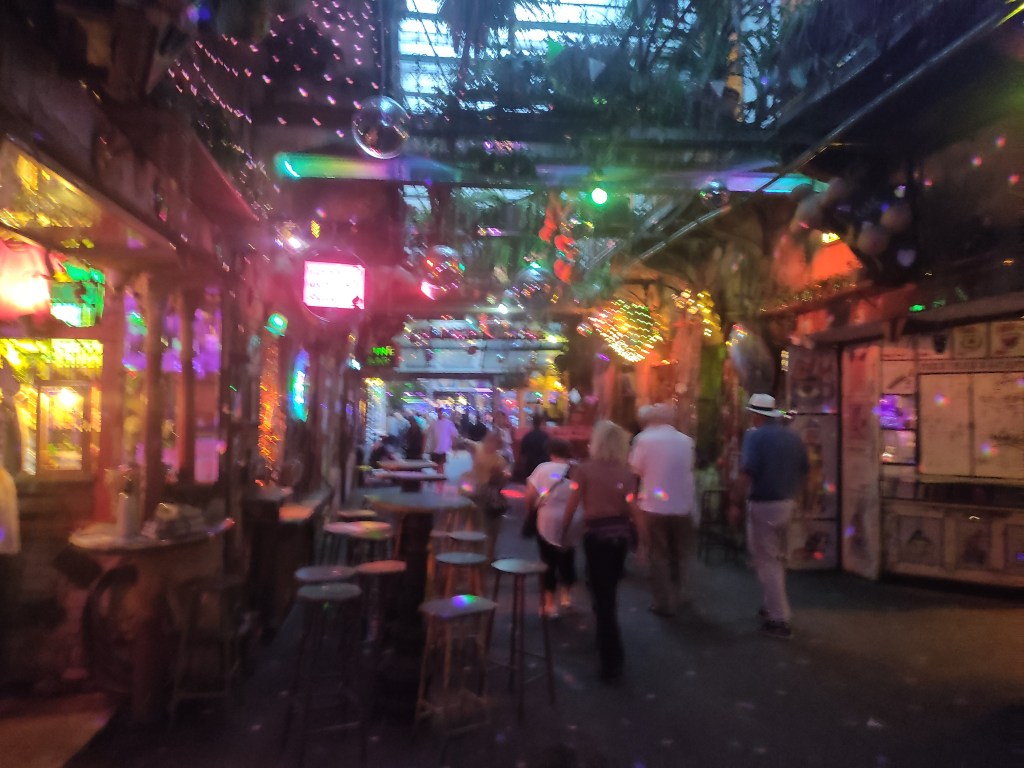
In the evening we went to a Ruin Bar in the Jewish Quarter. We had a slightly overpriced drink in a trendy bar. It was alright, but honestly I’ve had better beer in a Spoons. Yes, I’m a pleb.
A ruin bar
Tuesday 19 September
We are now 2 weeks into our adventure in Europe. This is an “unpackaged” holiday, there is no charming courier to take us on a coach to our hotel and organise tours for us. So we spend hours each day planning the next leg of the trip, and the one after that. Our original plan was to go from Salzburg to Innsbruck, but it’s going to be raining in Innsbruck so we will go straight through to Verona.
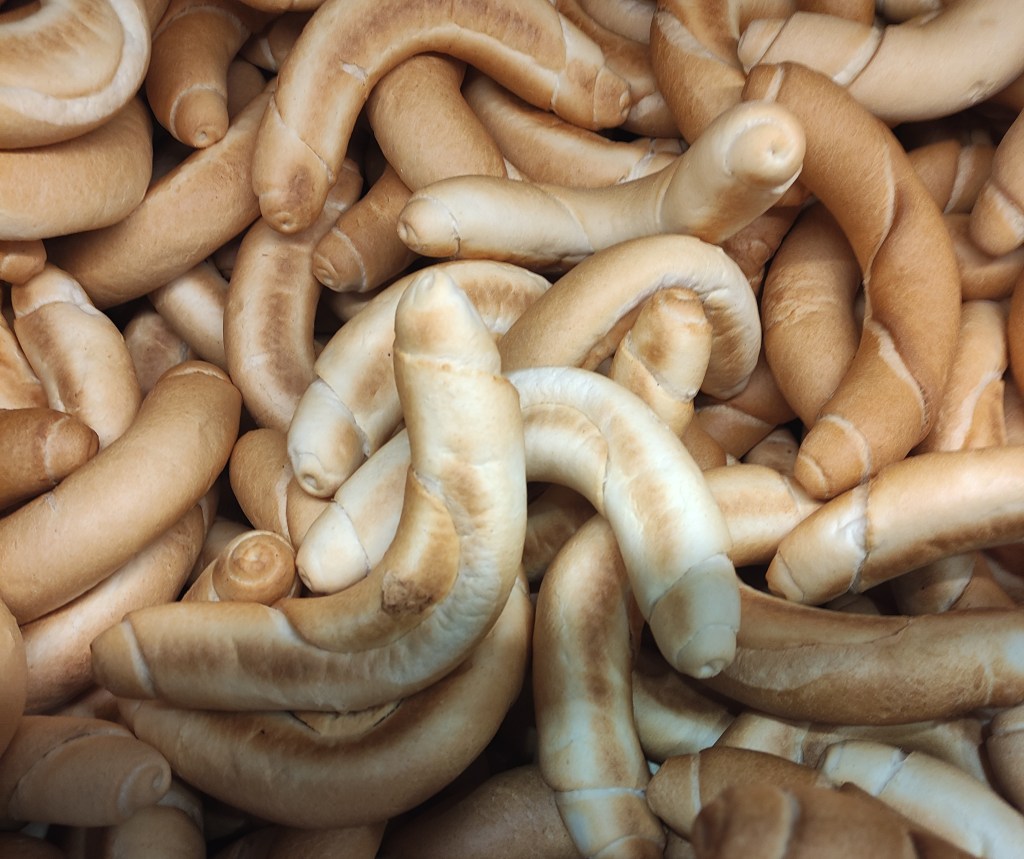
It’s raining in Budapest this morning, so we are doing our admin. I went to Aldi nearby where they have bread that looks like dildos. I bought flat bread in a plastic bag, no chance of miss-use.
Ooh err missus…
Once it stopped raining we go the metro line M1 to City Park, a couple of miles away. The metro is the oldest in continental Europe, built in 1896. That’s more than 30 years after London, they took their time didn’t they ? It look like it has barely been modernised since.
The park is very lovely, with several Hapsburg era buildings and some strikingly modern ones.
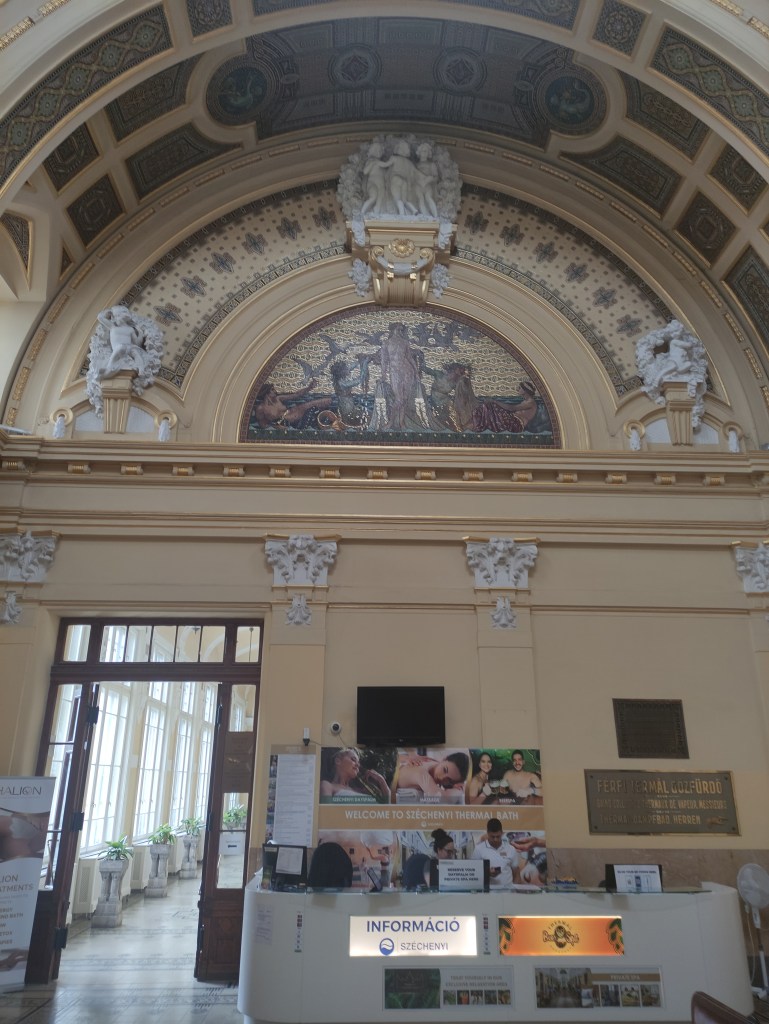
The metro stops at Szechenyi baths, the grandest of the thermal baths in the city. I didn’t go in, I didn’t fancy sharing a hot bath with other people drinking beer. I know what people do when they drink beer.
The thermal baths
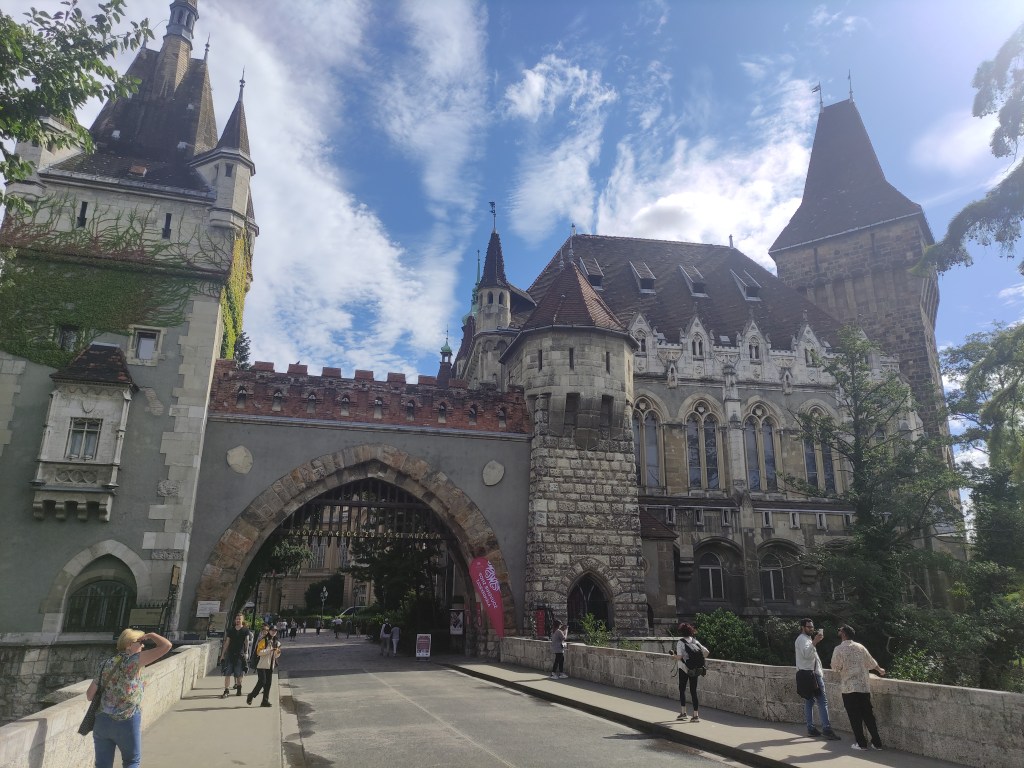
Nearby is a mock castle with an agricultural museum in it. Didn’t go in their either, I got museumed-out in Munich on the very rainy day.
A mock castle, a bit like in Cardiff
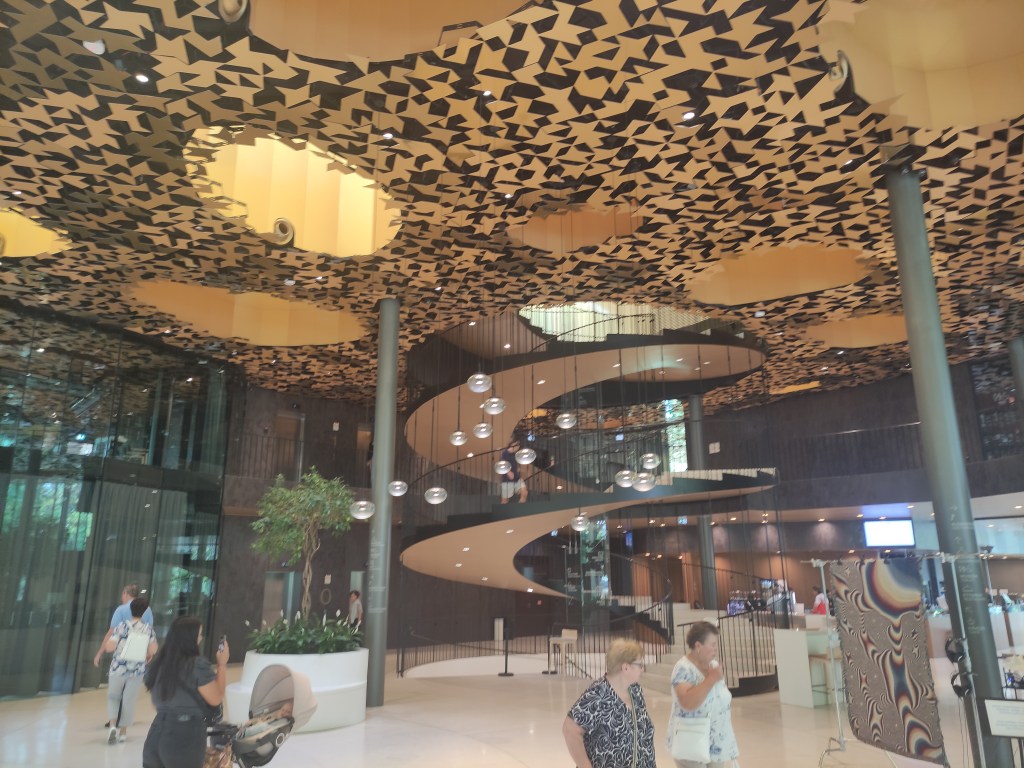
The House of Music is a very modern concert hall with a fantastic ceiling and staincase. Like most arty places it had excellent toilets, so I had a quality metropolitan elite piss.
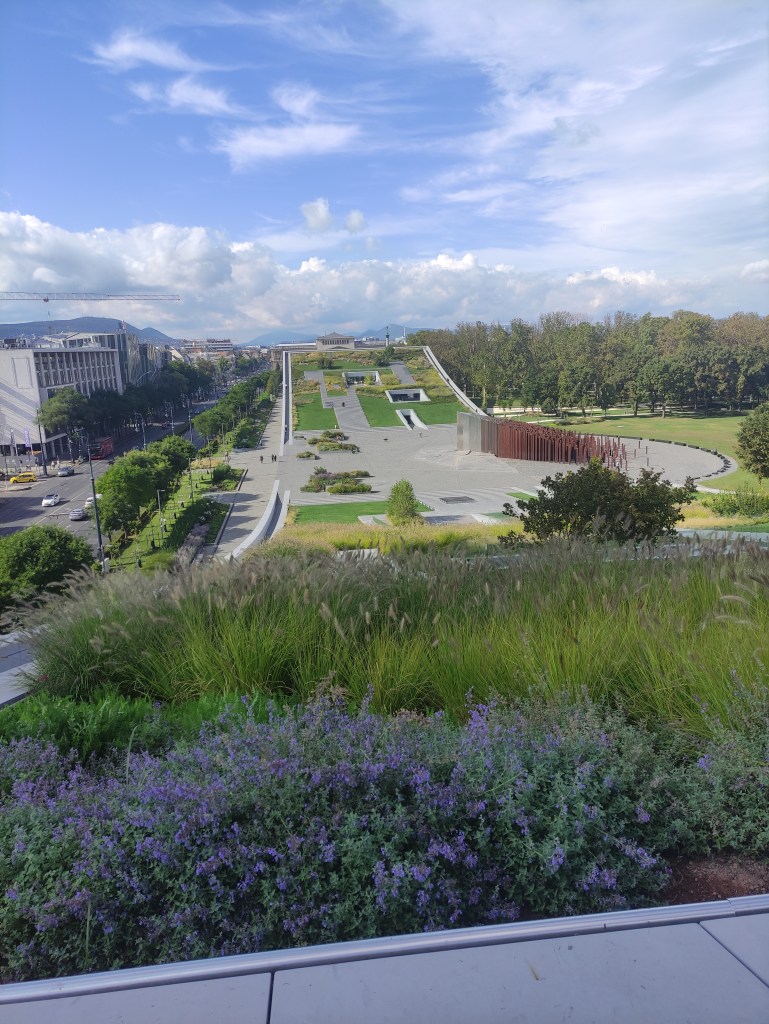
The most interesting building is the Ethnographic Museum, which has a dish shaped roof that is also a garden. It looks better than I have described it. Inside it has a huge architectural model of Budapest showing all of the city city. The Ethnographic collection didn’t appeal, that’s a rainy day trip I think.
The sloping museum roof
It’s our last night here, so we went down to the Danube to enjoy the view of the castle and have a beer.
We had dinner in a Mexican cafe, a delicious Budapest Burrito.
For the last time we got the tram from Jean Jaunes stop to Gare Central and caught the 9.50 2 coach train to Appenweier. There is precisely bugger-all at Appenweier, and we had to wait 50 minutes for the Karlsruhe train, which was 10 minutes late. We sat next to 2 German ladies on there way to see a Tina Turner show in Stuttgart. They assured us that German trains are often late or cancelled, which made me feel better, I think they called it Schadenfreude.
At Karlsruhe we raced to platform 7 and got on the Munich high speed train with 5 minutes to spare. Phew.
Twas a very pleasant journey on the fast train, at one time we were going at 250kph.
high-speed Tintin hair
Munich station had the biggest model railway shop I have ever seen. The prices are eyewatering, the tiny trains are hundreds of euros each. I liked this tiny model of a wedding couple on a Scooter.
At the station in Munich we found the S Bahn platform for Oberschliesenheim where the AirBnB is. But all the trains on line S1 were all cancelled, so we took an alternative route via Dachau.
In Britain we only know Dachau for one reason. Now it is a pleasant suburb with a Memorial Centre.
After arriving at our flat we walked to a Lidl 5 minutes away. It was like a warm embrace from an old friend. I’m sure the prices were half what we spent in Paris, especially the Primitivo Pugilio for under 3 euros.
I was dead chuffed, and I am now in a state of considerable relaxation.
There is a huge TV, and Guardians of the Galaxy 2 is ready to go, so over and out.
Saw the film, it was a loada tosh. But I am at least 50 years older than the target audience.
Wednesday 13 September
We have a lovely big flat in Oberschleisheim, very modern, cool and spacious. Much better than the hot and cramped places we had in Paris and Strasbourg. Our preference is somewhere with a kitchen so we can cook for ourselves and do some laundry.
It’s also literally 5 minutes from Schleisheim Palace which was built for the Bavarian Royal Family in the 17th Century.
The new palace is vast, and the style is Baroque and similar to Versailles and Hampton Court. There are dozens of huge rooms furnished with tapestries and damask wall coverings. They are hung with hundreds of pictures including masterpieces by Ruebens, Van Dyke and Caravaggio.
But there was hardly anyone there. At times we had vast swathes of palace to ourselves. It cost us 8 euros to get in, compared to Blenheim Palace which cost £30 and is much smaller.
We needed a coffee after all that culture, and found a cafe outside. There were more people there than inside the palace, and they were all drinking large mugs of beer. They were eating large plates of food, and it wasn’t a lightly dressed salad. Very different for yer average National Trust Tearoom.
I was green with envy, but I knew that if I ate and drank like that I would be catatonic for the rest of the day.
In the afternoon we visited the nearby Schleisheim aircraft museum, a collection of old planes in 3 big hangers, much more my kinda thing.
I wanted to steal this one for the RAF, but I had no wings.
There were 2 more museums we visited because we had bought combined ticket. The Altes Schloss (old castle) was full of models of nativity scenes, dozens and dozens of them.
A nuns delight, but really boring.
Lustheim Schloss was all porcelain, interesting for 10 minutes and totally deserted. I didn’t take any pictures so imagine a nice plate with flowers on it.
There was a huge thunderstorm when we walked back to the flat and we got soaked. But it made a change from being roasted.
Thursday 14 September
We took the S1 train into the Central station and then walked to Marienplaz, the main square of the city. It is dominated by the Neuesrathaus, the gothic town hall. Close by is the twin towered Frauenkirche Cathedral, which is quite plain and undecorated compared to others we have seen. I’ve seen a lot of cathedrals (I have a list if you are interested), and they do get a bit samey.
Munich is gearing up for the Octoberfest which starts on Saturday, Europe’s biggest piss up. The shops have lots of Bavarian costumes, which don’t come cheap. A pair of lederhosen start at 200 euros and can go up to 1000 euros.
Suits you sir
Close to the square is Viktualenmakt, which is a food market a bit like Borough Market, but with many more pubs. We went to a restaurant called Bratwurstherzl for lunch, I had Schnitzel and a pint of helles lager very nice. Better than the bacon and cabbage on Strasbourg.
After lunch we visited the place we should have actually gone for lunch, the Hofbrauhaus. It’s a giant beer keller that can hold over a thousand people. Naturally they had a umpah band, and outside was a splendid dray with 4 horses.
In Odeonspaltz there were dozens of armed policemen. Julie saw a miniature soldier and asked him “wassup”. Turns out there was a military passing out parade and the Prime Minister of Bavaria was there. The cops were there to guard the soldiers. There were tall soldiers as well.
FUN FACTS
Bavaria (a state of Germany) has a population of 13 million and Austria (an entire country) has a population of 8 million.
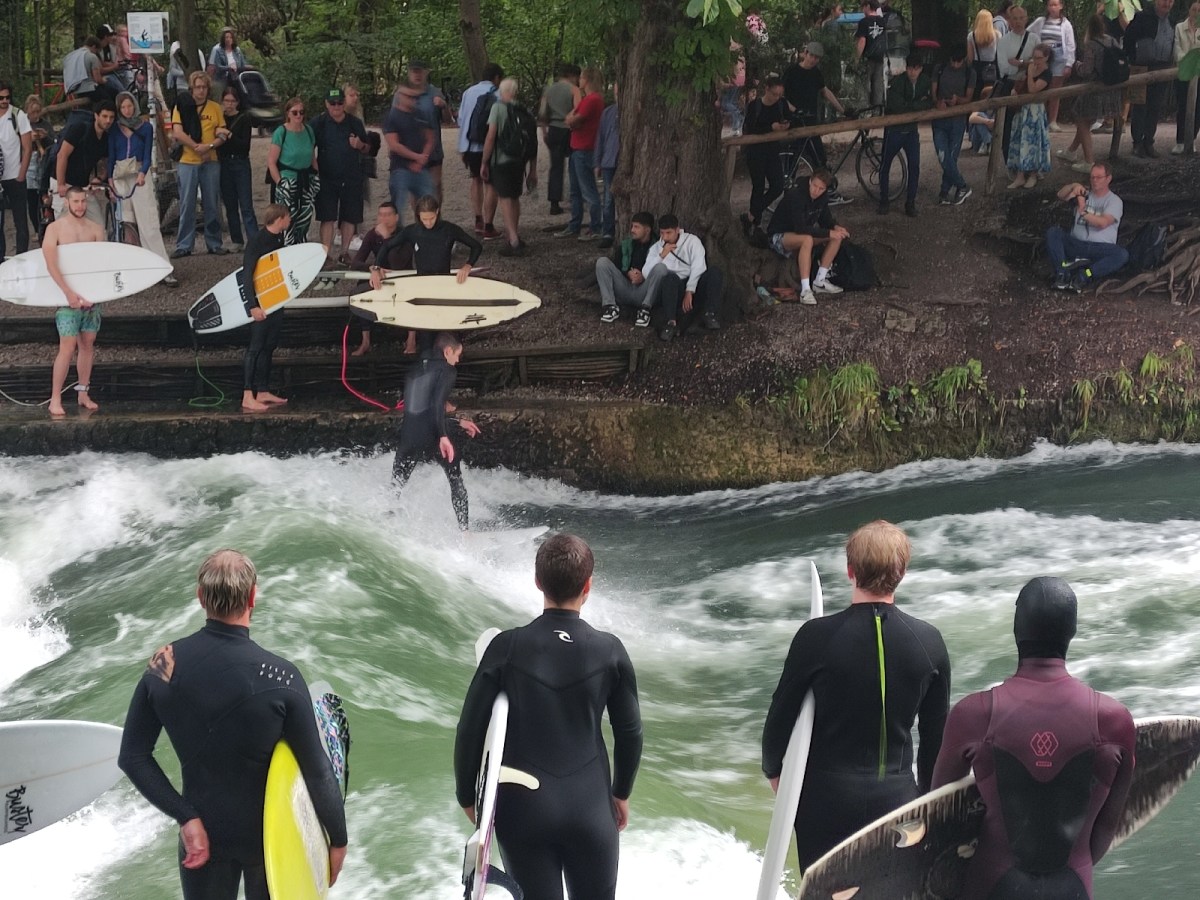
The biggest park in Munich is the Englishen Garten, and running through it is a very fast running river called the Eisbach. It is a very popular surfing spot. Just close to a bridge is a standing wave which surfers take turns to ride.
It is great fun to watch and some of the surfers are really good. They spent more time upright than anyone I have seen surfing on the sea, and then got another go at it 10 minutes later. The river runs remarkably quickly, i can’t think of anywhere in London where it would be possible. You are lucky to get good game of Pooh Sticks on the River Crane.
Friday 15 October
There’s probably 3 things that Munich is internationally famous for: the Octoberfest, Bayern Munich and BMW. Europes biggest party starts on Saturday, just as we are leaving, so we will miss that. Football – ask anyone who knows me – is an alien world to me. Some people would say that I’m not interested in cars, so to confound them all, I went to BMW Welt.
Basically it is a big flashy car and motorbike showroom for the Munich monster of automotive engineering. It’s also free to get in, which is nice. They have most of the latest models of BMW, Rolls Royce and Mini cars there to be admired and purchased if you wish. It was interesting to get up close to massive status symbols, including a BMW with bodywork that changes colour. It looked very tacky, but I’m sure the young princes from the Gulf that rev up and down Kings Road would love one.
Lady Penelope’s Roller
I sat on an 1800cc Transcontinental motorbike, and it was very comfortable, as motorbikes go. It was quite good fun to look round for an hour, but the cars didnt really excite me much and wouldn’t look right in a Lidl carpark.
On ma new hog
BNW Welt (world) is next door to the Olympic Park, so we wandered around that. It was built for the 1972 Olympics on a site where all the rubble from the destruction of Munich in the war was built. The rubble was beautifully landscaped with hills and a lake, and still looks great 50 years later. We had lunch in a cafe in the Olympic pool where Mark Spitz won 6 Golds for swimming. My toasted cheese and ham focaccia was over-baked into a cheesy brick, but it was just about edible.
There is a 60 metre tall hill with great views over Munich and the BMW tower and factory. In the past it has been used for winter sports events. It is also made of rubble, and is about the same height as Richmond Hill. It’s a lovely place to sit on a bench and enjoy the views of the park and the BMW complex of buildings.
Some men like football, some like drinking large amounts of beer. My particular weakness is a science museum, and Munich has a bloody good one. The Deutsches Museum sits on an island in the river Isar, and matches the London Science Museum in size. There is a great aircraft and rocket section, I love a good rocket. The other surprisingly interesting department was on bridges and hydrology. It was full of astonishingly good models of bridges underconstruction. I now know how an 18th Century French basket-arch bridge is constructed, and if we ever meet you at a party I can tell you in detail.
My favourite exhibit was the first reinforced concrete building in Germany, which is a dog kennel. How bizarre.
Fortuntely they chucked us out at 5pm, or I would still be there now. I really am that geeky.
Julie and I went our separate ways in the museum because she is fed up with aeroplanes, but happily we were reconciled in the sunshine afterwards and she made me buy her an Aperol Spritz. I had a helles lager because I’m a cheap date.
The neighbours had a party at 2am last night, which kept us awake for hours. The bastards were having a really good time, and I wasnt! So we have been a bit tired and narky today.
It took just 2 hour from Gare L’Est station to Strasbourg, which in on the Rhine on the border with Germany. It has been part of Germany several times, so has a distinctive look and feel compared to Paris.
Our accomodation is a bit out of town, so we left our bags in left luggage and explored the city. The city centre feels spacious and prosperous, lots of it is pedestrianised and has more bikes and trams than cars. The old part of the city is encircled by rivers, and is full of old squares and quaint old buildings that look much more German than French. The River Ill surrounds the Grand Ile, which is a bit confusing.
The cathedral is quite spectacular and the tower in 142m, 466 feet tall. it was the tallest building in the world until 1874. But in the spirit of completeness I have to say that Lincoln Cathedral was 160m (525 ft) until 1548 when the spire fell down. So in my opinion Lincoln was the champion, but Strasbourg scored in extra time.
The city centre is very pretty and very busy with tourists, I think that Rhine cruises stops there, so lots of senior citizens all enjoy the city at the same time.
In the afternoon it was very hot (again) so we scuttled into a museum like crabs caught in the sunshine. The Rohan Museum is a fine building built for the Prince Bishops of Strasbourg, four of whom were from the Rohan family. The archeological museum in the pleasingly cool basement is worthy, full of Roman remains, but has all the fun of a February Sunday in the 1960’s i.e. a bit dull.
So we got our bags and hopped on the D line tram to our suburban i.e. cheaper flat. It’s fine, and has an Auchan supermarket nearby.
Sorry, I’m to hot and tired to write entertainingly this evening.
Sunday 10 September
Strasbourg is exceptionally pretty, with many half timbered buildings close to rivers and quaint squares lined with restaurants. We followed a recommended route on a map Julie got from the tourist information office near the cathedral. It went to all the most picturesque sites in the Grand Isle.
The district called Petite France has several bridges over the Ill river (it is ill, not 111 like Napoleon III). There river is fast moving so there are former water mills and a lock to let the Batobus tour boats get through.
There are 3 tall brick towers which were part of the fortications, and a Covered Bridge that no longer has a cover (it’s complicated).
The Barrage Vaudan is a dam with sluices in it which would allow defenders of Strasbourg to flood part of the city if it got invaded. It sounds bonkers to me, and clearly didn’t stop the Germans 3 times in 1870, 1914 and 1940.
We had a huge burger in the Abattoir bar, not the best name for an eating place, but the beef was very fresh.
After lunch we had a quick walk around Neustadt, the new district built by the Germans on grand imperial style after they took Stratsbourg in 1870.
Eet ees ver ver ot, as they say in French. So I am tapping this out with one finger in the Parc d’Orangerie, which is very beautiful. The gardens are in full bloom and the lawns look perfectly verdant.
Strasbourg has a fantastic public transport system of modern trams and buses and many cycle path. I got a 24 hour pass for trans and buses for 3.70 euros, which is cheap and convenient.
Monday 11 September
So what do you do when you have seen Strasbourg? You go to Colmar because it’s only 30 minutes away on the train and it’s like Strasbourg but condensed.
Also since we have our Interrail passes it’s very easy to take another journey. Basically I find the journey on the Interrail app, tap a digital switch and hey presto a digital ticket appears that I can show the train guard. Simples.
Colmar looks like a film set, the old town is full of colourful half timbered buildings with a picture perfect river running through it.
Versions of it have inspired villages in the films Beauty and the Beast and Howls Moving Castle, and many fairy tale books.
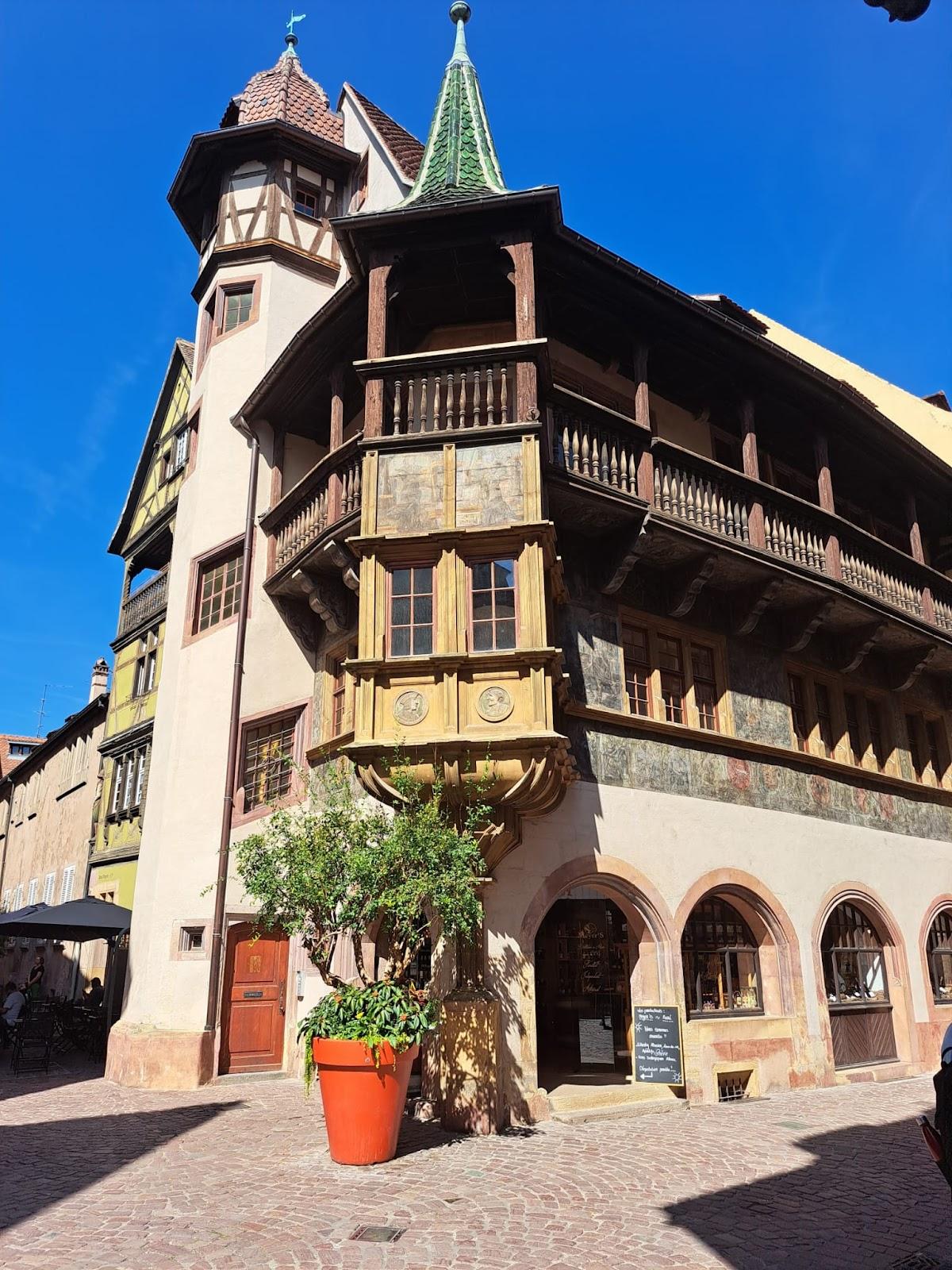
This is called the Pfister House. Honestly.
Consequently it is busy with visitors and those little tourist road trains that transport the less able and less slender around town.
It’s much smaller than Stratsbourg, so in 3 hours we had seen the town and had lunch. I thought I would try Choucroute for lunch, which I supposed to be a local speciality. It is a heap of sauerkraut with one potato, topped with 6 types of processed pork. I ate it all, I’m pleased I ate it, but I don’t want to eat it again.
Hot pig and salty cabbage mmmmm
Returning to Strasbourg we went to the Museum of Alsace which is housed in old houses by the River Ill. It was somewhere to go in the shade, and is a collection of rooms with old furniture and domestic furnishings in it. It was moderately interesting, but not exactly fun.
Go there if it’s raining, baking hot or if you love old French stoves.
We have been self catering quite a lot in our rented flats, it’s too expensive to eat out all the time. But I mustn’t moan, I’m having a wonderful time!
Alsace is a useful transition to Germany, and tomorrow we are going the whole hog (more bacon) and travelling to Munich.
So farewell lovely Siena! On Saturday morning it was yet another epic trolley bag drag about 30 minutes to the station, and then 10 more minutes just to get down the escalators. The 9.18 train to Empoli, so we got on at about 9, and it was half full already. More and more people got on with lots of luggage, and all the seats rapidly filled and then there was barely standing room left. The train slowed down several times, and then stopped a few miles from Empoli. There was vehicle damage at the level crossing and no trains could move. In the end we were an hour late, and there was no toilet!
Arriving at Empoli was an enormous relief! Then we got another train to Pisa, and a third one to Genoa. The last train went past Carrera where I could see the vast marble quarries, and the Cinque Terre, where we saw glimpses of the beaches between tunnels. I know we should have stopped there, but it’s expensive and Genoa has much more choice of accommodation.
Our flat is pleasingly close to Brignole station, so we were soon settled in an enormous 19th century apartment furnished in Ikea chic. It has a washing machine, which is brilliant for our smalls, and a freezer with ice for our drinks! It overlooks a busy street, and we can hear the trains going by, it reminds me of home.
Our first trip into Genoa was to find the Tourist Information Office. We do this in every city we visit to get hold of free maps and guides to the city, and the people are usually very helpful and speak good English. But to get to the Tourist Office we followed Google Maps which led us through the old town with very narrow quaint streets with tall buildings on either side.
Hang on, what’s that lady in a short skirt doing on the corner? Oh dear there are more ladies in tight clothing, actually there are dozens of them. Those blokes standing in doorways look very dodgy as well.
We won’t be taking that route in the future.
Sticking to the main streets we found our way to the seafront and the Porto Antico, the old harbour. Genoa was one of the Maritime Republics, and very rich from the 13th to the 18th centuries. The old harbour is blighted by modern edifices designed to make an impact in the 1990’s, but IMHO have blighted the area today. There’s a panoramic lift, which is quite bizarre, and the aquarium which is just fugly. It was Renzo Piano who designed the aquarium, he must have been having an off day.
But there was a restaurant on the harbourside selling burger and chips, and it was really really good, a taste of Good Old Ingerland.
Sunday 1 October
It was time to put our newly acquired maps to good use, so we followed a walking tour that promised us the highlights. Genoa is very different from Siena and Verona. The oldest part is next to the harbour with very tall houses (8 or 9 stories) and narrow streets. Beyond those there are the 16th to 18th palazzos where the richest merchants lived, and the the 19th and 20th century buildings.
Our first stop was Piazza Ferrari, a big square with a theatre and statue of Garibaldi on a horse. On the way home we walked through again and saw David Harewood having a drink on his own, he’s a very cool man.
Genoa has a beautiful Doges Palace, it’s not just Venice that had a Doge. There was an antique market going on inside, but my bag scarcely has enough spare room for a fridge magnet, so I won’t be bringing any vases home.
There were several churches on the route, with flamboyant baroque interiors clad in marble and gold. The rich in the days of old didn’t have cars or superyachts, so they spent their money on palaces and getting a place in heaven by funding churches.
Our route took us back to Porto Antico, which was packed with tourists, and we soon saw the reason why. There were 2 gigantic cruise liners moored up across the harbour. One of them, the MSC World Europe can carry 5,400 passengers, they must buy a helluva lot of pizzas!
Alongside the harbour, there were superyachts tied up, one of them called DAR cost $175m to build and costs $17m a year to operate. That’s just stupid big willy waving.
We ate lunch by the harbour, Julie had a deep fried calzone pizza. It was a bit strange, and probably not as good as a proper pizza.
In the afternoon we continued our walk to the Palazzo Real, which belonged to various aristocratic families and then the Italian Royal family. I’ve seen so many palaces I have got quite blase about them, I expect King Charles feels just the same. But it was nice and cool, and best of all, free.
This little fella is Crapula
Our last stop was the Funicolare Zecca Righi, which goes up the hill behind Genoa to a height of 279 metres. Its 1.5 km long and there are 7 stops on it, like a tram line up the hill. There is a forest park at the top, and a road along the old outer wall of Genoa which is dotted with forts. Of course there were fantastic views over Genoa city and the harbour. We could see the football stadium where Genoa were playing Udinese (2-2) , and we could hear the crowd cheering from the top of the hill.
Genoa is a much more interesting city than I knew it was. It has a fascinating history, but is not a “living museum” like Siena or Verona. It definitely has a rough edge, more like Liverpool than Bath.
Monday 2 October
I was woken up by a strange noise last night from next door, a woman whining loudly. I think the neighbours might have been..yer know. So I stuck my head under the sheet, focussed on the history of Genoese fortifications, and bored myself back to sleep.
Walls of Genoa
Genoa boasts of having the biggest aquarium in the Mediterranean, so we went to see it. I have seen a few, and it was quite good, but not the biggest or best. It was very popular though, and the children loved the pool where they could touch Rays. They feel like sandpaper by the way. I found out that tropical fish and manatees both like lettuce to eat, and swordfish appear to sleep at the bottom of tanks.
A sawfish having 40 winks
The aquarium.was designed by esteemed architect Renzo Piano, but it was not one of his finest works.
We had lunch at a stand up bar underneath a road. It was cheap and sustaining, and a bottle of Moretti was 1.5 Euros, result!
A YouTuber has recommended a walk to Bocadasse called the Corso Italia. The first part was down a busy road which was a bit grim.But it turned into a picturesque coastal walk past an excellent gelateria where we sat down in the shade for a cornet.
Bocadasse is a tiny former fishing village with a beach about 30 metres wide. It looks like one of those tiny Cornish villages, but instead of a pub selling Proper Job it has a bar selling Aperol Spritz. So we got one and it was the perfect drink for the situation.
We CBA to walk back to our flat, so bought bus tickets for the 31 from a tabacchi by the bus stop. Unfortunately we stood on the wrong side of the road and got the bus in the wrong direction, DOH!
We went for dinner at a restaurant about 10 minutes walk from the flat, and had seafood risotto and yet another Spritz. Living the high life in Italy.
Tuesday 3 October
This is our 4 week anniversary, the longest holiday we have had since Sri Lanka in 2017. Another recommendation I got from YouTube was Nervi, which is only 20 minutes away from Brignole station.
It was a great decision to go there. It’s a small fishing harbour within greater Genoa, but feels a hundred miles away. After watching a fisherman load his nets from a tub on the quay into his boat, we went for coffee on a terrace overlooking the sea.Just bloody lovely.
At the bottom of the cliff was a little stony beach and clear blue sea. I found a good spot on the beach and enjoyed my first swim of my holiday. It wasn’t exactly a swim, more of a bob around in the water and a few duck dives.
We ate in a little cafe within a supermarket, and it sold various types of focaccia, which is a delicacy in Genoa. I have some that was like Margarita pizza, but the base was light and airy, very delicious.
Walking beyond the harbour there is a promenade called the Parcheggio Anita Garibaldi, named after a Brazilian revolutionary and the wife of Guiseppi Garibaldi. It is a really beautiful walk along the coast that passes by a small castle, a few cafes and bathing beaches.
One spot where we sat is called the “stoves” because the sun heats up the dark stone in the cliff and it radiates heat. There is also a well kept park close to Nervi station, but we couldn’t sit for long because of the annoying flies, we were constantly flicking them away.

















 timharnesstravels