Touring with Riviera Travel
- Touring with Riviera Travel
- Across the Veld to the Game Park
- Safari in Kruger National Park
- Graskop Gorge Elevator
- Journey to the Battlefields
- The Zulu war Battlefields
- Wet Journey to Joburg
- Ferry to Featherbed
- The Garden Route to Wine Country
- Franschhoek and Wine Country
- Capetown!
- A Tour of the Cape Peninsula
- Visiting a Township
- Wine Tasting in Robertson
- The Little Karoo
- Up a Mountain Then Down Again
- The Great Karoo
- Elgin and Sir Lowry’s Pass
- So what do I think of South Africa?
Flying to Johannesburg
Wednesday 16 April 2025
Africa is a huge, huge continent which I have never visited. All of what I know about Africa is either from the News (often grim) and nature documentaries (all beautiful). Those two lenses of experience can’t be the only ways to know about Africa. It’s fantastic that at last we have an opportunity to see it for ourselves.
A few months ago Julie got a random travel email from the Guardian. She was immediately interested in a Riviera Travel “Grand Tour of South Africa”. I had a quick look at the itinerary and thought “why not?”, we haven’t been to Africa and I want to go somewhere really different.
So we booked it, and here I am tapping away on a laptop in the Indara Hotel in Johannesburg.
We flew from Heathrow on a Virgin Atlantic Boeing 787 900 called “West End Girl”. It was only about 70% full, so I got a central row of three seats to myself, so I could Manspread as much as I like. The Boeing Dreamliner took off at 22.20, and i settled in for a ten hour flight. Dinner came round in a foil covered dish at midnight, sausage and mash. It was quite tasty with a G&T and a can of white wine. #touring-with-riviera-travel
I struggled to sleep sitting up, and there was a very whiny two year old in front of me. Her parents were very patient and exhausted. I just felt awful, like I had been to an all night party without having the fun.
Breakfast came round at 6am, sausage, egg and some other mush I couldn’t identify. The coffee was the best part of the meal, I badly needed caffeinating.
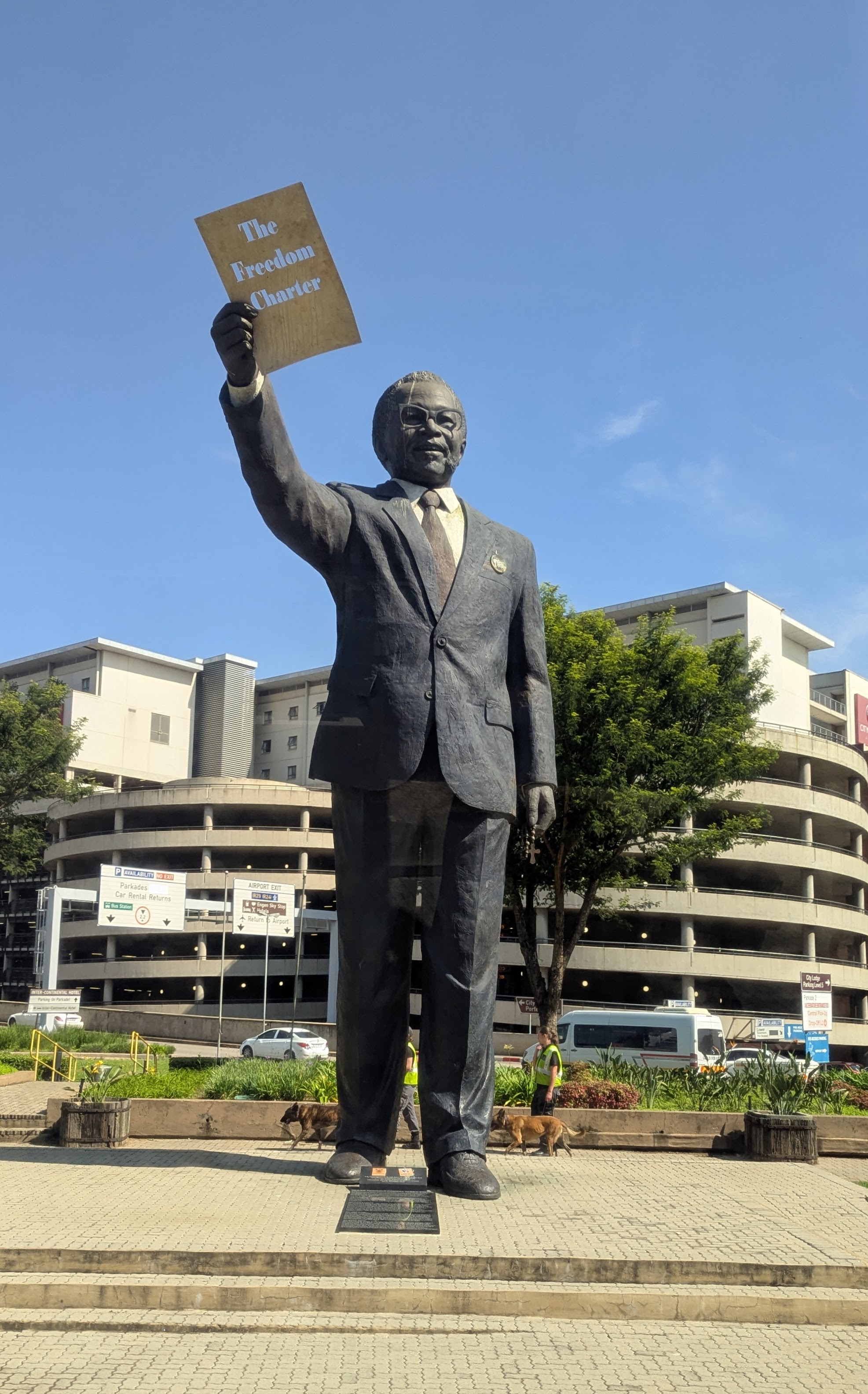
We landed at about 08.30, and soon got through OR Tambo Airport quickly. It is named after Oliver Tambo, one of the founders of the ANC. They have a colourful statue of him on the approach to the airport.
In the lobby we were met by Ian Dove and Lizwe from Riviera Travel . Ian is our Tour Manager from Capetown and Lizwe Ndlovu is the Local Guide from East London.
There are only twenty people in our tour group, with an average age about the same as Julie and me. It’s likely that we will manage to at least learn their names on this tour, and possibly make friends with some.
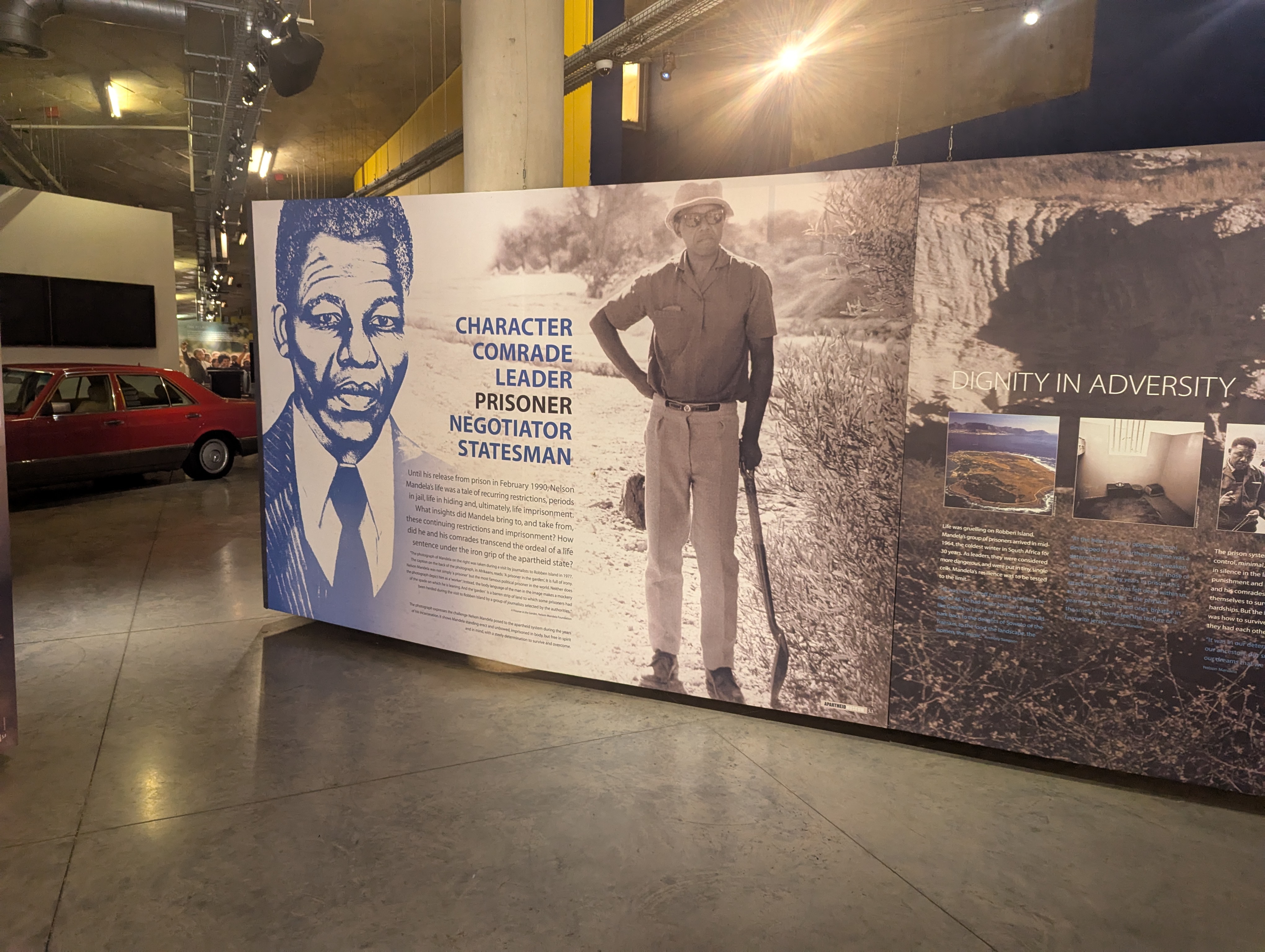
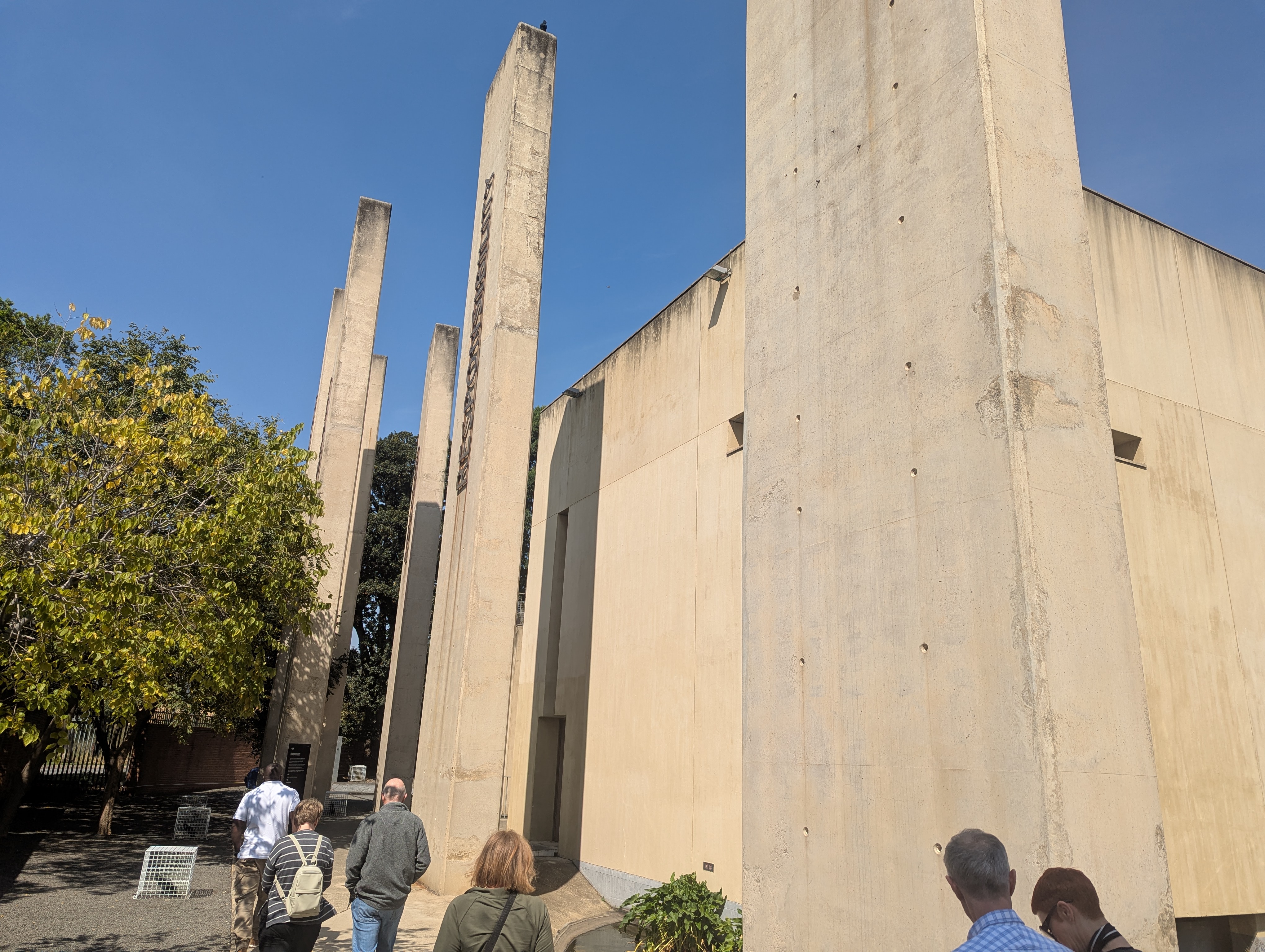
A coach took us to the Apartheid Museum, a purpose built concrete modernist structure next to a theme park. It told the history of South Africa, and the rise and fall of the Apartheid system between 1948 and 1994. Of course the life Nelson Mandela was a major part of the exhibition, and there was a room dedicated to Archbishop Desmond Tutu. It was educational and inspirational, which is what a good museum should be.
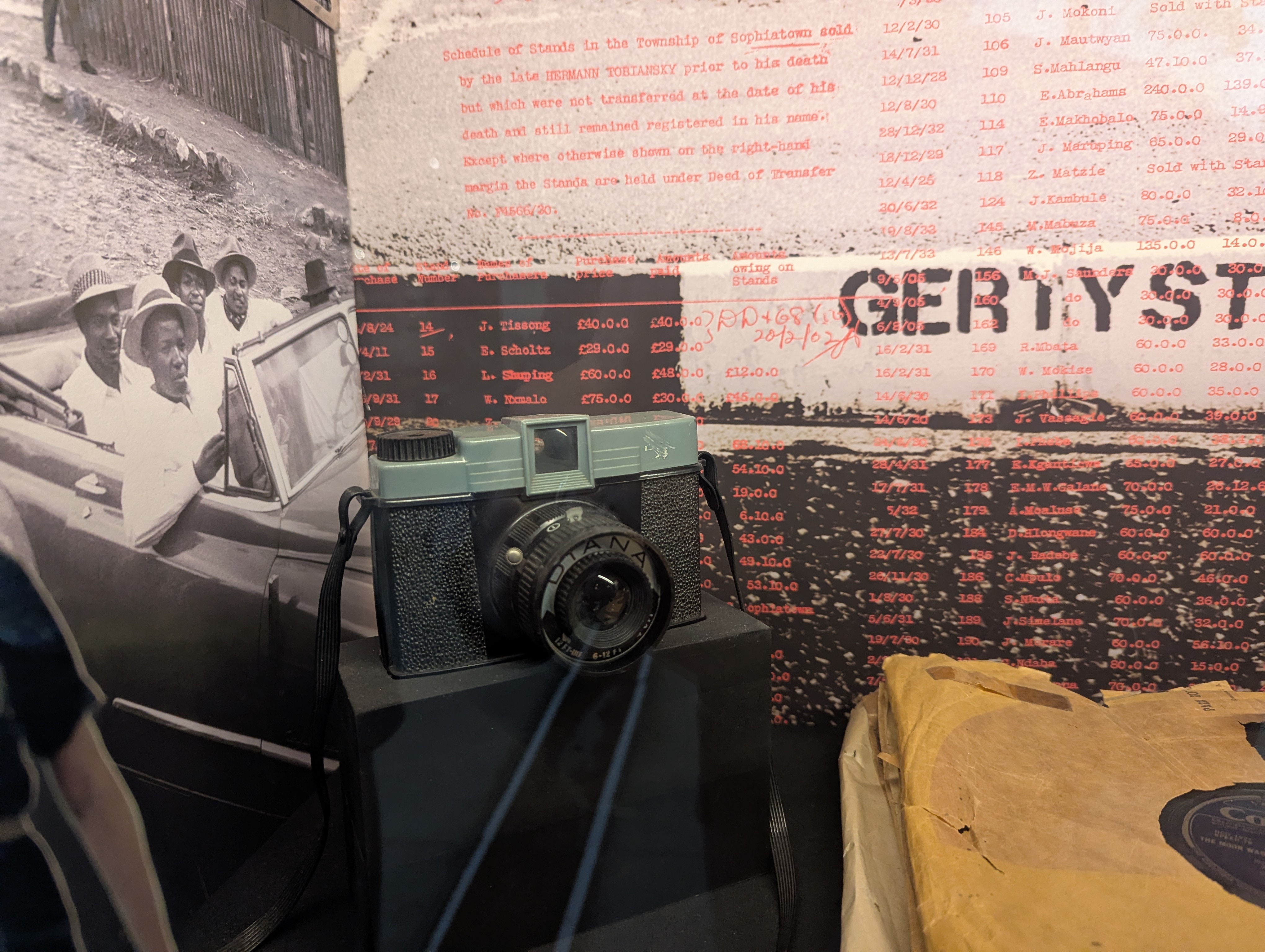
One of the items in the museum was a Diana camera just like the one I got (and still have) when I was seven! It is a cheap plastic 120 film camera Made in Hong Kong
It also had an excellent cafe where we have more coffee and start feeling human again. After a couple of hours, we got back on the bus. We went round the motorway to the Indara Hotel. We are staying there for the night. Close to the hotel were scores of minivans. These minivans are the main form of public transport for the majority of workers. Most workers spend fifty Rand a day travelling to work and back.
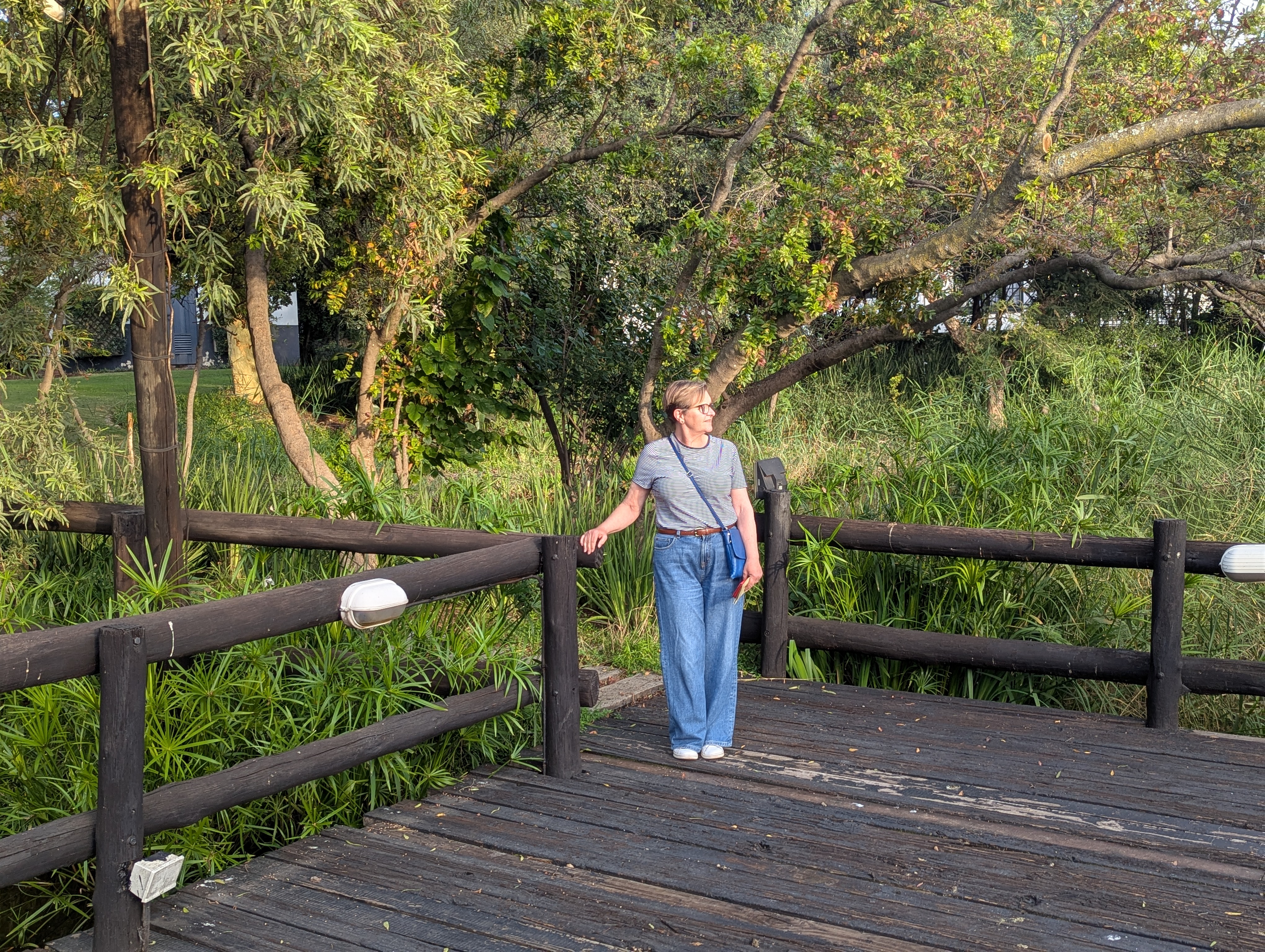
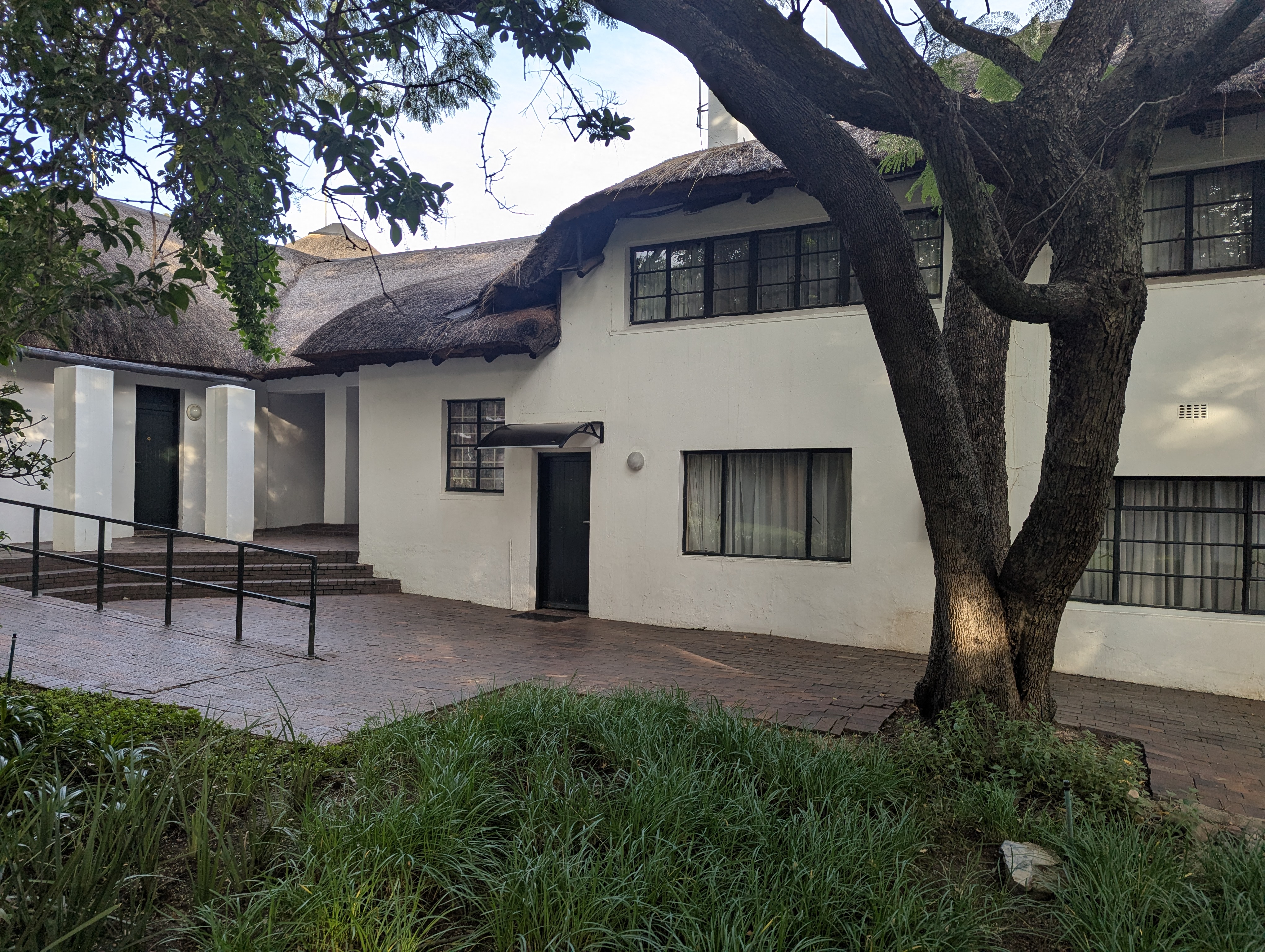
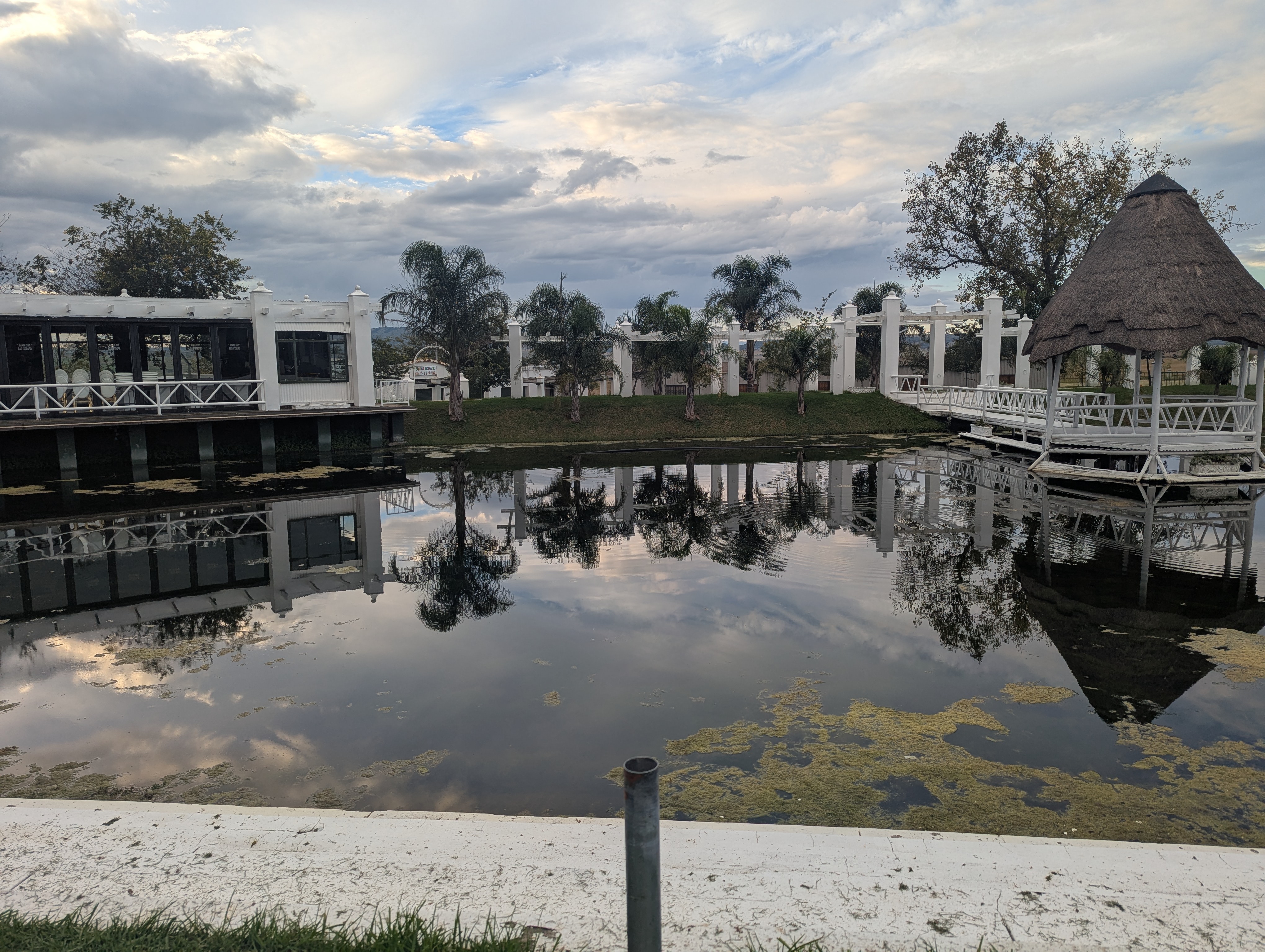
The Indaba is a sprawling hotel and conference centre. It is built of whitewashed low-rise blocks with thatched roofs. This makes it very picturesque and unusual. There are lots of staff who maintain the facilities and keep the gardens looking perfect. On the small map we were given it showed a lake with a dam, so we went to investigate.
The lake has big carp in it who splashed and dived away from us when we approached the bank. The surrounding trees are alive with birds, most of which I hadn’t seen before. There were several chicken-sized birds with long curved bills. Google Lens told me they were Hadaba Ibis. They were pecking at the lawn like pigeons or geese. There was a Cormorant in the lake and Parakeets zipping overhead. The buildings all had thatched roofs and were whitewashed, it was like being in Devon.
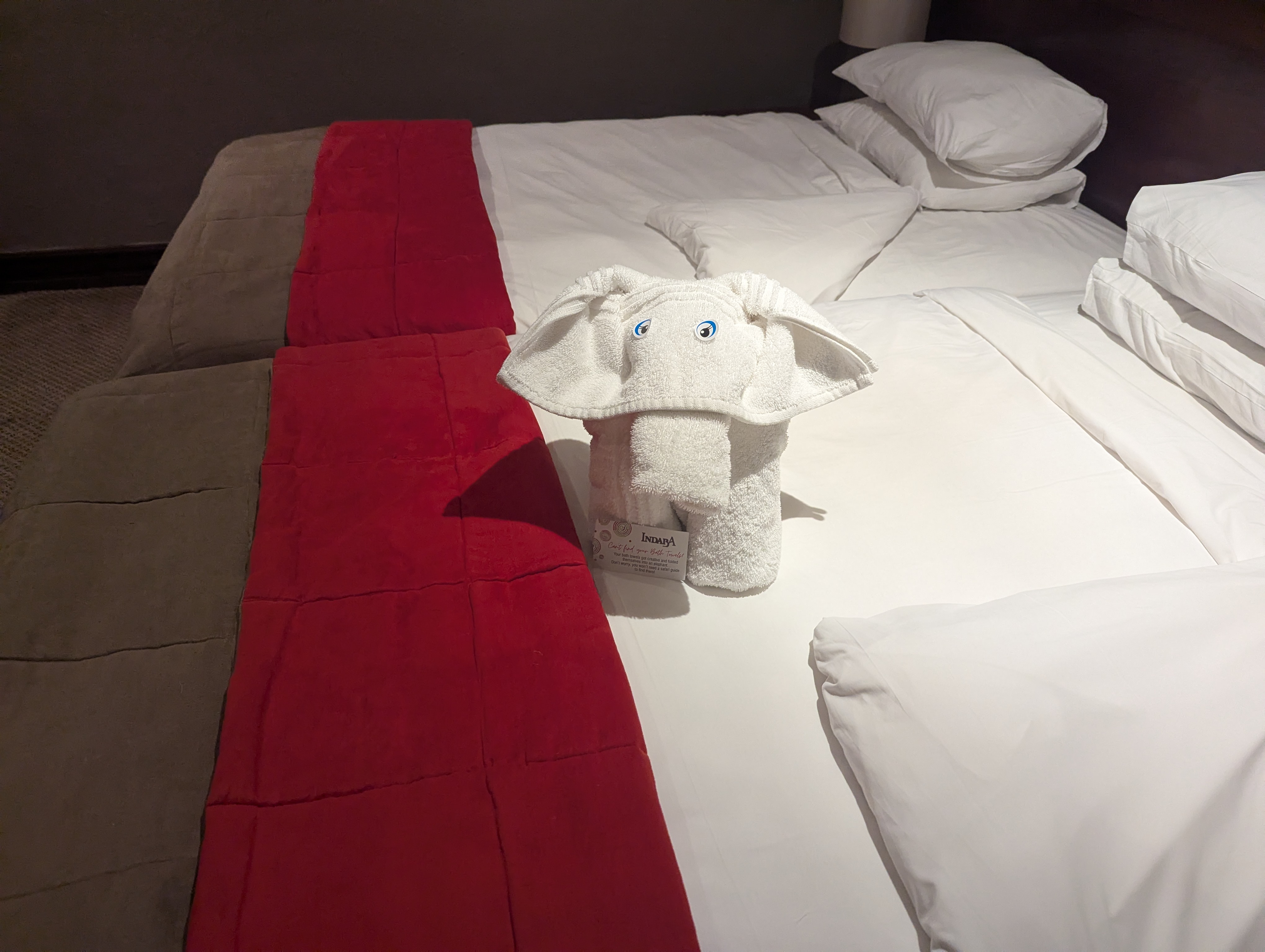
In the evening we went to The Chiefs Boma, which is a big African food barbecue buffet. It is served in a big dining hall decorated in kitch African style. There is a huge number of hot and cold dishes to choose from. If you are feeling adventurous, you can select local meat. A chef will then cook it for you on a grill.
So in for a penny, I had Impala, Kudu, Crocodile and Boerwors. It was like eating a National Park on a plate, and all of them were good. I know its a cliche, but crocodile really does taste like chicken, very tasty actually. To make it socially acceptable I had some salad with it. Merlot goes very well with big game.
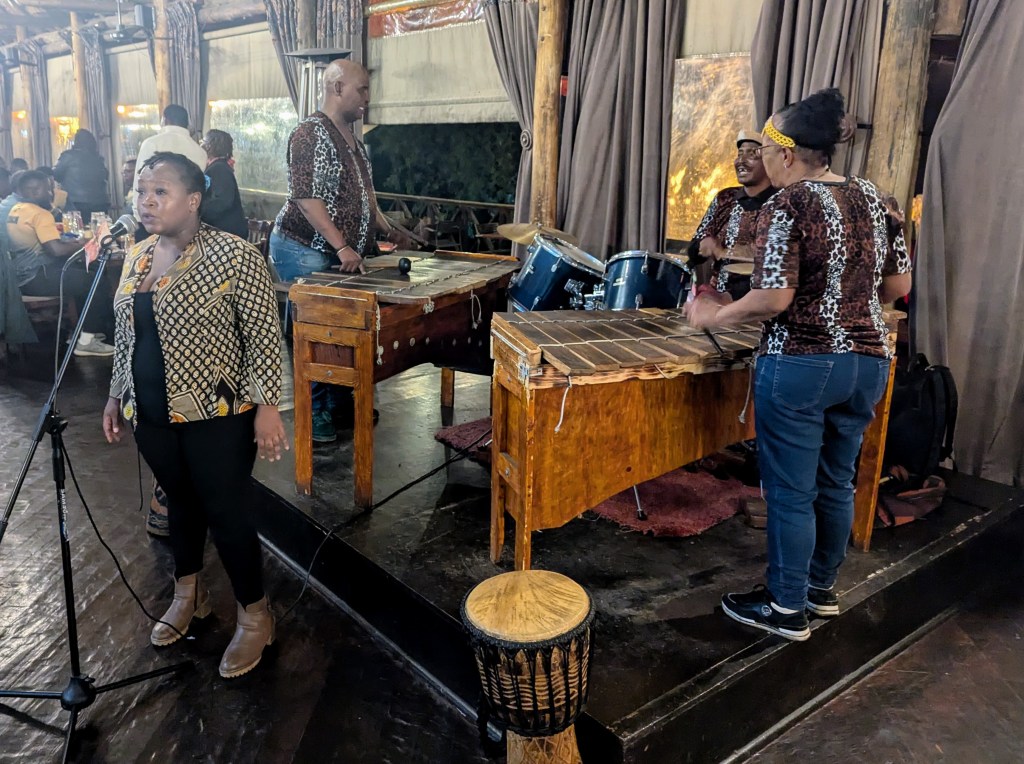
A local band played catchy music on xylophones with an excellent singer. Of course they played Wimoweh, and Debbie from Stafford who was a bit tipsy got up and danced with them.
Tomorrow (Friday) morning we are getting up at stupid-o’clock to drive on the coach to Kruger National Park.
Back to Top Menu
Across the Veld to the Game Park
Thursday 17 April 2025
Our alarm went off at five and we got our stuff together for travelling. At the breakfast buffet they had EVERYTHING, and my resistance is low. It was all typical British hotel buffet food: bacon, sausages, beans, eggs plus those very naughty fresh pastries. Its was much too tempting.
We got on the bus at 5.30 for our drive to Kruger National Park. It was a long way on moderately good roads. It was also Good Friday Bank Holiday, so the roads were busy with holiday makers getting out of Joburg. The ring road showed the contrasts of the city. We passed townships where poor black people live in tin shacks. There is 35% unemployment in South Africa, so poverty is very widespread. Not far from the poor township was Steyn City. It is an entire suburb for the wealthy, enclosed by walls and barbed wire. It resembles one of those Soviet secret cities where they created rockets and H bombs.
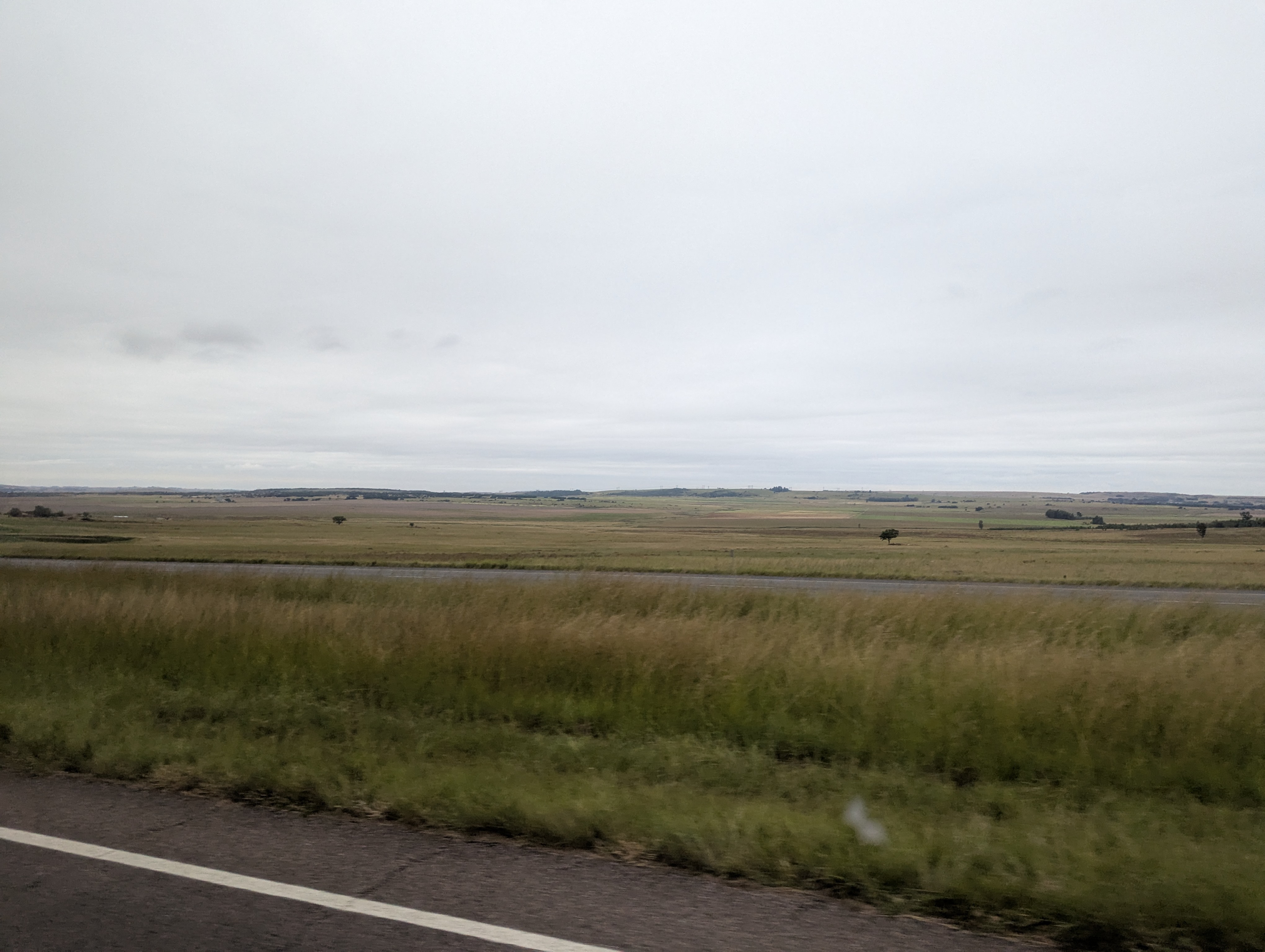
The journey largely took place across the High Veld. It’s a 2,000 metre plateau of rolling hills. The area is sparsely populated with clumps of trees and occasional bored looking herds of cows. Its a really dull featureless landscape like the high moors of Bodmin or some of the high Peak District.
The area is rich in coal seems, and we passed several mines and many many coal trucks. They a huge vehicles which tip sideways along the long axis, and they all have a huge trailer. They are so heavy they damage the roads. The High Veld is the powerhouse of South Africa. It has 14 power stations burning coal. The renewable revolution hasn’t reached South Africa yet. I saw very few windmills or solar panels. I suppose the coal is very cheap. They don’t care about sustainability.

We stopped for lunch is Dullstrom, which is a strip of restaurants where people go for the trout fishing. It was busy with people enjoying their Bank Holiday break, particularly local farmers in big pickup trucks which they call “bakkies”
We started heading downhill towards the Low Veld after leaving Dullstrom. We moved from a desolate plateau to a more Mediterranean climate zone. The highlight of the day was a stop at the Blyde River Canyon. The coach took a side road to a small collection of souvenir shops and a restaurant. The coach parked and we walked for five minutes along a concrete path through the bush to a fence. Beyond was a precipitous drop down to the Blyde River. There was a spectacular view of a vast canyon. It is the second biggest in Africa. The walls of the canyon are clad in green, so it is quite different from the Grand Canyon. At last I felt I was in Africa! The view point is called Three Rondavels, named after three hills that look like round African huts.
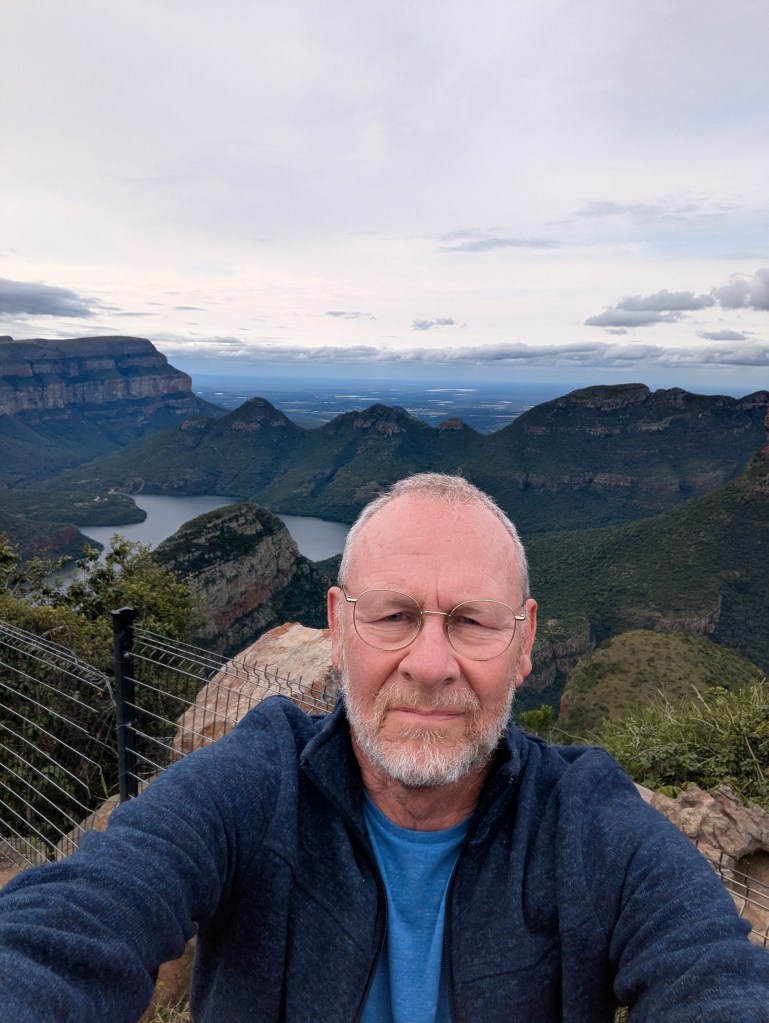
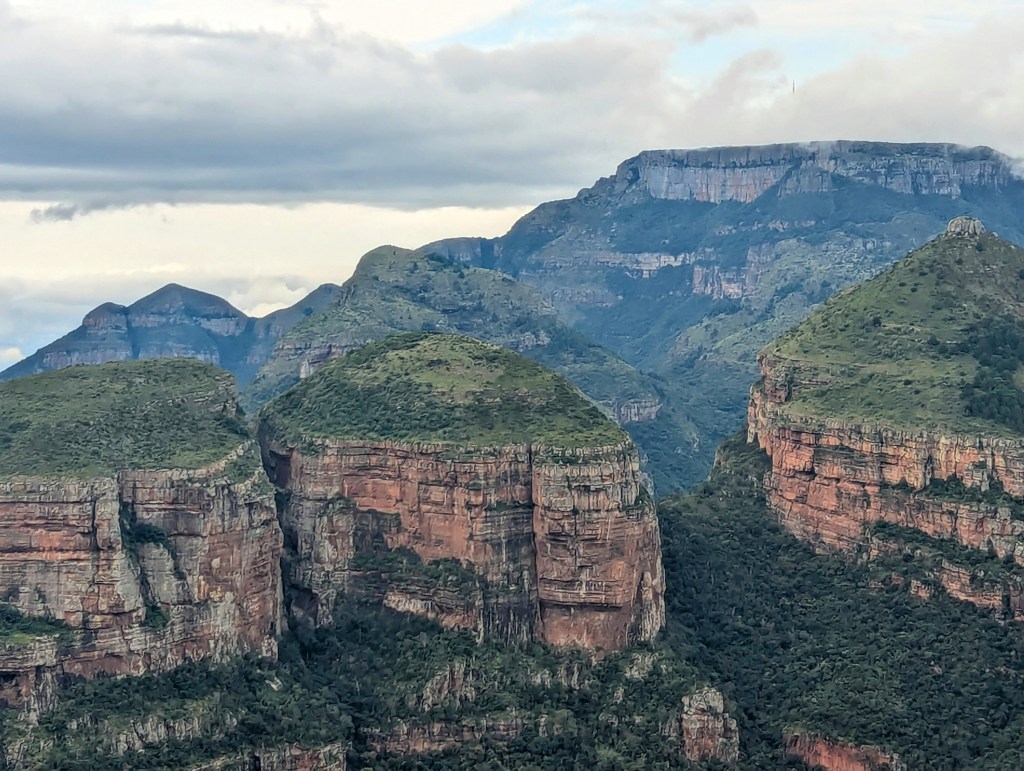
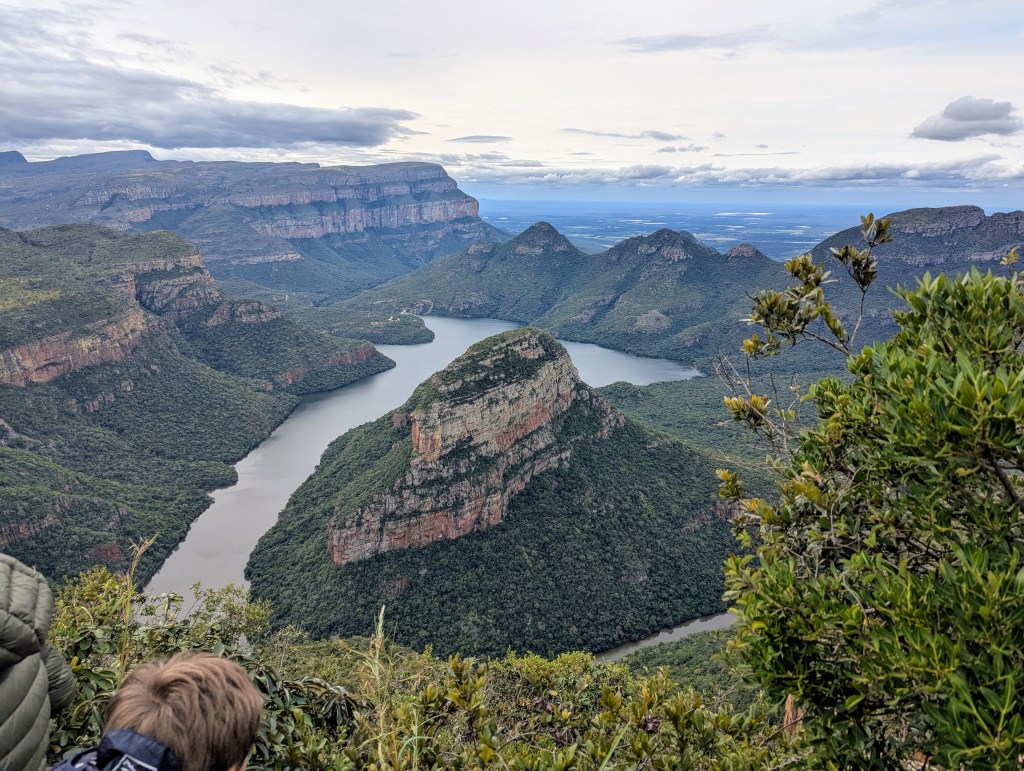
From there it was only just over an hour to our next hotel next to the Kruger National Park, which is “the size of Wales”. The coach passed through huge forests of pine and eucalyptus, which looked like Germany. neither of these trees are native to South Africa, but they produce valuable fast growing timber. That was followed by plantations of citrus fruits and avocados, and finally bananas. South Africa is very productive of everything good to eat.
Our accomodation is the Hippo Hollow hotel, which overlooks the Sabie River near the town of Hazyview. We are in another “thatched cottage”, fifty yards from the river which is home to hippos and crocodiles. It’s a good job I don’t sleepwalk.
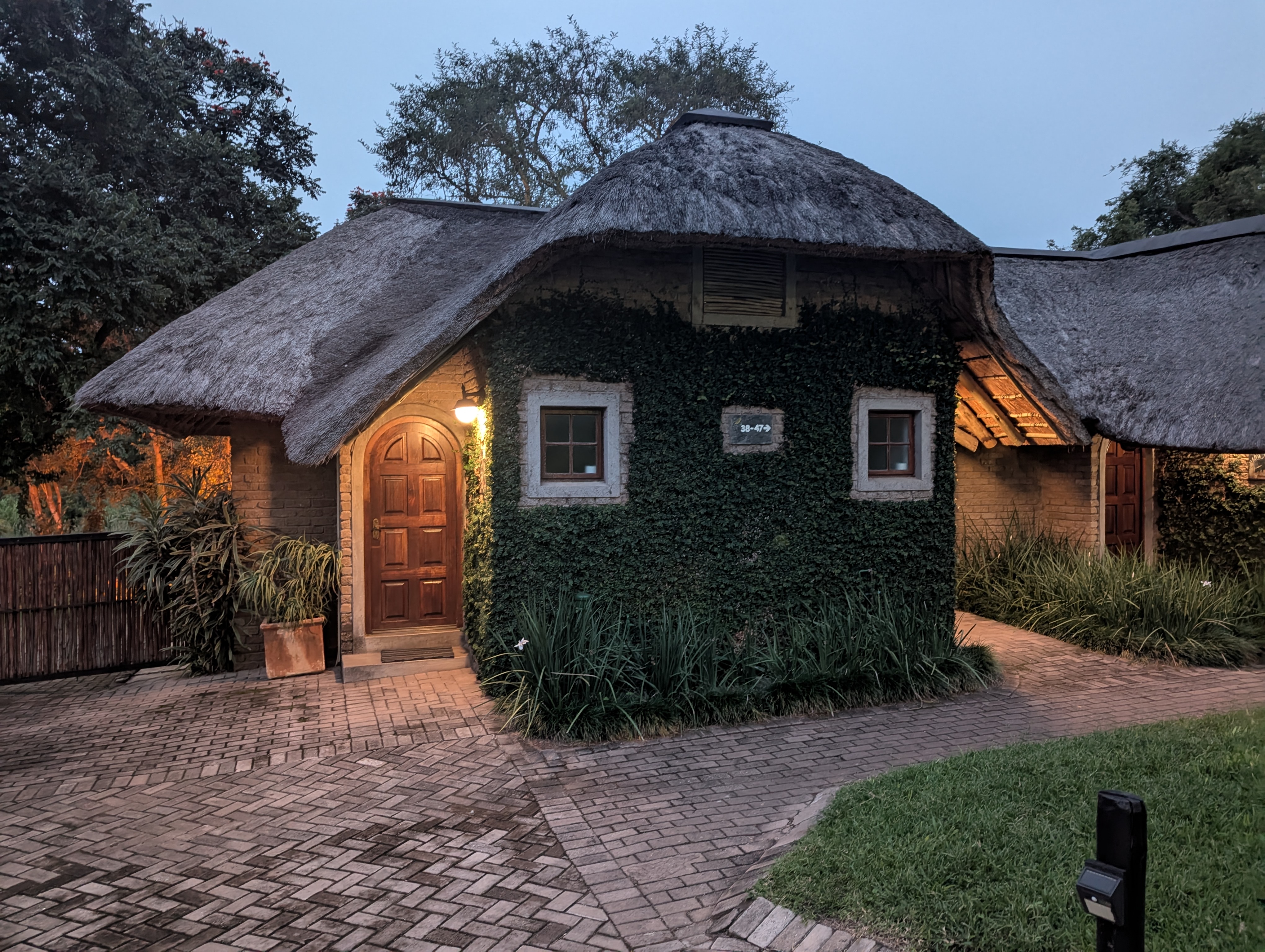
We had a Mojito cocktail on the terrace followed by a massive buffet dinner. It was bloody marvelous washed down with a bottle of South African Pinotage.
Safari in Kruger National Park
Friday 18 April 2025
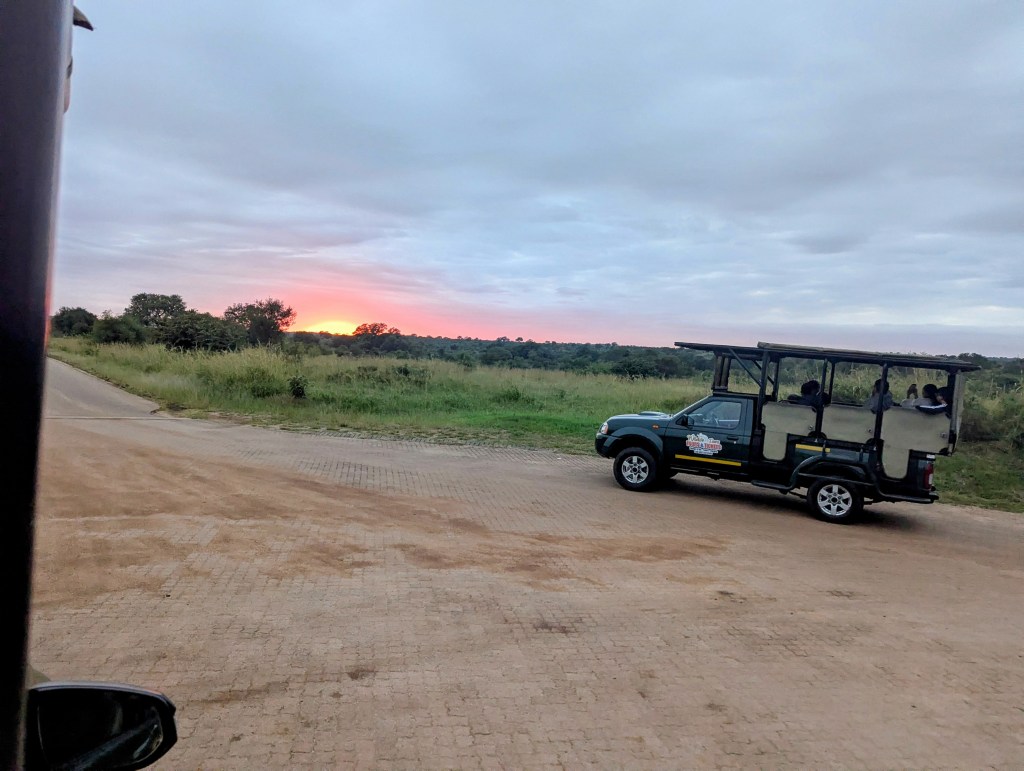
The knock on our door was at 5.45 am, urgh. We met our companions at 6.20 and got a quick cup of coffee and picked up our “breakfast bag”. Our Megacoach (28 seats, so not so mega) took us to the Phabeni gate of Kruger National Park. There we transferred to Toyota Hilux trucks with a high back and canopy and three rows of seats. Our Ranger was Andrew, who was swaddled in an anorak and woolly hat.
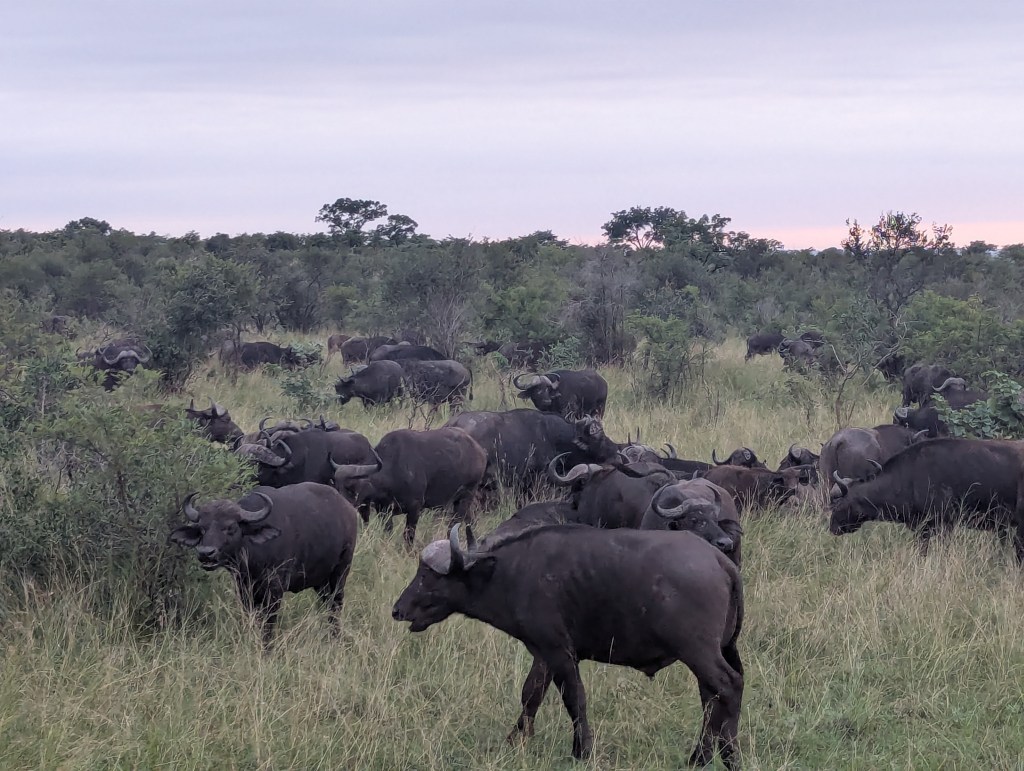
He set off at a good pace and the cool morning air whistled through the open truck. We were grateful for our layers of clothing, and some wish they had brought more. We soon started seeing wildlife as the sun started rising. Hyenas in the grass, Cape Buffalo (one the most fierce animals) grazing in a herd. Then Wildebeest, Impala, Hornbills, and then a top-notch spot. In the crotch of a tree a Leopard was sitting next to the carcass of an Impala. Leopards will catch one every five days or so. When it starts to decay, they will leave it for the Hyenas and Vultures.
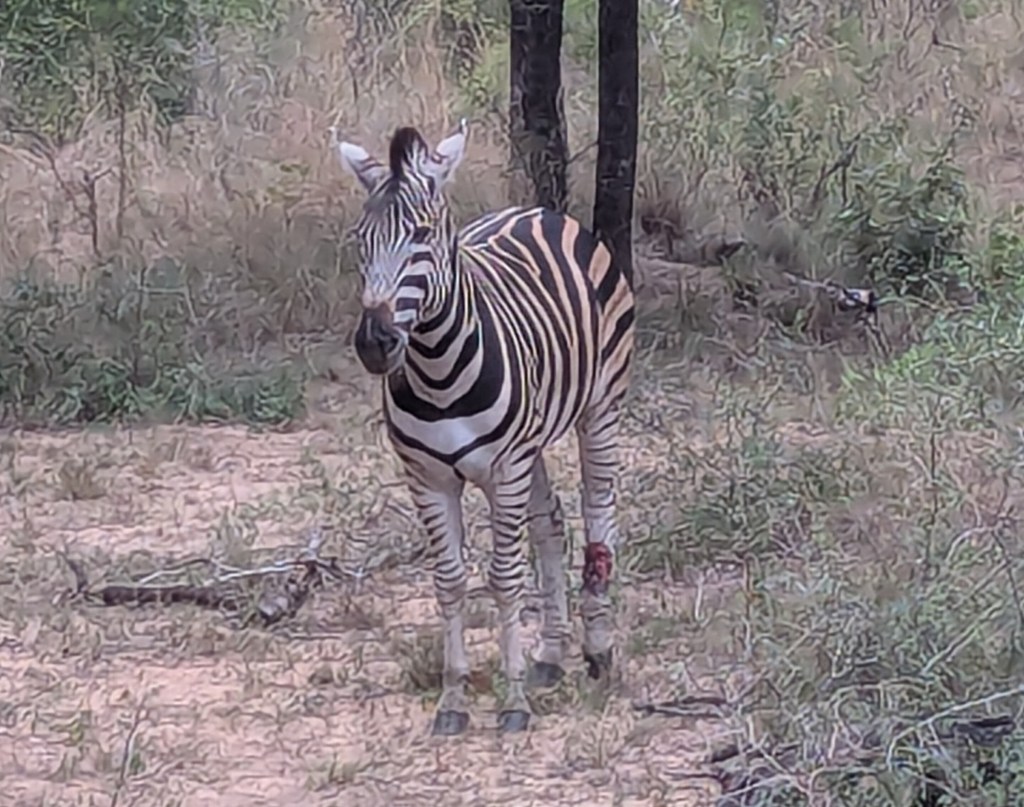
Andrew was constantly talking to other Rangers to find out where animals had been spotted. He would race ahead to find a good viewing spot. Burchell’s Zebra, Kudu, and then a herd of Elephants crossing the road. They are all females and juveniles, since adult males live on their own. Giraffes came striding through the tall grass and Baboons with their intimidating canine teeth sat by the road.
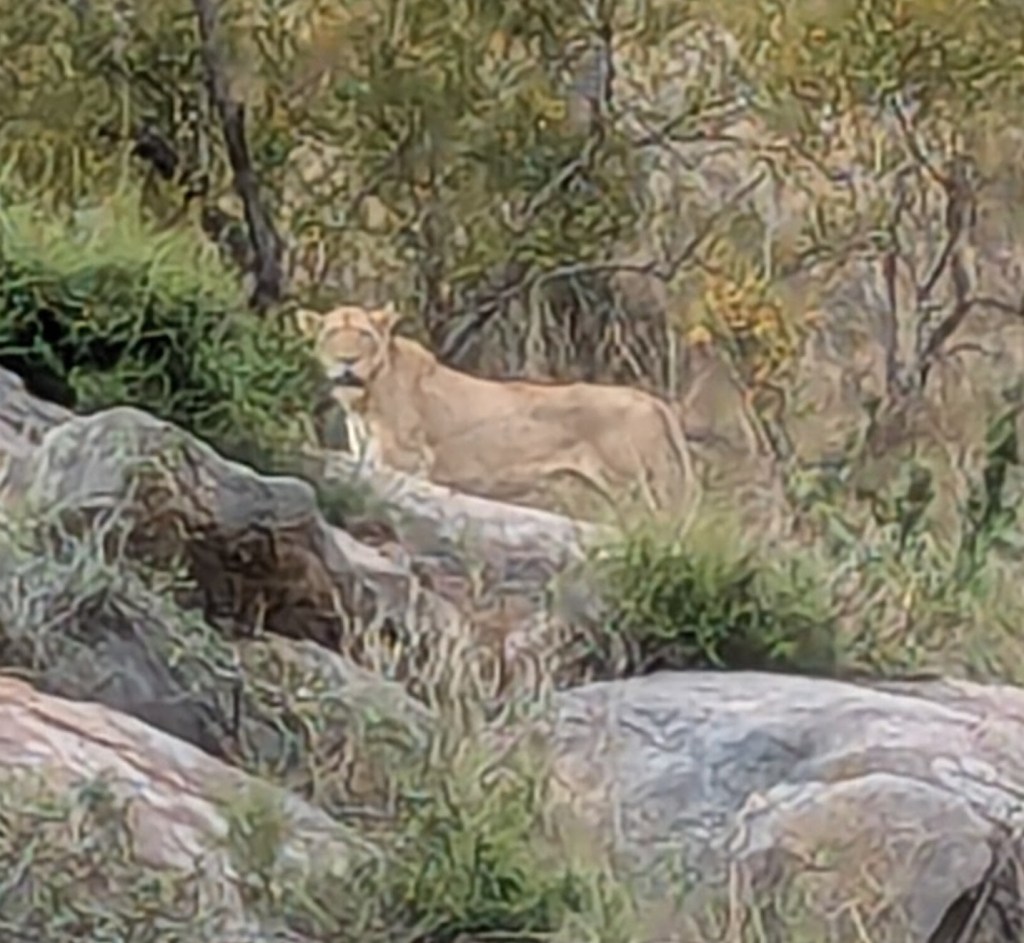
The landscape was mostly flat. The vegetation consisted of grasses a few feet tall. There were shrubs up to about eight feet and then trees. Many of the trees were bashed about by elephants. Occasionally there were small rocky hills with boulders of rounded granite, we have all seen hundreds of times on documentaries. The Ranger stopped abruptly at one small hill. He pointed out a female lion walking up the hill. It was like a scene out of the Lion King.
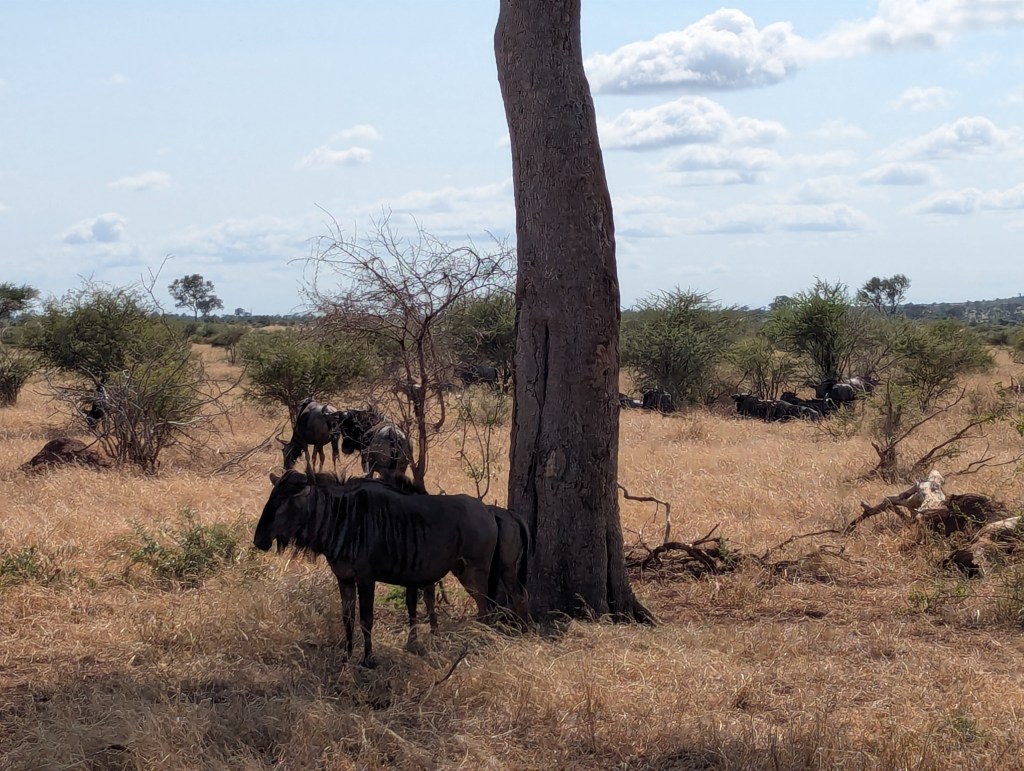
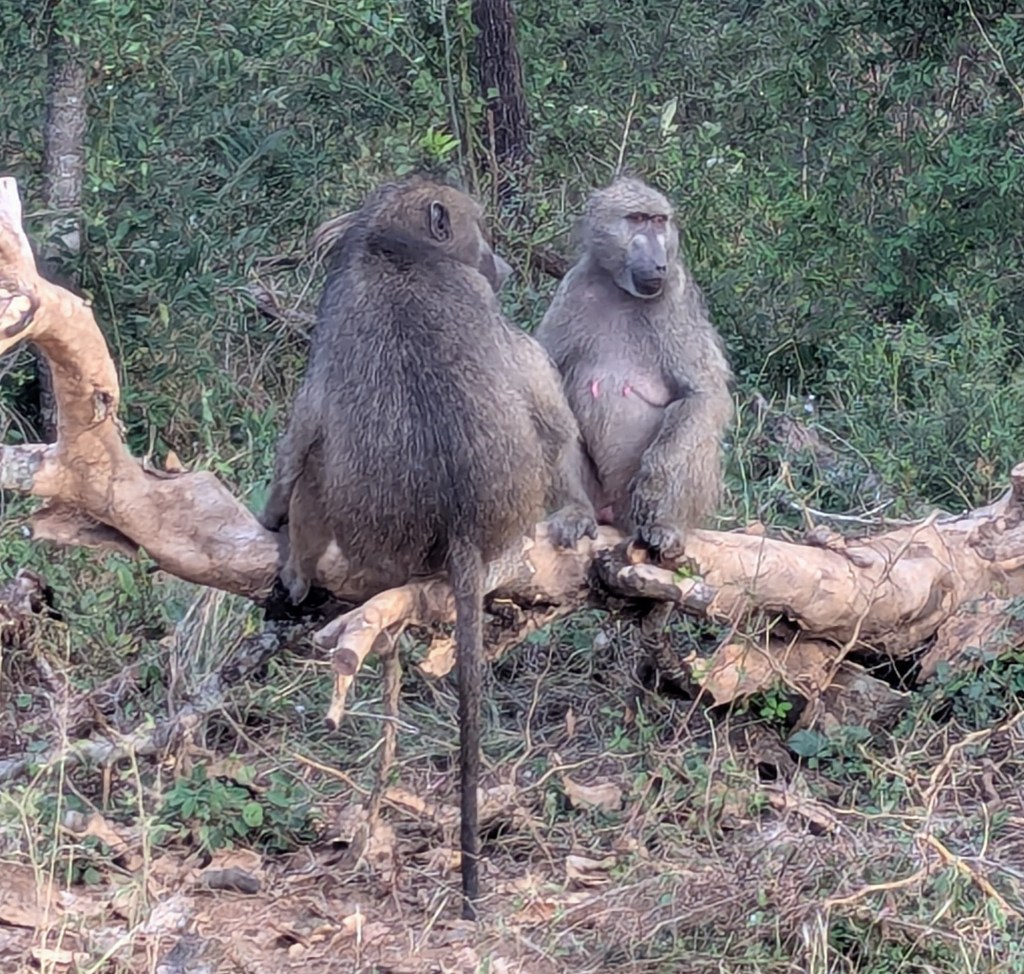
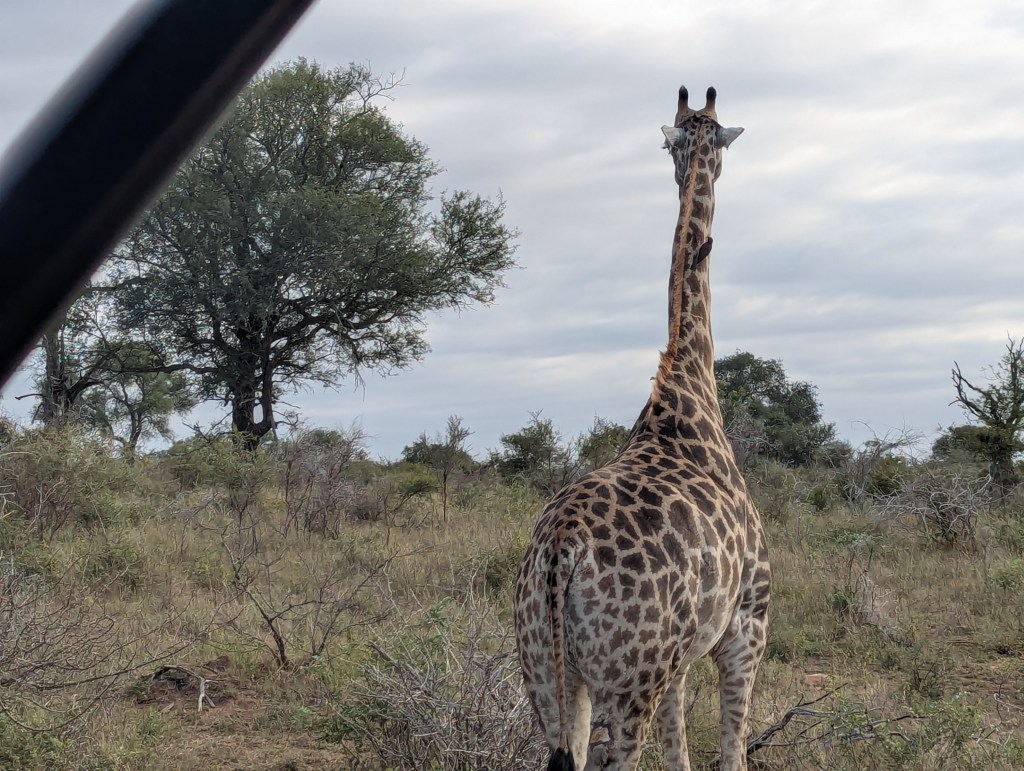
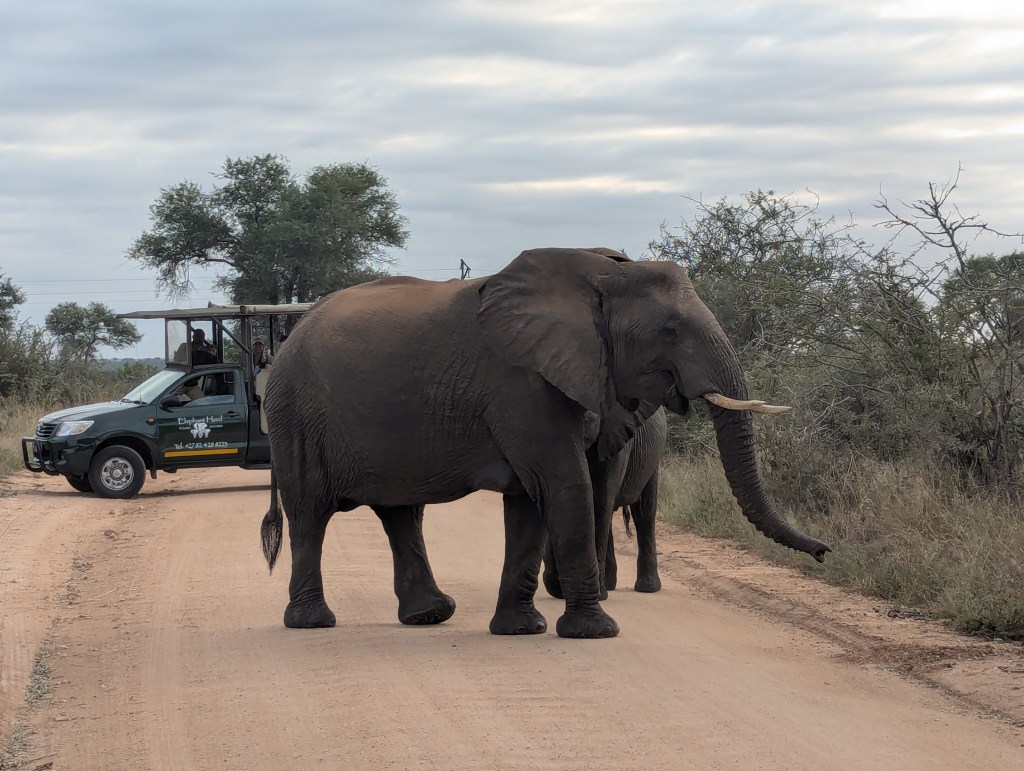

We stopped for lunch at Scakuza Safari Lodge and opened up our packed lunches. The bags contained cheese sandwiches, not my favourite food, so I gave them to the Ranger Andrew.
Seeing all the animals in context is very different to seeing them in a zoo. It is much better to watch a pride of lions walking along a sandy river bed. This is more enjoyable than seeing them sleeping on a log in a cage. It’s a thrill to let a herd of Elephants cross the road and see Impala bouncing around like spring lambs.
Our drive finished at 2pm. We had spent eight hours spotting animals and birds. The Ranger kept the 4WD in third gear on dirt roads.
Back at the hotel, we relaxed on our balcony overlooking the Sabie river. We looked for Hippos, which live there, but saw none. Dinner was a carvery buffet, and I ate too much, I was a Hungry Hippo.
Graskop Gorge Elevator
Saturday 19 April 2025
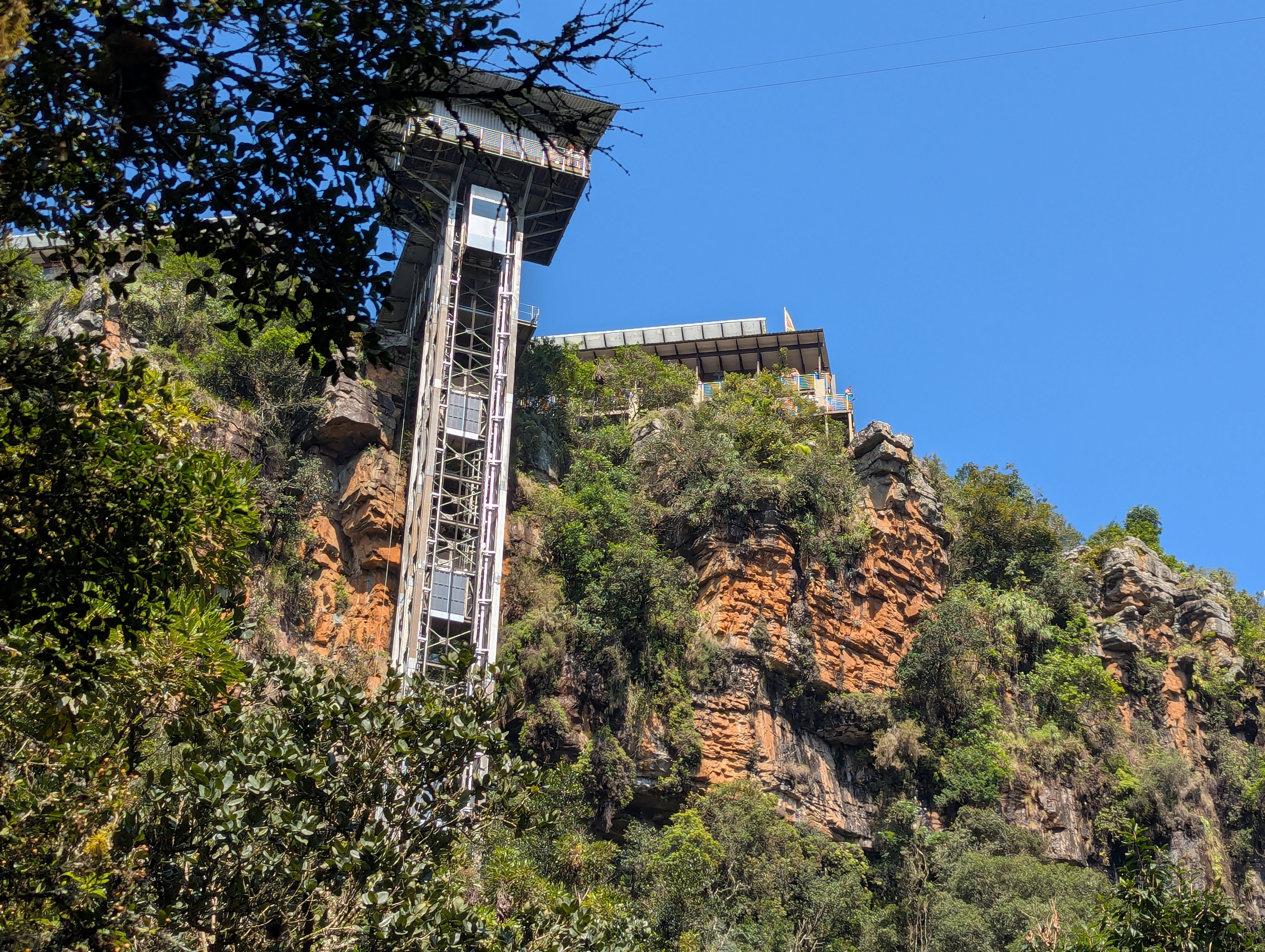
A thirty minute mini-bus journey from Hippo Hollow is the Graskop Gorge. Our Riviera guide book described it as “a fifty metre ride down a lift into a gorge. It has rare indigenous forest and a walk at the bottom.” This description didn’t make me shiver with anticipation. However, we don’t have anything else booked for the day. We joined the bus at 9am.
The attraction had a big car park with several young men telling people where to park. It appears that in South Africa there are always many more people than necessary fulfilling roles. Unemployment is so bad, job creation is crucial to keep people above the poverty line.
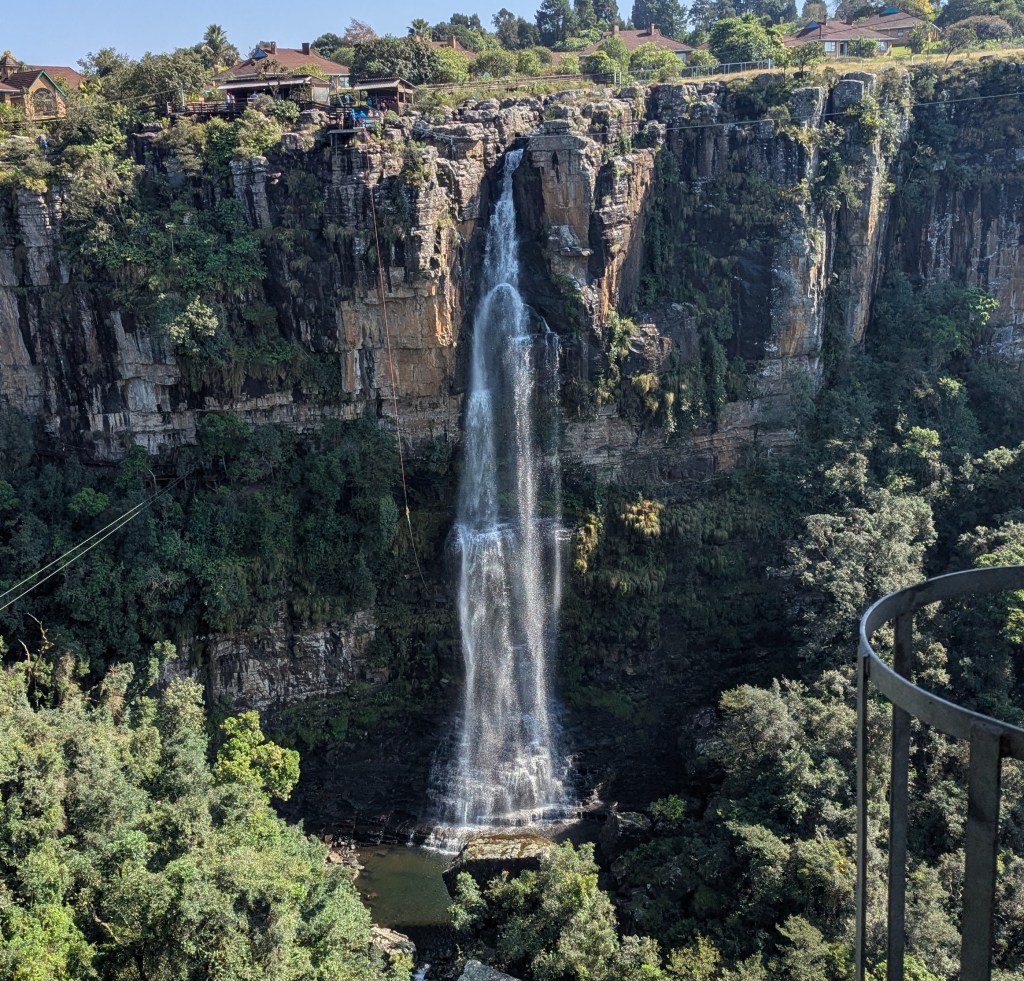
Our genial guide Sisyfo took us into the reception and straight to the lift. All eight of us got into the lift. It took us to the base of a gorge about 70 metres across and 50 deep. On the opposite side, a spectacular waterfall cascaded into the river at the bottom. This river is part of the Blyde River canyon we visited a couple of days ago.
Crossing the top of the gorge were two zip lines, with visitors whizzing across. A platform at the top of the opposite edge of the canyon was the starting point for the “Big Swing”. Intrepid visitors put on very secure harnesses and walked backwards to the edge of the platform. They were secured to a cable connected to the midpoint of a cable which tightly crossed the gorge. When they stepped backwards off the platform, they plunged down for a second or two. Then the cable gained tension. They swung from the centre position. When they came to a halt they were gently let down onto another platform. Some were screamers, others were stoic. They were all entertaining.

My group walked six hundred metres around the base of the gorge. We did so on a wooden boardwalk through dense, damp tropical forest. The waterfall creates a constant high humidity ideal for mosses, ferns, epiphytes and other water loving creepers and trees. I absolutely loved it, it had a proper Jurassic Park vibe.
We went round twice. We enjoyed reading the many explanation boards. They tell the full story of the gorge over hundreds of millions of years.
We got the lift back to the top. Then we had a coffee. Afterward, we crossed a suspension bridge to watch the Big Swingers close up. It was great fun watching them plunge backwards into the abyss.
Back at Hippo Hollow, we had lunch. We watched people riding elephants on the other side of the Sabi River at the Elephant Sanctuary. It was a wonderful view.
In the afternoon we spent a very pleasant couple of hours by the swimming pool enjoying the afternoon sunshine reading out Kindles
Our room overlooks the hotel lawns and Sabi River. So I could see Habana Ibis feeding on the lawn and hear the very nearby main road. It sounded like the A316 back home in Twickenham.
This is an awesome place, I feel very privileged to stay with so much natural beauty.
Journey to the Battlefields
Sunday 20 April 2025
We woke up early again. We left Hippo Hollow Hotel at 8am. Our destination was the battlefield of the Zulu wars in the 1870s. To be honest, I wasn’t excited about the eight-hour journey. However, visiting the battlefield is part of the tour.
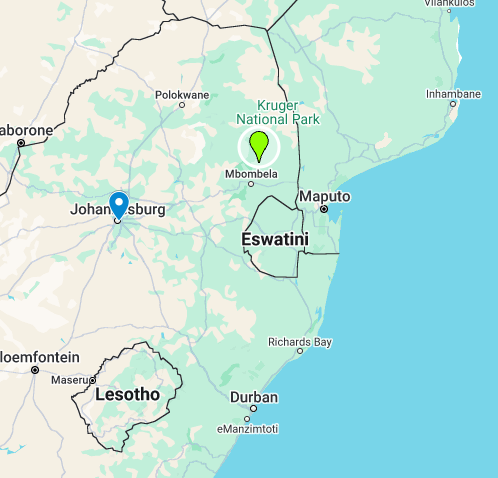
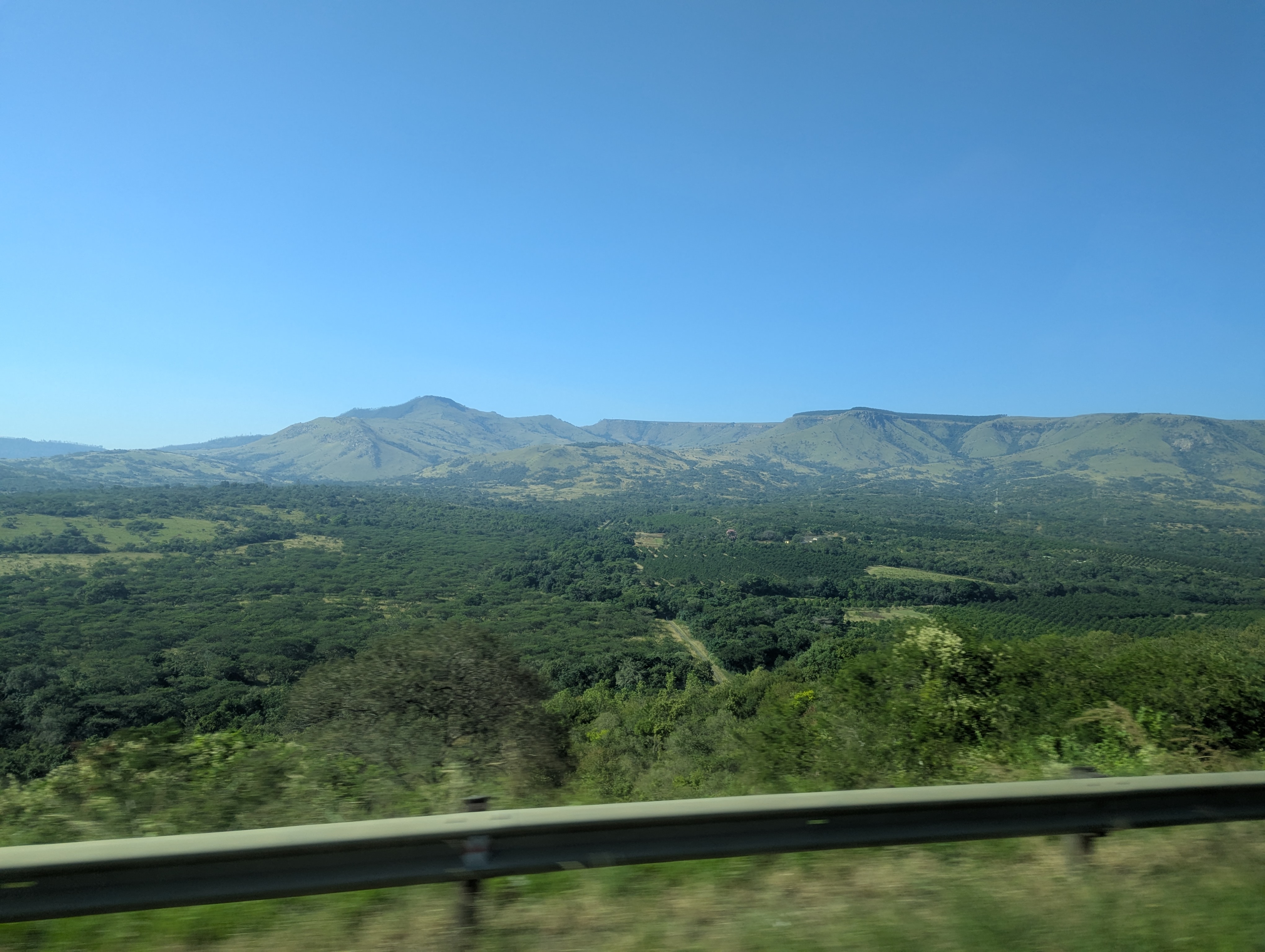
The initial part of the journey was very enjoyable through Hazyview, to White River and then Mbombela. The countryside was forest clad mountains and lush river valleys with plantations of bananas, avocado and macadamia nuts. There were miles and miles of pine and eucalyptus forests. Each tree stood no more than a couple of metres from its neighbour. Our guide yesterday said only baboons live in the forests, no other animals.
Those towns looked prosperous with many shopping malls and fast food outlets, almost looking like the USA. Shopping malls can be made secure with walls and fences, and heavy security. The contrast between the prosperous white towns and the black townships is quite stark and worrying.
Then we started getting higher and higher towards to High Veld that we had passed through on Friday. The forest was replaced with open dry grassland with occasional clumps of trees. After two hours of driving we stopped at Millys, a service station that was very busy with Bank Holiday travellers. After a quick coffee we pressed on through the undulating grassland, which reminded me of the American Prairie. It didn’t appear to be very productive. There were a few farms and herds of cattle. Most of it was empty of anything apart from grass. There were scattered trees, but few birds and no other wildlife.
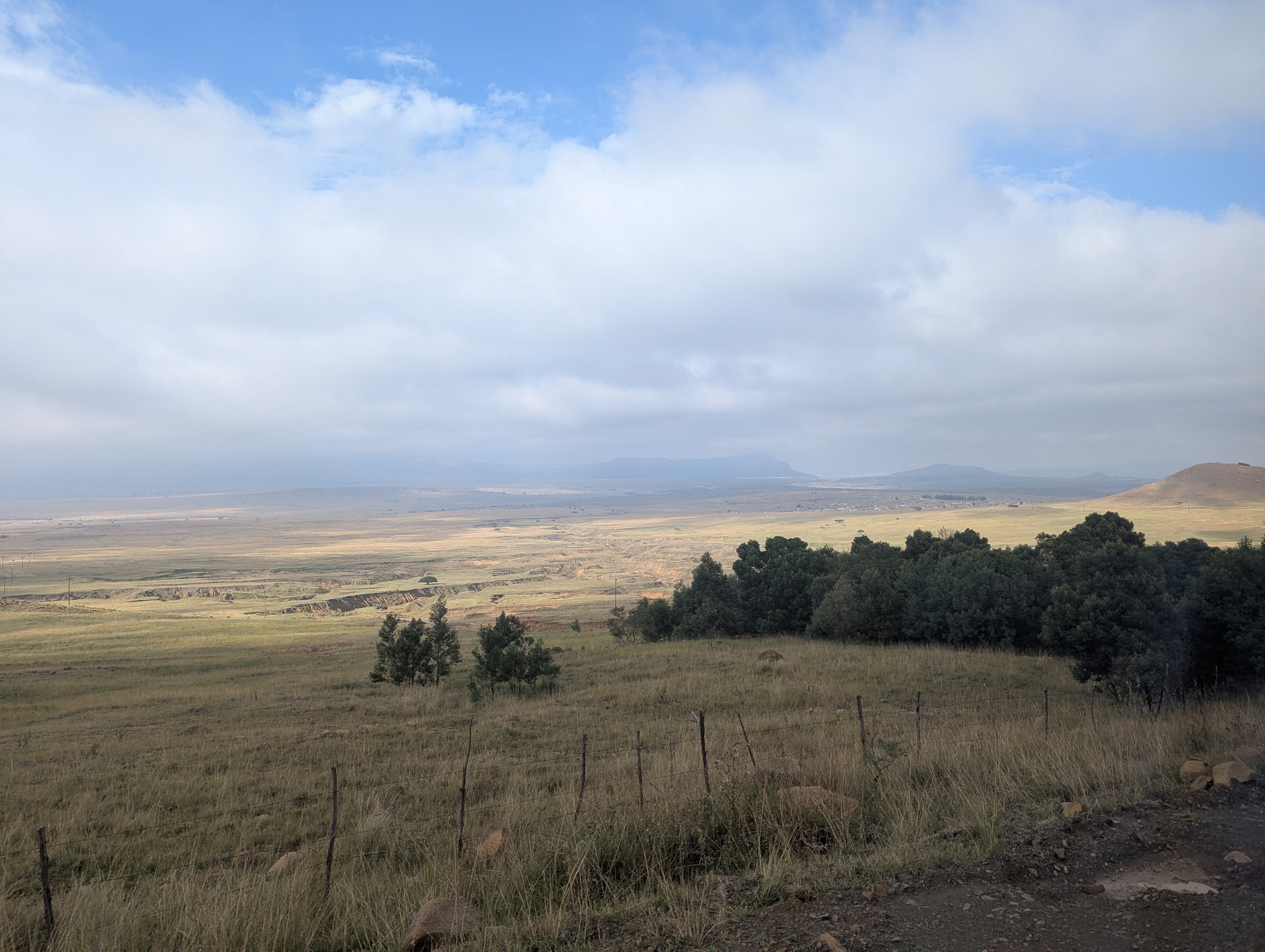
The poor black people live in small houses provided by the government: two bedrooms, a kitchen, living room and toilet. The better ones are made of cement blocks, others are simply corrugated iron. Occasionally I see one or two people walking down the highway, perhaps they have no other means of getting around.
The next town was a crossroads settlement called Ermalo, and then to Volkrust for lunch at a petrol station with a cluster of fast food places and decent toilets. It’s a bit rough compared to Milly’s, but served a purpose.
Not far from Volksrust we drove through the Laings Nek Pass, which is 1,680 metres (5511 fet) high, the highest point on the road between Pretoria and Durban. After it was much more High Veld with distant power stations and many huge coal trucks. In the days of sanctions against South Africa, coal was used to make liquid fuels to keep the economy running.
We drove through the small town of Dundee, then soon arrived at the Battlefields Lodge. It is on its own in the countryside and is a collection of accommodation blocks and a restaurant. Its more down market than previous hotels, but will be fine for a couple of nights.
Dinner was beef curry, simple but tasty.
The Zulu war Battlefields
Monday 21 April 2025
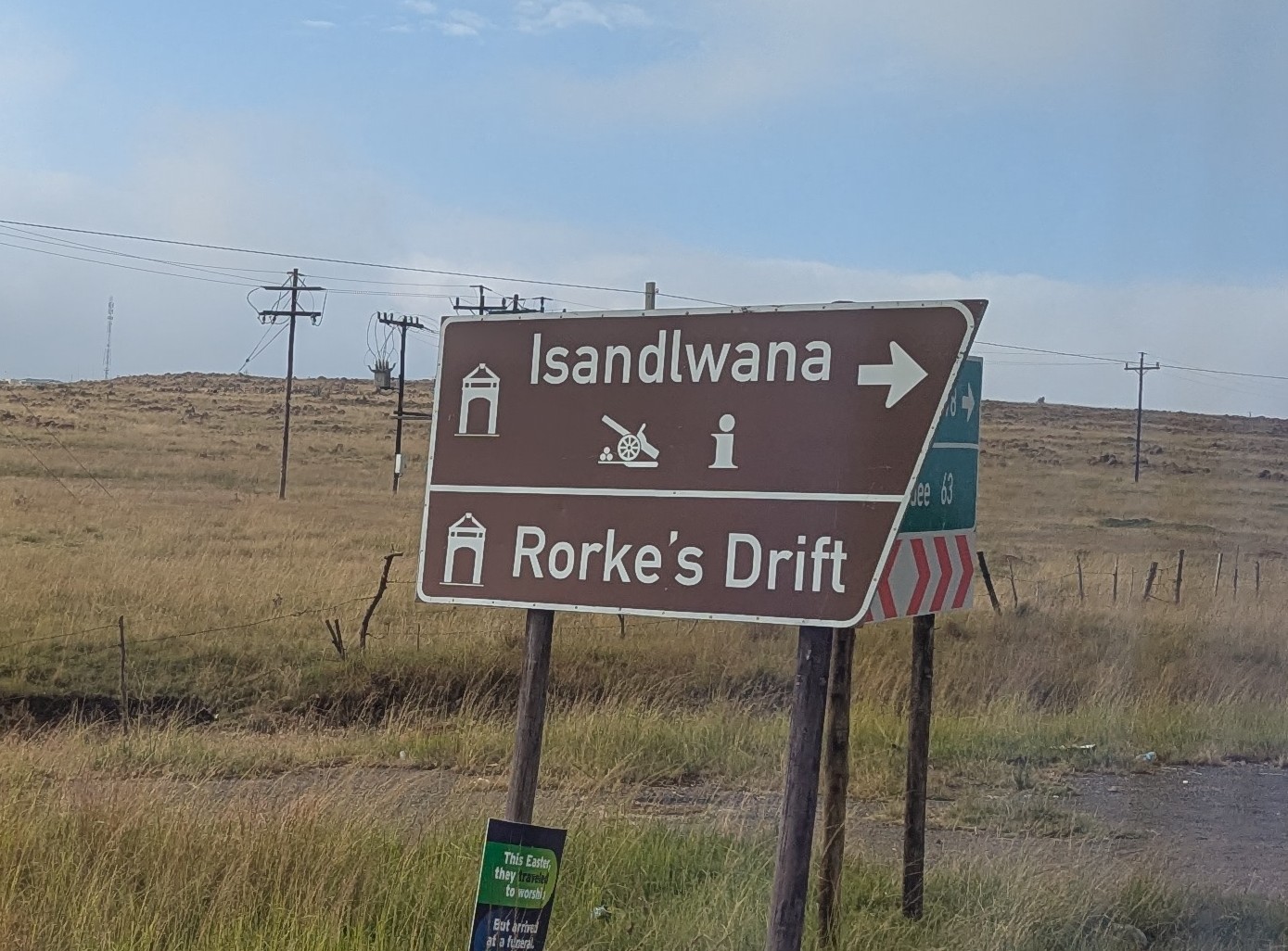
It was a misty overcast morning as we drove to Isandlwana, it is autumn here and the weather is changeable. We travelled an another older coach driven by Achmed, who is experienced is the very rough roads in Zululand. The road was long and straight. Villages of small square and round houses were spread out. They appear to be very poor. School children walked along the road wearing smart English-style school uniforms.
The last seven kilometres was dirt roads, with plenty of potholes. The landscape is boulder covered hills and flat bottomed valleys with many small streams wandering across. Cattle and sheep wandered slowly across the road, and Achmed carefully drove around them.
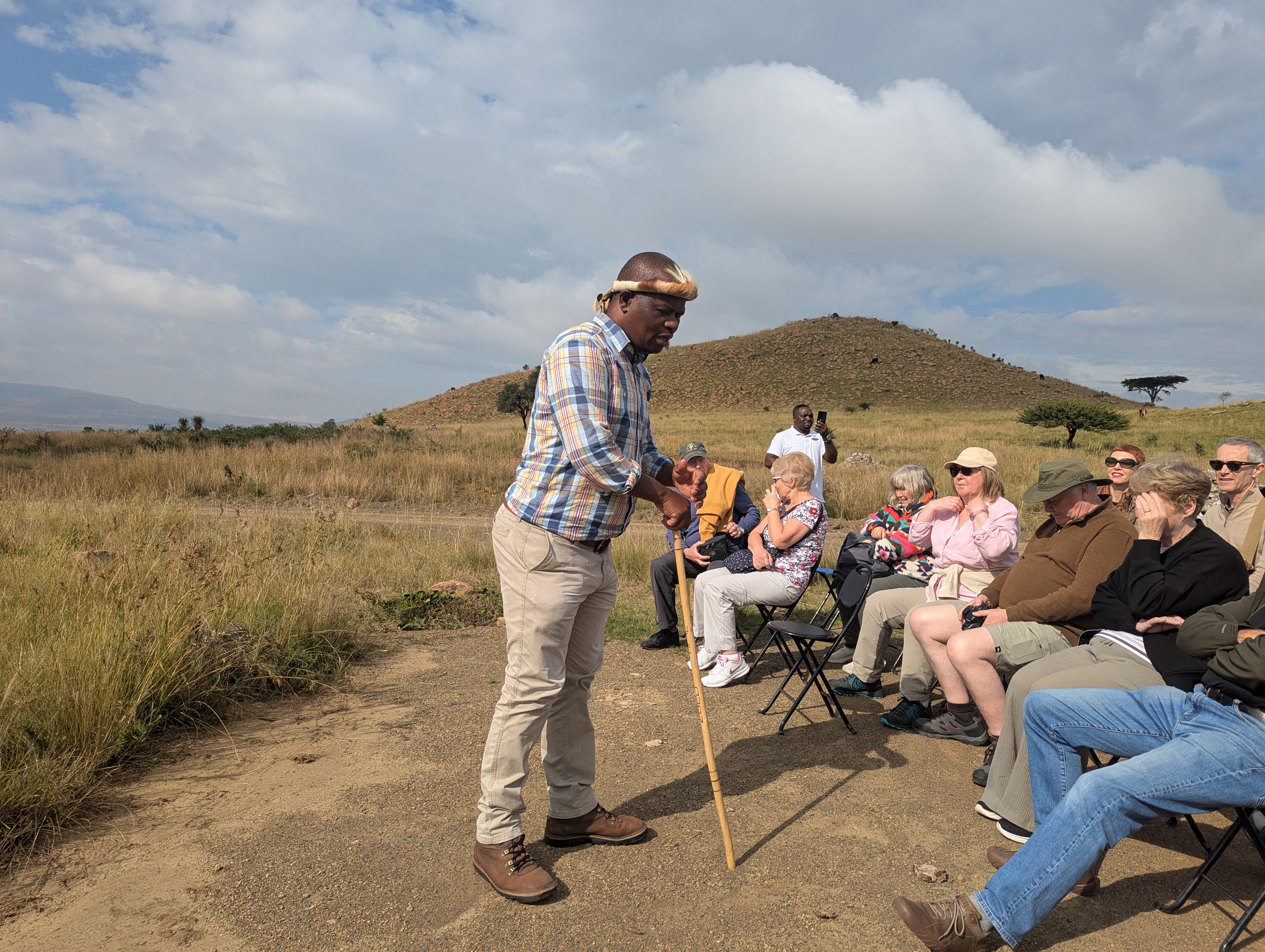
At Isandlwana, we were met by a local guide. He has a Zulu name, but he is happy to be called Dalton. He led us to some rows of folding chairs set out on the grass. They were in front of the hill where the battle took place. He told us all about it in an animated fashion. He was a coronet of cattle hide and had a stick that substituted for a rifle and a spear.
Dalton told us the story of the great battle on 22 January 1879. A badly prepared British army attempted to invade Zululand. They were wiped out by a very well trained Zulu army.
A Zulu force of some 20,000 warriors wiped out an opposing force consisting of about 1,800 British, colonial and native troops with approximately 350 civilians. The Zulus were equipped mainly with the traditional assegai iron spears. They also used cow-hide shields. Additionally, they had some muskets and antiquated rifles. The Zulus had a vast disadvantage in weapons technology. They greatly outnumbered the British. Ultimately, they overwhelmed them, killing over 1,300 troops. It was one of the worst defeats of the British army by natives using their own weapons.
The site there are several memorials to the dead, but no buildings. There is a small museum (where we had a loo stop) which is a couple of miles away.
Then it was back on the bus to go to Rorkes Drift. Dalton explained that Zululand is now part of KwaZuluNatal. There is still a Zulu King Misuzulu Sinqobile kaZwelithini who rules through three hundred chiefs. By the way, the word Zulu means “heaven” in their own language.
Next we went to Rorkes Drift, a much less picturesque site. It was originally a trading post set up by an Irishman called Rorke. Drift is the Afrikaans word for a ford. It refers to the Buffalo River, which was the border between Zululand and Natal. The original buildings don’t exist. But there is a museum and Swedish Lutheran Church built by Oscar Witt who features in the film Zulu and was played by Jack Hawkins.
Dalton gave us an animated talk once again using his stick to shoot Zulus and stab Redcoats. It started raining so he started his talk under a tree and finished it in the church.
The Zulus that fought at Rorkes Drift were regiments who left Isandlwana after the battle and had not had the opportunity to “wet their spears”. They were lead by the Kings half brother Prince Dabulamanzi who disobeyed his king by taking his warriors into Natal.
There were 3000-4000 Zulu warriors fighting 150 British troops. This time the British were better prepared and were able to build a wall of mealie (maise flour) sacks and biscuit boxes which they could fight behind.
The battle lasted 12 hours, 351 Zulus had died and 17 British soldiers. Dabulamanzi withdrew because of the number of dead and wounded and his warrior had not eaten properly for two days.
The museum was great and had splendid mannequins of John Chard and Gonville Bromhead, memorably played by Stanley Baker and Michael Caine in the film Zulu. They both were awarded the Victoria Cross, eleven were awarded at the Battle of Rorkes Drift.
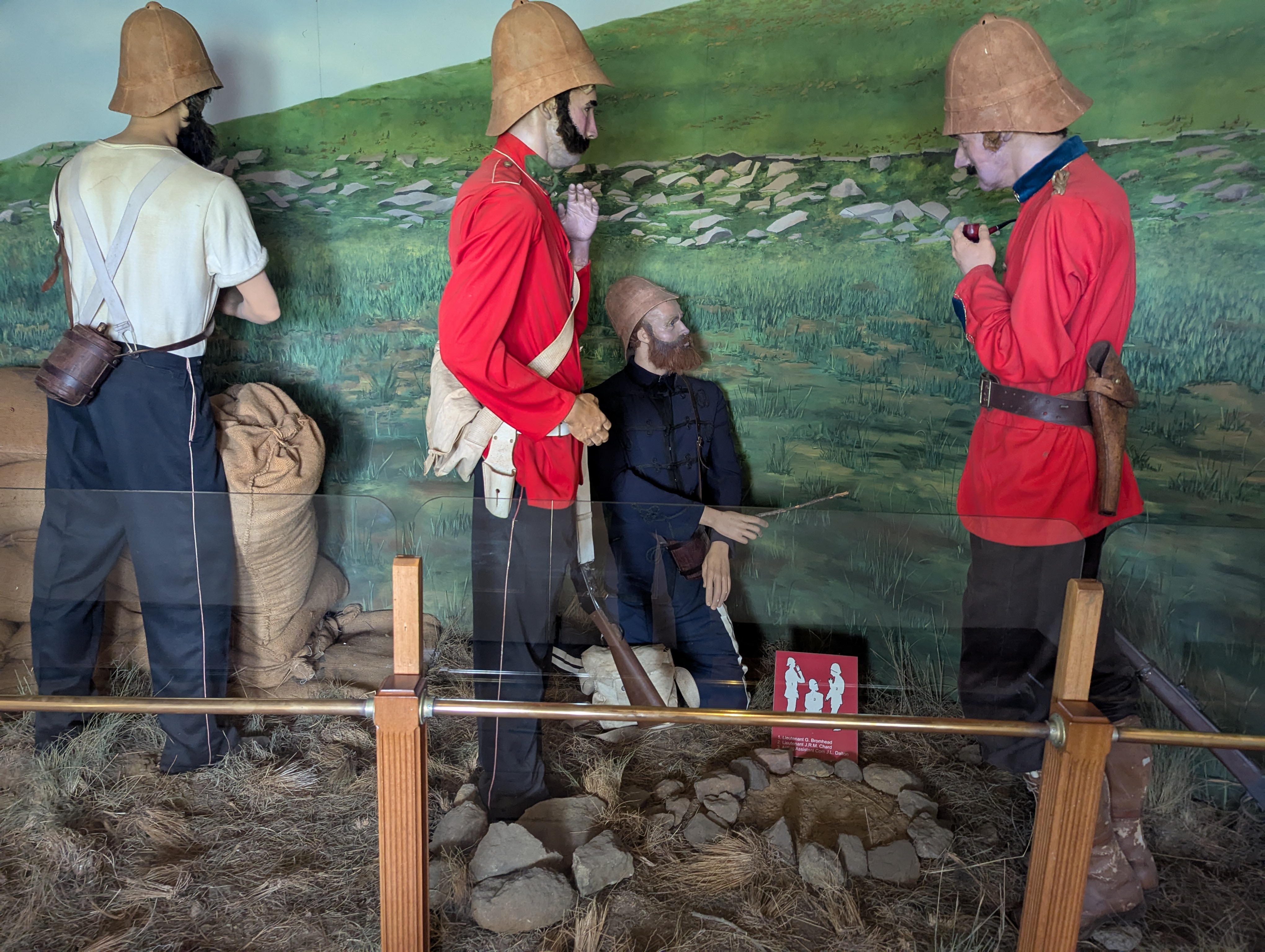
The road back to Dundee (where our hotel is) was notably rough and more suited to a Landrover than a coach. We had lunch at the restaurant of the Talana museum and a quick look around afterwards. It’s a lovely museum about all sorts of local history, including a big section on coal mining and the Zulu and Boer wars
Below are the places I visited in the north of South Africa
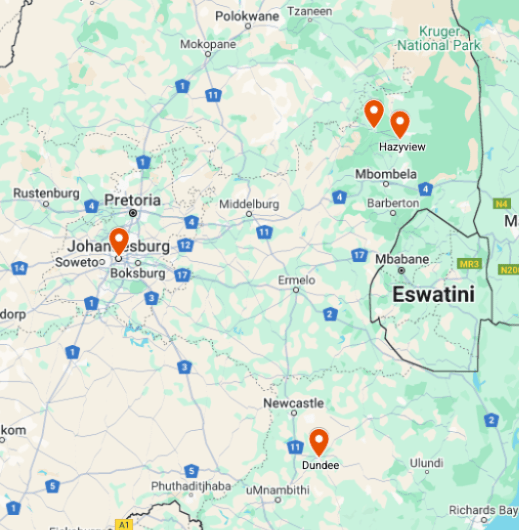
Wet Journey to Joburg
Tuesday 22 April 2025
Last night there was a thunderstorm. It was not for long, but it put the power out for a while. We had to use our phone torches until the generator kicked in. It started raining at 7pm on Tuesday and rained all night and most of the way to Johannesburg. It was a four and a half hour drive through pouring rain and very boring countryside. It was high veld over 6,000 feet up and it looked like the Highlands of Scotland without the mountains. There are vast tracts of yellowy green grass and long straight roads. The thermometer on the coach showed eleven degrees outside.
Inevitable there are many big coal truck wrecking the road surface. The small towns are unattractive conglomerations of small houses with central strips of McDonald’s, KFC and other fast-food places. The more prosperous towns (with white people) have malls in big sheds and security. Many of the vehicles are “bakkies”, white pickup trucks often with men in the back going to work.
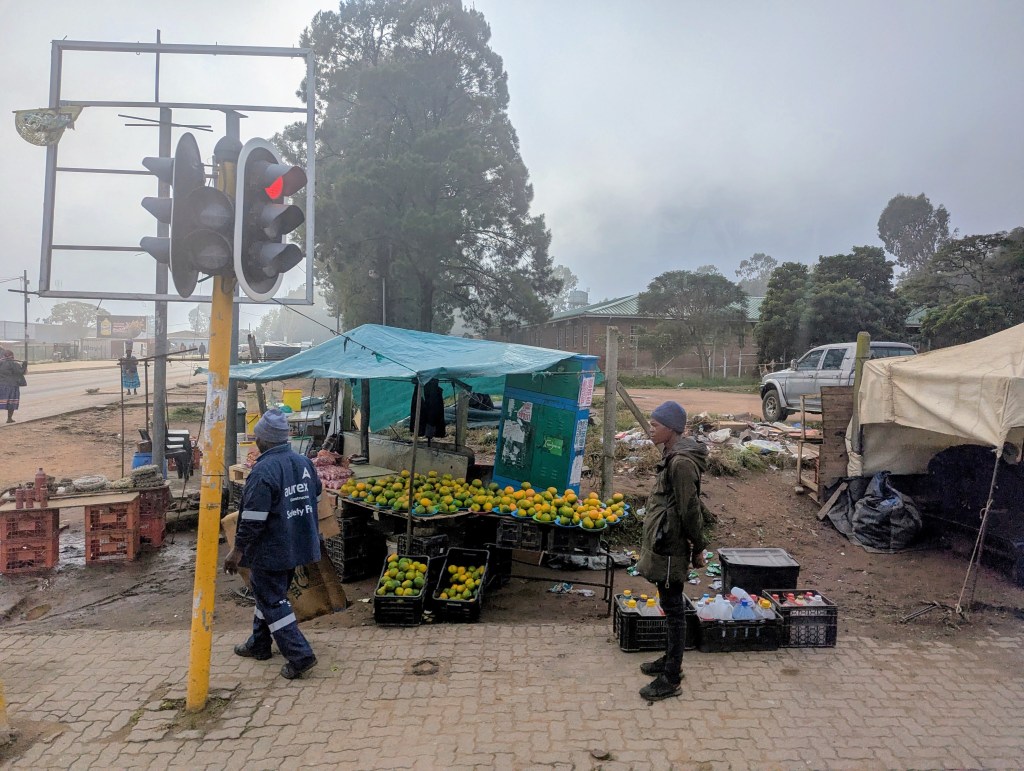
It’s good to see all sides of this huge country. You can see the wealthy living in fortified estates. The poor live in corrugated iron or cement block homes.
We passed from KwaZulu Natal into the Free State, formerly the Orange Free State. We started to see more maize growing. There were huge silos in the small agricultural towns. Closer to Joburg we crossed the Vaal River and stopped at a service station just off the motorway. It was almost exactly the same as a service station in the UK, and everywhere takes cashless payments. But everywhere it takes a long time to get served, fast food it ain’t.
Back at OR Tambo Airport in Joburg we had a baguette and croissant for lunch and then caught the 14.30 flight on Cemair to George in the Western Cape. The plane was a Bombadier CRJ100, a fifty seat plane with a very peculiar smell…
But I can’t complain since we got a sandwich, a bag of crisps, a tiny chocolate bar, a Lindt chocolate and two glasses of wine. So we consumed UPF most of the flight, unhealthy but fun.
At George airport we very rapidly got our bags and got another coach (identical to the last Magabus) to our hotel in Knysna. Our new driver took The Garden Route , which is a scenic 124 miles road from Mossel Bay to Storms River. There is a string of pretty resort towns and a really good road between them. The towns are where South Africans go to retire. It’s like the English south coast but with better weather. It’s without the crappy parts of Eastbourne and Hastings.
Some of the route is reminiscent of Devon, it’s very green and woody and there are numerous lakes. The town of George where we landed was originally a timber industry town with many woodcutters.
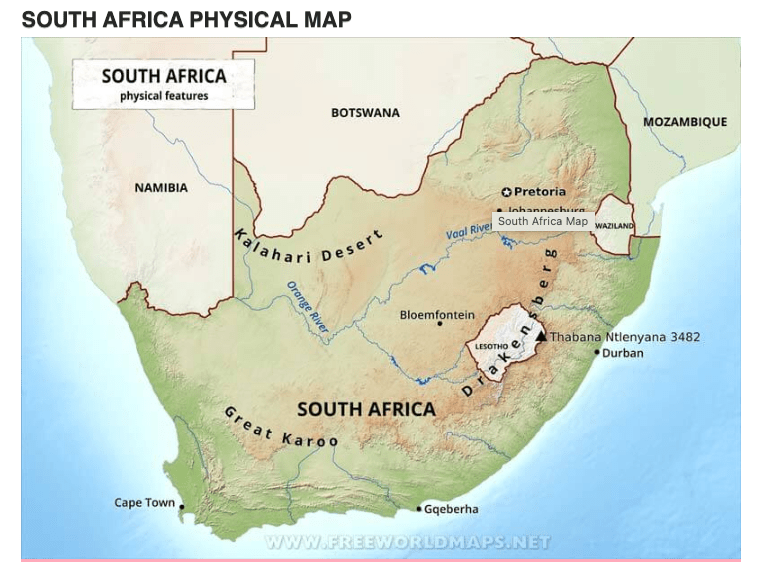
Knysna (pronounced nice neh) is a resort town in the Western Cape. The Southern part of South Africa is divided into two provinces , Western Cape and Eastern Cape. Between the Cape provinces and Johannesburg is a huge desert called The Great Karoo.
We are staying in the Protea Hotel. The Protea is the national flower of South Africa. It is part of a waterfront development of shops and restaurants. This area is similar to places I have been to in the Canaries. It’s a lovely hotel, several levels of comfort above the Battlefields Lodge.
In the evening we all had dinner together at a restaurant called the Drydock. There was a big party of teenagers in, so the volume was about the same as a Saturn 5 rocket taking off.
Ferry to Featherbed
Wednesday 23 April 2025
We were allowed a lie-in this morning, our day trip today doesn’t start until 9.30. But unfortunately Julie had a bad nights sleep and feels terrible this morning. She might have the bug thats been going round, two people on the tour have been sick already. So Julie stayed in bed and I had breakfast without her.
Our group walked a short distance down to the quay to get onto the Spirit of Knysna ferry to take us to the Featherbed Nature Reserve. Close to the hotel is the disused Knysna railway station which has been shut since 2006 when a flood washed the line away and there isn’t enough money to rebuild it. The railway gauge in South Africa is 3 foot 6 inches rather than the standard gauge of 4 feet 8 and a half inches. Narrow gauge railways are cheaper to build and can go round tighter bends, which is useful in the mountains.
Knysna is built on a broad tidal that is called the Lagoon. It is like a big lake which opens onto the Indian Ocean through a gap called The Heads. At one time the town was a commercial port, but not since the 50’s. Timber from the huge forest was shipped out from here. But it is a big centre for yachting, with the third oldest yacht club in South Africa.
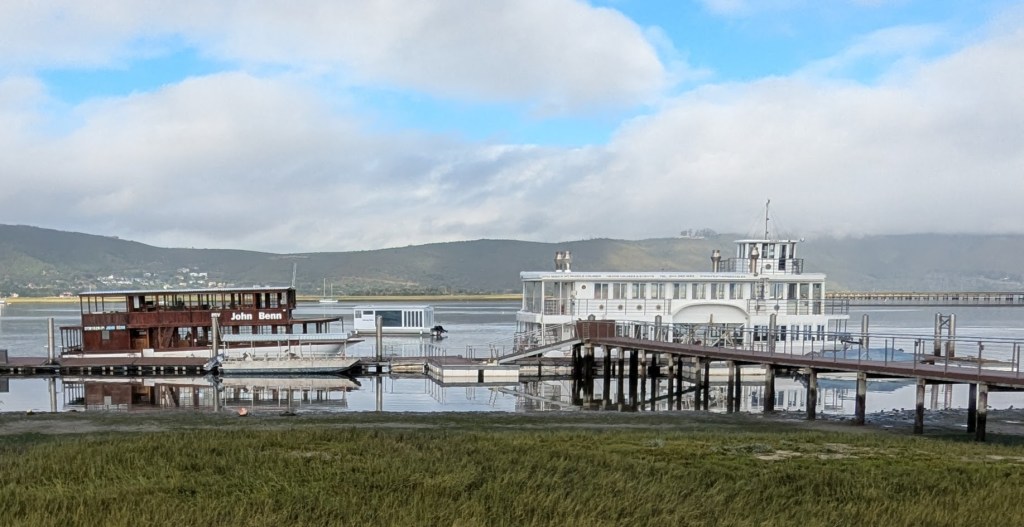
It is a prosperous coastal town which reminded me of Salcombe, with steep slopes going down to the sea and huge expensive houses. There are two islands in the lagoon called Thesen Island and Leisure Island which have been subdivided into housing plots for wealthy holiday makers.
In 2017 a forest fire was started by lightning which destroyed five hundred homes and huge numbers of trees and fynbos vegetation. Much of the fynbos has grown back, but the trees are just skeletons.
The boat tied up at the Reserve’s jetty and we disembarked. The Reserve is the tip of a peninsula on the western Head of the outlet of the Lagoon into the Indian Ocean. To take us to a viewpoint at the top of the Reserve we climbed onto two trailers towed behind an enormous Mercedes lorry, which had rows of bench seats in the back. The lorry and two trailers trundled up a concrete road at walking pace.

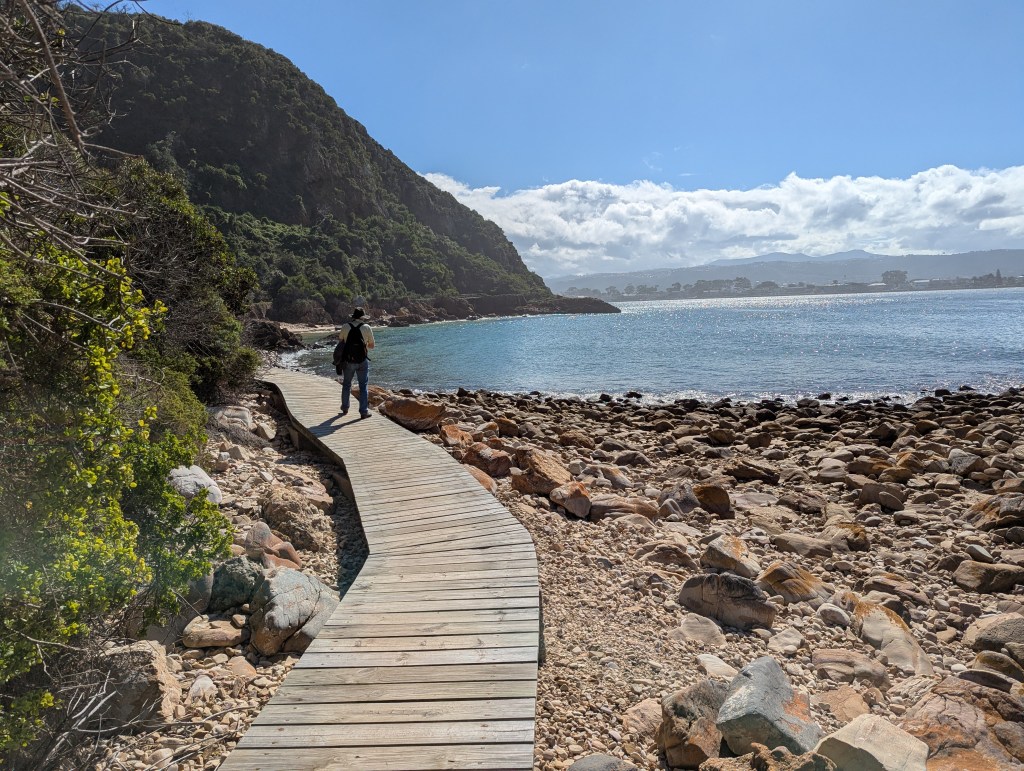
At the top we had a fantastic view of rugged orangey brown cliffs overlooking the Ocean. We descended from there down a rough path with simple steps and some rustic handrails. We had been given broom handles to use as walking sticks, and they were very useful. Halfway along we took a steeper staircase to see a sea cave where stone tools had been found from very early hunters tens of thousands of years ago.

Close to the waters edge there was a level path and board walk which lead back to a restaurant near the jetty where we had an excellent buffet lunch.I have never eaten so many buffets in my entire life! I had salad with some fish and chicken with a bottle of water, very healthy.
At 13.30 we took the boat back across the Lagoon. Julie had just woken up and was still not feeling great. In the evening we went back to the Dry Dock restaurant. I had calamari followed by sirloin steak, Julie just had soup.
The Garden Route to Wine Country
Thursday 24 April
The phone buzzed at 06.00 to wake us up, and at 07.30 we were back on the bus again and driving west down the Garden Route. Our new driver is Tertius, who is very good. The road is a sweeping motorway through green fields and woodlands, it deserves its name. The start of the Garden Route is Mossel Bay, which is both a resort and home to an enormous chemical plant that turns natural gas into liquid fuels. In the time of sanctions against South Africa, they needed to make all their fuel from coal.
The Cape was originally occupied by native Khoi people (better known to Europeans as Bushmen), then the Portuguese then the Dutch. The Dutch brought slaves from Indonesia, who were known as Malays. The Malay mixed with the native people became the Cape Coloured population who live there now.
We stopped for a “comfort break” at a place where they sell Aloe Ferox products, hand cream ‘n shit. I had a lousy cup of coffee, I won’t be going there again!
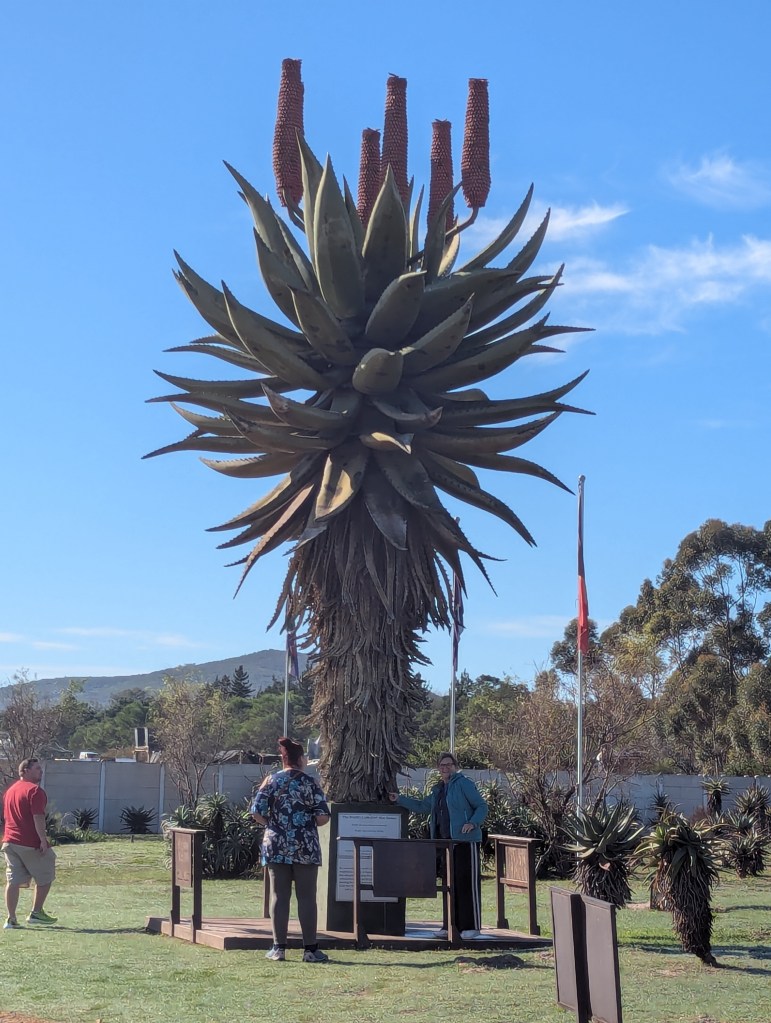
The landscape changed to rolling open enormous fields of rape and wheat, which looked a bit like Wiltshire. There is a huge variety of landscapes in South Africa, it is a very big country.
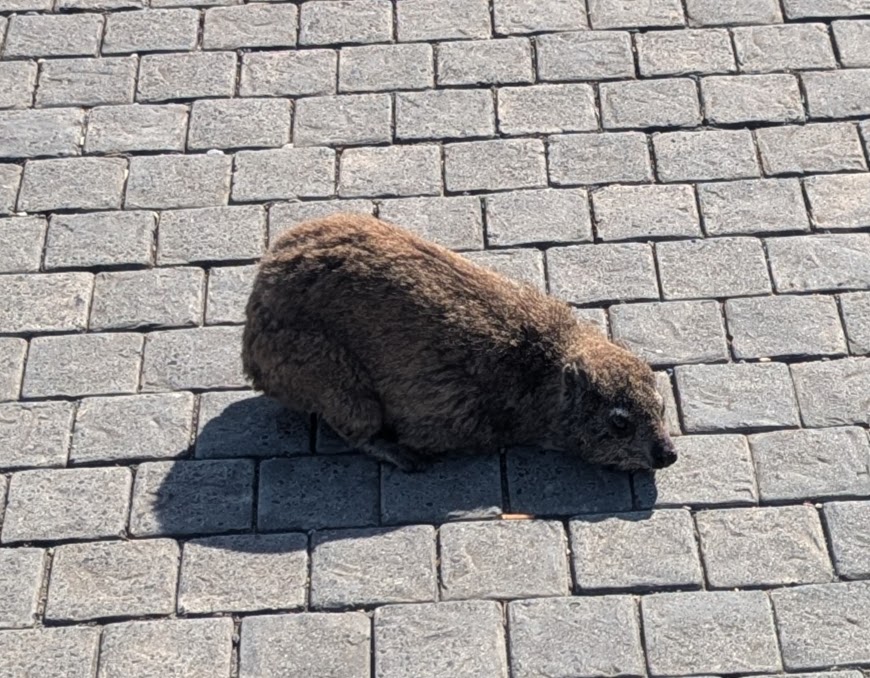
The road turned south towards the Atlantic and the resort town of Hermanus on Walker Bay. The coach stopped by the seafront, and it was very quiet. In the middle of the road sat a small rabbit sized creature, a Rock Hyrax. It looks like a rodent, but it’s nearest relative is the Elephant.
In the tourist season it is incredibly busy, people visit for whale watching. The town centre is fairly small, but the suburbs go on for miles on the American pattern, with massive shopping malls.

All the houses have high walls with electric fences on top, I would not like to live in fear all the time.
From Hermanus we drove north towards Franschhoek (French Corner) and the wine country. To get there Tertius drove us through the Franschhoek Pass along a steep and windy mountain road. The mountain passes in South Africa are quite spectacular, and I was very pleased not to be driving the coach!
The town was founded by French Huguenots who were settled in the area by the Dutch and brought their grape growing expertise with them. The Revocation of the Edict of Nantes in 1685 lead to thousands of Protestant Huguenots leaving France for England, and Holland. Several hundred were encouraged by the Dutch to travel to Franschhoek . It is a beautiful verdant town with trees lining the road and houses with thatched roofs and Dutch gables.
Our accommodation for the next three nights is the Pearl Valley Hotel. Blimey its posh! It is a new hotel with a golf course and swimming pool. Our balcony overlooking the tennis court measures 9 paces by 3 paces, almost as big as our kitchen at home. The view is over pink cliffs which look stunning (genuinely) in the light of the setting sun.
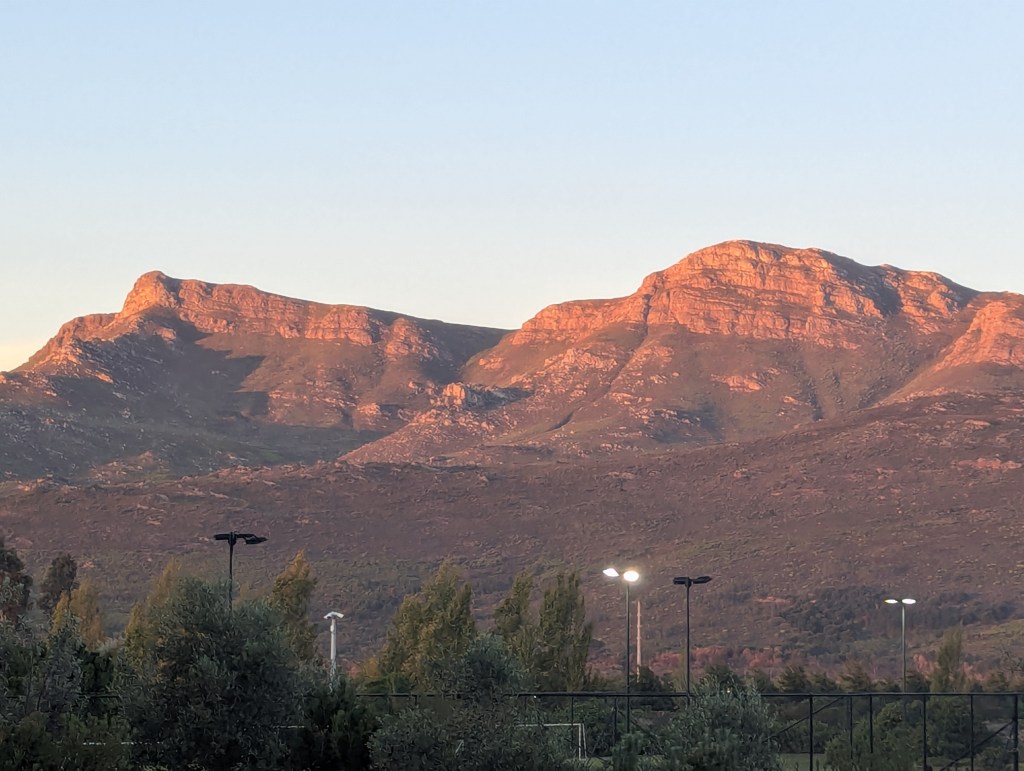
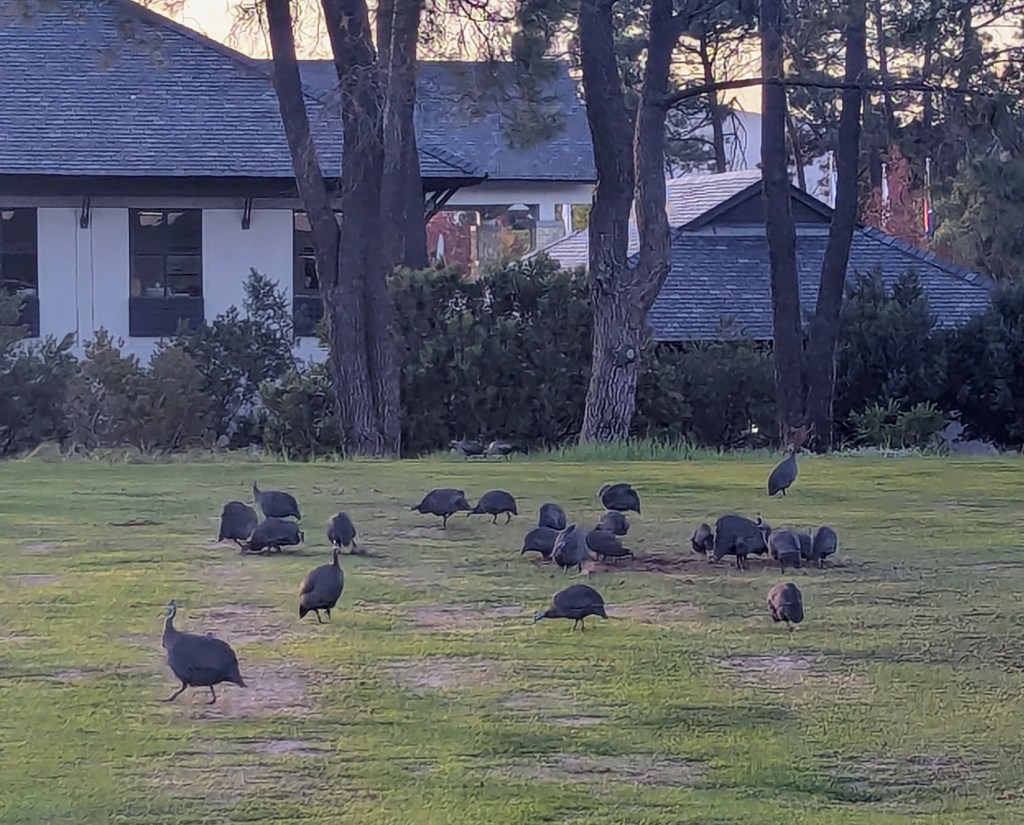
The hotel is a golf resort, but it was being repaired so we were allowed to walk on it. It was very popular with the local Guinea Fowl population
At night we could see many bright stars in the sky over the golf course, but since we were in the southern hemisphere, I was not able to identify them. To be honest if we were in the Northern Hemisphere, I would only recognise The Plough.
Franschhoek and Wine Country
Friday 25 April 2025
After breakfast (which was a bit meagre compare to previous hotels) Tershus took us back to Franschhoek . It is a small very upmarket town full of estate agents, clothes shops and art galleries, it felt like Salcombe or St Ives. It was prosperous and pretty, but didn’t feel authentic, like a resort only for the rich. It did have lots of roadside trees and flocks of Lycra clad cyclists out for a Saturday run. I used to wear Lycra for my commute by bike to Shepherds Bush. I don’t know why, it’s actually tight and uncomfortable and makes you look like a proper knob.
There are a lot of vineyards in the area with French names. They did well during the Napoleonic Wars when the British couldn’t get Continental wine. In the 1850’s Phylloxera killed the vines and the vineyards had to be reestablished with Californian rootstock. Sanctions killed the business again but it picked up in the 90’s.
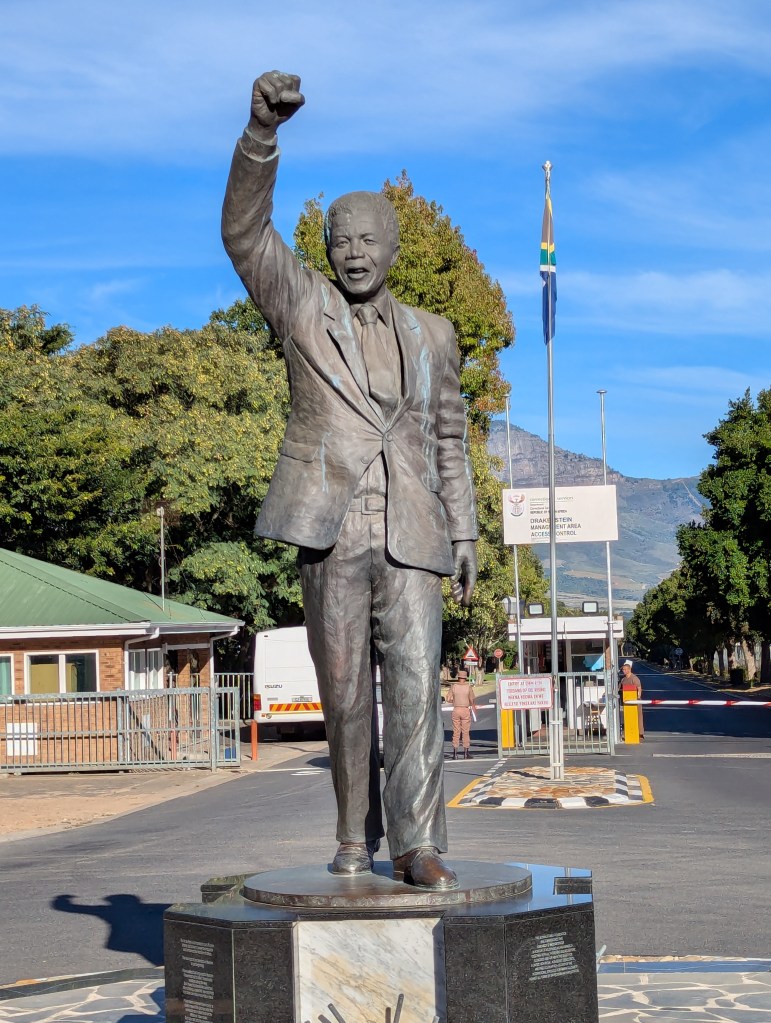
Then we had a brief stop at Drakenstein prison, Nelson Mandela’s last prison before he was released. We took a quick photo of his statue then sped on.
Then we drove to Stellenbosh, which has the biggest and most prestigious university in South Africa. It is also the second oldest settlement after Cape Town founded in the 1680’s by Simon Van de Stel. The town is build on a grid, and the centre has old whitewashed buildings with Dutch gables. There is a distinctive style of architecture called Cape Dutch, which have Dutch gables, like town houses in Amsterdam, whitewashed walls and thatched roofs.
Tertius parked next to the local museum, so we went in for a look. There are four old houses full of period furniture. The oldest is a restored thatched house from the pioneering days of the 17th century. It was interesting for about 40 minutes, but there is little in the way of interpretation boards in some of the houses. The Cape had a slave economy. Many of the enslaved people enabling the comfortable lifestyle of the Dutch burgers were brought from Indonesia. These individuals were classified as Malay. All the races in the Cape; the Dutch whites, Khoisan, Bantu and Malay interbred to create the Cape Coloured people.
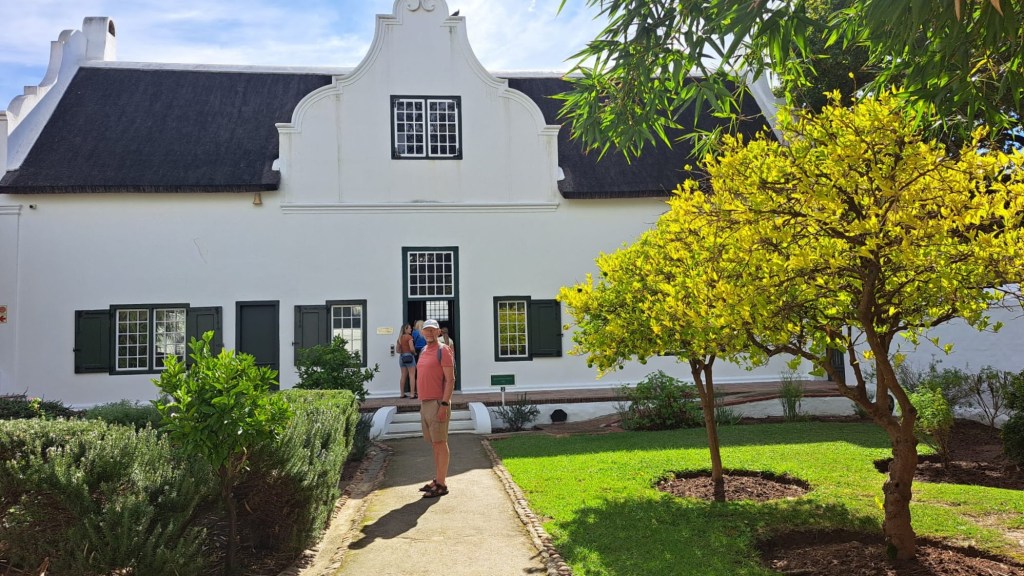
There are some lovely old houses in Dorp Straat from the 18th and 19th centuries, the largest collection of heritage buildings in the country.
We got back on the coach and drove through the gorgeous wine country surrounded by mountains to the Neethlingshof Vineyard, which was established in 1692, but proper wine production started in 1802. It has some big wine making buildings built in Cape Dutch style with curvy gables.
We went into the tasting area and a young lady from the Xhosa tribal group (she told us) introduced us to five different white and red wines. To be honest they all began to blend into each other. The whites were good straight out of the bottle, but the reds needed to breathe for a while to disperse the tannins. Our trainee sommelier talked the talk, but did not have the knowledge to explain the wines convincingly. Also some of our group talked over her, which is just damned rude.
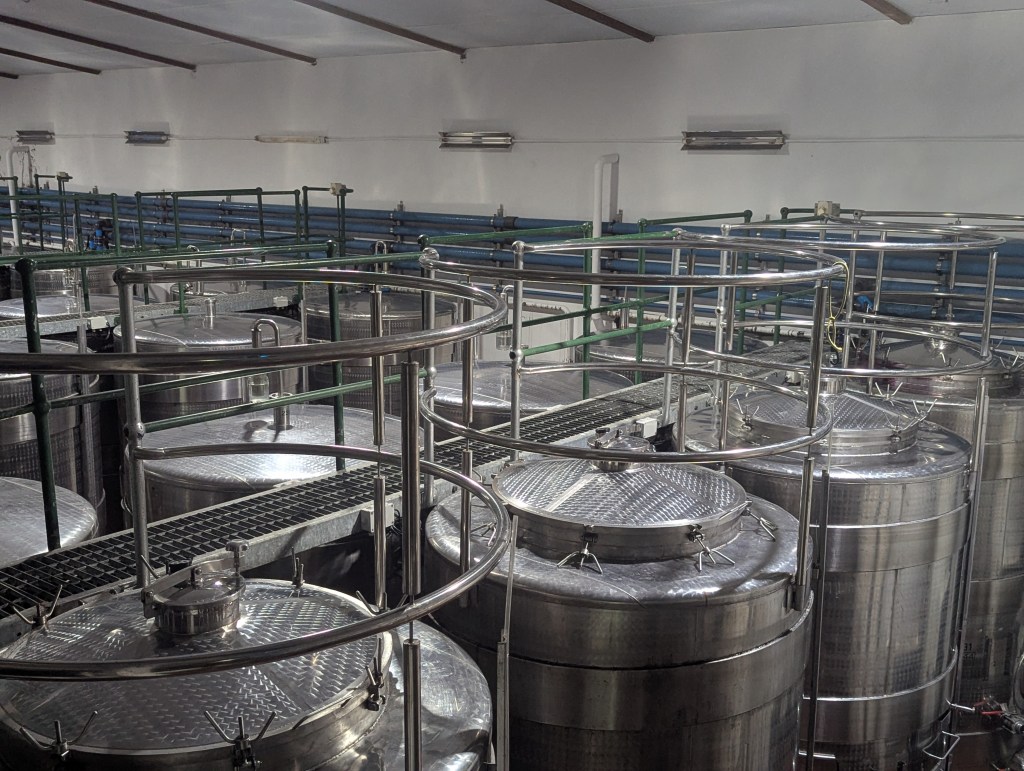
We had an opportunity to buy wine, but passed on that. Then it was back on the bus for a scenic drive back to our hotel. I am now drinking some very acceptable “good value” Tall Horse wine from Pick and Pay in Hermanus.
Dinner was in Backs restaurant at the hotel by the swimming pool, our last inclusive evening meal. We had a Cape Malay dinner, which included a slow cooked beef stew and chicken sort-of curry. It was all tasty when washed down with an Aperol Spritz.
Capetown!
Saturday 26 April 2025
So farewell the Pearl Valley Hotel, easily the best hotel we have stayed in so far. It scored very high for the size of the room and balcony and quality of fixtures and fittings. But it was a bit under par for its catering, it did not such a good breakfast selection. But hey ho, at home I just have Lidl muesli for breakfast.
On the way into Capetown, we passed the film studios in the distance, where my neighbour Martin had spent six months as VFX Supervisor on an SF epic for Apple TV +. The tall masted ships were from a pirate show on Netflix called Black Sails

Close by was huge townships bristling with satellite dishes, the locals love the English Premier League.
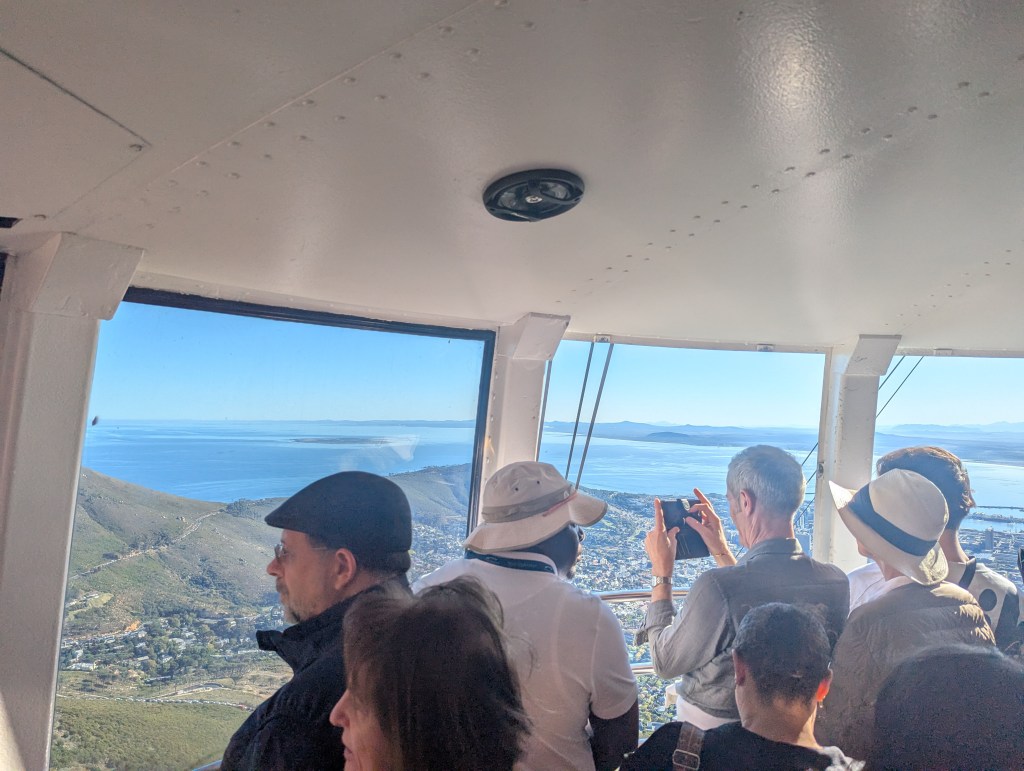
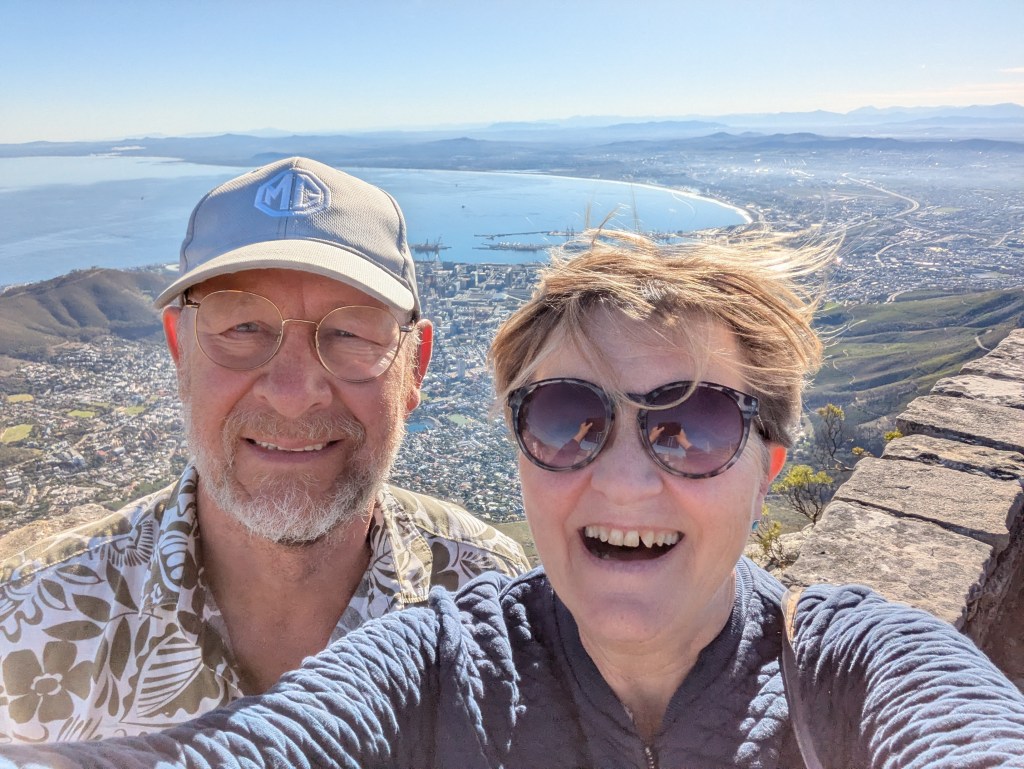
Tertius drove us straight to Table Mountain to get the cable car to the top. It is a big car which takes 65 people. Amazingly, the inside rotates. This ensures everyone gets a great view of the mountain and the city below. Table Mountain is 1067 metres high. At the top, there are footpaths around the rocky sandstone plateau. This plateau is covered with fynbos vegetation. Some of the viewing places were incredibly windy and I was afraid my glasses might be blown off! The views were fantastic, and we spent an hour enjoying them.
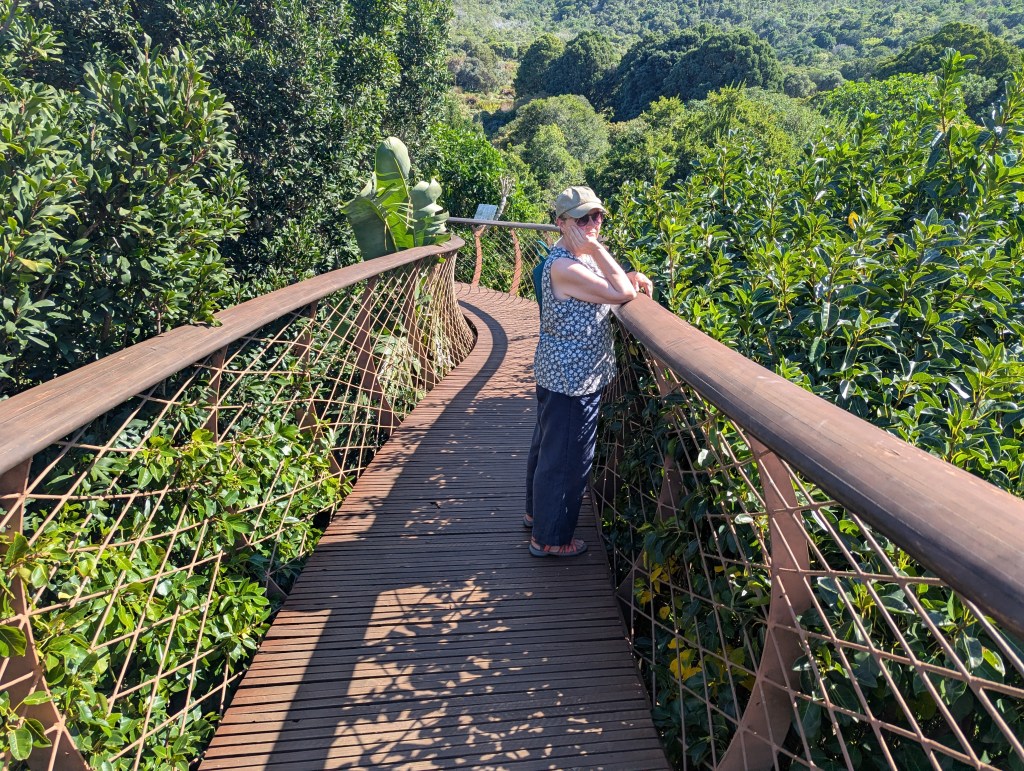
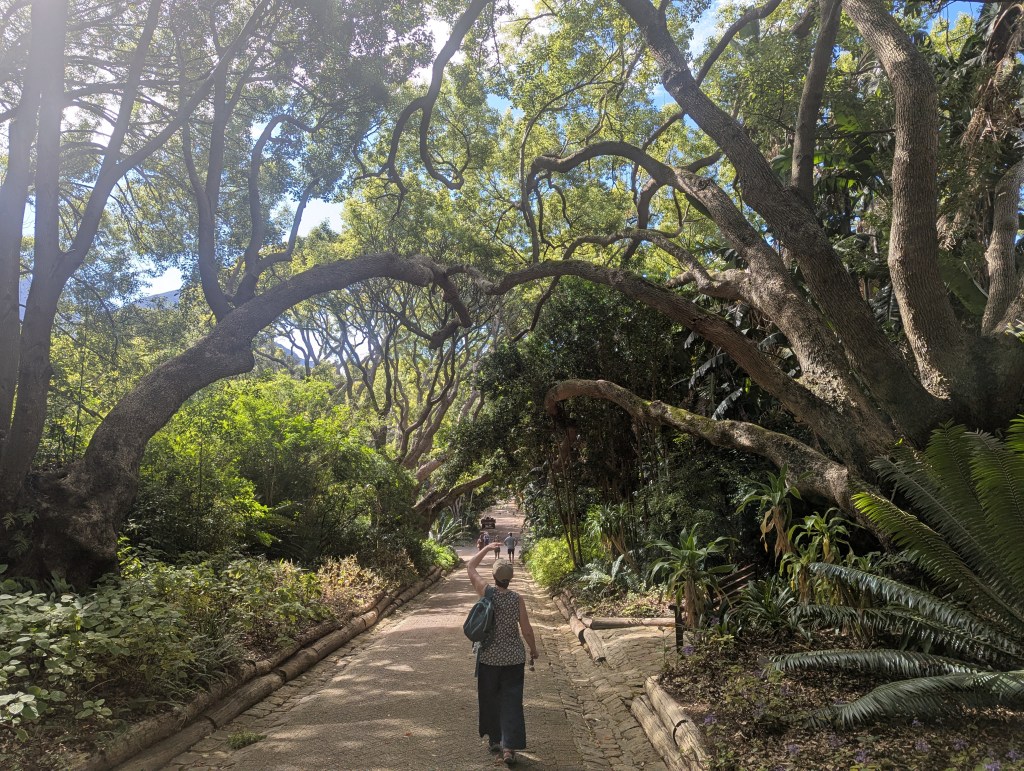
The next stop was the Kirstenbosch Botanical Gardens. It is a “child” of Kew Gardens and was built of land on the lower slopes of Table Mountain that was purchased by Cecil Rhodes to save it from development. The gardens are gorgeous with a mix of woodland, gardens and lawns. I was especially impressed by a single great Mahogany tree and an avenue of Camphor trees that formed an arch over the road. An alarming sign informed us that the garden hosts a selection of snakes including the Boomslang, Cape Cobra and Puff Adder.
Out next hotel is the Southern Sun Waterfront, a 14 story slab in the city centre. Our room is very nice, but half the size of the last one at Pearl Valley and is rather characterless. It is in the city centre, which is a grid of skyscrapers, without any character. We were advised not to go for a walk for reasons of safety, which was disappointing.
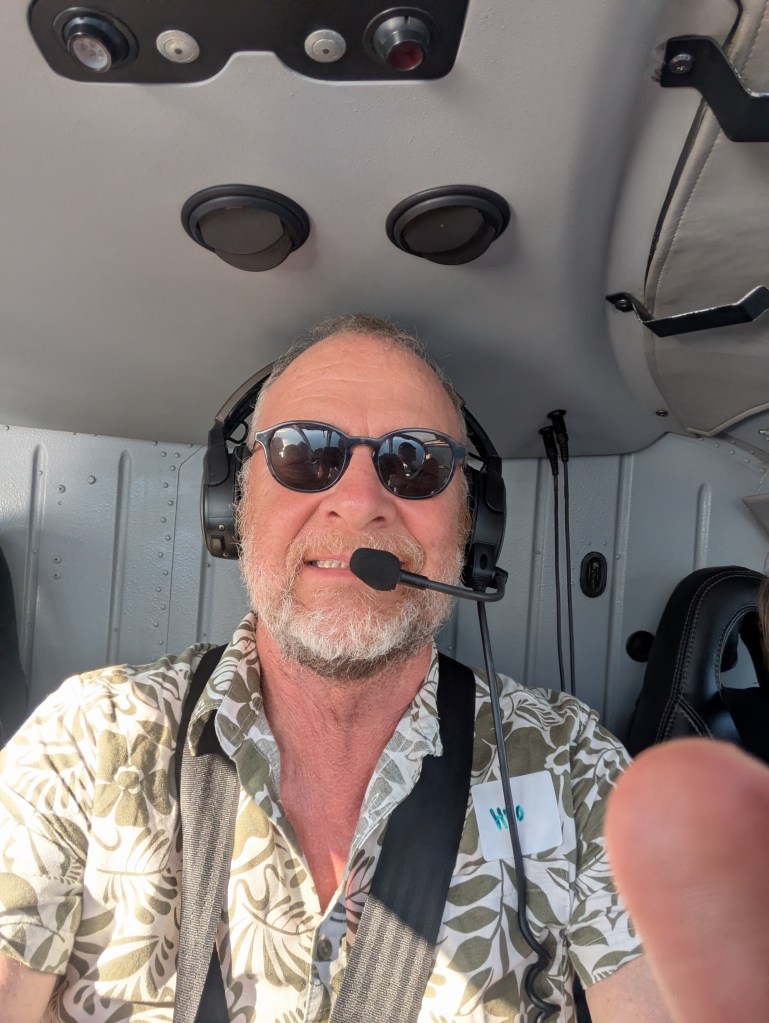
After an hour in our rooms to sort ourselves out, a mini bus came to take us to what is probably the highlight of our trip so far. The bus took us to the harbour, and after giving Capetown Helicopters £283 we got a “flip” in a helicopter! I was soooo excited, I have never been in a helicopter before, and its something I have always wanted to do.
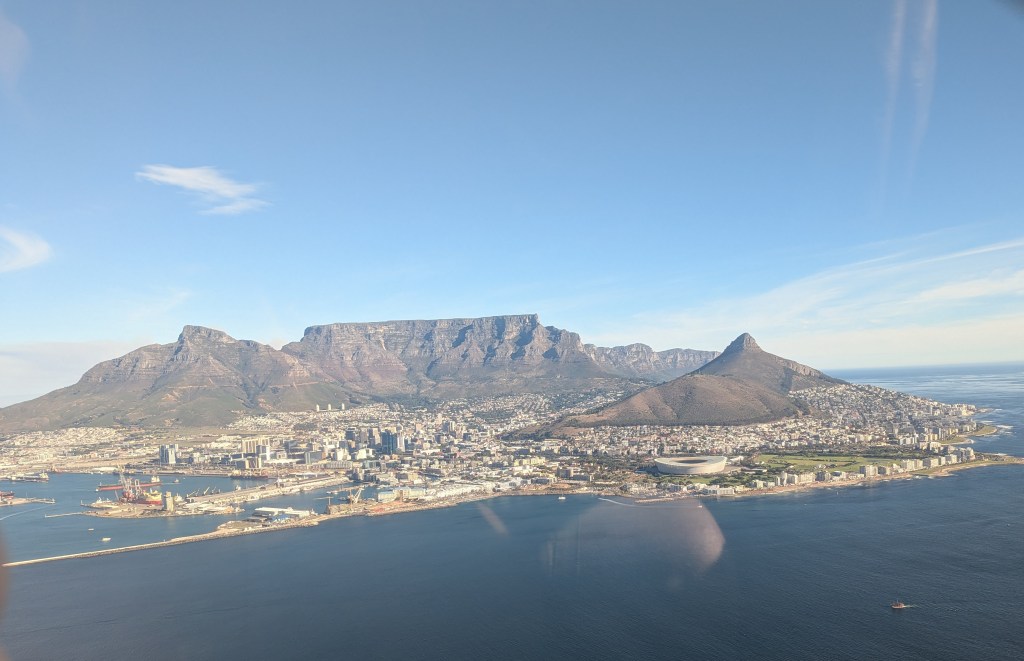
Five of us, plus the pilot (Ryan) squeezed into the Eurocopter EC130, and he took us out to sea and then around and over Table Mountain. To make the flight even more interesting there was a wild fire on the mountain creating a huge plume of smoke. It was a very exciting trip with fantastic views of the city, harbour and mountain. We could see Robben Island in the distance, which is a UNESCO Heritage site.
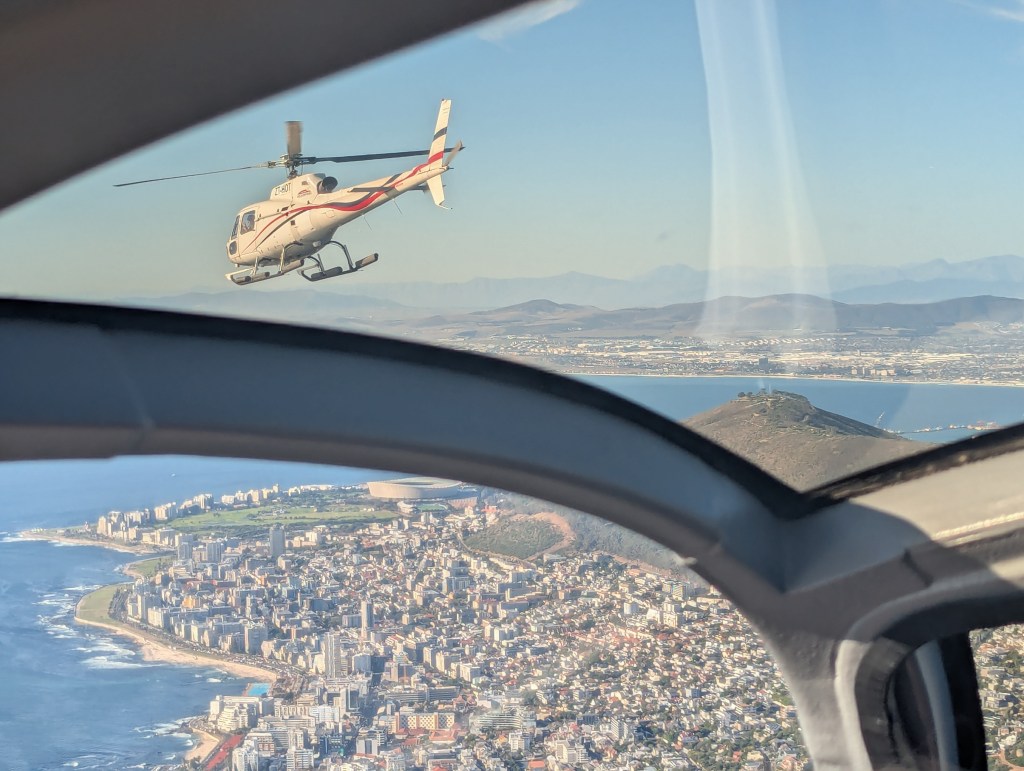
There was another helicopter up at the same time as us and we flow side by side for a while.
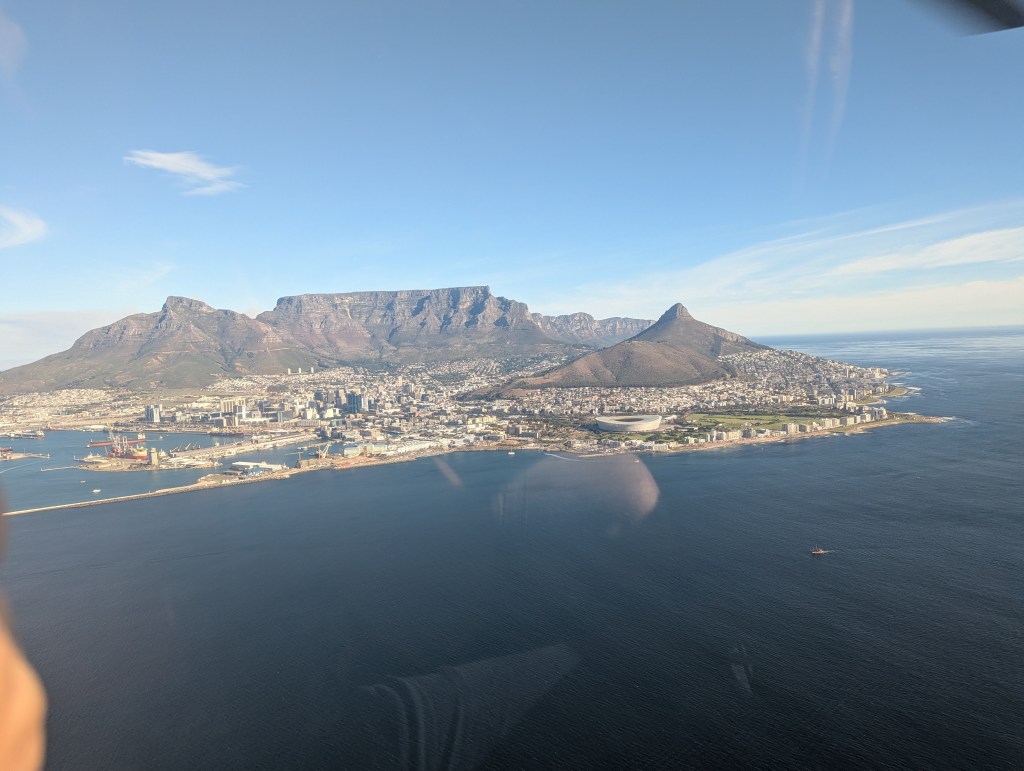
It was all over after 20 minutes and we landed gently at the heliport where we started.
A golf buggy then gave us a lift to the Victoria and Albert Waterfront, a huge shopping mall and streets of shops and restaurants. It is Freedom Day in Capetown, a public holiday enjoyed by everyone. So it was really busy, like Camden Town on a Saturday.
We found an Italian restaurant and enjoyed a meal on our own for a change. It has been really hot today, but as soon as the sun went down it got cold quite quickly. We had to wait 45 minutes for the shuttle bus back to the hotel, which was a pain in the behind.
A Tour of the Cape Peninsula
Sunday 27 April 2025
Until I got to South Africa I thought The Cape of Good Hope was the southernmost point in Africa. I was wrong, it’s Cape Agulhas, further down the coast. But the Cape of Good Hope is the most south westerly point of the continent, and we visited that today. Our driver took us all around the Cape Peninsula, a pointy area of land to the south of Cape Town.
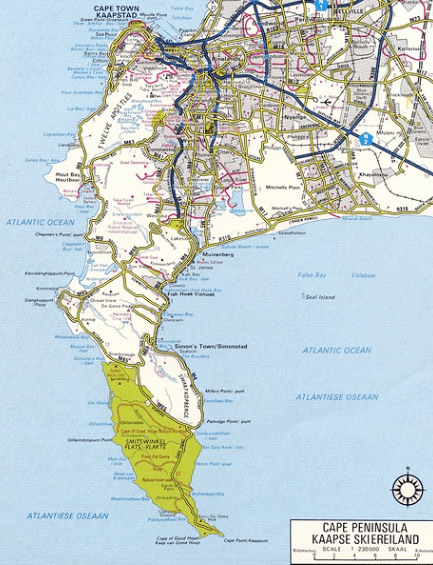
When we set off from the Southern Sun Hotel at 8am, there was thick fog. Capetown is where the Atlantic meets the Indian Ocean, so the weather is very variable. It was also 12 degrees cooler than yesterday, twenty degrees rather than thirty two degrees. Along the peninsula there are a string of affluent suburbs facing the beaches and the sea. They look more like the Cote D’Azur than Africa. But since it was foggy we couldn’t see much of them. There were plenty of fit twenty somethings running and cycling along the coastal footpath, like we were in Los Angeles.
We passed through Camps Bay and Llandudno (honestly) then paid a toll to go along Chapmans Peak Drive. This is a road blasted out of the cliff face in the 1920’s that winds round like the Amalfi Drive, it’s exceedingly picturesque. Then through lovely Houts Bay, I could see why people want to live there.
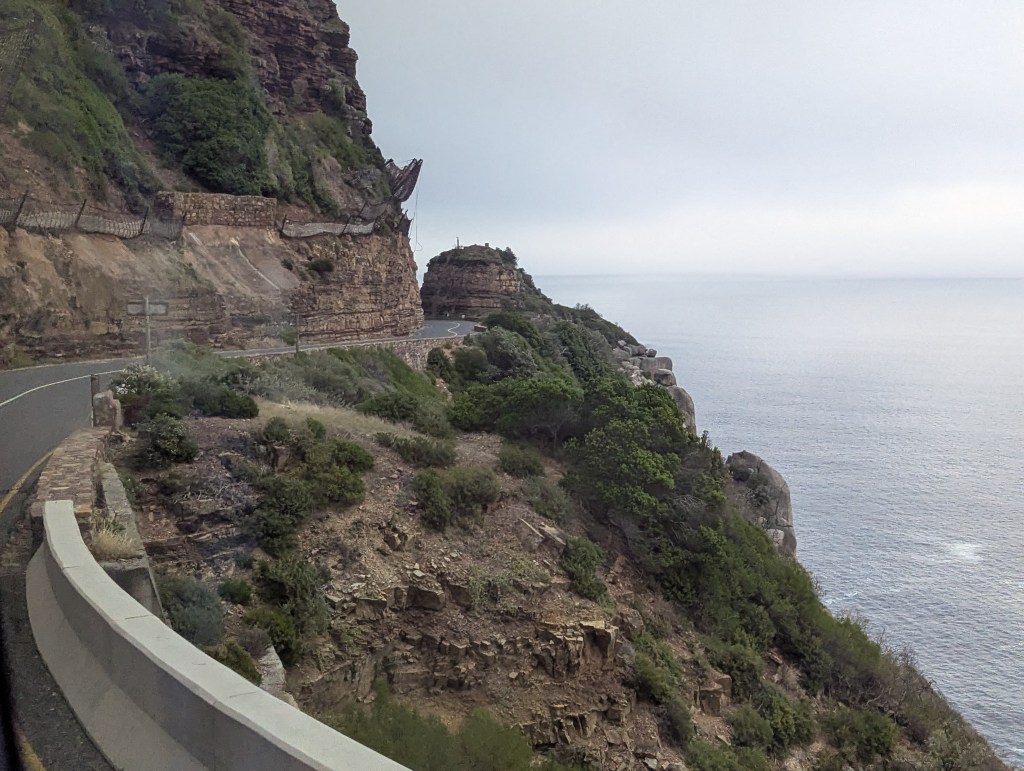
But by the road side a group of local black men, mainly immigrants from other parts of Africa (our guide told us) waited to be asked to do casual gardening, painting or other labouring jobs. Unemployment is around 38%, which is diabolical.
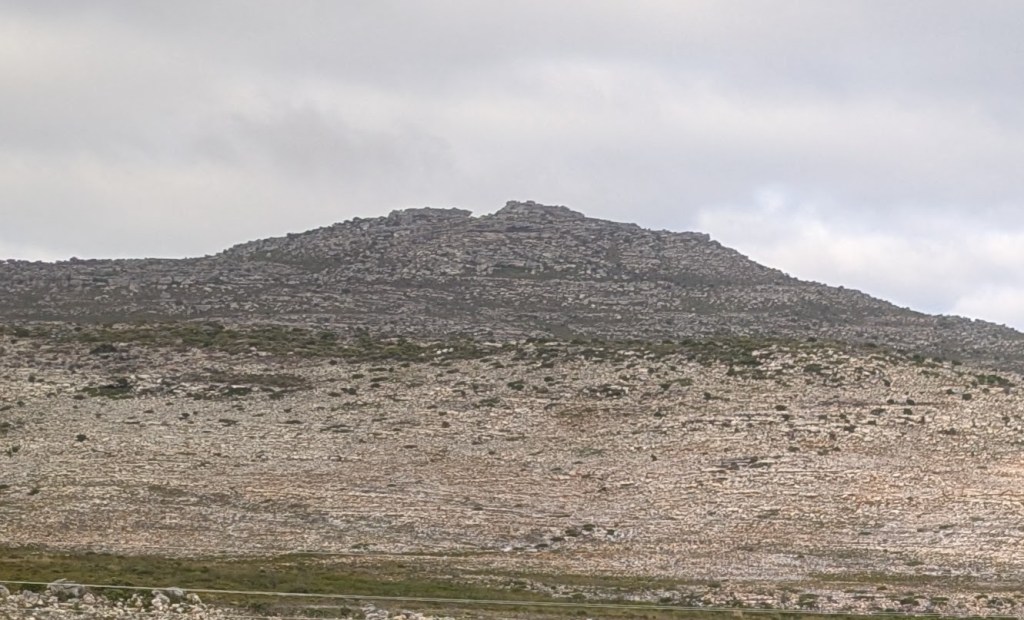
At Scarborough the road crossed the peninsula easterly to the National Park, which takes up a large part of the lower peninsula. It is an open treeless country that reminded me of North Yorkshire around Ingleborough. The land is covered in fynbos, which has a lot of heather in it. But instead of sheep there are antelope, baboon, zebra and wild ostriches.
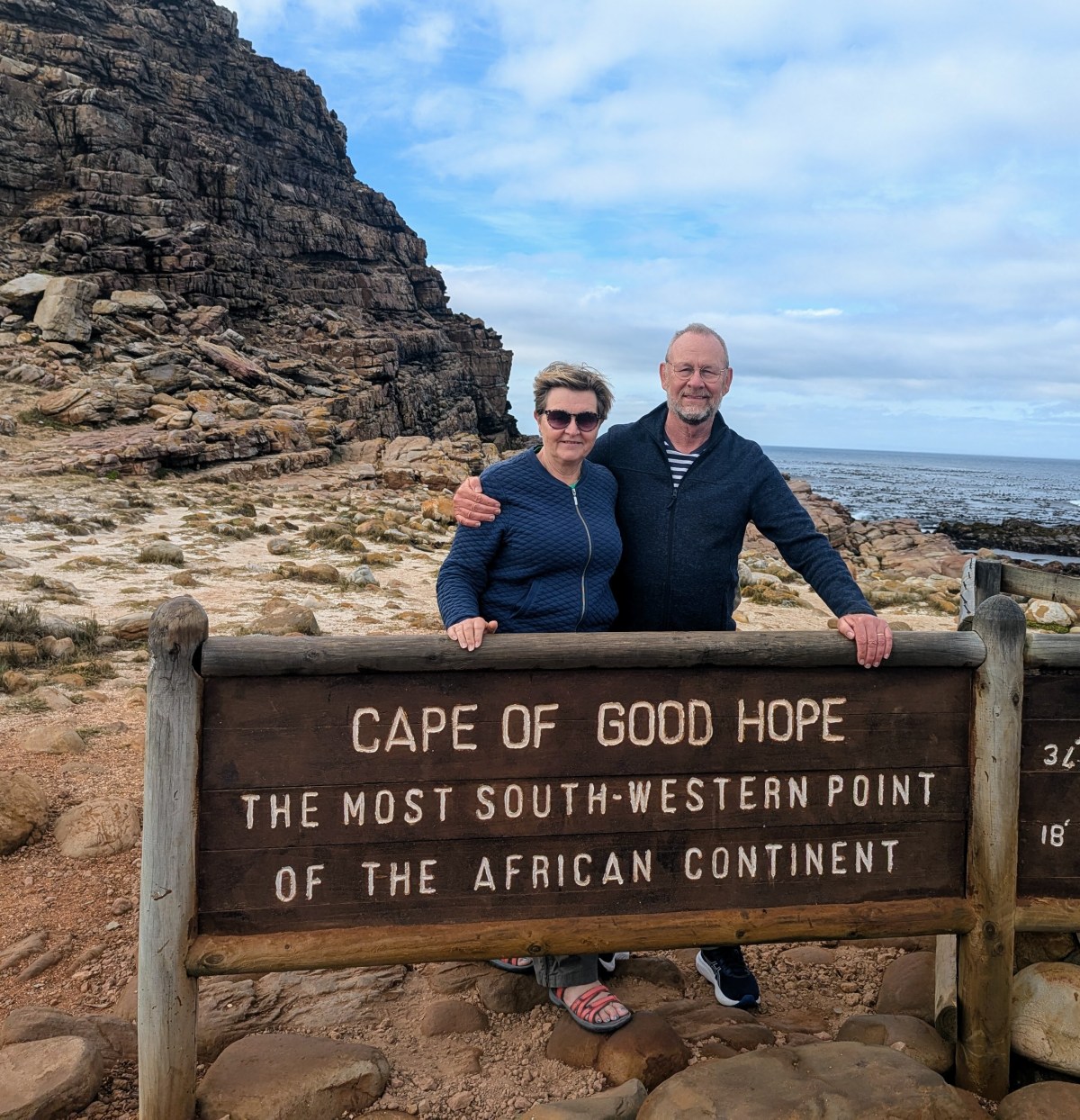
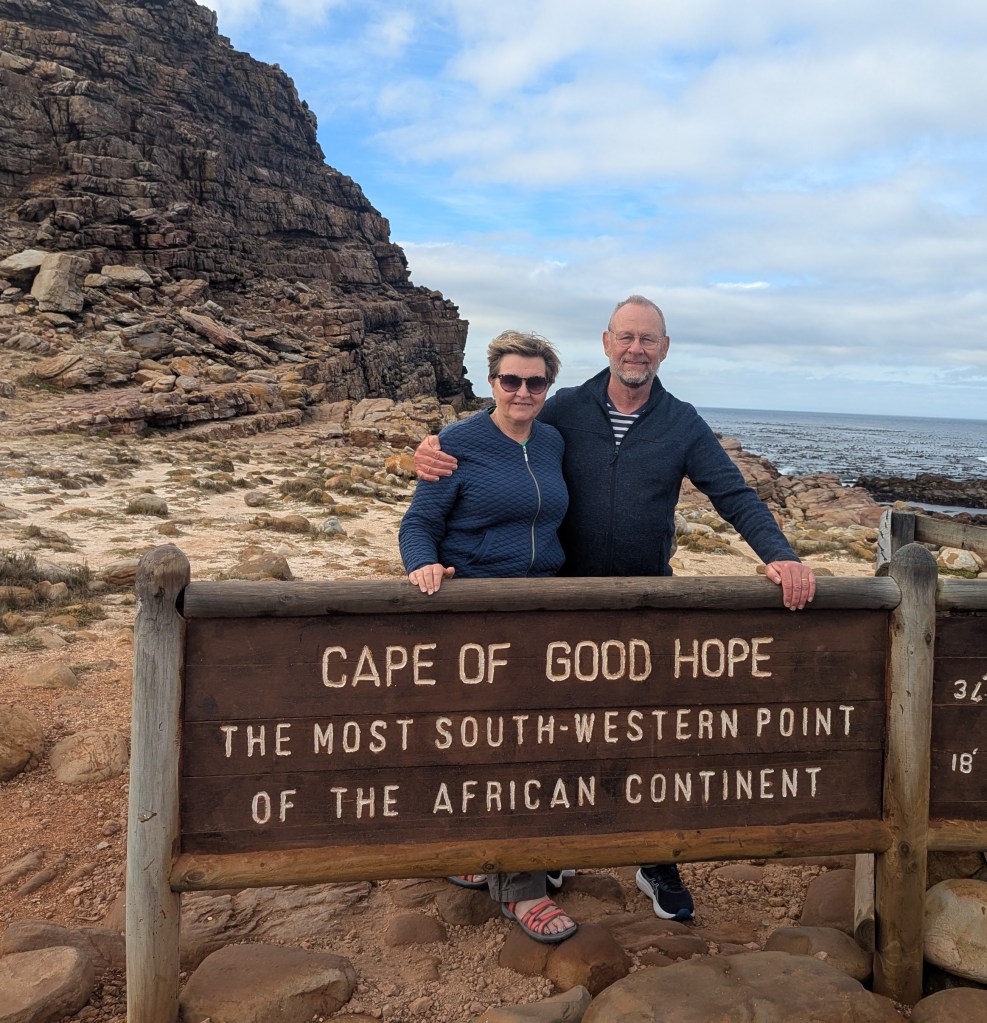
We stopped briefly at the Cape Of Good Hope, and joined the queue for our guide Lizwe to take a photo of us by the sign. It’s like Lands End without the dreadful gift shops.
Then onto Cape Point where there IS a gift shop, but also a lighthouse at the top of a hill. Julie and I hiked up the path and steps in 15 minutes, but everyone else took the funicular railway up, the lazy bastards. We had great views of the endless oceans and a signpost that said 9623 KM to London.
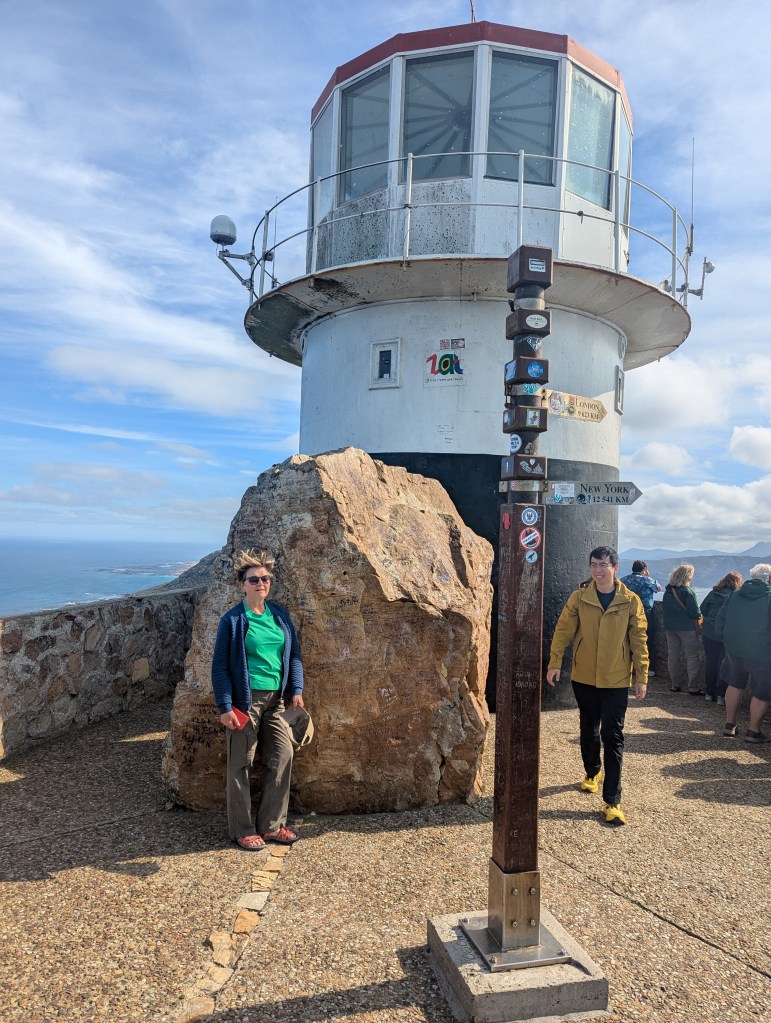
Everybody got back on the bus. We headed north up the eastern side of the peninsula to Boulder Beach at Simonstown. It’s located next to the naval base. It is home to several hundred beach loving Jackass Penguins. There’s a boardwalk to the beach and 800,000 people visit every year to see the little fellas. They don’t do much apart from looking cute, so for most of the time we just sat on a bench and enjoyed the warm sunshine.
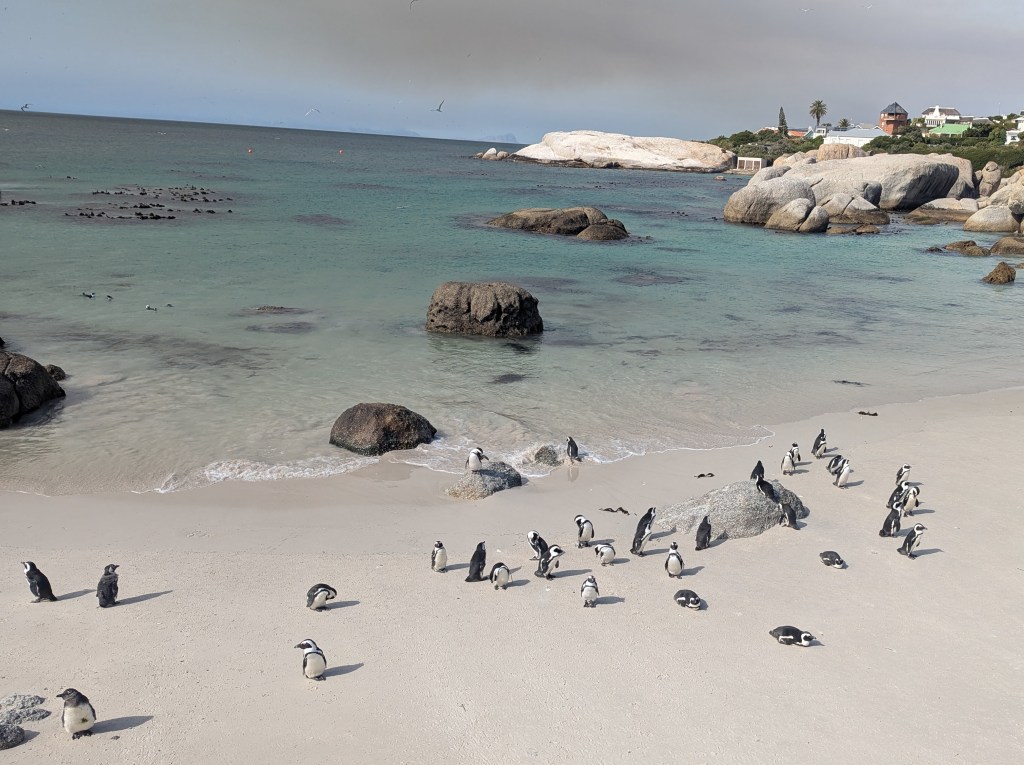
After that it was back to the hotel via the very expensive suburbs of Tokai, Constantia and Bishops Court. Constantia has the oldest vineyards in South Africa, and of course very high walls and electric fences.
Visiting a Township
Monday 28 April 2025
This morning we took a tour which showed us how the majority of people in South Africa live. A minibus picked us up from the Souther Sun Hotel, which was driven by a local man called Zandy. The first stop was the City Hall, a big Victorian building which looked like a town hall in the north of England. It wasn’t a beautiful or welcoming place.
The attraction there was another statue of Nelson Mandela, who is like a saint in South Africa. We took our photos with the statue, which felt a little peculiar, and then went a short way to a former Methodist chapel, now the home of the District Six Museum.
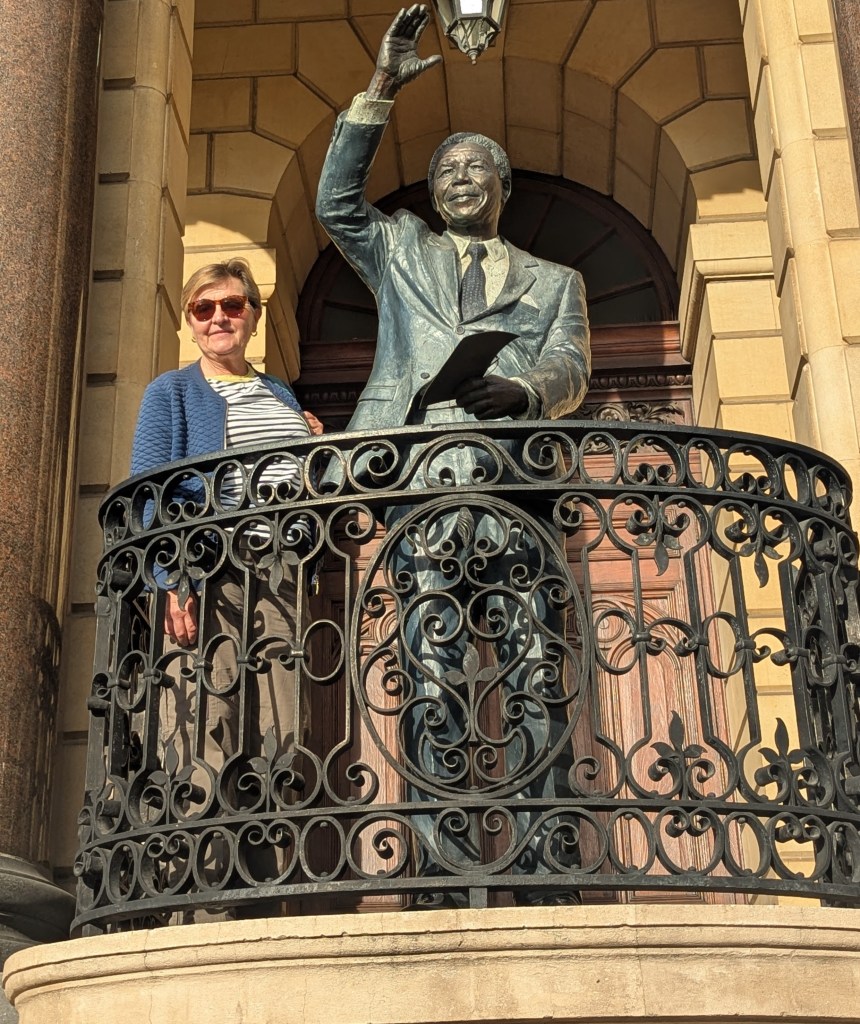
District Six was an inner city area which was mostly populated by Cape Coloured people, and other poor immigrants including a Jewish population driven from Europe. In the 1960’s the Apartheid regime decided they wanted the city centre land and demolished most of District Six. A vibrant community was flattened, and its people moved into distant townships.
By the way, “township” is a South African term for a settlement populated by black people on the edge of the white-dominated city centres. Before 1994 there was not enough investment in basic infrastructure and education in the townships. Today they are somewhat improved, but they are still quite wretched and suffer enormous unemployment. The museum remembers all the people who lived there whose lives were violently disrupted.
Coloured or Black people could get seventeen days in prison for sitting on a Whites Only bench.

There are many photos in the museum showing the People of District Six living joyous lives in a vibrant happy community. I particularly liked these youngsters dressed up in their finest Saturday Night gear, I would never have guessed that there were Teddy Boys in Cape Town!
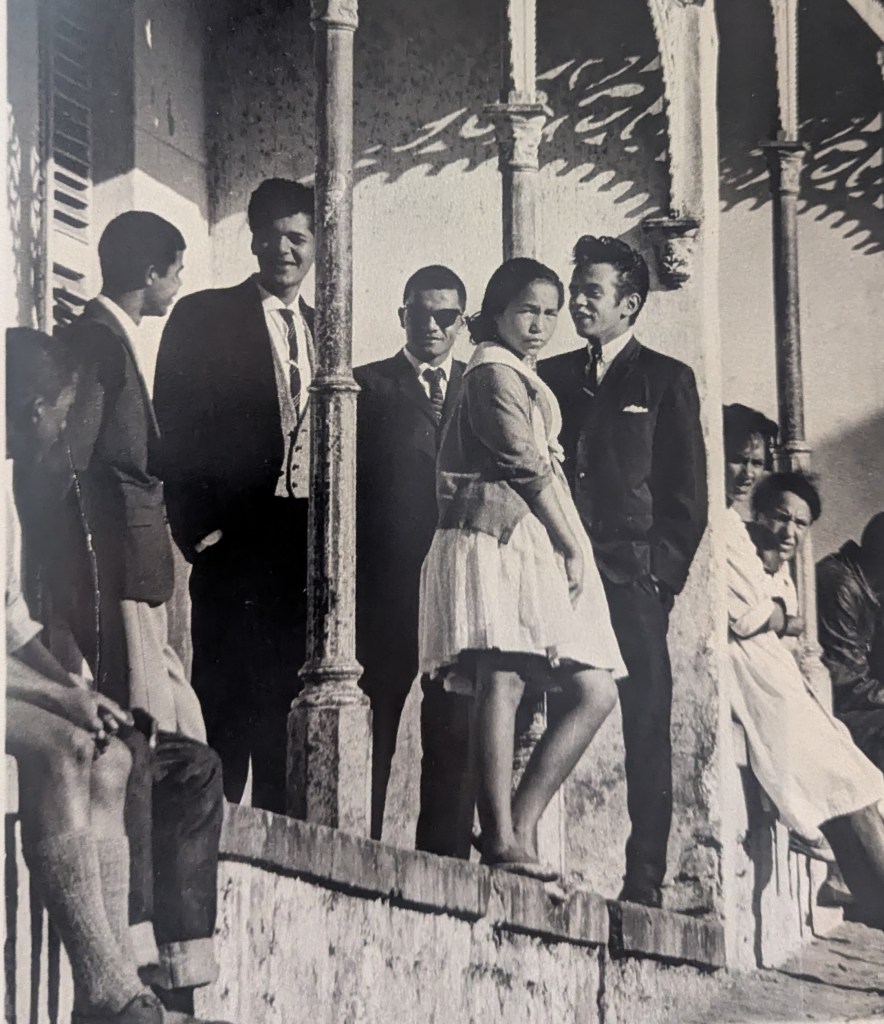
The government built a Whites Only university smack in the middle of the District, which is now open to any students.
Our next stop, fifteen minutes away down the motorway was Langa, a Township which is also a tourism showcase that is used to visitors. The housing is mixed quality, varying between very basic overcrowded hostels and small bungalows with nice cars outside them. The streets are quite scruffy, but there were plenty of ladies cleaning up litter. I’m not sure how typical it is of regular townships.
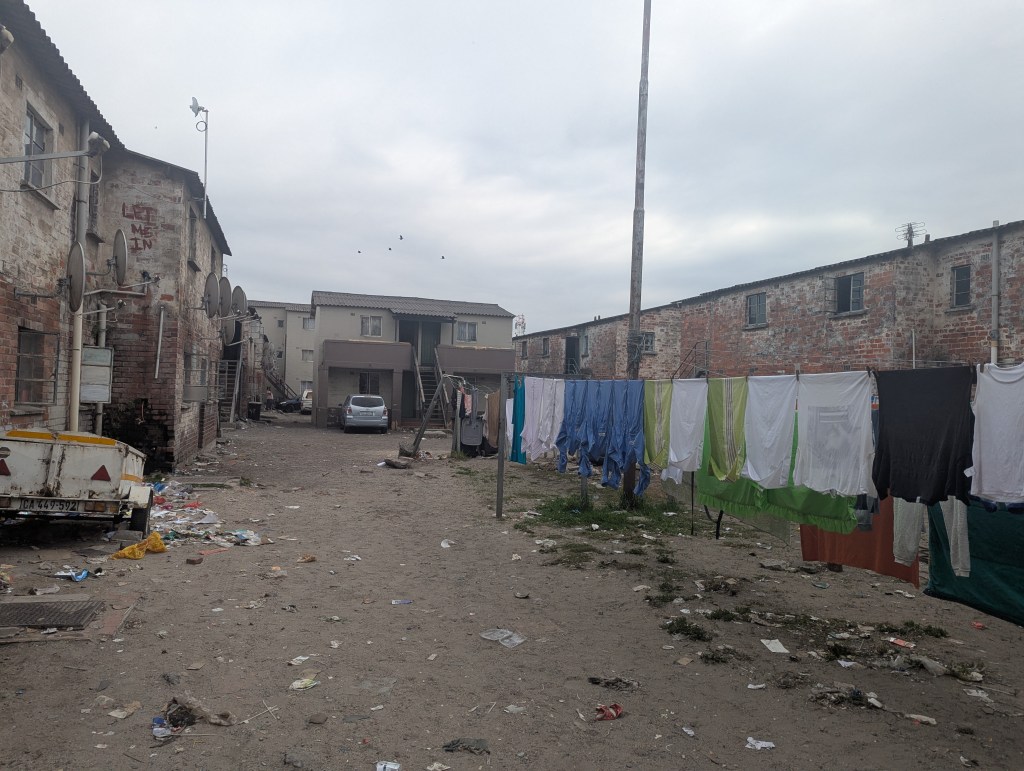
We were taken into a “hostel”, shared accommodation that is very cramped and basic. The Jacob Zuma government promised to knock down the hostels and replace them with better housing. The some of the demolition happened, but money for rebuilding went into the pockets of his cronies.
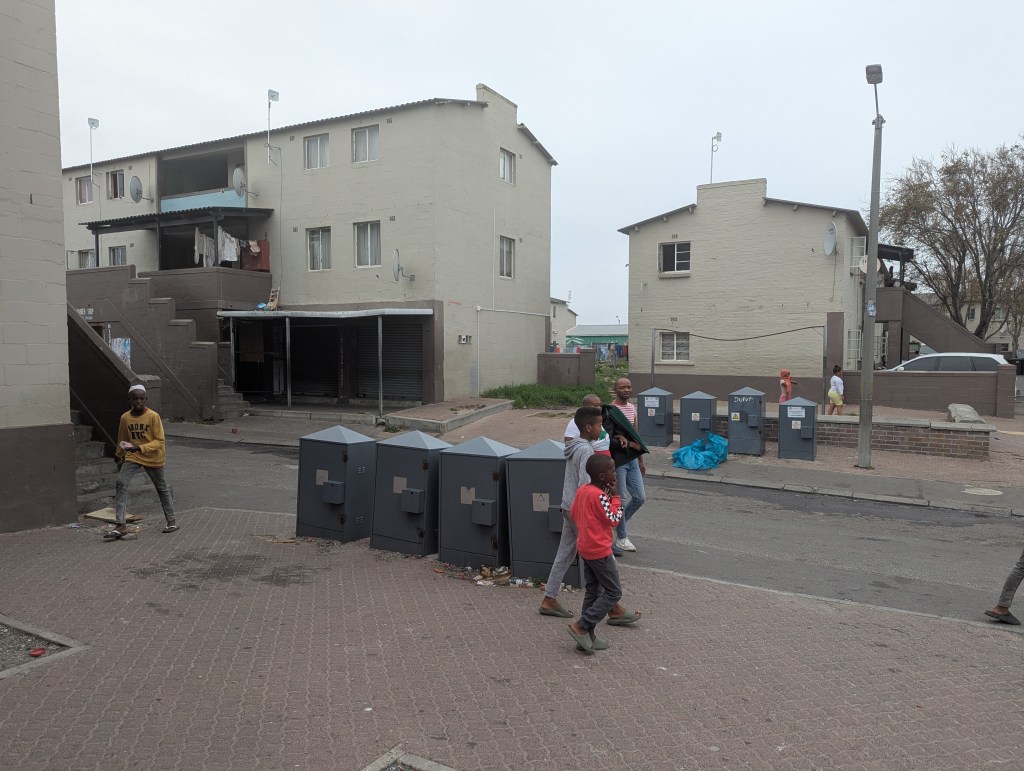
It wasn’t an easy visit, but it filled in many gaps in my knowledge of South Africa.
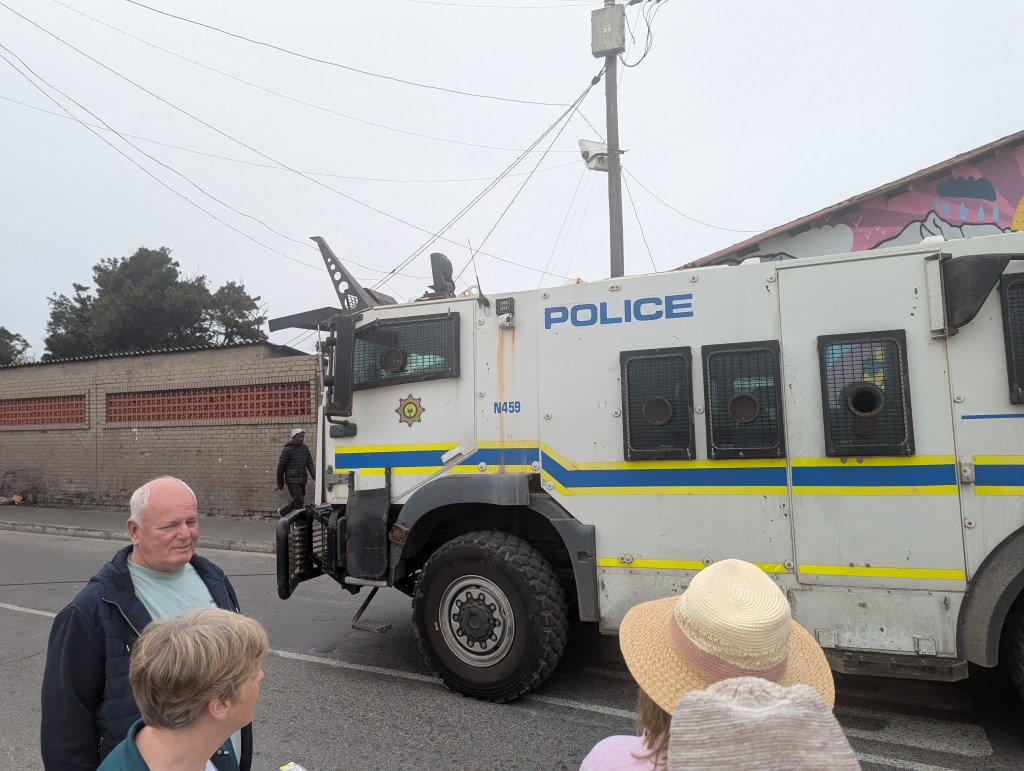
At a local community centre we visited a pottery and Julie bought a mug.
The driver dropped us at the Johannesburg Waterfront and we went straight to Zeitz MOCAA, a contemporary art museum built into converted grain silos on the docks.
To quote Wikipedia
“Using a variety of concrete-cutting techniques, the interior of the building was carved out to create a number of galleries and a large central atrium. The remaining concrete shafts were capped with strengthened glass in order to allow natural light to enter and create a “cathedral-like” interior.”
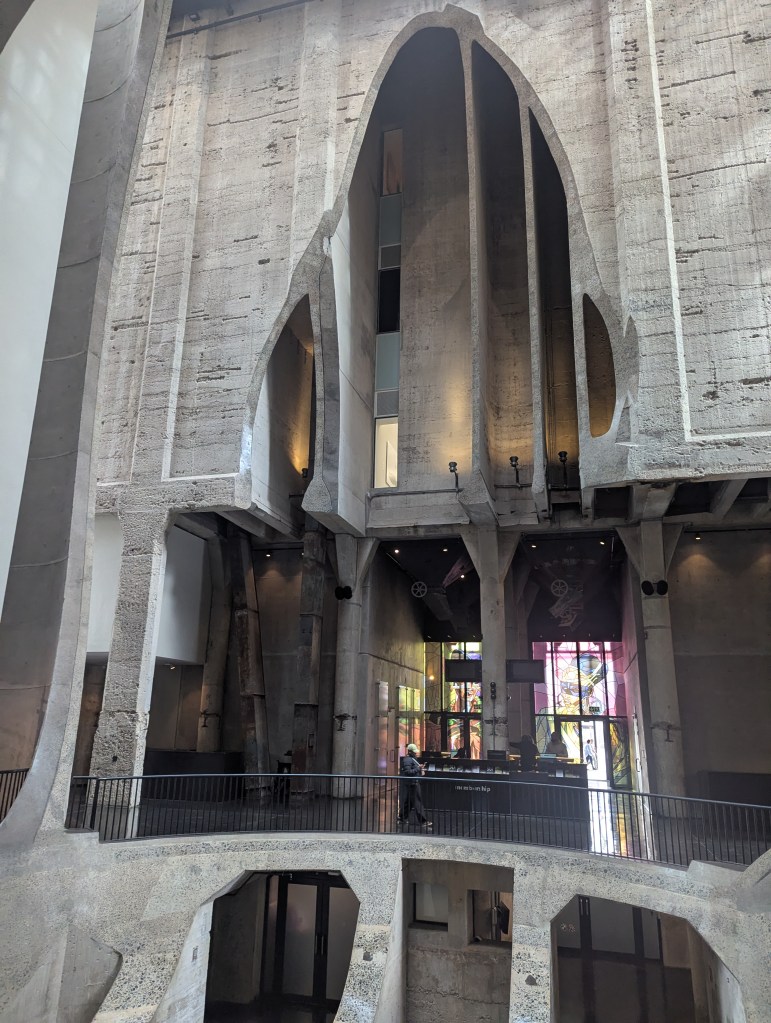
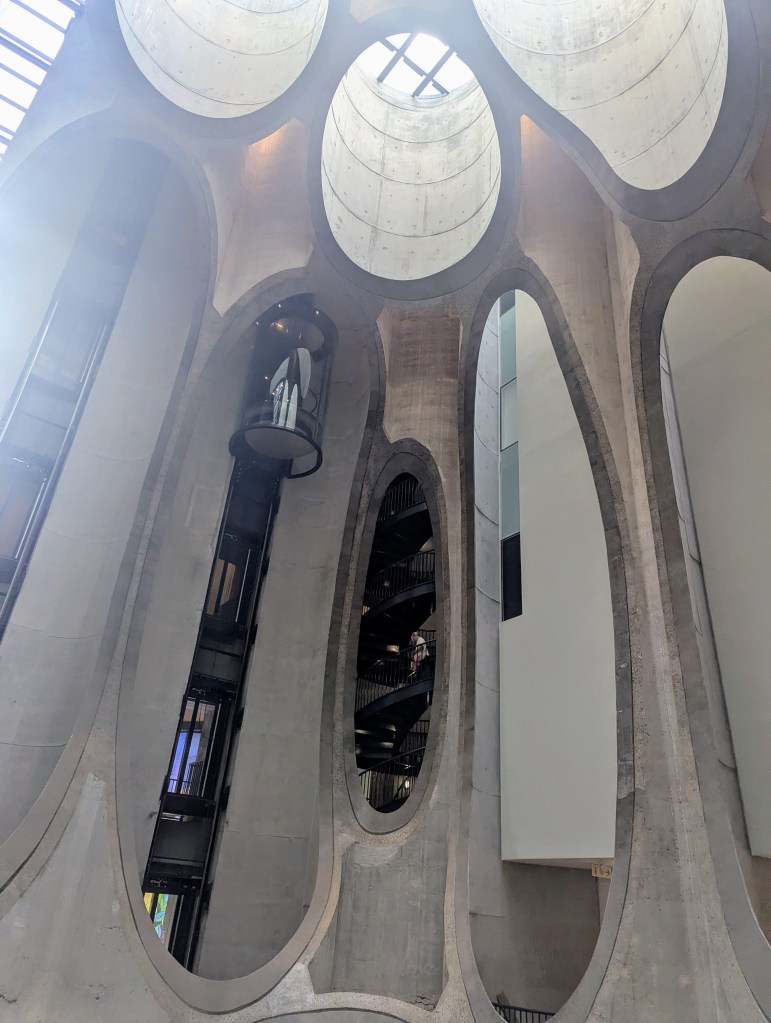
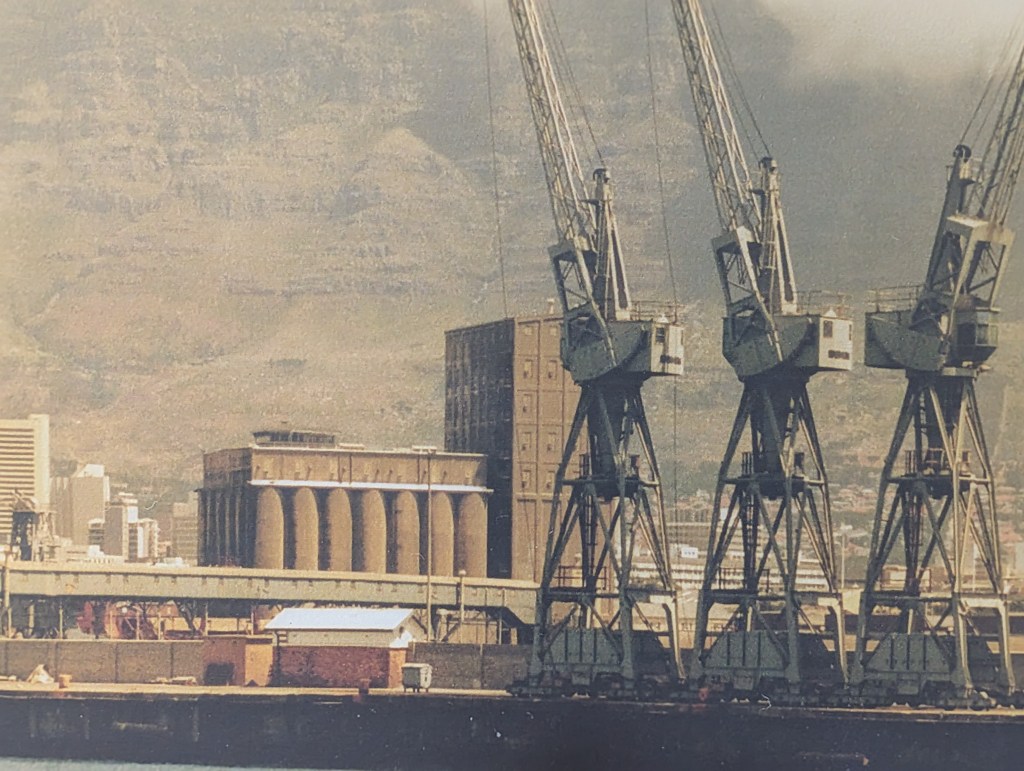
The building had originally been 42 tall cylindrical 57 metre tall silos. On level 6 there a very good cafe overlooking the docks, and there were only a few people in there. So we relaxed, and had an Americano and a light lunch, it was bloody marvellous.
The art was similar to that in the Tate Modern, what I call “modern bollocks”. After a quick look round the galleries we went back to the bar for a drink and gaze at all the ships including a huge pipe laying vessel. I had some Windhoek Draught beer from Namibia. It actually came in a bottle and tastes terrible. In general South African beer is not good, it is best to stick to the wine.
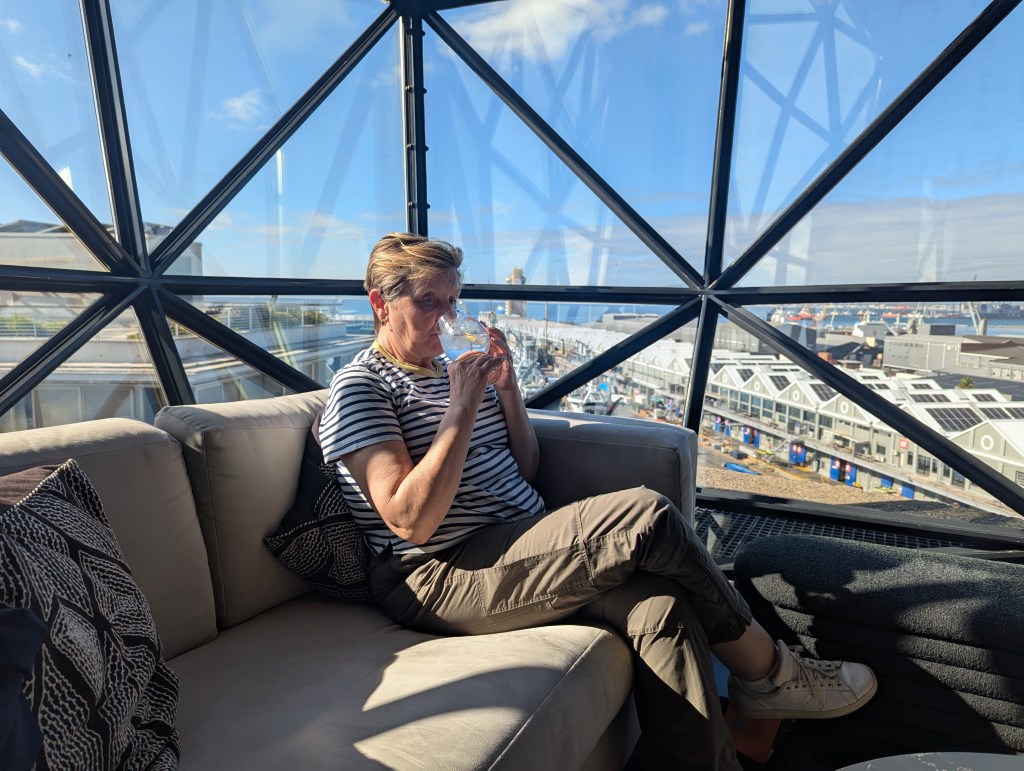
The Waterfront area is very lively and attractive, with buskers, harbour tours, and even Sea Lions swimming in the harbour. Its a great place to sit in the sunshine and watch the world go by.
Wine Tasting in Robertson
Tuesday 29 April 2025
Farewell fair Capetown. We are back on the road heading north east to more wine country, close to the town of Robertson. The weather is cool and damp today, so I have got my waterproof jacket ready.
We had all been good tourists, so we were taken to Vijoensdrift vineyard to have a tasting. We were taken into a large tasting room with tables and lines of four wine glasses on them. A nice lady brought round two white wines and then two red wines. I could tell you what they are but it would be meaningless, but I can assure you they were all good. Then, inevitably there was an opportunity to buy wine, so we got the best Sav Blanc for about £3.50.
After that we climbed aboard a big pontoon boat and had a gentle chug along the Breere River, a slow broad river lined with willow and eucalyptus trees.

Everyone was mildly pissed before we got back on the bus. We went to a roadside shop/restaurant called Platform 62 which was built on a disused railway platform. It had an old steam train outside. There wasn’t a wide choice of food, and the Eland burger caught my eye. It tasted pretty much the same as a fat beef burger, really good.
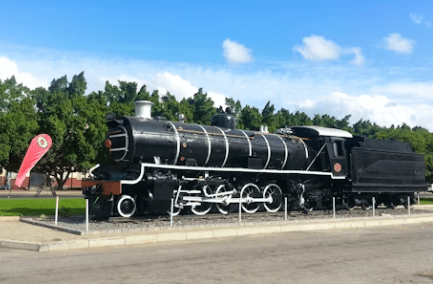
As well as offering food and wine (at £1.30 a glass), Platform 62 had a huge range of dried fruit and nuts, like a warehouse of them. I got some crystallised ginger and roasted macadamia nuts.
Our hotel stop was at Montgu, a small town built on a grid with a few pretty 19th century buildings. Our residence for one night was the Montagu County Hotel, a lovely Art Deco styled place with wooden floors and stylish furniture. We even had a chandelier in our bathroom, nice!
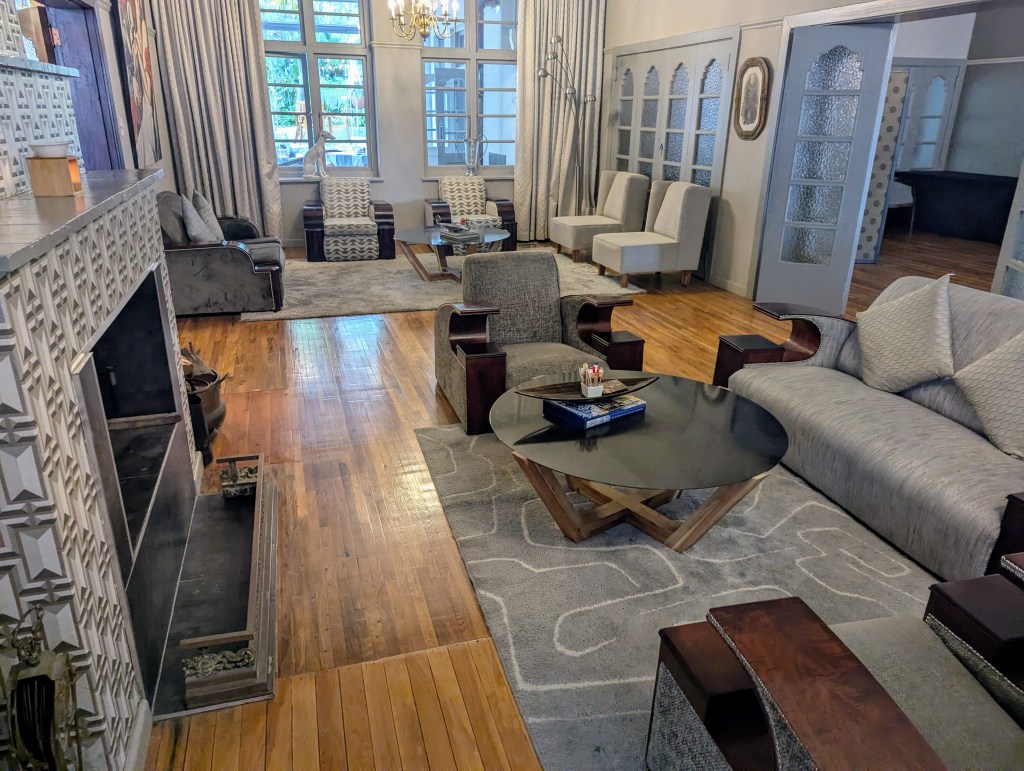
Julie had a cold, so stayed in bed while I went for dinner with the other tourists.
My dinner took over an hour to arrive, but it was good (steak and chips). Some of the other diners got substandard food and were not happy, one of them was really unhappy and complained loud and long. Very awkward for the rest of us.
Slow restaurant service seems to be a theme in South Africa.
The Little Karoo
Wednesday 30 April 2025
After a cracking breakfast at the Montagu, we continued up Route 62, a two lane A road through the really beautiful countryside of the Klein Karoo. Karoo means dry in Khoisan and Klein means small in Dutch. It is small compared to the Great Karoo which covers a third of South Africa. It is a dry mountainous landscape which reminded me of southern Tenerife with low shrubs and few trees. Despite the dry climate there are fields of grape vines, olives and fruit trees, it’s a very productive area. We pass a small troop of baboons by the roadside, they live everywhere.
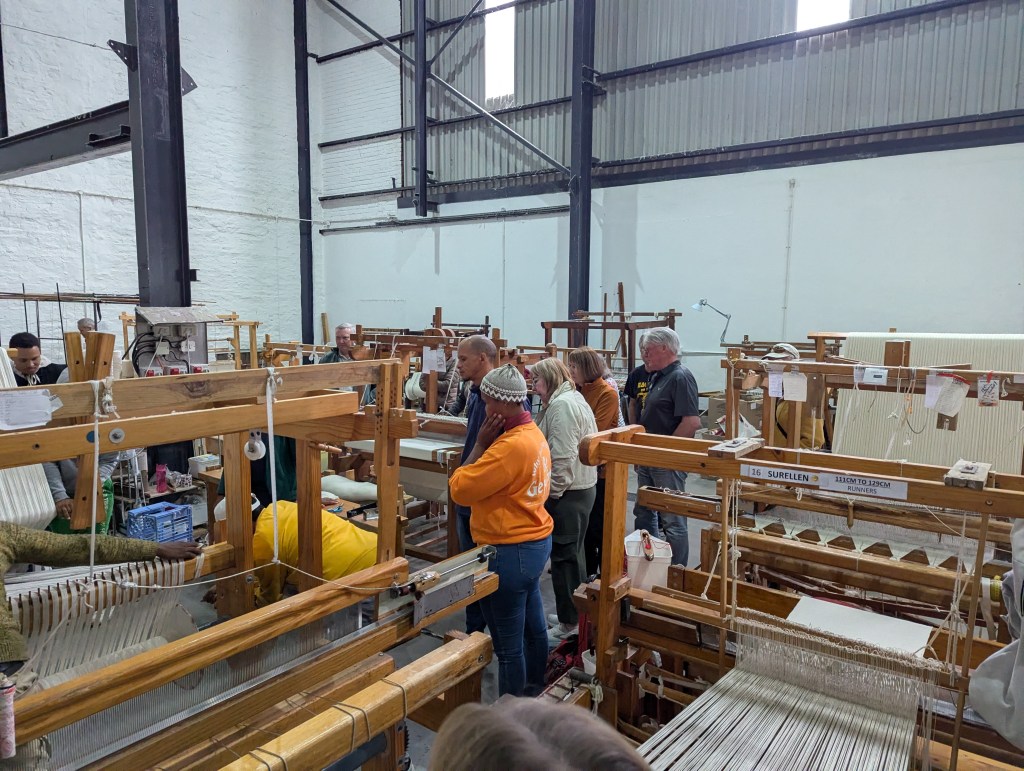
At Barrydale we turn into Barrydale Weavers, which has several big industrial sheds. A smiling lady (I didn’t catch her name) took us into one of the sheds. Inside were many flying shuttle wooden looms, simple manual machines from a pre-industrial age. Their operators were skilled local people working very fast with their hands and feet weaving white cotton fabric. The company makes towels, cushion covers and blankets and sells them all over the world.
In the next shed there was something even more interesting, a brandy distillery! Joseph Barry came from London in the 18th century to make brandy. The company makes some damned fine stuff. We tried the VS, VSOP, XO, and the Muscat. We tasted them on their own and then with a small lozenge of chocolate. Which was nice, but to be honest I couldn’t really tell the difference between them.
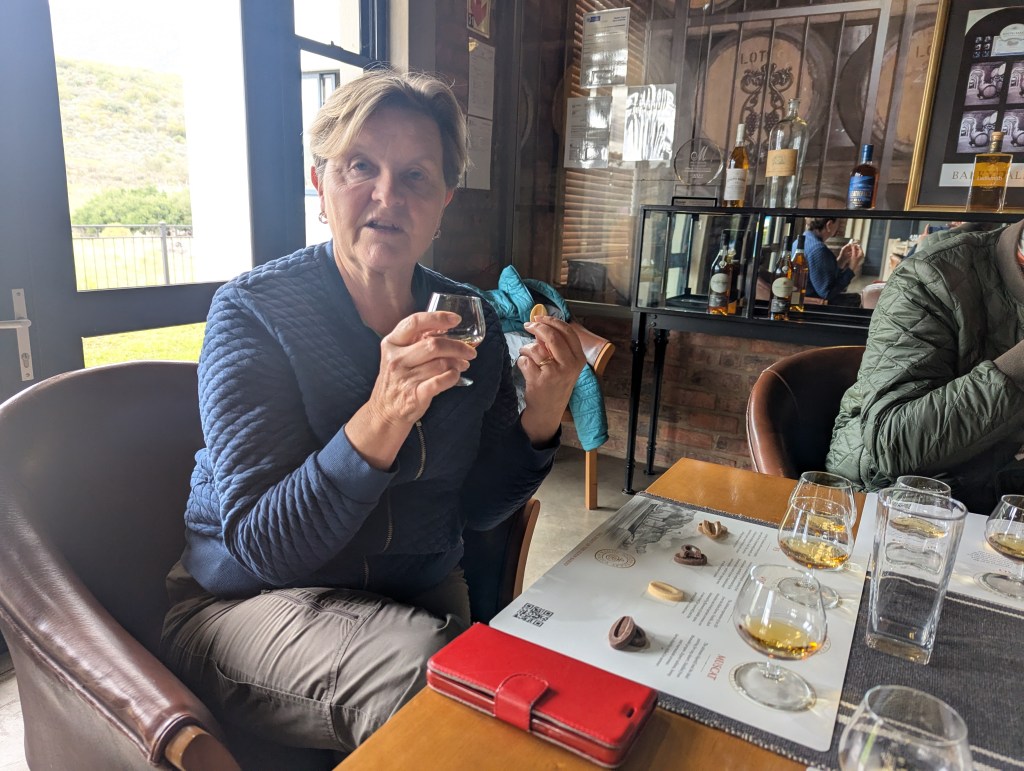
You may think a brandy tasking was the best part of the day, but dear reader but it was not.
Our next destination was Oudtshoorn, a little further up Route 62. On an open stretch of road there was a loud neeeyaaaaaah and a Ferrari sped past, then a second, then a fourth. They must have got lost on the way to King Road.
Just outside of the town is the Safari Ostrich Farm, no Lions, no Rhinos or Hippos, just Ostriches. First of all we all went for a much needed wee, and then had lunch. It was possibly the best lunch I had eaten in South Africa: Pea Soup, Ostrich steak, Chicken thigh, fresh vegetables and a salad followed by Malva pudding and hot custard. Malva is quite similar to treacle sponge, a School Dinner staple.
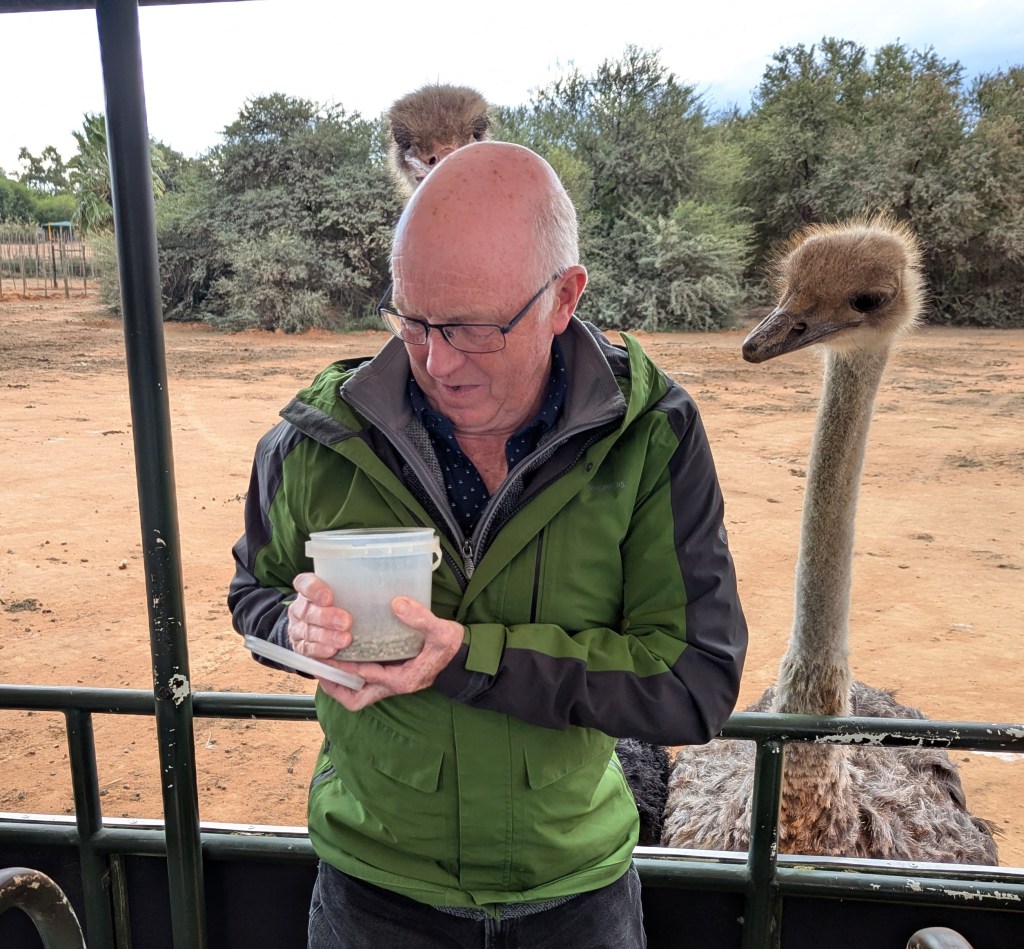
A charming young lady called Oreal then sold us some buckets of Ostrich food for 5 Rand, and took us over to a trailer with benches on it towed by a tractor.
We were taken into an enclosure with half a dozen big ostriches in it. They immediately bent their heads into our little buckets of feed and pecked away until it was all gone. It was hysterically funny, these comically tall creatures mugging us for a free lunch. The farm has 1800 hectares of land and thousands of Ostriches which can grow to over two metres tall.
FACTS
Ostriches eyes are bigger than their brains
Ostriches can live to be sixty years old
Ostriches can produce eighteen kilos of meat
Ostriches can produce over two kilos of of feathers
Our guide told us that during the Victorian boom they were worth “more than their wight in gold”. But I looked it up and found they sold for £22 to £26 a pound.
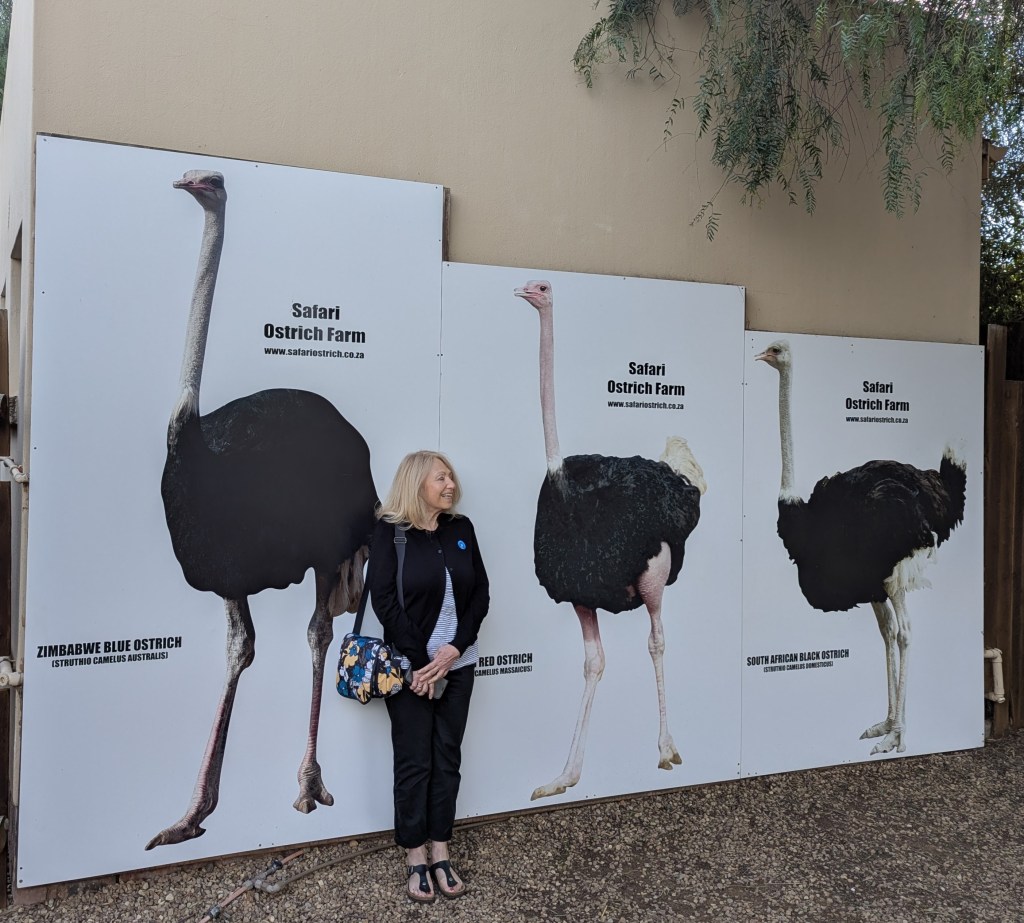
We next stopped at the Queens Hotel in Oudsthoorn. It is a Victorian stone building on the high street. Q stayed there in 1947. In Victorian times the town became very wealthy from Ostrich farming, when their feathers were in huge demand for ladies hats. The town is the biggest settlement in the Klein Karoo and still has the worlds largest ostrich population.
Having eaten a huge meaty lunch, we just had a very healthy combination of snacks and wine for dinner in our bedroom.
Up a Mountain Then Down Again
Thursday 1 May 2025
Today was more adventurous, we drove into the Swartburg Mountains to see the Cape Biome up close. The coach took us through some of the Klein Karoo (pronounced klane karua) past tobacco farms and game reserves. We didn’t see any game but did see camels being ridden at a farm.
We stopped at a small farm, and then transferred into a smaller Toyota bus driven by a very enthusiastic guide called Stephen who knows everything about the area. Stephen drove us up the B328 road called the Swartburg Pass, which starts off as tarmac but rapidly becomes a first road winding up the mountain. It was constructed by Thomas Bains between 1883 and 1888 using convict labour. He constructed many mountain passes in South Africa and was a remarkable engineer. Bains estimated a cost of £40,000 but he came in under budget at £35,000. The pass has many retaining walls on the bends built of dry stone, which stand very firm after 140 years.
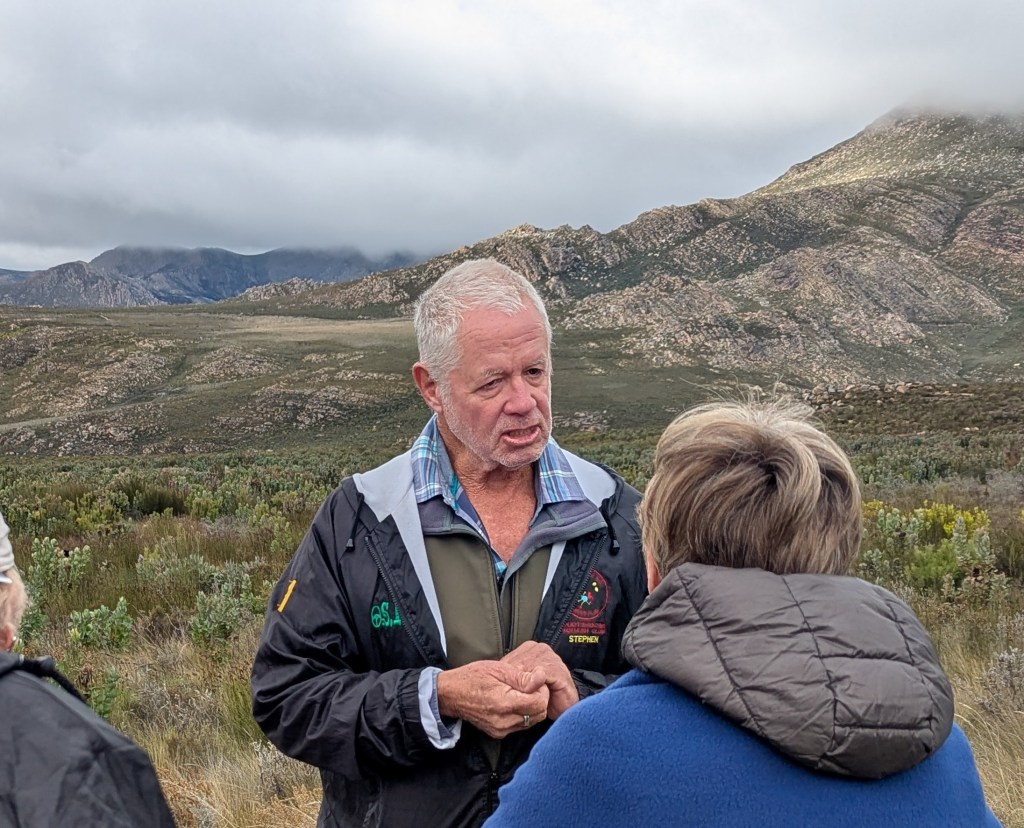
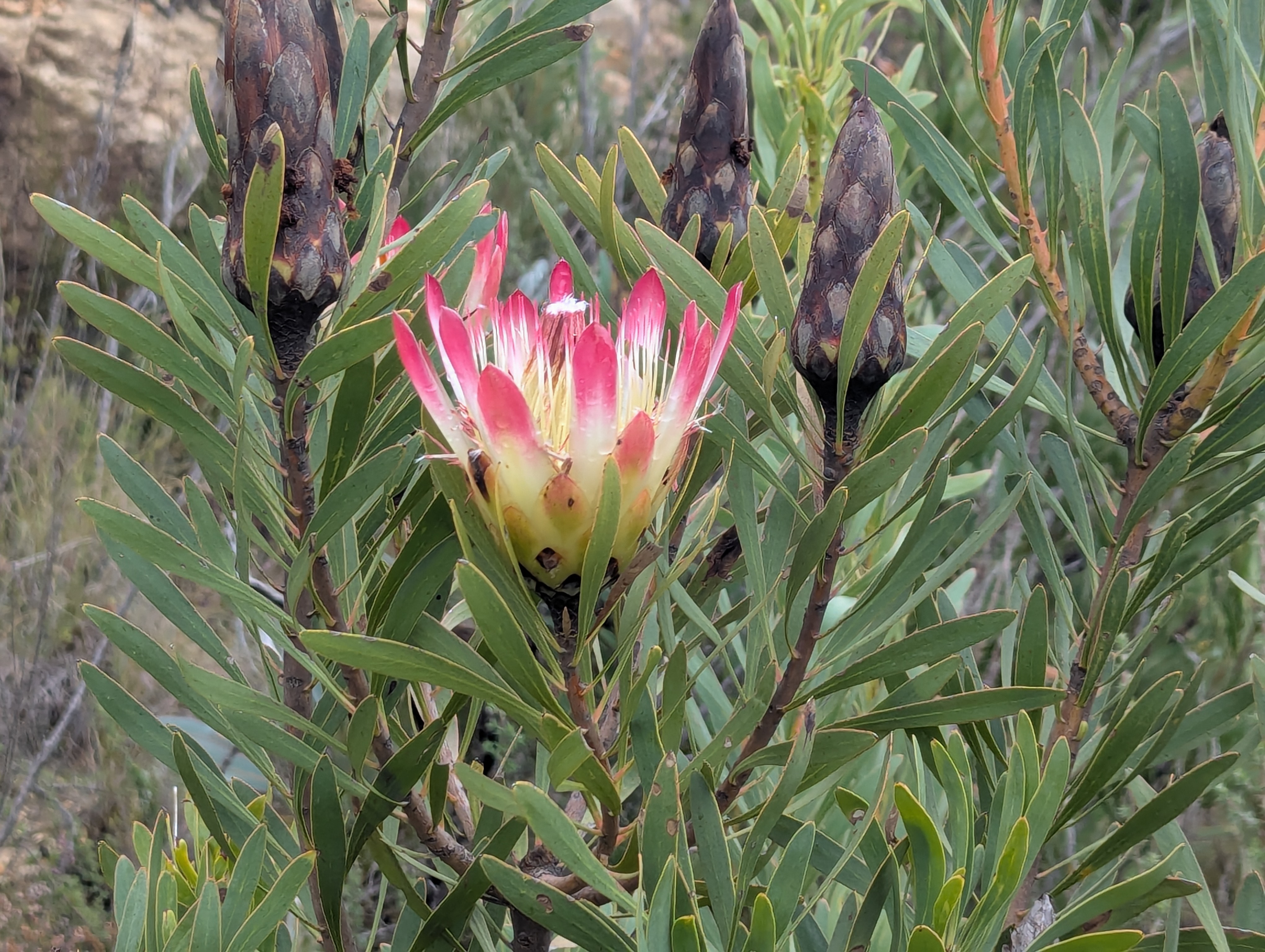
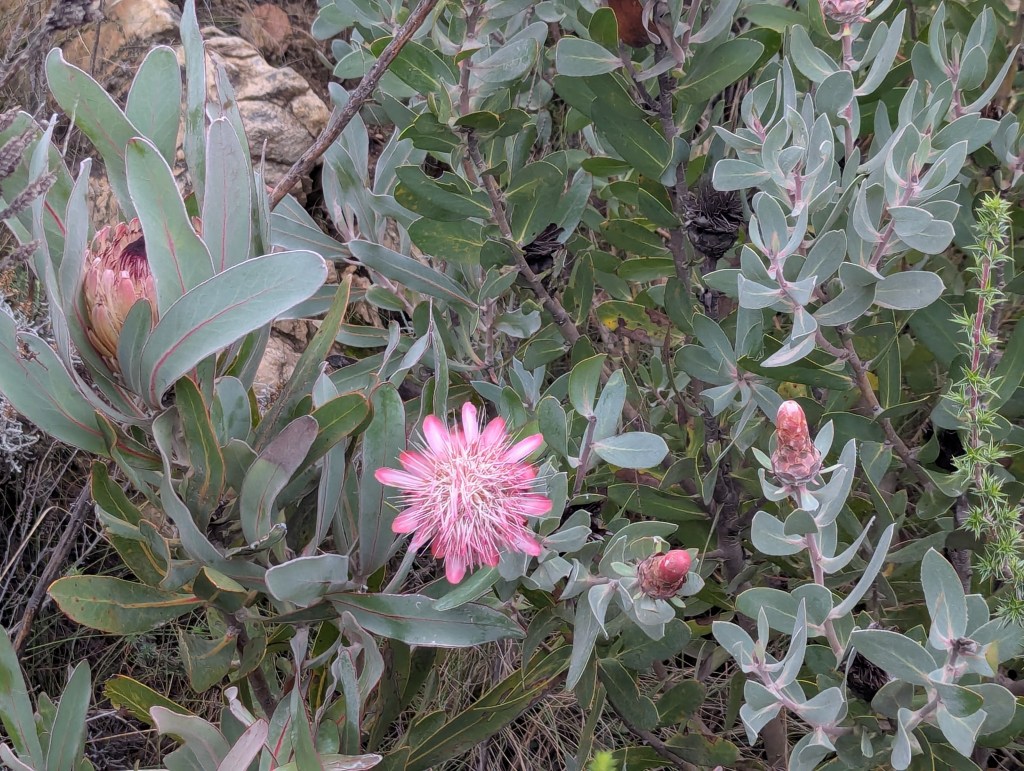
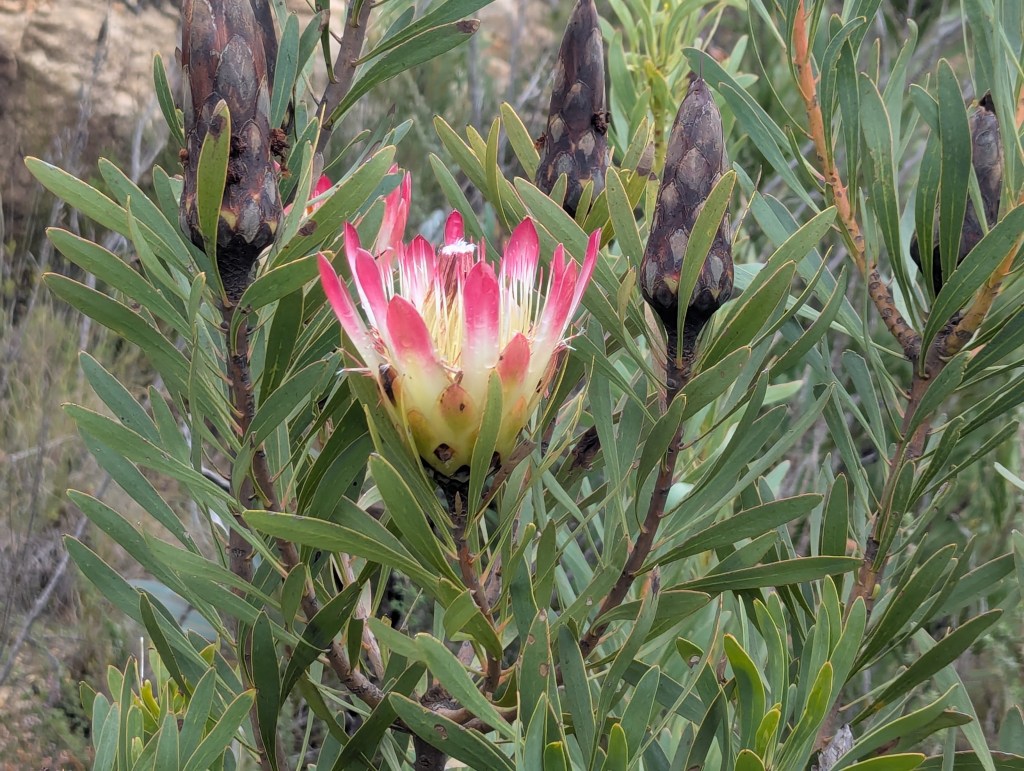
Stephen stopped the bus often and told us about the flowering Protea bushes, the restios reeds used for thatching houses, and the Wagon Tree used to make brakes for ox carts. The area had a devastating seven year drought until June 2023, and huge wildfires. It has rained since and the fynbos have recovered.
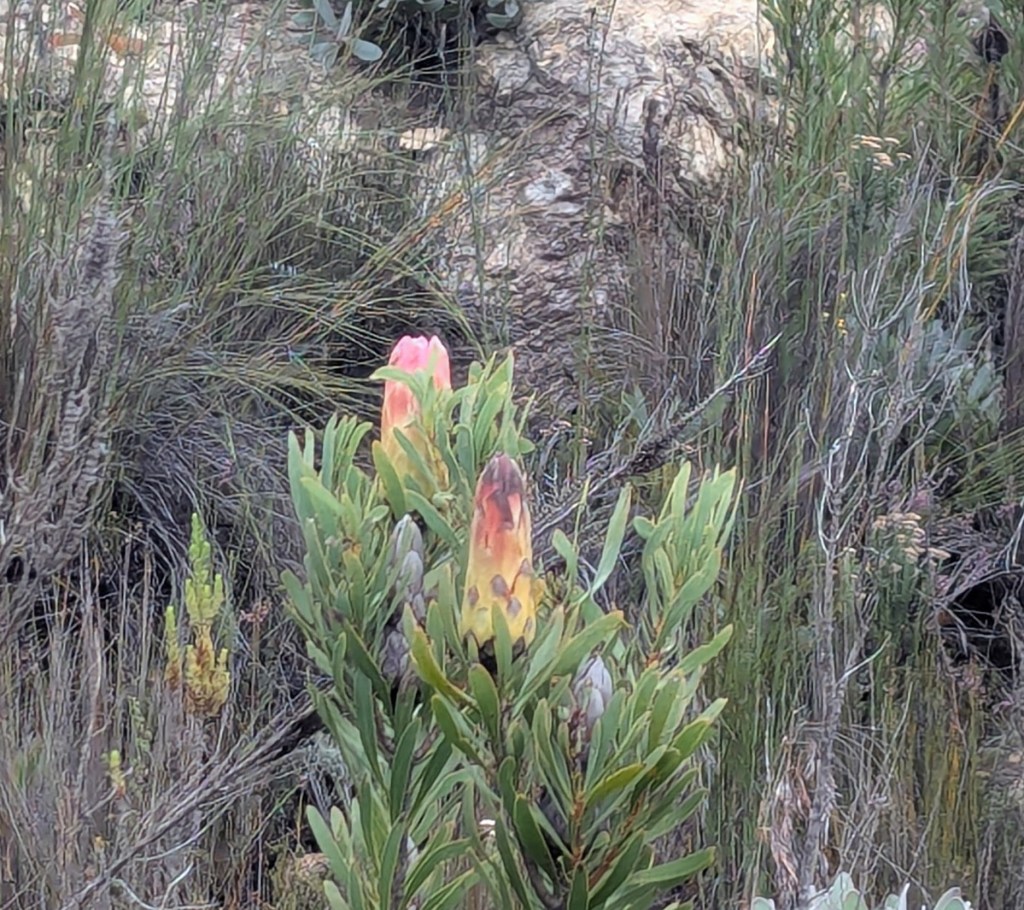
Baboons inhabit the mountains and raid the farmers’ gardens. They are preyed upon by Cape Leopards, which are much smaller than other Leopards.
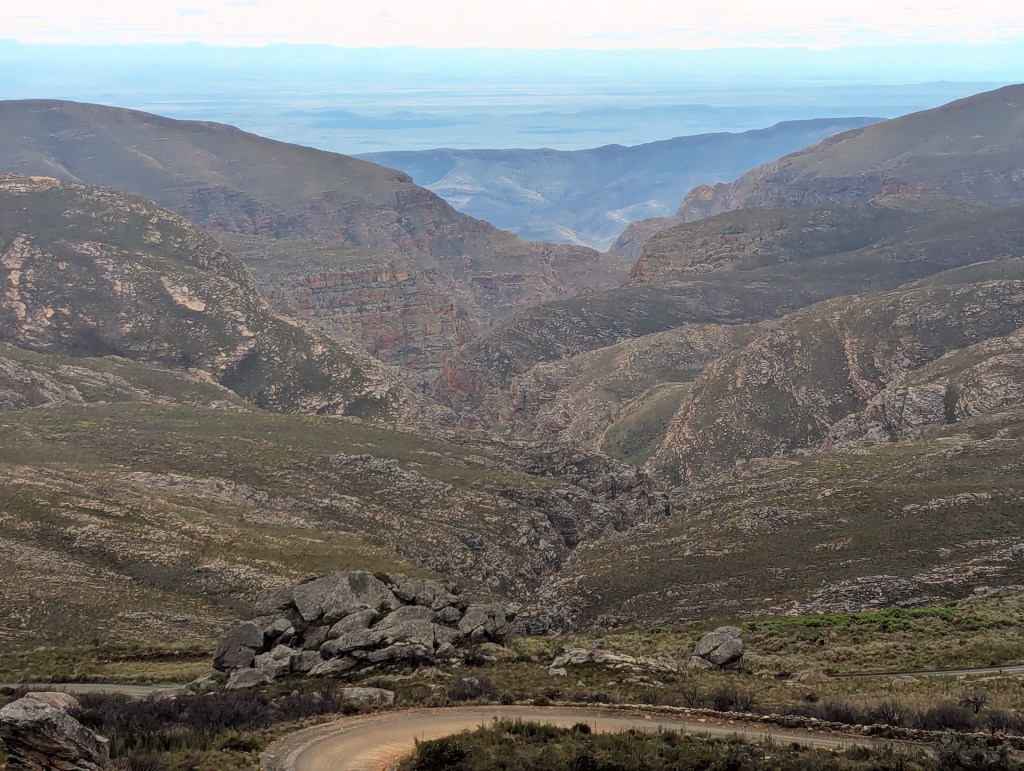
The coach climbed slowly and carefully up the winding road until we reached the top of the pass at 1570 metres. It was really cold up there, probably 5 or 6 degrees, but there are fantastic views of the Great Karoo, a huge area of semi-desert. The geology is very striking, with quartzite cliffs tilted at up to 90 degrees, and mudstone with fossils of ancient mussels. On mountains a few miles away we could see snow on the peaks.
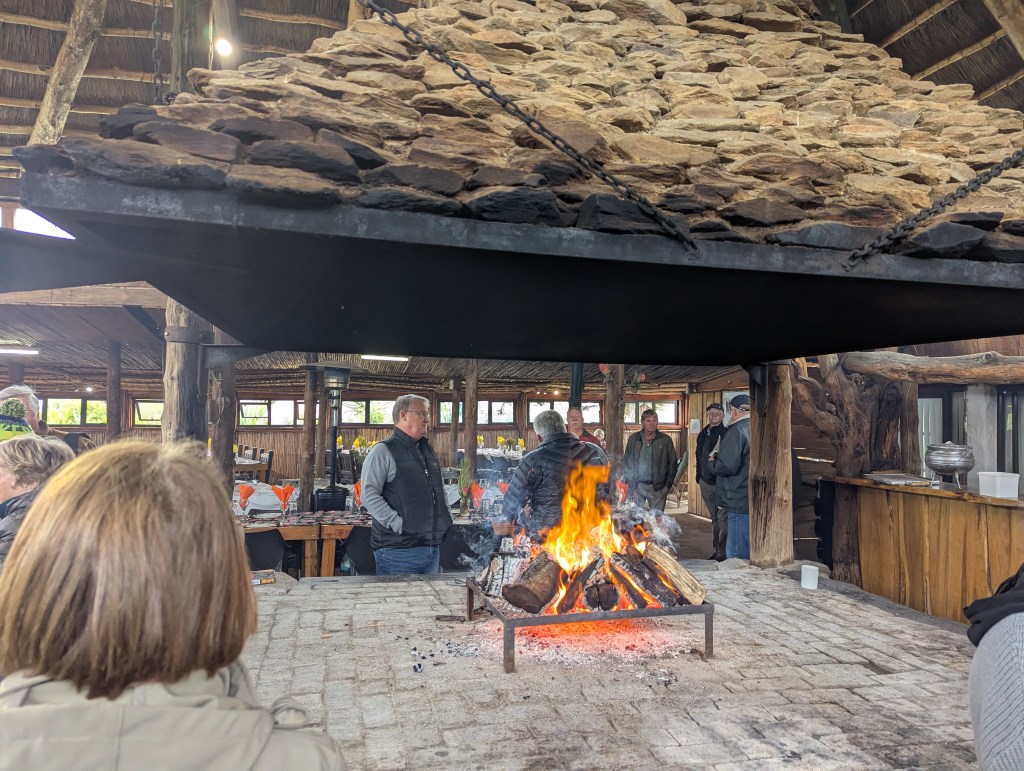
Returning to the farm where we started, we sat around big tables and had a Braai lunch, South African barbecue. We queued up for salads and then ostrich, boerwors and lamb chops, very hearty. All meat for the meal was cooked by one cook on a big barbecue at the back of the dining room.
From the top of Swartberg, we went underground to Cango Caves. They are big show caves, a bit like Cheddar caves but bigger.They were very impressive, but unfortunately we were in a very big group of about 50 people with a hopeless guide. All she had to tell us was that stalactites go down and stalagmites go up, the average ten year old could have told us that.

Back at the Queens Hotel we had more snacks for dinner, purchased from the Pick and Pay a short walk away.
The Great Karoo
Friday 2 May 2025
We took a long journey on the Megabus today from Oudtshoorn to Worcester which is close to Capetown. Passing through the pretty village of De Rust (The Rest) we saw enclosures of ostriches and fields of alfalfa that they are fed on. To get through the Swartberg mountains we passed through the Meiringspoort pass, another of Thomas Bains engineering marvels. The pass follows a river and twists and turns through gorges cut into orangy-yellow rock thats has been enormously deformed by massive tectonic forces. Some of the beds which were laid down by ancient seas now lay vertically. It is 25 km long and crosses the river 25 times.
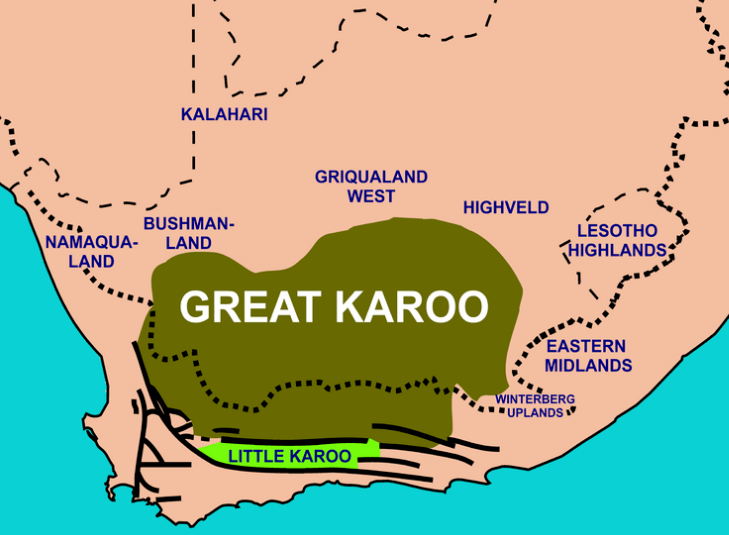
The pass was constructed so that farmers in the Great Karoo (the Great Dry) could get their merino wool to the port at George. The Great Karoo covers one third of South Africa, and farming productivity is extremely low.
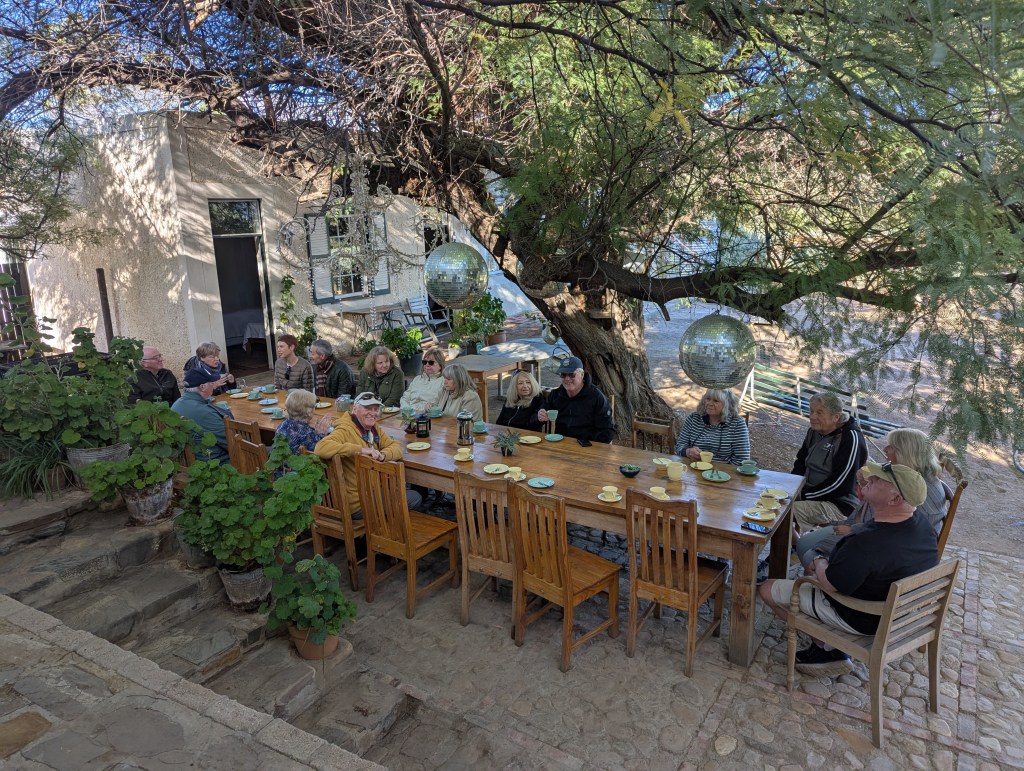
At Klaarstrom (Clear Stream) we stopped at the home of Jeremy and Sharon at their old farmhouse to see what an old rural house is like. It was built in 1885, and all the materials for the house, apart from bricks and sand, was imported from England. The house has big rooms and high ceilings to deal with the summer heat. The kitchen is warmed in winter by an Aga oven. Their village was founded so that farmers can wash their wool in the clear stream on its way to market. Our genial host told us all about the village and his house and gave us coffee and milk cake, which is like egg custard.
From Klaarstrom we passed into the Great Karoo proper, a treeless area of low sage-green shrubs, open plain and hills. It looks like the south west of the USA that we have all seen in films.
The nearest town to Klaarstrom is Prince Albert, which is a very pretty holiday town with eucalyptus trees along the road and pink bougainvillaea in the gardens. In Victorian times it had a Water Court to sort out disputes over irrigations between villagers, farmers and other commercial users.
After a very long drive through the Karoo we took a break at Majitsfontein (Majits Spring), a 19th century village next to the main railway line from Capetown to Jobourg. There is a small street of Victorian buildings including a battlemented hotel, an old post office, a church and a museum.
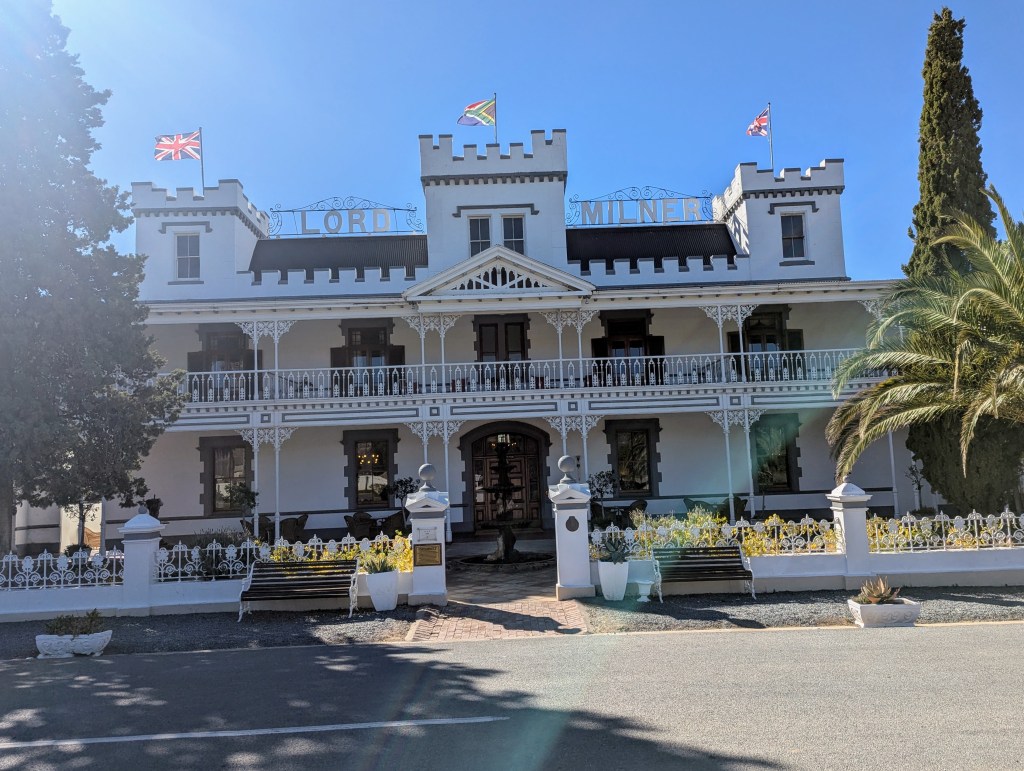
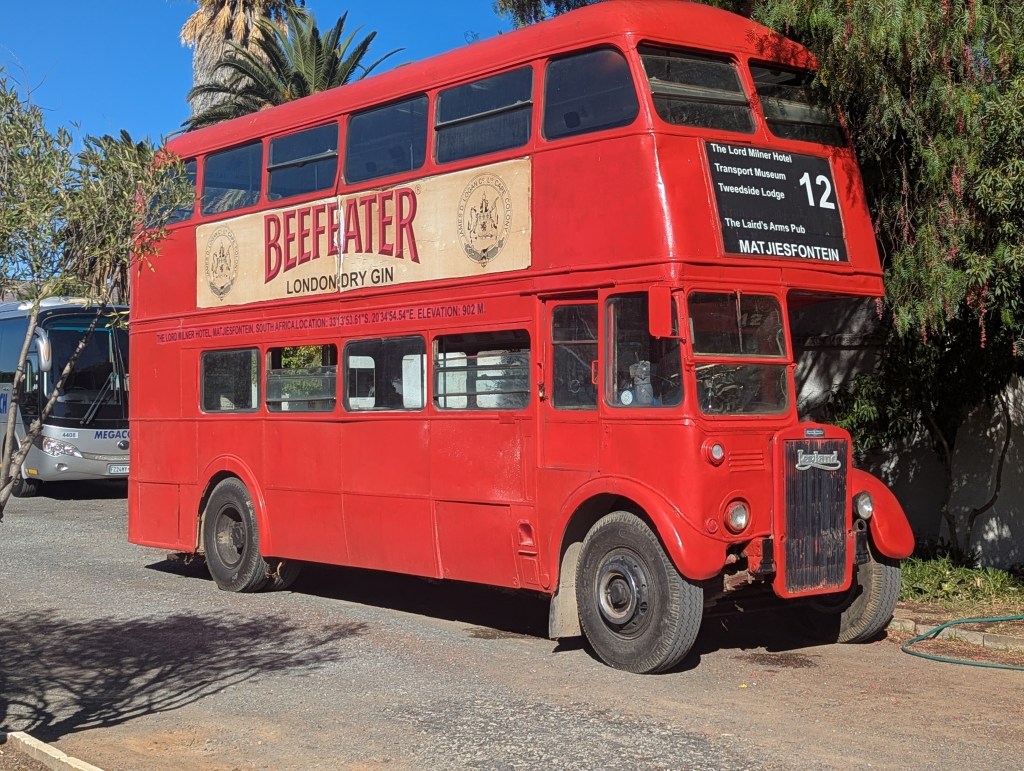
The museum has a very big collection of old stuff, including: sewing machines, cameras, typewriters, tools and even bedpans! In a separate building there was a dozen old cars, big American and British luxury saloons which all looked in need of TLC.
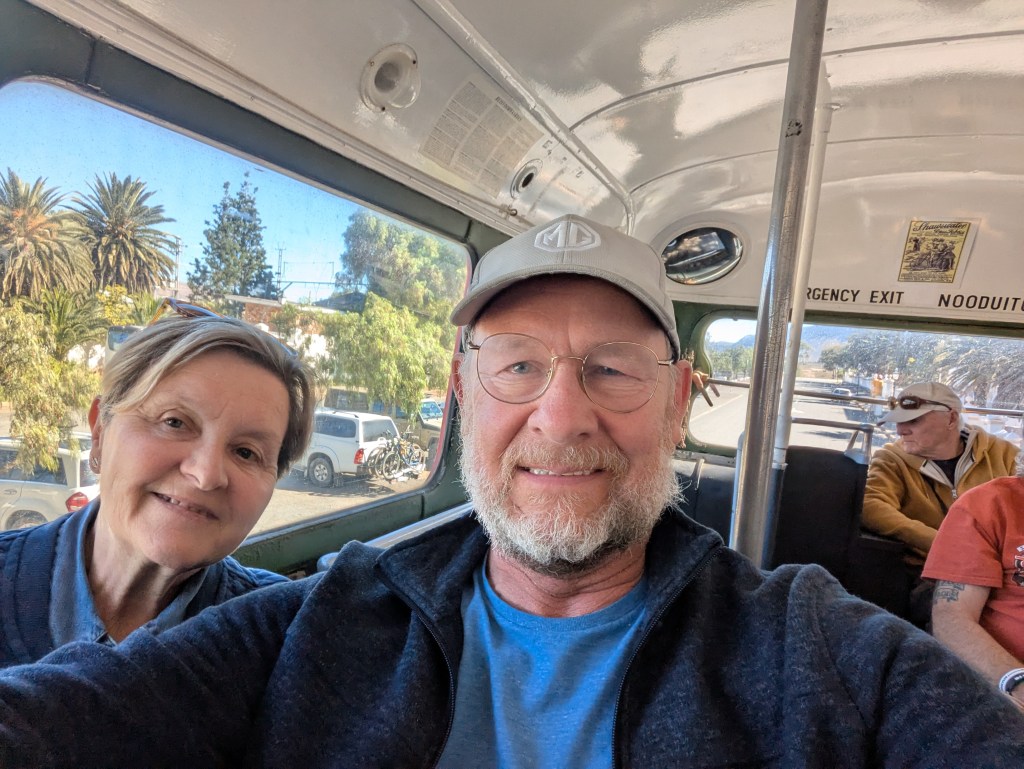
As we got closer to Worcester we passed huge fields of grape vines, which are grow for the table.
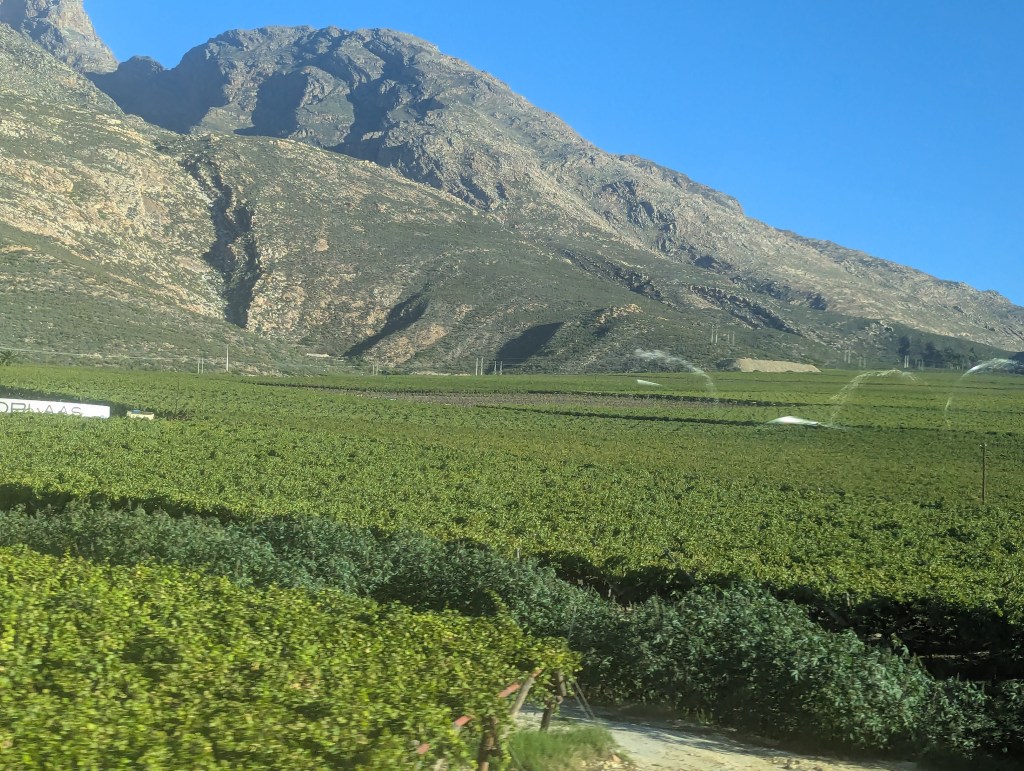
At 4.30 we reached the Sun Valley Casino and Hotel, our last hotel on the tour. Our driver took us to a local steakhouse, so we don’t have to suffer all the lights and noises of the fruit machines in the casino restaurant.
The Huzzar Steakhouse was very smart with nice staff, and the menu (mostly steak) looked great. BUT it took two sodding hours to get our main course. TWO HOURS! We were all rather grumpy when our meals arrived, and very hungry.
Elgin and Sir Lowry’s Pass
Saturday 3 May 2025
Today is our last day in South Africa, and I think we are suffering from travel fatigue. We have traveled over 1500 miles by coach and stayed in many different hotels. I have eaten a ridiculous amount of meat, my microbiome must be suffering from culture shock.
To end our tour our coach driver Tertius took us by the scenic route to OR Tambo Airport in Joburg. We passed through mile after mile of apple orchards, which are mostly picked by immigrant workers from Lesotho and Zimbabwe. In the distance there was the Appeltizer factory, a South African invention that is now owned by Coca Cola.
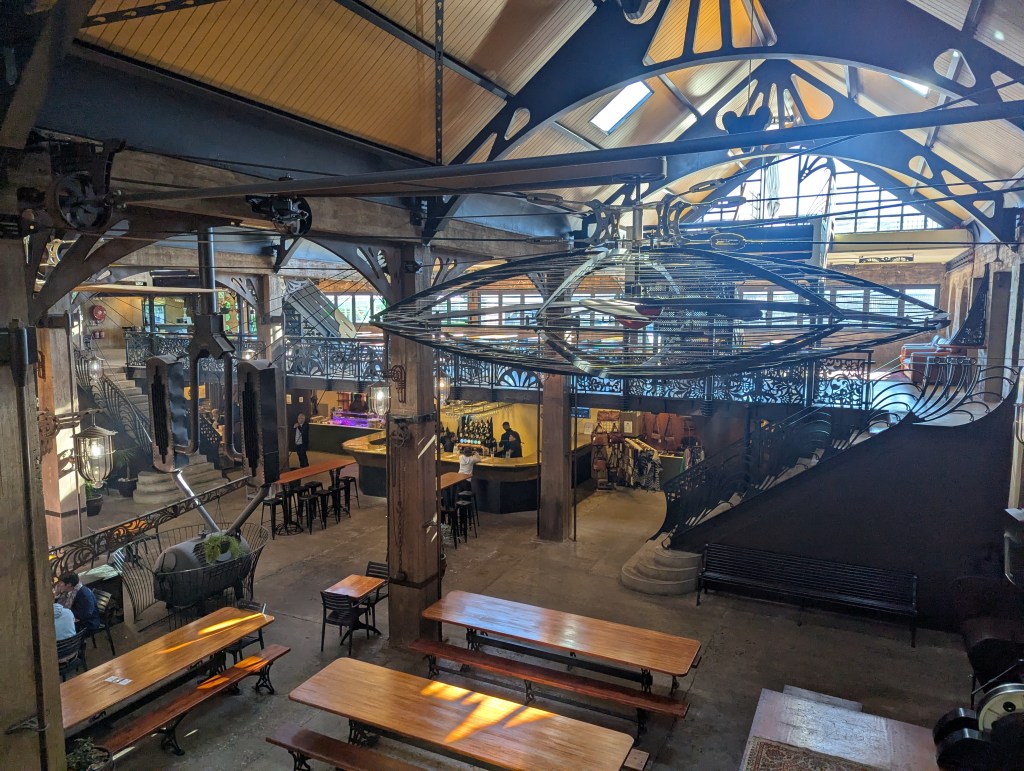
At the town of Elgin we stopped at the railway station and went into a big concrete building which looked like an old warehouse from the outside. Inside it had been converted into a wonderful indoor market full of craft shops and places to eat and drink.It was quite up market and beautifully designed, probably the best indoor market I have ever seen. The iron balustrades, banisters and log burners were really interesting looking, and there were huge rotating fans in the roof suspended by horizontal steel cables.

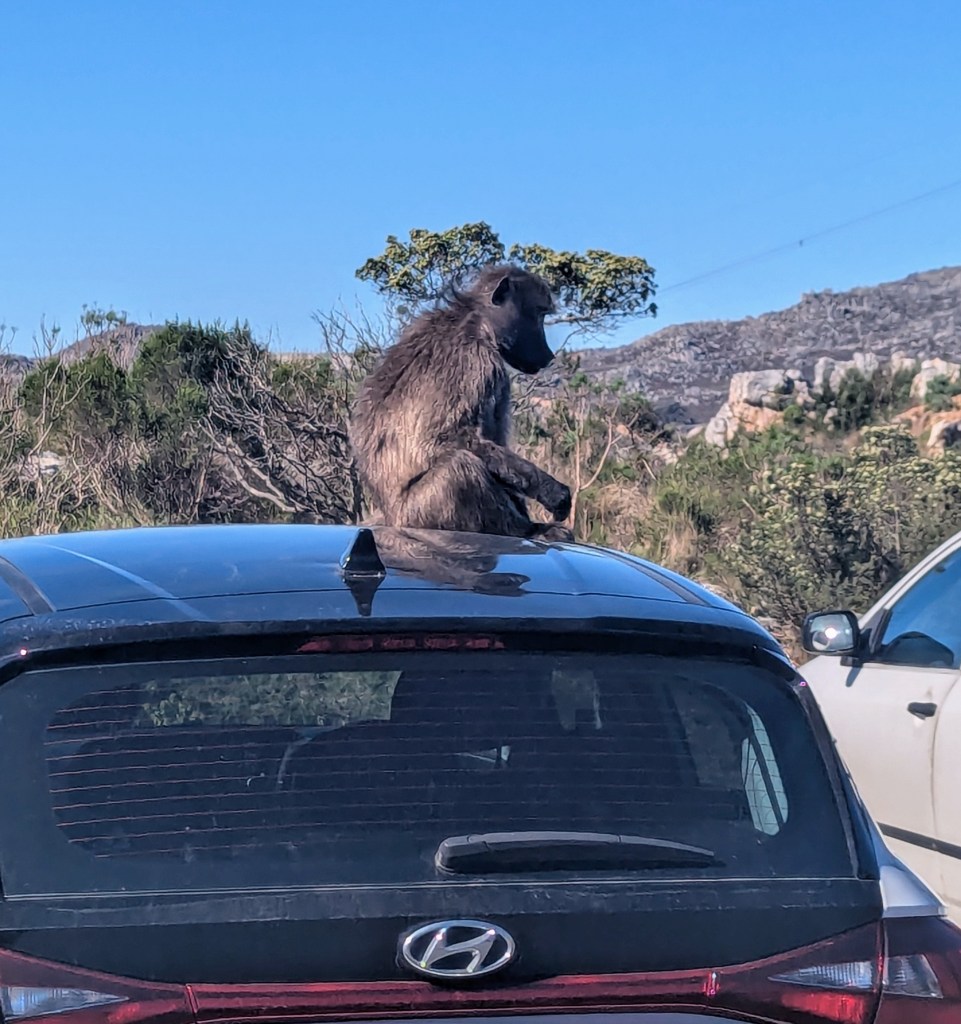
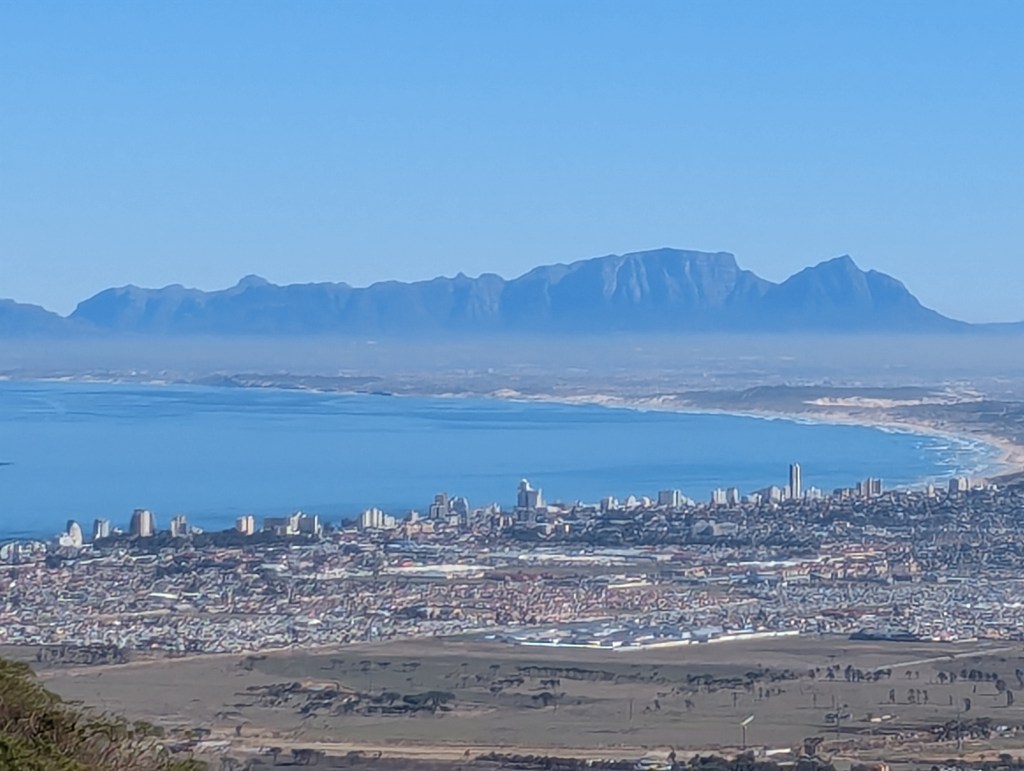
After an hour of mooching about it was back on the bus and up and over the Sir Lowry’s Pass. Sir Lowry was the Cape Governor who got the pass constructed in 1830 to allow safe passage to ox carts. Our coach parked at the top of the pass for photos. There is a steep drop down to Cape Flats and a fantastic view of False Bay and the back side of Table Mountain. From where we parked paragliders were queuing up to jump off the top of the mountain and fly hundreds of feet to the bottom. In the car park a hungry baboon was trying to get into a car and our coach in search of lunch.
Then we descended the pass and drove down the motorway to Capetown airport to catch the 13.30 Cemair flight to Joburg. I’m now in a restaurant eagerly anticipating the arrival of our dinner and a Virgin Atlantic flight to Heathrow at 20.40.
Inevitably my burger took ages to arrive, I think the waiter forgot about us. The fight to Joburg was on time and uneventful. We were met at the airport by someone who guided from Domestic Arrivals to International Departures where we waited for our Virgin flight back to LHR.
The flight to 10 and a half hours overnight, and it wasn’t comfortable for me, but it arrived on time. We soon got through the airport and caught the 490 bus home, getting through the door at 8.30am.
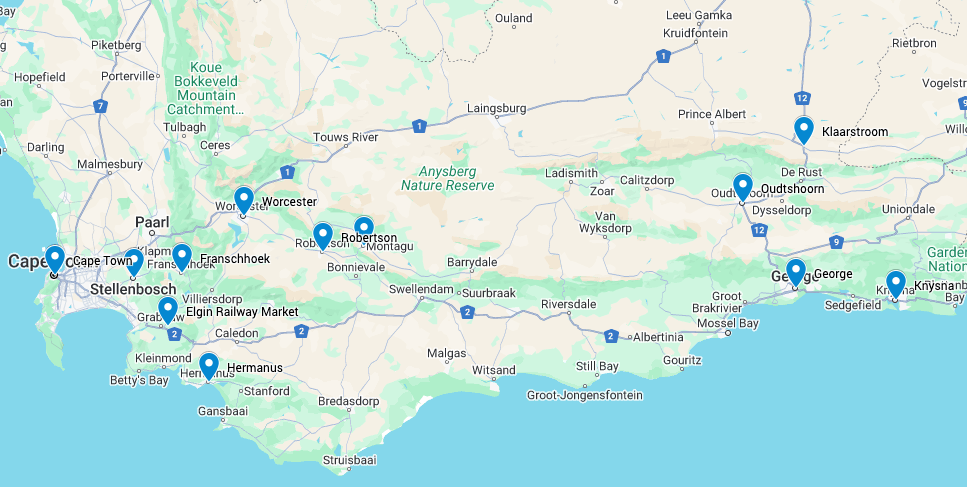
Here are all the places I visited in the Western Cape.
So what do I think of South Africa?
The Riviera Grand Tour was a very good way to see many of the highlights of the huge and diverse country. The guides, Ian and Lizwe, looked after us very well, keeping us well informed and ushered us in and out of all the different hotels.
The hotels ranged from Fine (Battlefield Lodge) to Top Notch (Pearl Valley Hotel) and the food was very good. I have never eaten so much meat in my life, and it shows on my waistline!
The tour covered a huge amount of territory and we had to spend a great deal of time on the coach. But the only way to see a big country is by travelling through it. I saw a huge variety of landscapes, geology, flora and fauna in the provinces of Guateng, Mpumalanga, Kwazulu Natal and the Western Cape.
It was great not having to be concerned about how to get around the country, and have a great view of the countryside from the coach. The scenery is very varied, and destroyed my preconceptions of what Africa looks like, having been brought up on nature documentaries.
The high crime rate meant that there were many places where it wasn’t safe to wander the streets as I would in Europe. We couldn’t simply visit other restaurants or bars and mix with the locals, apart from in some of the resorts. I did miss that freedom, but understand entirely why.
South Africa is a cheap place to eat and drink. For example fish and might cost about 150 Rand, which is £6.50, and a glass of wine would be 60 Rand or about £2.40. The food was generally really good. Breakfast was the same as at home, and that was always inclusive. For lunch and dinner there was often buffets with lots of different meat, salads, chips etc. For dinner you could get fish, which would be Hake or Kingklip, and once I got Mussels as a starter, exactly eight of them.
The staff in hotels were all black, and universally friendly, helpful and cheerful. It was especially good when we arrived at a hotel. Our cases would arrive outside our room 20 minutes later. They would get collected the following morning and be stashed on the bus.
On a tour you are in close contact with the same people for several weeks, which is a mixed blessing. All of the people we travelled with were very well mannered and good at timekeeping, which is crucial on a tour.
It was fun tasting wine at Neethlingshof and Vijoensdrift, but my palate is note refined enough to appreciate them properly. It was fascinating seeing the production process at Neethlingshof, and the enormous stainless steel tanks where they make thousands of gallons of wine. We passed huge amount of vineyards, showing what an important industry it is.
What you don’t get in South Africa compared to Europe is the depth of history, there are no palaces, mansions, abbeys, medieval towns and so on, but its not a fair comparison. But you do get spectacular mountain passes, hysterically funny Ostriches, Leopards in trees, Elephants crossing the road and more statues of Nelson Mandela than you can shake a stick at.
The highlight?
Flying in a helicopter past Table Mountain.

 timharnesstravels