Day 11 Sigirya and Kadulla

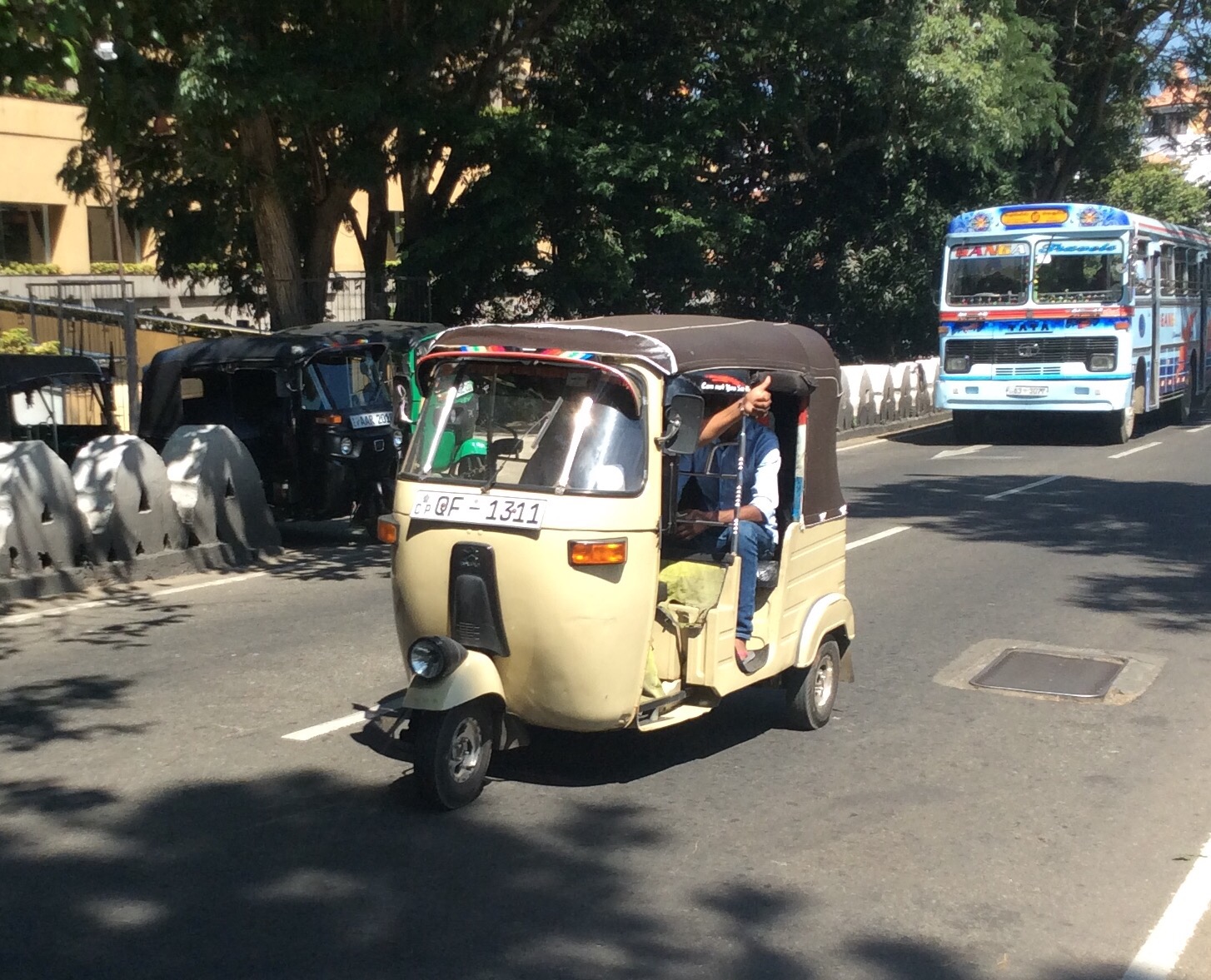
When we returned to the Amarantha after the Rock Temple, we got a tuk tuk driven by Nihal. He is a nice guy with good English, who wanted to tell us about the area, and offered to take us out on a day trip.
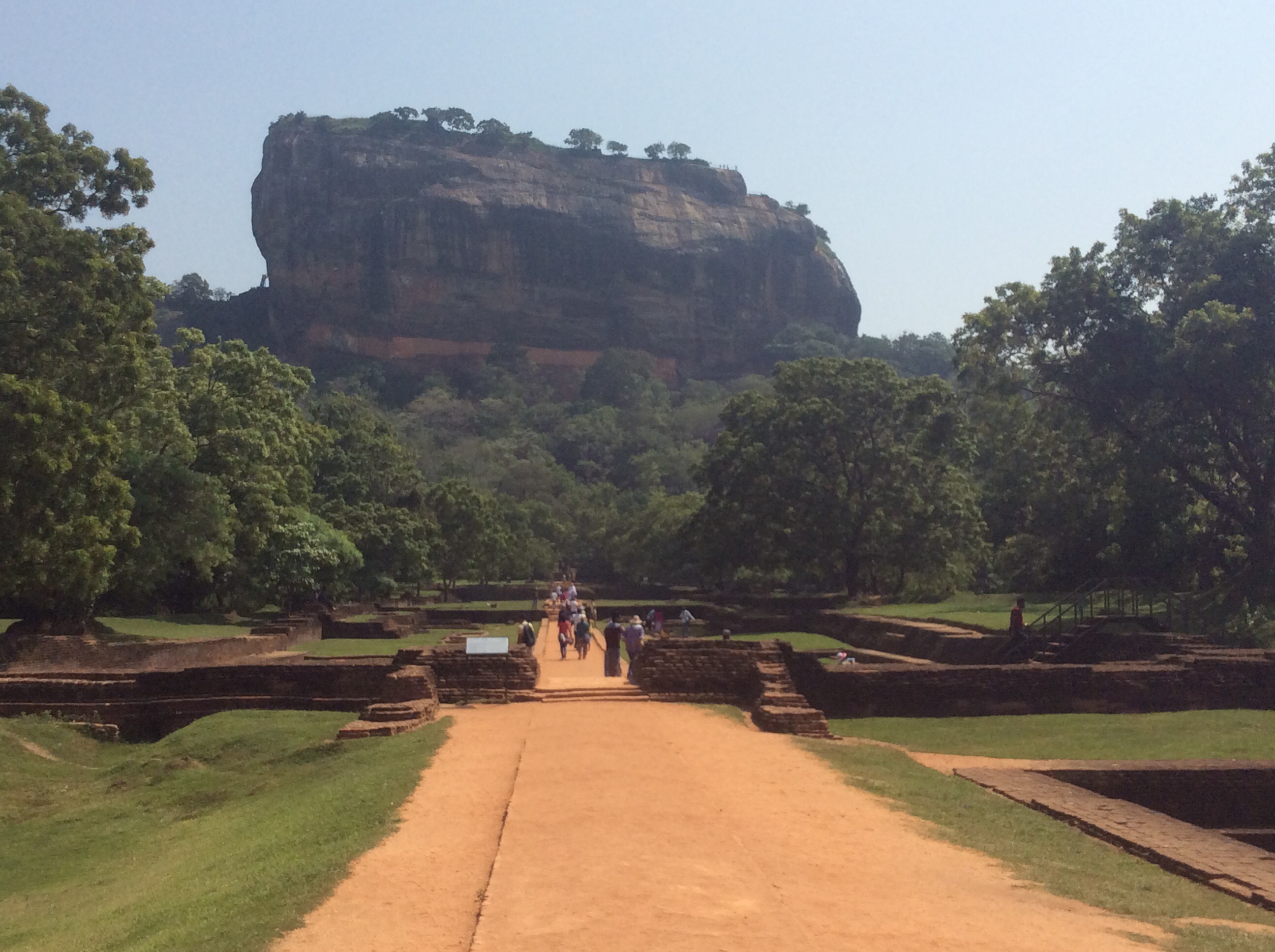
Sigirya rock

So today he took us out for the best day of our holiday so far. We got up at 7am and he picked us up in his superior three wheeler. It has seat belts, comfy seats and goes reasonably fast for a three wheeled scooter. Our first stop was Sigirya, a ruined fortress that sits on top of a 200 metre rock. The admission cost is as steep as the rock, 4,500 rupees, which is about £25 each. There are two prices at most of the sites, the locals pay a fraction of what foreigners pay, which is fair given the difference in incomes. The approach is along an avenue flanked by ponds and lawns, and foundations of brick buildings, long since gone. It was about 9am when we arrived, and was already heaving with European and Chinese tourists. To reach the top you take metal staircases which are attached to the sheer sides of the rock. The ascent is steep, and in some places a metre wide staircase is shared by people going both up and down the rock. There are 1200 steps, but you can’t go up quickly so it isn’t very taxing. The main hold up was people taking photos of the making views.

Climbing the staircase

The hike is worth is for amazing view at the top, you can see for miles around in all directions. The summit has more foundations of brick buildings, and cisterns for water storage. On the way up are some frescoes painted onto the inside of a rock overhang. They are of either concubines, goddesses or nymphs depending on what you read, and they are very curvaceous, like images of Shiva’s consort Parvati that we saw in the museum in Colombo.

Julie at the top of Sigirya rock

Nihal picked us up at the exit car park and took us to a local cafe for lunch. The rice and curry was delicious, better food than we get in our hotel. Next he took us to meet our safari driver, and we parted with about £65 before climbing into a big Mahindra jeep. We drove to Kadulla National Park, a large area of dense forest surrounding a huge open meadow with a big reservoir and smaller lakes and water holes. In the forest we saw monkeys, peacocks and a monitor lizard. Once we got into the meadow there were elephants, hundreds of them! They were in many family groups of ten or twenty, with some big males away from thegroup on their own. They were grazing, pulling up grass with their trunks in a twisting motion, then sweeping it back an forth to remove the dirt before eating it. A few hundred yards away we saw a herd of wild buffalo, but we didn’t go close.
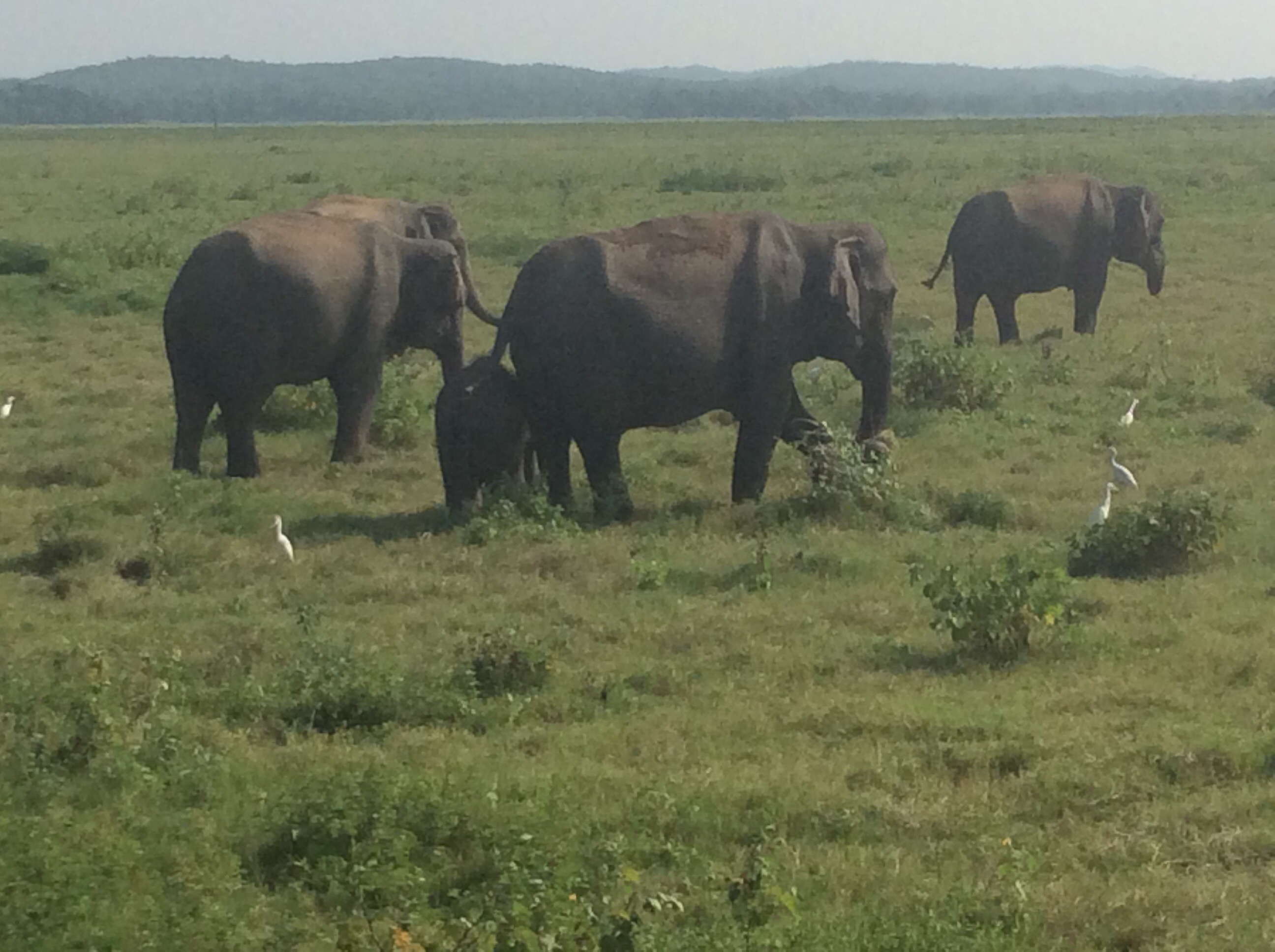
Elephants in Kadulla National Park

When we first arrived with the elephants there was one other jeep, by the time we left there were dozens of them, some loaded up with eight or ten people. The elephants behaved like the deer in Richmond Park, they just ignored us and carried on eating.
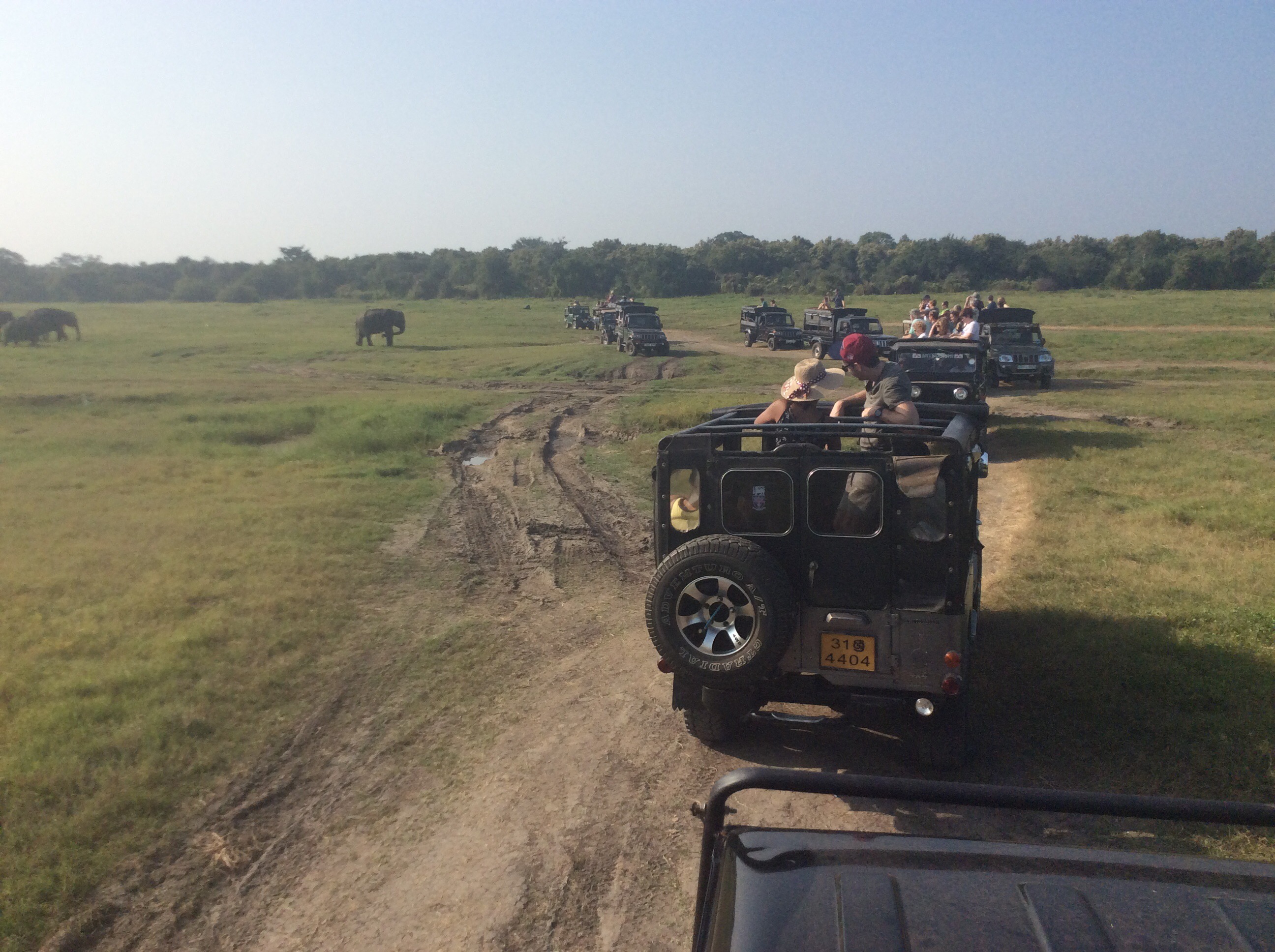
A jeep jam watching wildlife having their lunch

It was a real privilege to get so close to so many magnificent animals, there was also fox, fish eagles, storks, egrets and many colourful bird I didn’t recognise. On the main road back we had to stop while a big male elephant stamped on some kind of nut on the road.

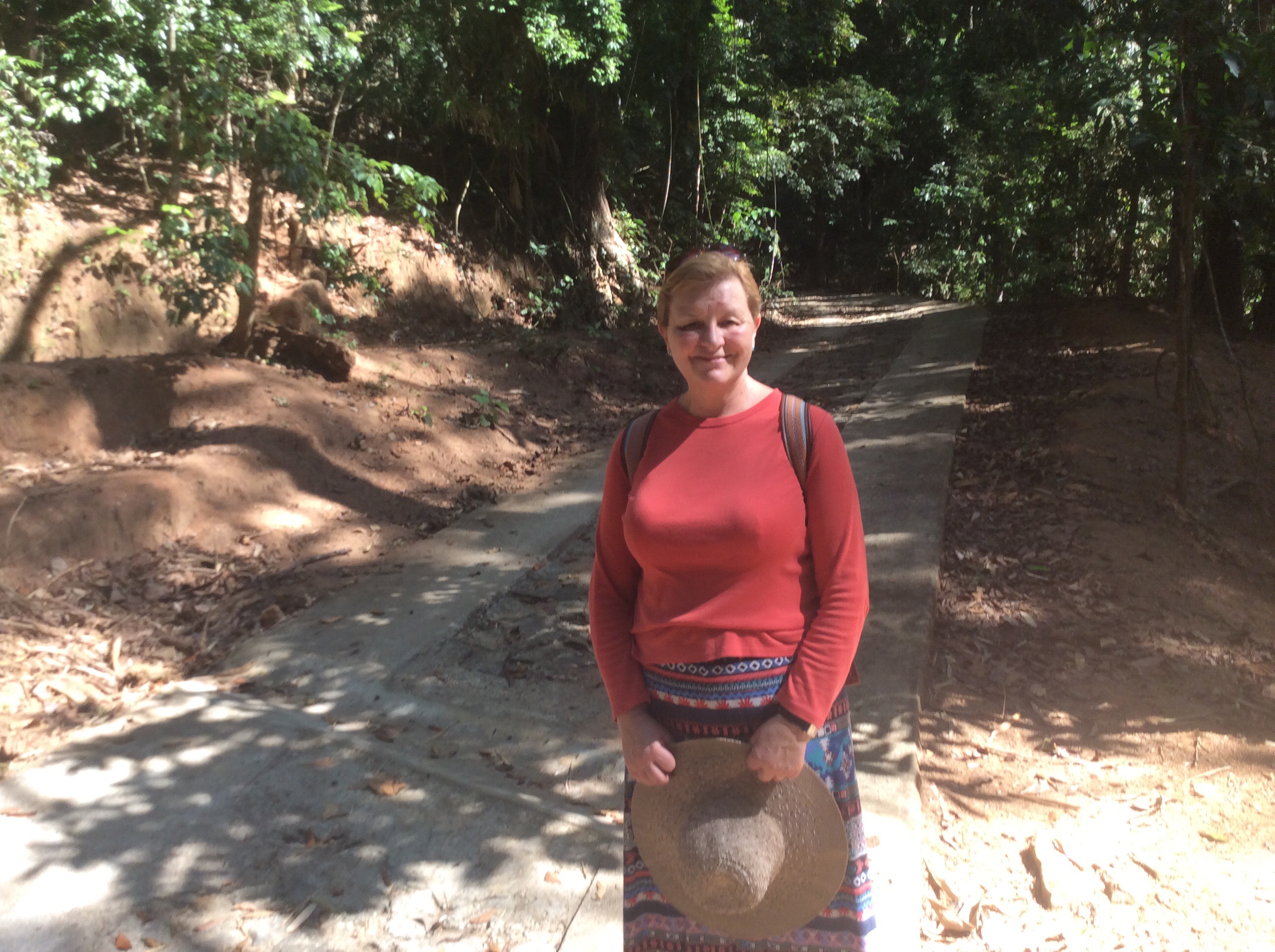
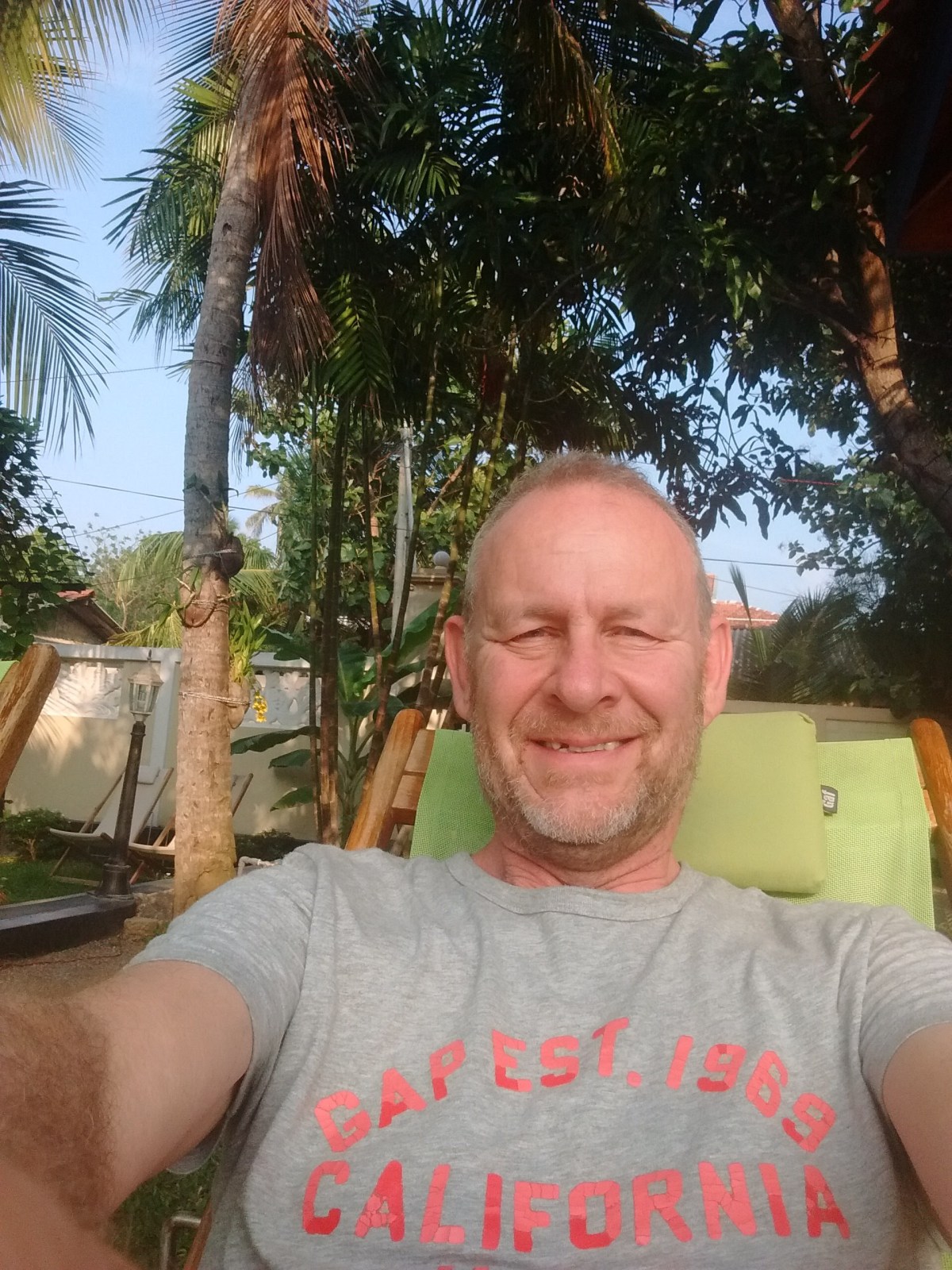
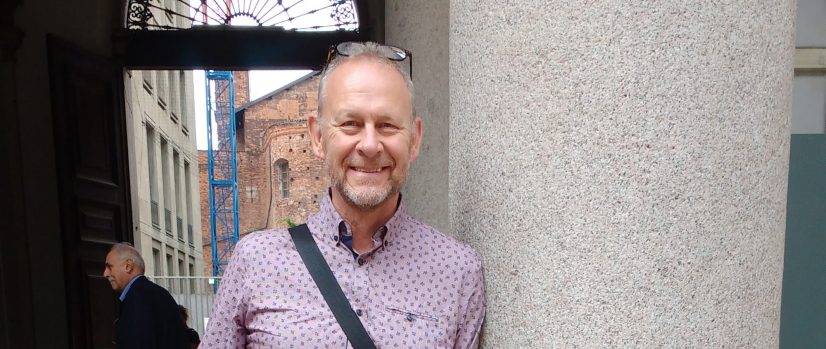
I must apologise for not looking very cool in the photo below. I needed a “prat hat” to save my head from burning, and sunglasses to keep the dust from my eyes. I don’t think this photo will be published in Vogue.


What great day that was!
Day 10 – Dambulla

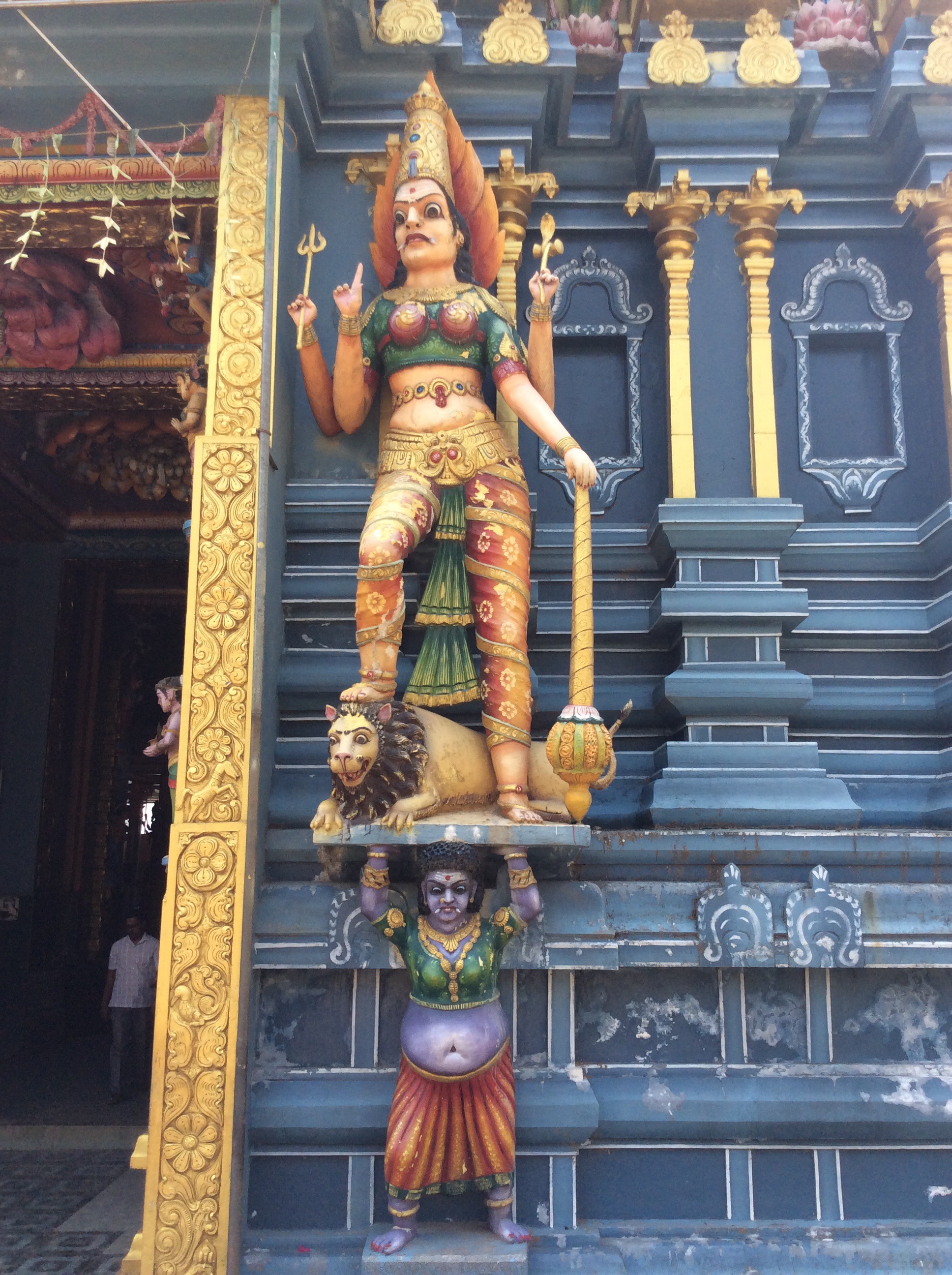
A black Prius taxi, which would very at home in London, took us to Dambulla in the heart of Sri Lanka’s Cultural Triangle. This region is where most of the ancient ruin sites are, relics from over two thousand years of history. On the way we stopped of at Matale to see the Sri Muthumariamman Thevasthanam Hindu temple. Imagine being on the switchboard there, I’m sure you would soon get fed up of the full name and just call it the Temple. It is covered in flamboyant statues and paintings inside and out of many different Hindu deities and demons. The faithful were making offerings of flowers and ghee lamps were lit.

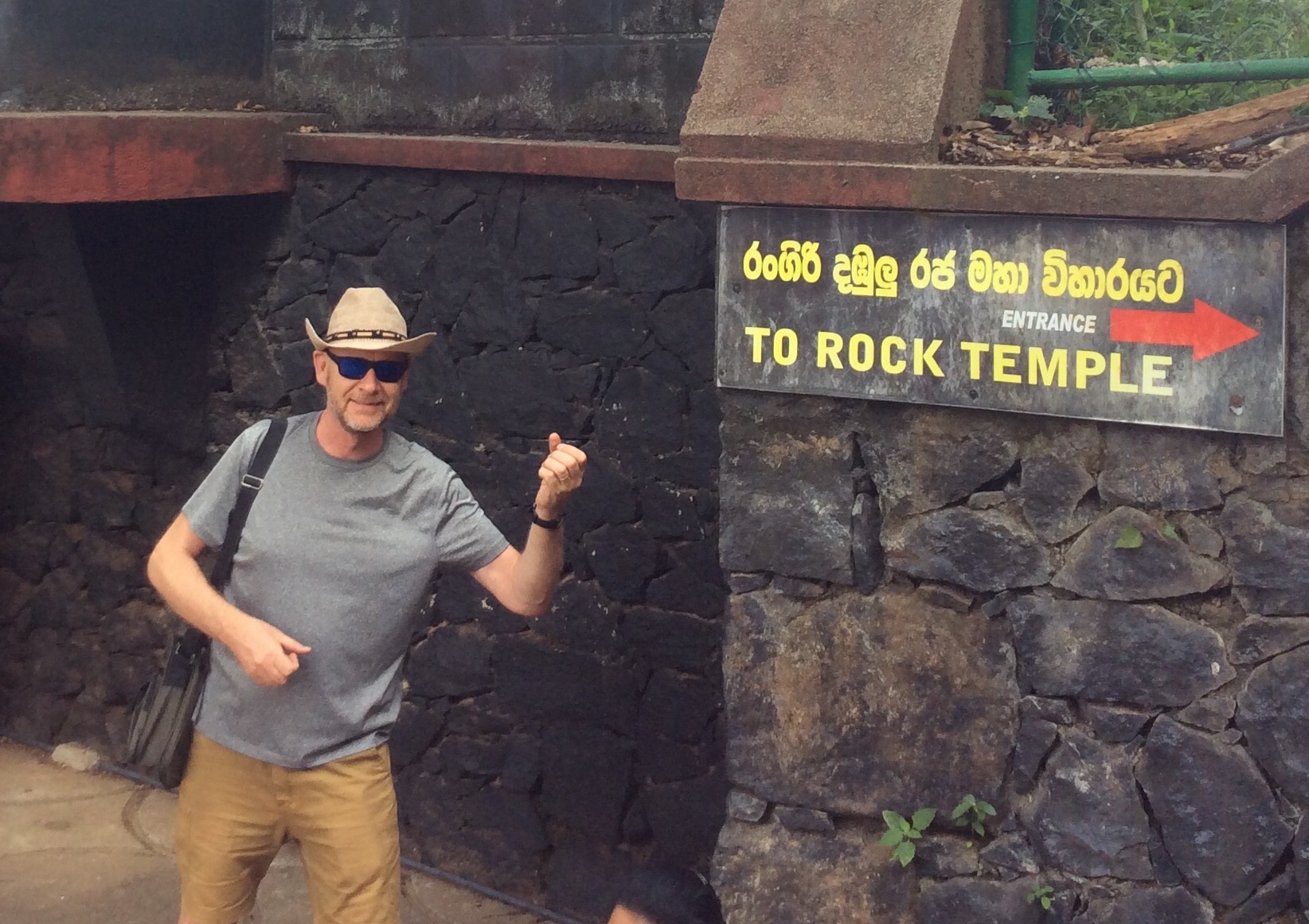
After asking a few tuk tuk drivers for directions, our taxi man located the Amarantha Classic Resort on the main road into Dambulla. After a welcoming glass of papaya juice a receptionist asked what meals we had in our package, since Expedia hadn’t informed them. I had definitely booked a package with breakfast, but the paperwork didn’t show it. So I had to fanny about for an hour on the internet to find the page where it said we hate a free breakfast. Gord gimme strength! Anyway I did find it, and the hotel guy seemed happy.In a slightly narky mood we we out on the road to get a tuk tuk to the Rock Temples of Dambulla, a couple of miles down the road. The temples is a major Buddhist site, and even has its own Buddhist TV station! At the entrance to the complex is a massive golden Buddha and a Buddhist museum. We followed the sign that said Rock Temple and it wasn’t the Hammersmith Odeon

Every girl crazy about a sharp dressed man
Note for younger readers

Hammersmith Odeon was a cinema that was also a top venue for rock bands. These days it’s called the Hammersmith Apollo and is better known for rude comedians.

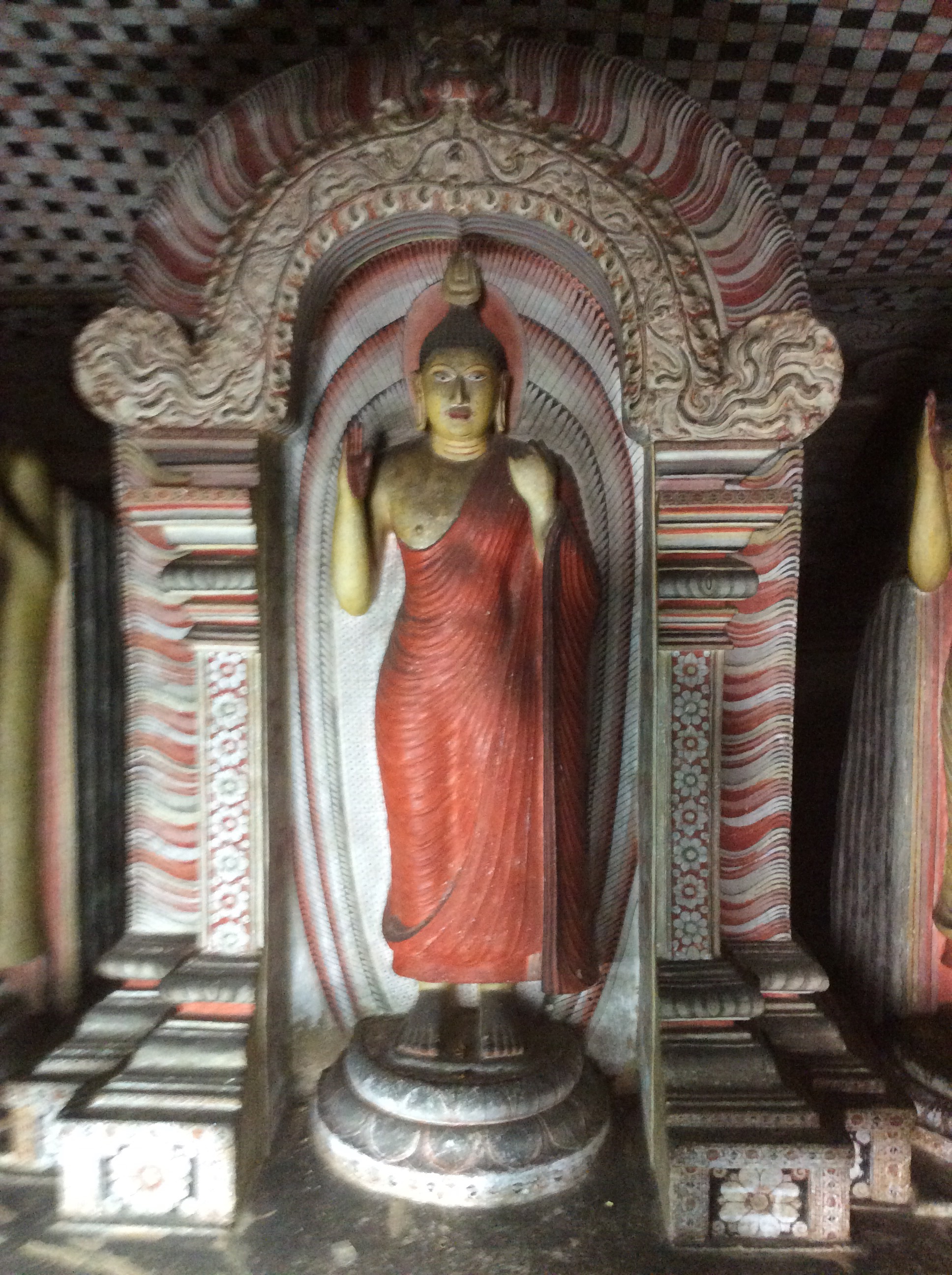
It’s quite a steep climb up a massive granite rock to the five temples that are set in a natural overhang. Some of the temples have been there since 100 BC, and the most recent was made in 1915. I relinquished my shoes and put on a sarong to cover my offensive legs. There was no admission charge, but we got latched onto by a guide who was very persistent. But to be honest once you’ve seen one ancient Buddhist temple… Once again there were many Buddha images, some of him resting, some sleeping and some when he was dead. Some were built of brick and plaster, some of wood and other carved out of solid granite.

Buddha stopping the traffic

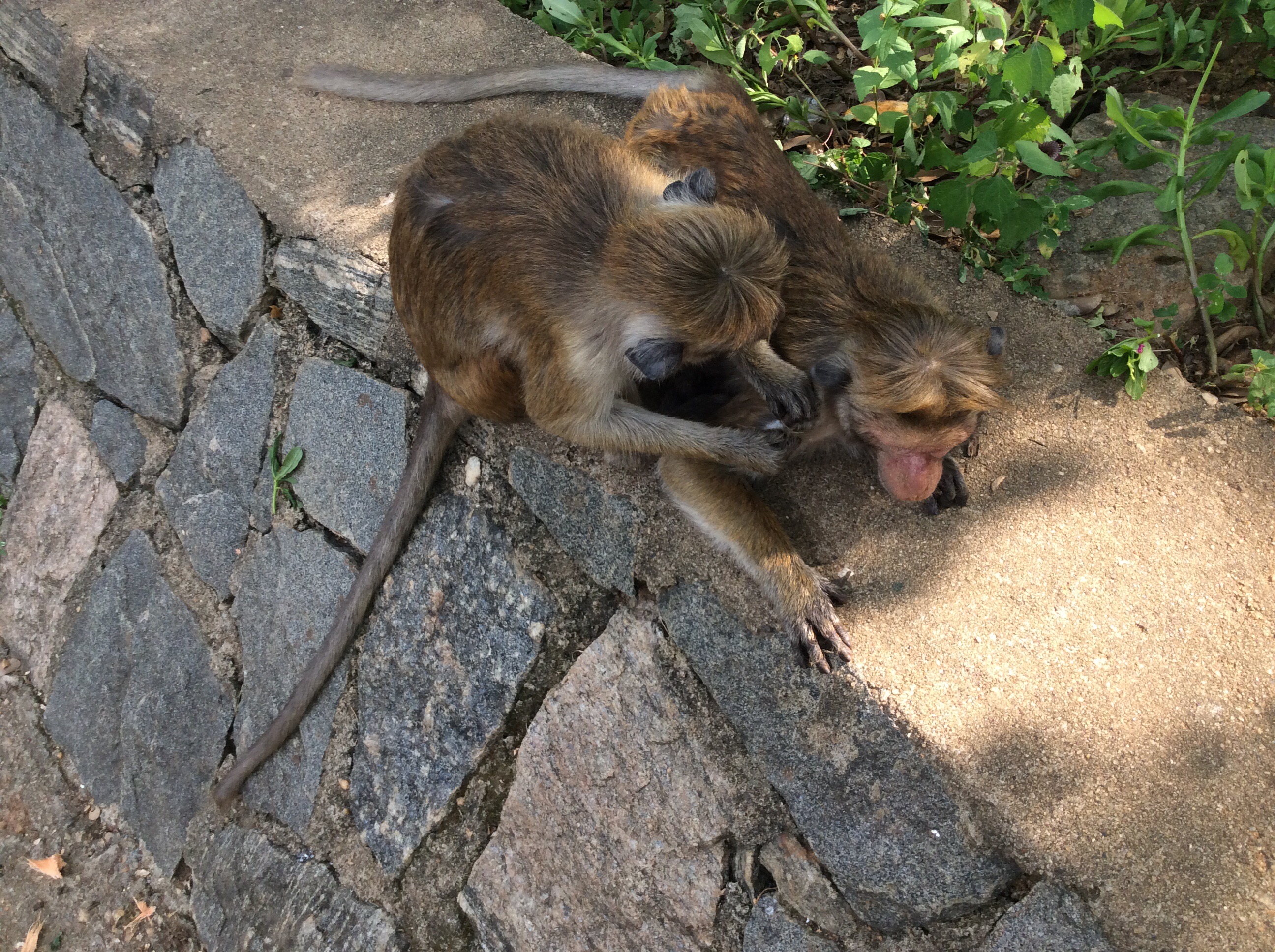
The five temples are quiet and subtly illuminated, I enjoyed it far more than I expected to. The views at the top of the rock are wonderful. Once again the monkeys stole the show. They ran all over the place and provided lots of entertainment diving into the bins for fruit and flowers to eat.


There are not many restaurants in Sri Lanka. Negombo is different because it’s a seaside resort, but even in Colombo we had trouble finding places to eat out. So when we have been in Kandy and Dambulla we have eaten in the hotel. Also it’s damned hard to get a drink in this country! Supermarkets don’t sell alcohol, and (outside of Negombo) i haven’t seen any off licences.  I’m sure it’s much better for my health, but a G&T at dusk would be really nice.

Day 7 – Columbo and Kandy

I slept like a log last night due to a beneficial combination good food and no beer. After consulting the great guru Google we walked to a “restaurant” called Pillawoo on Galle Road. It is a utilitarian place for local people and serves very good food. I had Egg Roti with Mutton Masala, which was proper mystery food. It was a curry of Mutton, tomatoes, onions and spices mixed with pieces of roti, a type of flat bread with an egg between its layers. The resulting mixture was very tasty, especially when I washed it down with mango lassi. 

We packed our bags and stashed them at the Ocean Front and walked to Colombo’s only park to visit the museum.

The National Museum

The National Museum is an imposing Victorian building that would look right in any English city centre. Inside it’s like an old fashioned provincial museum with objects displayed in wooden cabinets. There are many, many Buddhas, Shiva and Ganeshas made in every material you can think of. The splendid throne of the last king of Kandy is on display, before the British deposed him. The throne was a gift from the Dutch when they ruled the coast, but not the kingdom of Kandy in the mountainous centre of Sri Lanka. The bit I enjoyed the most was an exhibition on agriculture, explaining how rice is grown. 

We picked up our bags from the hotel and took a taxi to Colombo Fort station to get the train to Kandy. The Sri Lankan train system was built by the British in mid Victorian times, and is still vital for getting around. We took the 15.35 from Colombo Fort station to Kandy in second class. The ticket was 580 rupees for 2 tickets, which is about three quid! 

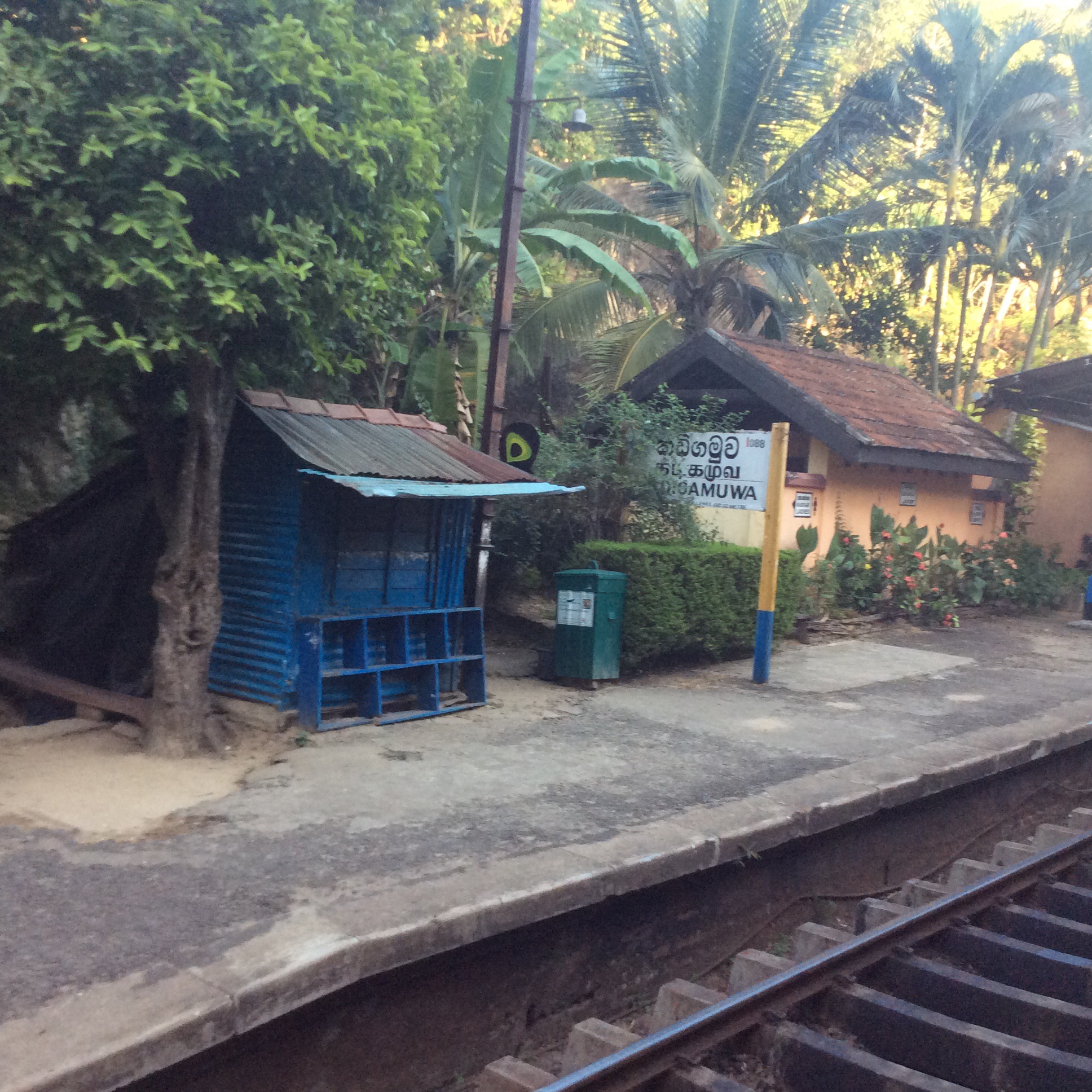
At times it felt like train hadn’t been maintained since the British left in 1947, the ride was very rattley and bumpy, I didn’t want to read in case I became travel sick. I opened the window about twenty inches to let in fresh air and get a splendid view of the lush green countryside. Paddy fields are edged by coconut palms, banana trees, papaya and bamboo. Tethered cows graze while egrets pick at the long grass looking for bugs to eat. The train climbed into the hills, winding along embankments and cuttings and through several short tunnels. 

A station on the way to Kandy

Kandy is five hundred metres above sea level and surrounded by hills, and was a separate kingdom until 1815. The Portuguese and Dutch never conquered the Kingdom of Kandy, but the British did in 1815 when locals conspired to depose the unpopular king. It is the second city of Colombo, but has no high rise buildings, and is a much more typical Asian city.

We arrive just as it was getting dark at about 6pm, and took a taxi to the Amanda Hills Hotel, which is at the top of a steep hill overlooking Kandy. The hotel next door is called Sharon, ladies names see, to be a popular choice. Since it was late we dined in on the terrace. I had Chicken Biryani, and the chicken tasted like it had died of old age. We didn’t eat in the hotel again!

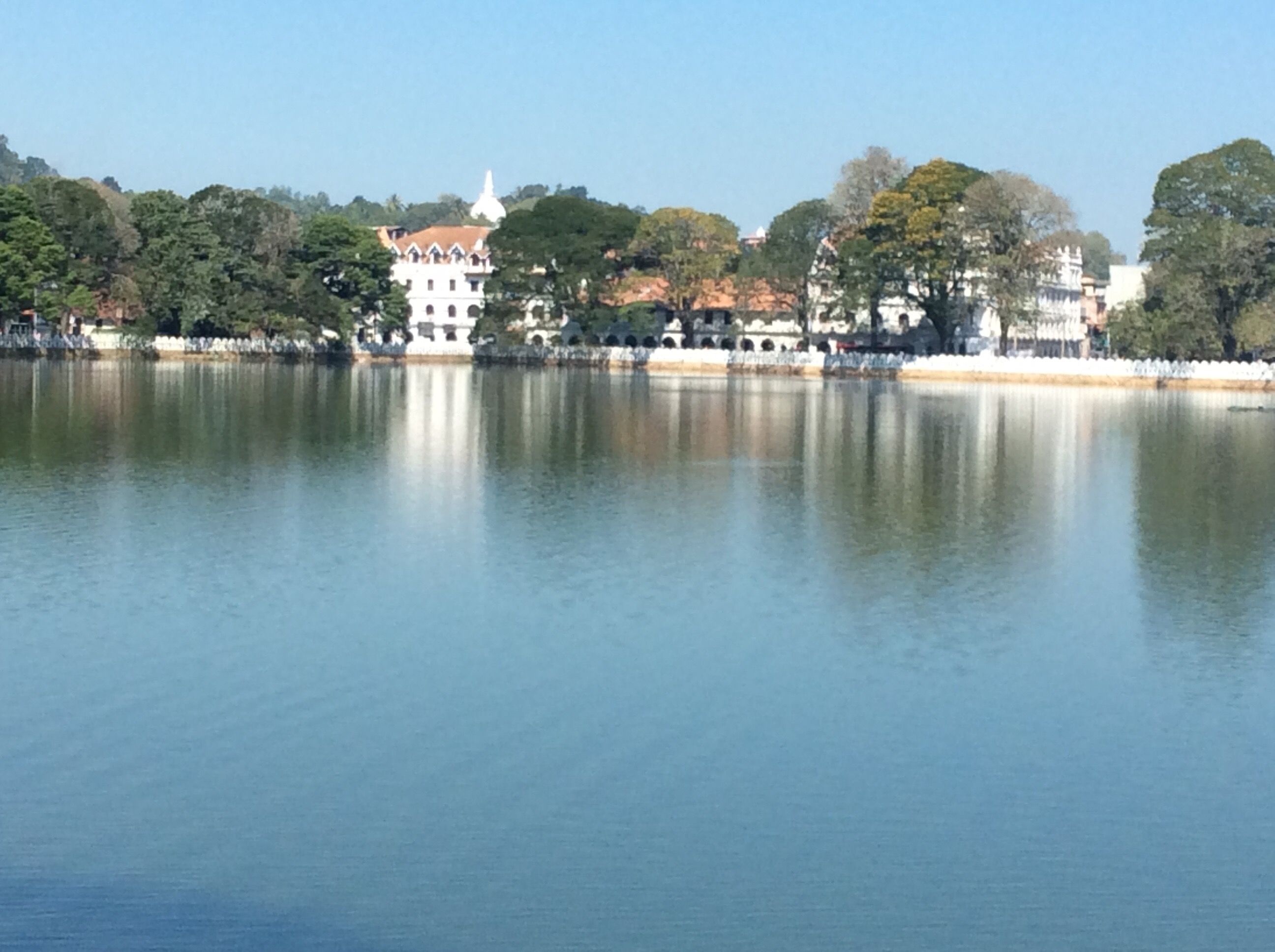
The lake in the centre of Kandy

Day 9 – Kandy

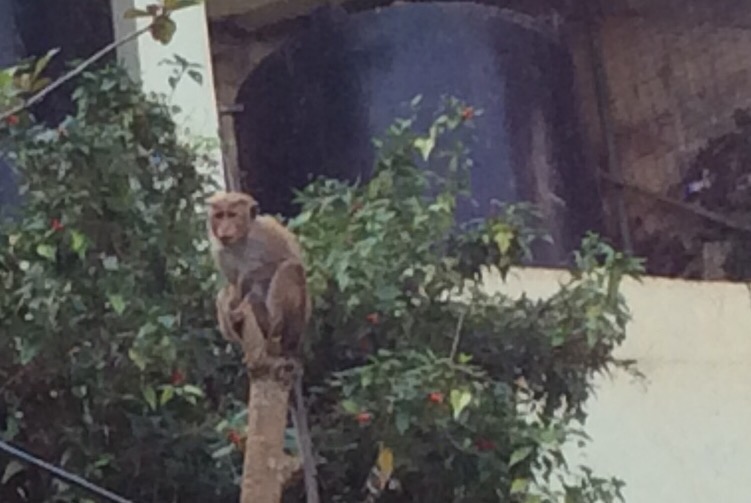
Screeching monkeys awoke me this morning. They were running around on tree outside our room, and all over the outside of nearby hotels. The run up drain pipes, swing along cables and balance on hand rails. Occasionally there would be a fight between  different bands,  so there was aggressive charging at each other and louder screeches.

Cheeky monkey outside my bedroom

We ate a typical Sri Lankan hotel breakfast this morning:

  • A plate of prepared fruit; banana, papaya, pineapple and melon
  • An omelette with diced onions and chillis, Sri Lankan style
  • Pancakes with honey
  • Toast with butter and jam
  • A pot of excellent tea

The breakfasts are so substantial they keep us going all day. They also keep you “going”, no worries in that department.

After breakfast we had to decide where to go tomorrow. We are making this trip up as we go along, which can be time consuming making decisions about the next hotel, there are plenty to choose from. Our strategy is to look for hotels and guest houses in a price range, about £25 to £35, in the right part of town. Since we haven’t been to any of them before, that location is a bit of a stab in the dark! 

I just love my iPad Mini!  To find hotels I connect to t’internet and use Trivago/Booking.com/Expedia/Agoda/Tripadvisor, and so far Expedia has proved most useful. If I look up a place on Google Maps, I keep the app open as I travel around. the map can show me where I am with a blue dot, without being connected to the internet. it’s magic! If I get bored I can read the books I have downloaded on Kindle, or listen to BBC podcasts I have saved on Radio iPlayer. I am writing my blog on it now, and incorporate photos I have taken on the camera. Because it’s small and light, I can carry it around everywhere. Right now I’m sat on a bench in the serene botanical gardens in Kandy. Once I get back to the hotel I can edit this and post it.

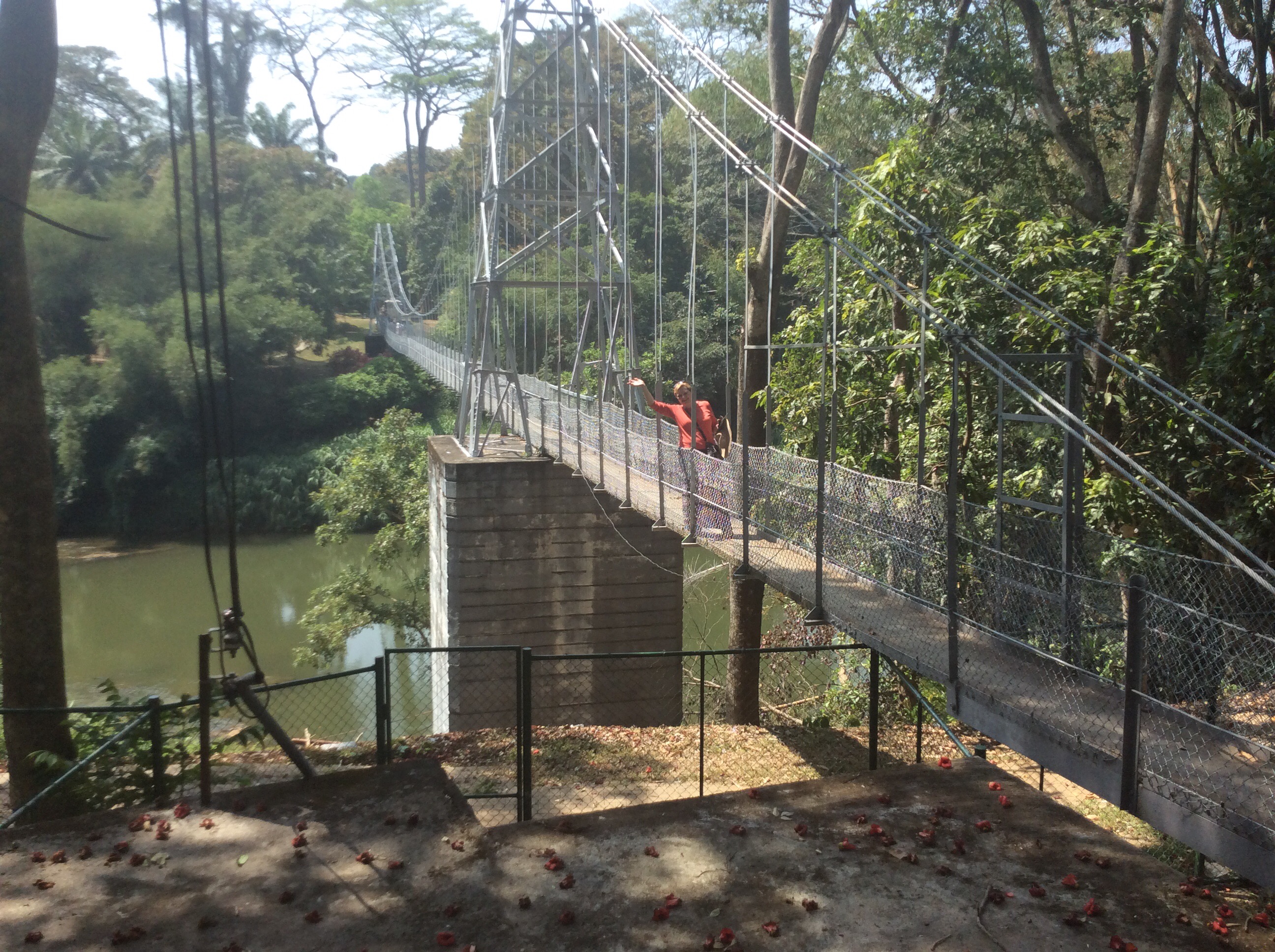
A tuk tuk brought us to the Royal Botanic Gardens at Peradeniya, a few miles out of the city centre. Our driver dropped us at a side entrance and we crossed a narrow suspension bridge to get in. It became a Royal garden in 1780, at about the same time Kew Gardens was being established in London. After the last King of Kandy, Sri Rajhadi Rajasinhe, was deposed by the British, they set up a garden on the Kew model in 1821. There are pictures of these gardens in the Marianne North gallery at Kew, painted when she visited here in 1876.

Julie suspended at the gardens entrance

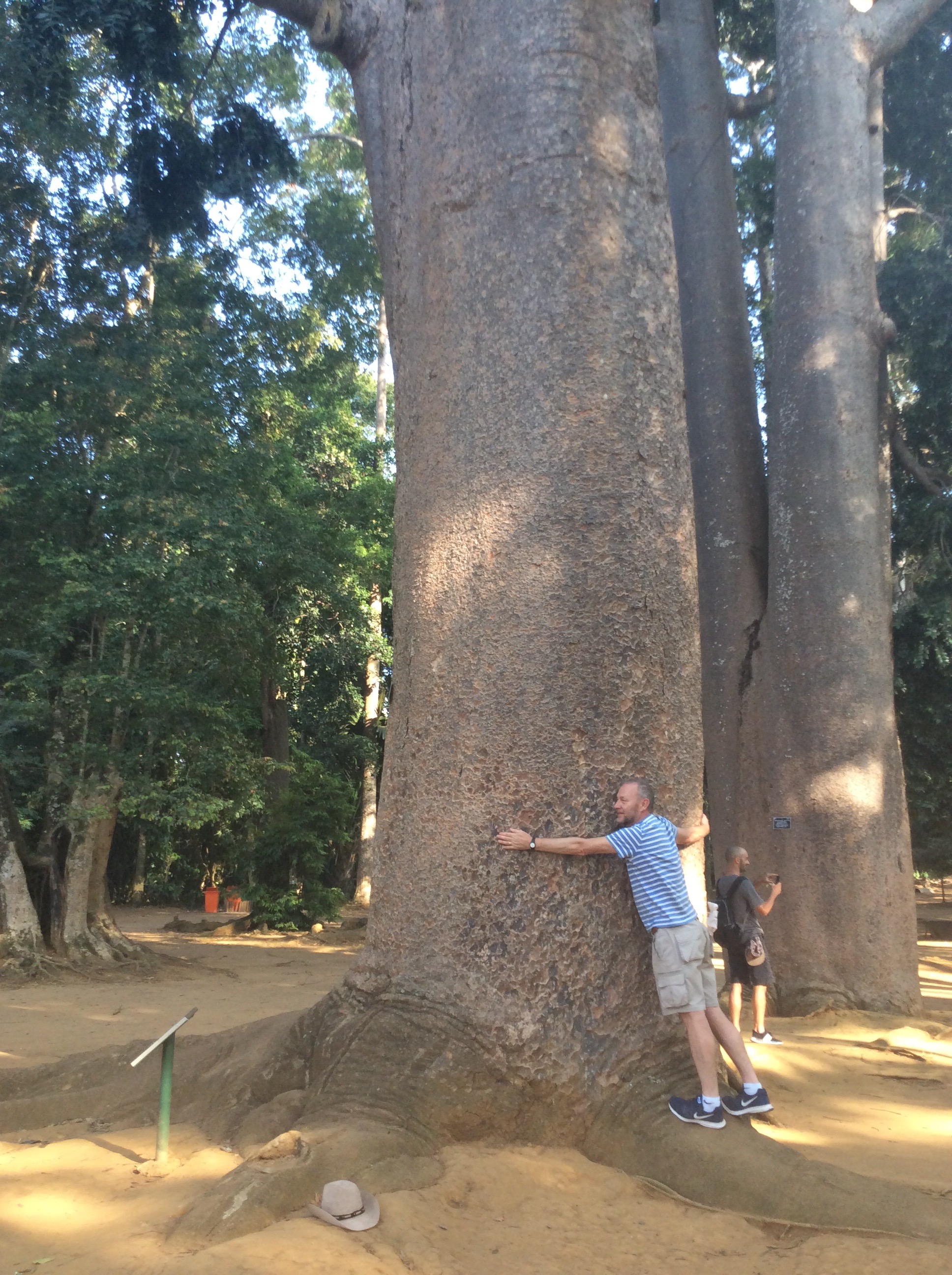
The tropical trees are very impressive, some are well over a hundred feet high with mighty buttressed roots. I expected to see David Attenborough dangling from a rope at the top. There are groves of giant bamboo eighty feet high, but only twenty centimetres in diameter. There are huge collections of palms from all over the tropical world. I didn’t spot a specimen of my own Chusan palm, I had it chopped down in the summer because it was too big for my little London garden. My favourite was the mighty Queensland Kauri tree, a massive podocarp pine.

It’s hug a Kauri day in Kandy

In the tree beside the river, thousands of fruit bats were roosting, hung upside down from branches. They truly live up to their other name “flying foxes”, with wingspans up to a metre across. They make an unpleasant squeal that sounds like a pig, not the squeak from British bats.

Fruit bats, they get their 5 a day

One of the major benefits of travelling in Ceylon is that you can get a good cup of tea. It comes in a proper pot, and they serve it with hot milk, it’s delicious and just what you want on a scorching hot afternoon. If they had a tea room inside the palm house at Kew, it would feel just like this.

We got a local bus back to Kandy which cost us fifteen rupees each, which is about eight pence. The three wheeler that took us to the gardens cost five hundred rupees. Our laundry needed collecting, so using Google maps magic we located the laundry and walked up a lane to find it. I heard a bang on a corrugated iron fence which I thought was a dog, then I saw a yard long yellow snake slither rapidly into the undergrowth. The walk back to the hotel was along the main road into Kandy, and it was jammed with traffic. There aren’t many proper wide pavements, so you walk down the road and keep looking carefully!
Our next accommodation in Dambulla is now booked, and we are planning a trip to the hill country at after that.

Day 8 – Kandy

The Amanda Hills wanted £15 to wash our sweaty tee shirts, knickers and socks. No way Jose ! So we located a laundry that washes clothes by the kilo and set off to find it. After half an our of getting lost in central Kandy we got a tuk tuk. You don’t have to use Uber or ring a mini cab, tuk tuks are iniquitous and make up a large percentage of all the traffic. Negotiating a price is a pain in the behind, but I feel I always need to get the price down at least 20% to keep my credentials as a serious traveller. After asking a few other drivers, our driver located the laundry and we deposited our smelly carrier bags, 1.8 kilos for 300 rupees, about £1.50. My self esteem was enhanced enormously by saving a few quid.


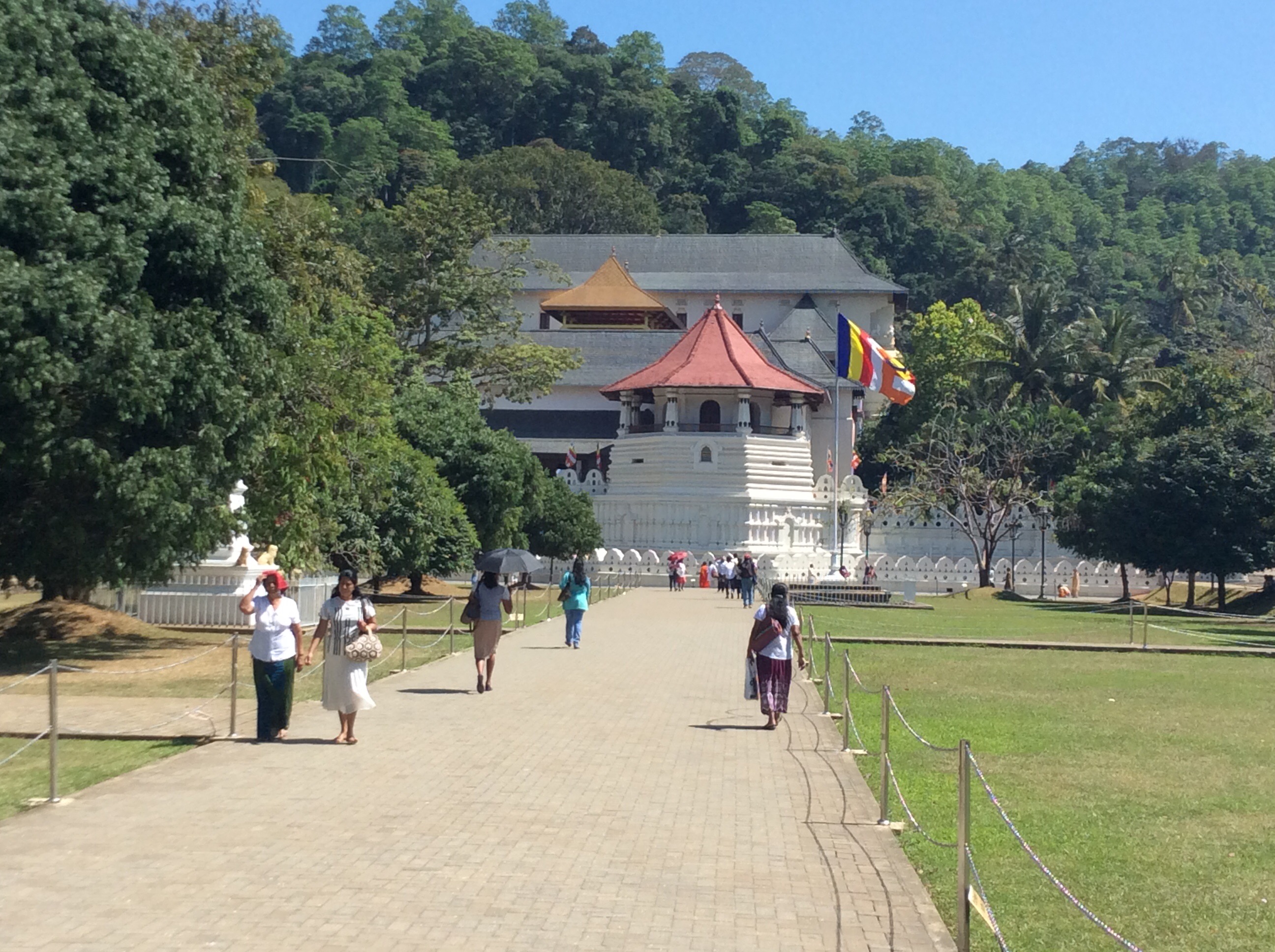
He then took us on an exciting drive to the Temple of the Tooth, the most sacred site in all Sri Lanka which attracts a multitude of pilgrims and tourists. The cool interior is peaceful and fragrant, pilgrims bring sweet smelling flowers as offerings to lay before the shrine. Security is tight, since the Temple was bombed by the Tamil Tigers in the 1990’s.

The approach to the Temple of the Tooth

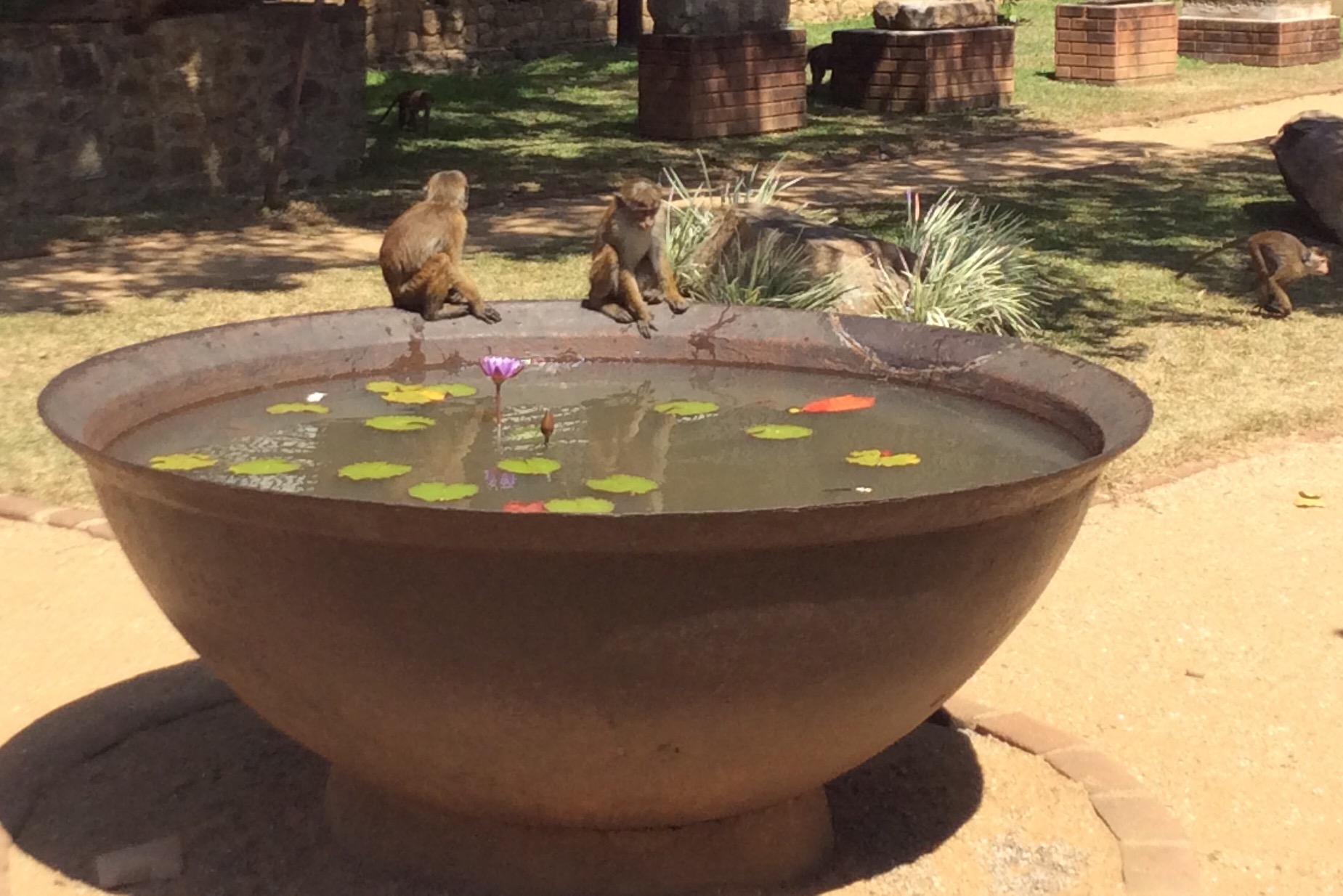
The Temple is a group of buildings including several museums of Buddhism. One building is dedicated to a huge stuffed elephant, the remains of the tusker Raja. He carried the Tooth is a procession once a year for fifty years, and was held in great affection by Sri Lankan’s. But now he’s well and truly stuffed. The grounds of the temple are quiet, shady and peaceful, and a haven in the centre of the bustling city, which is the second largest in the country.at the entrance you buy a ticket (if you are a foreigner) and leave your shoes at a special hut and walk around barefoot. Inside the floors are smooth, cool hardwood, outside the paving stones are scorching hot! So we squealed and dashed for shade to find the cool slabs. The monkeys in the gardens are kept at bay by fire crackers, which are very alarming when you don’t expect them.

Monkeys at the temple monkeying about

To escape the heat we walked uphill to the Uddawatakele forest sanctuary. It was formerly a royal forest for  the Kings of Kandy, but is now a public reserve. There are many different species of huge tropical trees, monkeys,  Barking deer and evidence of pigs, but none visible. The map we were given was useless and we couldn’t find the Lady. Horton Drive that was supposed to go round the forest. So we used the Lady Graham Drive instead. I’m sure these dead wives of colonial governors wouldn’t mind.

Julie in the forest
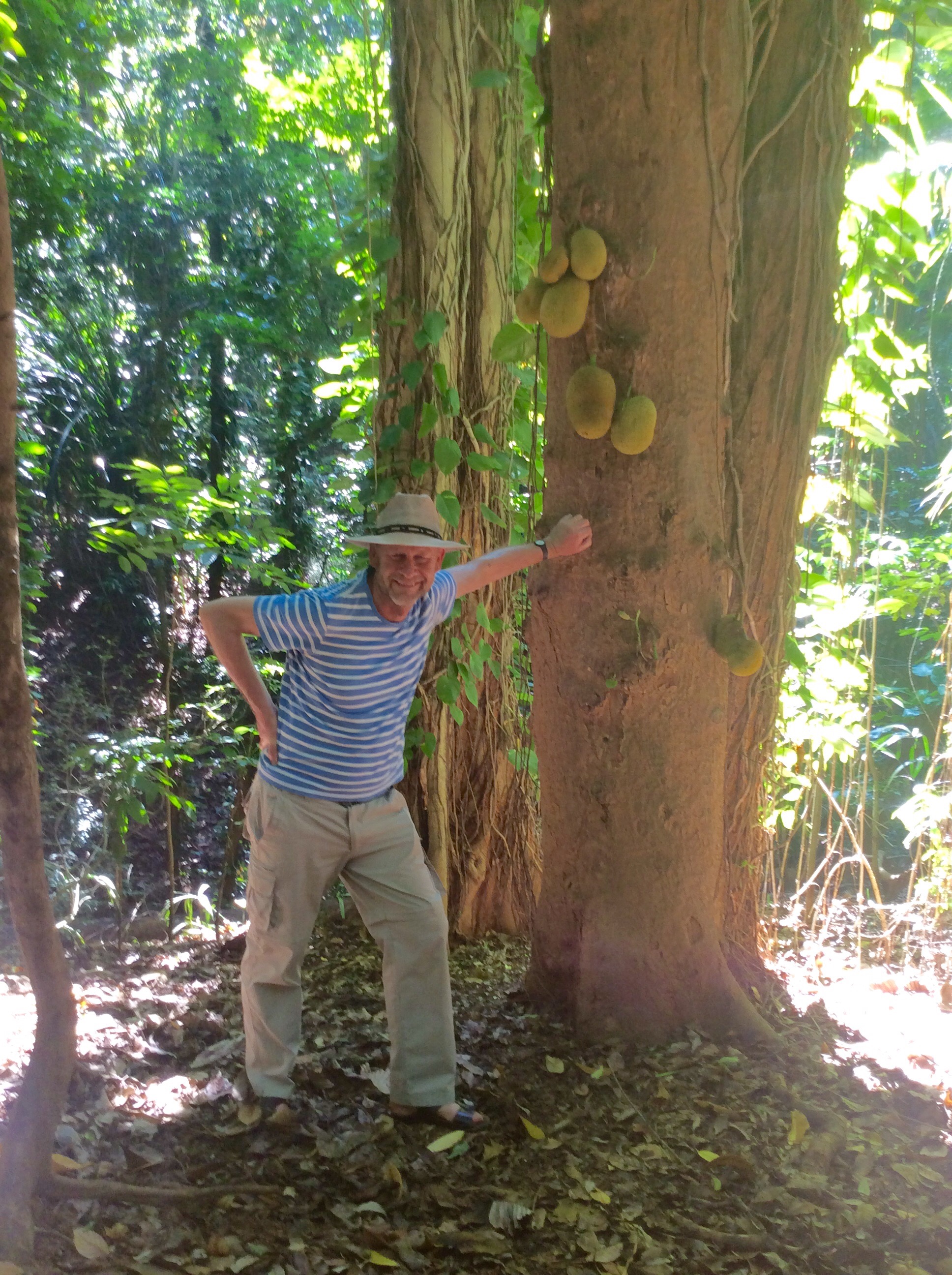
Me and a Breadfruit tree

Day 5 – Columbo

Our plan today was to get the 9.25 train from Negombo to Colombo (Fort station). Our tuk tuk took us to Negombo station, which looks a bit scruffier than the stations than what we are used to. In fact it looks more like a disused  station that has been abandoned for twenty years. The ticket office opened at 9am and I boldly asked for a first class ticket on the 9.25. The clerk told me the next train is 10.30 and he only had third class. The upside is that the tickets cost us 40p for both of us. We have a reservation at the Ocean Front hotel, which is close to the main Galle Road in Colombo.

Inside the 3rd class carriage
As I write I’m sitting in a cafe drinking creamy warm tea watching the tuk tuks, motorbikes and buses rush past. Only a small fraction of the traffic are cars, people in Negombo are not wealthy enough to afford them.
The 10.30 to Colombo was an ancient bumpy train, at least fifty years old. We found somewhere to sit on bench seats that run down each side of the carriage. The forty kilometre journey took an hour and twenty minutes to reach Fort station, the terminus in Columbo. At every stop food vendors and buskers got on an off. There were also some disfigured and blind beggars who depend on the generosity of strangers.
At Fort station we bought our tickets to Kandy, which is our next destination in two days time. I bought second class which mean the carriage has a roof fan. The tickets were 280 rupees each, about £1.50, the same as a bus journey in London. Also to put things into perspective, I have just had a delicious mango drink in a lovely cafe which cost me 220 rupees. Train travel is a bargain in Sri Lanka!
Our home for the next two nights is the Ocean Front Hotel, which is in the Kollupitya district close to Galle (pronounced gorl ) Road, the main road to the south. We walked to Vihara Mahadevi park which is big and has many shady trees. Some of the strangler fig trees are inhabited by fruit bats hanging from the branches.
Next stop on our walking tour was Gangaramay Buddhist temple. It has thousands of images of Buddha, mostly small statues given by devotees. There is also a Rolls Royce donated by the Queen, and a full size model of an elephant.

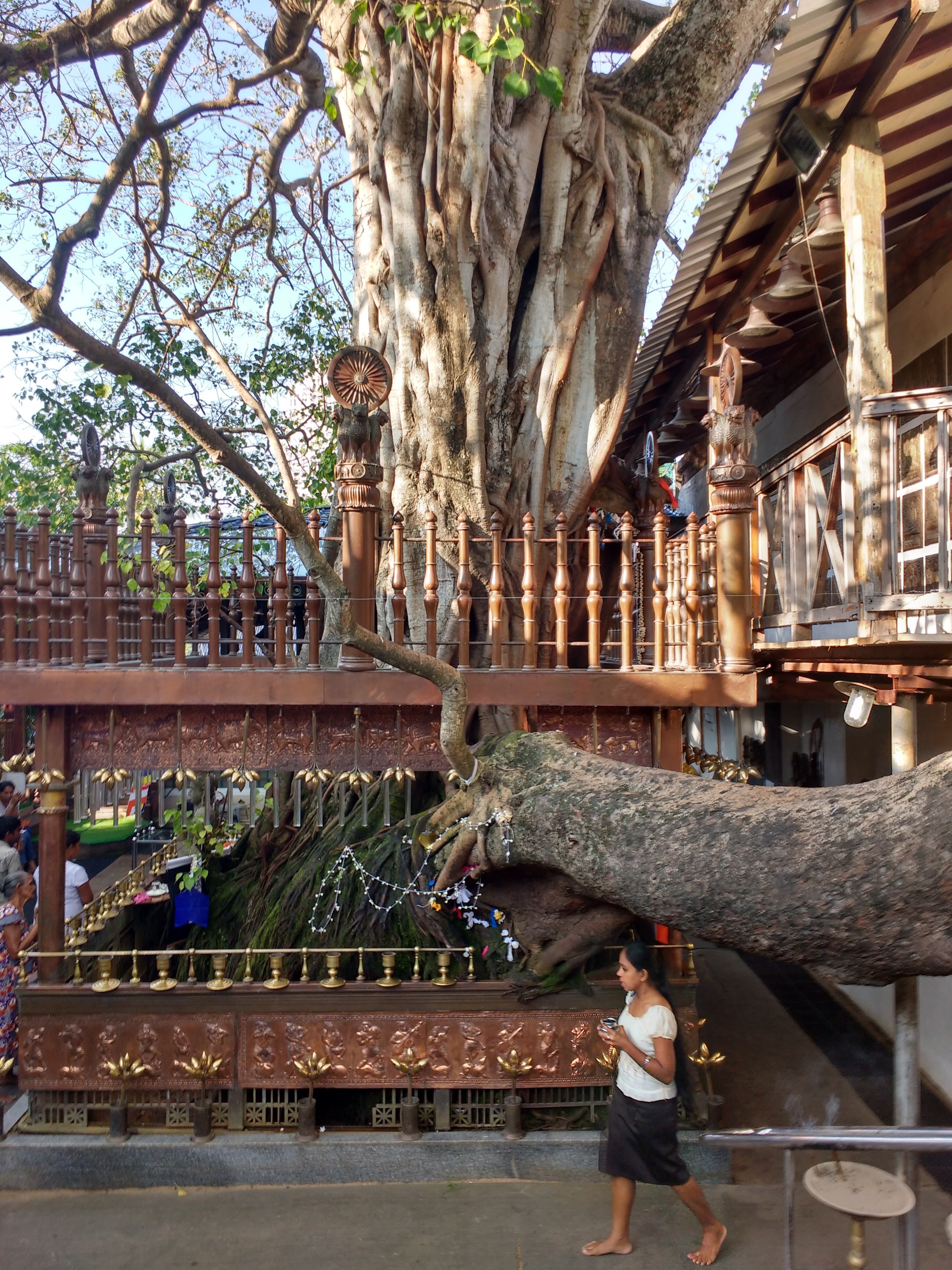
A bodi tree inside the temple

Hiking over to Fort, the central business district and historic centre of Columbo, we went for dinner in the Dutch Hospital. It was built by the Dutch East India Company for its staff in the seventeenth century. It is now upmarket shops and eating places similar to Covent Garden. Our dinner was a delicious Mutton Curry with Lion lager. Then we watched a band playing very good covers, better than bands that used to play in the Red Lion in Twickenham. Afterwards we walked back in the dark along the coastal Galle Road, there was a warm breeze and it was a lovely end to the day.

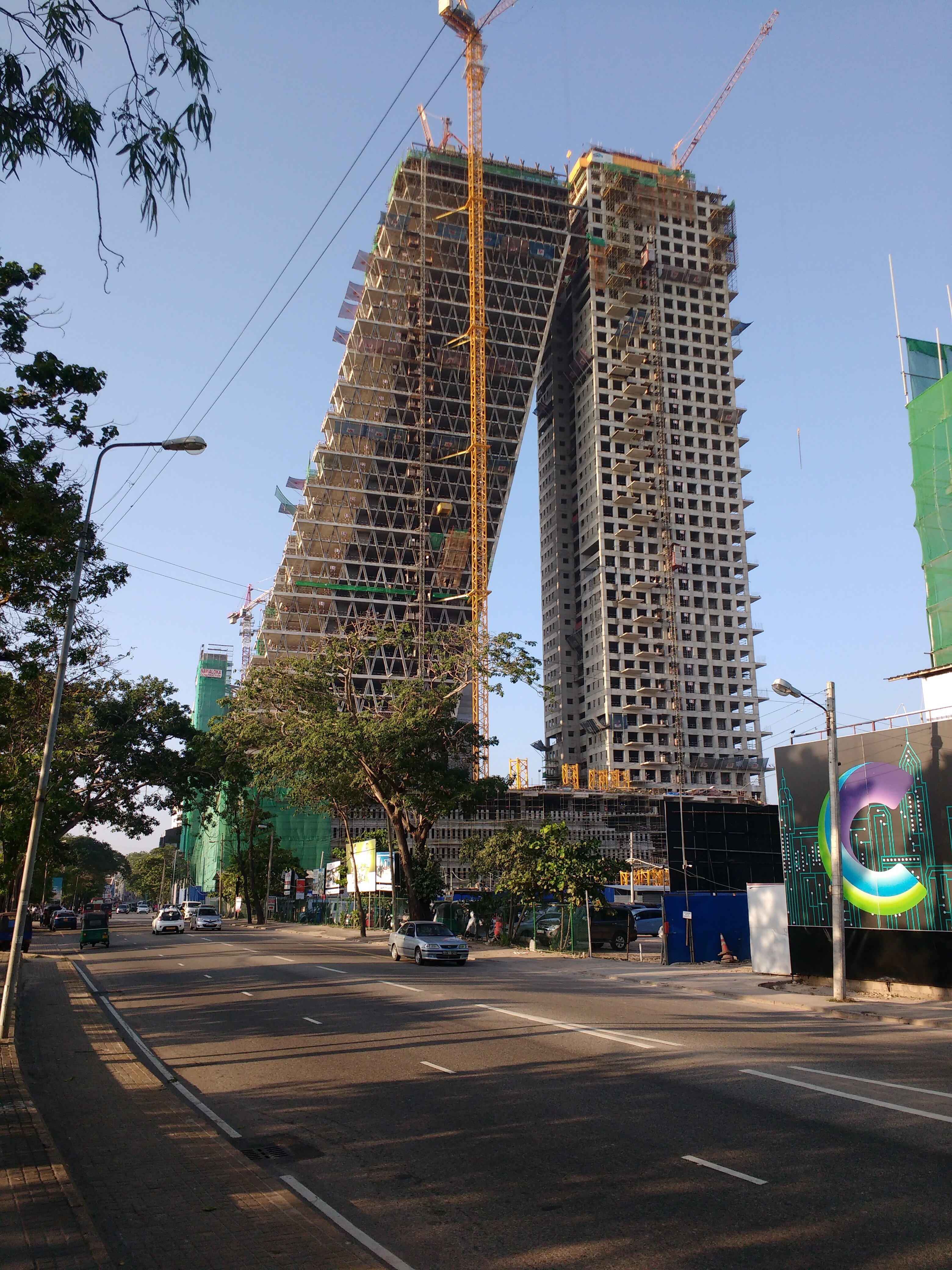
A new apartment block near Biera Lake. it’s meant to look like that

Day 4 – Negombo

It’s has been an “admin” day today.  Our aim on this holiday is to be free spirits, to go where the wind takes us, wherever I lay my hat, that’s my home. But all that hippy bollocks comes at a price. There is always a slight anxiety about not knowing where we will be in two days time, and how we will reach our mystery destination.

So this morning we went down the beach road to buy a local SIM for the very basic Samsung phone we use for travelling. It does texts and calls and a charge lasts for ages. On our way to the shop we heard a scrambling in the bushes over the wall, and saw a five foot long monitor lizard dashing through a thicket. I’m glad I didn’t see at at night when we were walking home in the dark.

The roads are not well lit. Last night I stepped back to avoid a sharply turning tuk tuk, and almost fell  down a big concrete drain. That could easily have been a broken leg and a very short holiday.

Returning to the Serendib we walked down the beach. It is very wide and quiet, considering it’s the holiday season. The beach doesn’t have loungers and umbrellas like most resorts,  so there are no comfortable spots to enjoy the beach for a few hours.

The Rimini Restaurant is a blue shipping container with a gazebo dining area. It is very basic, but friendly. Some Swedish customers sitting next to us ordered a beer. It was a long time before it arrived, then it came by tuk tuk! The owner was out of stock and had to send out for more beer.

cfdd23a7-2a9b-482c-b61b-b3a8a5c1d26b
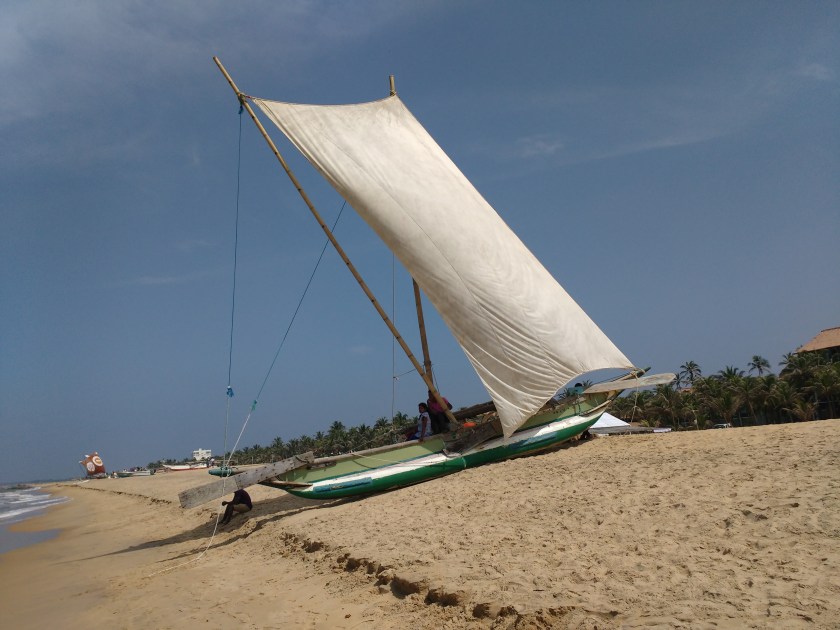
Outrigger sailing canoe on Negombo beach

Day 6 – Colombo

Bloody hell I had an awful nights sleep. The Ocean Front Hotel is built of concrete and is all hard surfaces, and any nocturnal noises get bounced into my ears. The main train line to Galle is also twenty yards away, and trains rumble through regularly and sometimes toot their horns just to make me feel worse. So I felt LIKE SHIT at 8.00 when the alarm went off. After a shower I felt half human and went down for a proper Sri Lankan breakfast, String Hoppers. It is thin rice noodles served as a pattie, accompanied by chicken curry, dhal and coconut sambol.  That was followed by a plate of fresh fruit. Staying “regular” ain’t gonna be a problem in Colombo!


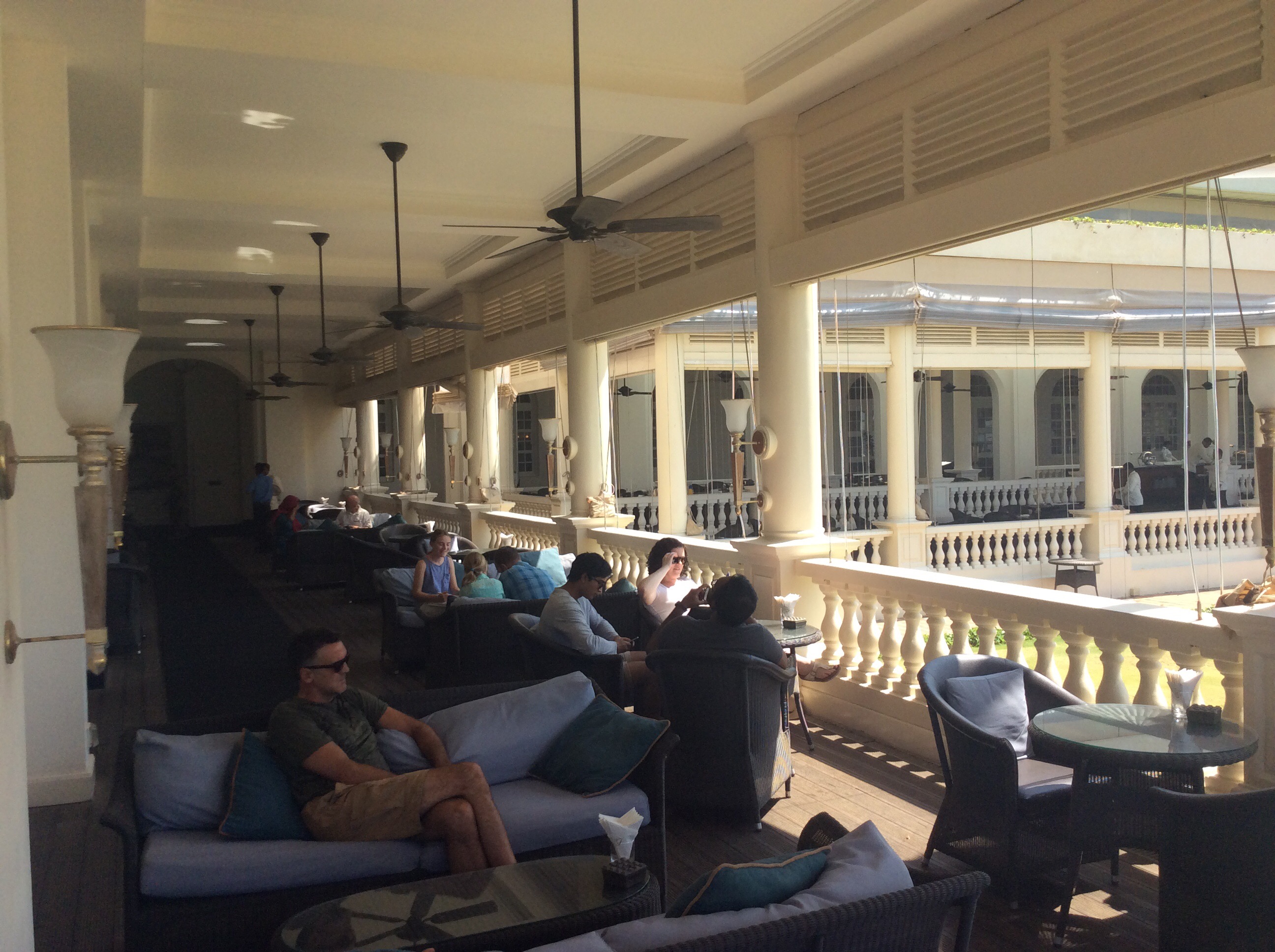
Thus reenergised we walked up Galle Road for coffee at the exceedingly posh Galle Face Hotel. It is so posh the main doorman wears a white dress. It is actually a white sarong and white jacket with puffy sleeves, but he looked like a pantomime dame at a wedding. The coffee lounge overlooks the sea on one side and a lovely lawn on the other side.They actually have men with catapults to scare off any crows that bother diners outside the hotel. The wifi was really good, which is what you expect if you pay £200 a night.  So we relaxed for an hour, sipping our coffee and enjoying the ambiance. The bill was about £4, less than two coffees at Nero in Teddington!

Coffee lounge at the Galle Face Hotel

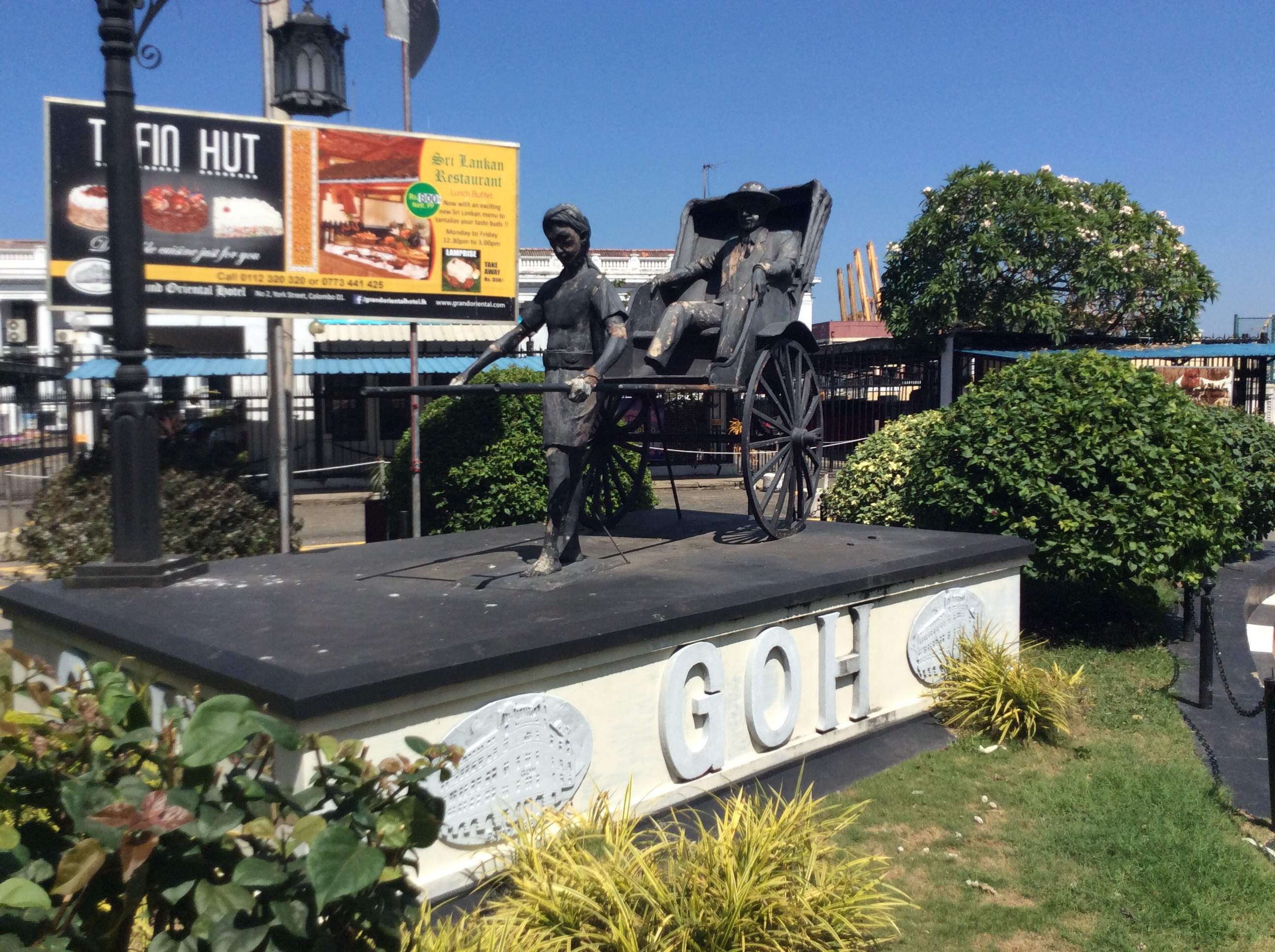
Fort is the historic heart of Colombo, but there aren’t many historic buildings left, and what remains are mostly badly maintained. The city wants to be another Singapore or KL, but doesn’t appear to be interested in its heritage. Cargills the old department store is decaying and looks unloved and the Grand Oriental Hotel looks like a seafront Victorian pile in one of the scruffier English resorts. It has a bizarre statue outside of an Englishman (complete with pipe) being pulled in a rickshaw by a downtrodden looking local man. It says a lot about the political order a hundred years ago, when the white men lorded over the brown men.

Colonial statues outside the Grand Oriental Hotel

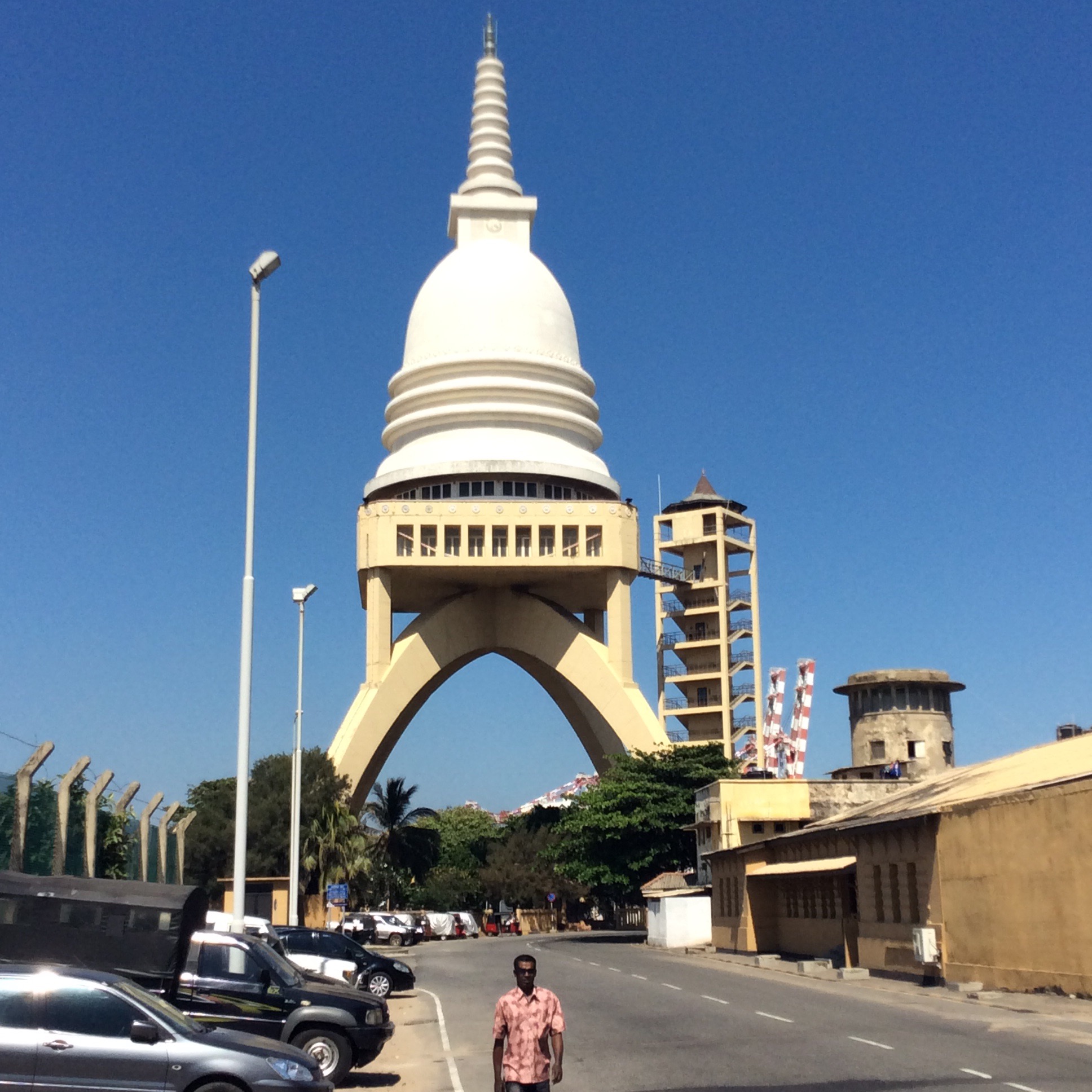
The Sambohdi Chaitiya dagoba is a Buddhist stupa built in 1956 that sits on legs over the road. The climb up many steps to the viewing area is worth it for the view of Colombo docks. A huge new dock is being constructed, and a big sand dredger was spraying a constant stream of sand to create new land to build on.

Buddhist stupa near the port

Our last destination today was Pettah, an area of street markets, a world away from shiny modern Fort. I honed my haggling skills by buying AAA batteries and a crappy plastic belt. I probably payed over the odds, but I was happy and the stall holders were very happy. My final haggle was getting a tuk tuk back to the hotel for two hundred and fifty rupiahs, it was worth it.

Day 3 – Negombo

On our way to the beach this morning a tuk tuk driver offers us a tour of the town. My finely honed bartering skills managed to knock down his price by hardly anything, I must practice more! He was a chatty man, and like to look at us as he chatted, which caused him to almost shunt the car in front, luckily Julie shouted and he braked!

First stop was the beach to see loads of fish drying on mats and a very smelly by fascinating fish market. There were tuna, barracuda, sardines, squid, octopus and plenty I didn’t recognise. The big local fishing fleet goes out as far as the Maldives for its catch.

The people here are mostly Catholic, but there are also Muslims, Hindus and Buddhists, just like London!


Day 2 – Negombo

After lazing by the pool for a couple of hours reading “Sapiens” I got a bit restless so we went off to explore Negombo. Almost as soon as we got to the main road a tuk tuk driver approached us and offered a tour of the town. I thought I ought to barter, and knocked him down about 20%, which made me feel better an I’m sure he did well out of the deal.

Our first stop was the fish market on the beach. Outside the gutted fish was drying on mats. Inside fresh fish was sold by stall holders, sometimes only a few fish on each stall. The fish was caught by the substantial local fleet, which ventures out as far as the Maldives for its catch.

Our driver took us to the old Dutch fort, only the gate exists with as stone engraved 1688. On the other side of the gate was the waiting room for the prison, which holds 1,600 prisoners (according to the driver).

The town is predominately Catholic, but the locals are also Muslim, Buddhist and Hindu, so quite like London in that respect.

We are now sat by the pool as the sun goes down, but 6pm it will be dark. The local birds make all sorts of interesting noises. Fortunately the cawing crows has now gone elsewhere, they sound just like crows at home.

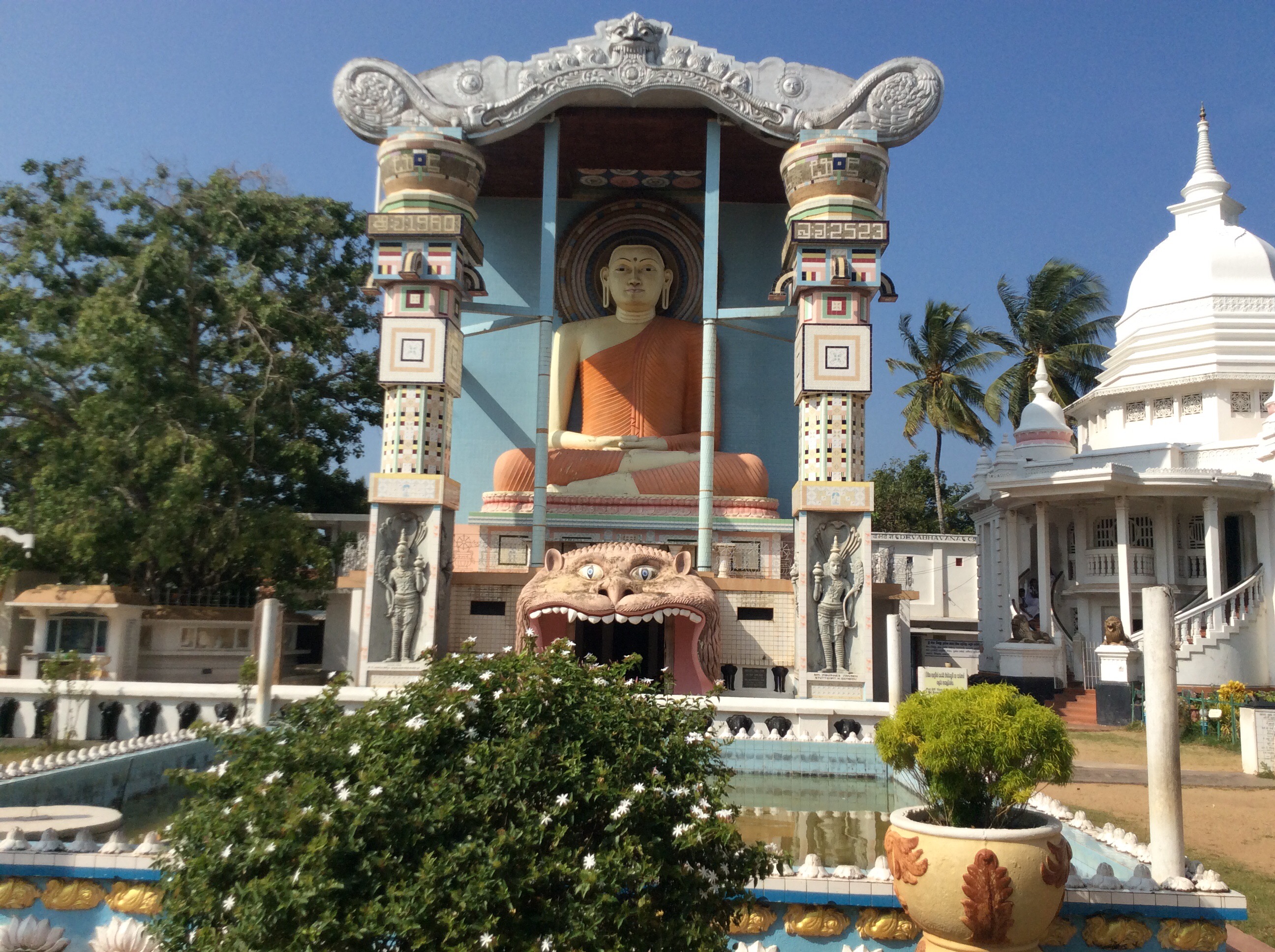
Buddhist temple
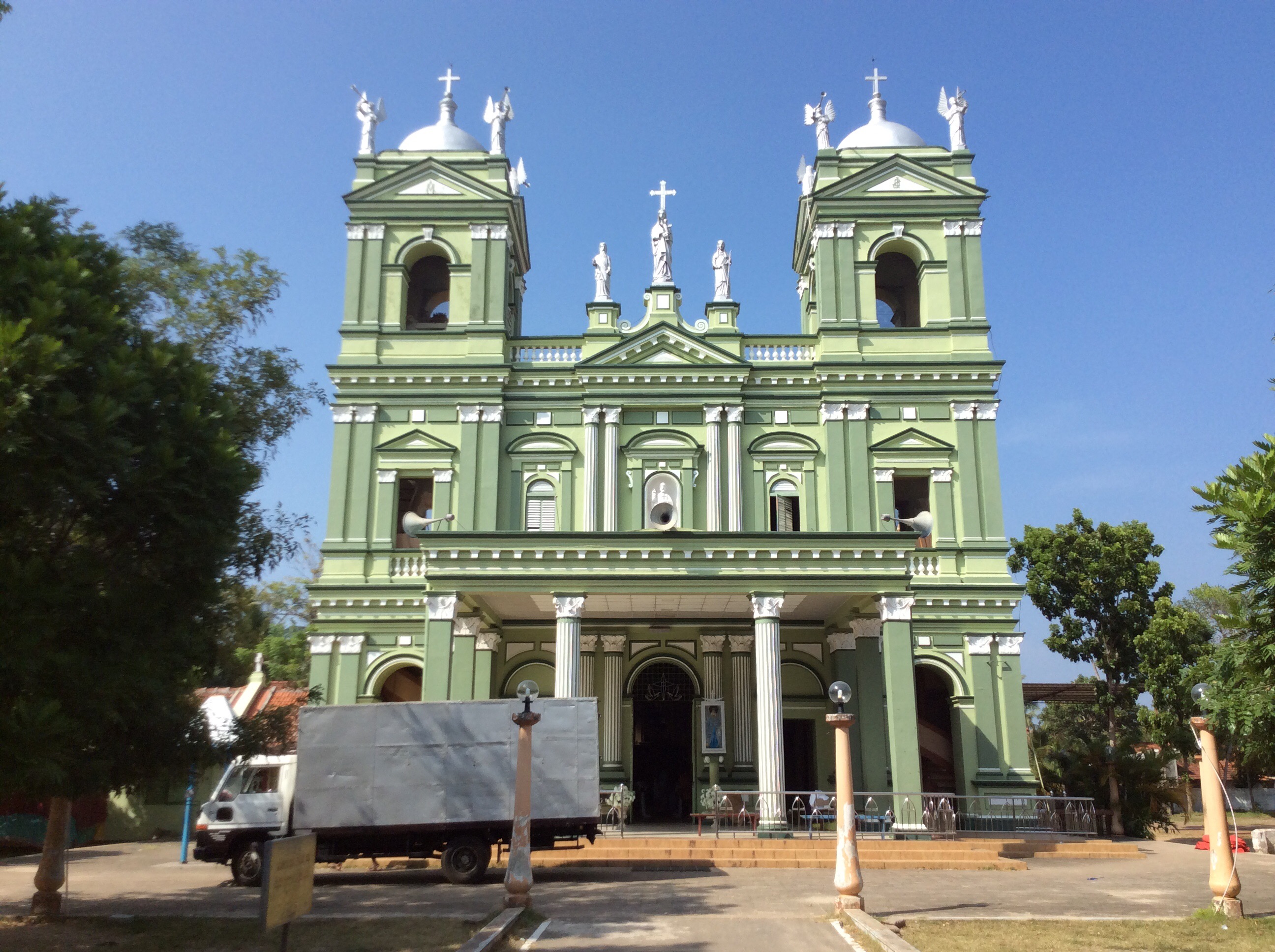
Catholic Church
Drying red squid
Dutch Fort gate and tuk tuk driver