I woke up at an ungodly hour (7am) to have a wee and couldn’t get back to sleep again. You know how it is. I tried all the counting stuff and saying goodnight to my feet and legs, but Morpheus would not welcome me back into his arms. So I got up and watched nerdy YouTube videos on my phone.
I like videos about rockets, construction, physics, engineering and geography. If I was to put those on a dating website profile, I would probably end up with Prof. Brian Cox. He’s a nice guy, but really not my type.
After Julie woke up, we had coffee n’shit, we set off on today’s Big Adventure with Jo and Dave, a cycle tour of Las Palmas. Our cycling host was Jose, who is a professional cycling teacher, mostly for 6 to 12 year olds. At weekends he takes tours with grown-ups.
The first leg was Vaguata and Triana, the oldest parts of the city. To be blunt, I’ve seen it already, so not exciting for me. After coffee in San Telmo Park we cycled north to see some parts of the city we hadn’t seen before. I haven’t got many photos since I was fully engaged with riding my pillar box red “Dutch style” bike. It was what I would call a ladies bike with a basket on the front. I forced myself to accept that there is diversity in the bicycle world, and in 2024 they should not be Gender Specific. I would have preferred a crossbar and darker paint job, but we are living in a Post-Barbie world and I have to reject Ken’s outlook on cycling.
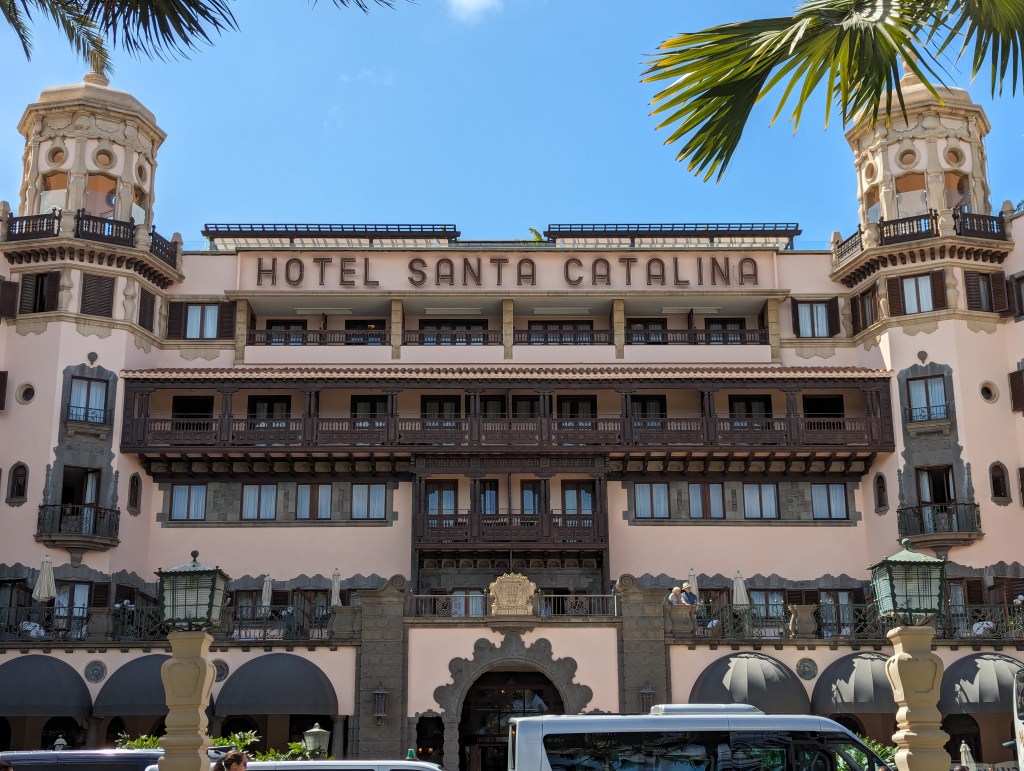
Jose took us to the Santa Catalina Hotel, the best in town. It was built by The British in 1890, when there were lots of Brits conducting business in the city. Las Palmas is on trade routes for steam ships to the Empire, so Brits built La Luz port to handle the trade. The city expanded massively after the port was built in 1885, and is the third largest in Spain.
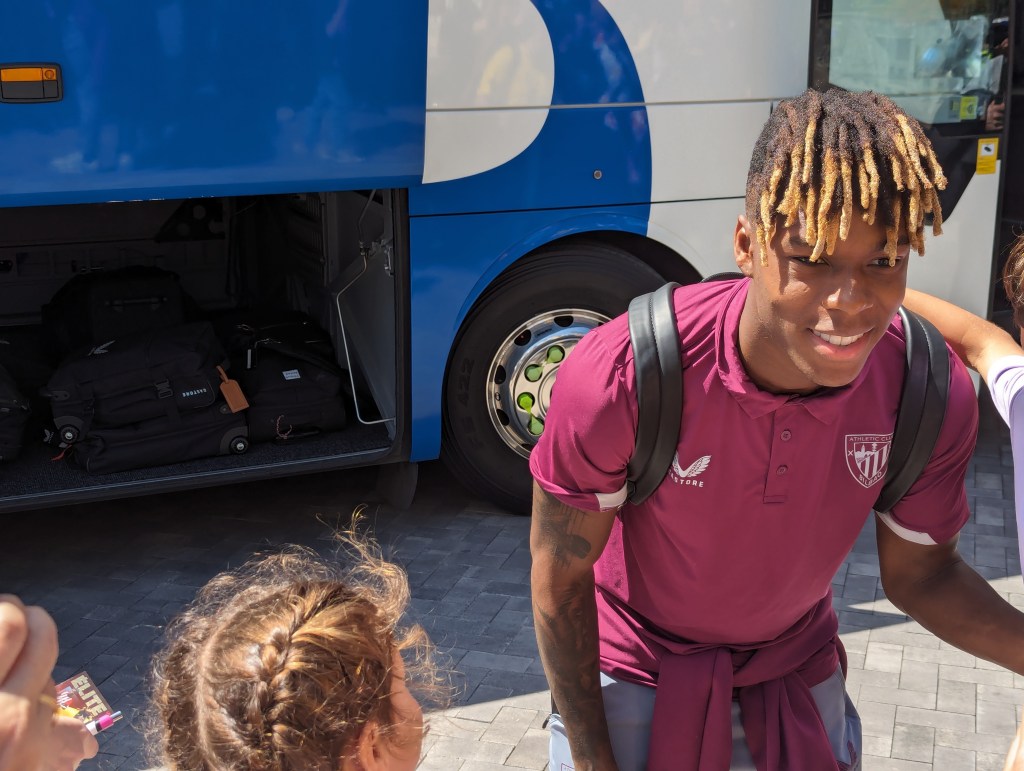
Just as we got to the hotel, the Bilbao football team were getting onto their coach on the way to a league match with Las Palmas. I took some photos of the players, I think this guy might be famous, lots of kids wanted his autograph.
The tour continued as far as the promenade at Canteras, which was heaving with weekend visitors. We had a brief look at it and then crossed the isthmus to the eastern side where there were two bloody great cruise ships tied up. After that it was a 20 minute ride along the coast back to Veguata and the end of our tour; Adios Jose!
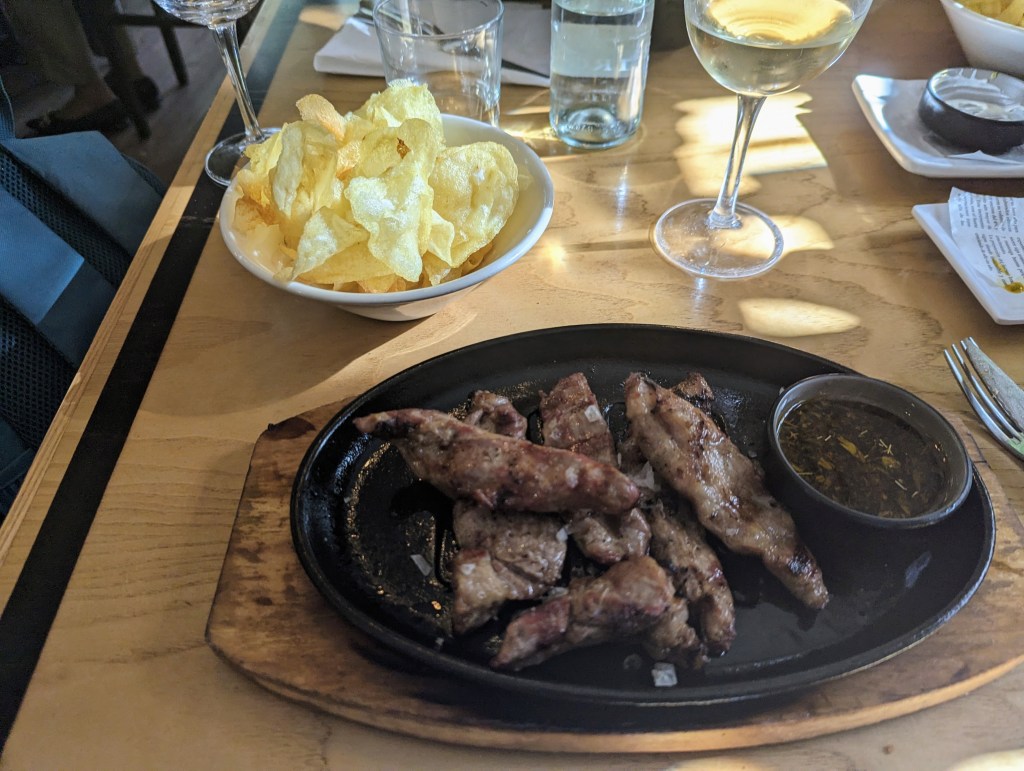
The 10k ride took about 4 hours, so not very taxing. Nonetheless a post-cycle beer at a cafe behind the cathedral was very welcome. We then went for a late lunch at Allende Triana. My main course was called Iberian Pork with Crispy Fries. It was strips of pork served with some sort of herb dressing in little dish. The fries were freshly cooked crisps, without any seasoning. It was tasty, but a bit simple and basic. Pork and Crisps, I don’t think it will catch on. The waiter (he told us he was from Cuba) was brisk and efficient, but had all the charm of a Macdonalds server on a bad day
Here’s a picture of my lunch, it was a vegetarians nightmare.
So it’s back to Canteras beach tomorrow, and possibly the Science Museum if the weather is bad.
Today it was time to get outa Dodge and commune with nature at the Jardin Botanico. Before we left Julie was about to make some coffee, but there was no power. There were workmen at a bank over the road doing something, so I went to investigate. It could have been a massive heist by a major OCG, but Ray Winstone wasn’t there and there was no glamorous lady criminal mastermind in a tight skirt and stilettos. A bloke in overalls pointed at a notice tied to a lamp post, written in Spanish of course. Google Translate worked its magic and told me that the power would be off until 5.30 in the evening. So no coffee for me.
The bus went from San Telmo bus station, 5 minutes away from the flat. It only took about 15 minutes to get to the botanic gardens in the hills above the city. There was a wooden cabin at the entrance where a man told us we wouldn’t need a ticket. Maybe that’s his job, and he has a degree in telling people it’s free to get it. Our first stop was the rather nice restaurant to get a coffee and book for lunch later on.
The restaurant was at the top of a big hill, and most of the gardens were at the bottom, so we walked a short way down and then sat on a bench in the sunshine until it was lunchtime.
The restaurant is very nice, and definitely a step up from the Mexican last night. We had a great table in the window overlooking the gardens and the hills across the valley.
Do you want to know what we had? Steak and Kidney Pudding and Mushy Peas. Only kidding, we had crispy prawns to start followed by Hake and potatoes and fried peppers. I said to the waitress “can I see the drinks menu?”, she said “we don’t have a drinks menu”. Aha I thought, a cunning trick to make us buy a 30 Euro bottle of mediocre wine, so we had water (flat).
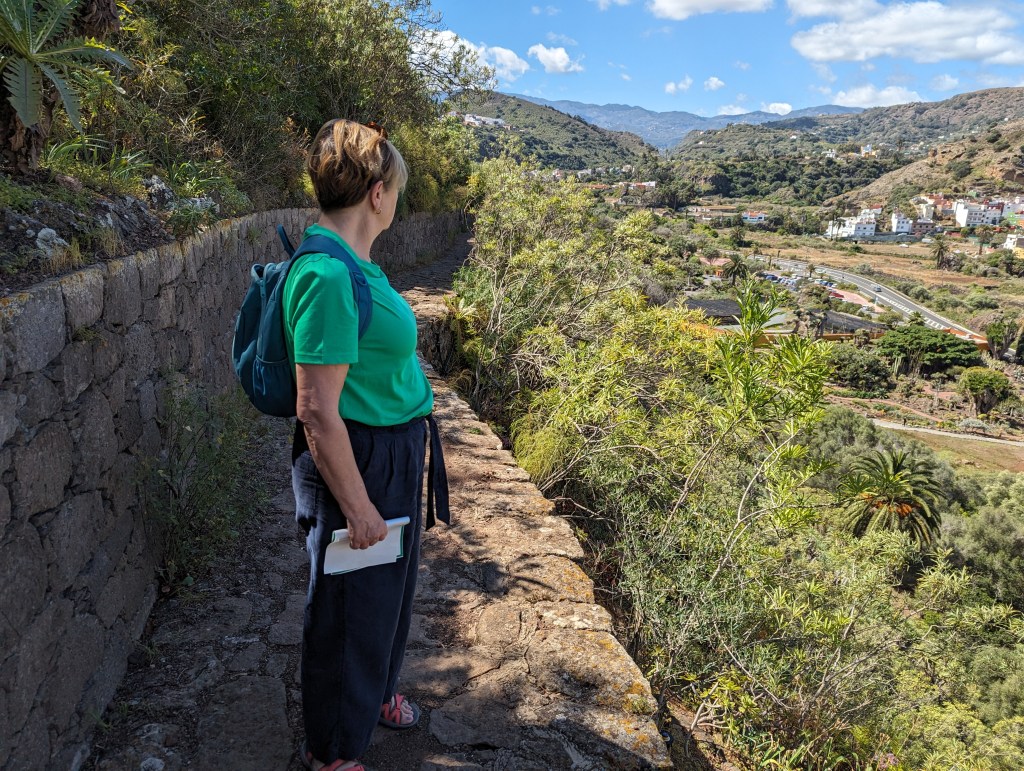
After lunch we walked down steps to reach the main part of the gardens. They are uneven stone steps, with a cliff on one side and a steep drop on the other. There are very few signs, and the wrong turn can lead to a dead end or really precipitous steps about 2 feet wide. So it took us 20 minutes of careful walking to get to the bottom of the cliff.
That’s Julie thinking about the Life Insurance policy I took out on her last week.
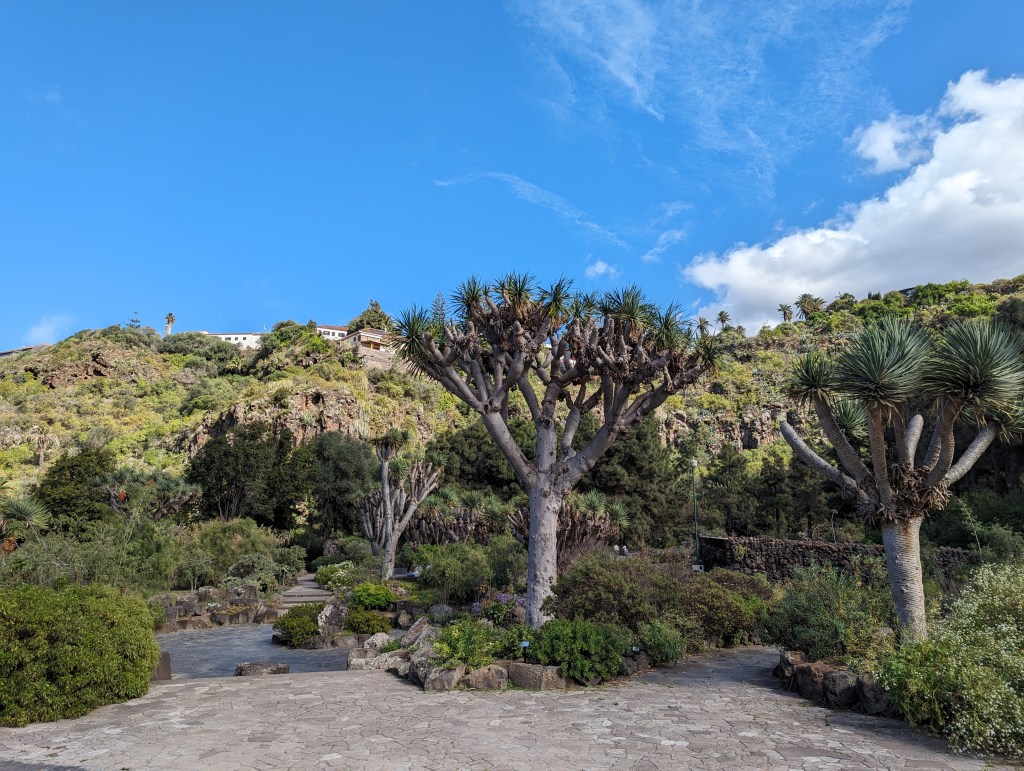
But it was worth it, since the gardens at the bottom are very lovely. It was much more Spanish (disorganised) than Kew, but it is extensive and relaxing. There are sections of pine forest, laura silva, coastal plants, succulents and cactuses. A murky pond was churning with fish and dragon flies hovered over it which were the size of Ornithopters.
Some of the cactuses are the size of trees, and have woody trunks with bark 60cm across. The laura silva woodland is a recreated remnant of a type forest which once covered much of the Canaries and Madiera. It was alive with birdsong, the most I have heard on the island. When we travelled to Costa Rica in 2022 we expected lots of birdsong in the rainforest, but all we heard was distant Howler Monkeys.
It is a great place to visit, but its a pity there are no bus stops at the bottom of the hill. On the other hand, climbing back up the stairs took only 11 minutes and we only had to wait 10 minutes for a bus. The bus dropped us in Vagueta and we saw some more lovely streets of old houses.
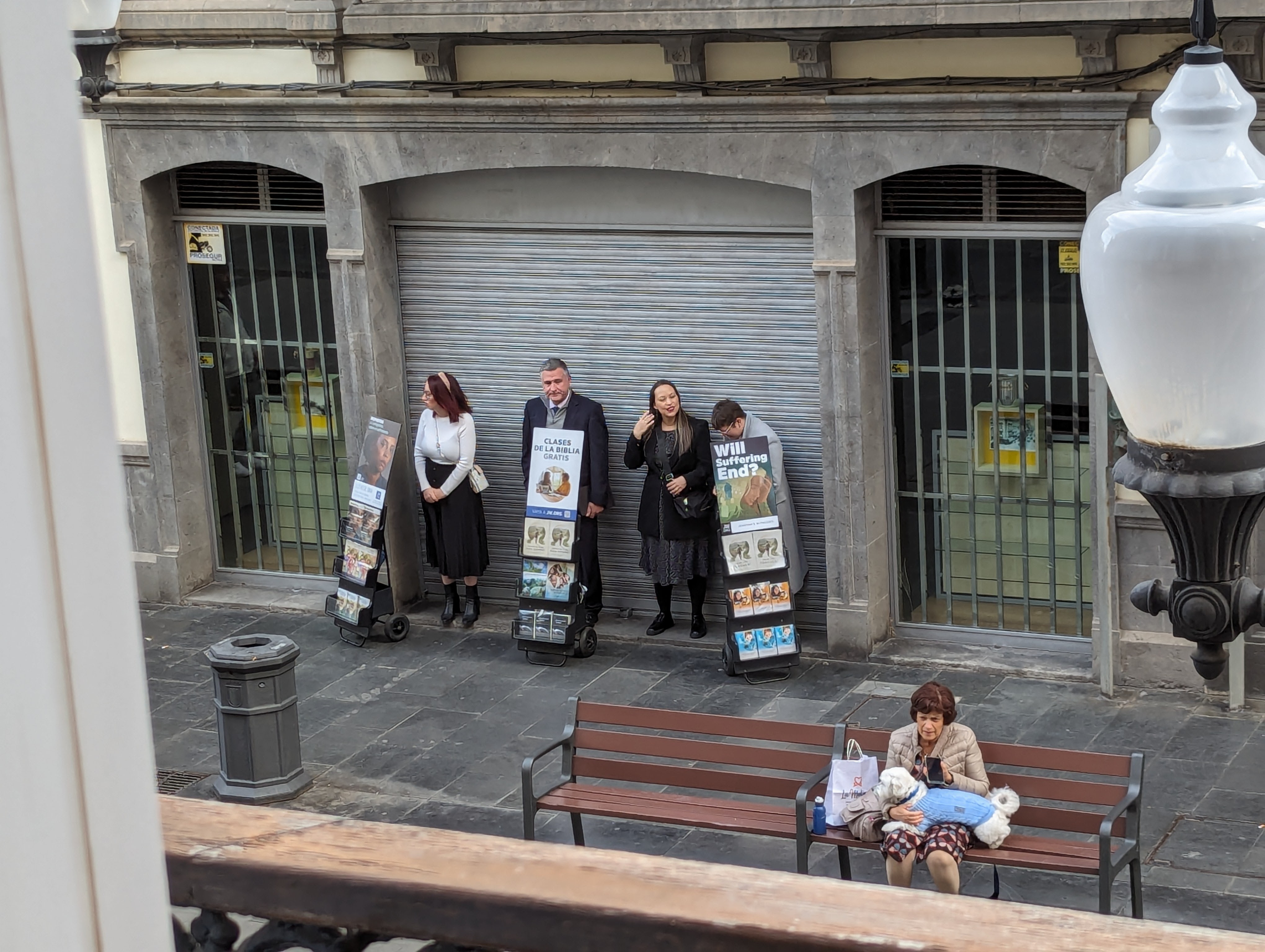
I’m sat next to the tiny balcony in the flat with the doors open listening to the chatter from the street below. I have a glass of iced Ron Miel and some salty nuts, so I’m happy as a pig in shit. The Jehovahs are down there witnessing all the people who won’t be going to heaven with them. What I’m thinking is that if heaven is full of that lot, it’s probably very boring and down stairs with all the sinners would be much more fun.
It was a lovely sunny day in Las Palmas today, and a great day for a dental crisis! Julie’s gold filling came off, after well over 40 years of excellent mastication service. Dental problems are never welcome, especially at a time when consuming food is an important part of the holiday.
After a brief flirtation with getting treated in Las Palmas, Julie spoke to the dentist at home and decided she would be alright for another few days until we are home. So no toffees, steaks, bubble gum or peanut brittle for a while, I don’t think she will starve.
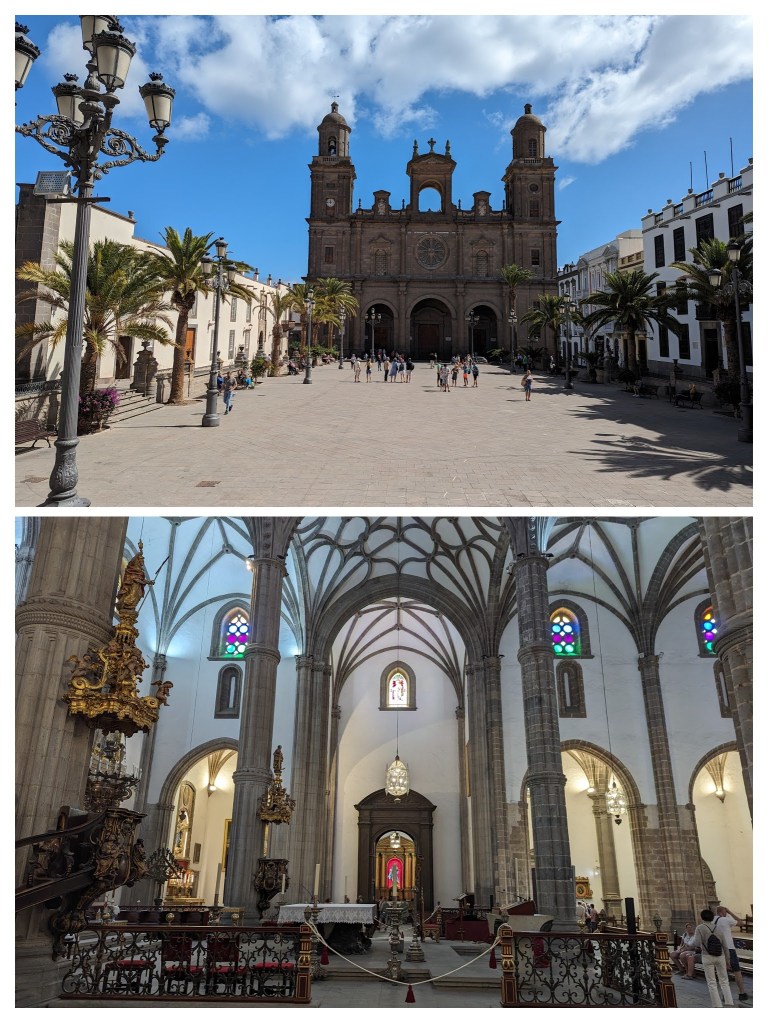
Crisis averted, we met Jo and Dave and walked down to Vagueta to see the Cathedral of Santa Ana. Having seen cathedrals in Italy and Andalucia, it is considerably plainer. Las Plamas didn’t have the vast wealth of South American silver and gold like Seville, or the rich bankers and merchants of Tuscany. It is a lovely building, but is not covered in gold and marble.
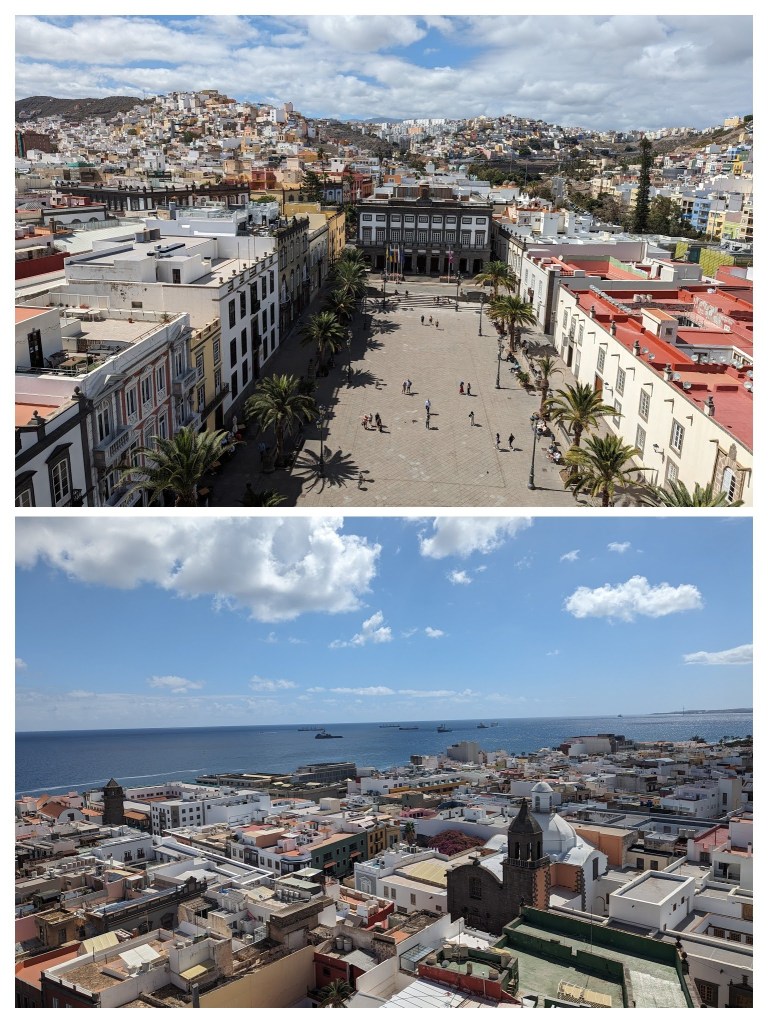
Part of the deal in the Cathedral was to ascend the tower and enjoy the view over Vagueta and the sea. You can see that the city is squeezed between mountains and the sea.
There was some unusual stuff in the Cathedral. In a little case there was Jesus dressed in one of Barbie’s skirts, it doesn’t suit him. There was a dead Bishop who was mummified and had his face literally painted pink to give him a rosy glow. There was a collection box to pay for him to be made into a saint, sadly I had no change to contribute. My favourite picture is my good buddy Jo looking quite holy.
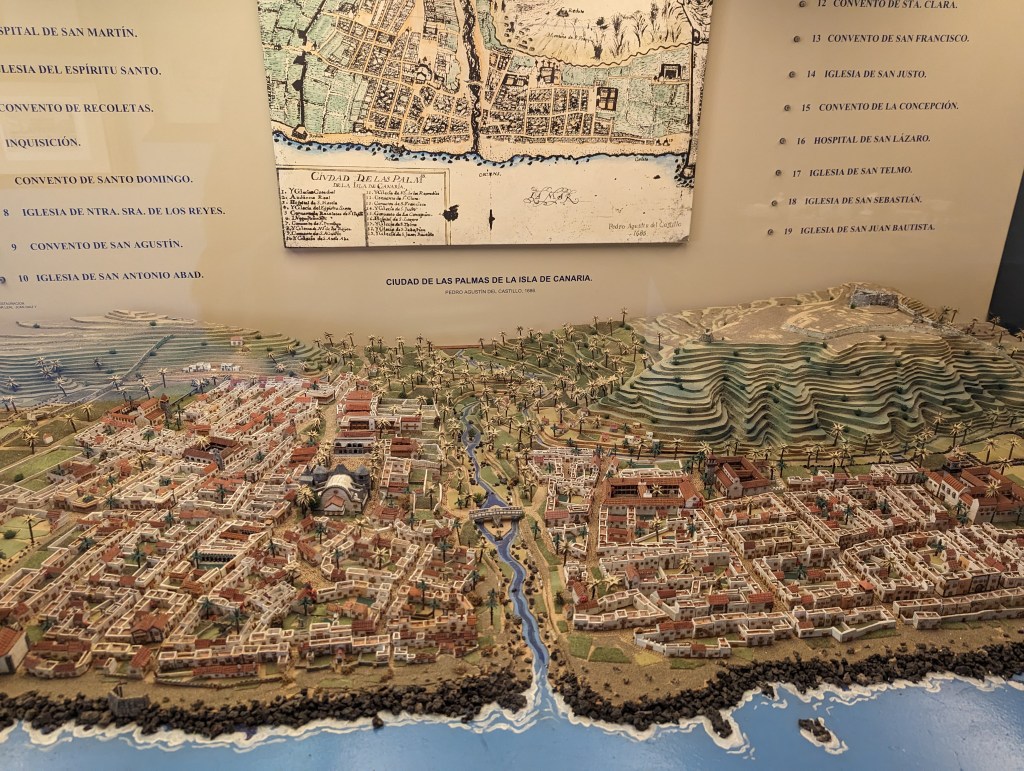
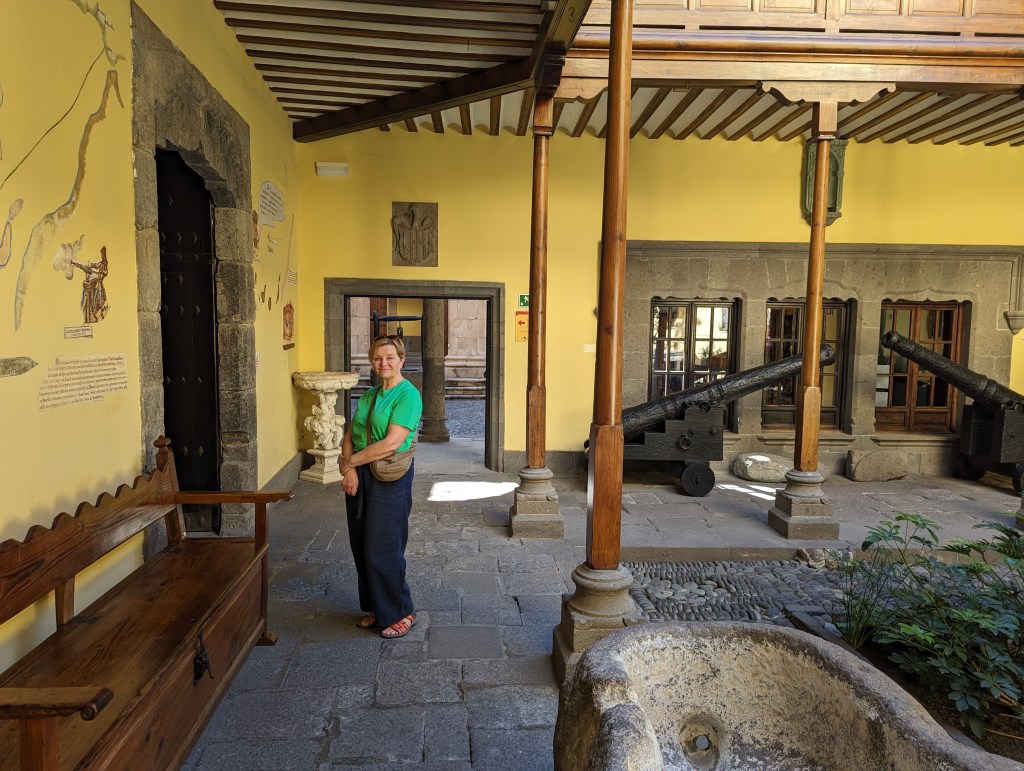
In the afternoon we visited Casa Colon. I know it sounds like an establishment for.. deep cleaning, but is in fact a museum to Christopher Columbus’s brief visit to Las Palmas. He wasn’t on holiday, he was on his way to destroy cultures and enrich himself in America. It is a lovely little museum, full of maps of his various journeys and a couple of squawking macaws. I especially liked the model of Las Palmas in the 18th century, when it was just Vaguetta and Triana. The Guineguada river is now covered over by a big road between the two barrios.
Here’s Julie looking fascinated by the many maps of Colonic journeys across the Atlantic. Lots of Canarians followed him to settle in South America, where the prospects were better than the Canaries.
In the evening we dined out at Gallo Negro, a Mexican restaurant in Calle Perdoma. I had Enchilladas washed down with an Aperol Spritz, proper holiday food.
The sun was shining this morning from the beginning of the day, so we got out of the flat early…ish. There were pants and socks to wash, so in the event we got out at 11, which is early for a holiday.
The Jehovahs were out on the street trying to convert people by just standing there with their leaflet stand. Quite honestly they could just as well have several cardboard cut-outs of varous versions of Doctor Who and achieve the same number of converts.
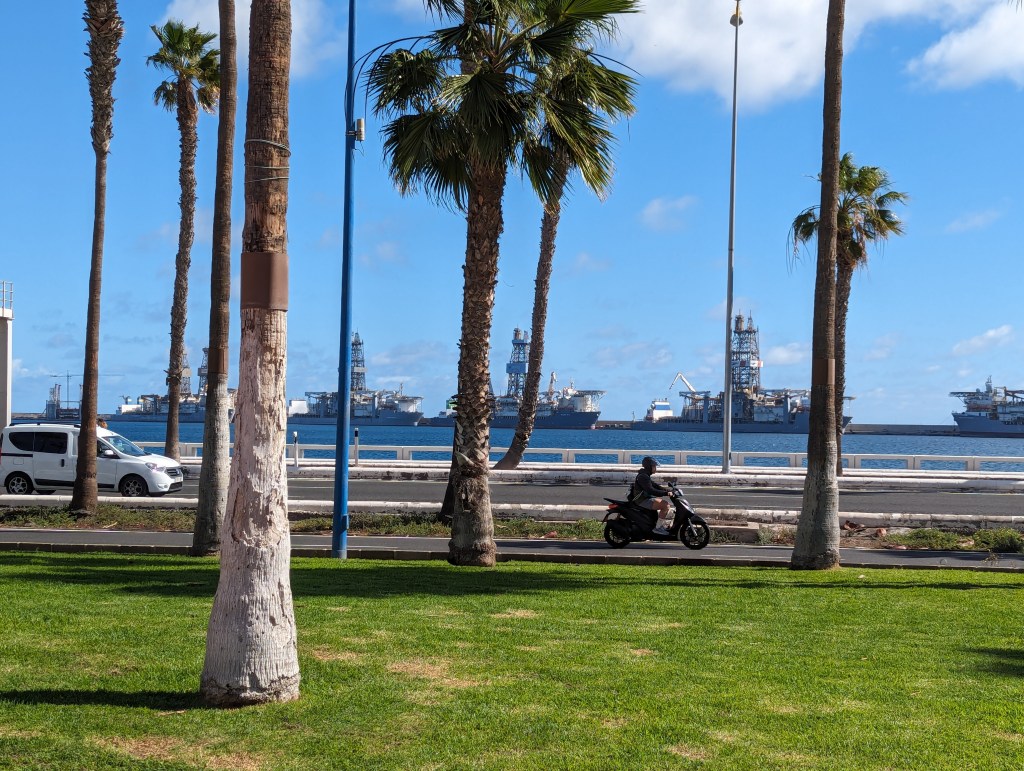
We walked for about 5 minutes to get to San Telmo Park, and decided we needed a coffee, its the only way to start the day in Spain. The park is opposite Puerto de la Luz, one of the biggest ports in Spain. They service floating drilling rigs at the port, and there were several lined up ready to get their spark plugs changed and timing belt adjusted.
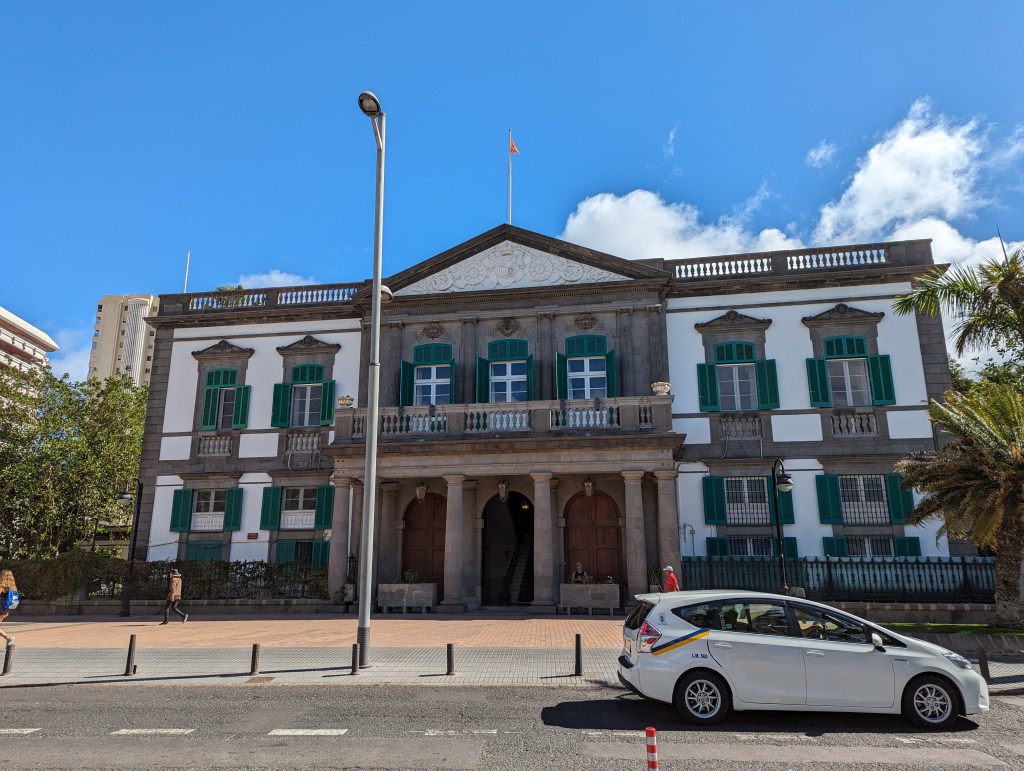
The park is close to the sea, but is overlooked by hills not far away. In Google Maps I looked up Mirador (viewpoint) and found Mirador de Schamann about 20 minutes walk away, so we headed up there. On the way we passed this interesting looking old building, which is the Canarian Naval Headquarters. I expect they are ready to vigorously fend off any English or Dutch pirates. But quite honestly the Spanish Navy hasn’t had much success since the Battle of Trafalgar.
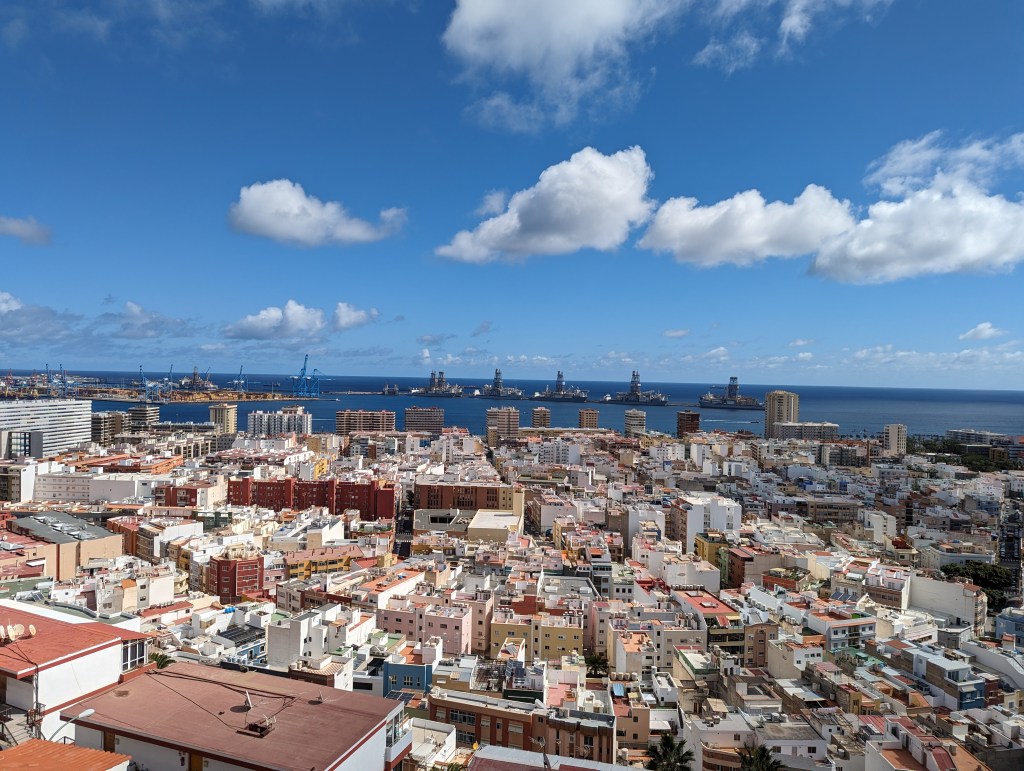
The view from the mirador was excellent, and the hike up the hill will hopefully negate the effects of the alcohol I will drink tonight. Notice all the drilling rigs in the port. Also you can see that the houses are all little boxes made of ticky tacky and they all look just the same.
We had lunch at the flat (bread/sardines/hummous/tomatoes/sangria) and in the afternoon had another explore of Triana. There are so many interesting streets and a plethora of restaurants.
Have I used the word plethora before? I don’t think so. Like Ithmus, it has a TH in the middle. My initials are TH, surely there is a mystical connection.
Anyway I digress, we mouched about looking at nice places and taking note of restaurants for this evening.
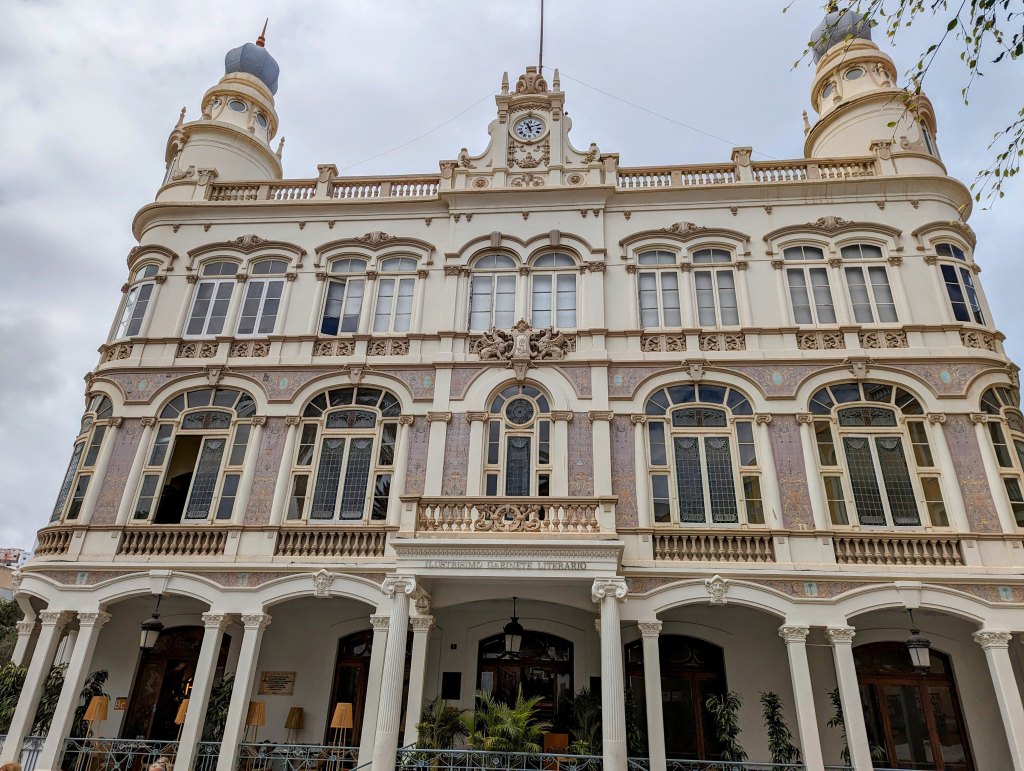
This is the Gabinete Literato, which is a cultural and scientific society a bit like our own Royal Society.
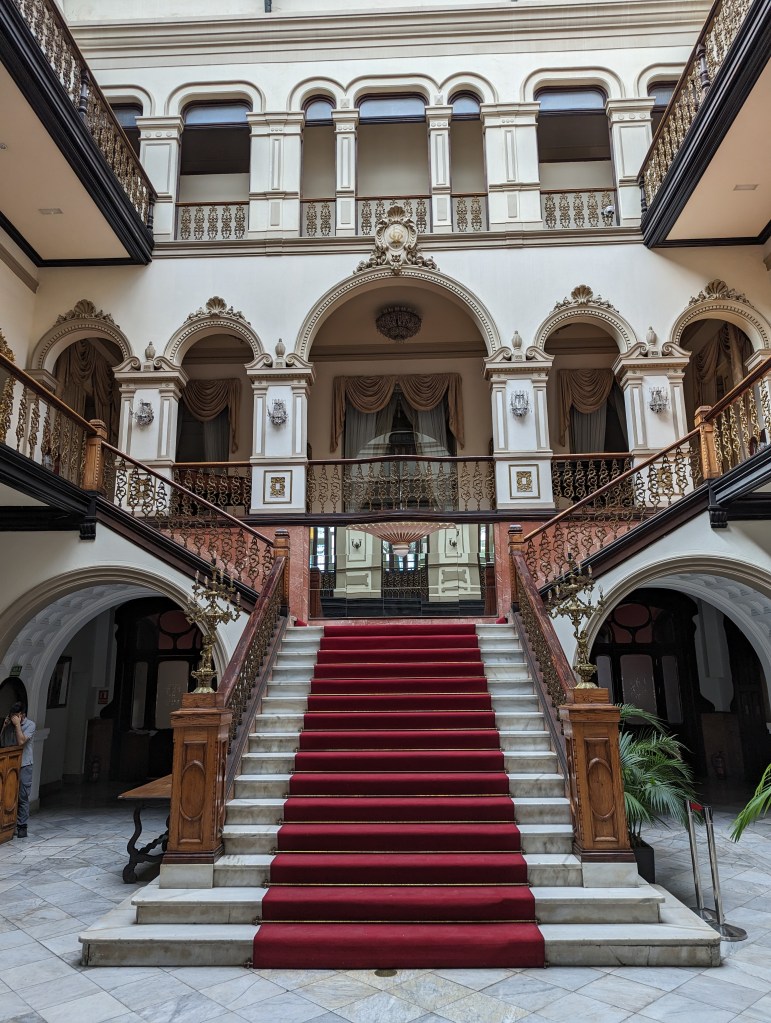
Inside it is equally lovely, and it has a restaurant that we might try out some time.
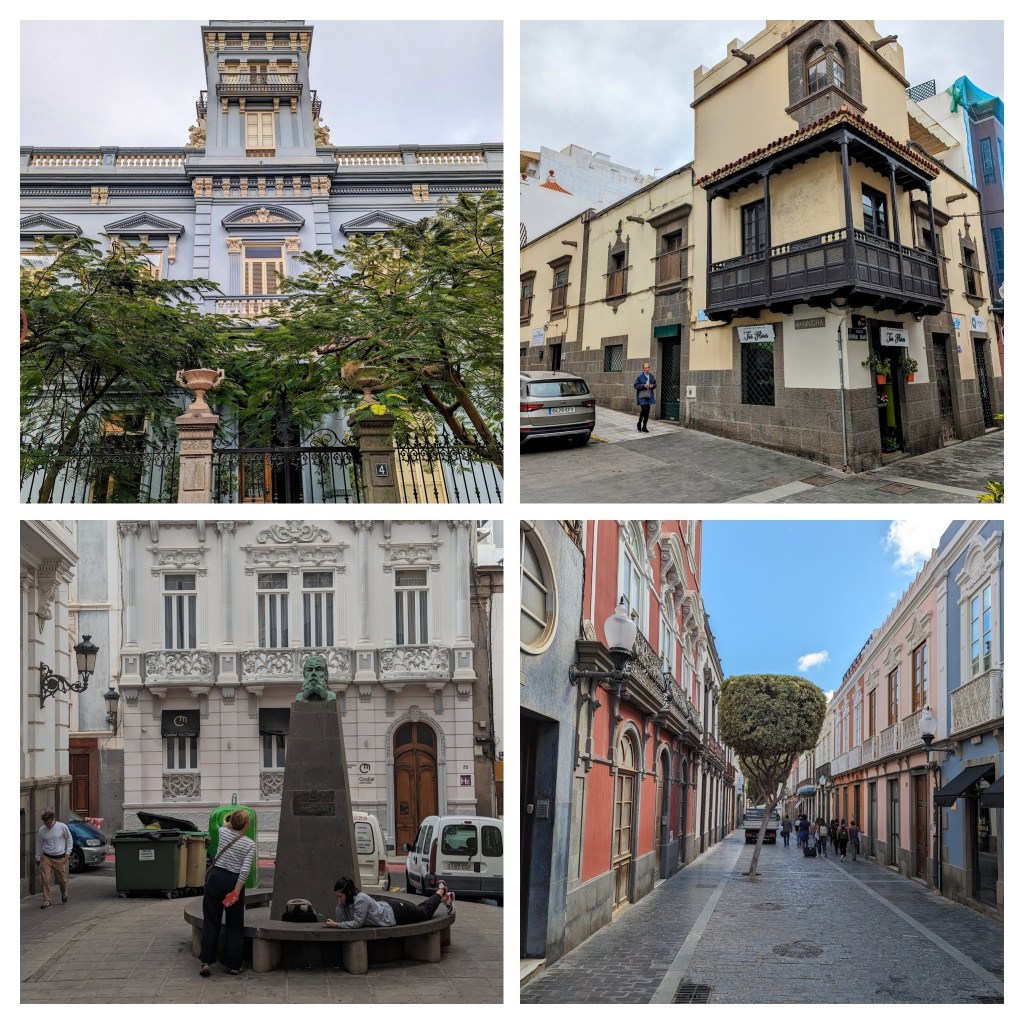
I took loads more pictures of pretty places, and have cleverly made them into a collage. Not only am I a master of unusual words with TH in them, but I also use collages in my work, I truly am a polymath (which also contains TH).
At 6.30 we met Dave and Jo in their hotel and walked them into Triana. We had a drink in one of the side streets running off Calle Triana, then went in search of a restaurant. They were either Inside Restaurants with no menu on the wall outside and linen table cloths (out of our league) or Outside Restaurants with affordable menus to peruse, but a bit drafty in the street.
Eventually our rumbling tummies overruled us and we found an Outside Restaurant near Plaza del Ranas (Frog Square). My chicken and wrinkled potatoes were very good, washed down with a hearty Rioja.
So far we have had an ‘amuse bouche’ of Gran Canaria, dipping into the old town in las Plamas and Canteras beach. Today we went for the Full Monty, a coach trip up to the mountainous centre of the island and south to Maspolomas. I booked the tour weeks ago, and was hoping that it would show us the interior without having to hire a car.
The bus picked us up at Plaza del Ranas, on the road that separates Triana from Vegueta. There were about 35 people on the bus, with an English speaking guide called Pavel, who is Czech, but has lived in Gran Canaria for a very long time. He was a ball of energy who barely stopped talking, but in a very good way.
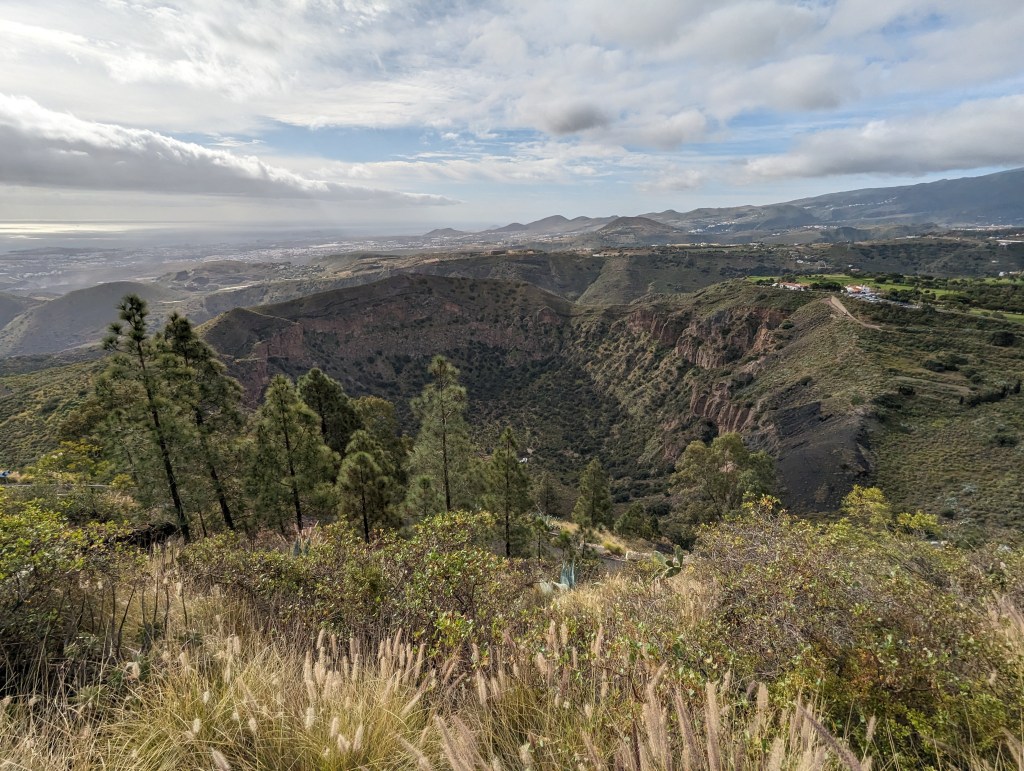
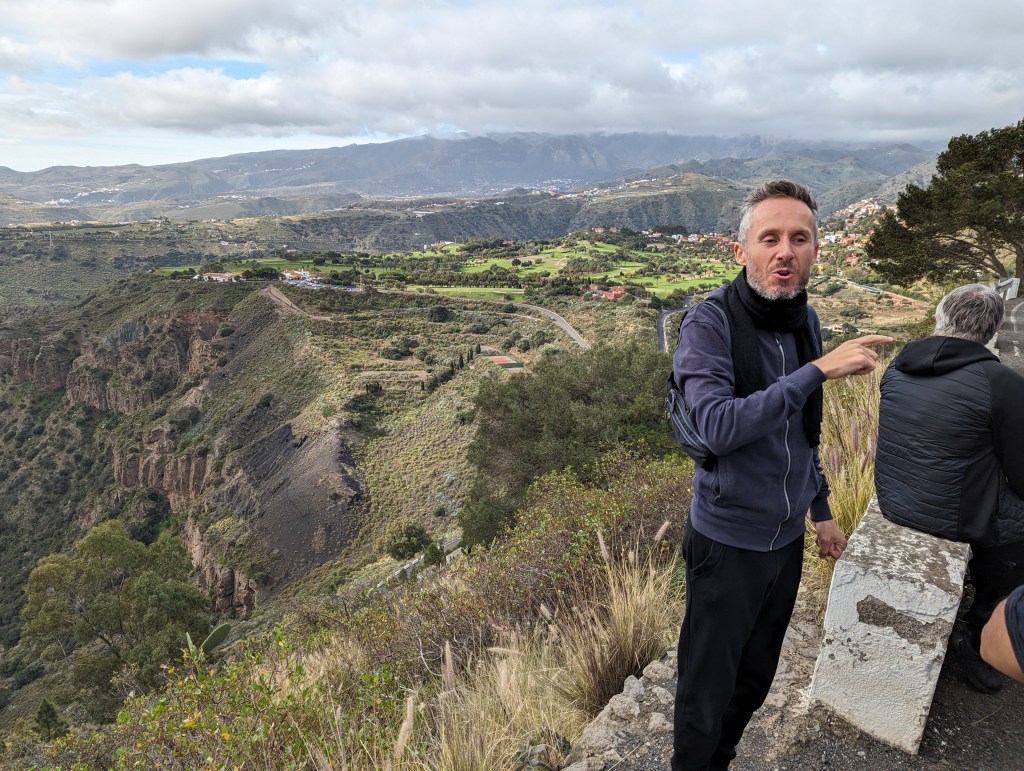
It is an understatement to say that the road was windy, it was nothing but bends for hours on end. Luckily my stomach didn’t complain much. The first stop was at Bandama, to see a bloody great hole. Bandama crater is the remains of a volcano that exploded millions of years ago, and it takes an hour to walk around it. It was named after a Dutchman called Van Damme, who owned the land, and the locals mangled his name. At the bottom is a farm where a man called Augustin lived with his family during the Civil War. He never left the crater until he was 80, when he moved in with his sister in the next village. Pavel reckons he is still alive and in his mid 90’s!
This is a picture of a perennially cheerful Pavel telling us all about the ancient occupant of the crater.
We stopped briefly at Santa Brigida, a village named after Saint Brigid. There were at least two Saint Brigids, one was an Irish Virgin and the other was a Swedish do-gooder. Catholics love a nice virgin, and so does Sir Richard Branson, for completley different reasons.
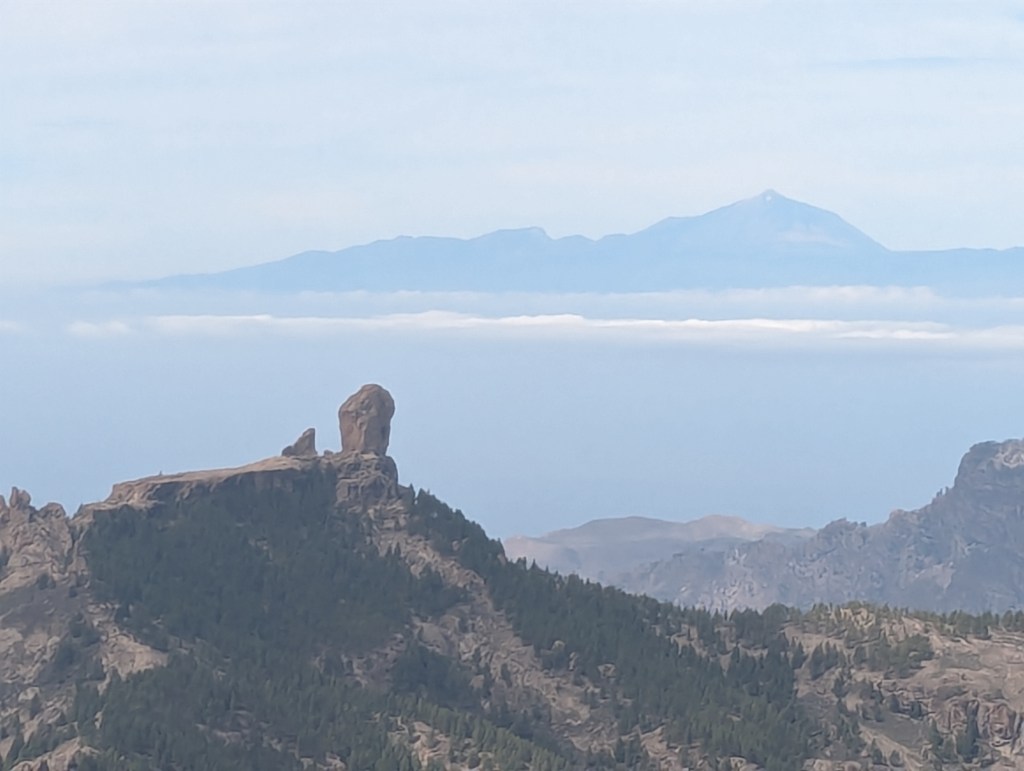
The bus went up and up and twisty turny twisty turny until we reached the top of the island at Pico de las Nievas, the snowy peak. But not today fortunately, it was sunny and we had amazing views across lots of the island. Not far away was Roque Nublo, an eroded volcanic plug (like Arthurs Seat in Edinburgh) and the island’s most famous landmark. Behind it I could see Mount Teide on Tenerife, which I ascended a couple of years ago (by cable car).
This is me at the top. I seem to have aquired a giant hand, it must be the altitude of something.
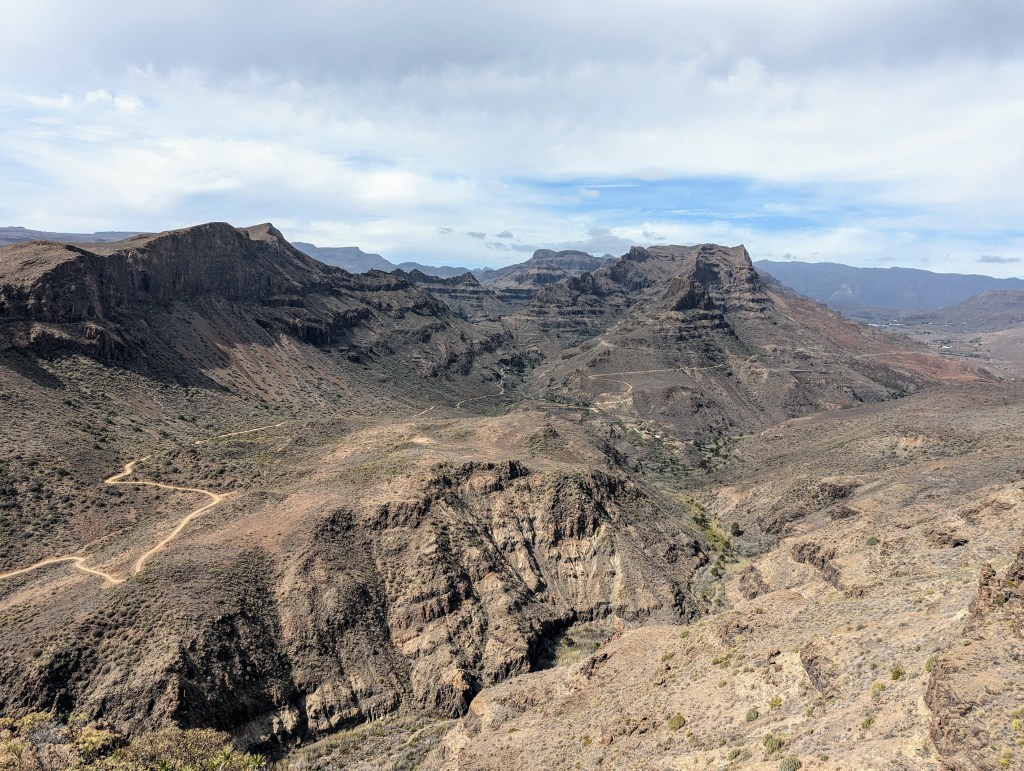
It was all downhill after that, literally. Beyond the Pico we were in the rainshadow of the mountains, so the landscape changed from lush green to desert. The vegetation changed rapidly to cacti and agaves, and the landscape was like Arizona or Utah.
We stopped for lunch at an oasis village called Fagata, and ate at a restaurant that Pavel had phone ahead to give them our order. I had goat stew with fried potatoes and padron peppers, it was very tender and delicious. I washed it down with a glass of Tropical beer, the local brew made in Las Palmas.
This is what erosion does to a volcano after about 12 million years.
From Fagata it was only half an hour to Maspolomas, which is the main mass tourism resort in the sunnier southern half of the island. The weather is better, there are lots of sand dunes and bars, but no culture. When I travel I want to see authentic places with history and culture, not just hotels and beaches that could be anywhere.
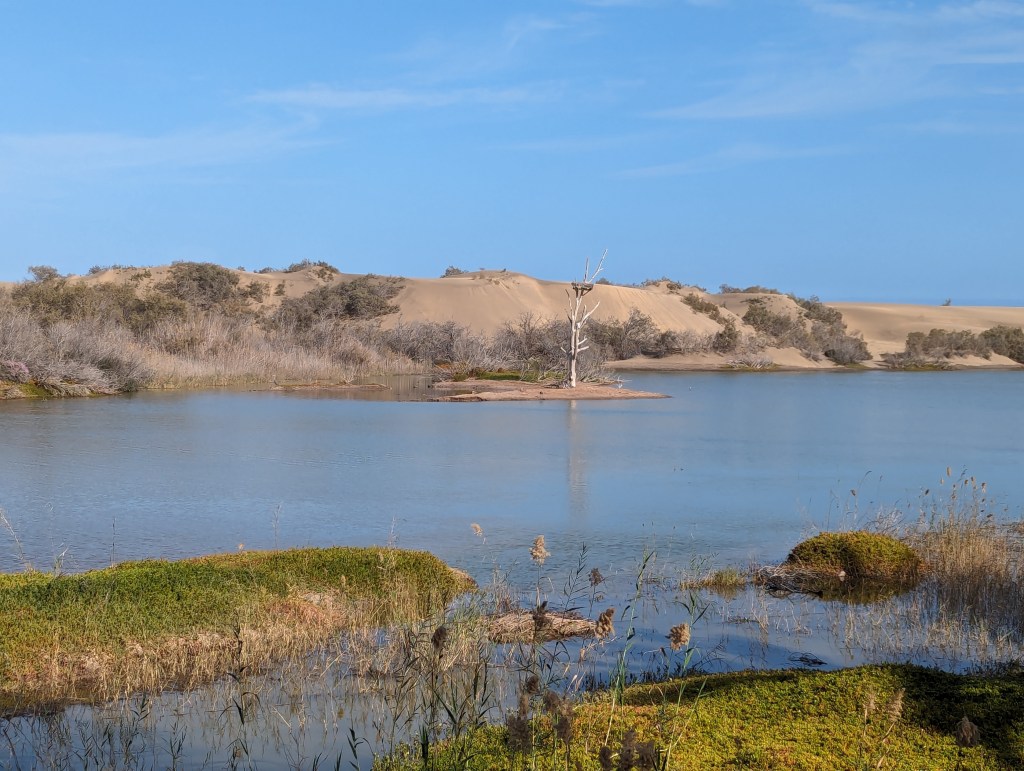
We had 40 minutes wandering along the beach and admiring a fresh water lagoon which is a bird sanctuary. I think we will come down on the bus one day so we can visit it properly.
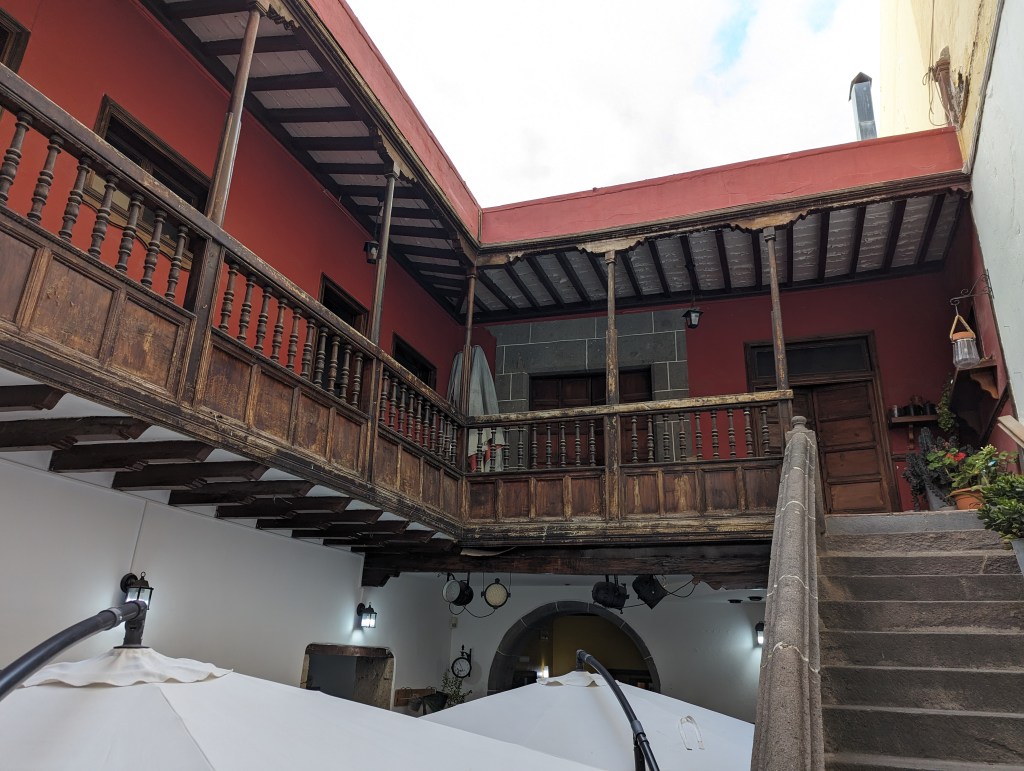
It took an hour to get back to Las Palmas on the motorway, so we celebrated our return with a glass of local wine in El Patio bar in Vagueta. It’s inside an old style courtyard, and definitly worth another visit.
It’s a big day tomorrow, our buddies Dave and Jo are joining us on our adventure!
We had a very languorous start to the day, mostly doing Sweet FA until about 11.30. We then ambled south along Calle Triana (Calle is pronounced Cayeh in Gran Canaria) and explored a few more of the side streets. There are some very beautiful old houses with wooden balconies, typical of the Canaries.
We crossed Calle Fuente to reach Vagueta, a major road that was once a river until the 20th century. The area we are staying in is called Triana which is 16th and 17th century, Vagueta is the original part of Las Palmas which was founded in 1473 by Castillian Juan Rejon. The Spanish fought the local people for five years before they were conquered by their better armed opponents. Guns, Germs and Steel win every time.
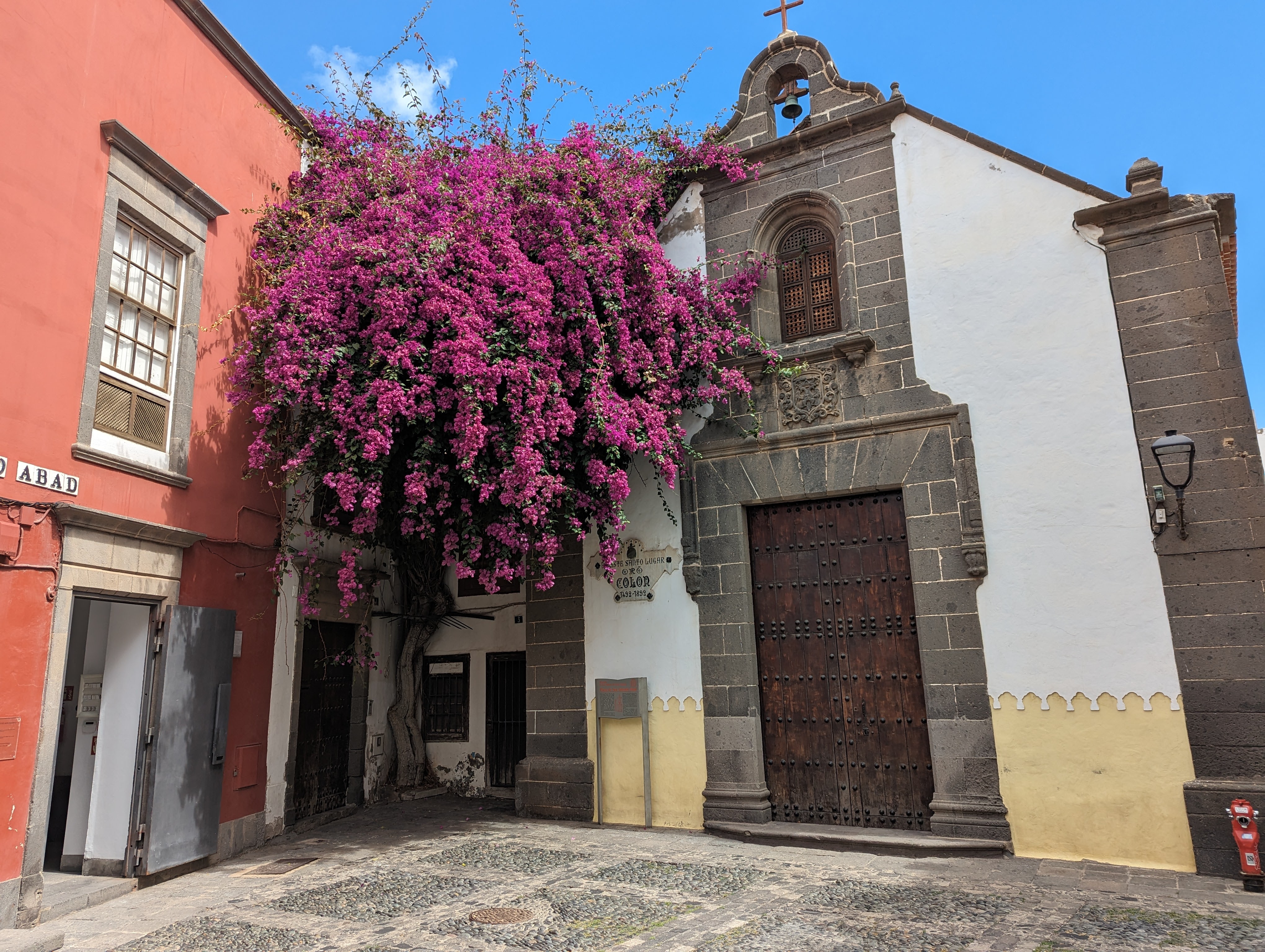
In Vaqueta we met Maria, a local guide who took us around the old town centre. She was an excellent guide and spoke ten to the dozen in a strong Spanish accent that I had to tune into. She loved the area and was enthused about the gorgeous old buildings. One of the first we saw was a little church where Christopher Columbus once prayed while one of his ships was being fixed on his first trip to China (that’s what he thought).
Next to the little church are some palm trees, not the original Las Palmas, but close to where they grew. Vagueta (which means a small piece of fertile ground) has several lovely museums and lots of cafes offering tempting pastries and cocktails (later in the day). Maria told us that Francis Drake had a go at Las Palmas in his usual piratical way, followed later by the Dutch having a pop. Gran Canaria is a very desirable location between Europe, Africa and America. The Canarians built narrow streets with tight corners, so they could pick off any invaders one by one.
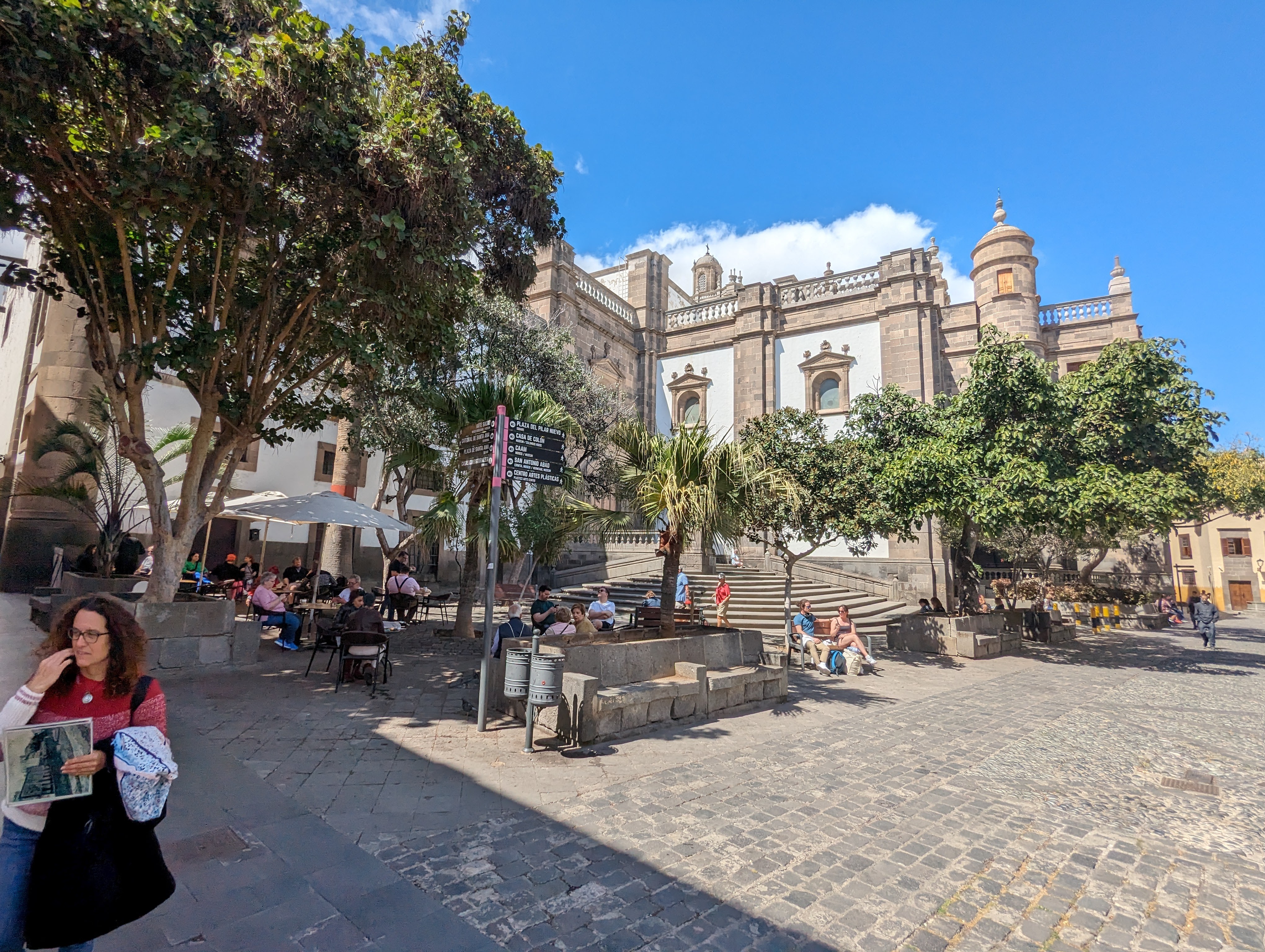
The grandest building is the Cathedral of Santa Ana. Apparently Saint Anne was Jesus’s grandmother, and his grandfather was called Joaquin, like Phoenix. Who knew that?
This picture is the back of Santa Ana, with Maria in the corner.
There’s a fantastic market in Vagueta selling local food. Pushing the culinary boat out we invested in some Iberico ham. The pigs are fed only on acorns, and it costs 20 Euros for 100g, that’s 200 Euros a Kilo my friends. Fuck it, we’re on holiday! To go with it, we got some spelt bread, and ate it at lunch in the flat. Needless to say, it was bloody delicious.
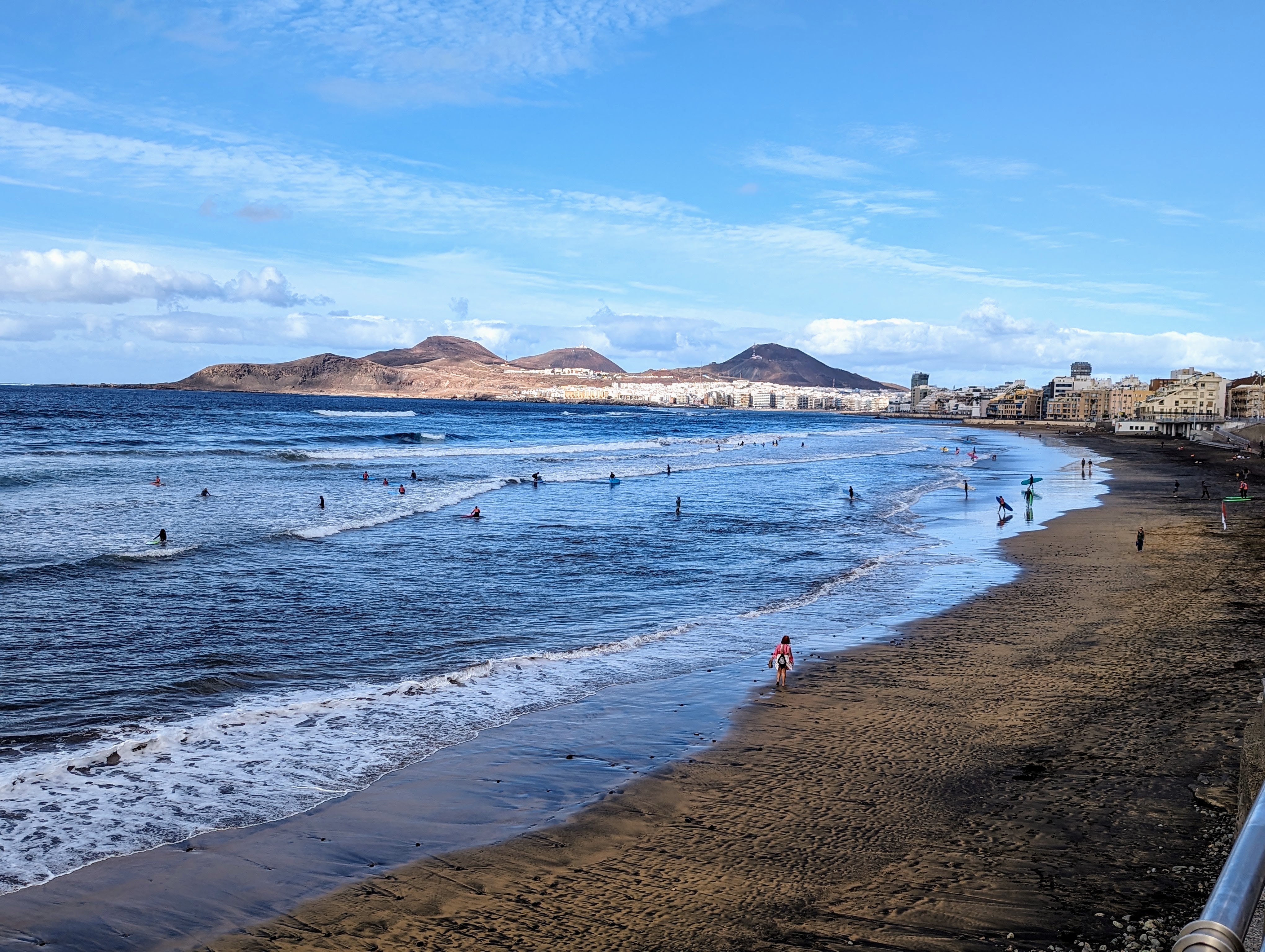
After lunch we got the 17 bus to Canteras beach. Las Palmas is a very big city, and the north of is shaped like a lollipop. There is a big peninsular sticking out at the northern end, which is made up of old volcanoes. This area is called Isleta, and is connected to the rest of the city by an isthmus. Dear reader this is the first time I have ever used the word Isthmus, and I’m proud of it. On the western side of the isthmus is a beautiful beach called Canteras, allegedly the best urban beach in Europe.
Its very popular with surfers, most of whom are enthusiastic but crap at surfing. But its a lovely place to hang out in the afternoon sunshine.
Isleta is the lumpy bit at the end of the beach.
Las Palmas is a lovely place, and I’m looking forward to exploring it more. It’s wine time for me now.
I’m visiting Gran Canaria for the first time. I have developed a taste for the Canary archipeligo for several very good reasons.
They are the nearest warm place you can fly to in the Winter/early Spring which is in Europe (sort of). The islands all have their own character, and you can get culture if you want it, plus the booze is cheap and the food is good.
London is still damned chilly right now and the beer is a ridiculous price unless you go to Spoons, and as much as I love them, I don’t want to boost Tim Martin’s bank balance too much. I do appreciate that he is called Tim, there many talented Tims, such as Berners Lee, Vine and Peak. I’m the most popular Tim Harness, I asked my wife and she agreed with me.
Julie and I are staying in the capitol of Gran Canaria, Las Palmas, which is on the top right hand side of the roughly circular island. Its a big city, half an hour from the airport by bus.
Our apartment is in the old part of town called Triana, which is full of shops and restaurants. Julie cleverly chose a beautiful flat on Calle Triana, a pedestrianised shopping street which is very cool. The flat has a balcony about 30 cm wide, too narrow to sit on, but we can open the big windows and watch the passersby.
Since we arrived there has been a group of Jehovahs Witnesses with their little stand of leaflets doing nothing, just across the road. They don’t appear to talk to anyone, they just stand there looking hopeful that someone will approach them. I guess they think they are doing Gods Work, but it appears to me like a total waste of time when they could be in the pub or watching a Grand Prix on the telly.
We got settled in and walked around the locality to suss out where we can eat and drink. Like all touristy places in the Canaries there is an Ale Hop (ally op) which is a bit like Tiger and sells pretty things that you don’t really need but you buy anyway.
There is a Hyper Dino supermarket close to the flat, so we bought our essential supplies, including two bars of 70% chocolate, which I consider is one of life’s necessities.
Thus enriched with supplies we enjoyed an aperitivo by the balcony and made quiet rude comments about the innocent folk below. Jehovah would be very disappointed with me, but I’m sure he will forgive me.
Venturing out again (no more than 200 yards) we found Cafe Cristal and I had a pizza. It wasn’t just good, it was magnificent, with more topping than Bertram Mills Circus.
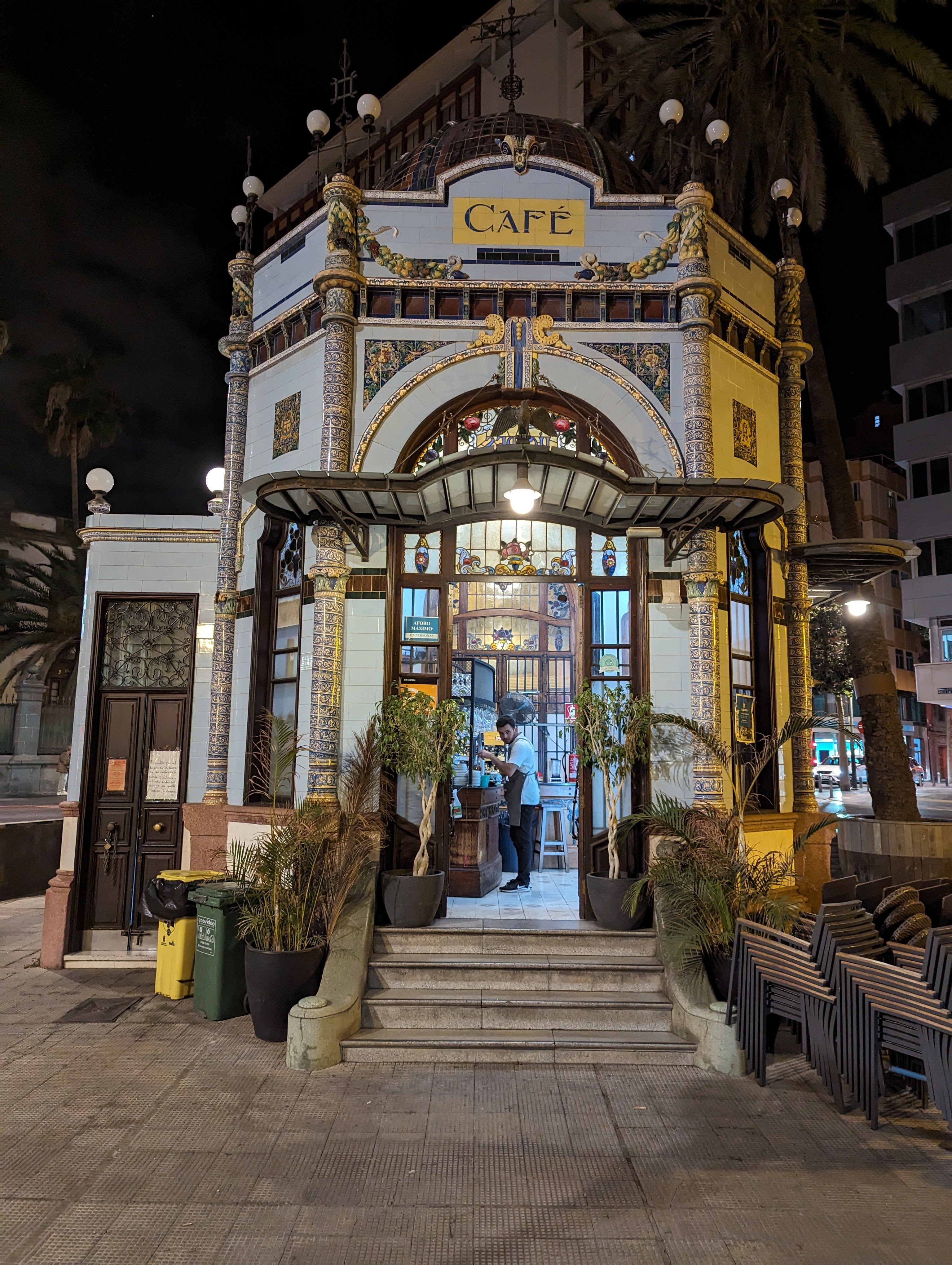
After loosening my belt, we walked down the Calle to San Telmo Park at the end, which is small but very very pretty. Take a look at this Art Deco cafe, isn’t it gorgeous?
This is what I found out during my Interrail trip in September – October 2023. You might find it useful, you might think it very tedious.
Wheelie Bag or Rucksack?
I know you are dying to know the answer to this big question.
We decided on small wheeled suitcases that we usually use as cabin luggage. They were perfectly good for our needs, which are modest
We packed carefully fitted most of our stuff in our wheelies. We both took small rucksacks to put out valuables (phone, passport, Chromebook) and food in so we could have them with us on the train. Its a well know fact foreigners will try and steal your bags if given the opportunity. Its best to sleep with one eye open.
Often we could put our wheelies above us on luggage racks, sometimes they went on racks at the end of the carriage. We secretly laughed at people with bags bigger than themselves that they could barely drag down the corridor. Ha ha ha you fools!
We never wished we had big rucksacks, they are heavy and needless. This isn’t Thailand in 1984, its Europe in 2023 where we have proper paving (mostly).
Wheelies are noisy on cobbled streets, and you have to be careful on kerbs. Julie lost a wheel from her wheelie and had to buy another one in Siena
What clothes to take?
Travelling in early Autumn in Europe I had clothes for 2 seasons, because I thought it would be cool in October. But it was hot all the time!
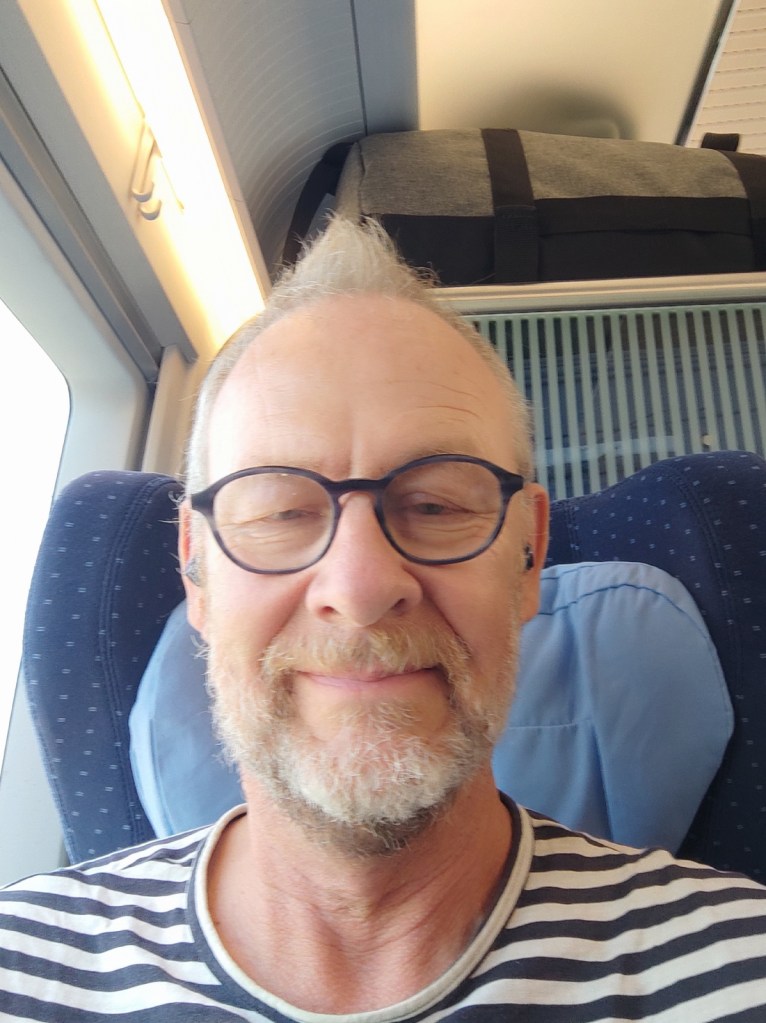
4 tee shirts – wore them all. The blue stripy one was my favourite
2 shorts – wore most of the time
4 pairs socks – wore occasionally with trainers
2 thin jumpers – wore very rarely
5 pants
1 jeans
1 hiking trousers – wore once in the rain
2 long sleeve shirts – for evenings out, wore rarely
I pair hiking sandals – wore constantly and they got stinky
2 pair trainers – wore occasionally
I pair swimming shorts
I microfiber towel – very good for the beach
Sun lotion
Bug repellent
Corkscrew – no screw caps on bottles in France
Earbuds
Hat/cap – i had to wash it after a month
Sunglasses
Battery pack for mobile – using Google maps uses lots of power
We stayed in small apartments, often (not always) with washing machines. Occasionally I would shower with my smalls on the floor and stomp them with shampoo.
This was enough because I could regularly wash stuff.
Food
We decide that we would rather have extra days on holiday rather than have lots of meals out. So we had occasional moderately priced meals out, but mostly cooked in our flat.
A baguette in France costs 1 Euro, which is a bargain.
Navigation
The Interrail app is fantastic for finding the train you want and getting the ticket as a QR code. It made planning our route quite straightforward.
The best source of advice is the website “The Man in Seat 61”. He has been everywhere in Europe and his train travel website is amazingly comprehensive.
The view Interrail app doesn’t show all the small regional stations in Italy when you look for stations between cities.
So I used the Trenitalia app (available in English) to find the trains I wanted.
Accomodation
We used Airbnb or Booking.com to find self catering flats. Paris (of course) was most expensive and Golfe Juan was the cheapest. Its a small beach town between Cannes and Antibes. We got a small flat with a swimming pool for £56 a night!
With an Interrail pass you can get cheaper accommodation by being close to a station away from the centre, which we did in Salzburg and Munich.
Eurostar Connection
With Interrail you are allowed one travel day from your home to Europe, so we booked a journey from Whitton ( our local station) to Paris (via St Pancras). To take Eurostar it a £30 surcharge each way and places are limited, so book early.
Sleeping
Take a sleep mask for accommodation with thin curtains.
New City
Find the Tourist Information office for free maps and finding out about places to see. It’s also useful to find where to buy bus/tram/metro tickets.
DON’T put Paris Metro tickets next to your phone, it wipes them out!
CityMapper is available in some big cities and is a useful alternative to Google Maps
Paying for stuff
I have my bank cards in Google Wallet on my Android phone that uses NFC. I used it all the time and it never failed.
We had some Euros to pay for toilets in stations and some small items.
We left our flat in Golfe Juan at 7.30 ish this morning and got to our hotel in Lyon at 3pm, changing trains twice on the way at Cannes and Marseilles.
The first leg along the south coast takes ages, then it was fast on the TGV from Marseilles to Lyon. Fortunately it all went smoothly and we settled into a proper hotel for the first time! It cost twice as much per night as we paid in our last place, but it’s delicious having some luxury.
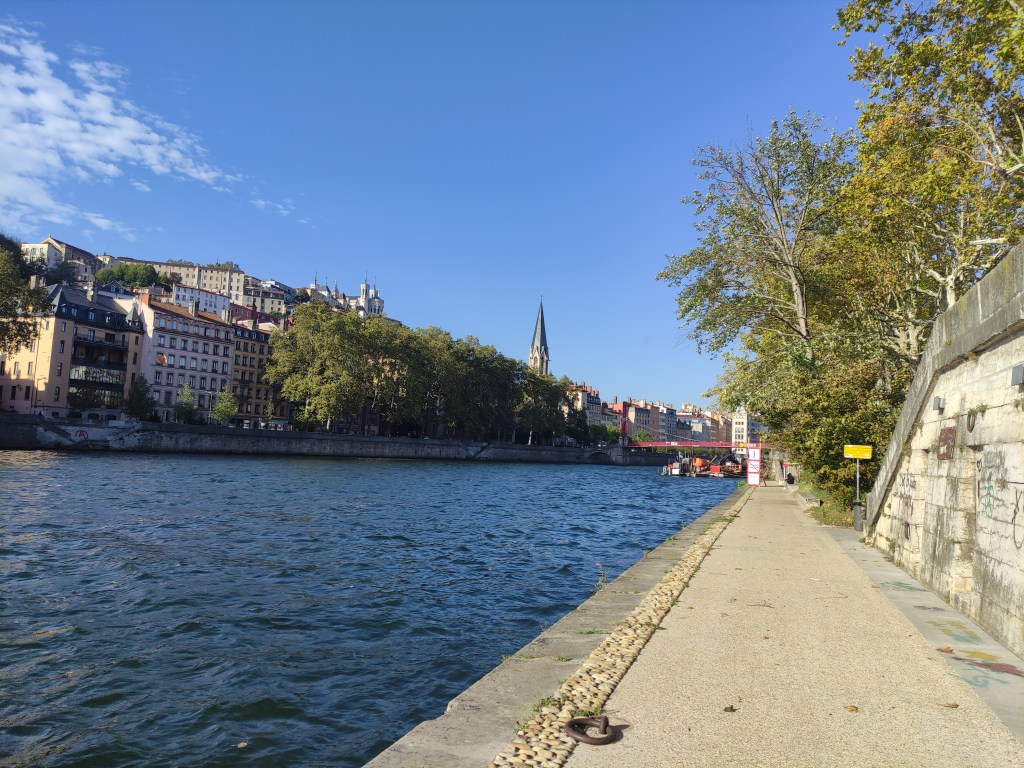
We stayed the Hotel Charlemagne on Cours Charlemagne, which is close to the confluence of the Rhone and Soane rivers in central Lyon. I grabbed a map in the hotel reception and we walked along the banks of the Soane in the direction of the Old Town.
The Soane is a big river, the size of the Seine or the Danube. The old town of Lyon is at the foot a a hill where the Roman settlement of Lugdunum was, and where its ruins remain. Lugdunum was the birth place of the Emperor Claudius. the Emperor who would conquer Britain.
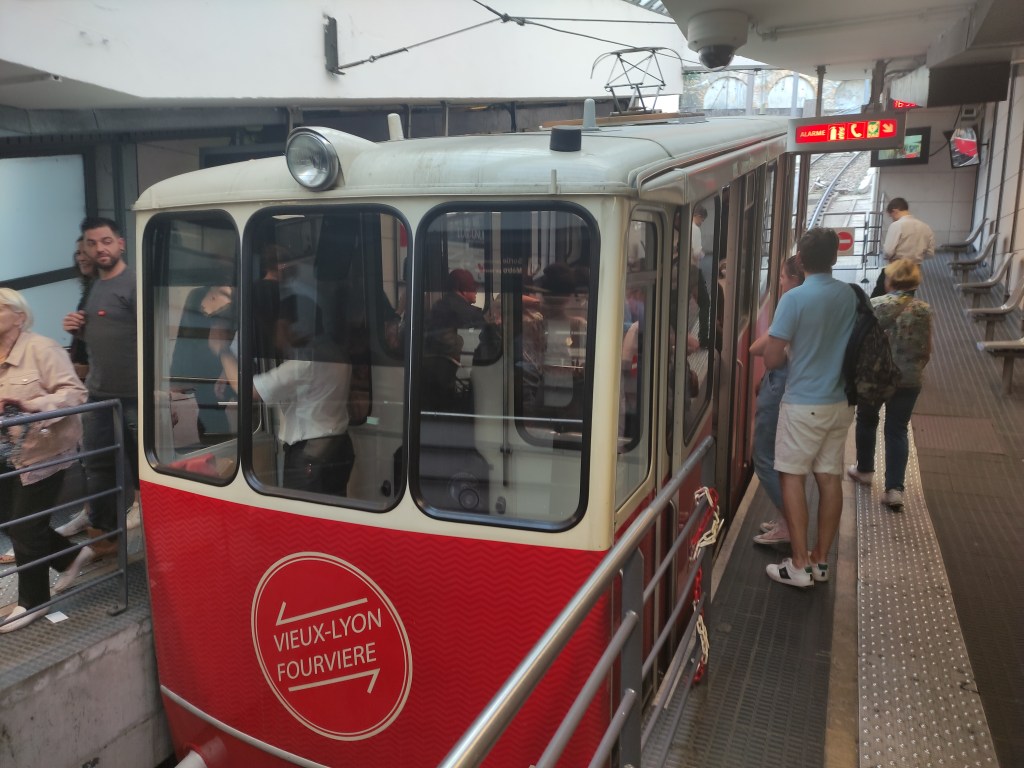
It is a bloody great hill, and neither of us fancied the hike on a warm afternoon. Fortunately there is a funicular railway going up, which is integrated into the metro system. It was well worth the 2 euros to reach the Fourviere stop at the top. Fourviere is on the site of the old Roman town centre, and the name comes from Forum Vieux, old forum in English.
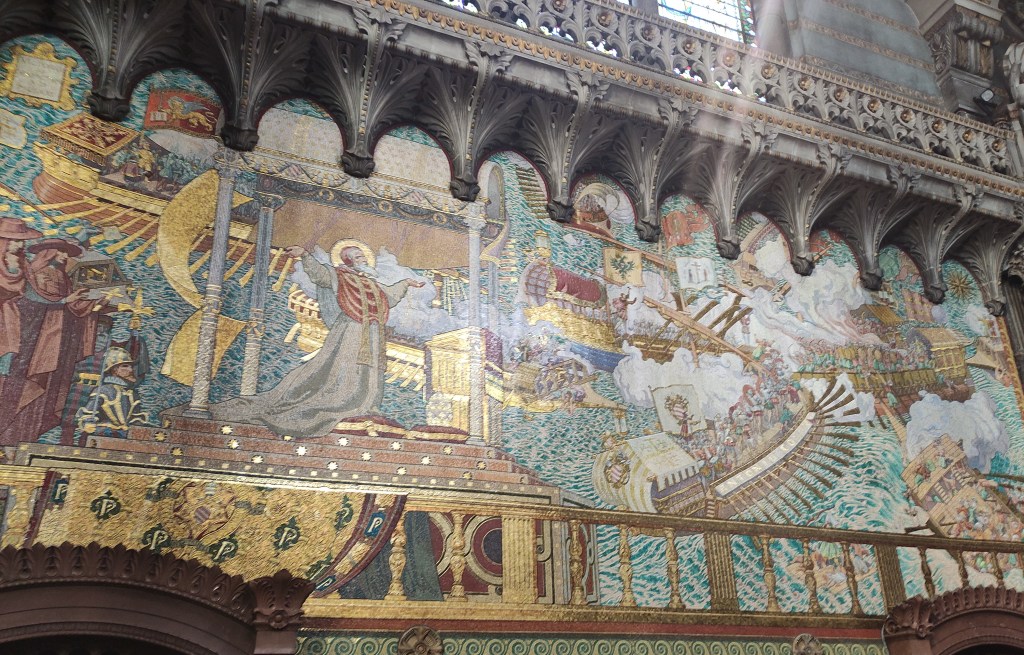
On leaving the station you are right next to the Fourviere Basilica, a magnificent white stone church completed in 1895. The interior is stunning, with huge mosaics highlighted in gold depicting biblical stories and the battle of Lepanto with the French fighting Turks in galleys.
I’m sure you are asking yourself what is a basilica? Well its a Catholic church given special privileges by the Pope. Often they are notable shrines and pilgrimage sites. They attract pilgrims and make more money for the church.
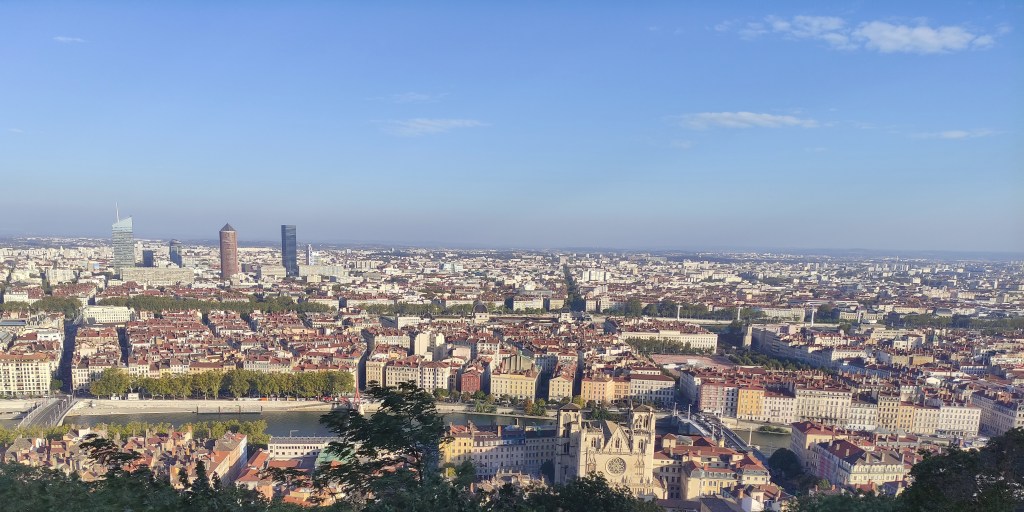
The view of the city from Fourviere is marvellous, it’s the third largest city in France and spreads out for many miles.
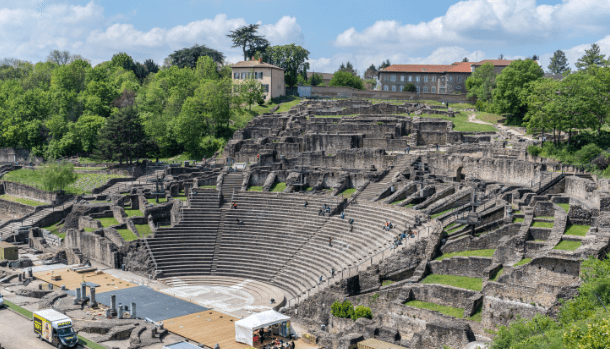
Not far from the basilica are the ruins of Roman amphitheatre. Part of the seating has been restored so it can be used as an auditorium. On the day we were there it was closed for filming, so I stole an image of the internet.
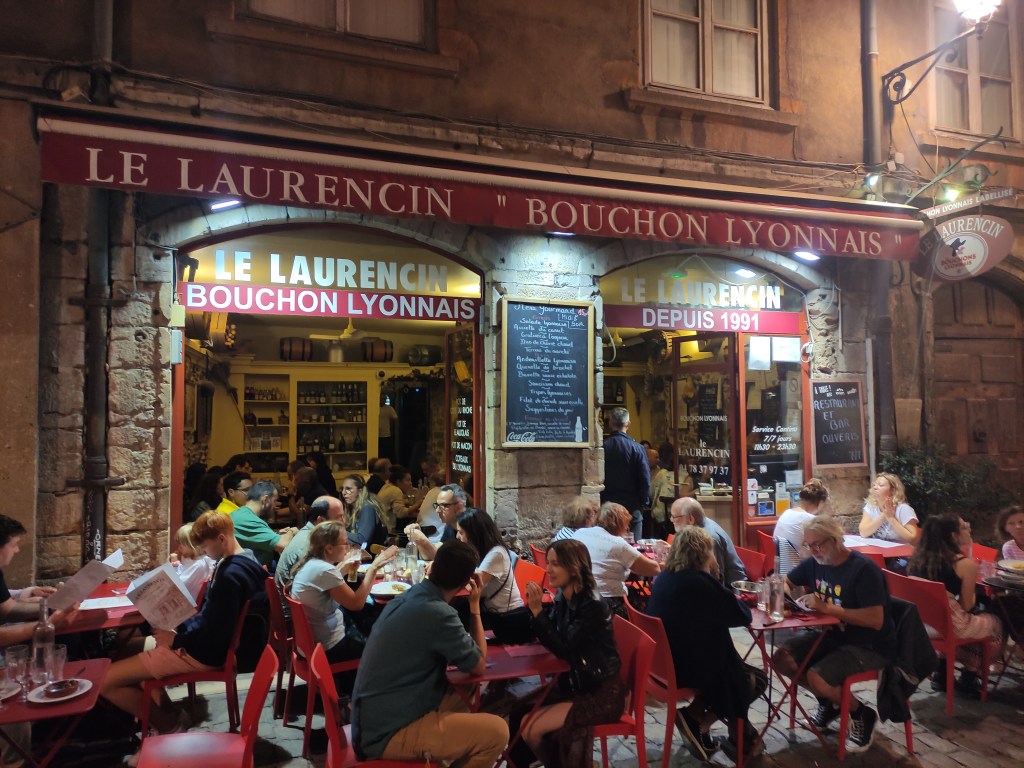
We walked down hill to the old town, which is very steep with lots of steps. Like all the old towns we have been to there were lots of restaurants, all competing for customers. Being a tight bastard someone who enjoys value for money I found a place offering 3 courses for 15.90 euros. So we sat down at Le Laurencin and had the best meal on our entire trip! I had pork terrine and salad, braised beef and daufinois potatoes followed by creme brûlée. Bloody hell it was good!
14 October 2023
It was our last day in Lyons, and I was not feeling great. My cold was starting to get the better of me. After coffee and a cake at a patisserie, I gained some energy and felt my waist expand. There are a ridiculous amount of patisseries and boulangeries in France, and it is very hard to resist them.
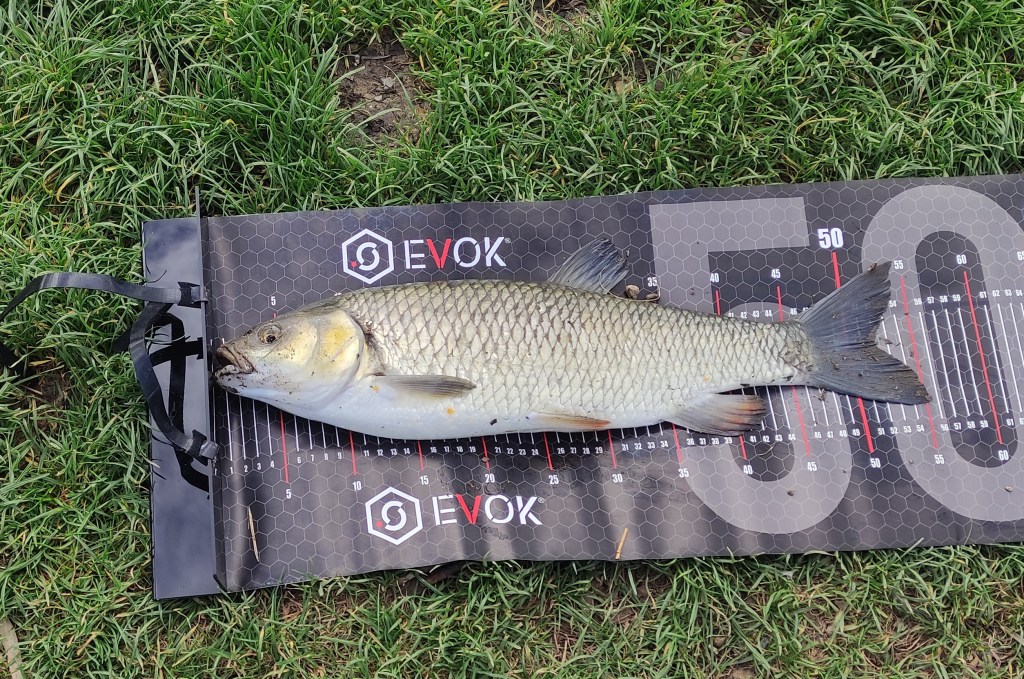
We walked to down Cours Charlemagne to the Confluence. This is where the Soane and Rhone join together. At the pointy end there was a man fishing, and he had just caught a large Chub, 55cm long. He measured it, photographed it and threw it back in the river.
The major attraction at the Confluence is the museum with the same name. It looks as if a space ship from a Ridley Scott film has landed on Lyon. Its a shame that some vandal had drawn a cock on the big Lyon sign, it spoiled it somewhat.
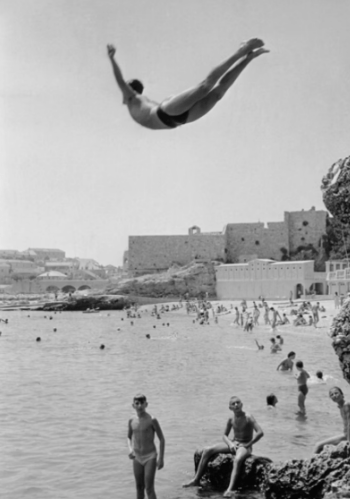
The website for the museum didn’t properly explain whet was in it, but it was actually a really good modern museum. It has themed rooms about living animals, prehistoric animals, technology and geology. The signs are in English as well as French which helped a lot. We spent a couple of hours looking around but could have spent a lot longer. There was an exhibition about a photographer called Marc Riboud who took photos in Africa and Asia in the 50’s and 60’s. this photo was taken in Dubrovnik.
Then we took the T1 tram and A metro to Place Bellecour an enormous square in the city centre. We discovered the Hotel Dieu, a huge 18th century building that used to be a hospital until 2010. It is now an Intercontinental Hotel, shops and restaurants. It is vast, the size of Les Invalides in Paris.
My cold was getting the better of me by then so we went back to the hotel for a rest. Our last evening out was at Tasty Pizza, a fast food place very close to the hotel. I’m very pleased to say it lived up to its name, but it wasn’t Claridges.
15 October 2023
Our last day of travels in Europe. We caught the 11.00 TGV to Lille, arriving at 14.30. After a quick coffee, we were soon queuing to go through Border Control and security for Eurostar. Our last 10 euros were invested in 2 small bottle of wine for the short trip to St Pancras. We got into London on time at 15.30 (London time is an hour ahead of France) and we were home about 16.45.
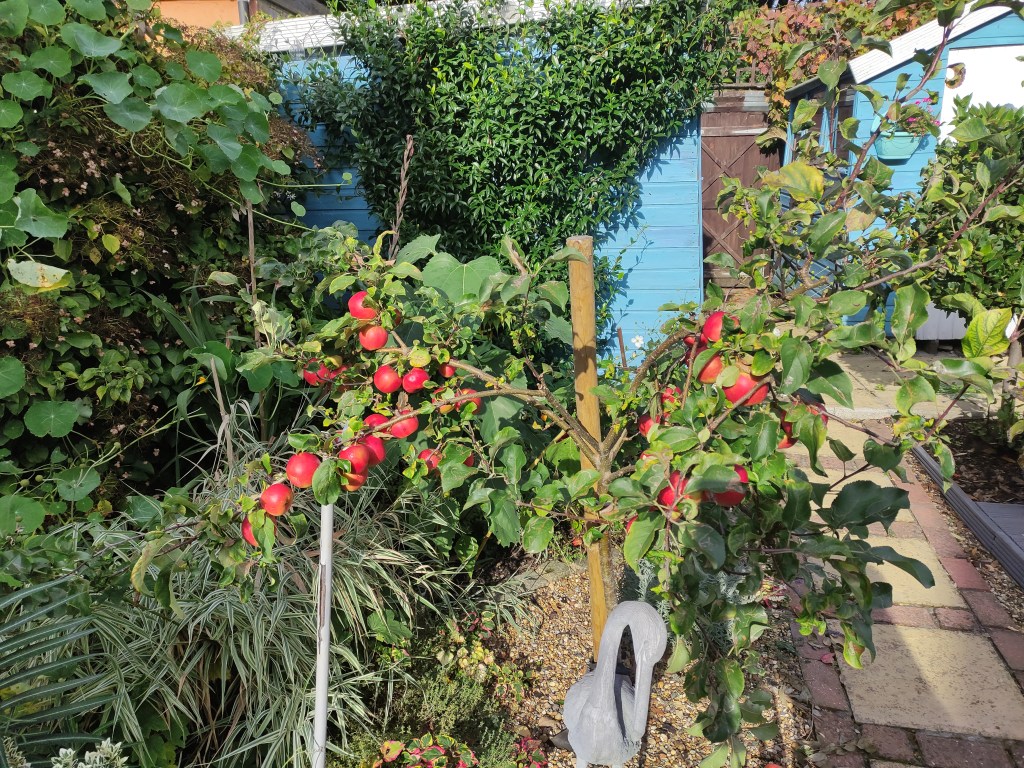
I was pleased to see that the apples in my garden had ripened nicely 🙂
The final statistics are:
5,135 KM (3,190 miles) of travel, on 50 trains to 38 places.
We spent 2 days 8 hours 8 minutes on the train over 40 days of travel
I ate 5 metres of baguettes (possibly)
Final Thoughts
Before you ask, yes I did have a good time. It only rained twice in Munich and when we changed trains at Innsbruck on the way from Salzburg to Verona.Other than that it was hot and sunny all the time!
Some of the journeys were long, 7.5 hours from Munich to Budapest though Germany, Austria, Slovakia and Hungary. But I had my phone and Kindle, som plenty to keep me occupied.
Yes I did drink alcohol every day. I was in holiday frame of mind and I know its not good for me. It would be no fun going to a beer festival in Salzburg and drinking a coke. I also ate a lot of croissants for breakfast, and every one was delicious.
How much did we spend? Well accommodation was between £50 and £100 a night, Paris was stupidly expensive, Budapest was very reasonable. Eating and drinking out is always expensive. You can get an Aperol Spritz for 6 euros in Italy, but its at least 8 in France. Food in supermarkets was generally more expensive than at home.
So we did spend a lot, but it was worth it.
Travelling by train is great, you arrive in the middle of the city, and generally don’t have to show any passports or go through security once you are in Europe.
Did we meet any interesting people? Not really, travelling as a couple we didn’t meet any other people.
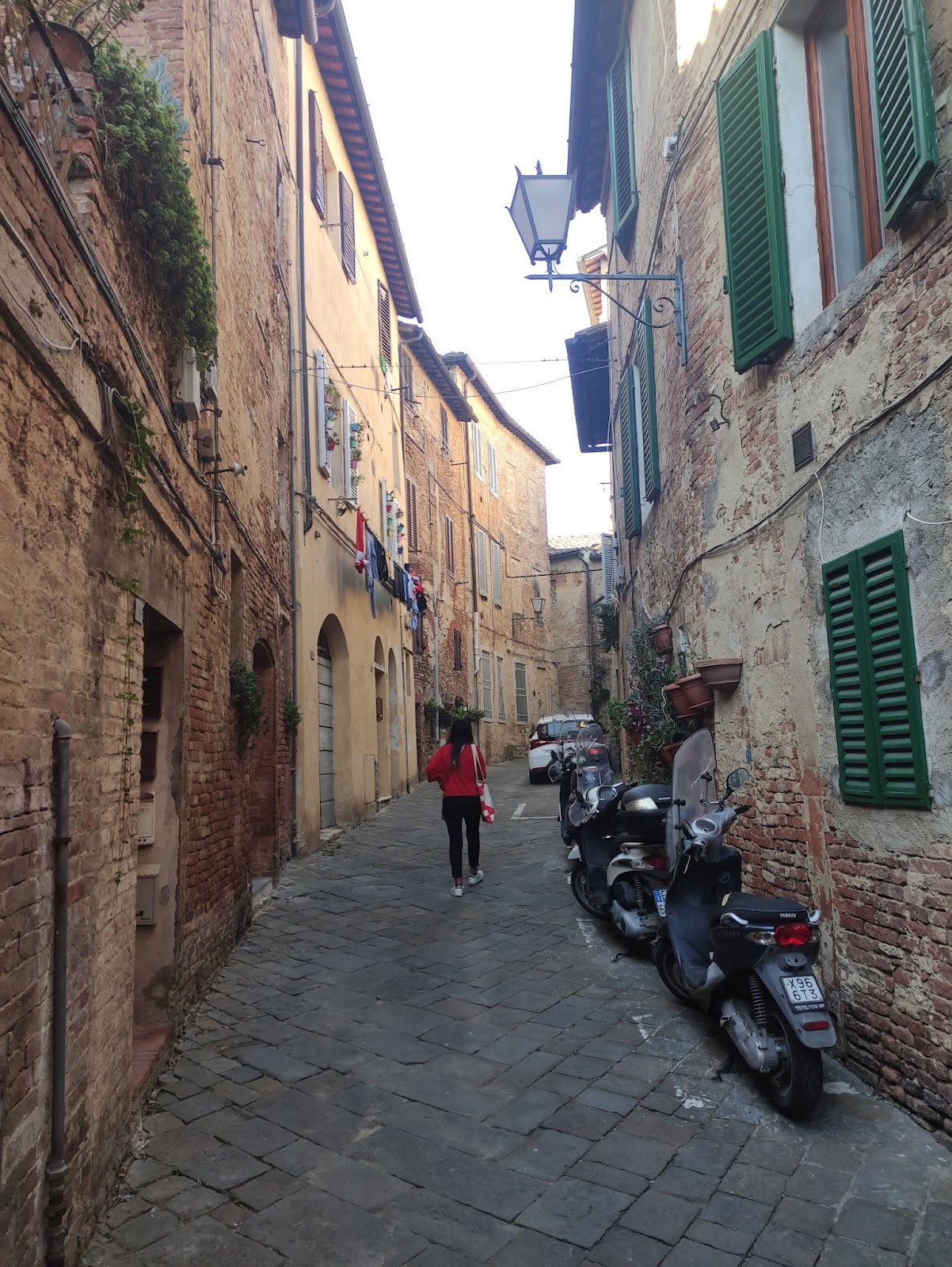
Siena was mostly built between the 11th and 14th century, then the Black Death hit in 1348 which arrested its development. It is situated on top of a hill, 320 metres above sea level in the midst of stunning Tuscan countryside. On our first full day we wandered around the narrow streets, awestruck by the beauty of the city. All of the buildings are brick or stone, and range from artisan’s apartment blocks to palazzos on piazzas and some enormous basilicas. I have seen a lot of old cities in Europe, and Siena is the most awesome I have seen so far. The centre is entirely medieval, and the it’s like walking through a film set. There are no footpaths, just roads paved with black stone, so you regularly have to pin your back to the wall as a taxi or rubbish truck comes through.
The rubbish trucks and buses are small so that they can get round the tight corners and along the narrow streets.
We bought the bumper bundle ticket for the cathedral, which would let us visit several different parts of it over 3 days.
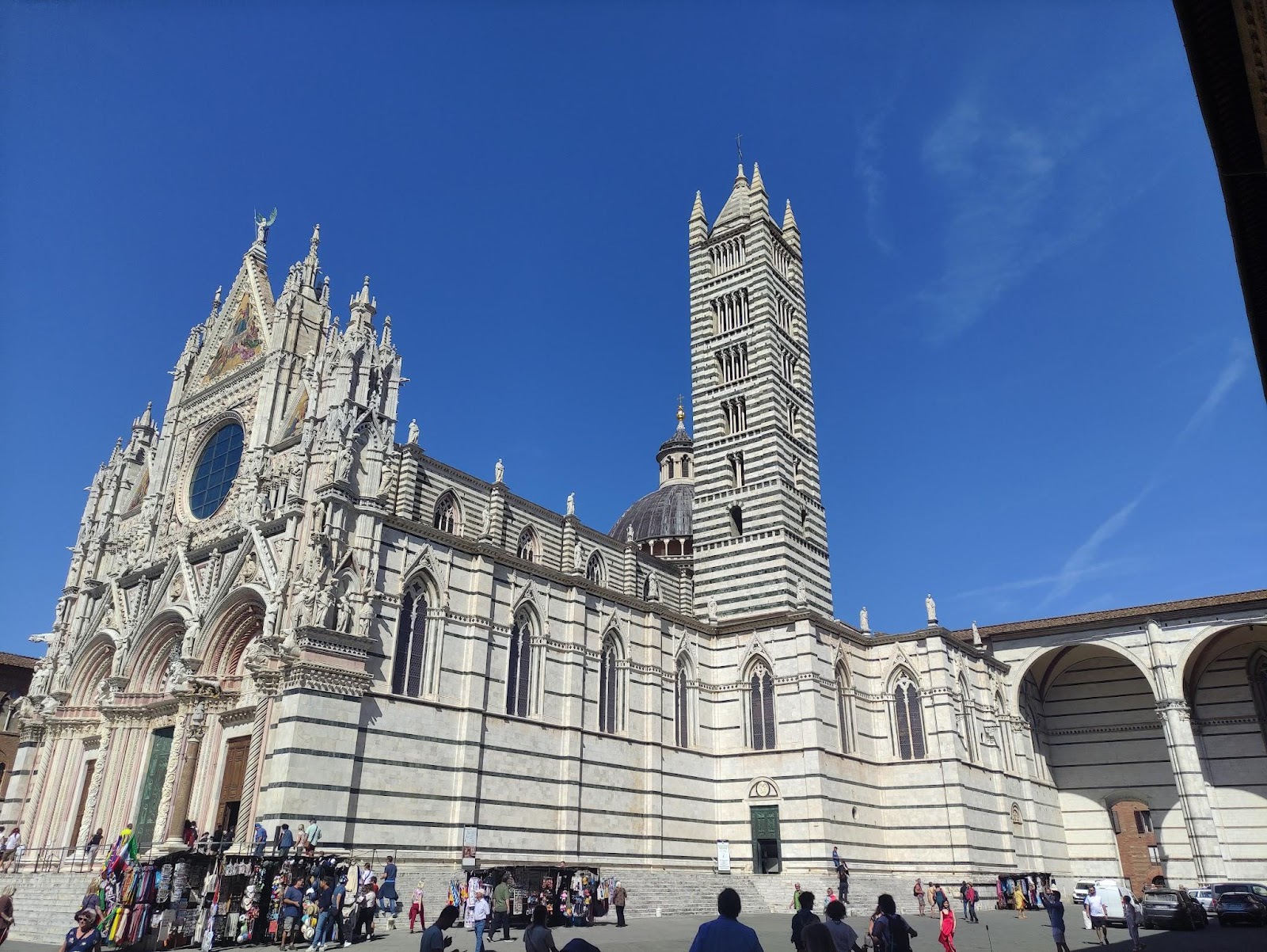
The Duomo is clad in black and white striped marble, whereas the Florence Duomo is green and white and bigger. The interior is sumptuously clad with marble, gold and rich frescoes on the walls. The floors are patterned in marble as well, I don’t know how they did that 700 years ago, they were very clever people!
After a shit-load of culture what you do? You have a drink right behind the cathedral in the sunshine.
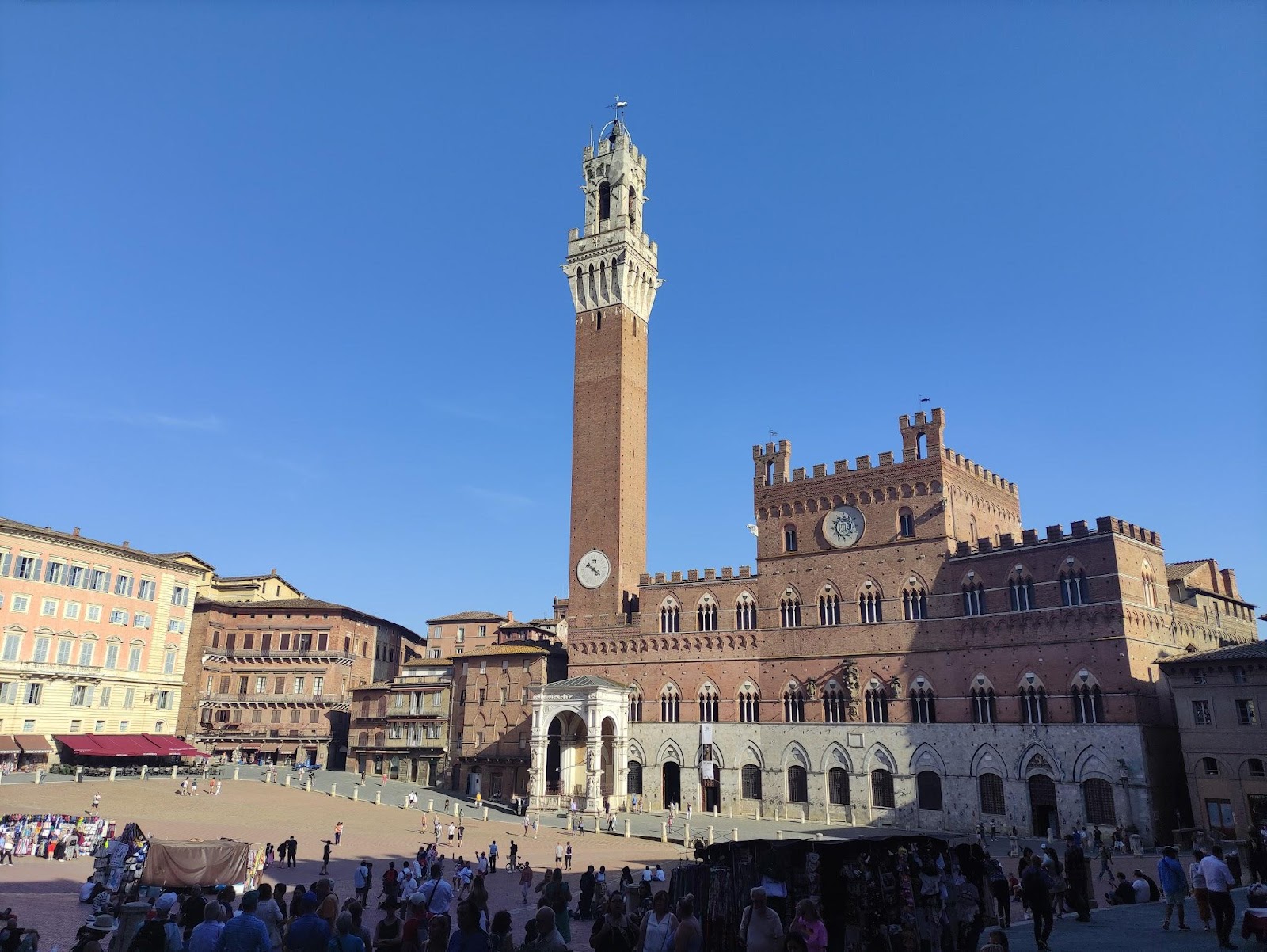
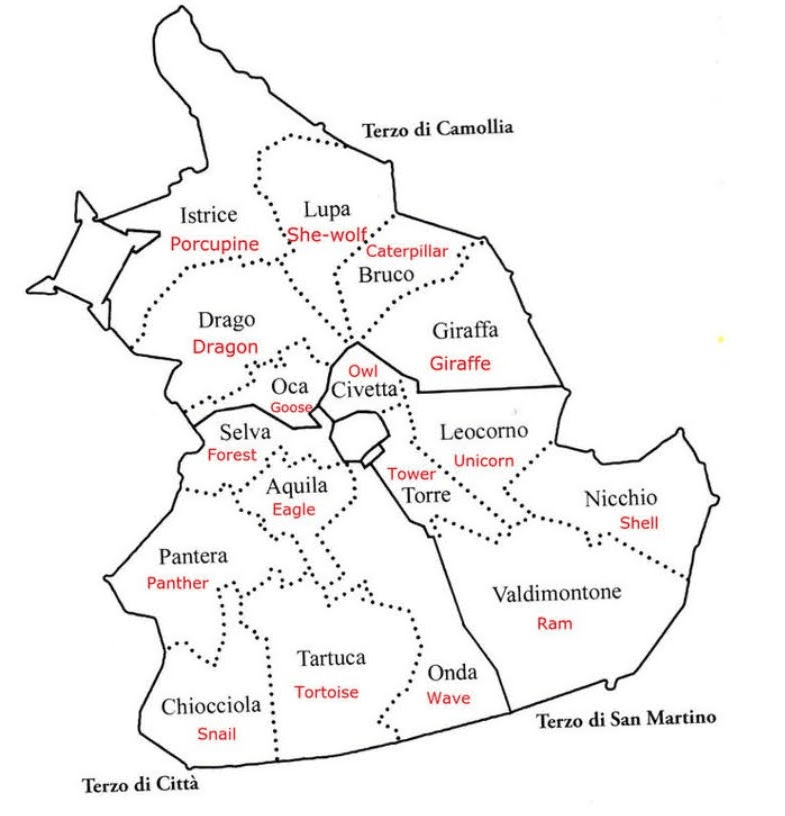
The Piazza del Campo is the central “square” in Siena, overlooked by the town hall with its great tower, the Torre del Mangia. The Campo is where the Palio horse race takes place every year on the 2nd July and 16 of August. Old Siena is divided into 17 contrada which compete for a silk flag. Out of the 17, only 10 are chosen by lottery to get a horse in the race.
The horses that the contrada get are also decided by lottery, so the competition is extremely intense. Have a look at the BBC Reel video on YouTube, it’s very exciting.
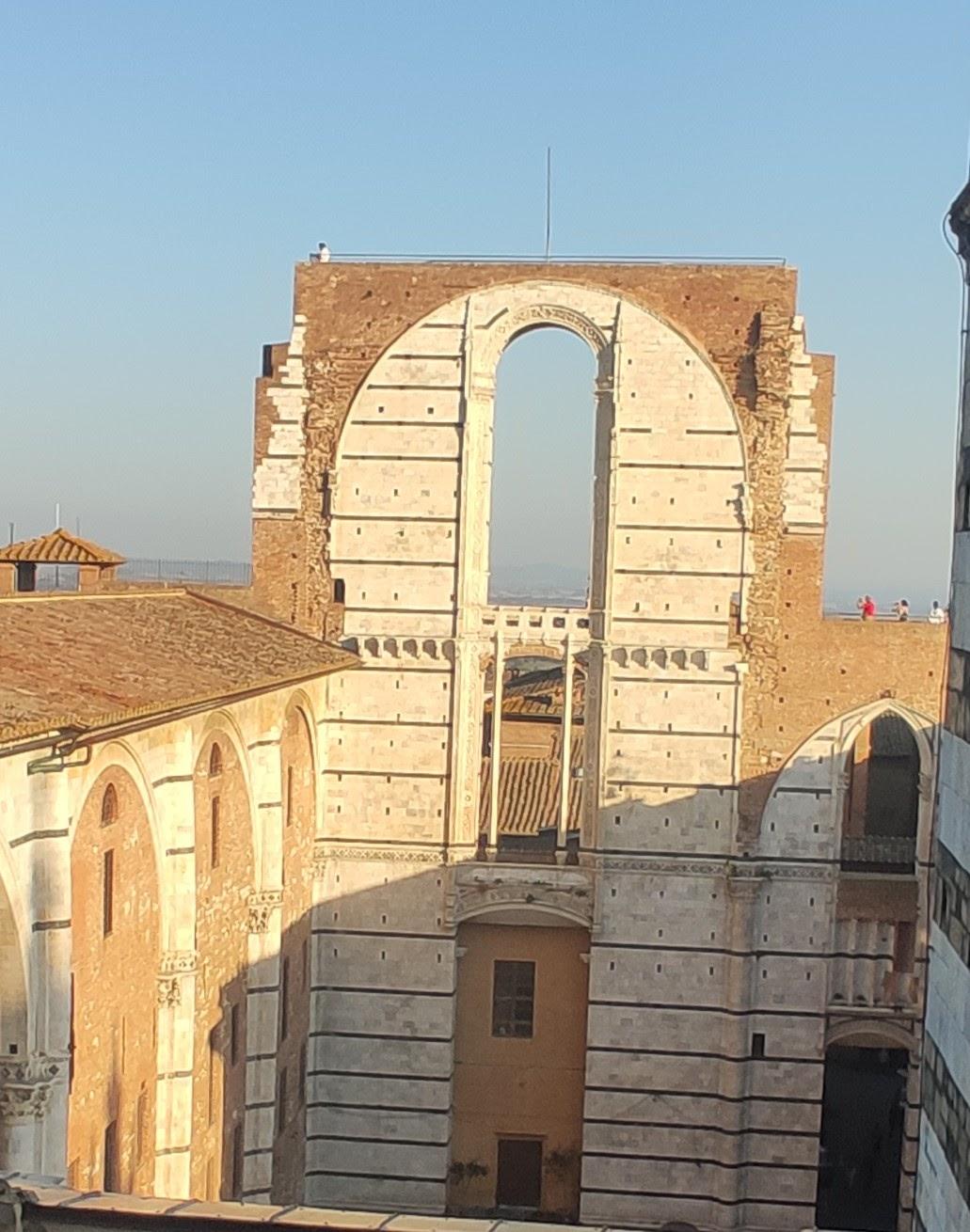
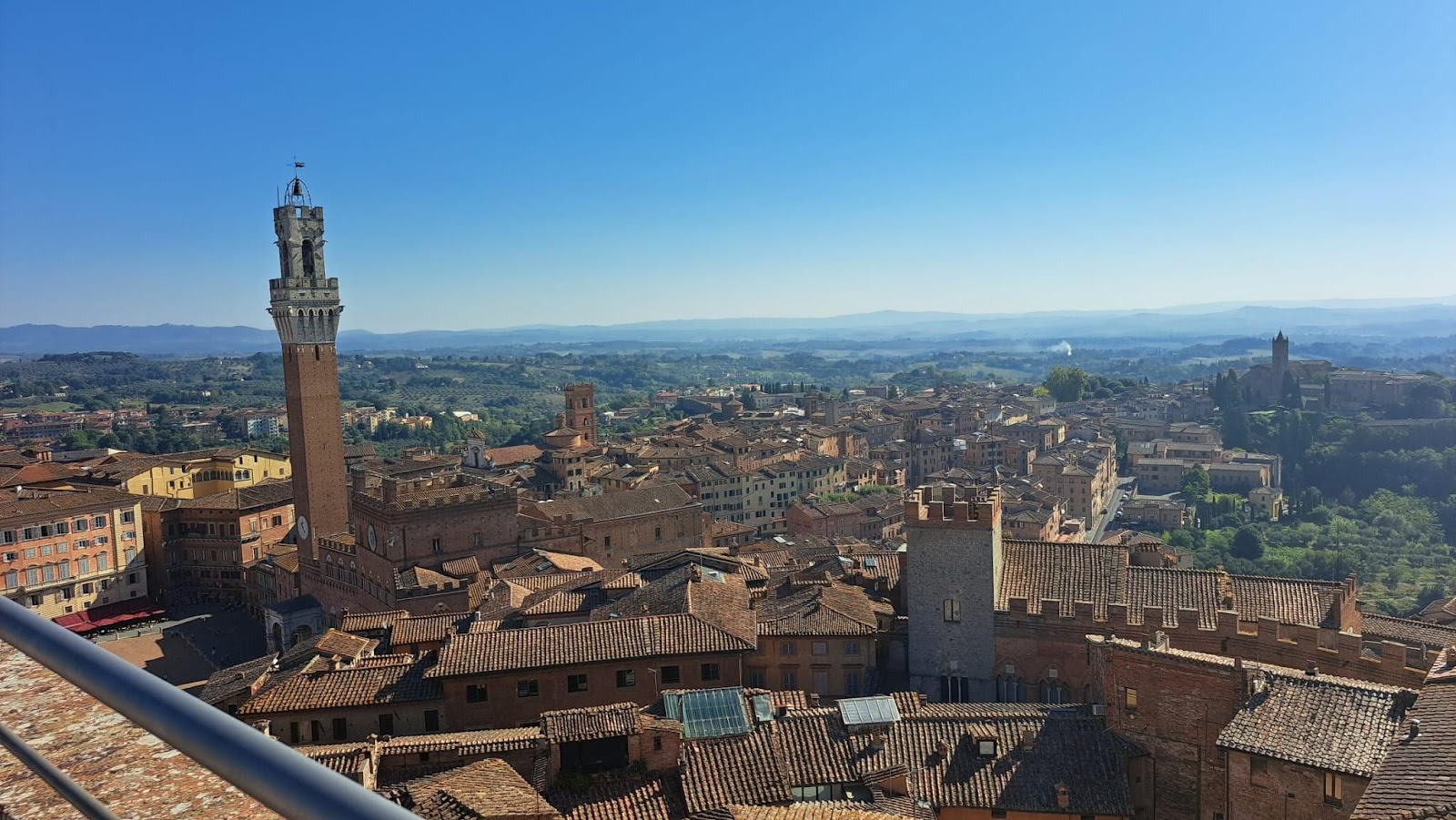
The second part of our Duomo trip was up just under the roof and below the bottom of the dome. We could see inside the cathedral, and had a splendid view of the city and the Facciatone. This was an extension to the cathedral, then the Black Death came along and the builder found a better paying job somewhere else, leaving one big wall.
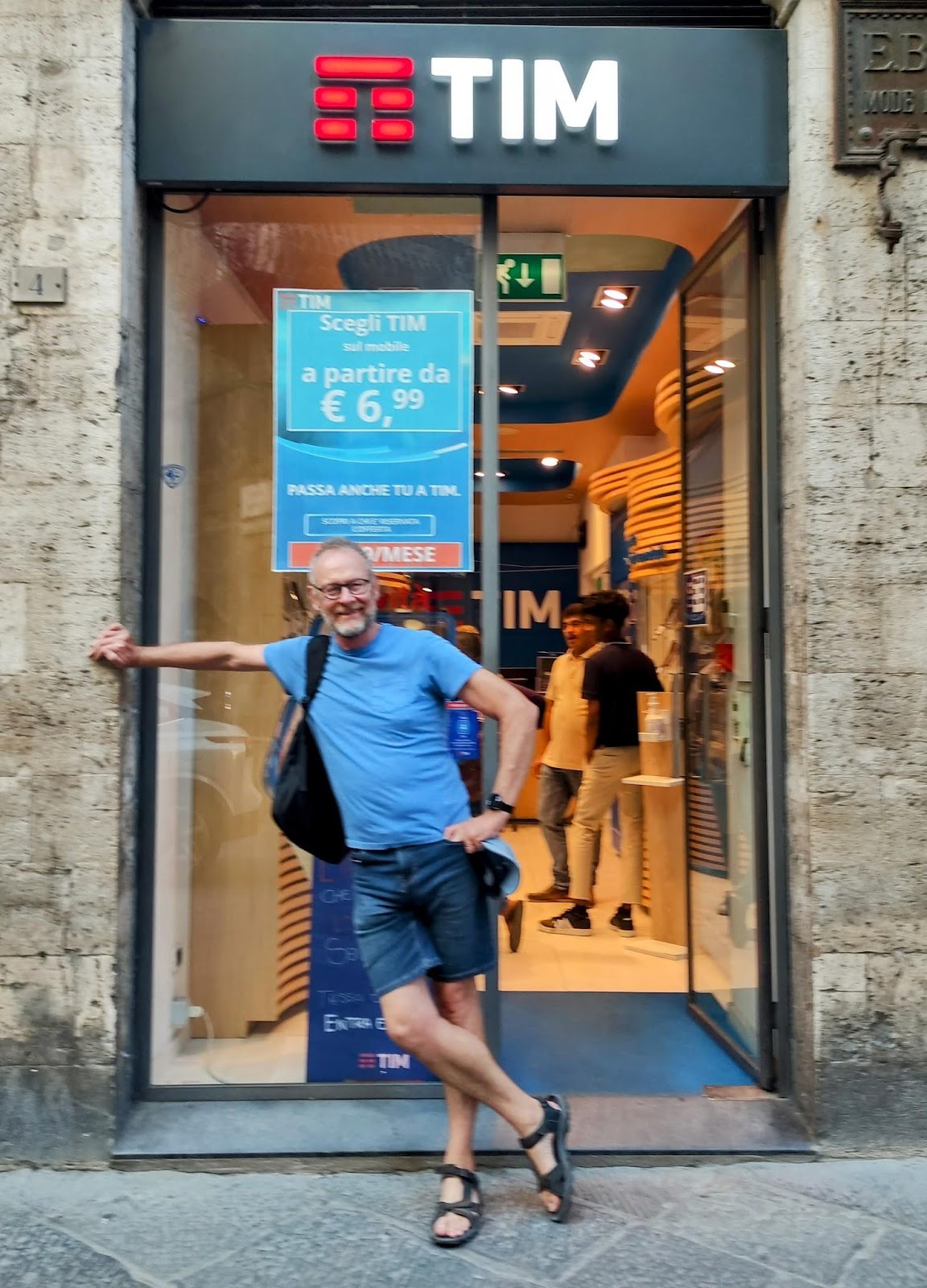
I managed to find a shop names after me. FACT I once stayed in TIM Hotel in Paris. I’m very popular.
Thursday 28 September
San Gimignano
San Gimignano came up on Google as a good place for a day trip from Siena by train, but it turned out to be simpler to go by bus.
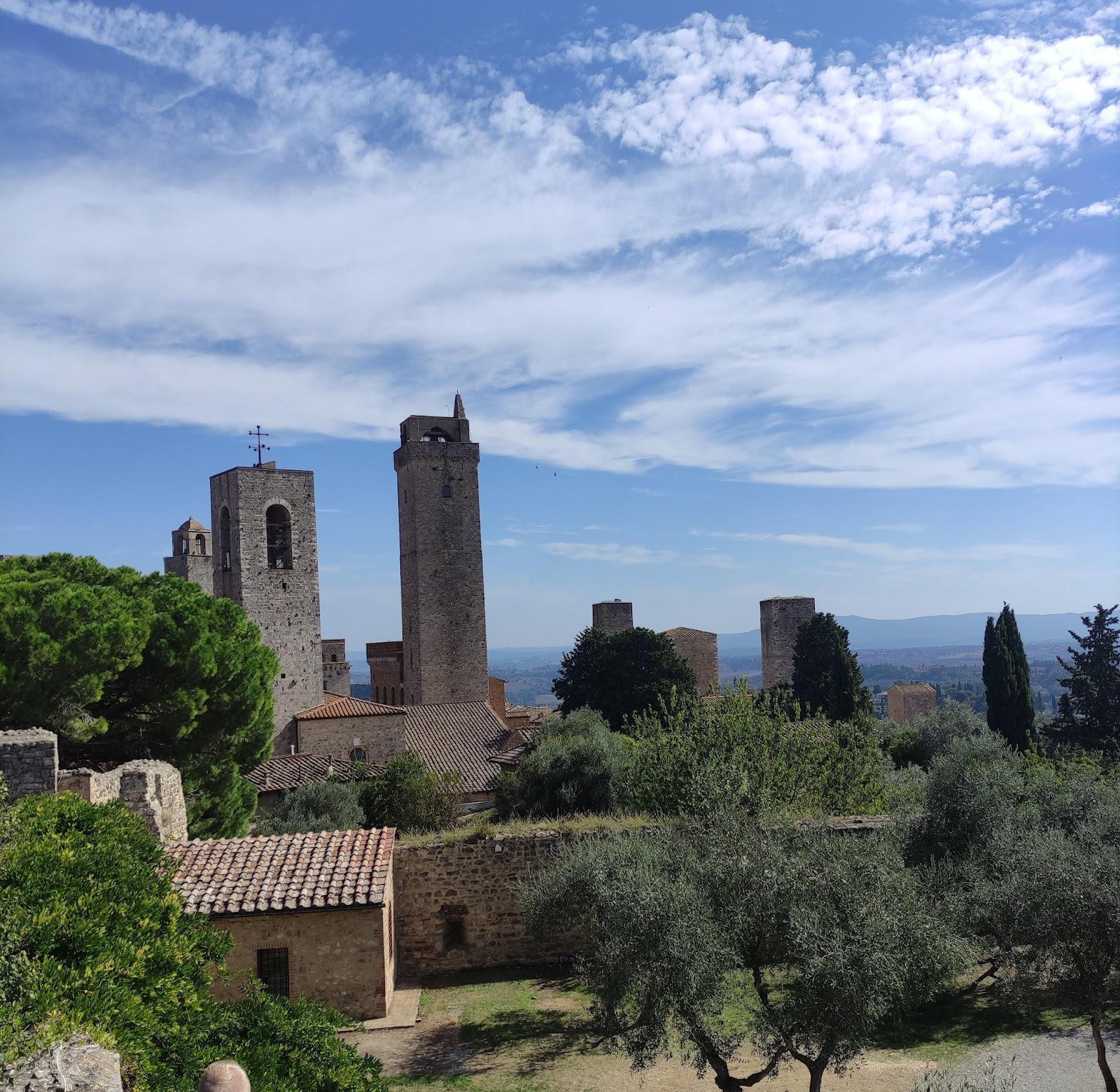
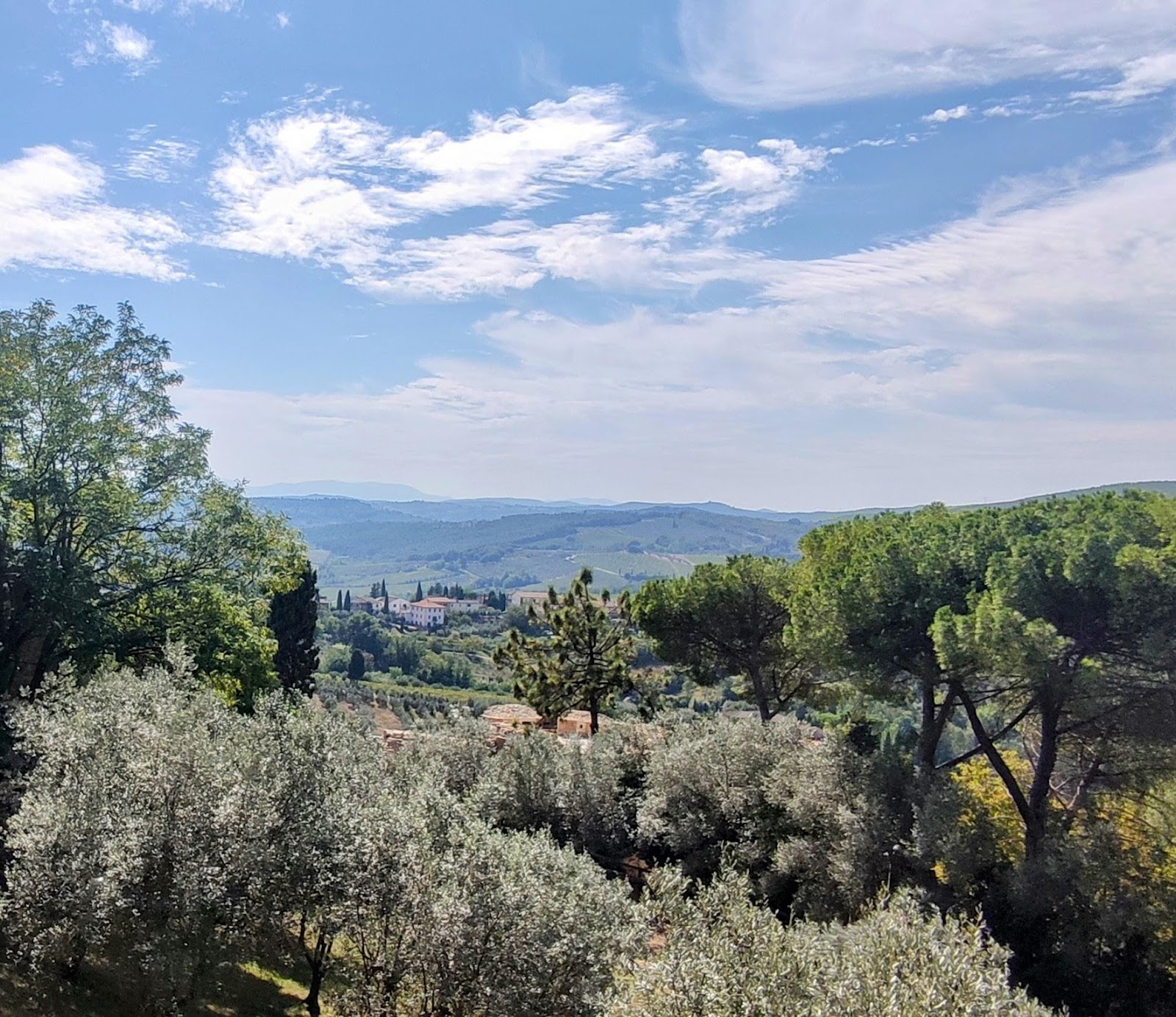
The bus took us through some lovely Tuscan countryside to a hilltop village taken straight from a Chianti bottle label, I expected some men in tights to ride out of the gates on horseback.
The town was doing well and thrived until the Black Death in 1348, then its development was stopped. It still has 7 great stone towers built by rival families in the town, and a good selection of Gothic churches. Because it is so remarkably pretty, it was swarming with other day trippers getting dinner party boasting points; “Have you been to San Gimignano? It’s absolutely fabulous, and the pasta with truffles is to die for’.
We wandered the narrow streets and admired the old houses and churches. There is a panoramic view over Tuscany which looked like the scene in Gladiator where Maximus is remembering his farm.
We watched it on Netflix the other night, it’s still a great film.
There was a market selling all the usual stuff; bags, hats, “truffle oil”, olive wood salad servers. But also a van selling pork sandwiches, which he carved from a large joint of rolled roasted pork. So we literally pigged out.
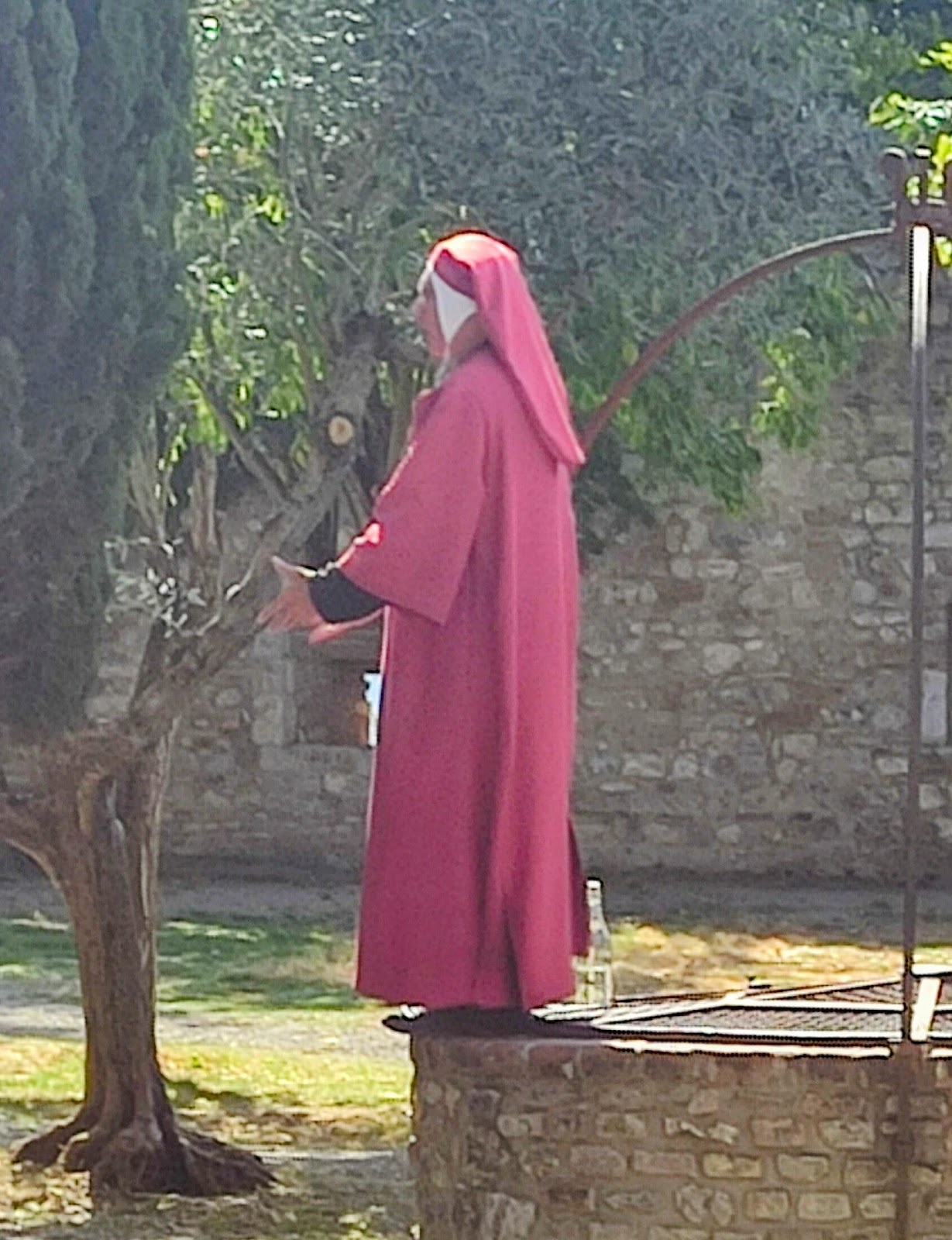
In the remains of a castle at the top of the town was a man dressed as Dante giving a speech from the Divine Comedy. He had the confident voice of a stage actor, but sadly his audience was almost non-existent.
Every other night we cooked in the flat. Often there would be a simple 2 ring electric hob, which was adequate for simple meals, usually featuring pasta and tuna. There was always wine with our meals, we are in Italy and it would be rude not to.
Friday 29 September
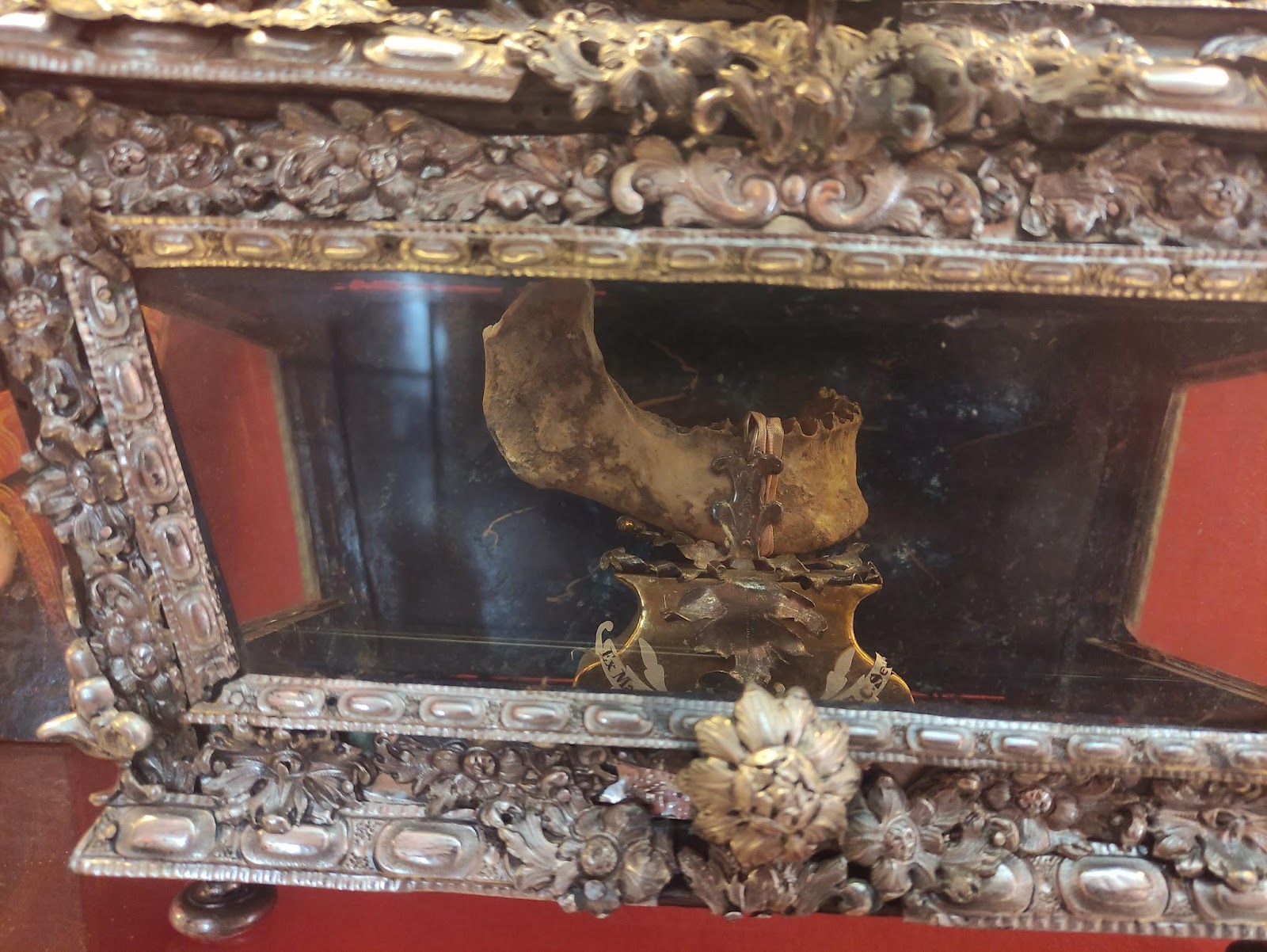
On our last day in Siena we used up the last parts of our Duomo ticket, which was valid for three days. The first part was a museum of treasures from the cathedral; paintings, sculptures, chalices and reliquaries. Reliquaries are just weird, they are fancy silver boxes that contain bits of dead saints; bones, teeth, jawbones, even complete skulls. Pilgrims would travel hundreds of miles to see a reliquary, and they made a lot of money for the churches.
This is the jawbone of a dead saint, I think it’s revolting, but I’m not a Catholic.
The treasures are very limited in scope; Jesus, Mary, saints and the occasional bishop. Some of the statues had a very peculiar posture, but they were designed to be on the top of the cathedral looking down on the pilgrims below.
The “highlight” of the tour was the climb to the top of Facciatone, the very tall wall of unfinished cathedral extension. The last climb was up a narrow spiral staircase designed for people with smaller feet than me. Then when we got to the top the view was fantastic BUT the wall only came up to my waist. I did not like that at all, my guts were churning and my balls were tingling, so I sat down and hung onto the rail. The guide could see the fear in my face and kindly told me about what was in view. Julie took these photos, I didn’t want to let go of the rail!
There are many ancient winding streets in the old town, which have hardly changed in 700 years. On many of the walls are large iron rings, which I guess are used for tethering horses. On many streets there are flags on the wall signifying the different contrada. They are a vital part of the community and organise social events all year round for their members. We were staying in Selva, and the flag has an oak tree on it.









 timharnesstravels