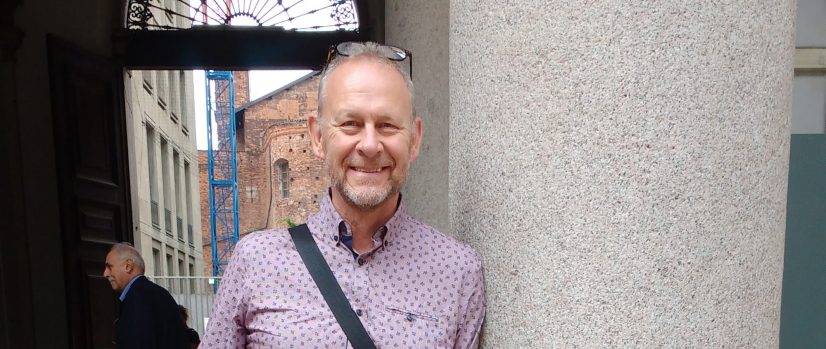
0.285 of a holiday in Malta

Malta in the Spring. Sounds lovely doesn’t it? Well it was until the first Pandemic for a hundred years arived and SPOILED IT.

Damn you Covid 19!

But we (Julie, Josie and me) did get 0.285 of a holiday, which was a delicious taster, a kind of “amuse bouche” of Malta.

It is the smallest country in the EU with and area of just 122 square miles, and is right in the middle of the Mediterranean. It’s so small it doesn’t actually show up on a map, the word Malta is bigger than the outline of the island.
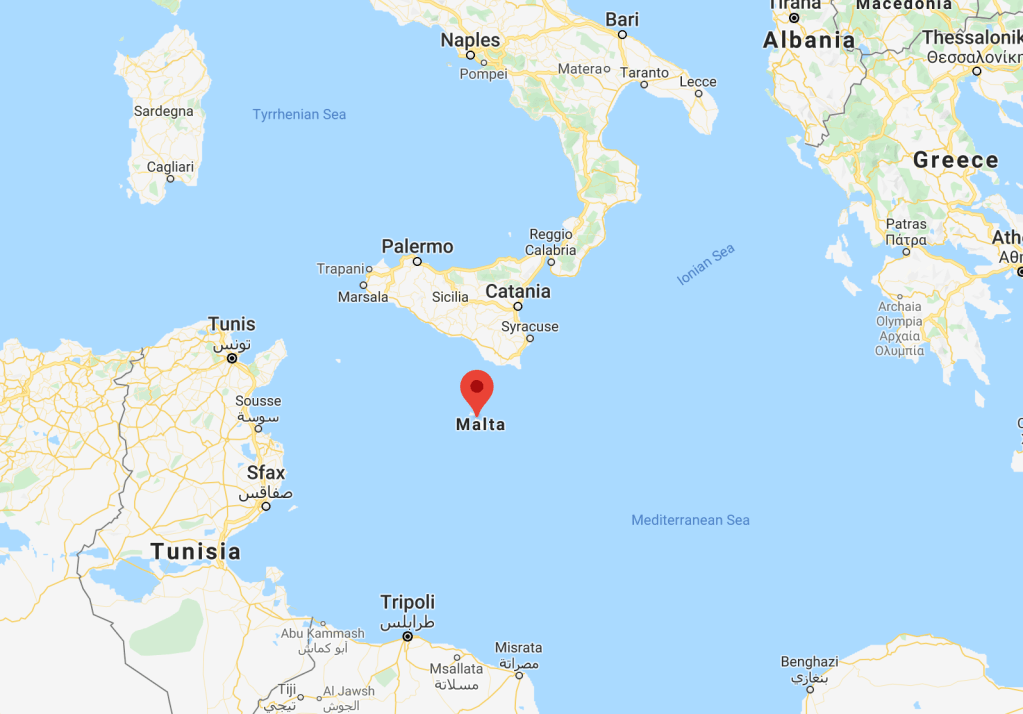
Over the course of history many different empires have invaded it; the Phoenicians and Carthaginians, Romans, Greeks, Arabs, Normans, Aragon, Knights of St John, French, and finally the British. Since 1964 it has been an independent country, and is the smallest member of the EU. Greater London is five times the size of Malta in area.

In March, Malta is generally warm (but not hot), cheap to get fly to, and not crowded. So it appeared to be an ideal place for an early spring break in March 2020. At the time we booked our holiday, the Covid 19 virus hadn’t got out of China. By the time we arrived at Luqa airport, it was raging across Europe. But there were only about 50 cases in Britain and 5 in Malta.

On March the 11th Julie, Josie and me got up at stupid-o-clock and drove down to Gatwick to get a 7.30 am flight on Easyjet, my favourite cheap airline.

The flight was about three hours, and we arrived at Valetta in warm sunshine yay! It was about 5 miles to the flat we had rented in Sliema, but the bus took an hour, it was almost quicker to walk.
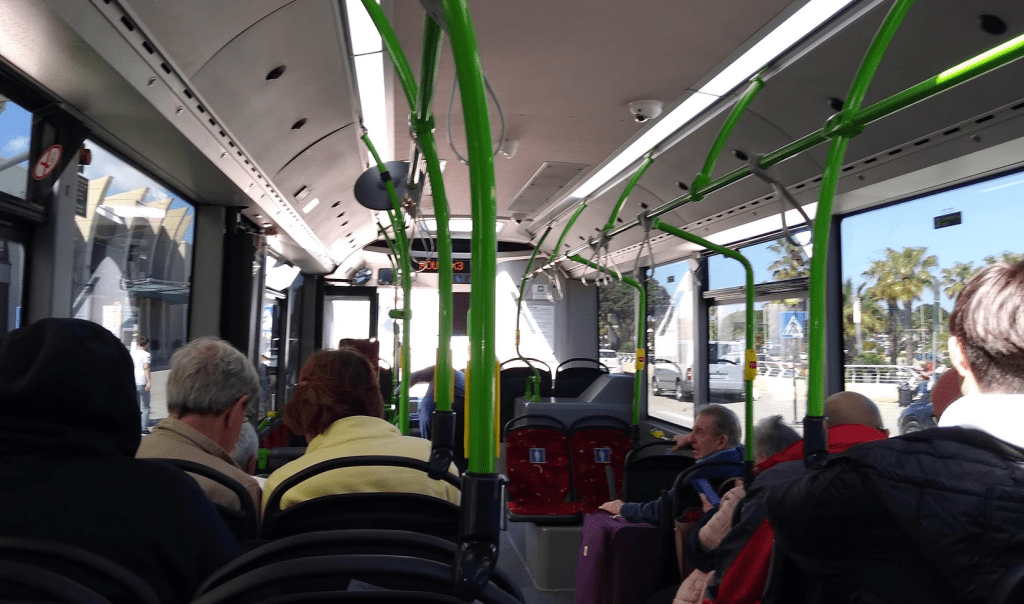
A Maltese bus, it’s no difference from a London Bus

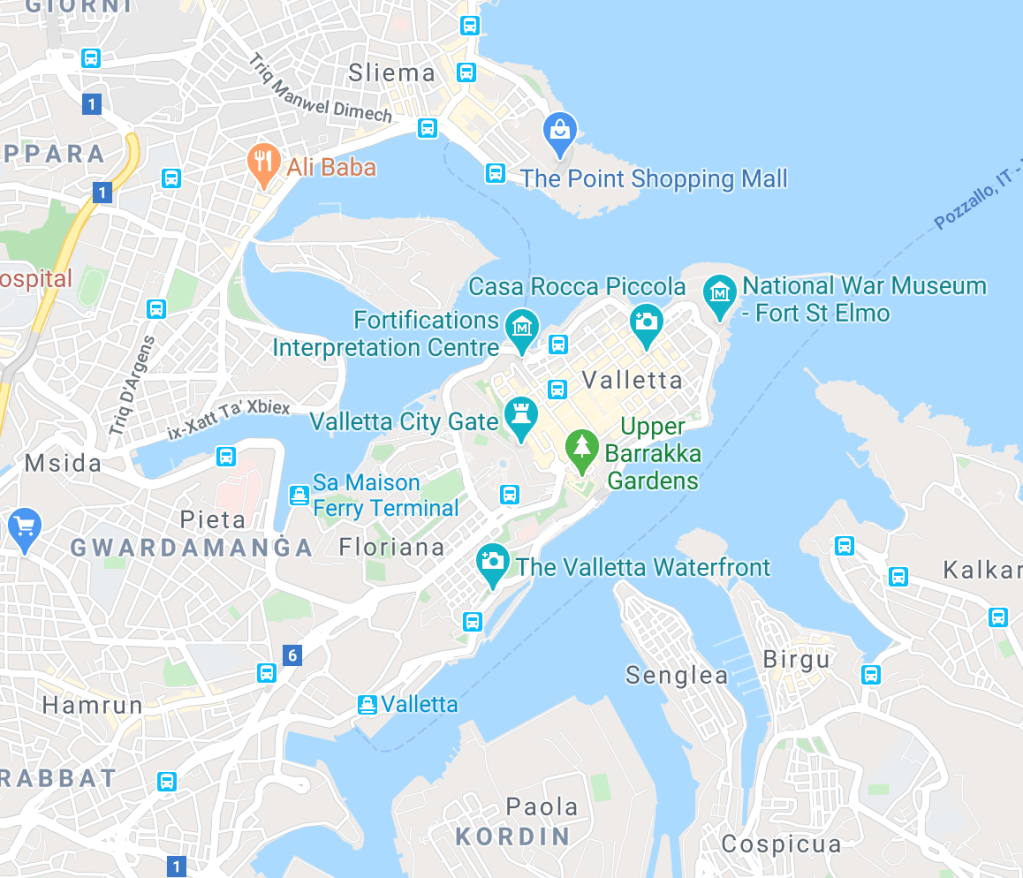
Sliema is across the bay from Valetta, which is the capital and most interesting part. The advantage of being in Sliema is that you can see Valetta, the view is amazing. 

Our apartment was a modern one, on the second floor. It was about twenty feet wide, but 67 paces long, it was enormous! It overlooked the Marsamxett Harbour and was close to the ferry over to Valetta.
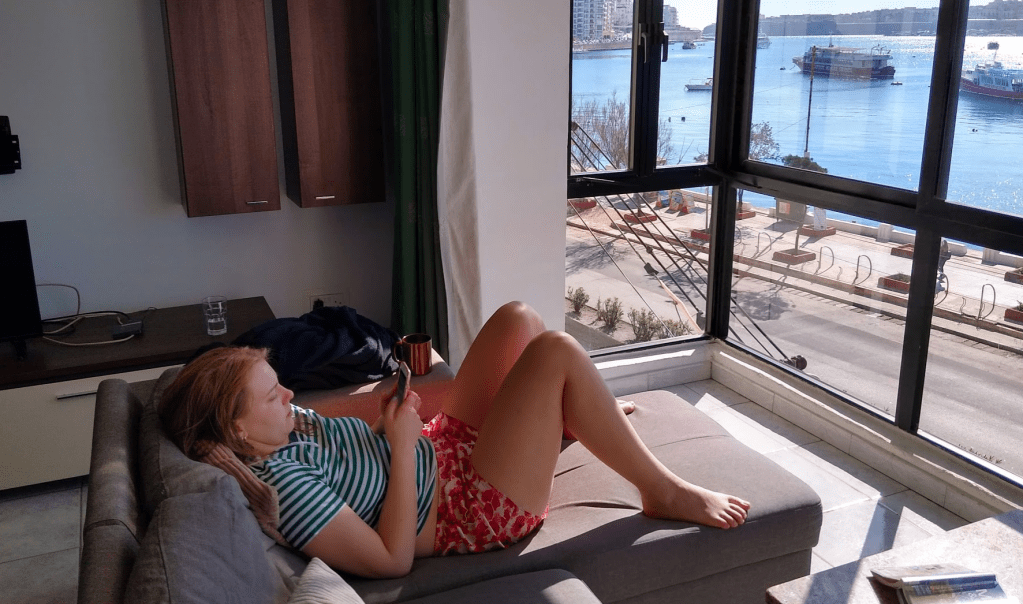
Josie settling in for the week (not)

Sliema is on a peninsula pointing east into the Mediterranian. It is part of the Valetta urbanisation where most Maltese live. Around the edges are modern blocks of flats, overlooking the sea, but the central streets are full of lovely stone-built houses with projecting covered balconies. At the tip of the peninsula is Fort Tigne, one of the many fortifications that cover the island, it must be the most fortified country in the world.
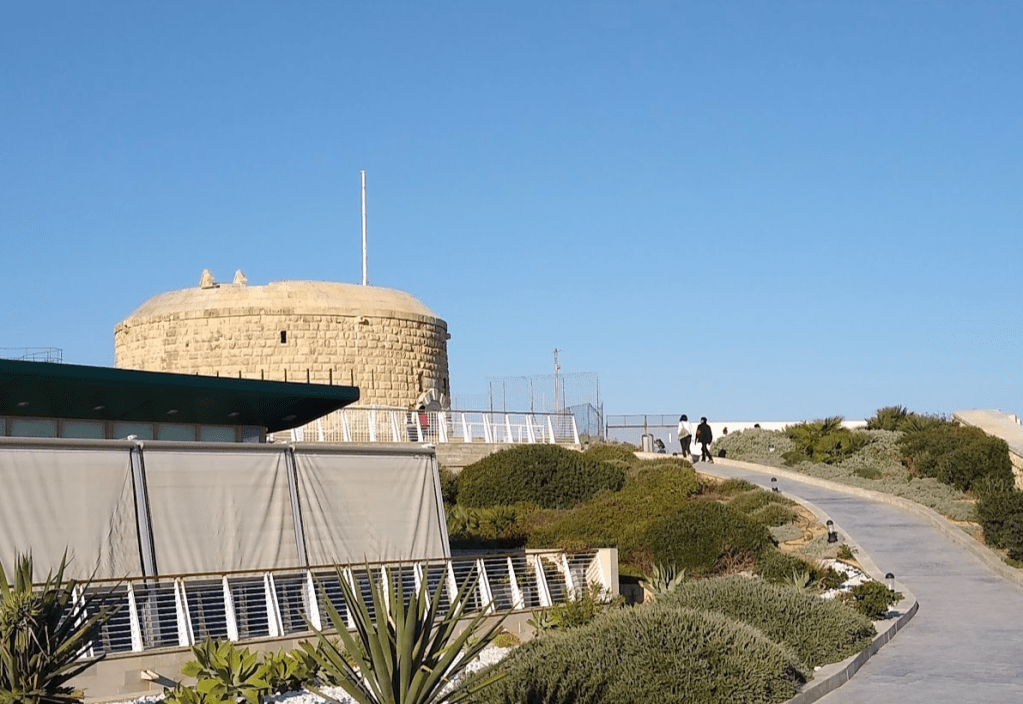
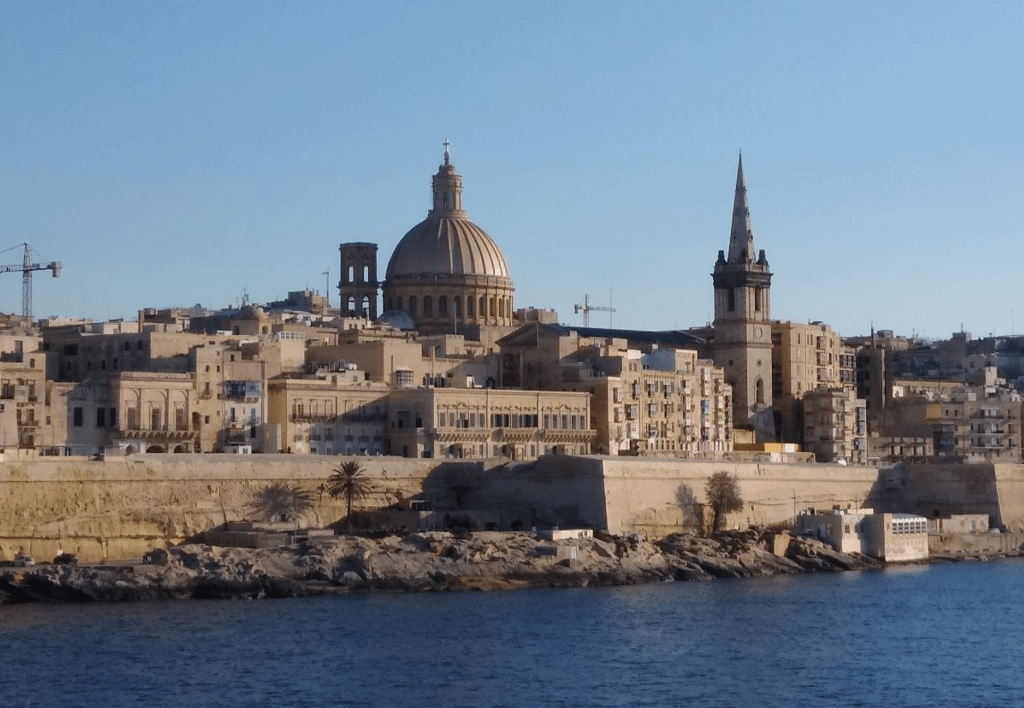
Fort Tigne
The view of Valetta from Fort Tigne
Sliema and Valetta and the two main harbours

The streets of Sliema away from the coast are made of of pretty, old houses with projecting balconies, much better architecture than the modern concrete and glass blocks overlooking the sea.
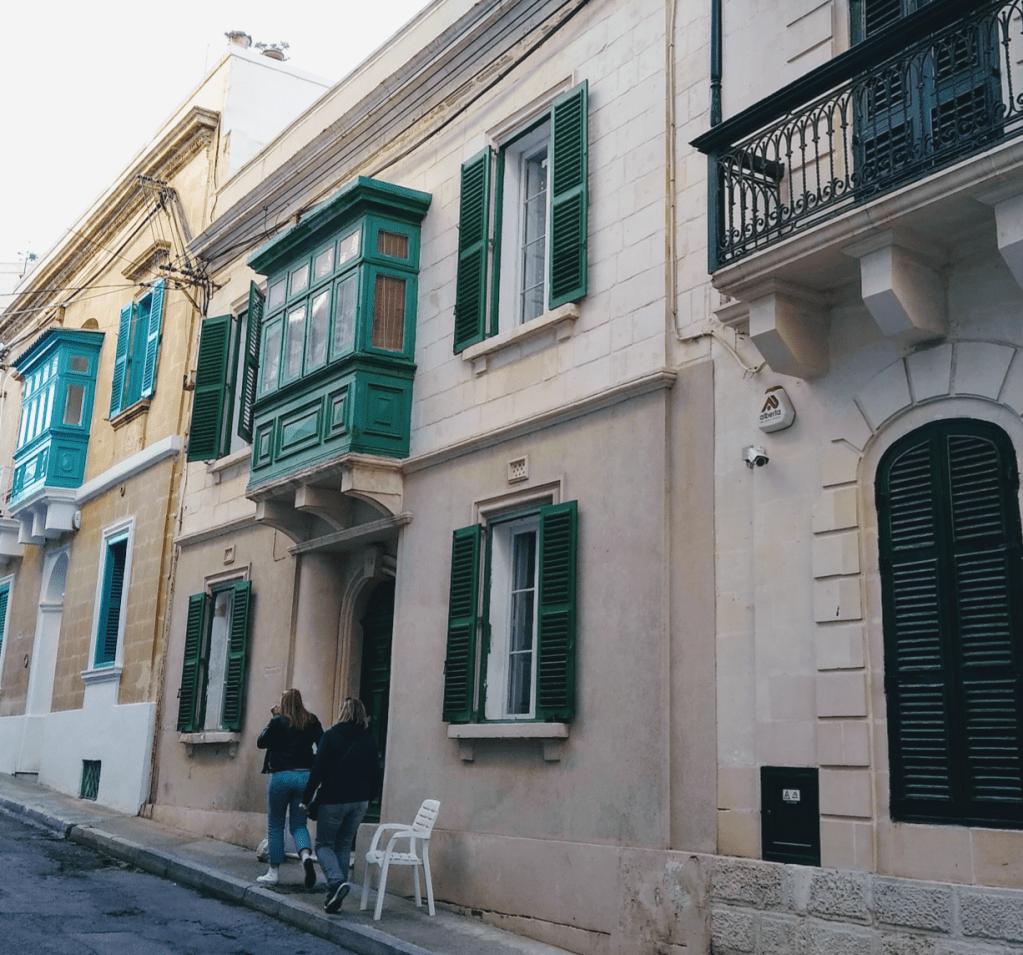
Old Sliema

Close to the main high street in Sliema is the Tower Supermarket, where we stopped for supplies. Unlike most shops that go up, in the Tower you go down to reach more floors, so it is cramped and a claustrophobic, similar to Sports Direct, which I think is the Worlds Worst Shopping Experience.
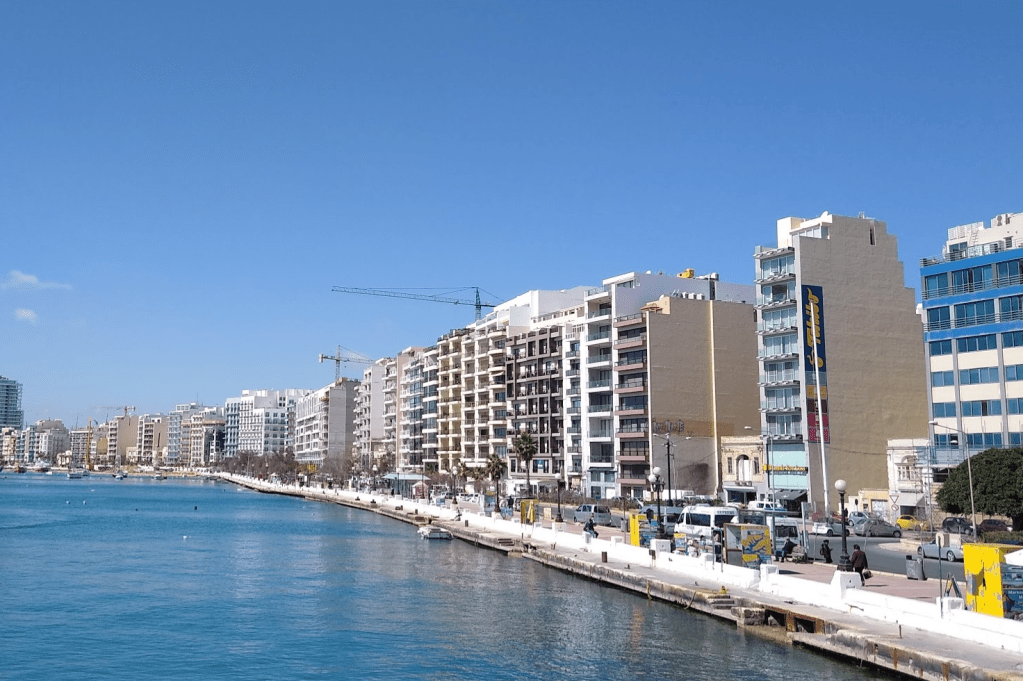
New Sliema

In the evening we walked a short way along the waterfront to Ali Baba, an excellent Lebanese restaurant. With our selection of small dishes, we had some Maltese wine which was very tasty, similar in flavour to Chardonnay.

On Thursday morning we took the ferry from Sliema over to Valetta, a journey of about ten minutes. The ferry passed Manoel Island, which is the site of a former quarantine hospital. People with fever were contained there for forty days. The French for forty is quarante, hence quarantine.
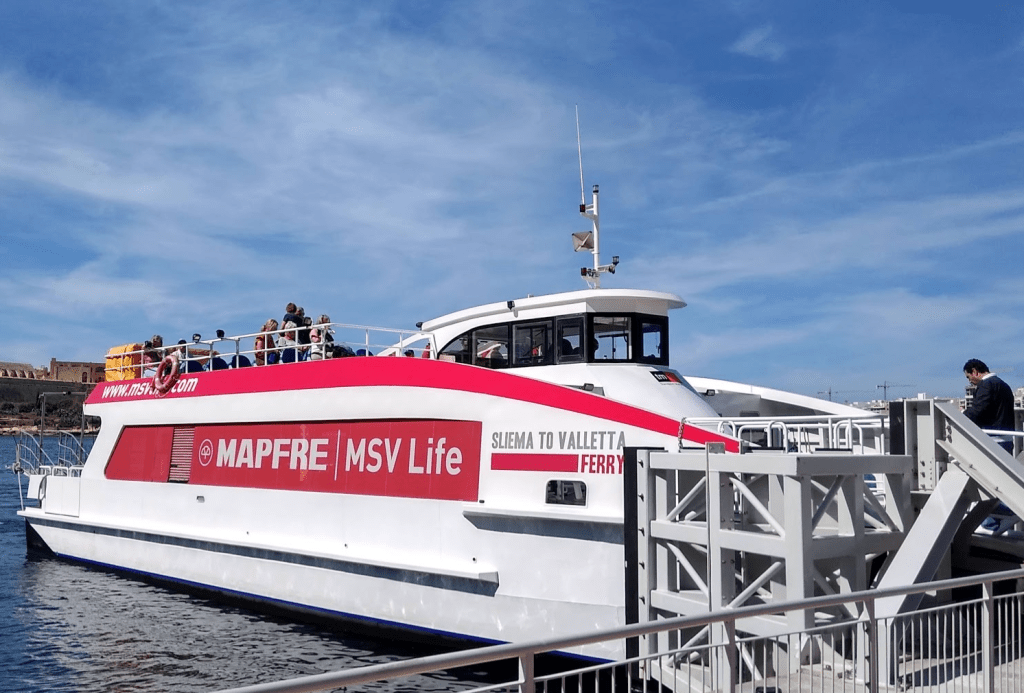
The ferry across the harbour

Not a lot of people know that.

Close to where the ferry stops is the Fortification Interpretation Centre, a museum all about the fortifications of Malta, and there certainly are a lot of them. It is housed in a 16th century building near the walls of the city which may have been a store for ammunition.
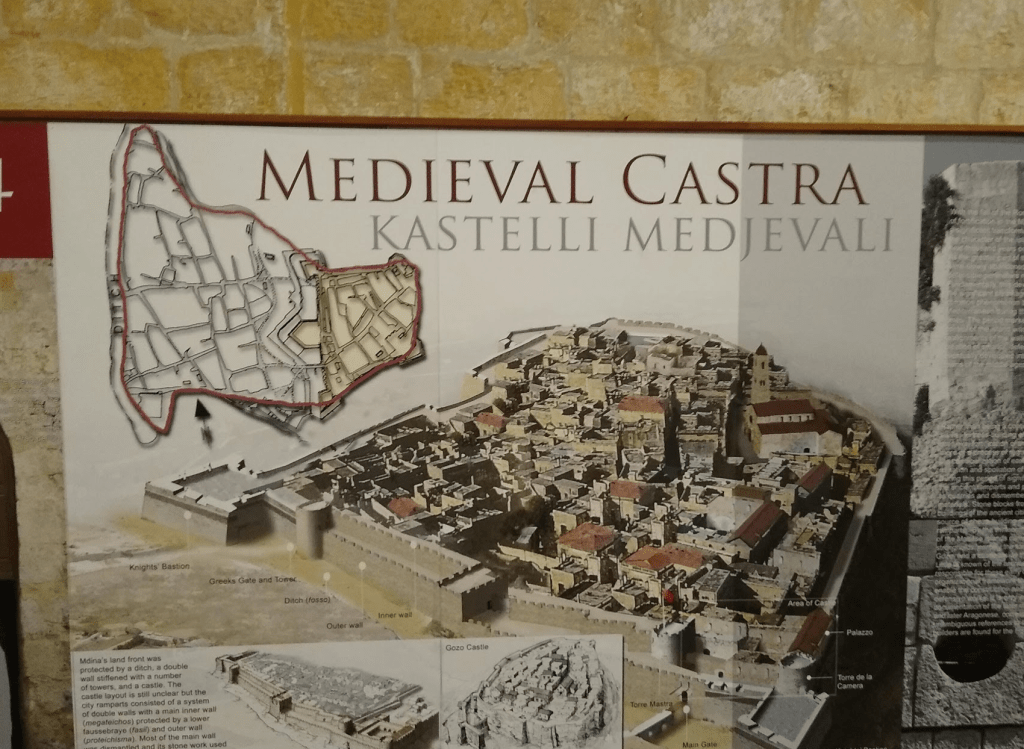
Diagram showing a medieval fortification

The museum is on several floors, and explains fortifications from ancient (pre-Roman) times up to the Second World War. I was with my wife and daughter, so I couldn’t read all the boards as I usually do, but there was loads of stuff to appeal to the nerdiest of history-lovers. 
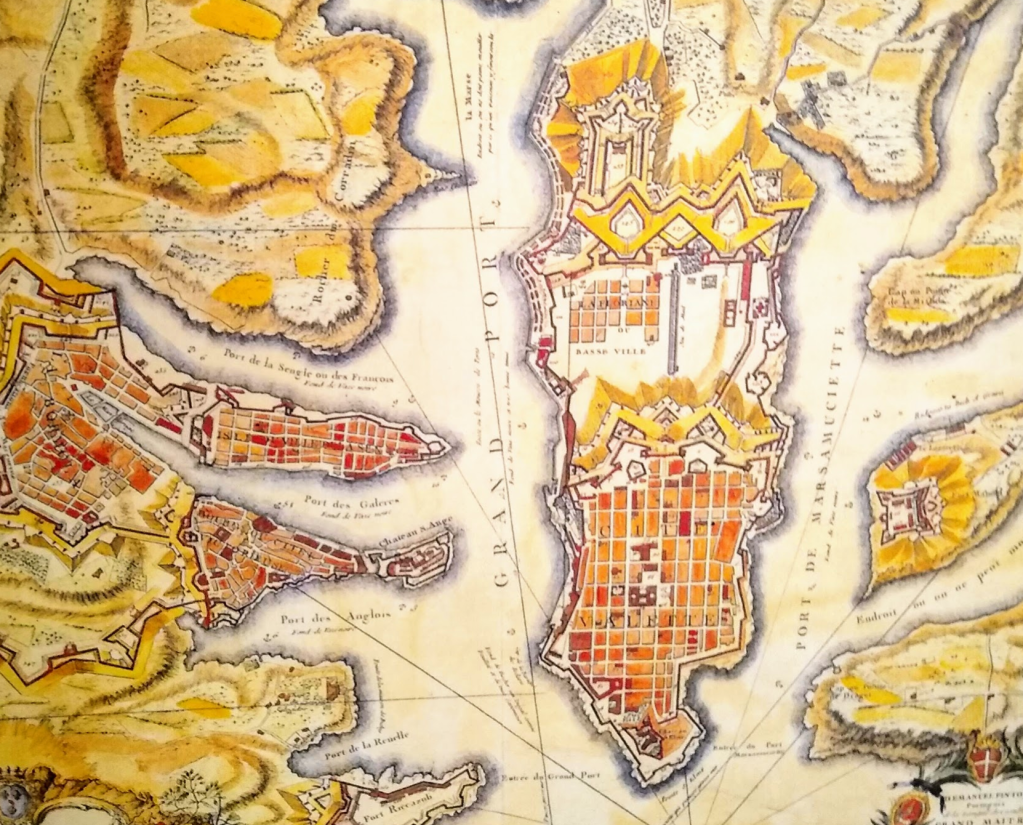
Fortifications in the 17th century

The Brits even built their own version of Hadrians Wall across the Island, the Victoria Lines. It was a twelve-kilometre long line of  walls and forts to protect the south of the island (where the harbours are) from invasion from the north. Since the Suez Canal had been built, it was probably to protect us from the French, but Wikipedia is too polite to say that.

If you like a fort or a wall, its worth a visit. If you prefer a cappuccino and a cake (like my wife and daughter) you might find it a bit dull.
The Knights of Malta

Here’s a bit of historical background. As I said wrote earlier, all the local empires had owned  Malta for thousands of years. In the 16th century the Mediterranean was owned by the Spanish and French at the western end, and the Ottoman Turks at the eastern end. A particular thorn in the side of the Turks were the Knights of St John. These guys were originally Knights Hospitaller, who looked after pilgrims visiting Jerusalem. But they took up arms to protect pilgrims and became a major maritime power. They were booted out of Jerusalem by Islamic forces in 1291, and settled on the island of Rhodes. They annoyed the Turks so much that Suleiman the Magnificent invaded the island and the remaining Knights were allowed to leave. 
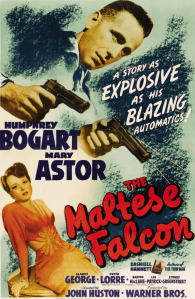
The Pope asked the Holy Roman Emperor Charles V to give them Malta, since he had it lying around in the back of a drawer and wasn’t using it much. He gave Malta to the Knights, and the Maltese didn’t have a say in the matter. The rent was very reasonable, one Maltese Falcon every year.

Dashiell Hammet’s famous book was about valuable statuette of a Maltese Falcon, but Sam Spade doesn’t visit Malta. It was what Hitchcock would call the MacGuffin, look it up on Google.

The Knights moved in in 1530, and naturally wanted to redecorate the place. They started to build walls and forts all over the island, and never finished fortifying the island.

In 1565 Malta was invaded by the Ottomans, who besieged the Knights in their forts. The Knights (with their Maltese helpers) withstood the siege and the Grand Master, Jean Parisot de Valette, decided to build a fortified city on the Sciberras Peninsula. The city was built in just five years and is named Valetta after the Grand Master.

It was one of the first planned cities in Europe, built on a grid of streets. The entire city is built of golden yellow limestone, similar in colour to the stone used in the Cotswolds. They quarried the stone from the rock beneath the city

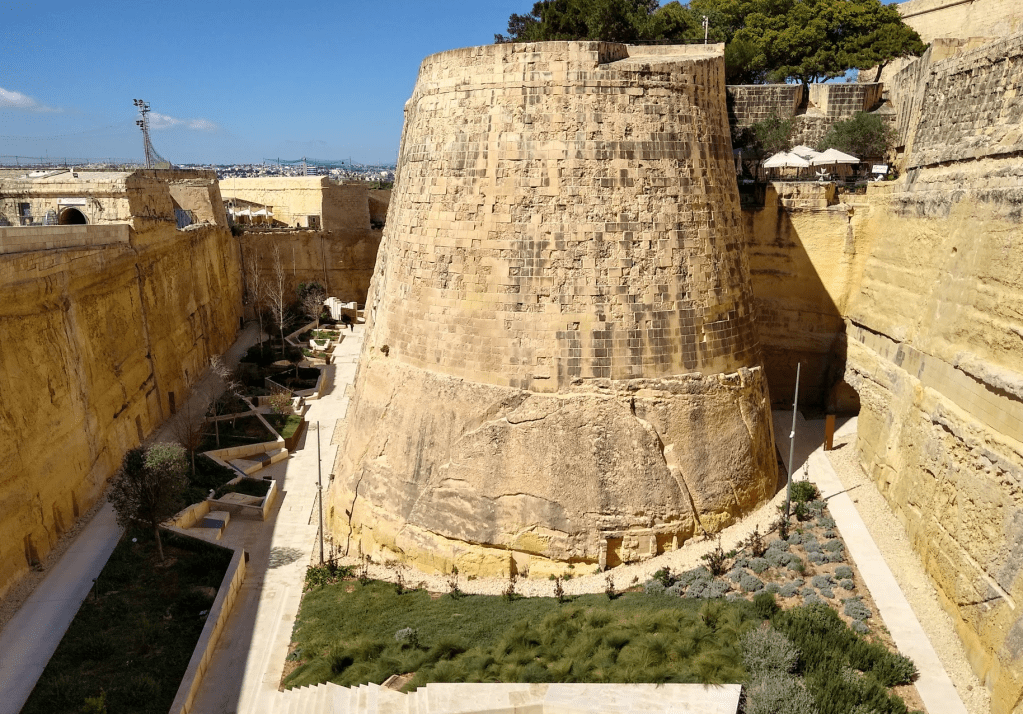
It is an incredible feat of engineering. The walls are amazing, massively built and surrounded by a dry moat that was excavated from the bedrock. At the western edge of the city is a modern gate in the walls designed by Renzo Piano, famous for designing the Shard in London. I think its a bit dull as city gates go, but I’m not an internationally famous architect. He probably thinks my blogs are a bit shit as well.
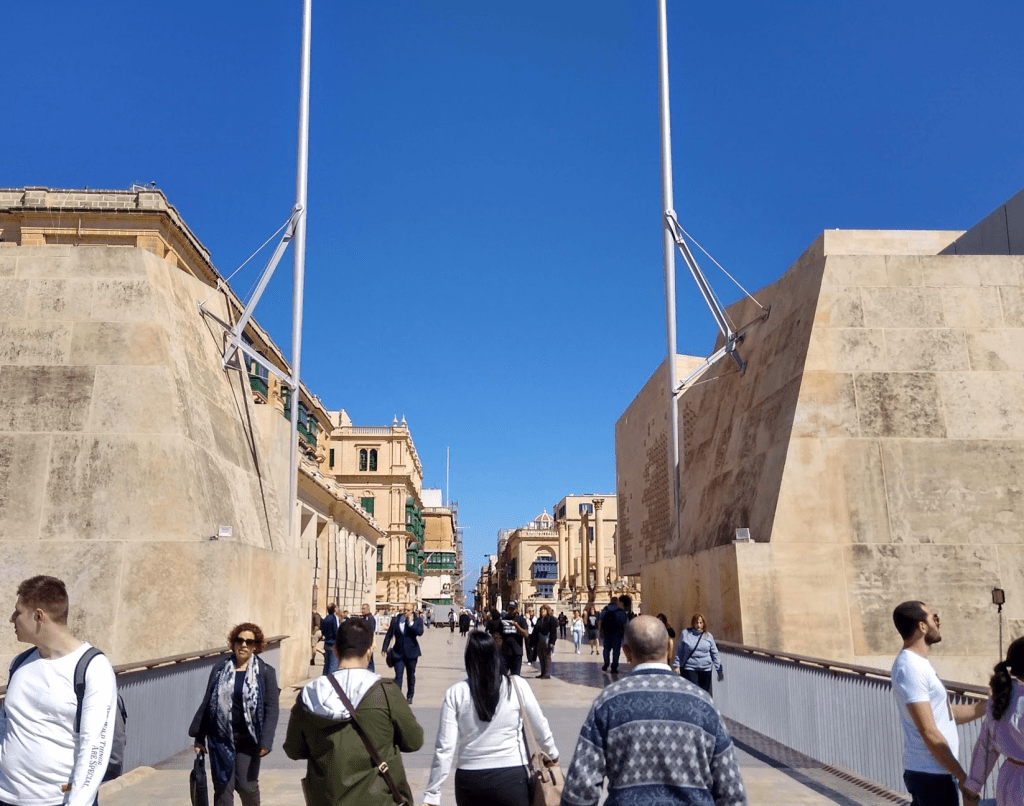
Renzo Piano’s gate. He hasn’t hung the doors yet

The builders carved a huge ditch out of the bedrock and used it to construct the walls, as you can see below.

The entire old city covers 0.61 of a square kilometre, it’s tiny. But every building is a Renaissance gem, perfectly designed and preserved.The Pope sent his architect  Francesco Lapararelli to plan and design the new city, and Phillip II of Spain paid for much of it. Malta was a bastion against the further western expansion of the Ottoman Empire, so Phillip was happy to pay for it. At the time Spain was enormously wealthy with gold and silver shipped from Mexico and Peru.
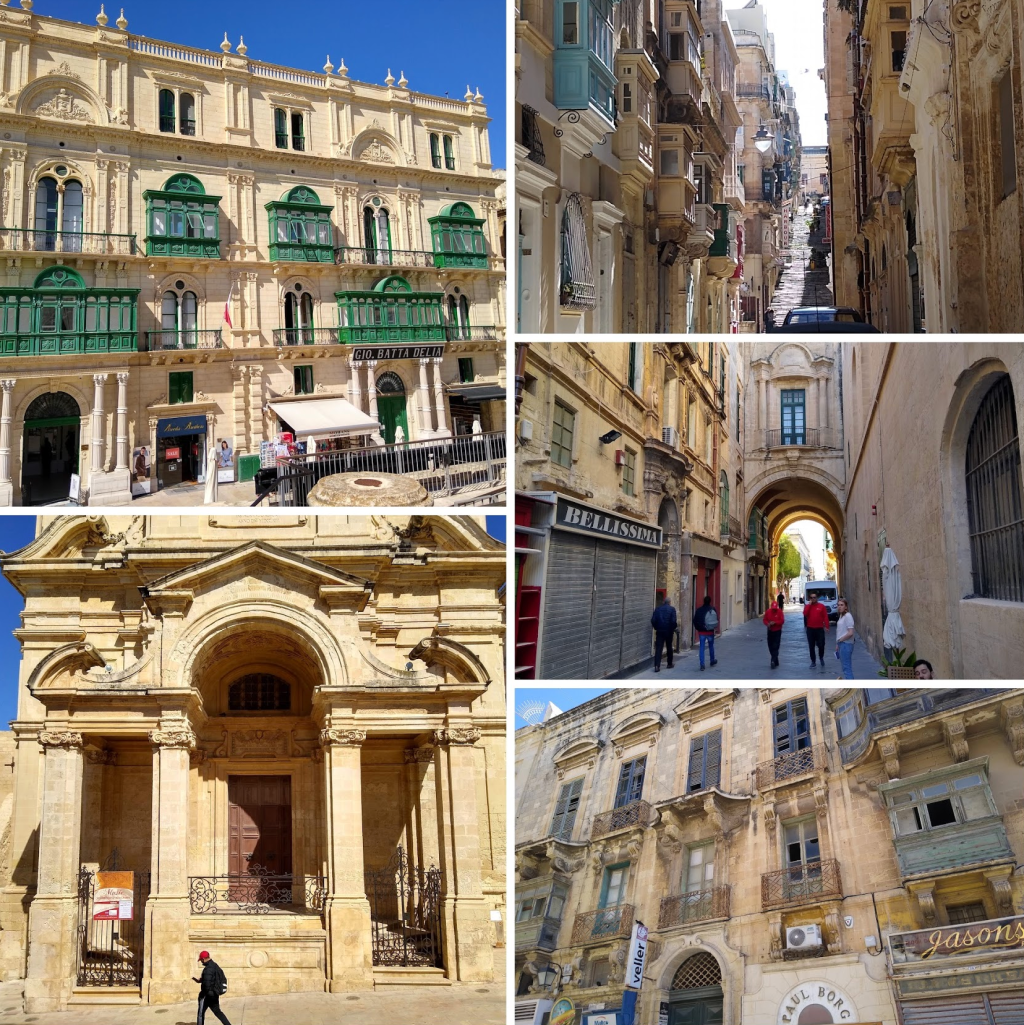
Valetta is a gorgeous city, and with its Baroque architecture looks both Italian and Spanish. Then you see a red telephone box, and old signs written in English. There are also many British chain stores around, there is even an M&S in Sliema!
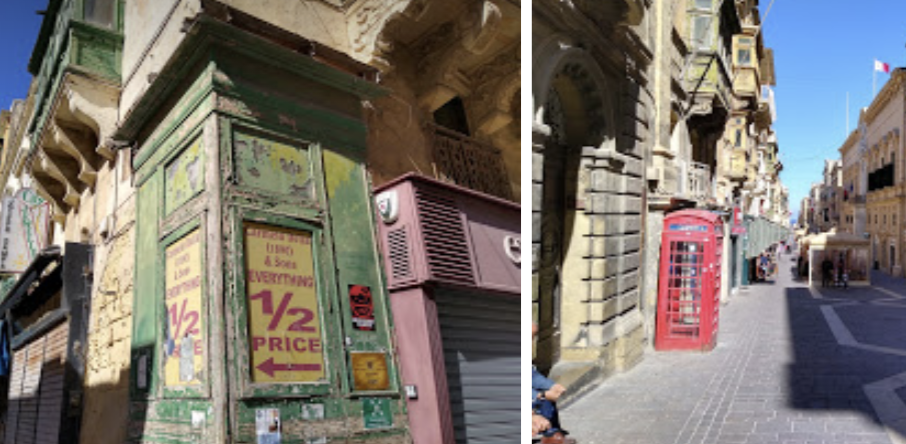
Malta was part of the British Empire from 1814 until 1964, and English is still the second main language spoken after Maltese. The Maltese language is derived from Sicilian Arabic spoken in the 8th century, and place names like Is-Swattar, Tal Fuklar and Rabat look very strange in an English speaking country.

The Knights of St John were divided into different groups according to where they came from, these were called Langues. Each Langue had its own HQ called an Auberge, many of them still exist. The English Langue was dissolved during the Reformation, Henry VIII didn’t like Catholic Knights with connections to England.

Because we were there in March, it was still relatively quiet, but there were still plenty of people around. The tiny city must be rammed in the summer, especially when the cruise ships come into the Grand Harbour.

The huge natural harbours are the reason that Malta was so fought over for thousands of years. Both Marsamxett Harbour and Grand Harbour could contain a fleet of ships. Marsamxett is mostly dedicated to yachting and leisure, whereas Grand Harbour is an active dockyard.
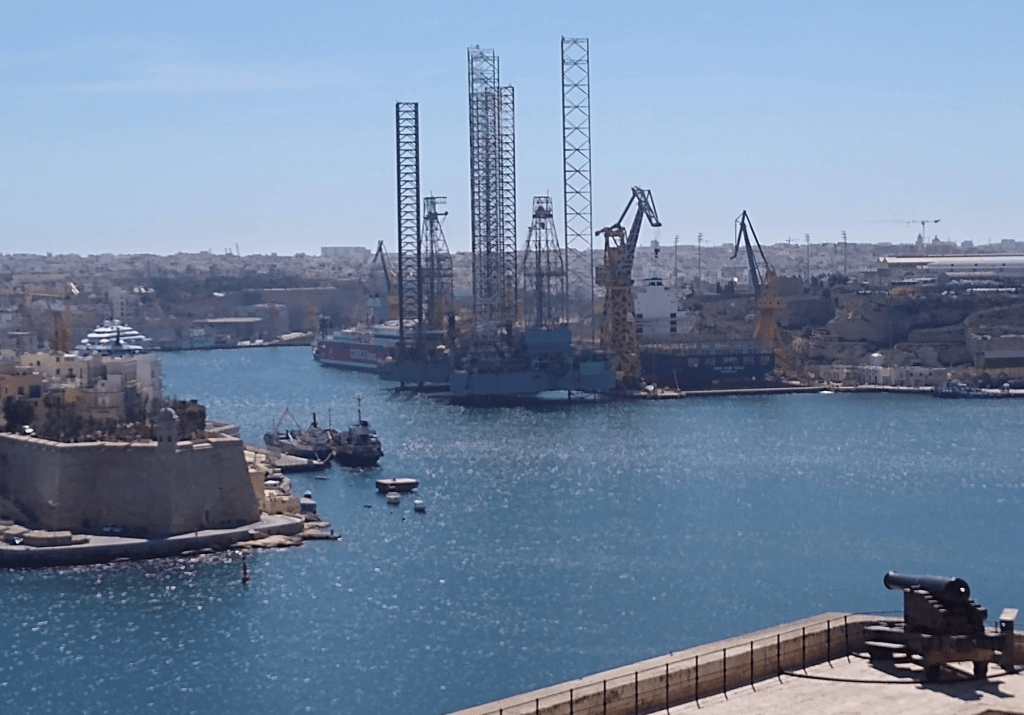
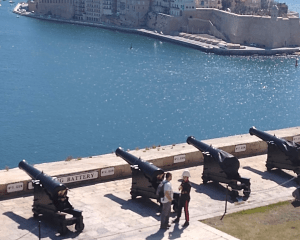
The Grand Harbour of Valetta
The battery and a fake Marine. Probably an out of work actor .

Overlooking Grand Harbour is Upper Barraka Gardens. Every day at 12 noon  a cannon is set off which as part of a formal ceremony by men dressed as British Royal Marines. This was a tradition which gave ships Captains the exact time to set their chronometers, which were crucial instruments for navigation. 

Malta was a vital fueling station for British ships going to India through the Suez Canal, which is why Mussolini and Hitler wanted to destroy it during the Second World War.

Upper Barraka Gardens looks over the Harbour to the Threes Cities, which where the strongholds of the Knights were before Valetta was constructed. They were some of the many places we didn’t get to visit. I could give your a list, but it would just make me resentful and angry.
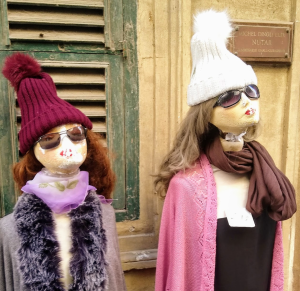
Italian tourists with the virus

At about midday, while we were relaxing somewhere in the sunshine, Josie got an alarming WhatsApp from a friend. The message said that Malta had suspended flights to and from Italy, Spain, France, Germany and Switzerland due to the virus. Mmm, that’s a bit of a worry.

In the afternoon we partook of the Malta Experience. It was a film about the history of Malta, followed by a tour of the Hospital of the Knights Hospitaller. The main old war is 155 metres long and could accommodate over 900  patients in an emergency, it is enormous! It was available to both rich and poor men, but not women. 
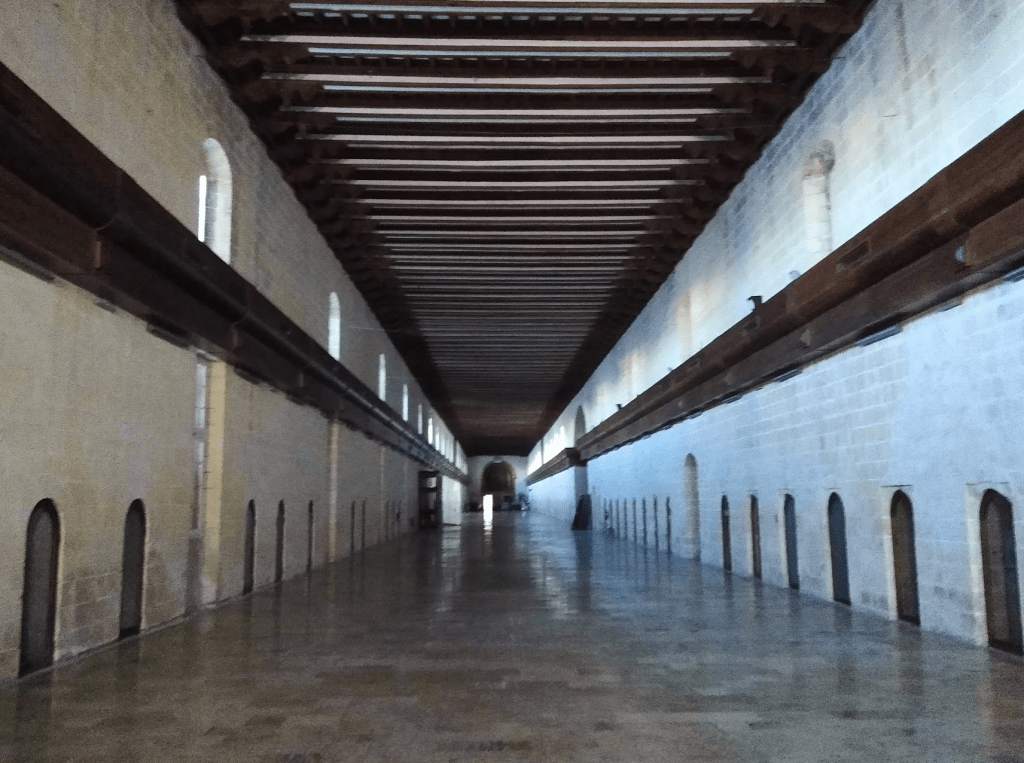
The Knights Hospital – it is very masculine

All Thursday afternoon we were checking our phones for the latest news about the Covid 19 situation, and tension was mounting in both the news agenda and in the family.
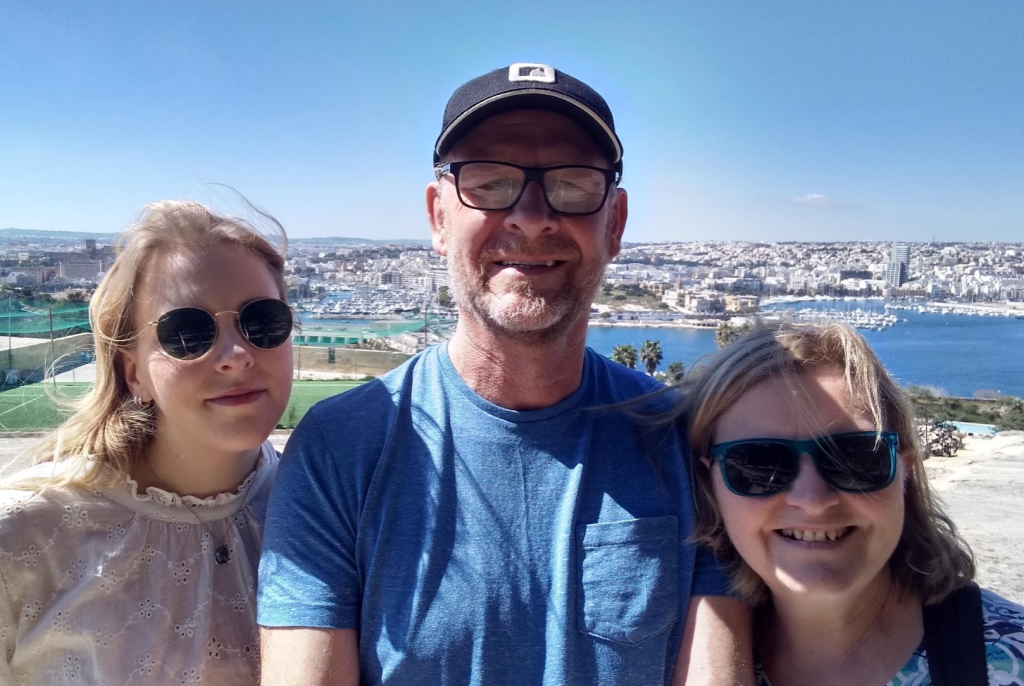
Before we made our escape from Malta

We bought a pizza and wine for dinner from the Tower Hell-Hole supermarket and talked about what we should do next. It was decided that on Friday I would call the British Consulate and asked for advice. 

Both Julie and I slept very badly and got up at 2am. We decided that the British Consul wouldn’t know any more than we would about how the situation would develop. Things could only get worse, and we didn’t want to get quarantined in Malta. So I immediately got onto Skyscanner and booked three expensive single tickets for Friday afternoon with Air Malta.

On Friday morning we packed our bags and got ready to leave. I had to abandon two bottles of Cisk beer in the fridge, Noooooooo.

The flight wasn’t until 5pm, so we got the ferry over for a last lunch in the sunshine in the square next to the Cathedral of St John. It was quiet and we were enjoying a delicious, and substantial Italian meal. Then some knob-end of a busker started singing sub-James  Blunt love songs through a loud amplifier, he was crap and very annoying! He must have felt the bad vibes and lack of takings because he buggered-off after 15 minutes.

We got a taxi to the airport, which was very quick, Malta was already closing down. On Friday afternoon the Maltese Government announced that British tourists would have to stay inside for 12 days, so we had made the right call.

The Maltese Airlines plane was an hour late taking off since some passengers from England who had arrived on Friday were going straight back to London, the poor sods.

So our 7 night holiday in Malta turned into a 2 night holiday or 0.285 of a 7 night holiday.

Also we arrived at Heathrow and our car was at Gatwick, that’s annoying!

But we got home safely and weren’t stranded in another country, unlike some people who are still a long way from home. It was disappointing, but could have been much, much worse.

Perhaps we will go back one day in better circumstances when I can complete the list of places I wanted to visit, the other 0.715 of a holiday in Malta.
Tenerife 2020

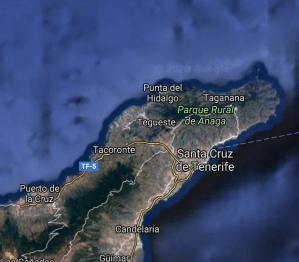
The north of Tenerife is a green and mountainous region, ideal for a winter holiday

Tenerife

January 2020

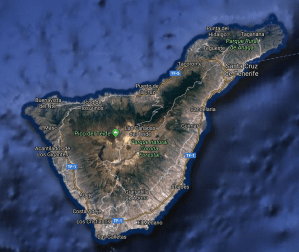
Tenerife, brown in the south, green in the north

Tenerife is the biggest island in the Canaries, a group of Spanish islands off the coast of Morocco in the Atlantic ocean. It is a volcanic island with an area of almost 800 square miles and a population of about about 900,00. In the centre of the island is a huge volcano called Mount Teide, which is 3,718 metres tall and is the highest mountain in Spain.

We went there because the Canaries are just about the only place you can fly to by EasyJet in January where it is warm, about 20 degrees centigrade on the coast.

Puerta de La Cruz

We chose to stay in Puerta de La Cruz in the north of the island because it is in the most verdant part of the island and there are plenty of places to visit close by. The south of the island is a desert, both physically and culturally. The south is sunshine and beaches and a Full English for breakfast. The north is sunshine, beaches, old towns and mountainous forests.

It takes about an hour to get there on the motorway from the airport in the south of the island. There is an airport in the north, but British airlines don’t fly there directly.

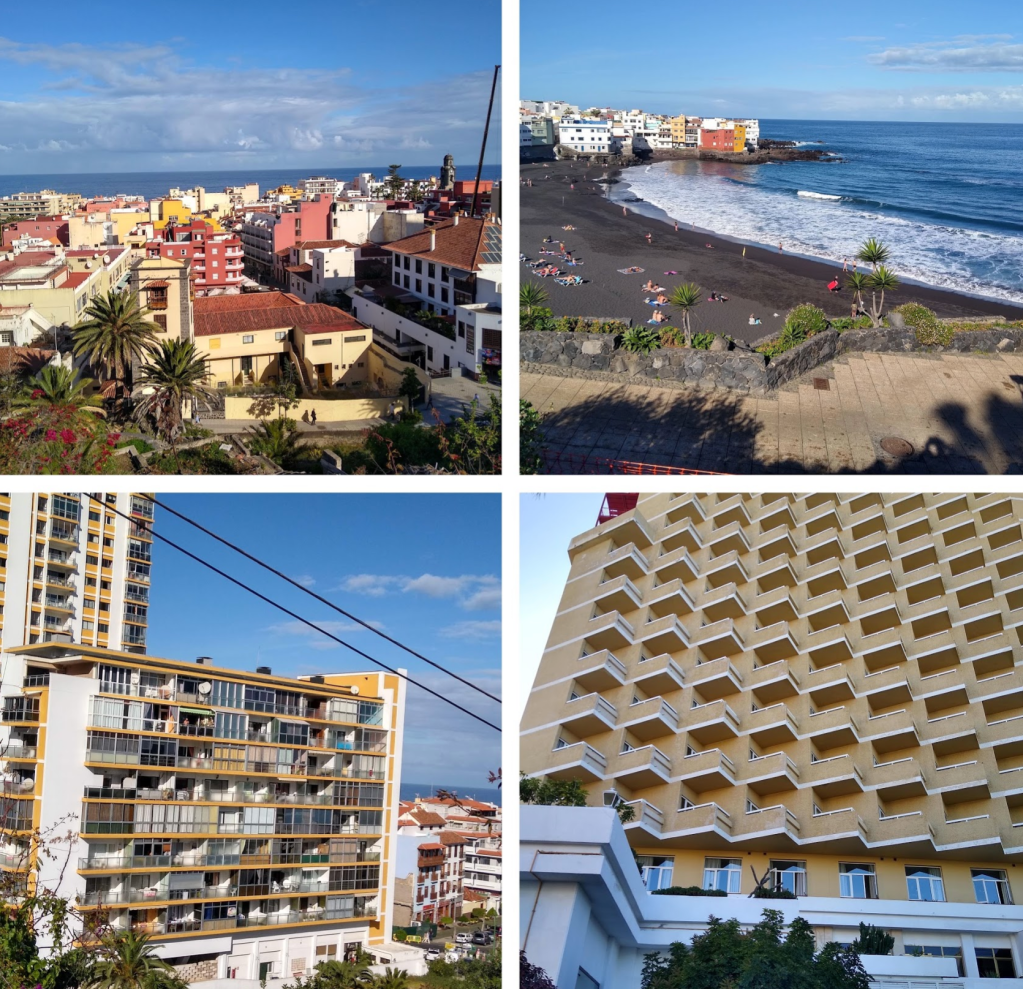
Puerta de la Cruz (I’ll refer to it as Puerta) is a very touristy town with a huge number of  hotels and blocks of flats, but it does have a historic town centre and harbour. It’s easy to get La Laguna, Santa Cruz, La Oratava and Garachico by car or bus, so its central for all the northern towns. Loro Parque is in Puerto as well, which is the biggest single tourist attraction on the island.

We booked an Airbnb in the La Paz district which looked good on the map, near the city centre and close to the sea. In reality it was a thirty minute walk from the town centre, up a big hill, but it did have sea views. But there were plenty of restaurants and a supermarket close by, if we didn’t fancy the hike into town.

Puerto is very popular with German tourists, so if you enjoy Curry Wurst and lager, it’s an ideal destination. There are endless pizza restaurants, and plenty selling local Canarian and Spanish food. The local Dorada beer is really good and washes down fresh sardines very nicely.

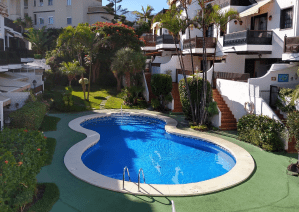
Flats by our unused pool

Our flat had a sunny patio at the front and a shared pool which I didn’t use (but I should have). Unfortunately it was above a noisy cafe, where people were enjoying themselves very noisily, the bastards!

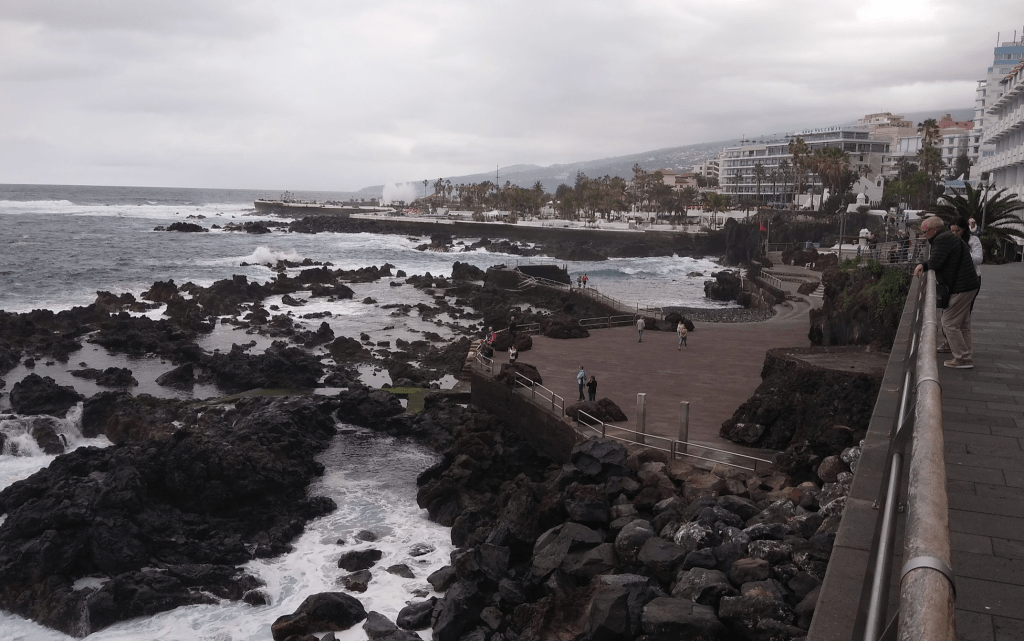
On the seafront there is Lago Martianez, which is an attractive group of seawater pools that I’m sure is lovely to lounge around if the weather is hot enough, but it was very gloomy and windy when we visited it.

Puerto seafront on a baaad day with waves battering the Lago Martinez

There is a small harbour (which was once the most important port on the island), and the main square, Plaza del Charco is close by which has many restaurants and bars.

Puerta has lots of flats, lots and lots

Botanic Gardens

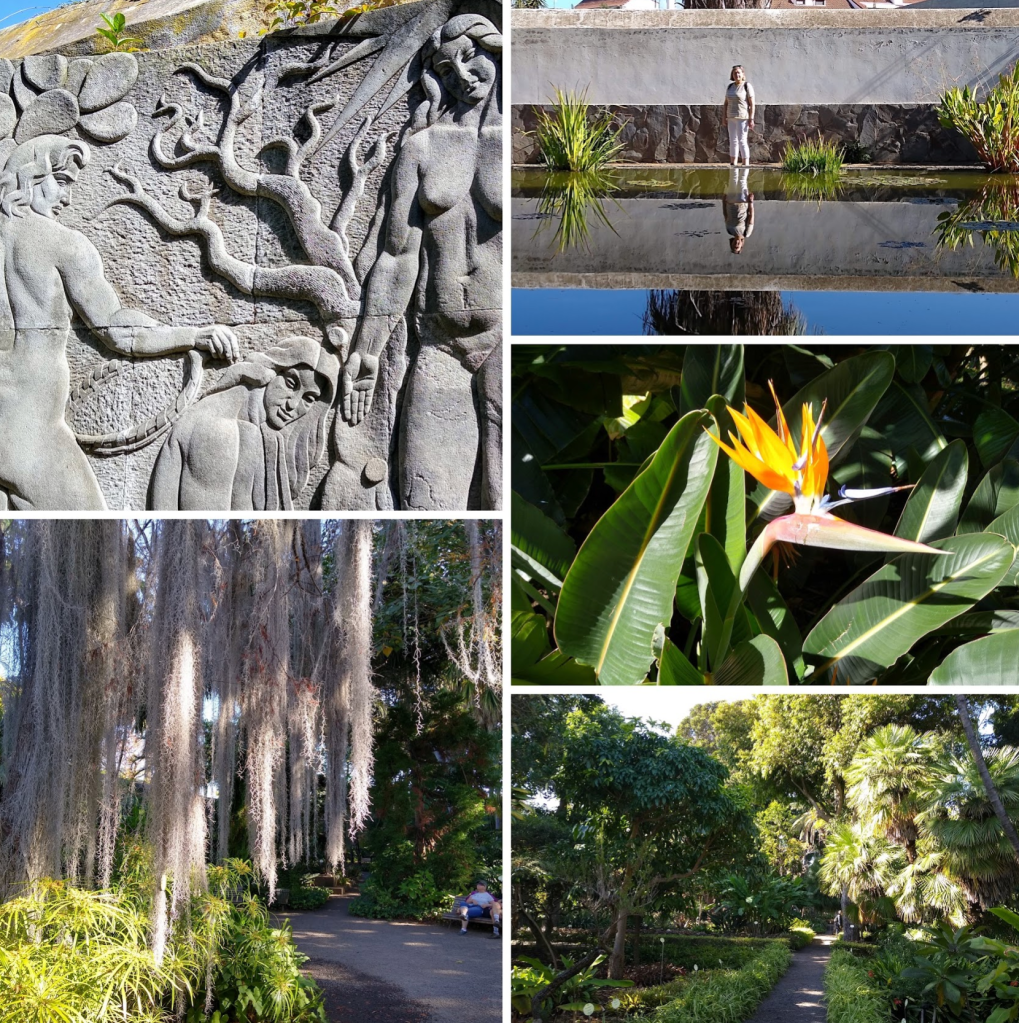
The Jardin Botanico is a beautiful oasis amongst all the blocks of holiday flats. It was founded in 1788 on the orders of King Carlos III to provide a place to cultivate species from the tropics. It’s small compared to Kew, but you can easily spend a couple of hours wandering around the neat paths which are roughly in a grid pattern. 

I did wonder if visitors under sixty were barred at the gate by security men from Saga, but was pleased to see two young fellas looking at a palm tree with genuine interest.

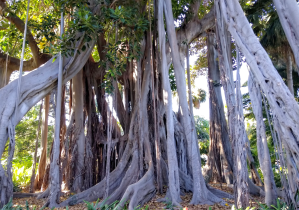
Lord Howe Fig with adventitious roots

The most spectacular tree is a mighty fig from Lord Howe island in Australia. It has adventitious roots (remember that word for a pub quiz) growing down from the boughs, which take take root in the ground and become extra trunks to support the weight of the tree. 

There are some magnificent Norfolk Island Pines, which I have never seen taller than twenty feet in other parks. The pines I saw in the Jardin had trunks four feet in diameter and I couldn’t see the top, real monsters! I get strangely excited about big trees, it is kind of wierd.

As well as amazing trees there are many palms, yuccas, streletzias and figs. But there was no cafe! What kind of public garden has no cafe? All the English visitors were is a state of shock and semi-starvation looking for tea and cake. Perhaps Brexit isn’t a mistake after all.

Mount Teide from the Jardin Botanico

La Oratava

We attempted to walk up the hill to La Oratava from the Jardin, but soon discovered that there were no footpaths and it felt a bit dangerous sharing the road with busy traffic. So we took the 345 bus to La Oratava bus station, which took seven minutes, a much better way to travel. 

La Oratava is one of the oldest settlements in Tenerife, the area was inhabited by the Guanches people before the Spanish arrived, who lived in simple stone homes and caves. It is a very pretty town, with many historic houses and civic buildings built on the slopes climbing towards Mount Teide. There are great views of the sea and Puerta de la Cruz below, which used to be the port of La Oratava.

Houses in La Oratava

The tourist information provided a very useful map that we used to find our way round the historic parts, which go back to the sixteenth century. The old houses have big wooden doors and carved wooden balcony’s in the typical Canarian style. There is a small Botanic garden behind the Ayuntamiento (the town hall), but the nearby Jardin Victoria is outstanding, a terraced garden that climbs up the slope with a Masonic Mausoleum at the top. 

Victoria Gardens with attractive visitors

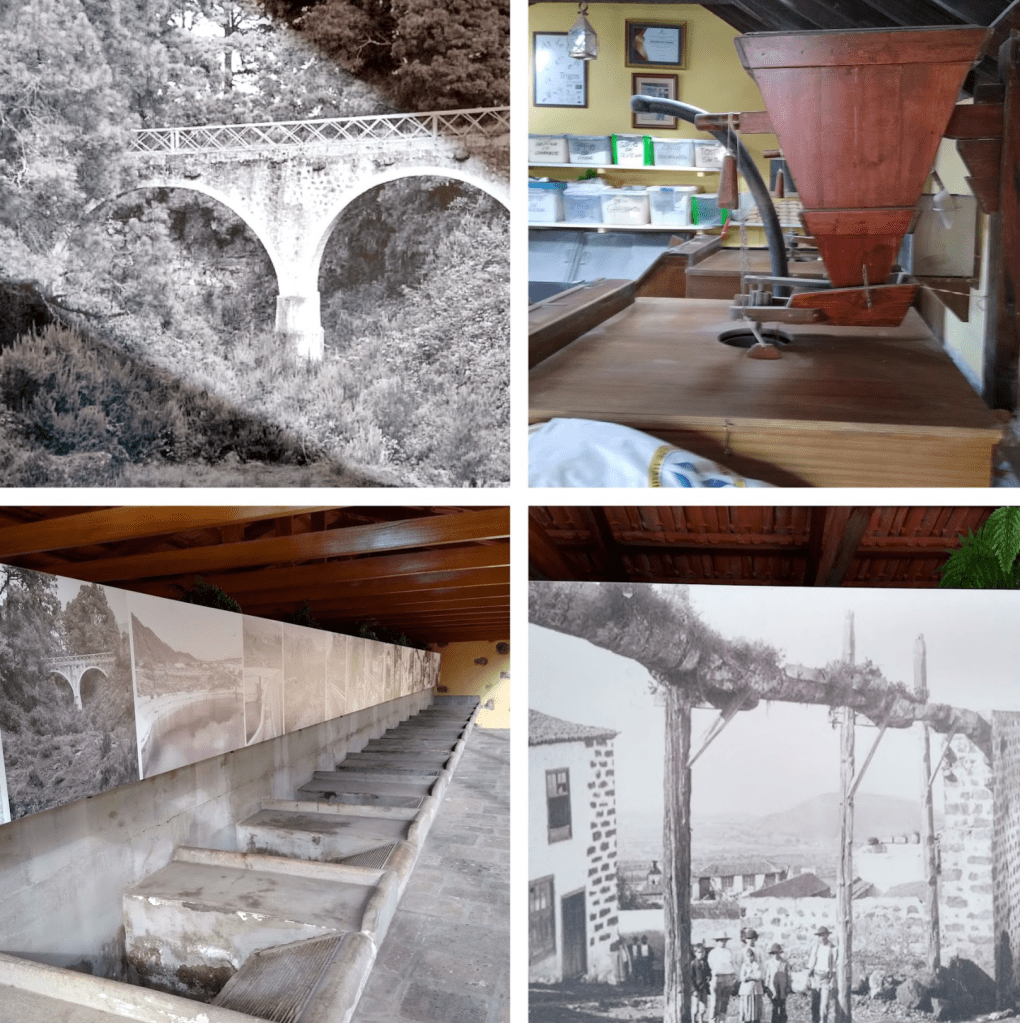
Near the Plaza de San Francisco some public laundry troughs have been restored. It’s close to an aqueduct which brought water down from the mountains. Next to it is the Molina de Chano, a mill which was powered by water but is now electrically driven. The mill produces Gofio, a flour made from toasted grains which was eaten by the Guanches and is still popular today.

Old laundry, Gofio mill and historic images of the aqueduct that supplied them with water

The streets of La Oratava are steep and cobbled, and the locals treat it as a rally course. It probably explains why we saw no English tourists on mobility scooters.

I would highly recommend La Oratava, there is a lot to see, and many great bars and cafes and surprisingly few tourists.

Scenic Drive Through Tenerife

A blogger said that one of the best drives on the island was from El Portillo to La Laguna, so we gave it a try. Julie drove the rented Polo and I navigated i.e. I did what Google told me to do.

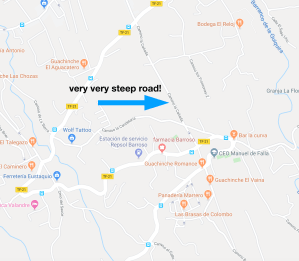
Stick to the TF 21

Our route was the TF21, which goes through La Oratava and then goes wiggly wiggly up the lower slopes of Mount Teide. It was incredibly windy, and Google took us up a stupidly steep hill (Camino La Canadas to be exact) to cut off a bend on the T21 to save a few miles. It was one of those “Oh Shit!” moments when we hoped nothing was coming down the hill. We crawled up it in first gear to rejoin the main road at the top. Google was sent to her room for being naughty, and after that, and we just used the map, old style.

We stopped at a cafe near Aguamansa for a coffee and met two cyclists from Hereford who were cycling from the sea up to the cable car, which at about 7,000 feet up. Nutters.

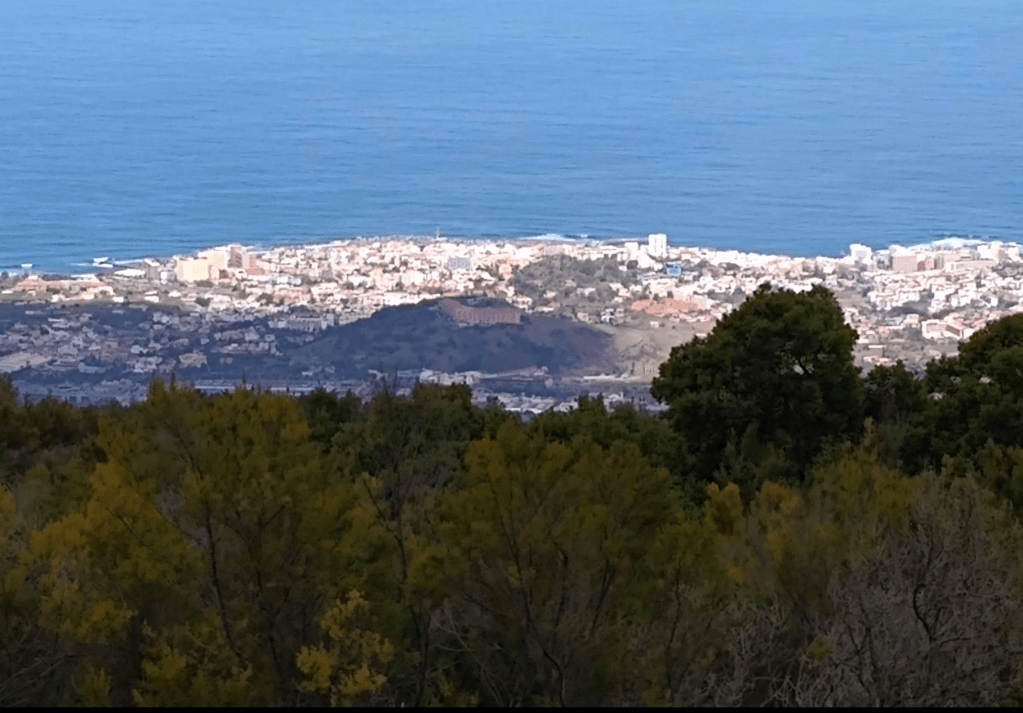
View of Puerta from the TF 21 raod

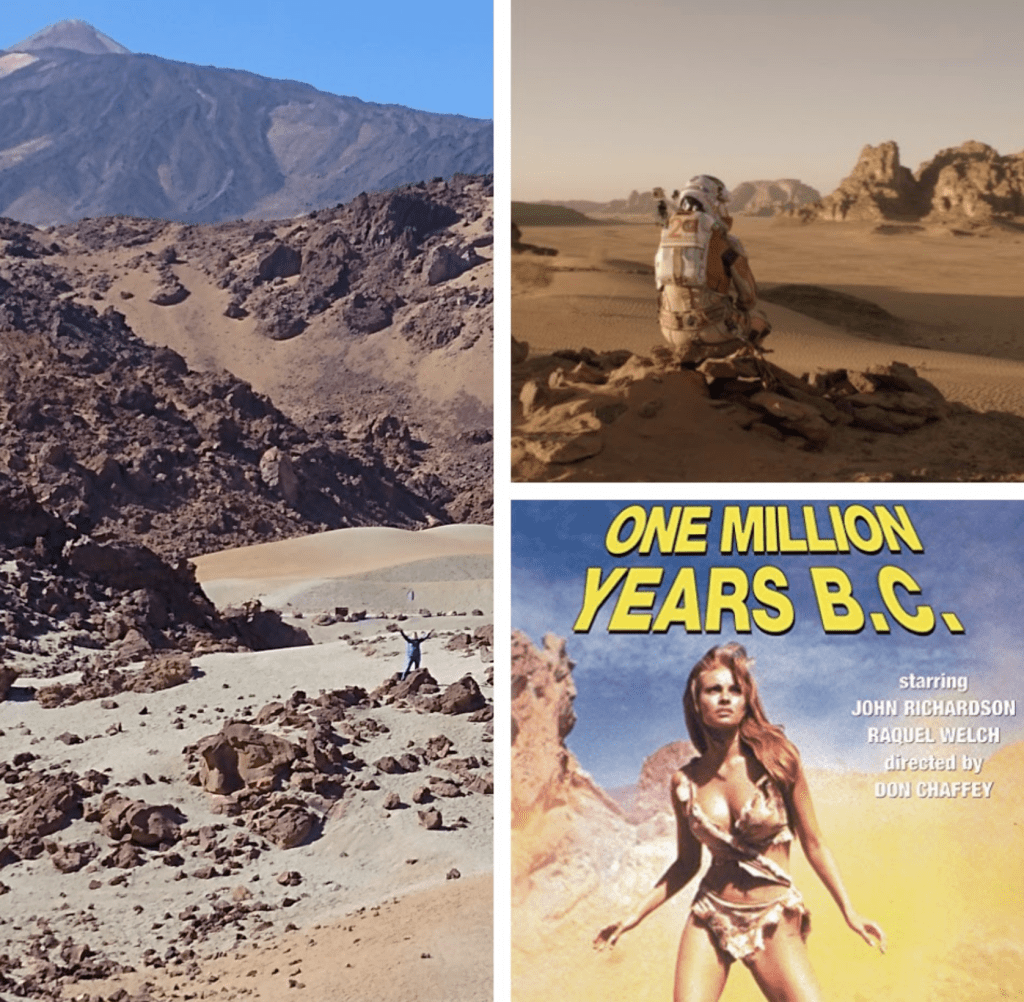
Once we were above the tree line (and the clouds) the landscape looked like a desert with scrubby vegetation. Further up it looked like the surface of Mars and I expected to see Matt Damon struggling in his space suit trying to get home. Raquel Welch encountered stop-motion dinosaurs here is the classic sixties SF movie “One Million Year BC”.

One of these people is me, one is Matt Damon and the other is Raquel Welch – work it out

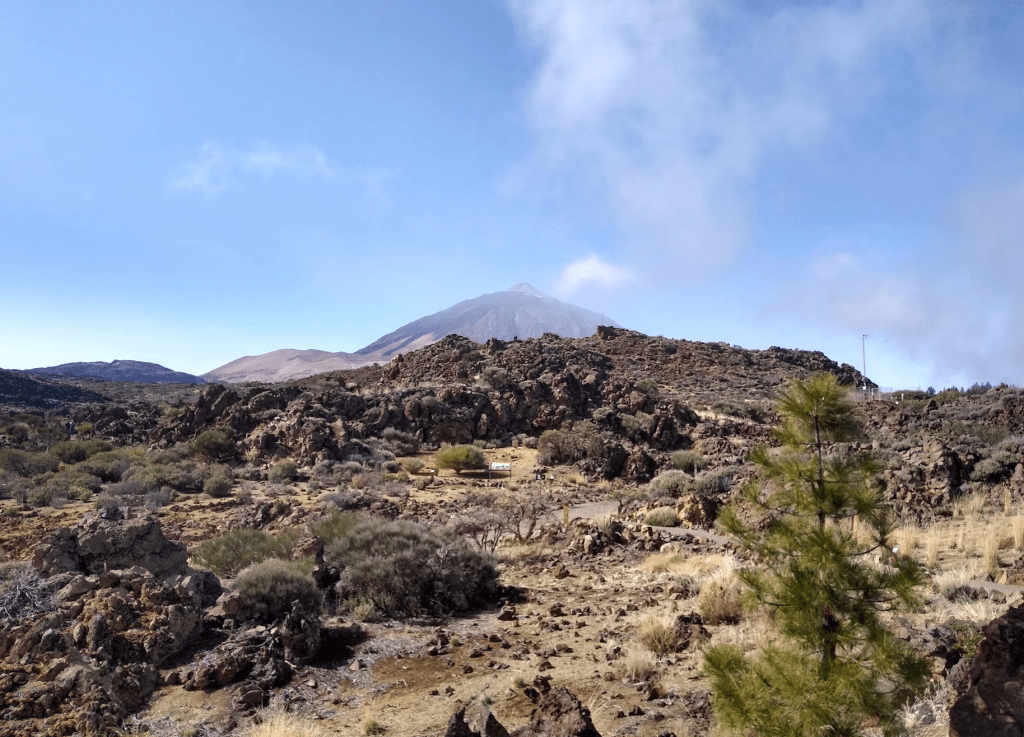
The area surrounding Mount Teide (it rhymes with Lady) is the caldera of a previous massive volcanic eruption, it is very other-worldly.

Look out for dinosaurs!

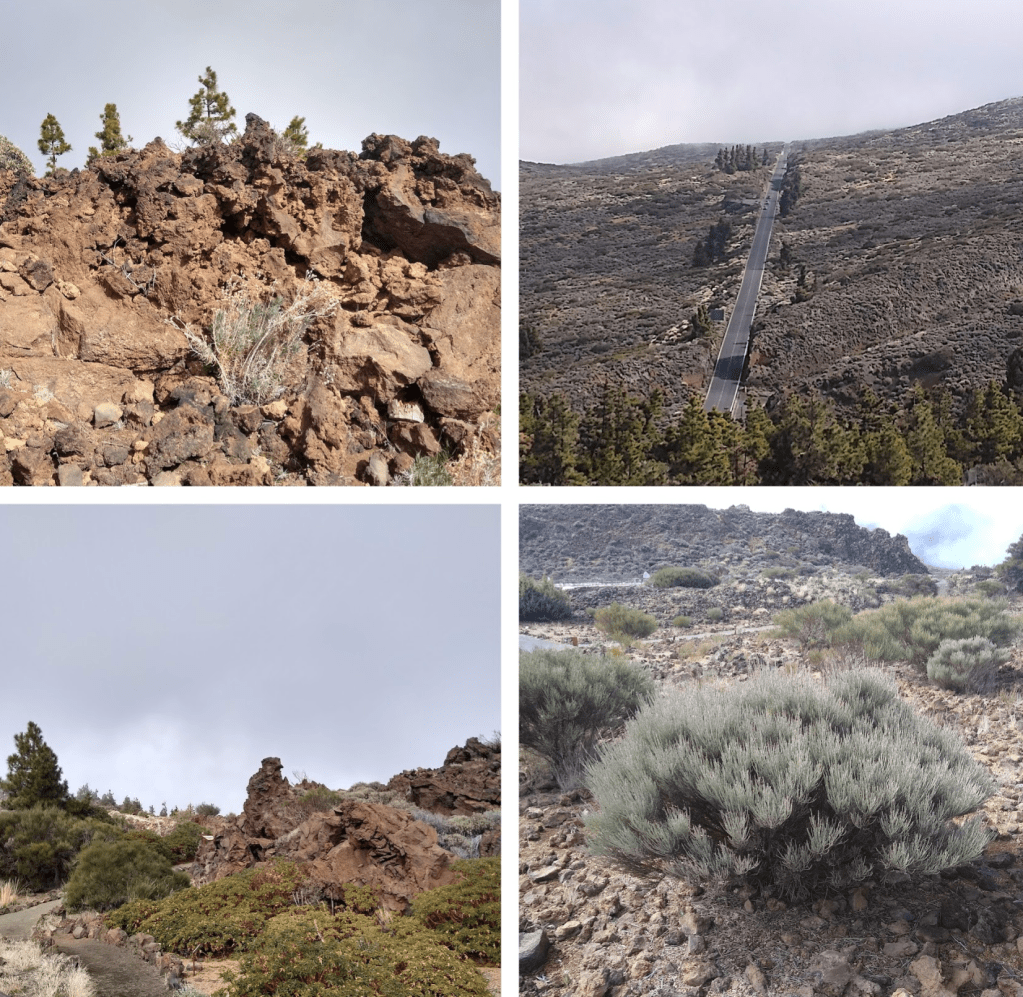
At  La Portillo there is an excellent visitors centre with a “Botanic Garden” which is a series of paths between small hills of basalt and ash planted with all the local plants. It was beautifully sunny , there was no wind and not a sound to be heard, perfect silence. In the visitors centre there is a small museum about volcanoes and a film about the volcanic origins of Tenerife.

The botanic gardens at El Portillo

Further along the TF21 is Los Roques, which are big pinnacles standing up above the pumice plain surrounding Teide. There is also a Parador with a cafe and toilets, the only ones for miles around!

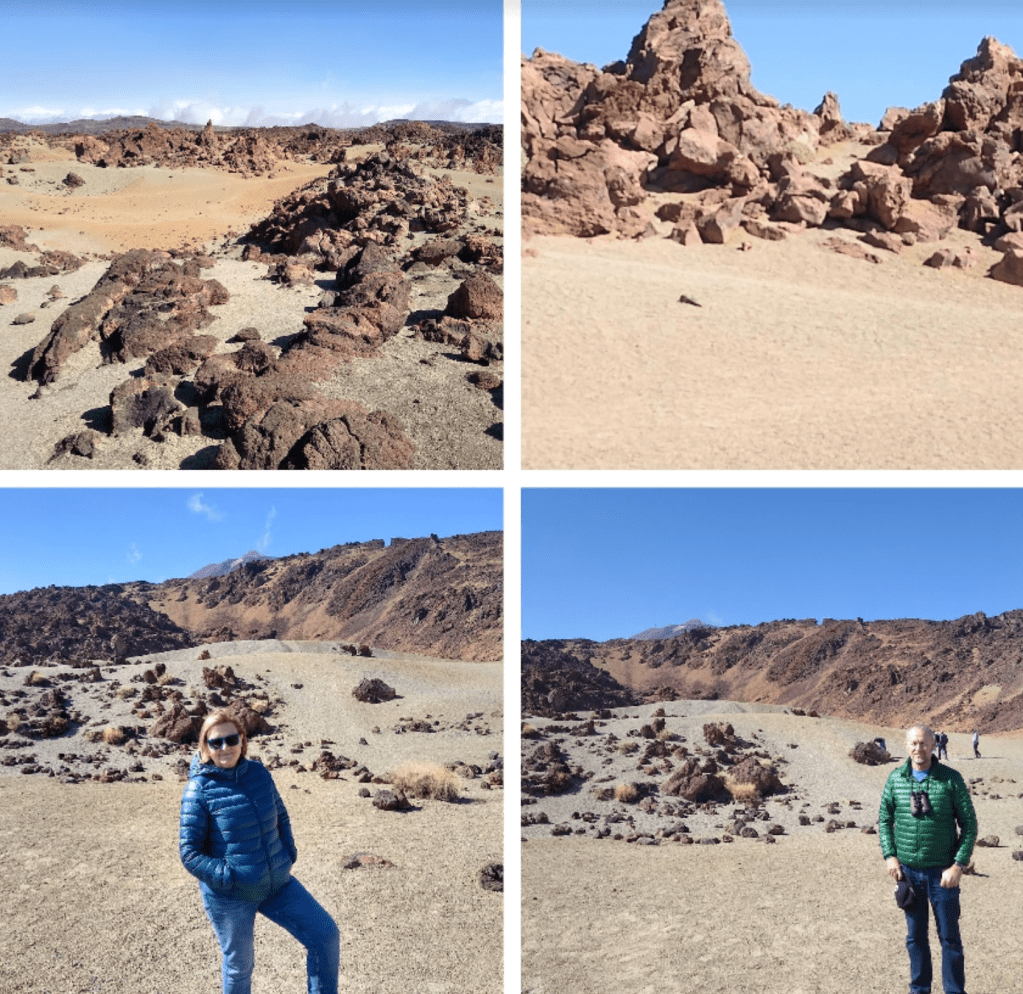
Martian landscape and two Martians
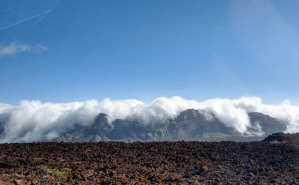
Clouds pouring over the mountains

The landscape is quite remarkable, with Teide towering up another fifteen hundred metres, with the cable car hanging onto the side of it. The rim of the caldera creates a circles of jagged hills surrounding Mount Teide. The clouds blowing from the east poured over the top of them into the caldera, it was so beautiful.

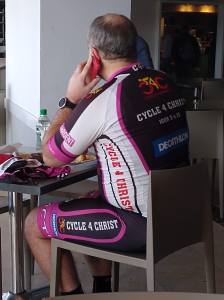
Cyclist at the Parador, he may have had devine assistance

The landscape is amazing, awesome and all that stuff, I was blown away by it’s magnificence. Cyclists take a perverse please in cycling up the mountain from the sea. It takes about four hours going up, and I’m sure the going down is much quicker!

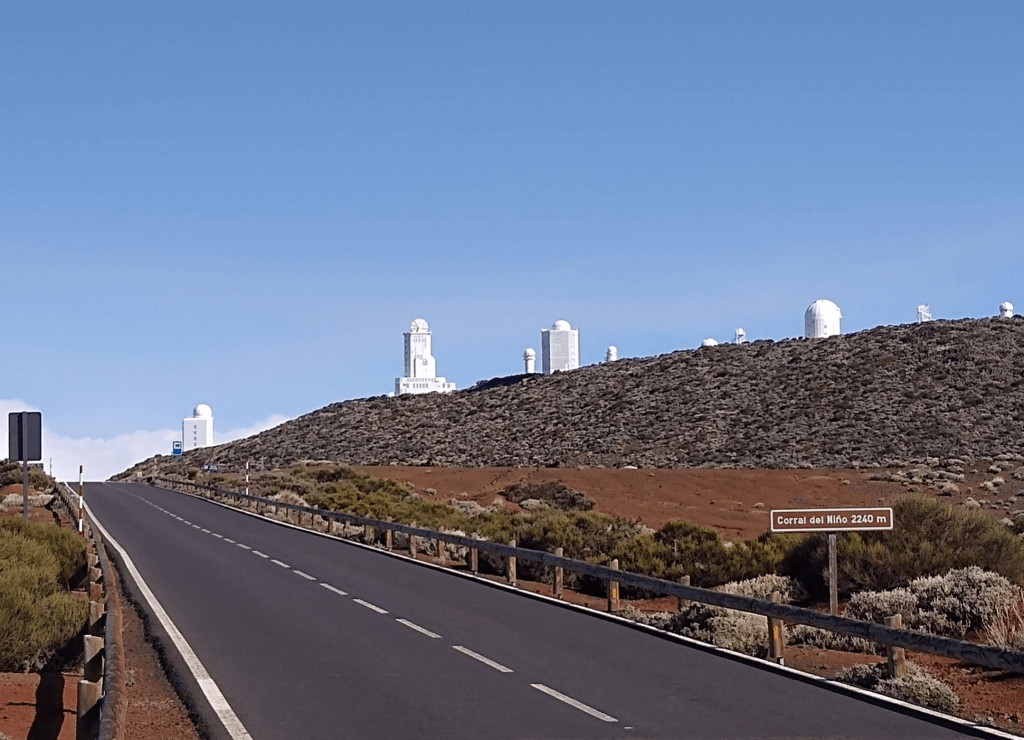
We drove back to El Portillo and took the TF24 towards La Laguna along the high spine of Tenerife. I passed the astronomical observatory with eleven different telescopes at about two thousand three hundred metres, with mostly clear skys.

Did you know that Brain May from Queen wants his ashes to be scattered there? True fact, you can Google it.

Brian May’s last resting place. Once he has died of course.

The views from the TF24 are supposed to be excellent both sides of the island, but all we saw was clouds below us. But it is a lovely winding road through pine and eucalyptus forests gradually down to La Laguna and the TF5 motorway back to Puerto de La Cruz.

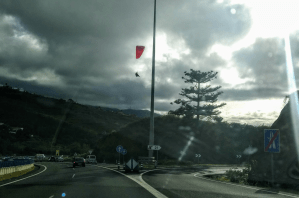
On the FT 5 on the way pack to Puerto, a para-glider flew over the motorway.Fortunately he didn’t hit the lamp post or the pine tree!

Loro Parque

According to TripAdvisor, Lord Parque is the No. 1 zoo in the world, which is quite a recommendation. It is also advertised on most of the buses and litter bins in Puerto, so it is a very big deal.

It was pricey to get in at 39 Euros, but we stayed there for over six hours and had a wonderful time!

Loro Parque means parrot park in Spanish, and there is a huge collection of them in cages and an huge aviary with an aerial walkway in which you can get close to the birds at feeding time. There is also a great collection of other creatures in a relatively compact area. It is beautifully landscaped and well maintained, with plenty of cafes with reasonably priced food and drink (which was a pleasant surprise).

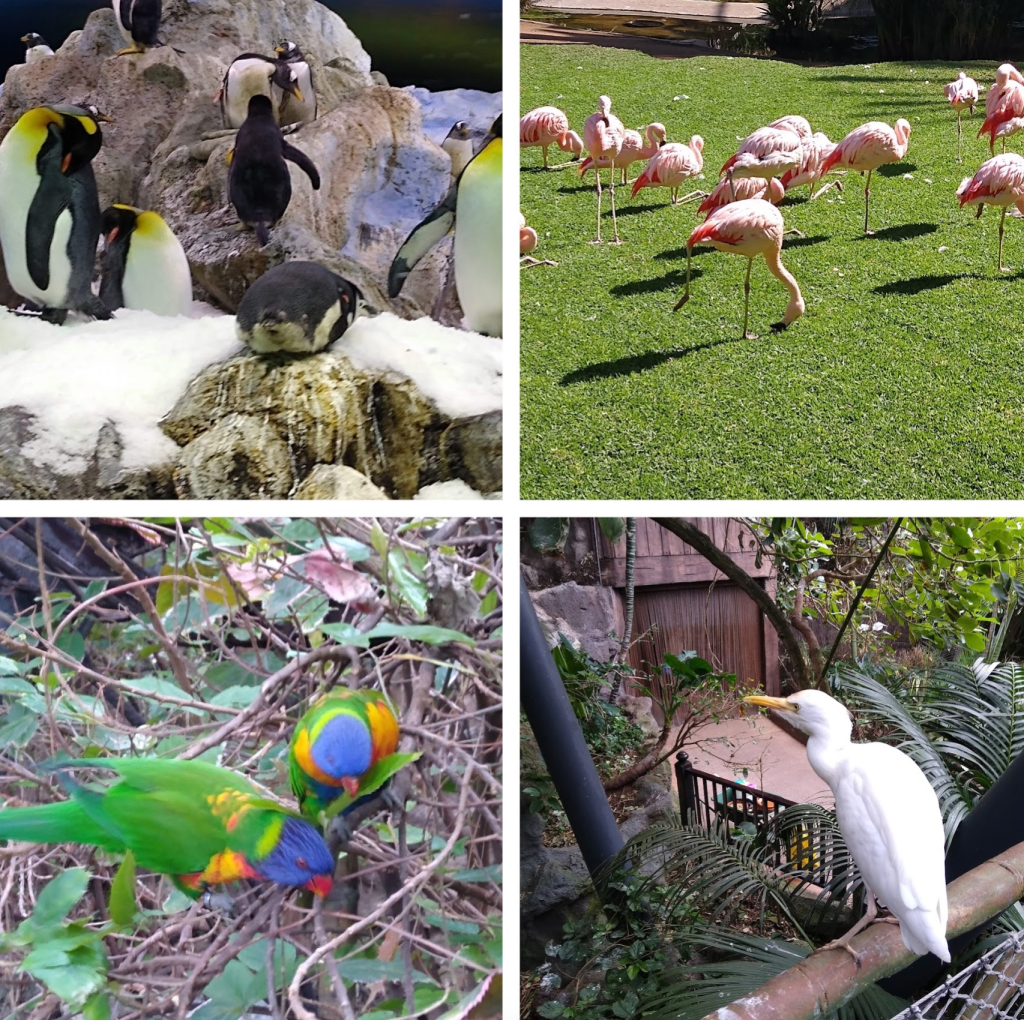
King Penguins, Flamingos, Parrots and an Egret
Giant Anteater, part-broom, part-vacuum cleaner

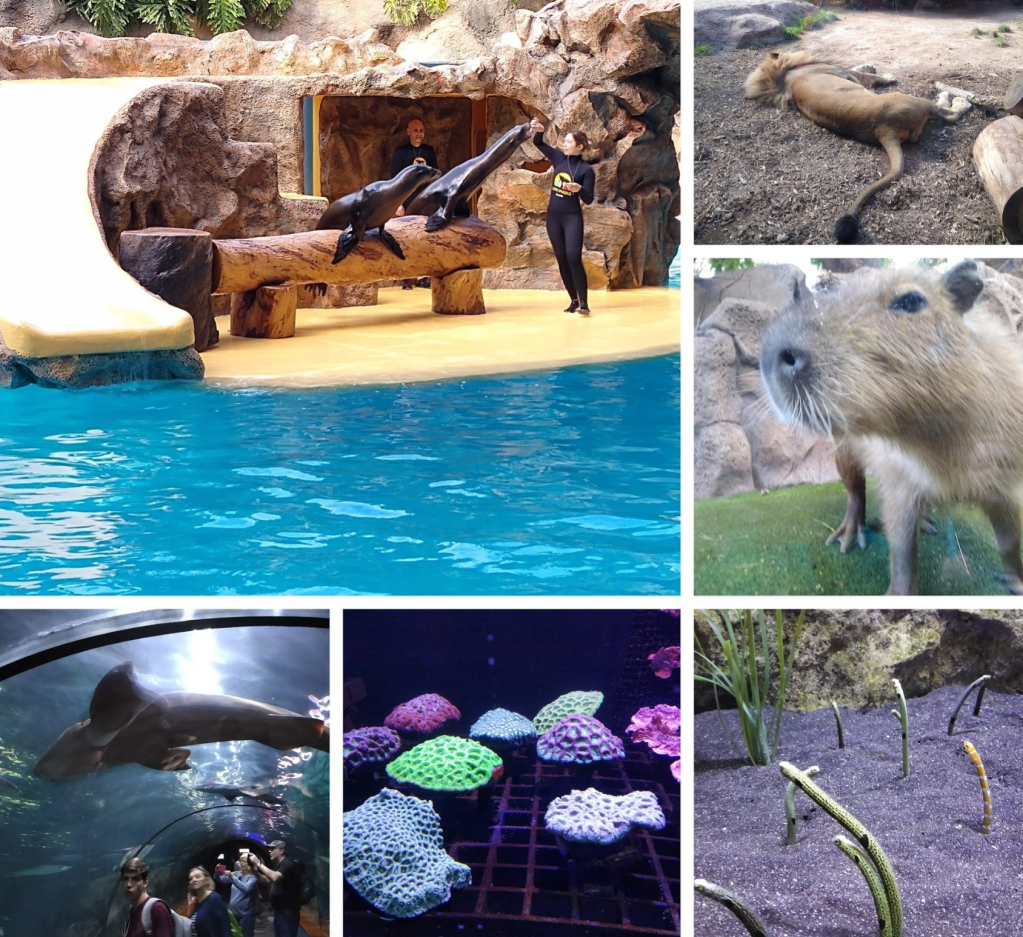
We made the most of the day and saw the Orca Show, the Parrot Show, the Dolphin Show and the Sealion Show, which were all good fun. The most lively performers were the leaping dolphins, but the Orcas made the biggest splash, soaking the people in the front rows. The big mammals and reptiles mostly just sat there and slept or watched us watching them. The Giant Anteater was very lively, and took the prize as the most bizarre looking creature.

Sea Lions, Sleeply Lion, Capybara, Shark, Coral being cultivated and Garden Eels
Penquin World, above and below water

Most zoos have a concrete pond painted white for the penguins. Loro Parque had a huge indoor environment for its collection with constant “Snow” falling from the ceiling and a slow travelator that took you around the enclosure, it was very clever. It was also very whiffy, you could smell the penguins fishy pong before getting into the enclosure.

The most impressive area for me was the huge aviary with a treetop walkway. We arrived at feeding time and saw parrots, cockatoos and egrets close up eating their rations of vegetables and seeds. They are very colourful and vocal, it was great getting so close up to them.

There is also an amazing aquarium with a tunnel beneath a tank of sharks, rays and groupers, it was like diving without all the annoying scuba business!

Loro Parque did live up to its reputation, and it was the best zoo I have been to. I understand all the ethical reasons for not having zoos, but I did enjoy it and felt slightly bad at the same time. But I have now seen Sea Lions, Penguins, Dolphins, Tortoises, Parrots, Orcas and Iguanas, so I don’t have to fly to the Galapagos. Think of all the air miles I am saving, I’m sure Greta Thunberg is proud of me.

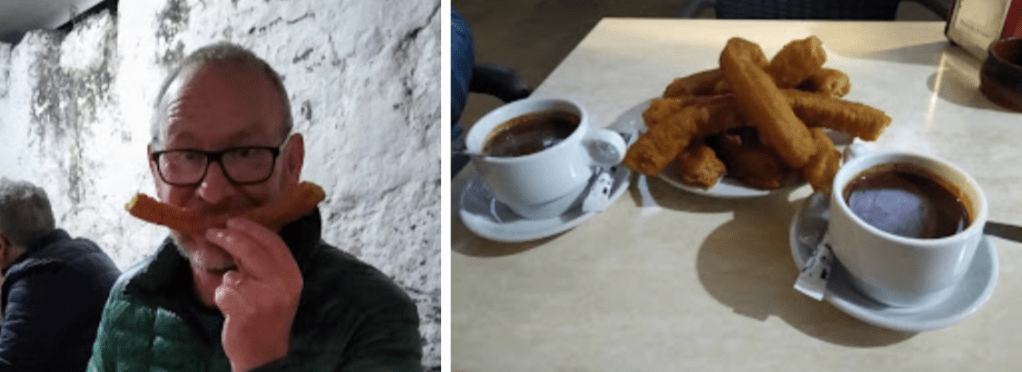
On our way back home we had some fish for dinner, followed by churros and hot chocolate at Churreria Perdomo. Churros are doughnut mixture extruded into hot oil to make long crisp cakey things. Fattening and delicious, ‘Food of the Gods!’

Mmm churros…

Anaga Park

In the north west corner of Tenerife is the Anaga Park, a wild region of forested mountains almost a thousand metres high. The TF 12 road from La Laguna to the Visitor Centre at Cruz de Carmen is very windy and narrow. Passing the big tour coaches on the narrow road is quite nerve-wracking, but it’s worth the drive.

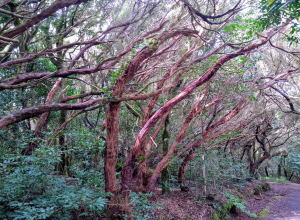
There are many different walks you can take from Cruz de Carmen, and we chose a five kilometre hike through the forest. The type of forest is called Laurisilva, an ecosystem that covered large parts of Europe before the Ice Ages, but now only found in fragments in Madeira and the Canaries. It’s a type of cloud forest of evergreen trees like laurels and heathers which grow to tree-size. It’s unusual and very cool, in both senses of the word!

Laurisilva forest

There are several Miradors in the area, view-points with parking. Close to the visitor centre you can look out over La Laguna, and at Zapata you can see the sea on both sides of Tenerife. You can watch planes landing at the Northern Airport. This airport used to be called Los Rodeos, and was where five hundred and eighty three people were killed when two Boeing 747 aircraft collided in fog in 1977, which remains the worst crash in history.

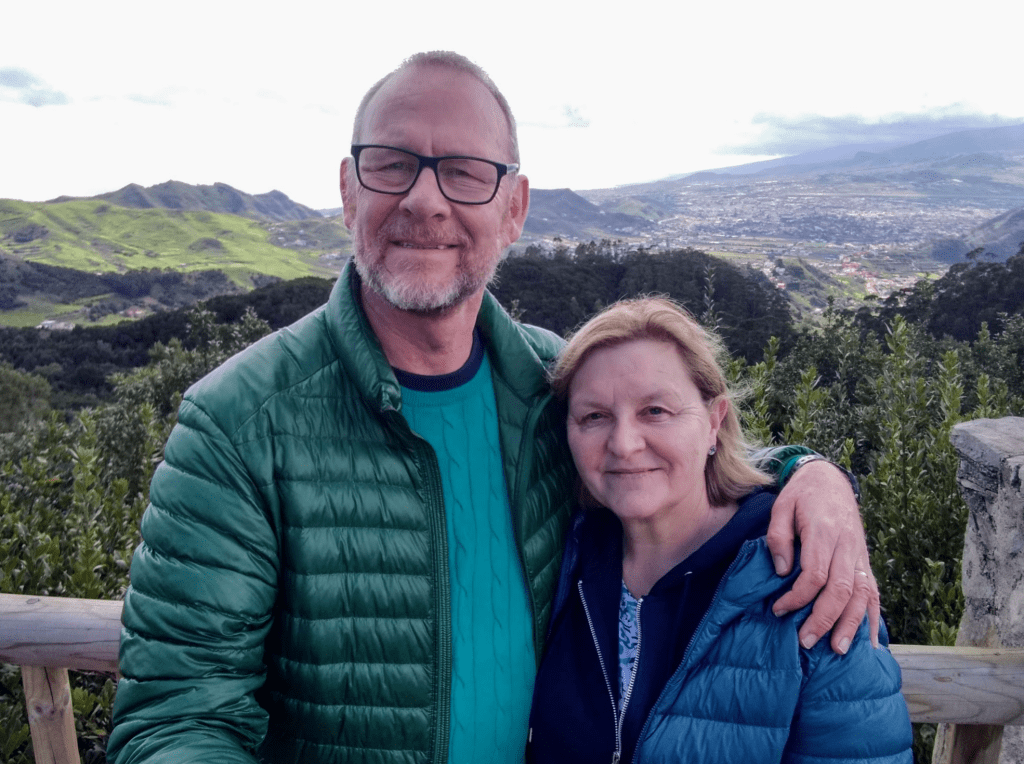
Zapata Mirador – me and Julie with La Laguna in the distance

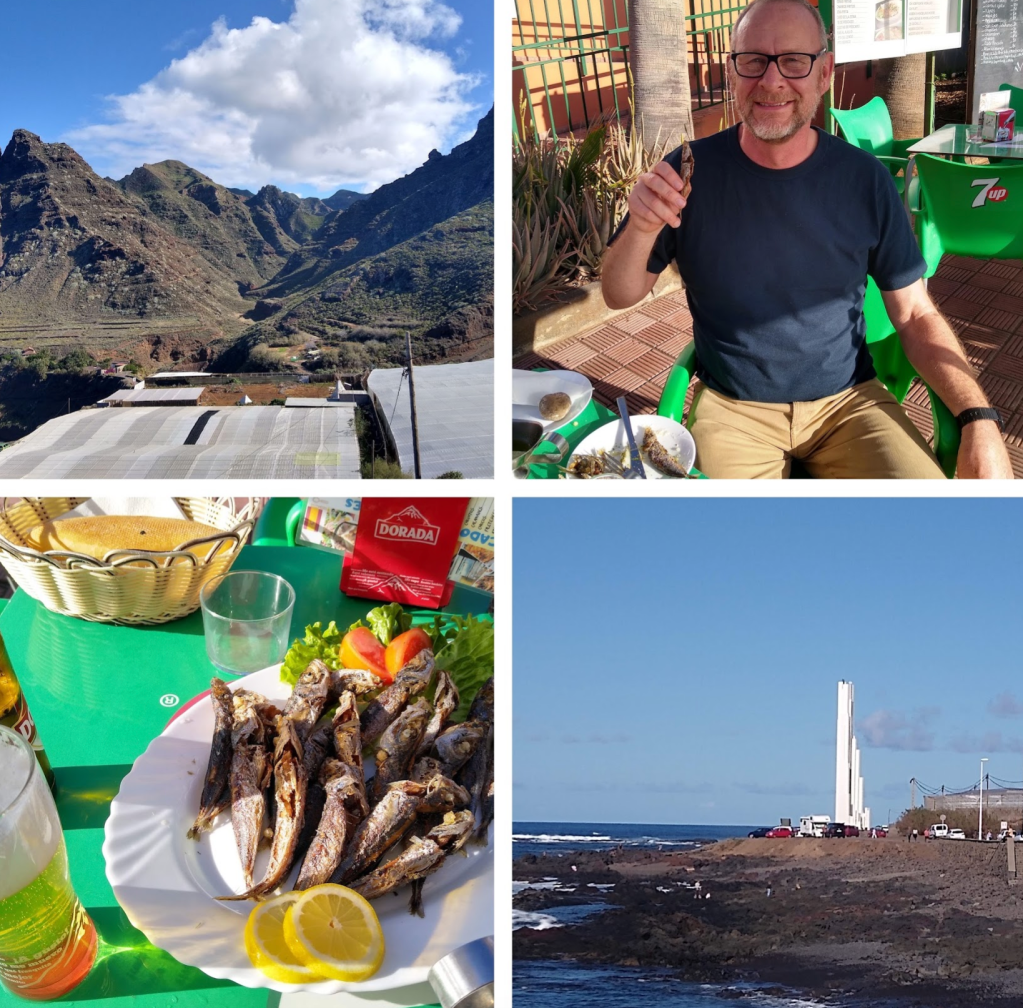
In the afternoon we drove down the mountain to Punta del Hidalgo on the north coast. It is best know for its modern lighthouse which is fifty metres tall and finished in 1992. The town itself is mostly holiday flats overlooking a rocky coast. There is a hiking trail from the coast all the way up to Cruz de Carmen.

There are a few restaurants on the sea front, and we parked ourselves in the sunshine for some beer (me) and Coke (Julie who was driving) and fresh sardines with wrinkly potatoes. Bliss.

Santa Cruz

There’s a line in “Withnail and I” from Richard E. Grant who pathetically exclaims, ‘We’ve gone on holiday by mistake”. I wanted to say that when we went to Santa Cruz, the capital of Tenerife instead of La Laguna.

It was a bit of an omnishambles day. The bus to La Laguna was late and full, so we stood all the way. The bus stopped at La Laguna tram station, but we didn’t realise where we were, so had an unplanned visit to Santa Cruz instead.

Brad Pitt’s helmet/concert hall

The capital has all the charm of Croydon on a wet Sunday. On the sea front is an enormous  concert hall that looks like a Greek helmet, not a practical design I would imagine. I suspect the architect thought Brad Pitt looked rather cute in his helmet in “ Troy” and then fitted an auditorium into his concept.

Brad Pitt’s helmet (fnaar fnaar)

Next to the helmet concert hall is another set of lakes designed by Cesar Manrique, like the ones at Puerto. They would be lovely on a summers day, but it wasn’t sunny or warm when we were there. It was the only day I wore shorts, and it was bloody cloudy.

I was sulking a bit on that day, can you tell?

We wandered aimlessly until we found a pretty street (possibly the only one) with some restaurants in it. Bonvieda had lots of people and an interesting menu so we plonked ourselves down there and hoped for the best.

Iberian Secret and me waiting for dinner, being a bit sulky
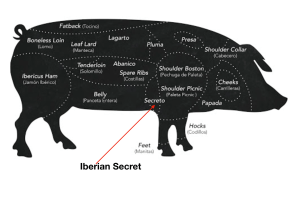
Maybe it just secretes in that region when it’s hot

An item on the menu stood out, Iberian Secret. Google gave a description as “armpit of a pig” which appealed to me. The delightful waiter recommended it, so I went for it. It was short strips of grilled pork on a bed of sauteed potatoes and apple, and it was unusual and quite tasty. 

In a slight food coma after dinner, we went round the Museum of Nature and Man, which was all in Spanish and a bit underwhelming. It covers the natural history of the island and its archeology. The inhabitants of Tenerife  before the Spanish arrived were the Guanches, who are thought to be related to Berbers. Inevitably the invaders killed them all, and the museum displays their pottery and mummified remains, which are quite gruesome.  Not recommended after an Iberian Secret.

La Laguna

Having exhausted the limited delights of Santa Cruz we took the bus up the hill to La Laguna, the oldest town in Tenerife. It is set out on a grid of streets which they probably copied from Milton Keynes some time in the 16th century. There are lots of old buildings and bars, but on an overcast Sunday afternoon it wasn’t exactly hopping with Latin joy and exuberance.

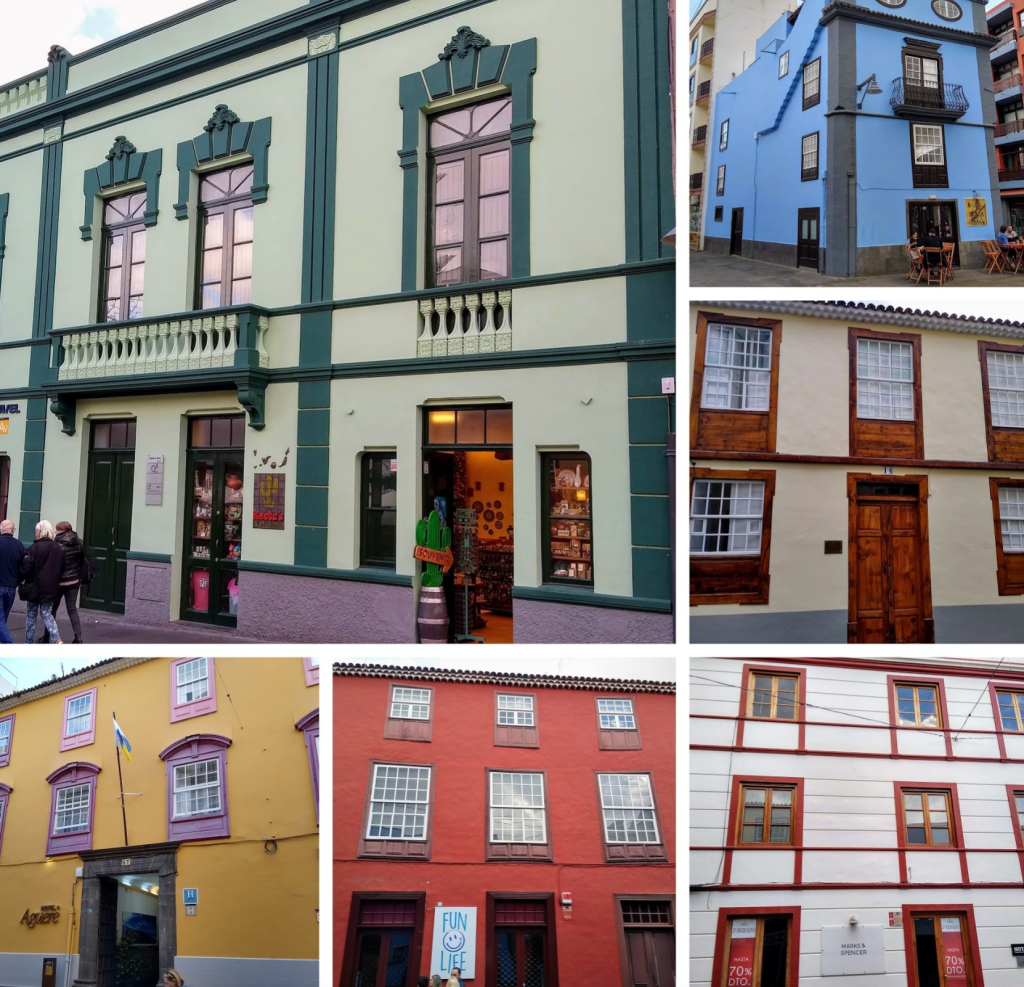
Multi-Coloured Cropped Shops in La Laguna

There are many colourful old buildings to enjoy, but I think our day had already peaked with Pigs Armpit.

Garachico

A thirty minute drive to the west of Puerto de la Cruz is Garachico. We got there early (10.20 am), before it started to fill up with coach tours and still retained its charm.

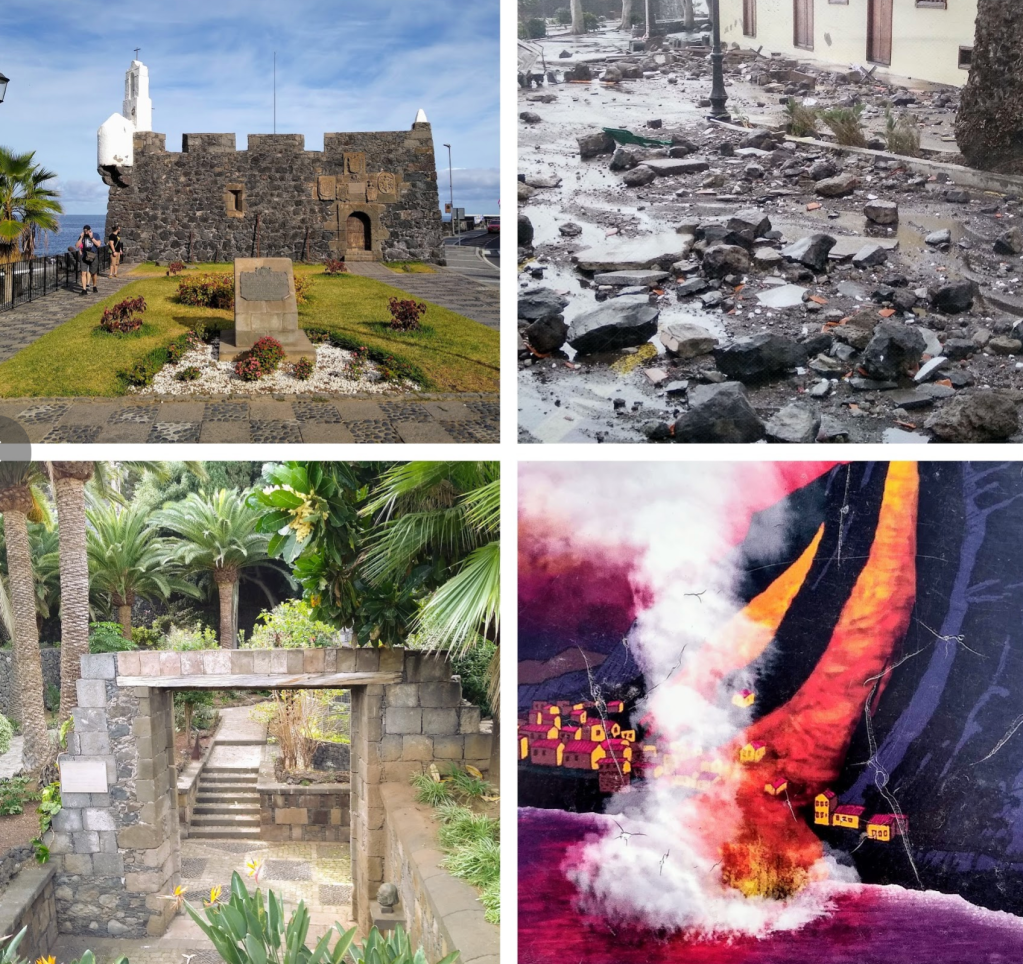
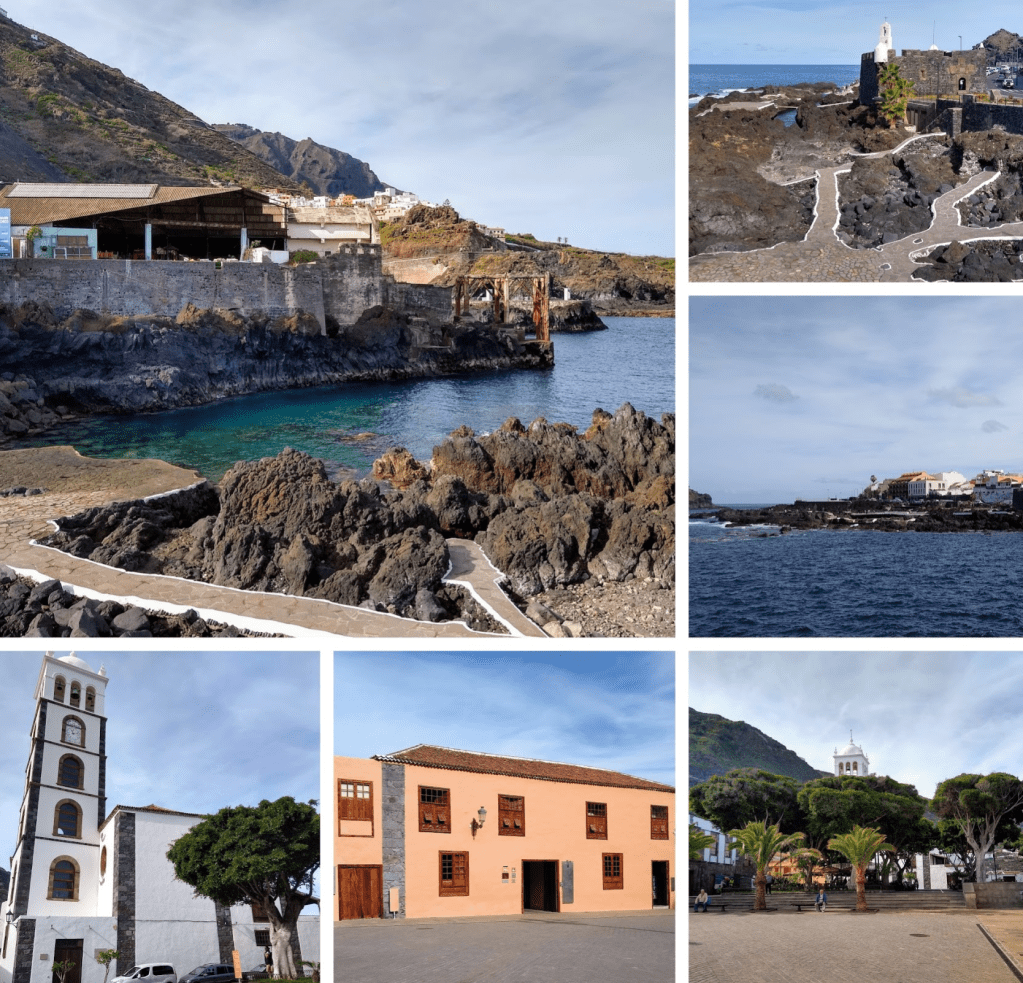
It is a very pretty small town on the coast which was once the most important port in Tenerife, shipping out sweet  Malmsey wine to Europe and America. But on May 5th 1706 the Trevejo volcano erupted and poured lava into the harbour completely filling it and destroying its trade.  Mostly the shipping moved to Puerto de la Cruz, and Garachico lost it’s leading role. The old gate to the port has been excavated and stands in a small but very pretty park. The old castle protecting the harbour was missed by the lava flow and still stands protecting the sunbathing area from pirate attacks.

Castle, storm damage in 2018, the old port gate and an illustration of the eruption

There is a lovely central square with a church and some grand buildings and cafes.  The are some pretty narrow streets, and a seafront with seawater bathing and places to sun bathe. The town was bashed around a bit by storms a couple of years ago, but has recovered now.

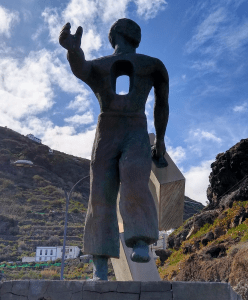
I left my heart, in Garachico

A few hundred metres up a hill to the west of the centre, is a look-out point with an unusual statue of a man carrying a suitcase and a hole in his chest. It is said to represent one of the many emigrant who left Garachico for Venezuala and left their hearts behind.

A Good Place for a Winter Holiday

We had a very good time in Tenerife for a week. Being ancient, we didn’t really sample the night life, but I’m sure there was plenty to do in Puerto at night. I took my Chromecast with me so settled on the sofa in the evening with Netflix, beer and snacks.

There are loads of things to do for a week in January. The weather isn’t really hot, but there were plenty of sunbathers on the beaches and even a few people swimming.

Best of all you can fly from Gatwick in the morning when it’s literally freezing, and be in warm sunshine just after lunch in Tenerife.

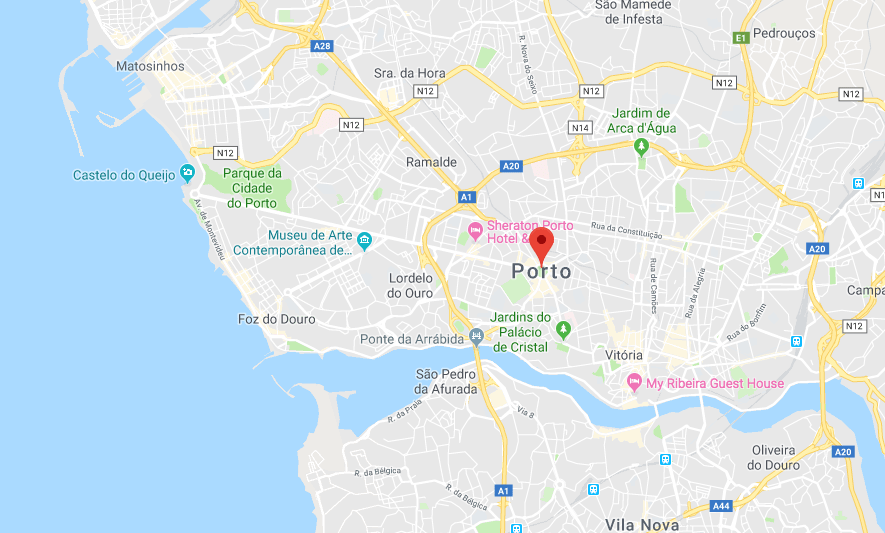
Oh Porto!

Sunday 1st September 2019

As you read this I’m drinking Port in Porto in Portugal, which has a wonderful triple symmetry unmatched in the world. The closest I have got to that previously is to drink a beer in Beer, but that’s in Devon and not in a fantasy county called Beershire. Close, but no cigar.

Me Julie and I are here for a few days to enjoy some September sunshine, eat fish and drink Port. Except Julie is on a medicine which precludes her from imbibing, so I’m drinking her share of the Offley Tawney that I just got from the Froiz supermarket over the road.

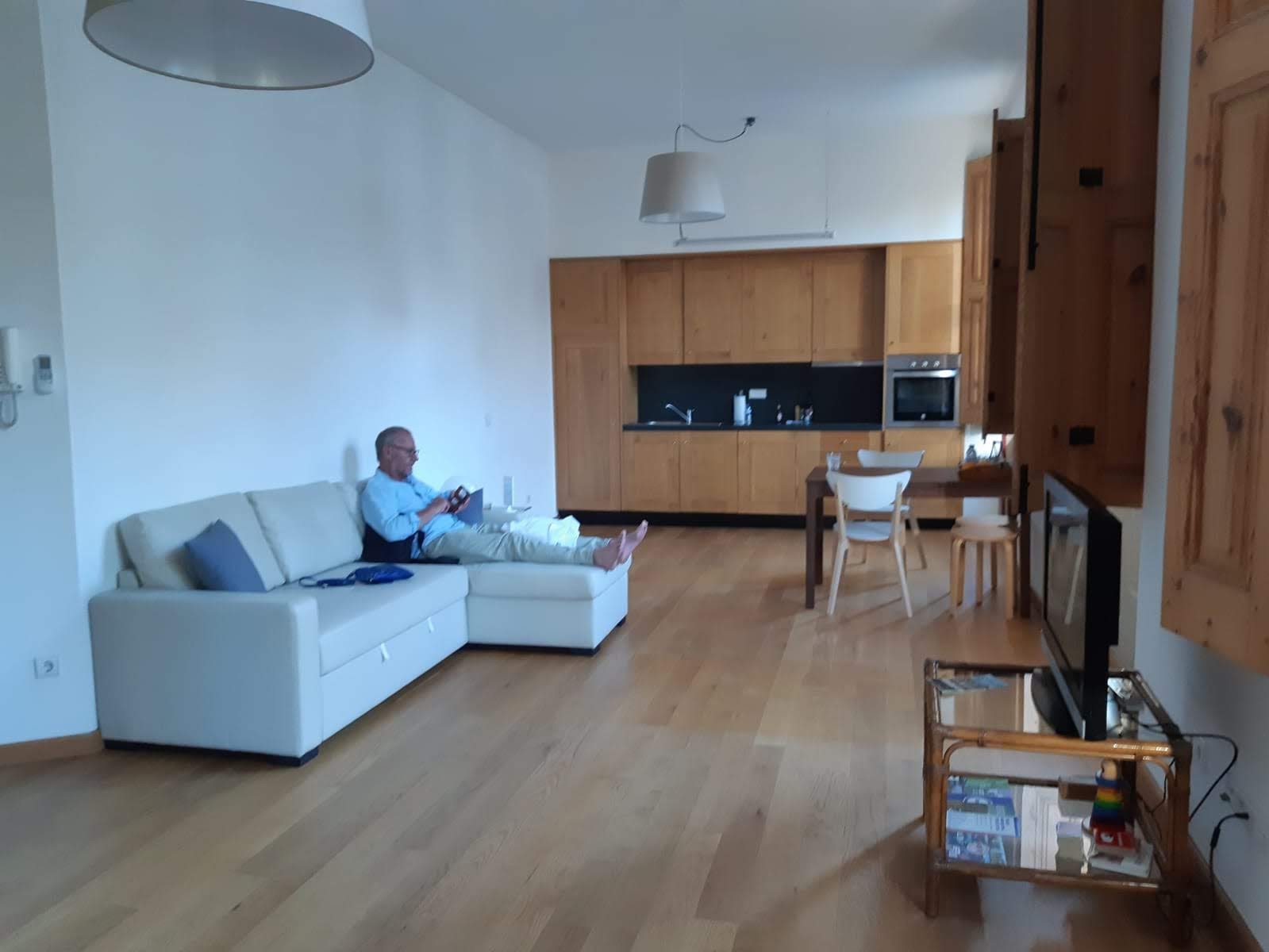
Our flat near Trindade in Porto

We were wafted here from the paradise that is Luton Airport by EasyJet, ninety minutes late because the French air traffic control system has gone tits-up. I expect some farmer ploughed up the fibre network in a fit of pique because he lost his cheese subsidy or something.

Porto has a very nice airport and a very nice metro system which look us to the very nice Trindade station. Sorry I’m tired and I just ran out of adjectives other than nice. We bought a three day unlimited ticket for buses and the metro for 15€, so we wouldn’t have to keep buying tickets, which is also nice.

Our AirBnB is very close to the station and our host is a stylish lady called Mariana who has a perfect bob haircut and a good list of local restaurants.

The flat is very spacious, with wooden floors and stone walls and a minimum of decoration. It is close to good places to eat and Mariana recommended Cervejara Brasao. It was a few minutes walk away and there were already people queuing to get in when we arrived. The waiters are young and dressed in dungarees, the decor is dark wood and the atmosphere is lively.

I ordered the “mixed grilled meat” and Julie ordered the Francesinha. I got a huge dish of pieces of steak and frankfurters in a spicy gravy with grilled cheese on top. Weird, but tasty and there was plenty of it. Julie got a steak and ham sandwich which was covered in cheese and grilled, served in a beer and tomato sauce with a fried egg on top. It really was a mutant meal that you might expect to get in a diner in Louisiana to feed hungry truck drivers. She had a half portion, which was massive, a full one would could have been fatal, definitely a heart attack on a plate.

Unusual food at Cervejara Brasao

We came out having been well fed, but our palates were not titillated. The local beer, Superbock, ain’t very super, and came in a big ceramic mug without a handle. The food was quality rather than quality, but definitely different.

On our way home stopped at a supermarket on the way home and I bought the Offley Port for my digestif/pudding. It was excellent Port, but then again I like all Port, I’m a not fussy drinker.

Why (you may ask) is the title to this post Oh Porto. In England we used to call the city Oporto rather than Porto. That’s because o Porto means “the port” in Portuguese. Its similar origin to the name of the city of Bombay (which was a Portuguese colony) – it simply means good harbour.

Monday 2nd September

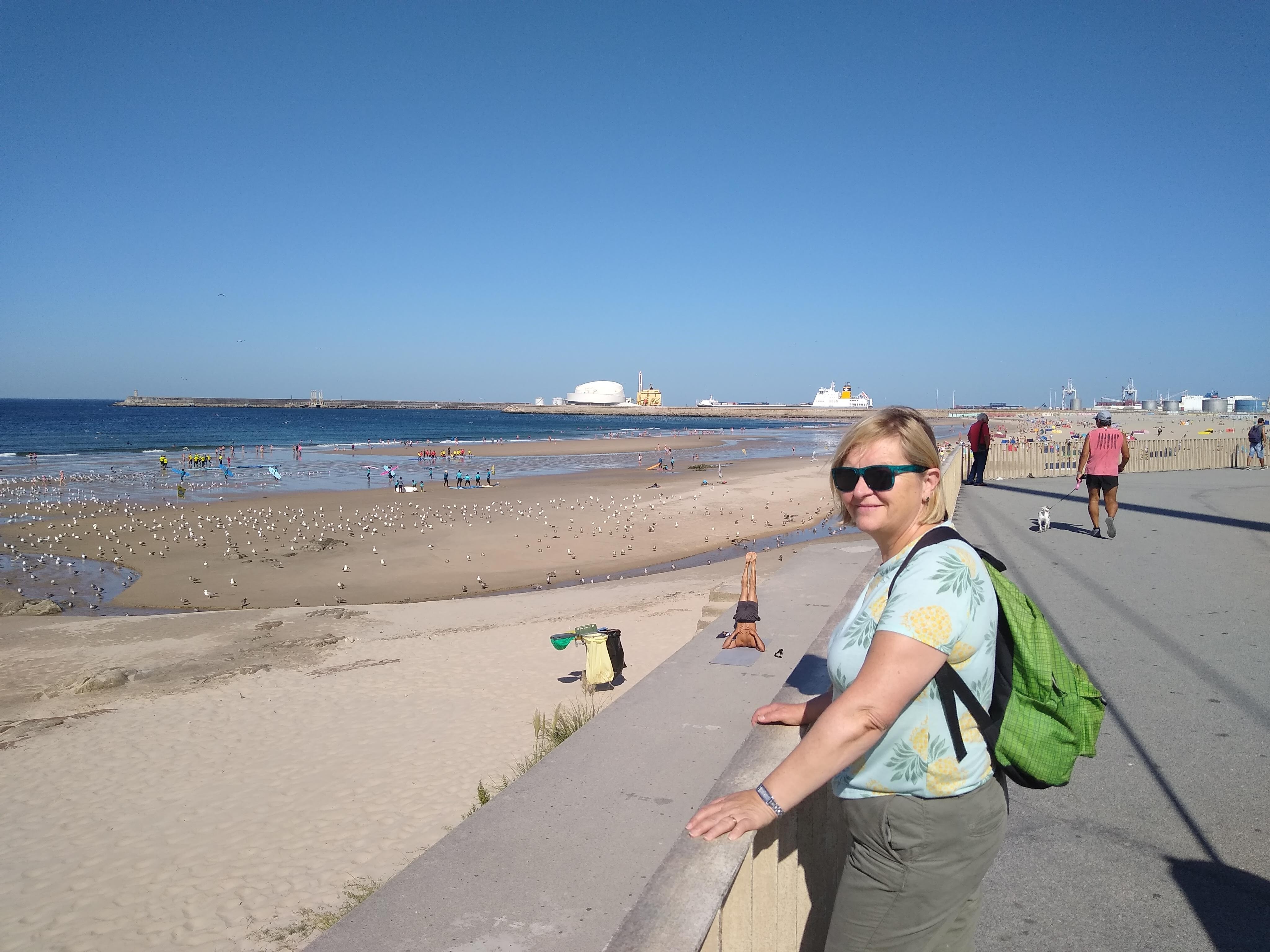
On our first full day in Porto, we got the the 500 bus from Sao Bento station to the seaside at Matosinhos, a suburb with a commercial dock and the best beach in the area. After a leisurely coffee at a beachside cafe, I went for a swim in the Atlantic. The sea was busy with teenagers in wetsuits learning to surf, I just had my covering of natural lard to keep me warm – and it was not effective. While maintaining a calm appearance, inside I was screaming “it’s really jolly cold and unpleasant”. I maintained a stiff upper lip (and shrivelled gonads) and swam around for a couple of minutes before emerging from the freezing waters like Daniel Craig in Golden Eye (except for the buff body).

Matosinhos beach

A couple of hundred metres from the beach is a large Lidl, so we bought some portable comestibles and found a shady tree. The temperature was over thirty degrees, and even the mad dogs were in the shade.

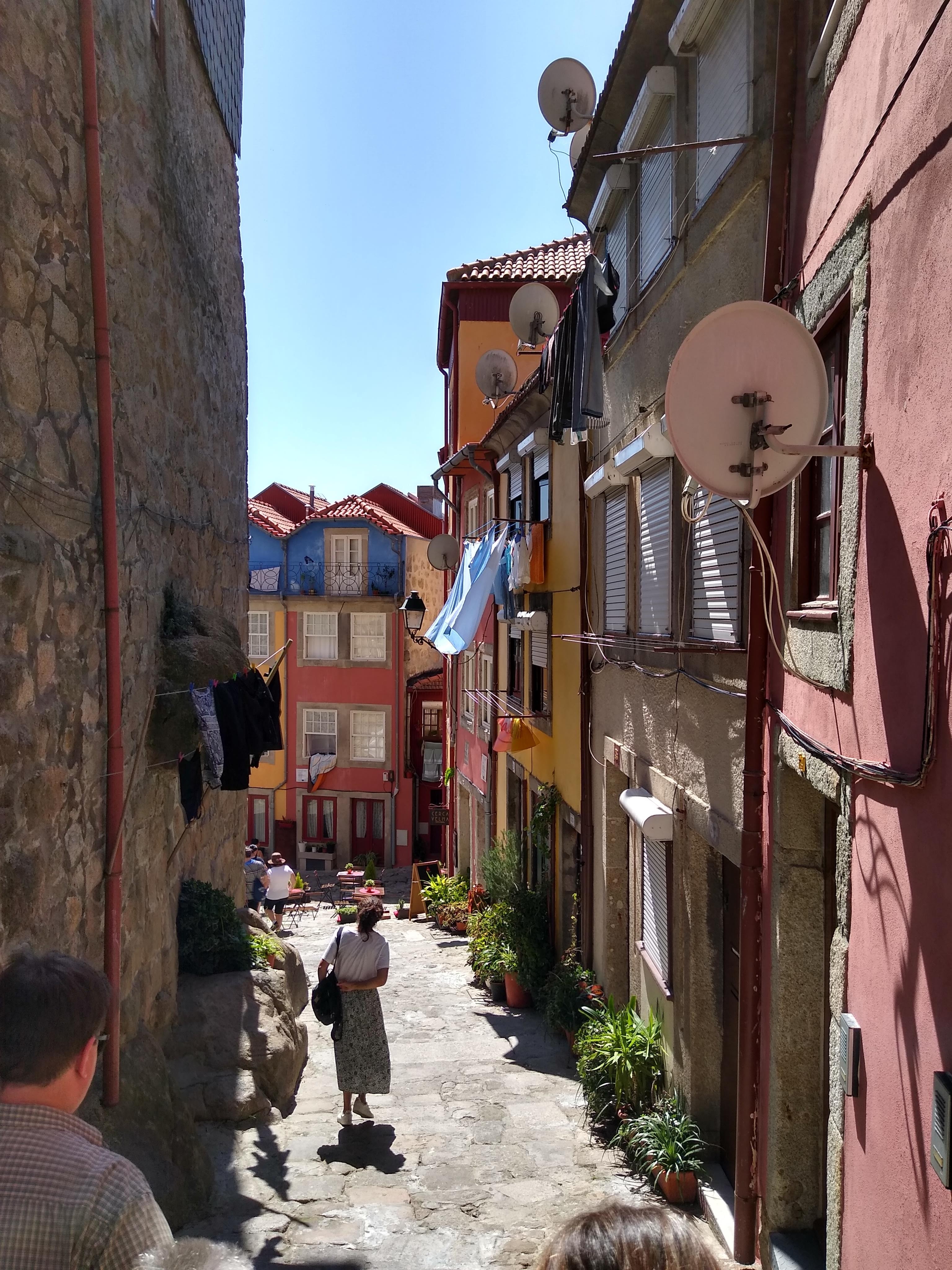
The 500 bus took us back to the city centre, and we met up with a group of people for a walking tour of Porto with Carlotta. She is a late twenty -something history graduate, who knows everything about her home town. The walk was all within the confines of the old city walls which have now gone, except for a few remnants. Below the Gothic cathedral (the Se) there are narrow medieval streets which are gradually being improved and gentrified. But there is still washing hanging from upper stories and even a big paddling pool in the street for hot neighbourhood kids!
The local swimming pool

There are also lots of pigeons, and one pooped on my shoulder, which must be good luck. I wiped it up with a tissue, and an American lady cleaned my shirt with a detergent pen she had in her bag! Bugger me Americans are clever.

The steep narrow streets of the old city

The streets are steep and picturesque, and bear the names of the craftsmen and merchants that lived there, such as the belt-makers. At the bottom of the hill is the riverside district of Ribeira, which was once home to the busy trading quays of the city. It was from here that Henry the Navigator set off in 1415 to sail to west Africa. Ribeira is now the touristic heart of the city, with bars and restaurants lining the riverside next to the Douro.
Ribeira Square

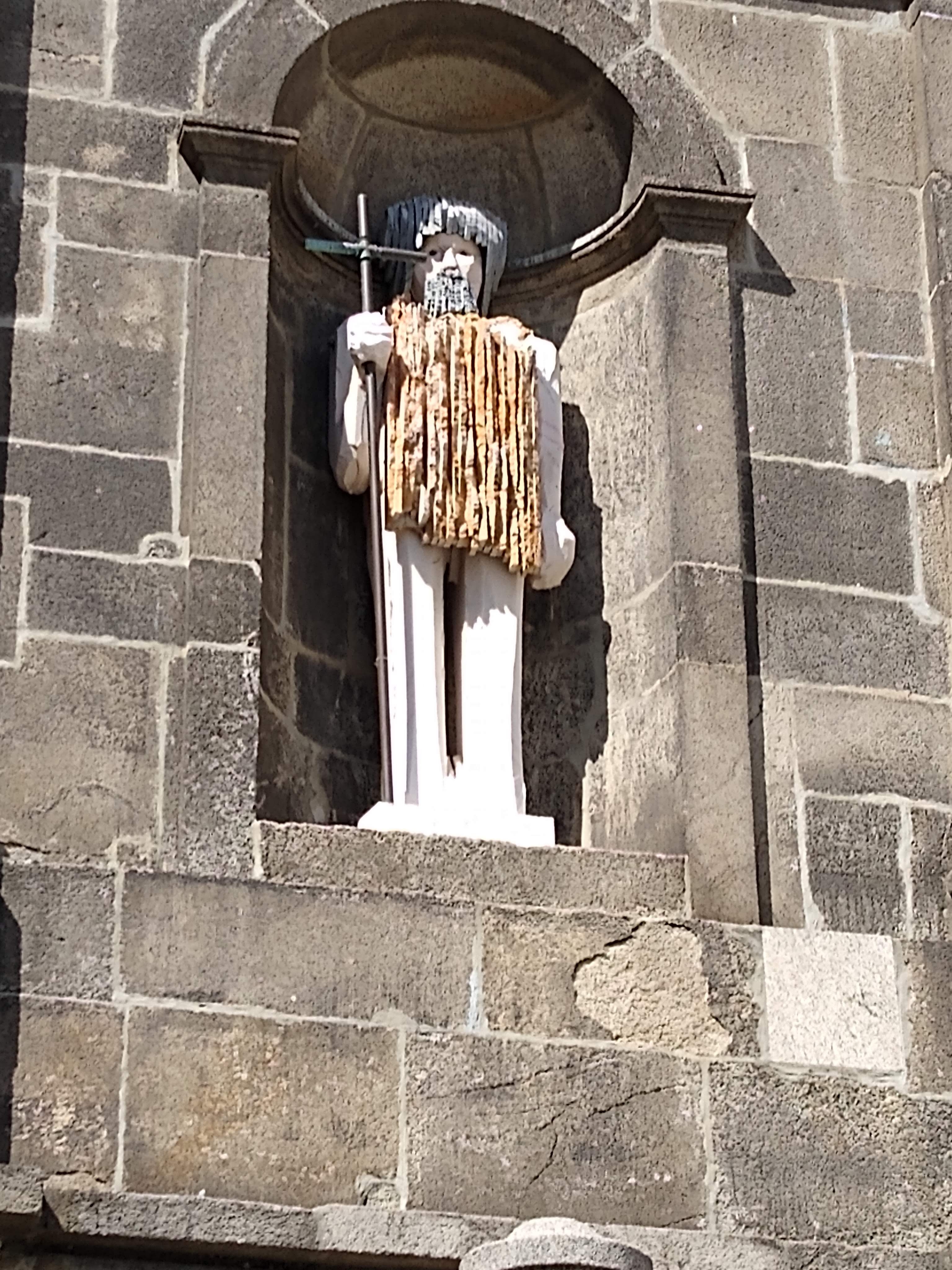
Ribeira Square has a peculiar statue of Saint John, known locally as the Lego Saint.

St John, the Lego Saint

Dominating the view is the Pont Luis bridge, a massive two level structure designed by a student of Eiffel (who built the Pont do Infante to the east).

The Luis 1 Bridge and Ribeira waterfront

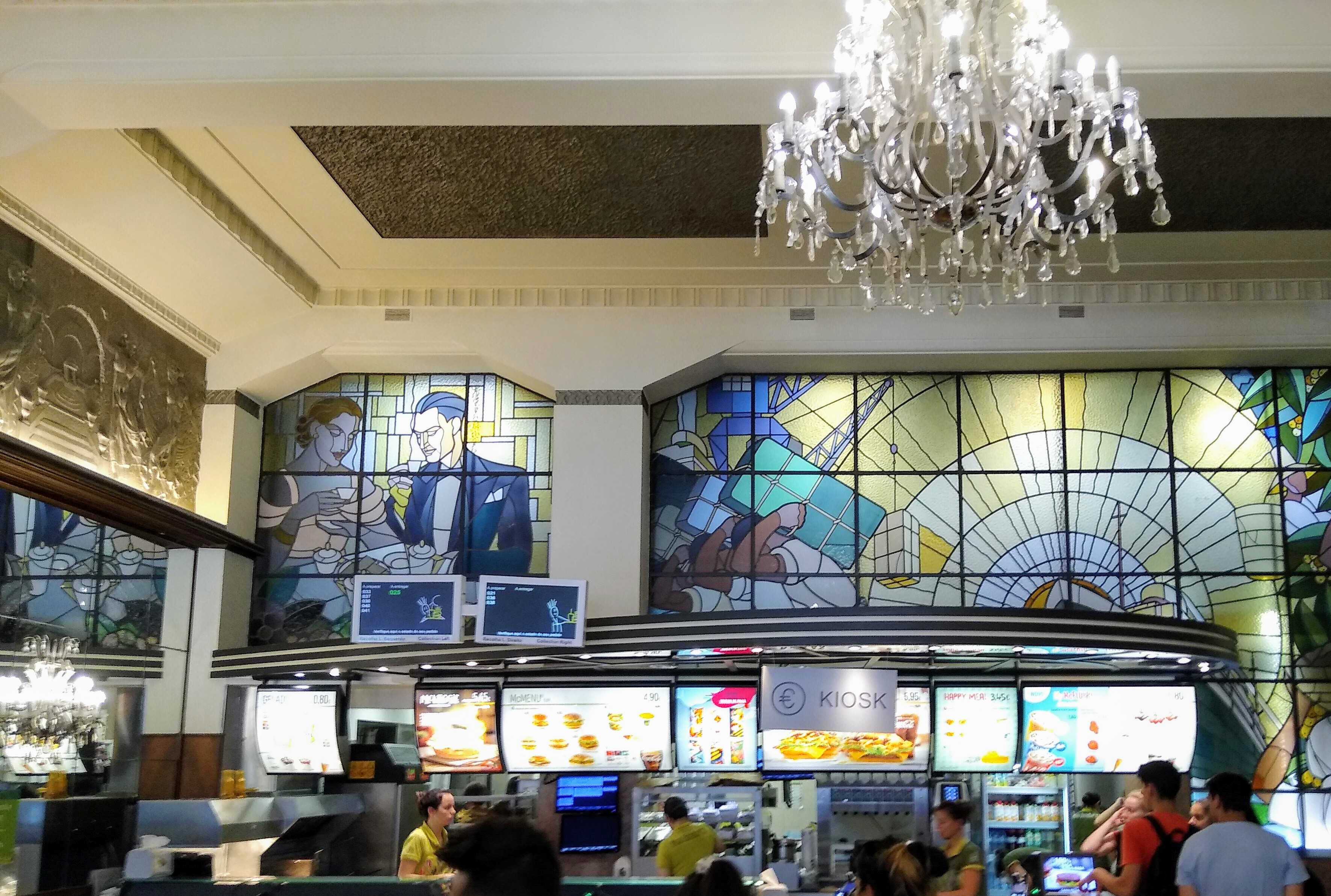
We progressed uphill to see more historical sites, and the day got hotter and we all got more tired. By the end of the tour in Praca da Liberdade we were hot and tired and ready for a visit to “the most beautiful McDonalds in the world”. It used to be a posh cafe, and all the lovely Art Deco decoration had been kept. I had a delicious ice-cream sundae and Julie had a Sprite, we were properly chilled. I don’t go in fast food places often, so I still think of them as a treat, just like a kid!

The lovely MacDonalds in Praco do Municipo

The last stop on the tour was Sao Bento railway station, which our guide alleged was “the most beautiful railway station in the world”. In actuality it is a very ordinary station with an entrance hall with beautiful tiles on the wall.

Sao Bento station

In the evening we returned to Ribeira and visited the Bacalhau restaurant for some bacalhau. It is salted cod, the Portuguese national dish and a ubiquitous favourite. Julie has a sort of cod risotto, and I had cod on a bed of potatoes, onion and egg. it was all very delicious, especially accompanied by a glass Vinho Verde.

After dinner we sat outside a bar by the river and watched people pass by in the warm night air. There’s no better entertainment than watching the variety of humanity and saying rude things about them (quietly of course).

Tuesday 3rd September

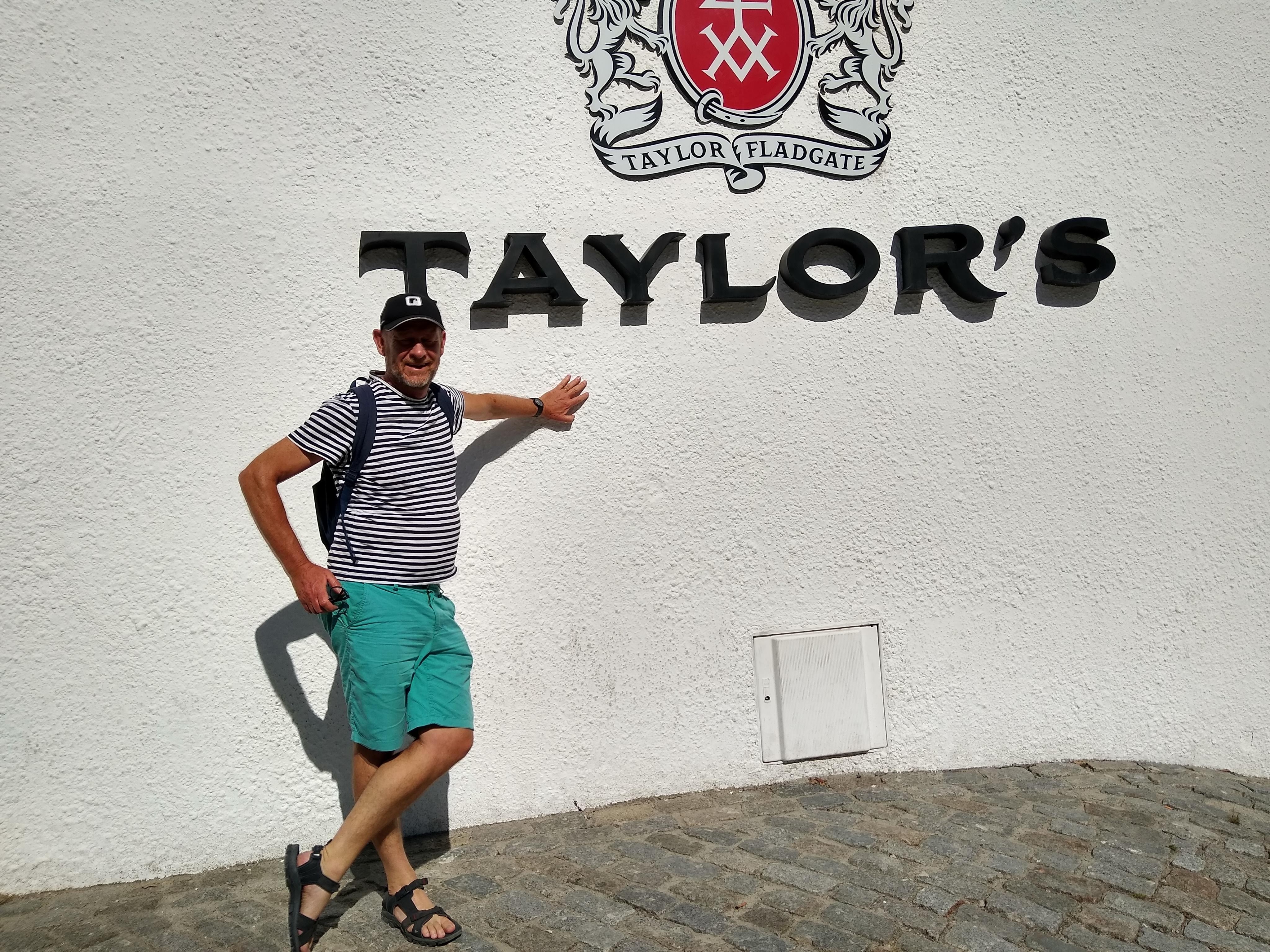
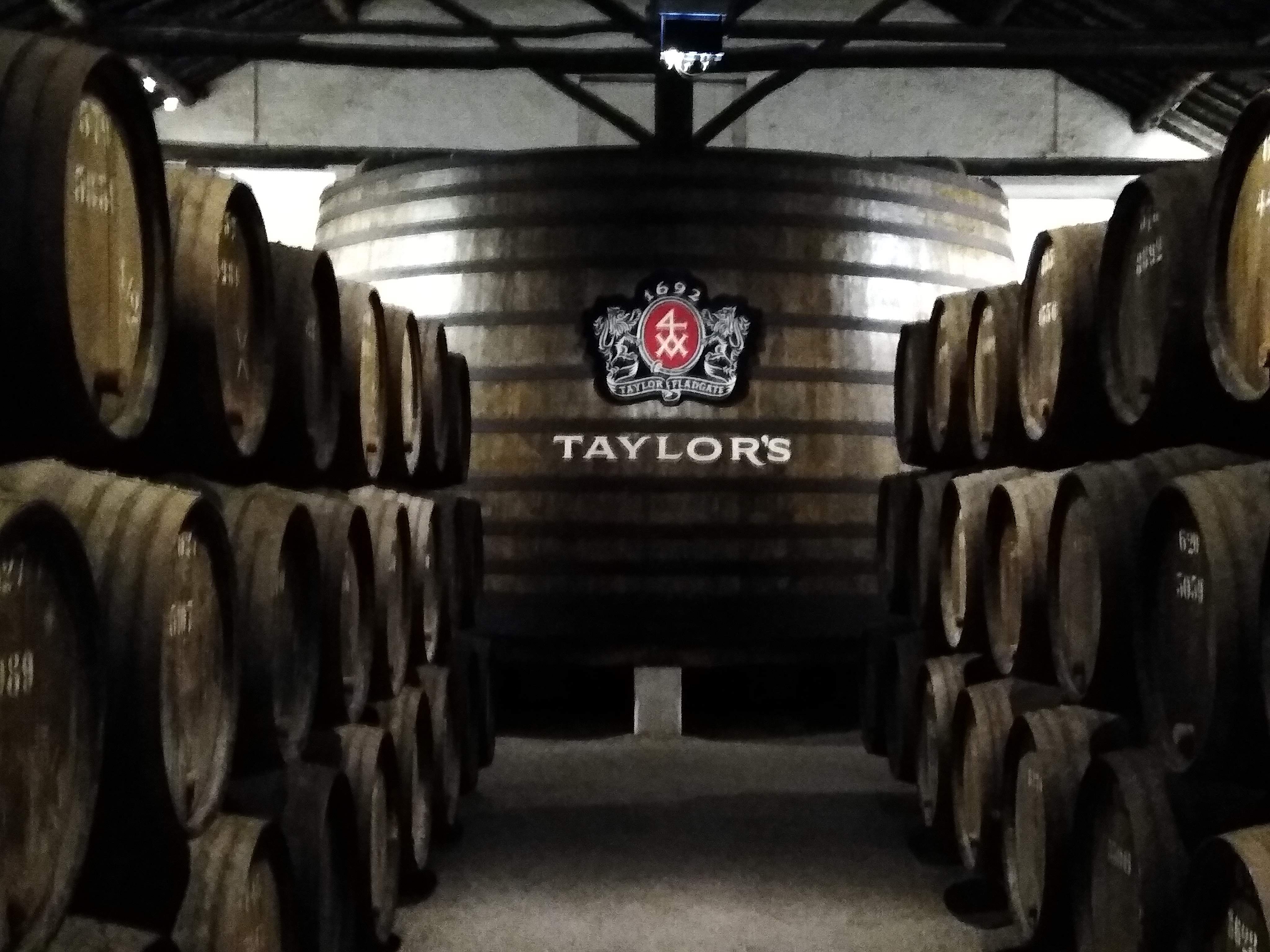
On our second full day we decided not to exert ourselves much, and keep out of the sun. So we got the Metro to Gaia on the other side of the Douro river to see how Port wine is made.Gaia is home to all the major Port producers, and they all offer tours of their facilities. After much discussion we decided on Taylors, and walked up a steep narrow street to their three hundred year old warehouses which are . The company was founded in 1692 by Job Bearsley, but is was his son which discovered the full bodied powerful wines of the Douro Valley to the east of Porto beyond the mountains. The weather there is hotter and drier, ideal for making wine with high sugar content. But Gaia, by the sea, is cooler and better for the long term storage and maturation of the wine. The casks (about 600 litres) and vats (thousands of litres) are made of oak and are kept in granite walled warehouses called lodges, which are always cool.

Guess where I am?
Casks and a huge vat in Taylors Port lodge

The Port wine trade developed more rapidly when the French government of Louis XIV banned the export of wine to Britain, so we got our booze from Porto instead, Hop Off You Frogs!

At Taylor’s we paid €15 for the tour, but it was really good. They provided an audio thingummy where you press a number on the keypad and listen to a description of the the room you are in. There were also very good displays and videos to watch in different rooms.

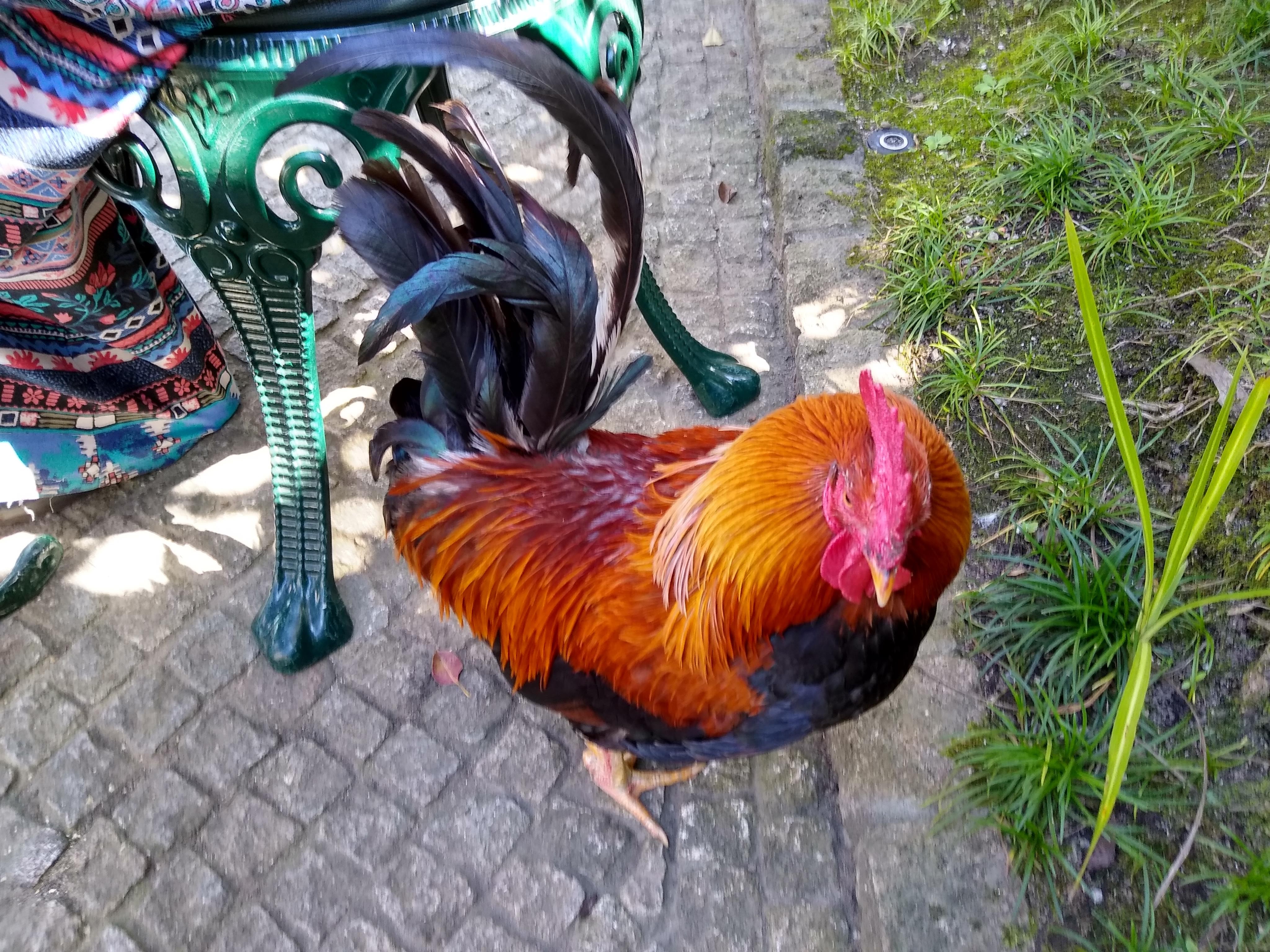
I am now a complete expert in Port, go on ask me a question. Go on, go on, go on, go on (as Mrs Doyle would have said in Father Ted). At the end of the tour there is a lovely garden to sit and eat over-price bread and olives. There are also some perambulating peacocks and cockerels. I was eating some bread and a cock stole some bread out of my hand, greedy cock!

The thieving cock that stole my bread!

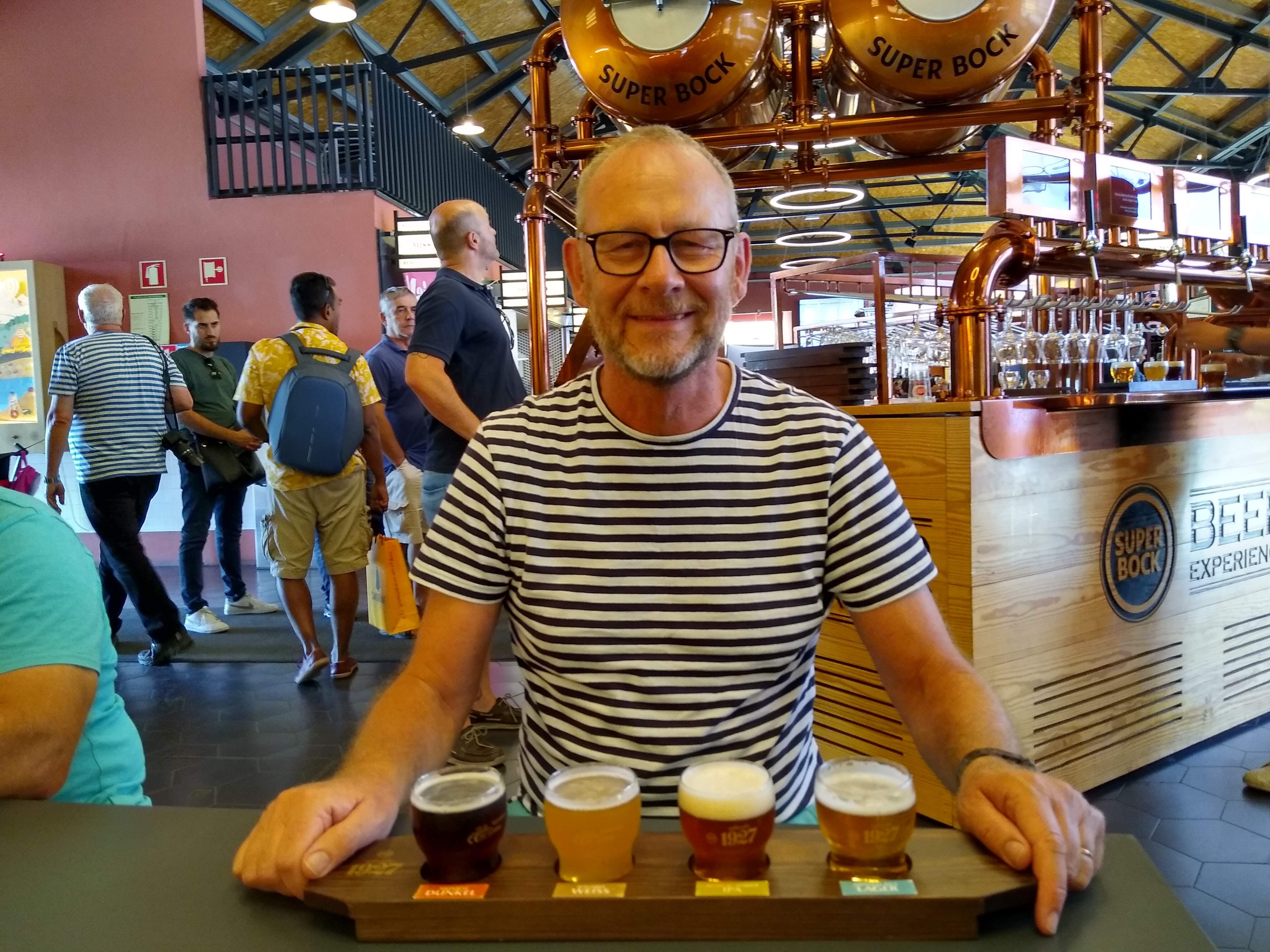
Walking down to the Gaia riverside we found a big indoor market with many stalls selling food and drink. I bought a “tasting plank” of four different beers, all quite tasty and better than the standard Superbock which appears to be the only beer available in most of Porto.

Mmm beer…

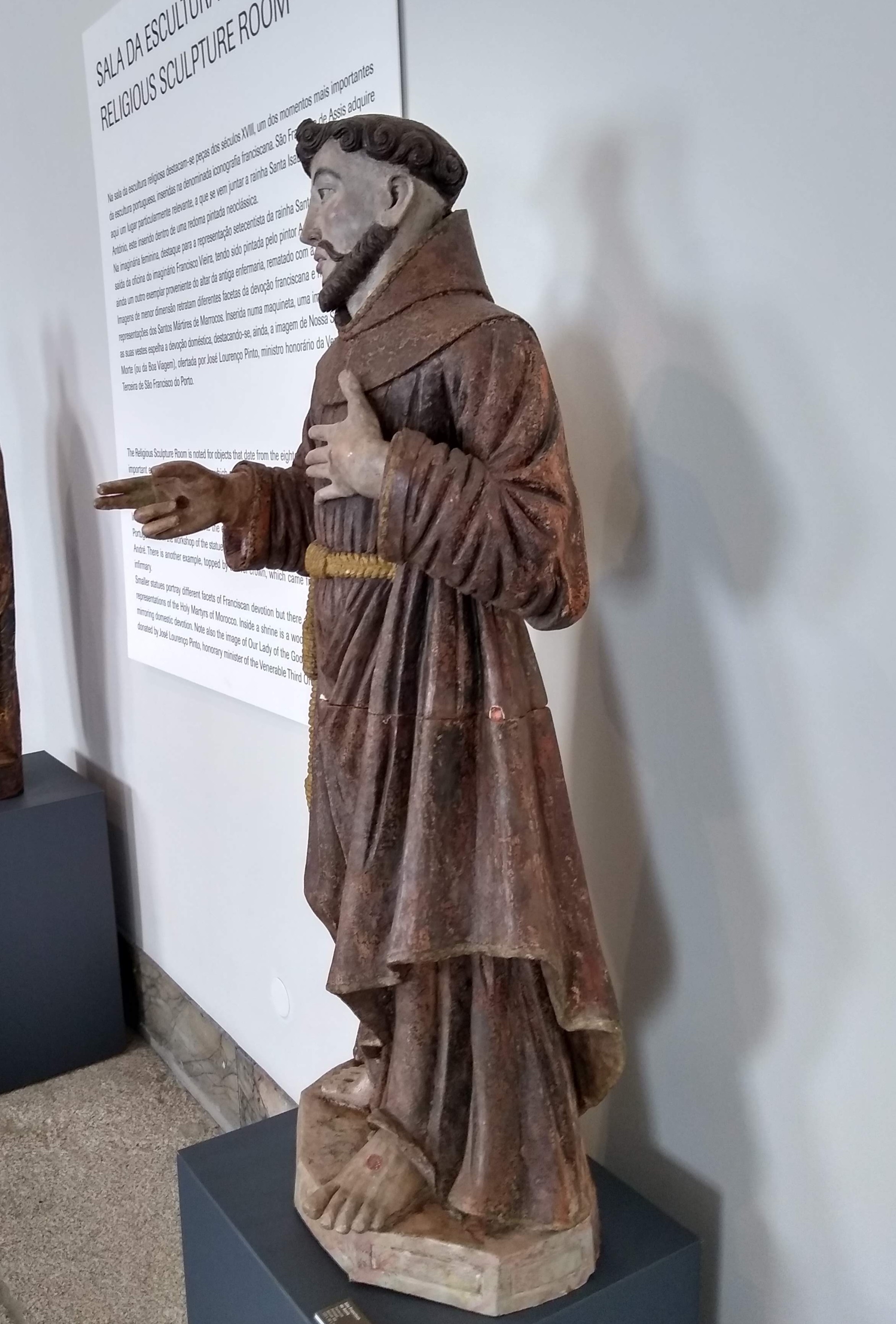
After lunch we lazily took the water taxi over the river to visit the church of St Francis. Our guide on the walk had said it was an unmissable spectacle with 400kg of gold leaf covering the interior. But I think they have been ripped off by the decorator. The interior was very ornate Baroque, every inch was gilded carved wood, but it looked shabby and dusty and was very disappointing compared to cathedrals and places I have seen in Spain. The catacombs were equally dull, unless you like carvings of saints and silver cups. I did quite like the statue of St Francis who looked like he was trying to rob a bank without a gun.

St Francis the useless bank robber

So after that minor let-down we got the bus back to the flat, had a shower and then got the metro to Matosinhos on the coast. It is famous for its fish restaurants in Rua Herois de Franca, foodies visit from many miles around. Because we are “careful with our money” we looked at the menus, saw that the fish was fifty Euros a kilo, and felt a bit faint. So we retreated to a side street and found O Lemo, a modest place much more fitting to our slender wallet. The mixed grilled fish (twenty two euros for two) was boney but tasty. It’s surprising how much meat there is on a large fish head.

Wednesday 4th August

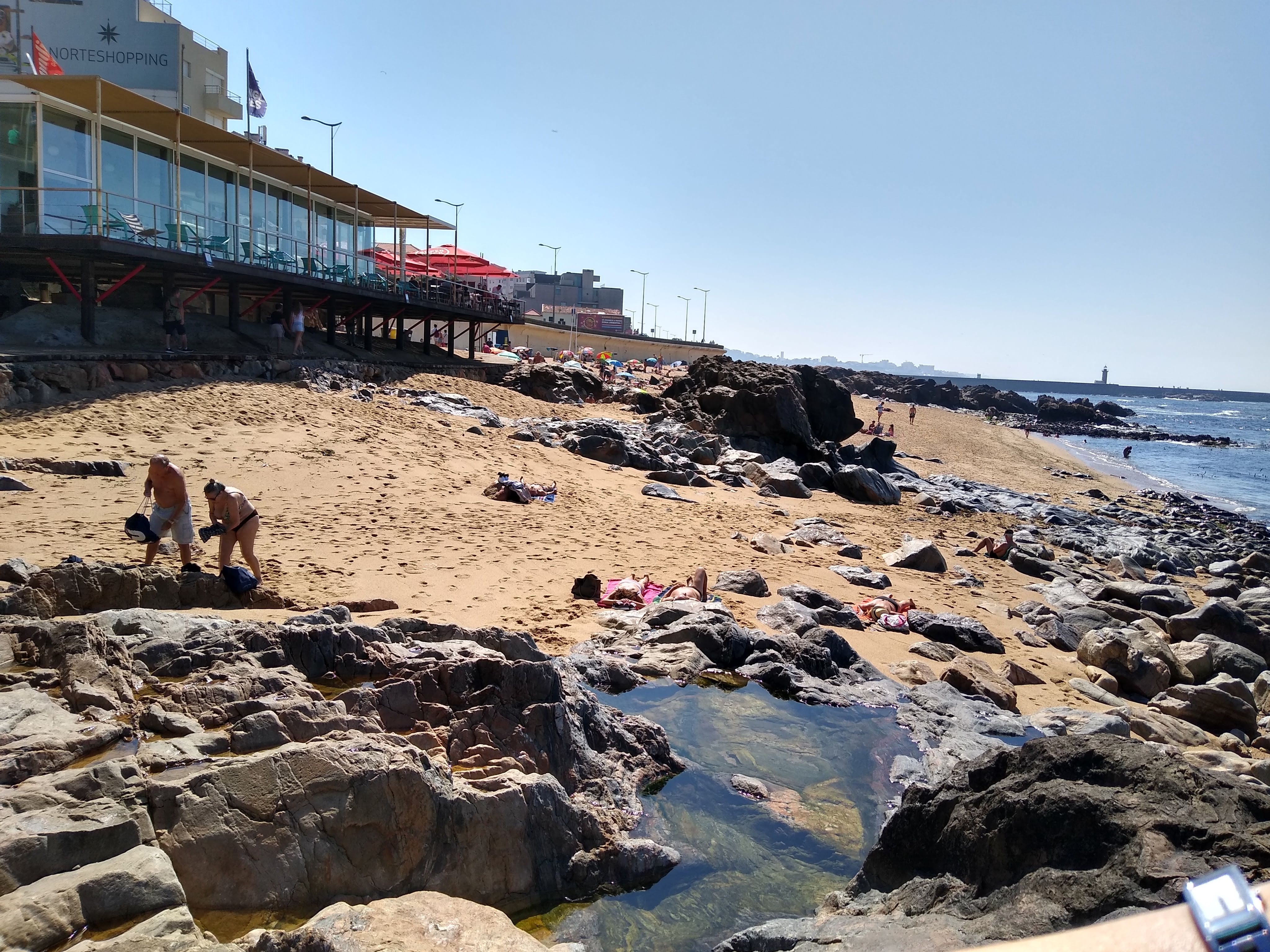
On Wednesday we got back on the 500 bus to Foz da Douro, a very pretty suburb at the point where the Douro river reaches the sea. It is small but moving up-market, as evidenced by the number of estate agents and an expensive whole foods store (like you get in Richmond). There are some lovely rocky and sandy beaches, we stopped at Praia dos Ingleses (English Beach) and sat of a big rock to watch the sea and people testing the water (but not going in).
Praia da Ingleses at Foz da Douro

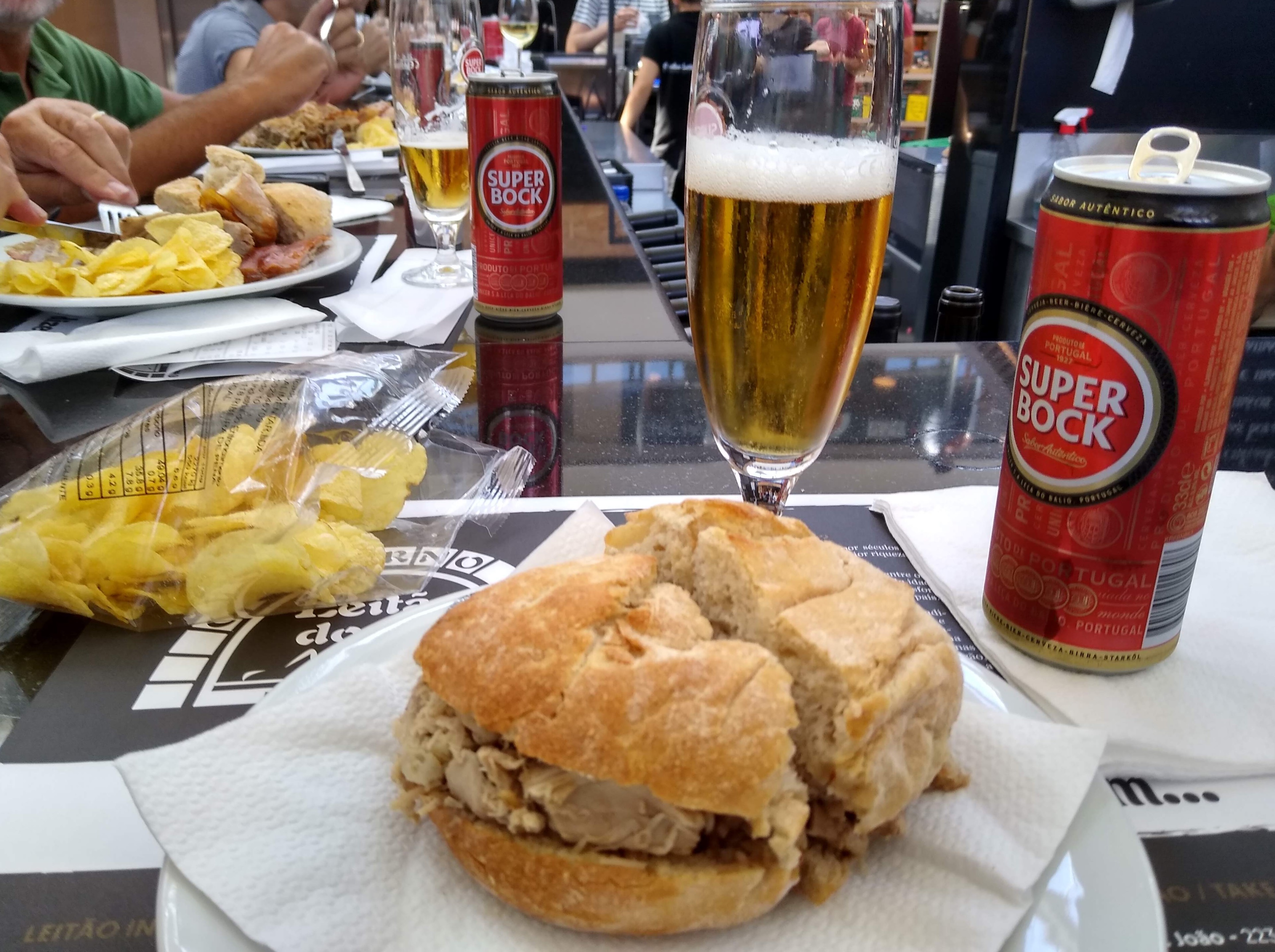
Walking away from the beach we stopped briefly at the Foz Mercado, which will be nice when the building work is finished. The 204 bus took us back into the city to the Boa Vista district to visit the Mercado Bom Successor, a huge concrete market that has been turned into a foodie centre with many different food and drink stalls. It’s a beautiful light airy building, with a great choice of different food styles. Today (as Jessie from the Fast Show would say) we will mostly be eating suckling pig. The pork came in a roll with a bag of crisps on the side and a glass of beer. Boy oh boy was it tasty! Sorry vegetarians, but meat does taste good.

This little piggy went to market – and then got eaten in a bun

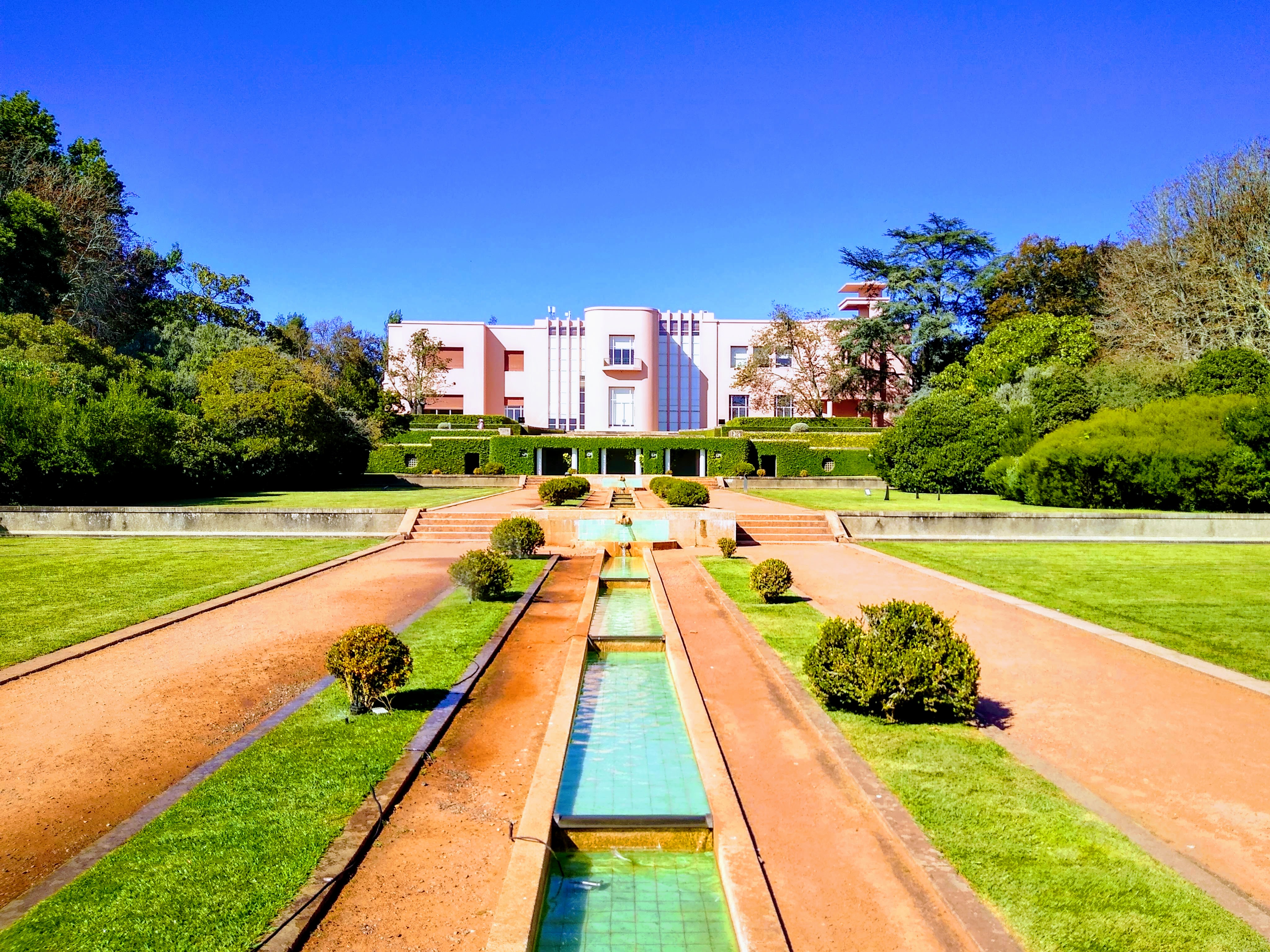
Tummy’s full, we got on yet another bus to Serralves, a modern art museum set in a beautiful park. We couldn’t just get a ticket for the park, so paid 12€ to see the modern art. It was mostly dull (my middle name is Philistine) apart from an installation with opposing mirrors which gave a clever repeating image effect. But the park is very lovely, and in it sits the Casa Serralves a stunning pink Art Deco building that houses a museum of Portuguese cinema.

Casa de Serralves

Another bus took us through rush-hour traffic to the Baixa district, which is very touristy, where we found a cheap (ish) restaurant for a simple dinner. A slightly annoying habit in restaurants is to casually plonk baskets of bread and olives and other starters next to you as you sit down. These are not complimentary, and appear on the bill at the end. They are betting on you being famished when you arrive, and grabbing at the nearest food!

My favourite piece of street art in Gaia

Worth a visit?

Porto is a beautiful city, which is small enough to walk round if you want to. There is plenty to see for three or four days, and its only about two hours flying from London. The food is not as good as French or Italian, but better than Stockholm. If you like fish there is a huge choice.

The transport system is excellent, and we made really good use of our three day travel card on the Metro and buses. I particularly enjoyed visiting Taylors and Foz da Douro. The beer is reasonably priced, but Superbock is like Fosters or Carling, not great. The Port is delicious, but then again I’m biased.

Porto is one of the cities I would like to visit again, you should go!

Meander on the Great Ouse and Cam 2019

Introduction

It was all Dan Smith’s fault. He suggested a meander along the Great Ouse and Cam, starting at Bedford and finishing at Cambridge. Dan went on a reccy with Ricardo and Captain Black, and found all the launch points, hotels and pubs needed for big group of thirsty skiffers.

Dan’s plan was like Operation Overlord for Skiffs, a beautifully detailed itinerary for four days of travelling and rowing. It also contained nuggets of useful information to toss into dinner party conversation; “Did you know that Persian Bishop Ivo died in Slepe which means muddy in Saxon? “. You should try that, guests will be phoning an Uber in seconds and leave you some of the Port.

Dan’s route for the meander

Wednesday 22nd May

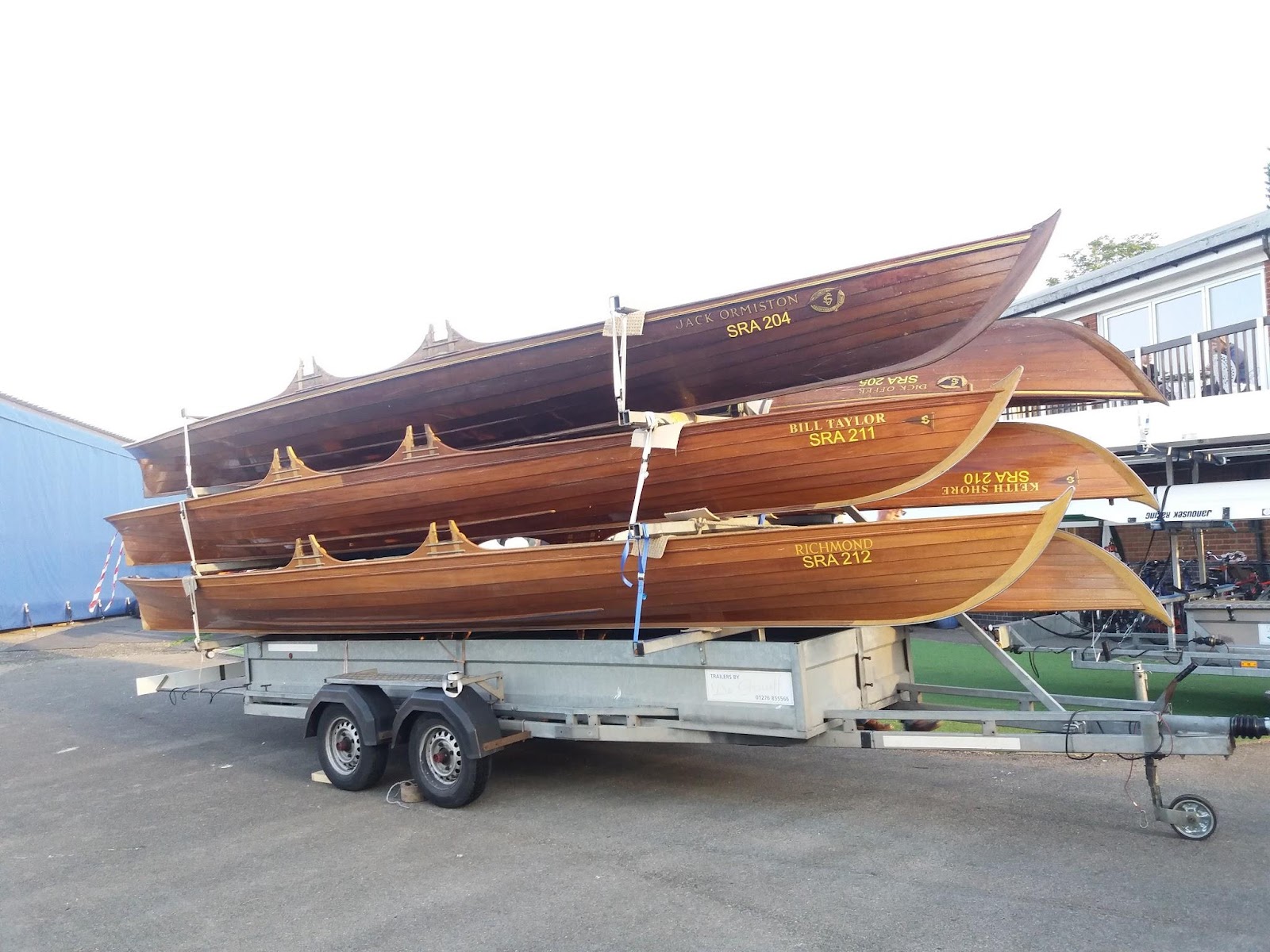
On Wednesday evening before the meander we got the SRA trailer loaded up with six double skiffs. This is a difficult and precise operation because they only just fit. You can barely get a Rizla paper between the boats, believe me, Ricardo has tried. Three skiffs are loaded the right way up on one side, and three upside-down on the other side. They are stacked from the top level down, which means that a heavy (and valuable) skiff has to be lifted six feet into the air and then laid down at the correct angle so the tholes don’t hit each other. Tall men are very much in demand in that situation. It’s nice to be popular.

We got the boats interwoven and then lashed them as tightly as possible to the trailer. Roger Haines is the Lord of Straps, and a Master of Skiff Bondage and Stowage. He will be towing the trailer with his mighty Land Rover Defender up the motorway, and definitely doesn’t want an “Oh Shit” moment on the M25.

Loaded and strapped, ready to go


A bunch of strapping lads

Friday 24th May

We all arrived at the Skiff Club at 5.30 am, bleary-eyed and laden down with bright orange wet bags and our second-best rucksacks. Meanders are always a logistical challenge, and this was even more so because there are twenty-six people involved. A hired mini-bus took sixteen people, Dom and Ricardo took a carload each, and Roger drove the Land Rover (with kayaks on the roof) towing the trailer. John Pengilly (JP2) let the train take the strain and took the BedPan line up to Bedford.

Bill Taylor off on an adventure

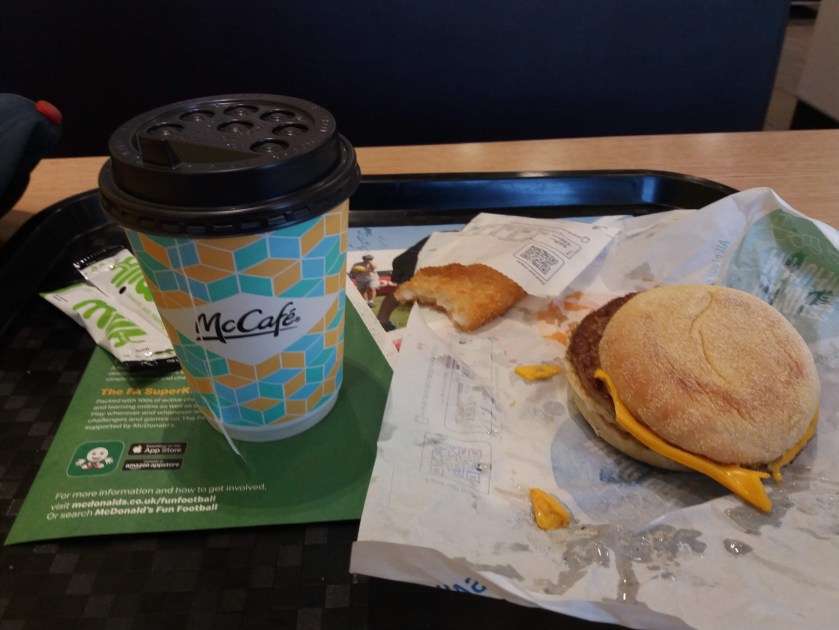
It took less than two pleasingly uneventful hours to get to Star Rowing Club, on the Great Ouse at Bedford.  Bedford is famous for John Bunyan, the inventor of the soft comfy shoes sold in the Mail on Sunday, and Pilgrims Progress. The drivers took the cars over to the end of the meander in Cambridge, and the rest of us dispersed to local caffs for breakfast. Fran, Dave and I found our favourite Scottish restaurant and we dined on Sausage and Egg MacMuffins, whilst the others found more up-market places and had lartays and cwassonts.

C’mon, you know you fancy one..

Kevin had been to school in Bedford, and David rowed there as a youth. That’s all the facts I know about Bedford.
JP2 scribbled the boating list on a scrap of paper, i.e. who was going in which boat. It’s a fine art, and John writes it in his own hieroglyphics that only he can understand. He wrote the boating list every day before breakfast, with care and sensitivity. It was like the Queen working out who would sit next to Trump at the State Banquet.
We loaded up the boats with a ludicrous amount of luggage and set forth on our adventure along the Great Ouse.

Not quite on the water at the Star Rowing Club

The weather was warm and sunny, and the vibe was excellent and we were soon at our first lock in Bedford and passed through without a problem. When we arrived at Cardington Lock, it was out of action and there were engineers trying to fix it. Not to be defeated by this trifling issue, we portaged our skiffs, Viking style, across about fifty metres of meadow to the other side of the lock.

Heave ho me hearties

The Great Ouse and surrounding countryside are very very pretty. It’s a windy river, lined with reeds and lily pads, and overhung by weeping willows and poplars. If I was I poet I’d write a poem. But I ain’t so I won’t. The Great Ouse starts at Syresham in Northamptonshire and ends at Kings Lynn on the Wash, and is 143 miles long. Ouse is an ancient Celtic or possibly pre-Celtic word meaning river or slow-flowing water. So stick that in your Pub Quiz pipe and smoke it.

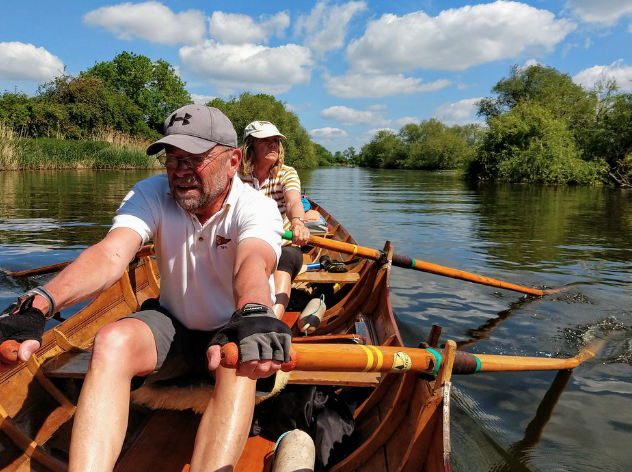
JP2 and Cap’n Black rowing our boat gently down the stream

We stopped for lunch at Danish Camp. I was disappointed that there were no flamboyant  Vikings singing show tunes, but there was an excellent bar and restaurant, so we could stock up with calories for the afternoons’ exertions. There was also an Eagle Owl in a cage called Ozzie. I whistled Paranoid to him, but either he didn’t recognize it, or was annoyed because he has heard it so many times. Owls are quite inscrutable.

Knobbly Knees competition at Danish Camp
Kim and Ricardo discussing Heisenbergs Uncertainty Principle over a cider

After another five locks, we reached Eaton Socon, which is a lovely village just off the A1. The Great North Road used to go through until 1971 when a by-pass was built. So every army going from South to North would have passed through the village. The Skiff Club successfully invaded by river and bypassed all their defences.

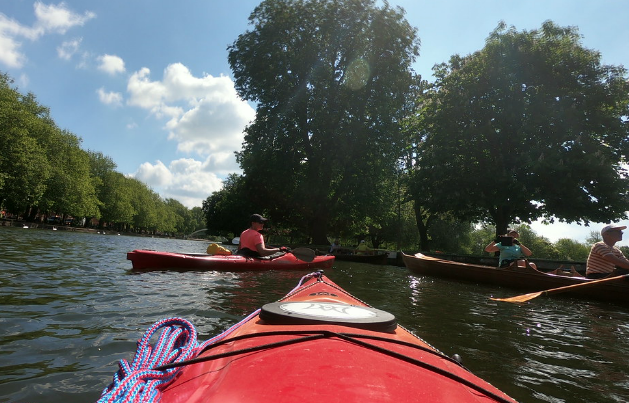
Roger kept a recording of the meander with a Go-Pro stuck on the front of his kayak. All the photos have the nose of a kayak in them to show they are his.

The front of Roger’s kayak , he has more photos like this

We stopped at the River Mill and left the skiffs by the owners garden. The owners wisely segregated us in a large upstairs dining room, where we could eat without frightening the other guests. We tucked into assorted pizzas and burgers and lots of very fine beer

The River Mill at Eaton Socon

Our accommodation that night was in the Premier Inn, about a mile up the road. That night we got to find out the nocturnal habits of people we had been allocated rooms with. I had brought earplugs with me for the snoring but wished I had nose plugs as well.
After a day spent hauling around four people and all their luggage I was knackered and slept like a big sweaty, beery, chip-stuffed baby.

Your gorgeous, modest author, with Gordon in bow

Saturday 25th May

Ah, the joys of a buffet breakfast! We stuffed our faces with fried food and coffee, leaving no corner of our insides vacant. Having cake at breakfast is a strange – and yet welcome – continental habit that I could get used to.
Back on the river again we rowed north through St Neots, Little Paxton, and Great Paxton. This is where Gordon was brought up and learned to drive at Paxton Pits  before it was a nature reserve. He was brought up in a pub, but the Chicken in a Basket had such a profound effect on him he is now a vegetarian.

Gordon watching Kim eat a sausage with fascination. Paul looks a bit rough

Roger and Amanda eschewed the pleasures of the double skiff, and paddled in his ‘n hers matching kayaks. They missed out on the boat banter, such as my amazingly witty double-entendres which I whipped out and waved around at every possible opportunity.

Roger tighten’s Amanda’s seal

The locks on the Ouse are almost all regular gates at one end and Guillotine gates at the other, God knows why. Craig leaped off his boat at every opportunity to crank the gates, in fact, we started shouting at him “Craig – you cranker!”.

Craig at the control panel of the Guillotine trying to press Button B to get his money back

The Ouse flows closely to the London to Peterborough rail line, and trains whizzed past at enormous speed carrying Remainers north to an uncertain fate in Farage country.
We stopped for lunch at Brampton Mill, a very picturesque spot with yet more burgers and chips on offer. I dined modestly on beer (thanks Gordon) and an Aldi Chicken Wrap. It wasn’t delicious, but at least I could row without farting afterwards.

Kim talking, Paul still looks rough

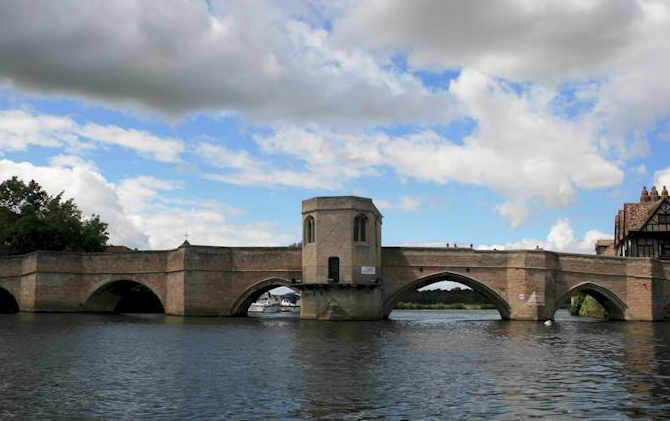
The post-prandial leg of our voyage took us under the bridge between Godmanchester and Huntingdon, and through Houghton and Hemingford locks to St Ives. This town is named after a Persian Bishop called Ivo who preached in the area in Saxon times. His bones were later conveniently discovered and a priory was founded to make some money from eager pilgrims. Slepe became St Ives and still confuses thick tourists looking for the beach and over-priced pasty shops.

St Ives in Cambridgeshire
The other St Ives – note the absence of Thames Racing Skiffs

Our accommodation for the night was the Dolphin. It a charmless modern hotel, but very conveniently positioned with good moorings next to the river. After finding our rooms we dashed into town to find picnic food for the next day. Some people went to Waitrose and others went to Mace. The Skiff Club is a diverse organization and welcomes people from anywhere on the social scale.

Dan and Sarah in perfect harmony


Copious beer was enjoyed on the hotel terrace, followed by a slap-up meal in our own dining room. The carvery was excellent, and the mega-puddings were dangerously delicious.

There were several birthdays around the time of the meander, so birthday cakes were produced to add a few more calories to the mountain already consumed.

Monica, Anna, Mary and Roger doing the Hokey Cokey around Kevin who is trying to snort the cake
Roger in his colourful cannabis shirt, the old hippy!

The party animals went off to explore the local pubs, but I had no room left for beer. I made the mistake of going to bed but was forced to listen to the hotel disco until after midnight. Once they started playing Dancing Queen, I sang along in bed with Agnetha and Anni-Frid. Not literally obviously, because they live in Sweden and I’m not that lucky.

Sunday 26th May

Dan’s itinerary for Sunday says “visit the fitness suite before starting”. Naturally, I was there at 6.30, but no one else joined me and I had to do the circuits on my own. Honestly.


JP2 is extremely good at waking up. As soon as the alarm goes he is in full conversational mode, whereas I can only grunt from both ends.
After another hearty breakfast, we re-loaded the skiffs and set off on the longest day of the meander, sixteen miles to Ely. At this stage of the journey, we have reached the Fens, the landscape is flat and the river is less windy but more windy. By the way that is a Homograph, two words with the same spelling that have different meanings  – you can learn a lot from this blog.

Say “cheese” Anna!

To be honest, this part of the meander was a bit dull, the river was straight and the banks high, so not much to see. But there was always fun with the waterfowl, which are not as used to skiffs as London birds. I had to shout “lift your blades” several times while coxing to avoid whacking a dozy swan. Some of the swans were very protective of their nests and made it clear they wanted us to hiss off.


By a quirk of fate, my skiff with Craig, Russell, and Anna managed to be leading the fleet.  We found a mooring place in the middle of nowhere, where there was some verdant grass suitable to sit on for our picnic lunch. I had bought a sandwich at Waitrose, whilst others had got a large array of savoury comestibles. Anna kindly gave me half a pork pie, a kindly act that I shall always remember.

Lunch in the middle of nowhere

Some skiffers took the opportunity to lay down and catch forty winks after their excess of Fun the night before.

Ricardo enjoying the grass

Then it started to rain, so we quickly cleared up and got back into the boats for the long haul to the Lazy Otter pub. This was a big bungalow/pub with a marina, a bit of a peculiar place. But it did have a bar, a big garden, and a toilet.

JP1 fine form at the Lazy Otter

Toilet stops are a key component of meanders. Meanderers are not in the first flush of youth, or possibly even the third flush of youth. I have just turned twenty-one again for the third time, and some of our senior members are over four times twenty one!


Roger, Dave and John Previte (JP1) are top class skiffers at an age when many of their contemporaries are in nursing homes or (to quote Monty Python) have run down the curtain and joined the choir invisible. I saw JP1 stepping from the river bank onto two boats to reach a third like it was an Olympic sport.

Russell was stabbed in the back with two blades, 25 suspects were arrested

The last leg of the day was to Ely, a former island in the Fens that covers twenty-three square miles and rises to the height of eighty-five feet. Not much, but it’s a mountain in the Fens.  The cathedral came into view as we skiffed around a corner, and that’s all we could see of Ely until we arrived in the town.

We dumped our gear on the town side of the river and rowed the boats over to the Kings School boathouse to park them for the night.

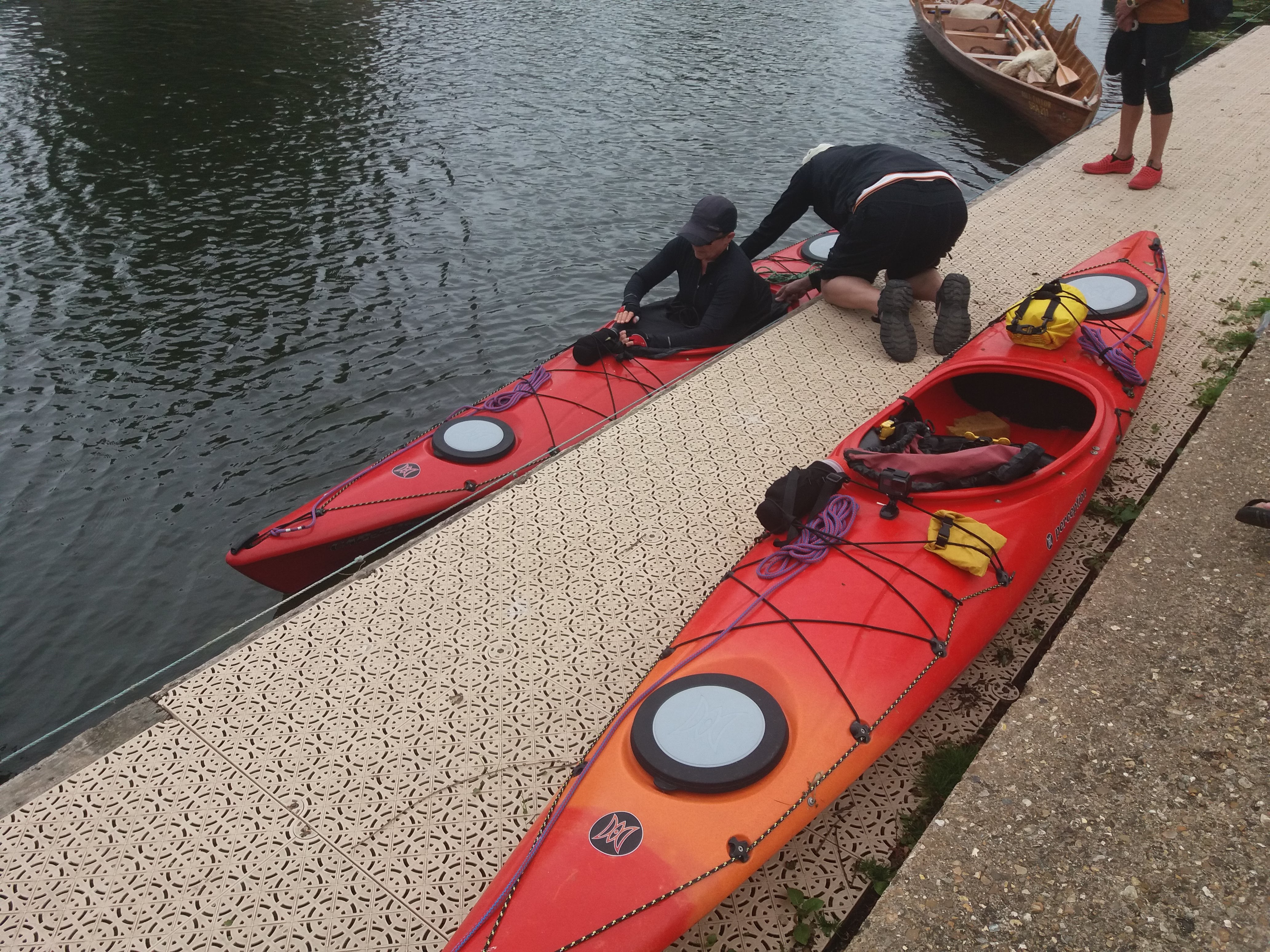
Amanda waiting to be lifted out of her kayak in Ely

Ely is a very pretty small town with an ancient cathedral in the centre that was started by a Norman called Simeon in 1083. The Lamb Hotel is an old coaching inn close to the cathedral that looks like it was last redecorated in 1083.

The room that JP2 and I shared had one window pane repaired with plywood, and a shower that didn’t shower. Hotel showers are often strangely difficult to work out, like they would rather you didn’t use them.

Before dinner we took a walk around the cathedral close and the park. It really is a beautiful building and worth a visit. Incidentally, Ely isn’t the smallest city in England, Wells in Somerset is. So there.

Ely Cathedral

Dinner was a proper belt-buster three-courser at the Lamb, I ate lamb in it’s honour. They didn’t have any Dolphin on the menu at the Dolphin

Kim explains the difference between Einsteins General Relativity and Special Relativity

Monday 27th May

The final day of the meander down to Cambridge. Dave Wright went to Cambridge as a student some time in the twentieth century. He rowed in those thin wobbly boats with a small shouty man at the back. Now he rows with Fran, who has the same horse-power as the entire Cambridge crew.

We went back down the Ouse to the junction with the Cam, and headed towards Cambridge. Lunch was supposed to be at a cafe called Five Miles From Anywhere, but we were early so we just had coffee. Each table had a bizarre metal bird to identify it, clearly someone had a welding kit and too much time on their hands

Ugly bird five miles from anywhere


At Baits Bite lock we waited for ages for the water level to go down. The lock is modern and operated by buttons, so I guess it had a bug. I expect Captain Black switched it off and back on again (or something) and the issues resolved itself.

Baits Bite, we didn’t bath or fish. We just sat there for ages.

Since we were ahead of our schedule, we stopped for lunch at the Beach Pub at Waterbeach. They valiantly accommodated twenty-six unexpected guests for lunch, and we boosted their revenue considerably!

Skiffers looking knackered at the Beach pub

After a leisurely lunch we rowed onto the CRA Boathouse in Cambridge. It is huge and very modern, with top-class toilets which we all enjoyed. The boats were rapidly pulled out of the Cam, stripped down and sponged out. Roger reversed in the trailer and it was hands-on to stack the boats back in the correct order. Lots of fiddling and tightening of straps went on and it rained really hard. I took shelter while Roger and Dan threaded and tightened straps, I didn’t want to get in their way.

Martin about to go skinny dipping

The minibus took off back to Teddington. After a final tug of the straps Roger set off with the trailer and the two cars followed to collect any bits if they fell off the trailer.

Boat cleaning at the CRA Boathouse

There were only two minor slippages of the straps on the way back. None of the boats fell off, even a tiny bit.

The Ouse and Cam Meander was a wonderful adventure. There was enough rowing to justify the beer drinking later, and plenty of time to see the countryside and enjoy ourselves. It has set a high bar for meander/holiday events in the future.

The heroes of the meander were Dan and Roger who were responsible for the organisation and logistics and enabled all of the motley crew to have a wonderful holiday together.

Some people have said that the Skiff Club is a drinking club with Skiffing. I agree with them.

Skiffers Assemble! It’s like Love Island for the over-sixties

Written by Tim Harness

Photos by Tim, Roger and Gordon

5th June 2019

Stockholm – much more than meatballs

I have to come clean and admit that I am a weak person, I have bought a beer in Stockholm. All my online research told me that Stockholm is an expensive city, and beer is a particularly pricey. So I (foolishly) told Julie that I wouldn’t drink while we were in Sweden.

My resolve lasted about four hours, which isn’t quite the forty days in the desert that Jesus managed. But he had his dad to back him up, which must have helped.

My excuses are:

  1. The sun is shining
  2. I have done my statutory ten thousand steps
  3. The beers was only about three quid for 400ml and was crying out to be drunk

So if you want a reasonably price beer visit Cafe Sten Sture which is between the Storkyran Cathedral and Stortorget square in central Gamla Stan, the old town of Stockholm.

So I’m sat here sipping my reasonably priced beer while tapping away ineptly on my iPad mini.

Day 1

Getting to Stockholm

We flew with Norwegian Air from Gatwick in just over two hours, and the sun was shining when we arrived. Clearly the Almighty wanted us to visit Stockholm and offered up reasonably priced lager. Or it might have been the Devil, you decide.

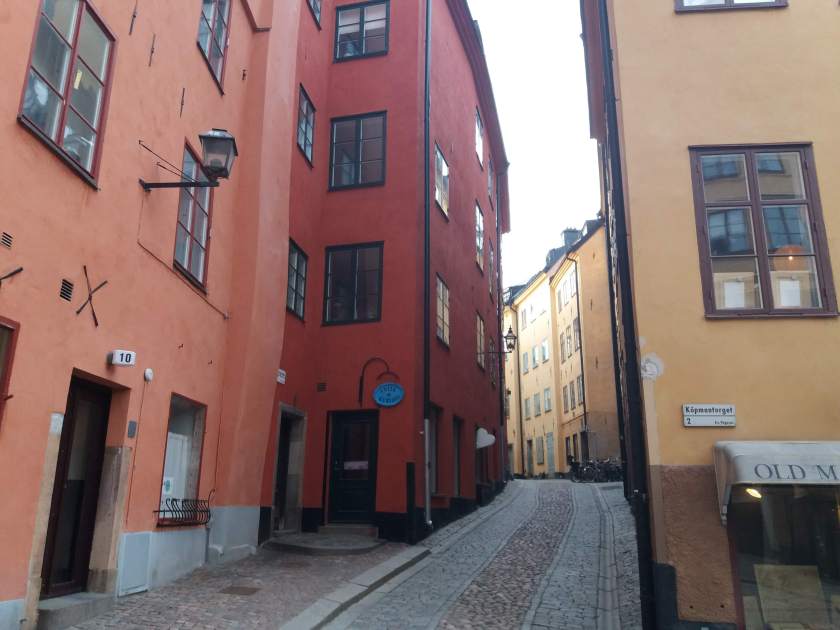
The Airport bus took us to the Central Station, where we locked up our luggage and walked to Gamla Stan. This is the medieval heart of Stockholm, on one of the many islands of this beautiful city. It has cobbled streets, tall ochre buildings, and is very neat and tidy. It’s also swarming with tourists, and has a plentiful supply of souvenir shops.

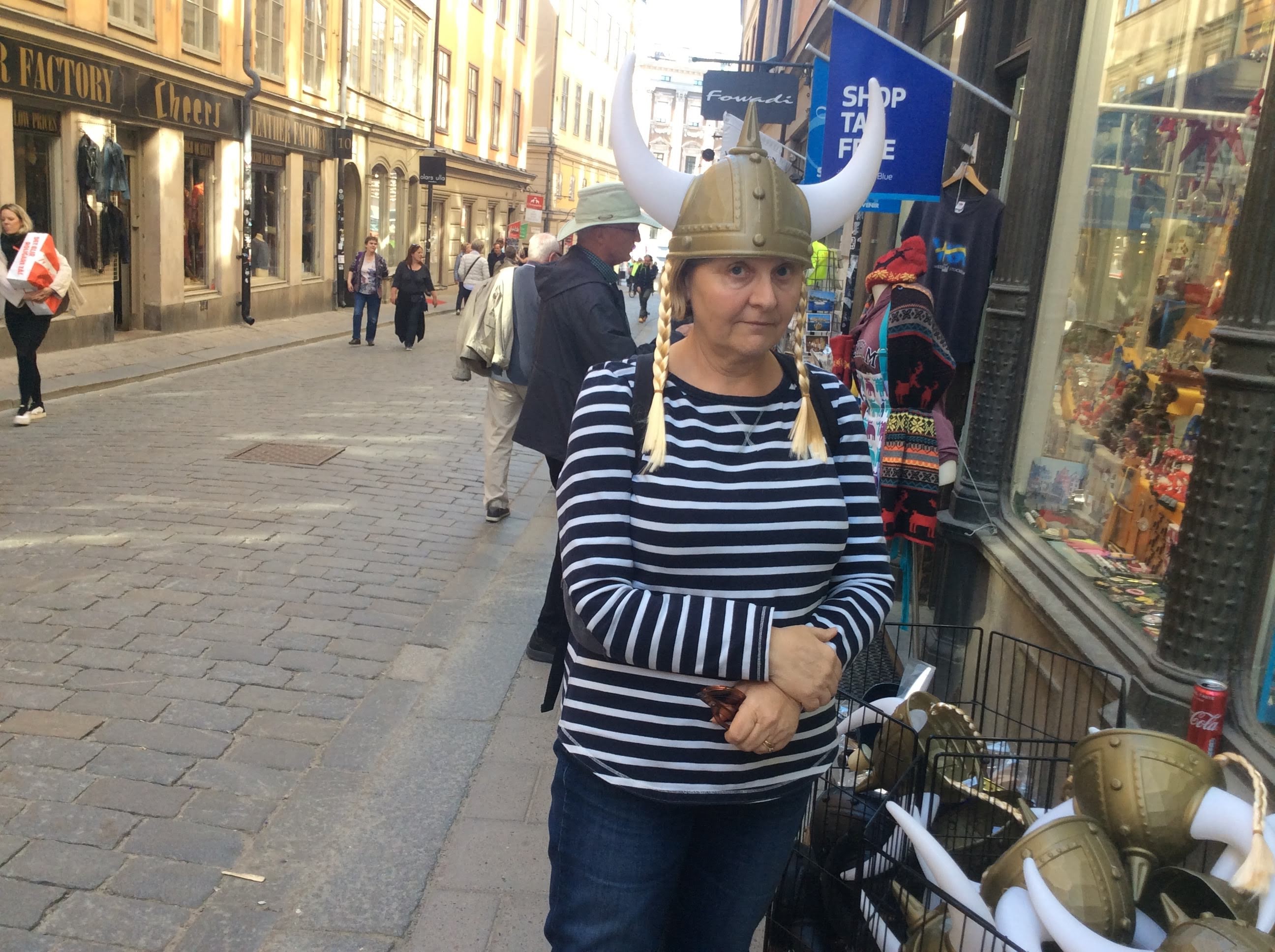
Julie with a comedy Viking helmet on in Gamla Stan

The Royal Palace is a monster of a place with over a thousand rooms, but it isn’t very beautiful on the outside. I have seen palaces in Madrid, London, Fontainbleau, Potsdam, Cintra, Krakow, Vienna and Hammersmith (Palais de Danse) and this wasn’t in the running for Palace of the Year.Sweden was going through an imperial phase when it was built in the eighteenth century and wanted to be seen as a Major Power. It had conquered many of its neighbours in the Baltic, and the Kings of Sweden (mostly called Gustav Adolphus) wanted a big palace like the French and Spanish. Eventually the Royal family have moved out to a smaller palace at Drottningholm, they couldn’t afford the gas bill in the old palace.

Giddy up Lenny!

Away from the main streets, Gamla Stan is very pretty, with narrow cobbled streets pretty restaurants.

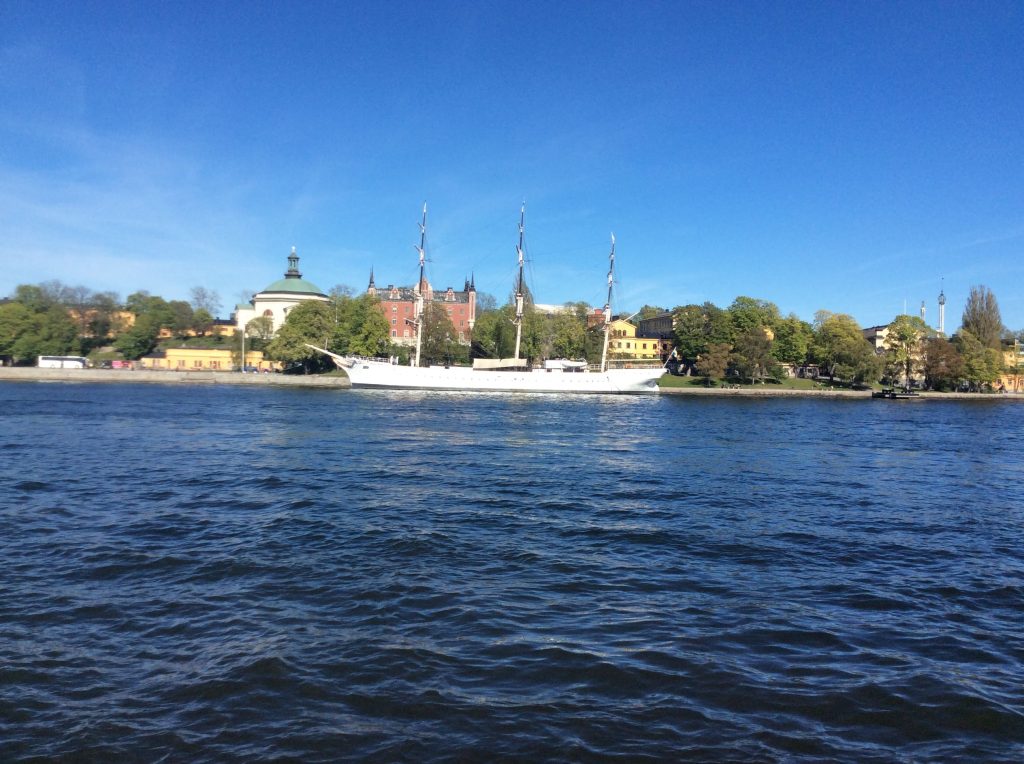
The weather was great so just strolling in the sunshine looking at ships in the harbours was a good way to spend time. Stockholm is a very watery place, with eighty bridges connecting different islands.

Our AirBnB was in Bjorkhagen, a suburb of mostly public housing a few miles out of the city centre on the metro. The house was in an estate of wooden homes in an “eco-village” built in the nineties. Our house keys were left under the doormat, so we let ourselves in and made a cup of tea.

Our host was Ufe, who was so hands-off, we never actually met him. At one time there were seven guests in the house, and the owner trusted us with all his stuff! The house was triple glazed and had a wood-chip boiler in the entrance hall, all very Swedish. Most of the breakfast food he supplied was from Lidl, very reassuringly familiar.

Our AirBnB, very woody

Day 2

Vasa Museum and Scansen

We took the metro to the central station called Central, and then a tram to Djurgarden to visit the Vasa Museum. It is probably the best maritime museum in the world, because it has a complete wooden warship on display.

In the seventeenth century Sweden was flexing its muscles in the Baltic, and needed a powerful navy to fight the Poland Lithuania Commonwealth. King Gustav Adolph ordered the construction of a new warship with sixty four guns, and asked a Dutch ship builder to lead the construction. He had never built a ship with two gun decks before, so just built the Vasa like one of the ships he had built, but with an extra gun deck. Big, big mistake.

On its maiden voyage in 1628 it sailed into the harbour, a gust of wind caught its sails, it heeled over and then the gun ports filled with water. In five minutes it was at the bottom of Stockholm harbour. Basically there wasn’t enough space at the bottom of the boat for ballast and the extra guns made it too heavy.

The Vasa in the gloomy Museet

In 1961 it was raised from the harbour and spent seventeen years being soaked with poly ethylene glycol (PEG) to replace the water in its timbers and preserve it. It absorbed forty tons of PEG and shines like an oiled baby’s bum.

It was in such good nick I half expected to see Jack Sparrow to run around the decks being chased by ghosts.

The Vasa Museet with fakes masts on the roof

The ship on display is ninety eight percent original timbers, which is amazing. The other displays give a very thorough insight into to building and sinking of the vessel. There is also a gallery dedicated to the many women who were involved in it, who are often overlooked.

There are even some sails which were found in lockers, and are now on display in giant picture frames

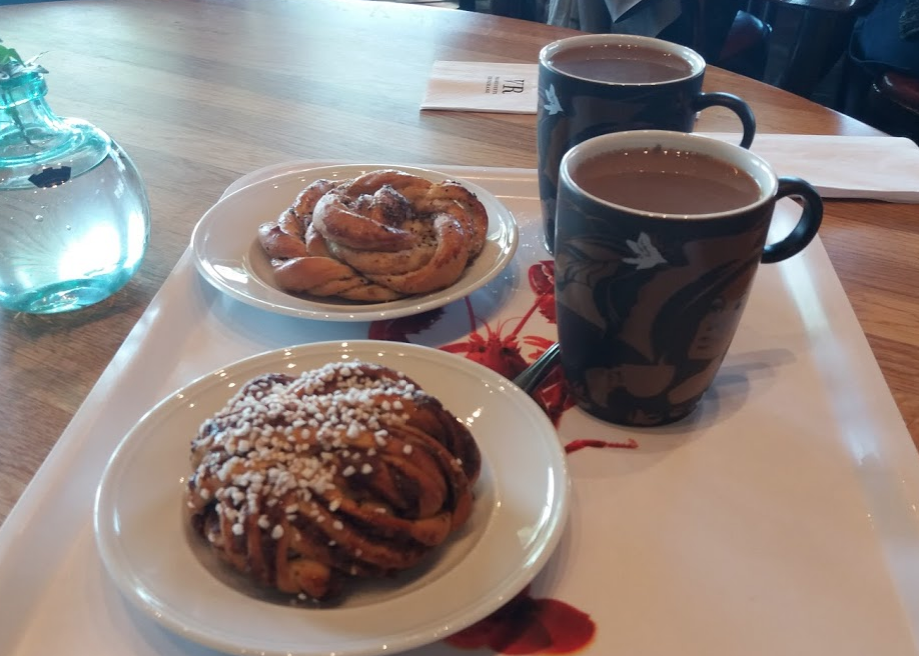
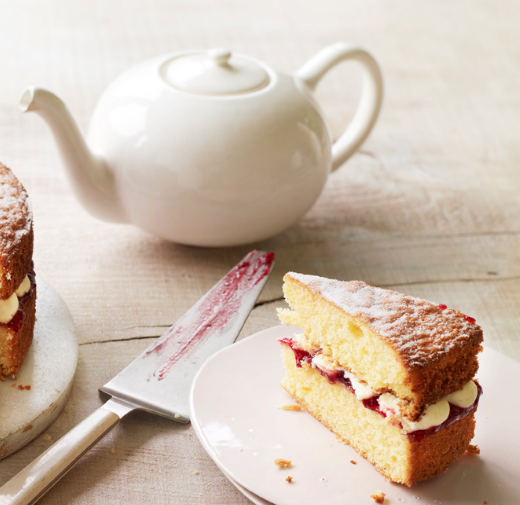
The Vasa Museet has an excellent cafe where we partook of fika. Fika is an institution in Sweden, and essentially it’s taking a break for coffee and a kanelbullar (cinnamon roll). The Swedes make a big deal out of it (like the Danes go on about Hygge) but it’s what us English have been doing in our own, understated way, for at least two hundred years at teatime with a slice of Victoria sponge.

Swedish fika, coffee and cake
English fika – we don’t make a big deal about it

I also bumped into Chris Coveney from the Skiff Club, who is on a three month tour of Scandinavia. The chances of him going to see the Vasa is quite high since it’s the most popular tourist attraction in Scandinavia. But being there on the same day at the same time is really lucky.

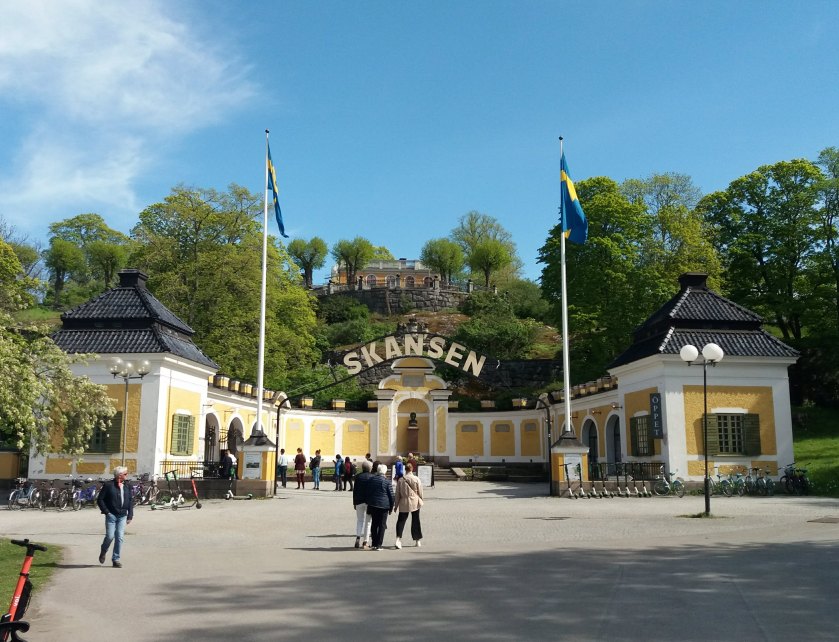
A short walk from the Vasa is Skansen, which is an open air museum with hundred of buildings brought from all over Sweden. On a sunny day it is a perfect place to visit. The old buildings are varied and attractive and some of them have guides acting’s as the original occupants. I spoke at length to a man pretending to be builder who moved to Chicago, but he hadn’t actually left Sweden yet, on his imaginary journey The site of Scansen is on a hill overlooking water in two directions, with great views of the harbour and Stockholm.

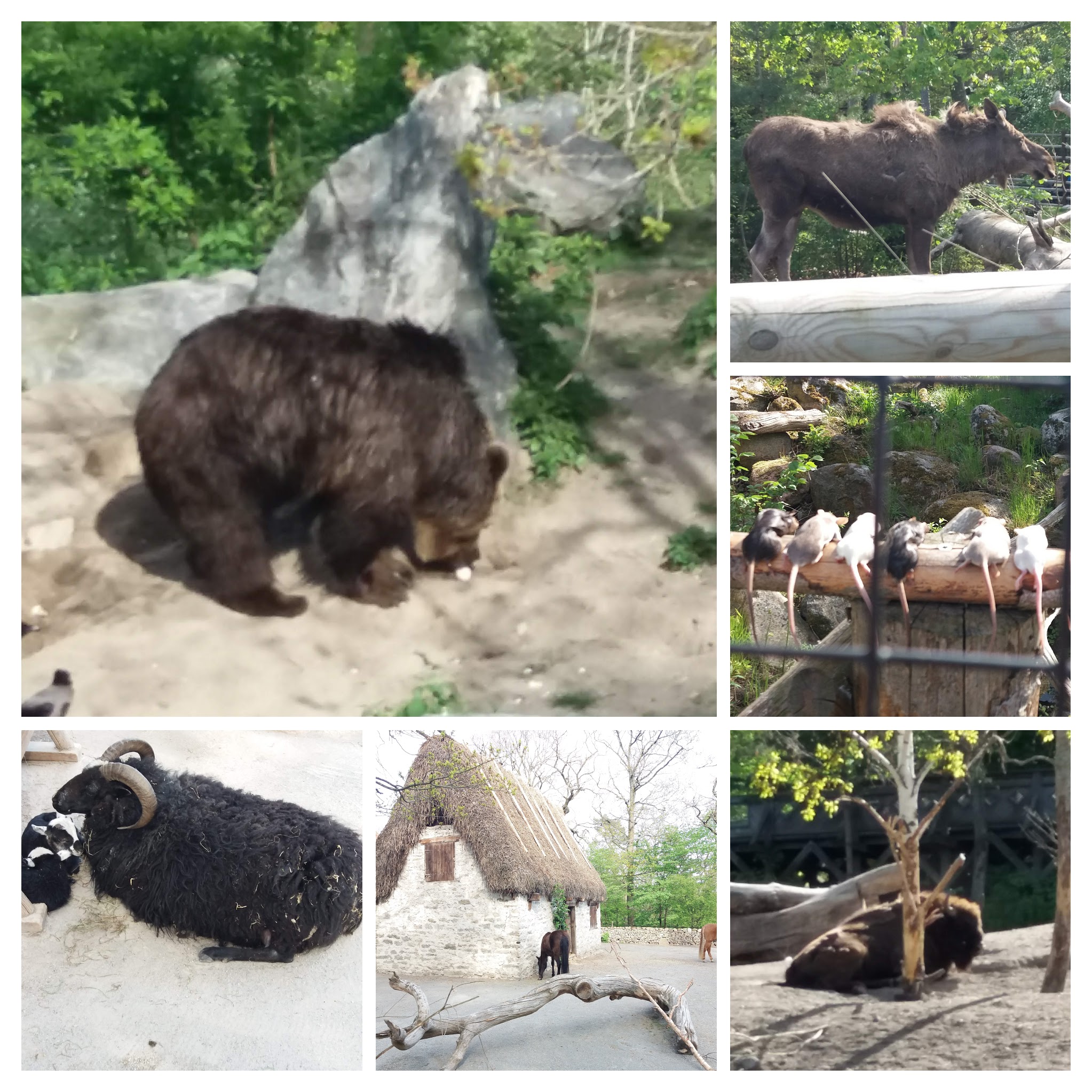
There is a small zoo with animals native to Sweden including wild boar, moose, bison and bears. The boars were not very wild, but I did see a bear eat an egg. It didn’t climb a tree it find a next, it just dug it out of the sand. I think it had been planted by the zoo keepers. Fake News!

In the Eagle Owl cage, there was a row on neatly lined up dead mice for their dinner. If you are a Vegan, don’t visit the zoo at Skansen

Swedish animal – note the bear eating an egg

It was Norwegian Independence Day on that day, celebrating their split from Sweden in 1905. So there was a band playing in an outdoor auditorium, with an audience wearing Norwegian national costume. I didn’t join in with the singing of the national anthem.

A man pretending to be a builder who emigrates to Chicago but hasn’t left yet

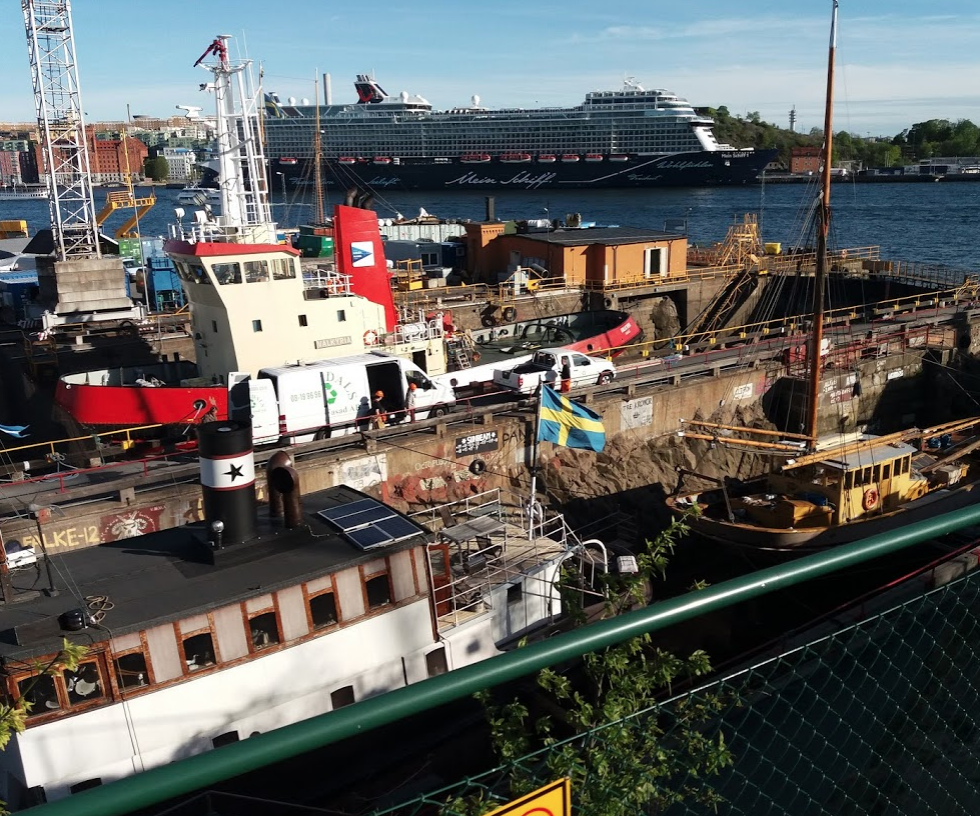
After leaving Skansen we had a look round the very pretty village of Djurgarden and the island of Beckholmen. It is a small island but has several dry docks for repairing ships. I love a good industrial site, especially with ships.

Beckholmen has a small hill which gives great views of the Gronen Fun Fair next door. Carriage loads of teenagers screamed as they clattered their way around the roller coasters or plummeted from great heights on plumetty things.

Dry docks on Beckholmen – note Mein Schiff liner in the background

We took the No. 7 tram back to T Central station and then the metro to our stop at Bjorkhagen. Our dinner was purchased at the Coop near the house, a frozen lasagne with salad and some Sir Taste-A-Lot beer. The lasagne was not great, but it was substantial. The faux English lager was quite good, but I wouldn’t select it in the Sussex Arms in Twickenham.

Day 3

Stadshuset and Drottingholm

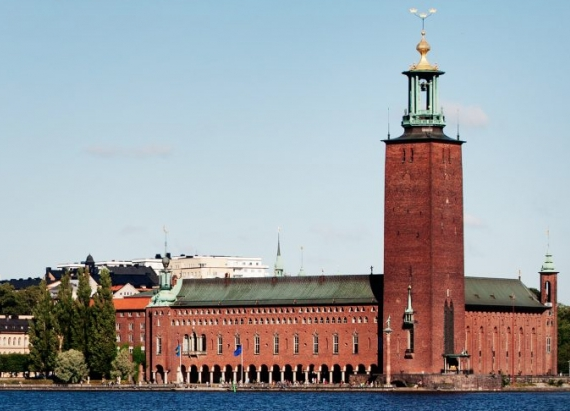
A short walk from T Central station is Stadshuset, Stockholm City Hall. It is a big brick building (eight million, I counted them) constructed in the twenties and thirties, but in an Italian Renaissance style. Unusually for that period, it is a beautiful building and a big tourist draw. You couldn’t say that for London’s City Hall.

Stadshuset – Stockholm city hall

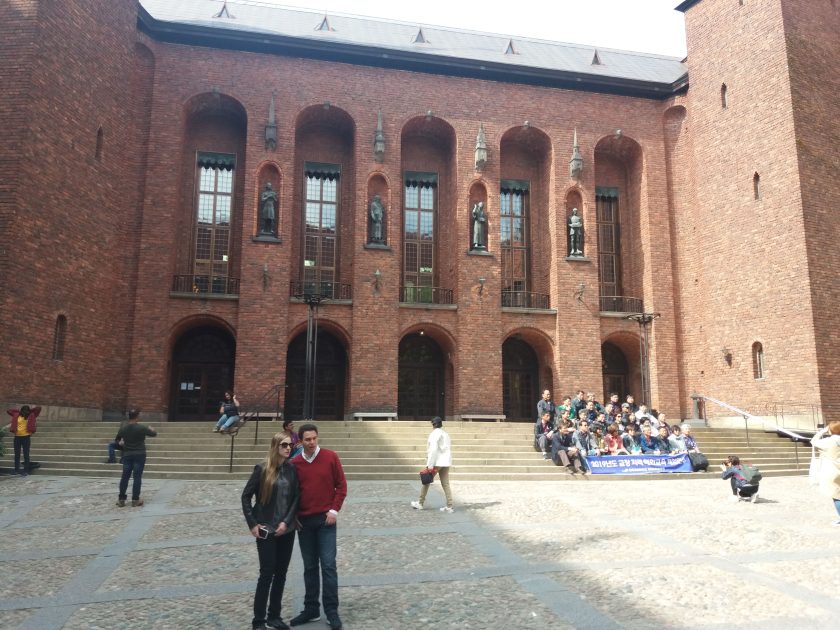
The tour of Stadshuset takes about forty five minutes (120 SEK each) and it is mostly three huge rooms. The Blue Hall is a huge dining room that is the venue for the Nobel Prize dinner, where the King of Sweden invites twelve hundred of his closest friends for dinner. The architect originally wanted to paint it blue but changed his mind, so it is still faced with red bricks.

Courtyard of Stadshuset

The council chamber is where the two hundred members of the city council meet, and isn’t that interesting. But I did learn that on average sixty couples a day get married in the city hall. It’s free for any Swedes, foreigners can marry for about fifty dollars. A long ceremony takes about two minutes, and a short ceremony takes forty seconds.

The highlight of the tour is the Golden Hall. It is another grand function room, which has walls entirely clad with golden mosaics. It is as beautiful as a Byzantine cathedral, the mosaics have ten kilos of pure gold in them, encased in glass. It was all designed by one young artist who had just two years to install it, and he did a fantastic job.

Mosaic of the lake goddess in the Golden Hall

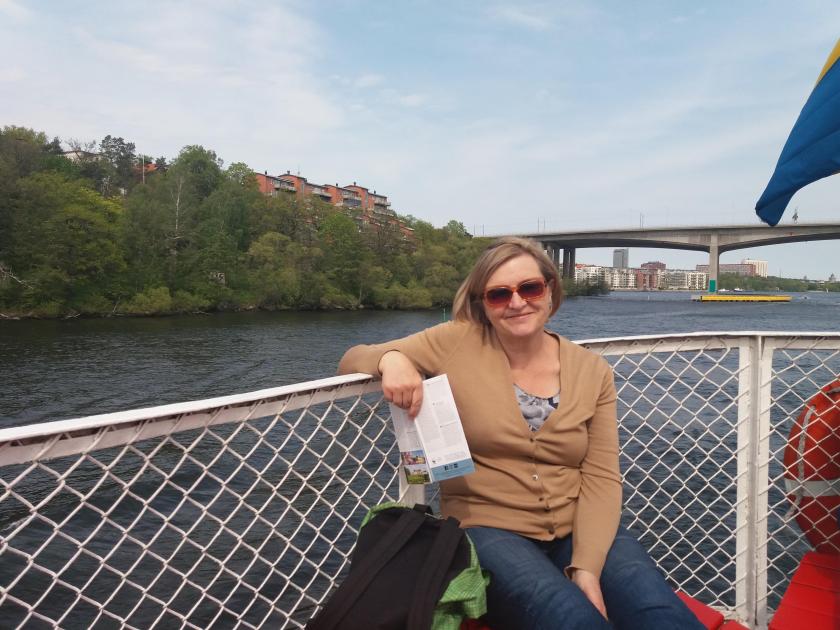
Stockholm is built on islands, and there are ferries and steamers operating on many different routes. One of the most popular routes is from just outside of the Statshuset to Drottningholm Palace on Lake Malaren. The steamer the Prince Karl Philip is probably over a hundred years old, and is looks like the Yarmouth Belle that runs between Kingston and Hampton Court.

The sun was out, and we sat on the rear deck and watched all the lovely riverside homes got by.

The trouble and strife on the steamer to Drottningholm

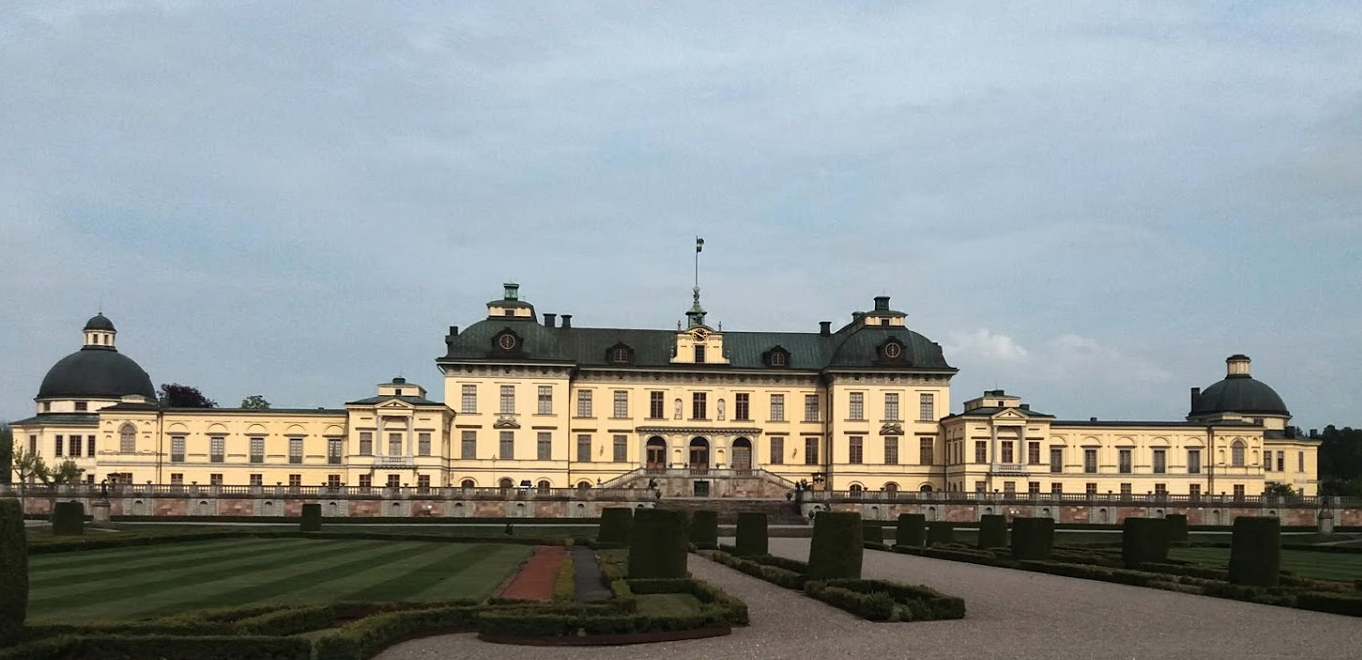
Drottningholm is an eighteenth century baroque palace where the Royal Family still live. As you know I have been to many palaces all over Europe. Since we have recently visited two palaces recently in Vienna, we didn’t want to repeat the experience in Stockholm. Yes, Palace burn-out is a real thing.

Drottningholm Palace

But outside of the palace There is an excellent cafe where we stopped for Fika, and I bumped into Chris Coveney once again! To be fair, there are a limited number of big tourist sites in Stockholm.

The palace (slot in Swedish) has formal gardens like at Schonbrun in Vienna, but also English style parkland with lakes.

Within the grounds there is a guards huts that looks like a Turkish tent, and a “Chinese” Pavilion. The architect probably got all his ideas about China from the designs on a Typhoo packet

Man with a lampshade on his head

Returning to the city centre we did some more exploring in Gamla Stan. The main streets are full of souvenir shops and restaurants, but turn a corner and there are some delightful old streets in ochre colours. The old city is quite small, so one can wander around it and not be too far from a metro station.

Gamla Stan, quite different from Kazak Stan

Day 4

It had to rain sometime..

Our last day in Stockholm and the weather is gloomy, definitely a museum day and not a boat trip day. Another of the cultural attractions on Djurgarden is the Nordisk Museet (Nordic Museum). It is housed in a huge Victorian building which looks like one of the museums in South Kensington. Inside is an enormous hall which is mostly empty. It cries out for a punk concert (the Stranglers would be good) or at least a badminton tournament. Surrounding the hall are galleries containing the exhibits on three levels. The content is similar to the V&A, costumes, household stuff, pictures and decorative items.

King Gustav Vasa in the Nordisk Museet – he was a big fella

To be honest it wasn’t really my thing, old Swedish wedding crowns and amber necklaces don’t interest me very much. Julie was mildly excited when she saw a cardigan on display just like the one she was wearing. But it was dry inside and there were plenty of signs to read.

It was drizzling when we came out, so we got the brollies up and walked along the waterside towards the Rosendal Slott. It wasn’t much of a slott more of a big pink house, and it was shut anyway.

On the way we passed a remarkably pretty statue of a girl which made a very pleasant change to the usual old men that get sculpted. Officially it is the The Lady Working For Peace In The World. I think she had better get a wiggle on, we need her services right now.

The Lady Working For Peace In The World

We followed everyone else walking with umbrellas and they took us to Rosedals Tragard, which is a posh garden centre with a cafe. It really reminded me of Petersham Nurseries near Richmond, with expensive plants on sale and a cafe in a greenhouse. It was a pleasant place to have a cuppa, and watch the Stockholm middle classes enjoy an open sandwich and a sticky bun.

Fika in Rosedals Tragard- note the jar of nettles

Everyone speaks English in Sweden, I heard it spoken almost as much as I heard Swedish. Disappointingly no one was walking around in blue satin jumpsuits with trousers tucked into their boots, I guess things have changed since Waterloo (the song, not the battle).

The lowlight of our day was a meal in the food court of a shopping centre in Norrmalm, the modern shopping district. I chose a meal that looked like a yummy steak and chicken combo for a very reasonable 120 Krona. It turned out to be two varieties of boot leather served with vomit flavoured mayonnaise. It was like the worst Wetherspoons meal you have eaten that had been left in the oven for an hour. My stomach my never forgive me.

We returned to Bjorkhagen and went for a walk in the woods to try and find the lake that our host Ufe mentioned. It was about twenty five minutes walk away and was worth the effort. It looks like a Cumbrian lake, surrounded by pine trees, and was dead calm. At a small beach there were two hardy bathers enjoying the clear, but no doubt cold, waters. There were also a few mozzies buzzing around, so we’re didn’t linger for long, they love the taste of Julie.

Looking miserable by Dammptorpsstjon Lake. It really is a place

Our AirBnB Ufe host never did make an appearance. While we stayed in the house there were eleven different guests, all of whom could have cleared out his collection of dull Swedish books and Lidl meusli. It does show that the system works on trust, and works very well.

You may notice very little reference to eating or drinking in restaurants in Stockholm. We were being careful with our money/stingy, so didn’t eat out. All the restaurants served meatballs, you could get about eight with some mash and gravy for about fifteen quid. I know what meatballs taste like, and it isn’t worth it.

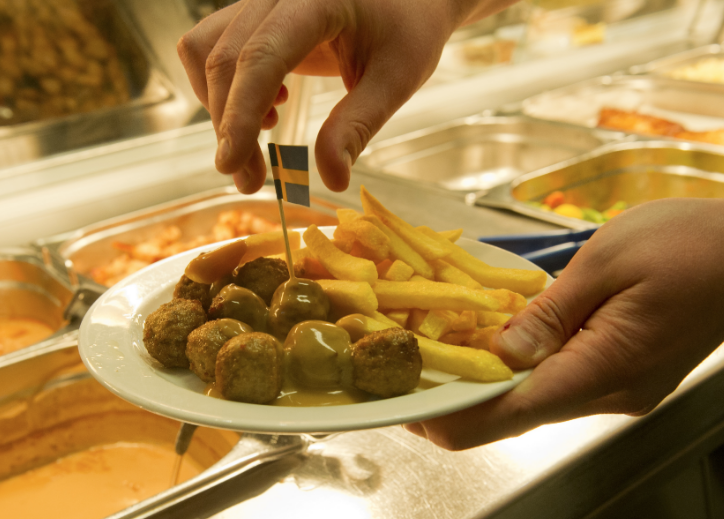
So when we returned home we visited Ikea and had fifteen meatballs, yes FIFTEEN, with chips and gravy for six quid. I love a bargain!

Stockholm was the first place I had ever been to where I didn’t spend any cash at all. We spent everything on the trusty Monzo debit card.

Remember having to find a bank where you could change Travellers Cheques, God, that was a pain in the arse!

Ah, Vienna – 2019

April 21 2019 – Stupid O’Clock at LHR

The Bat Cab arrived at 05.30, driven by Palminder, who has been driving cabs for forty two years. He wasn’t wearing a cowl with pointy ears, Bat Cabs is our local taxi company. There was very little traffic,  it only took twenty minutes to get to T3 Heathrow. Strong coffee was necessary as soon as possible from  Pret. I was surprised to see the Champagne and Oysters stand was open at six AM, to cater for passing oligarchs with the munchies I suppose.

The British Airways flight to Vienna was about two hours and the plane was half empty, that’s a good result! The OBB train from the airport takes about twenty minutes into Hauptbaunhof, a very modern station set in a district of Vienna full of new buildings. It costs about half as much as the CAT train to Wien Mitte station, which is more in the city centre. The Hauptbaunhof is close to the Belvedere.

After depositing our bags in locker at the station, it was a short walk to the Belvedere, which is two palaces (the Upper and Lower) set in beautiful gardens.  They were built for Prince Eugene who had helpfully (for the Austrians) won some battles during the War of Spanish Succession. That was a big squabble between France, Spain, Austria and Britain that began when then last of the in-bred Spanish Hapsburgs (Charles II) died.

The Upper Belvedere was for showing off his wealth and the Lower was for actually living in. Personally I can cleverly combine both these functions in one semi-detached house.

Mrs H and the Upper Belvedere

The Upper is an art gallery, where Gustav Klimt’s “Kiss” is displayed. The museum shop has the Kiss on posters, mugs, purses, pencil cases and key rings, so I didn’t feel the need to see the actual painting. There were huge queues to get in, and since  were knackered from getting up at five, we decided to laze around in the lovely formal gardens and the nearby Botanic gardens. 

I just want your extra time and your…Kiss

The Belvedere gardens are huge, and lovely and free, whereas you have to pay to get into all of the galleries and museums in Vienna.

At the other end of the park and down a hill is the Lower Belvedere. between them is a beautiful cascade of waterfalls.

Mmm nice cascade you’ve got there Eugene

On our return to the station we got some food supplies from Spar at the railway station, and collected our bags from the locker where we had deposited them. I decided to (foolishly) walk to our AirBnB in Lerchenfelder Strasse to see a bit more Vienna, rather than (sensibly) get the 13a bus as suggested by our host.

Unfortunately the GPS on my phone kept dropping out, so we took a bit of a diversion by mistake, quite a big loop. Julie was not happy after dragging her suitcase for an hour.

GPS FAIL in Vienna

Eventually we found the flat at 70 -72 Lurchenfelder Strasse and were greeted by a Frau who didn’t speak English, but we managed to communicate. The small flat was quite comfortable and had everything we need. Being a clever dicky, I fixed up my Chromecast device to the huge Samsung TV so we could watch Netflix via my phone. We watched Afterlife with Ricky Gervais, and it was very emotional and funny.

April 22 2019 – Exploring the Old Town

After breakfast we walked down Lerchenfelder Strasse towards the city centre. It doesn’t take long to get to the Ringstrasse and it’s grand Imperial buildings. This ring road replaced the walls of the city, which were demolished by the Emperor Franz Joseph in the middle of the nineteenth century. He didn’t do any of the work personally, since he was busy posing for portraits, or eating twelve course meals. Franz Joseph was Emperor of Austria and is considerable empire for sixty eight years, even longer than our beloved QEII

The Rathaus on the Ringstrasse under repair

Franz Joseph had a big building splurge, and wanted to reflect the glory of the Austro – Hungarian Empire in massive stone edifices.They are in Neo Classical or Gothic style, sometimes a blend of both. They replaced the medieval fortifications that once surrounded the city and protected Vienna from attempted Turkish invasions.

It was Easter Monday, so the museums and galleries were all closed, but we could sit on benches in the park to enjoy them from the outside.

The Kunsthistoriches – hard to say after a couple of drinks

Just inside the old city is the Hofburg, an enormous palace and home to the ruling Hapsburg kings and emperors from the fourteenth to the twentieth centuries. Every monarch added more to the palace right up to the end of the empire in 1918.

‘orse ‘n cart (not Orson Wells) in the Hofburg

You can walk into some of the inner courtyards and through to a ticket shop to get a tour of the interior. The Hofburg tour consists of three parts, the Royal Silver collection, the Sisi Museum and the Royal Apartments.

The Silver collection is the Hapsburg cutlery and crockery spread over numerous rooms. If you want to have dinner for a hundred people, you are going to need lots of knives and forks. Every course had its own settings, and there were between nine and thirteen courses at a big dinner. They ate off silver, gilt (gold-plated silver) or porcelain; there was literally tons of the stuff. My favourite crockery was the English Minton porcelain, which was more colourfully decorated than the plain silver and gold plates and is English!

I’ve got no photos of this because you aren’t allowed to take photos. Apparently they can steal the souls of the knives and forks.

The Sisi museum was dedicated to the wife of Emperor Franz Joseph, who was Empress from 1854 when she married EFJ (aged sixteen) until her death in 1898. Sisi was the Princess Diana of her day, beautiful but tragic. She was assassinated by an Italian anarchist who stabbed her in the chest with a file in Geneva in 1898. She was athletic and obsessed by her own beauty, dieting to keep her twenty one inch waist. She didn’t enjoy court life much, and spent a lot of time at her place in Corfu. Her fame was only established after her death, and and was cemented by a series of fanciful films about her in the fifties starring Romy Schneider. The museum is full of portraits, dresses and even her personal toilet! It was much more interesting than the spoons and plates that preceded it.

Empress Sisi – she was very “portraitogenic”

The Royal Apartments are stuffed with portraits, baroque furniture, tapestries and all the usual furnishings of Royal palaces. I have visited numerous palaces in England, Scotland, France, and Italy, and they all into a mess of gold, tapestries and dull portraits in my head. I did like the huge ceramic stoves in the corners of the rooms that were fuelled from the back by servants in hidden corridors.

Nearby is St Stephens Cathedral, which is the main church in the city centre. It’s an old Gothic building, and is rather gloomy and dark inside. If it was painted white and fitted with new IKEA furniture it would be much more attractive. I compare all cathedrals to Lincoln, and sorry Vienna, yours doesn’t come close. This may lose me some of my fans in Vienna (if I have any).

St Stephens – has a roof that looks like a Wetherspoons carpet

Culture is generally a good thing, but I can only take so much of it before I start haze over. It was Beer O’ Clock, so we found a cafe and had a Budewieser (the proper stuff, not that American wee).

Mmm beer. So good it makes me squint

April 23

April 23 2019 – Hidden Vienna Tour

The weather on Tuesday was a bit, well, shitty. We went to the Natural History museum but it is closed on Tuesday. The Kunsthistoriche museum opposite had huge queue, so we didn’t go in there either. I have very little patience for queues, so I don’t do to Theme Parks either.

We wandered round shops the shops in central Vienna, and then over to the Naschmarkt, a lovely semi-covered market of all sort of good stuff to eat. It’s like Borough Market in London, and well worth a visit. I can recommend Dr Falafel as a place to eat, have the Falafel Wrap.

Naschmarkt – note the ubiquitous Wien Schnitzel poster

Outside the Ubahn station we met Hannes for the Hidden Vienna tour that Julie booked on AirBnB. Hannes was an excellent guide, a local man who had to study for two years to get his guide qualification.

He us took us on a three hour tour of parts of Vienna we would never have found otherwise. These are some highlights

The 4th best staircase in the world as voted by a panel of architects, probably on a wet Sunday afternoon. Some people live dull lives. It was actually a pretty staircase. For reference purposes, the Spanish Steps in Rome was top of the list.

The 4th Best Staircase in the World

The Museum Quarter with its cool plastic benches. There are a cluster of museums and galleries housed in the former Imperial Stables.

Museum 1/4 and funky seats/couches

Two universities, one in old buildings and another in very modern buildings (the Wirtschaftsuniversität) The old Vienna University is very Victoric Gothic, the new one has a bonkers building designed by Zaha Hadid. It has no ninety degree angles makes the users feel sea sick.

Wacky building by Zaha Hadid – ooh I feel a bit queasy

The Rathaus (Town Hall), a neo-gothic building like London’s Royal Courts of Justice

The Prater park and funfair, with its famous Ferris wheel as seen in the 1949 film The Third Man with Orson Wells, Trevor Howard and Joseph Cotton. Everyone born in the fifties knows the famous theme tune played on a zither. It is the only tune anyone knows played on a zither. Don’t confuse it with the “Never on a Sunday” theme they used to played in every Greek restaurant, that was a bouzouki.

Did you know that London had its own Great Wheel which was built at Earls Court in 1895, but was demolished in 1906.

The Ferris wheel now and in 1949, with Joseph Cotton ‘avin’ a fag

It was an excellent tour, even though the weather was cold and wet. I did see a few interesting street art and signs which made me smile.

April 23 2019 – Schonbrunn Palace

On Wednesday the sun came out again and we took the Ubahn (underground train) and tram to Shonbrunn . This was the summer palace for the ruling Hapsburg family until 1918 when they had lost the war and the Republic of Austria began. The transport system in Vienna is operated on trust, there are no barriers, but if you get caught without a validated ticket, the fines are high. We bought our tickets in the Ubahn station, the machines have an English language option.

We purchased the “Imperial Tour” of state apartments, which was sixteen Euros for twenty rooms. For another four Euros we could have had forty rooms, but I have a limited attention span. The tour takes you from room to room, and none of them are homely. No wonder Sisi avoided the place and hid away in Corfu.

The Great Gallery is spectacular, a huge ball room decorated in white and gold and lined with mirrors. I’m sure they had many a good knees up in there. Actually Mozart did play there when he was six, and when he was finished he jumped onto the Empress Maria Theresa’s lap and gave her a kiss.

Great Gallery in Schonbrunn

Schonbrunn gardens has huge parterres, which are formal gardens in geometric patterns divided by hedges. There are plenty of wooded walks, ponds and bowers where courtiers could have dalliances in private.

Schonbrunn and a little of its gardens

The palace faces up a hill which is topped by a mock Greek temple called the Gloriette and the Neptune fountain. At the top of the hill there are good views of Vienna, although you can’t see the city centre.

The Gloriette and the Neptune Fountain, and a bloke in a stripy shirt

The UBahn took us back to the city centre and we had a beer in the Nashsmarkt, this time in the sunshine. Close by is the Karlskirche (Charles Church) built in gratitude when Vienna had had a plague outbreak. It’s patron Saint Charles, was revered as a healer.

It is a very beautiful Baroque church, with twin pillars outside which look like Trajan’s Column in Rome. Inside the church was a huge silvered globe, like a giant Christmas bauble.

Karlskirche
Enormo-bauble inside the church

So finally..

This was a short visit to Vienna on a budget, so we didn’t buy one of the Vienna Pass cards, which cost 59 euros for one day and 89 euros for two days. If you want to spend all of your time shuffling around museums and galleries they might be worth while, but then you don’t get the pleasure of the gardens and sitting around in bars drinking beer. You can see where my loyalties lie, not so much of a Culture Vulture as a Culture Pigeon.

You may be wondering why I called this blog Ah Vienna. The British readers will know that it come from the Ultravox pop song from 1981. Ultravox were a popular synth band lead by Midge Ure. He is still slogging around the summer pop festival circuit milking his hit almost forty years later

Midge Ure – Ah Vienna!

Lanzarote 2019

Day 1 Thursday 24th January

Bloody hell it was cold at five fifteen this morning when I was scraping the ice off the Qashqai. Our flight from Gatport Airwick was at seven forty, so we had to get up at stupid-o-clock on the coldest day of the year. 

The EasyJet flight was late taking off but made up the time with a tailwind and landed at the scheduled time. I sat next to a talkative man who loved telling me all about his wonderful life, preventing me from reading about even more about Brexit in my free copy of the Times.

20190124_081347-1
Leaving frosty Gatwick

At Arrecife airport, we collected an Opel Corsa from Autoreisen, which was great once we found out how to start the car (you hold the accelerator to the floor before turning the ignition key).

Julie drove slowly and carefully while I wrangled the Google Maps. Normally I have a good relationship with Google, but today it behaved like a bitch. I think Google must have heard about my flirtation with Alexa and was annoyed with me. My phone kept telling me to follow signs for Aeroporto, but there were no signs for the sodding Aeroporto! We drove round in circles for a short while and I swore at the phone and figured out which way to go. But I am “Tim the Navigator” (self-appointed), and found the LZ2 road to Playa Blanca. Julie confidently drove us there following the instructions from an AI somewhere in Seattle.

Then I got us lost again in Playa Blanca. The instructions we had been sent on how to find the apartment were shit (IMHO) and I had to phone the AirBnB agent to get directions to the flat. Anyway, after a short tour of Papagayo, it all came good and we met Karen at the door and got moved into the flat. It was literally spitting distance from the beach with big French windows that open up and a great view of Fuerteventura in the distance.

Our flat, top left above Romantica

First things first, we had a lovely sleep for an hour, before walking along the prom to see what’s up in Playa Blanc. Lots of restaurants and shops, that’s what’s up. There is a harbour full of fishing boats and a quay where the Fred Olson Express ferry approached at substantial speed, swivels on its twin hulls and backs into the quay. Every time it does this the ferry generates big waves which wash the beach and alarms paddlers. It rapidly disgorges its load of lorries and cars, ready to fill up again and go back to Fuerteventura.

Our flat with the ferry on the sea

We stopped at the Superdino to buy some vital supplies of groceries and San Miguel, at roughly twice the price of our local Lidl back home. Julie was still feeling lousy, so we had a sandwich for dinner and watched some bad TV in the flat before an early night.

Day 2 Friday 25th January

When I woke up the sun was shining and the promenade was empty, so I got my running gear on and went for a run along the seafront. It was most enjoyable, compared to running around the cold streets of Twickenham.

Playa Blanc promenade and beach

Julie had done the washing up when I got back (ideal) and had the kettle on. As seasoned travellers, we know that having breakfast out means either a fry-up or pastries, neither of which fit in with our current healthy-eating , post-Christmas lifestyle. We are fat and don’t want to get any fatter. So we ate the Asda meusli we brought with us, with some yoghurt and fruit that was left in the fridge.

We walked east along the promenade to the marina. There is a strip of restaurants along the front with menus in several languages. They are interspersed with souvenir shops selling wind chimes, dream catchers and all sorts of other useless tat. Lanzarote (named after a Genoese bloke called Lancelot) is very volcanic, so there are few proper trees and no grass. The flower beds appear to be made up of crushed clinker and no proper soil. Cacti thrive, and there are poinsettias growing outside in thew black gravel. There are a few little Dunlins running around on the beach, but the only land wildlife I saw was this lizard.

Atlantic Lizard

At the end of the promenade is a big marina and more up-market hotels and cafes. Beyond that are several beaches, we’ll save those for another day.

Dorada Beach, Playa Blanca

We had a sandwich for lunch with some San Miguel, and then a nap because we could! The sun was shining in the afternoon, so we walked for about a minute to get to the beach outside the flat. I had a swim with my goggles on and saw loads of fish around the rocks in the cold clear water. I sat against the wall and read my paperback, Bruce Dickinson’s autobiography. I have never been an Iron Maiden fan, but I do like rock music and aeroplanes, like Bruce.

We had dinner La Romantica, which is right underneath our flat. It was recommended on TripAdvisor, and both the service and food was really good. The wine I chose was El Grifo, a local Malvesi white wine from central Lanzarote. It was good wine, but not outstanding.

Day 3 Saturday 26th January

After an uncomfortable sleep due to a stiff neck, I was woken by someone dragging furniture in the flat above, bastards!

But by Saturday I was properly oriented and ready to see some volcanos. Lanzarote is totally volcanic, and the greatest eruptions were between 1730 and 1736.

Lanzarote (thanks Google)

We set off before nine for Timanfaya National Park, which is about half an hour away by car up the LZ2 main road. The Park is entirely made up of extinct volcanos and lava fields, which are completely barren and in various shades of black and ochre, it looks like Mars. I kept expecting to see Matt Damon trudging aroiund in a spacesuit trying to find his way homeThe winding road leads up to what looks like the lair of a James Bond villain at the top of a mountain. You can’t walk or drive around the park on your own, you must take the coach tour which is included in the entry price (10€). The coach drove us on a winding narrow road across fields of lumpy black lava and red gravel which looks like it could have been thrown out from the volcanos last week.

The only thing growing is lichens which can survive on the bare rock, and one valley with some tussocks of hardy grass. The scenery is amazing, and it was well worth arriving early to avoid the later crowds.

Timanfya National Park

At the end of the forty-minute tour, the coach takes us back to the visitors centre. A park ranger puts some dead brash into a hole in the ground and it caught on fire immediately. Then he chucked half a bucket of water down a pipe in the ground and it exploded into a geyser of hot steam and made everyone jump!

Looking for Matt Damon

Inside the visitor’s centre, there is a twenty foot deep well exuding hot air, which bakes potatoes that sit on a grill over the hole.

Spuds baking over volcanic heat

Getting ahead of the crowd we dashed into the cafe for cafe con leche and a tortilla, which was bloody lovely. A nice man from Broadstairs sat next to us, who had paid more to hire his scooter for the week than we paid for our car! Schadenfreude is a wonderful thing.

After lava-land we went to the south west coast of the island to see the sites. First, we stopped at the Salinas de Janubio, photogenic salt pans which were good for a ten-minute viewing. A local travel blogger described it as one of the most beautiful places in the world, I think her world didn’t extend far.

Salinas and me

Then a bit further north is Los Hervidoros, a scenic part of the coast where the lava flows meet the sea. The sea beats against basalt cliffs and has carved out caves in the rocks. There are man-made viewing positions right over holes in the roofs of the caves, where you can look down into the swirling sea.

Sea cave at Los Hervidos

Back on the road again we went north to El Golfo, a pretty village full of seafood restaurants, and no golf courses!. Beer beckoned, so I had just a small one in a cafe next to the beach and watched the rollers bashing onto the beach – bliss.

The beach at El Golfo

It only took half an hour to drive back, the whole island is only thirty-six miles long. I had another swim to freshen up and saw plenty of fish around the submerged rocks. Our restaurant this evening was one the talkative man on the plane described to me, Typico Espanol. I had sardines and very substantial beef stroganoff, a proper belt-buster.

Day 4 Sunday 27th January

Last night I had horrible neck ache again. I writhed around in bed but the best thing for it was to swear and then find a comfortable position. In the morning Julie administered Ibruprofen and massages my neck, which made me feel better.

Karen, who had let us into the flat, suggested the market at Teguise as a Sunday destination. The drive from Yaisa through La Geria is very scenic and strange. It is the main Lanzarote wine district, which is like no other in the world. There is hardly any proper soil on the island, so the plant grow in volcanic gravel. Grape vines are planted in an individual pit in the black gravel, with a low stone semi-circular wall that protects it from the wind. Dew forms on the gravel and trickles to the bottom of the pit to feed the vine. Consequently, there is a low density of vines, but the wine they produce is very good.

Grapevine pits in La Geria

Teguise is the former capital of the island and is in the middle well away from the pirates and slavers that plagued Lanzarote for hundreds of years. There are four hundred stalls at the market, all of them selling stuff I don’t want. But it is a pretty town, and lively with the market and swarms of tourists who do want to buy tat. In a large square a row of caravans sold junk food to eager buyers, the sort of shit they sell outside of sports stadiums, Type Diabetes 2 on a plate.

Flamenco dance in the plaza in Teguise

Against all expectations, I actually bought something, a pocket-sized set of binoculars, from a nice African gentleman. I can now examine the ferry close up from the flat when arrives and departs several times a day. Yes I am a nerd, but I blame reading “Look and Learn” in the school library and watching “How” on TV.

The town is high on a hillside with excellent views of the surrounding countryside, and a small castle up on a hill. It appears to be one of the few places on the island with historic buildings.

Me Julie

After lunch, we drove back past the vineyards and avoided mocking any cyclists off their bikes. There were several recumbent cyclists pedaling using their arms lying flat on their machine. What a fucking stupid way to ride a bike!

The landscape is very weird and interesting, some parts look like a desert, other parts look like the world biggest fly-tipping site

The strange volcanic landscape

Back in Playa Blanca I read more of Bruce Dickinson’s life story in the sunshine and then went for a swim in the sea. It’s about as warm as the sea at Lyme Regis in the summer, i.e. freezing cold. But the water is beautifully clear and there are a few fish to see around the rocks; Turkish Wrasse, Sole and very pretty Bluefin Damselfish

Dinner tonight was at La Rustica, about two hundred yards from our flat. The pizzas were exceptionally good, and the waiter was attentive without being subservient. Dear Reader, I implore you to eat at La Rustica.


La Rustica, a restaurant with three walls

Day 5 Monday 29th January

Julie is learning to run using the “Couch to  5K” method, which is a combination of walking and running while listening to encouragement on an app. She usually goes out with her mate Rowena, but had to settle for me today. We walked and jogged to the marina and back, and then had scrambled eggs for breakfast.

The promenade and running route

It felt like a good idea to see another seaside resort, so we drove to Puerto Del Carmen half an hour east. It was my turn to drive the hired Corsa and I was fine with it. We parked in the hilly back streets and walked past the harbour and along the seafront. It’s much bigger than Playa Blanca, and has an unfeasible number of restaurants and tat shops. By the way, tat is stuff I’m not interested in buying, which is most stuff. There are several big beaches, and we came across a big group of people having a Scandinavian horseshoe tossing contest. Man, it was riveting.

Heart attack on a plate in Puerto del Carmen

For lunch, we had Chinese food, which made a change. Then we found a bench in the sunshine and read our books, we know how to have a wild time.

A pretty part of Puerto del Carmen

After we returned to Playa Blanca I went for a proper run along the prom to build up an appetite for another dinner at La Rustica. I had chicken and chips (with token salad) and it was bloody lovely.

Julie wouldn’t come with me into the Irish bar next door to our flat. Live music doesn’t really interest her, but I just love it! The singer was Gerry Cassidy, a really nice Irish guy in his fifties who can sing and play beautifully, as long as you like songs from the 60s and 70s.  He actually sang Matchstalk Men and Dogs, a catchy song but hardly a rock classic. The song was perfect for his audience of mostly men with white hair and no hair at all, I am somewhere in between the two. He sang with enthusiasm and love for the songs, and of course, I started singing along. Julie would have hated it.

He then sang “A Horse With No Name” by America, which has really daft lyrics (the first thing I met was a fly with a buzz) but a great melody and Gerry sang it so well “Oive been true the desert on a horse with no name..”.

Day 6 Tuesday 30th January

The north of Lanzarote beckons for further adventure. There is a cluster of interesting places to visit right up in the north of the island, about an hours drive away. Julie drove us up to Yaiza and then through La Geria where all the vineyards are, which is also the most popular route with cyclists. Lanzarote is very popular with cyclists since most of it can be reached in a day and the mountains aren’t enormous. The road wasn’t wide, so she had to slow down to get past them. After that a rubbish truck trundled along at 40 kph causing more baaad language from my driver.

The road wound up a big hill to a cafe at Los Helechos, with a fantastic view about 1700 feet down to the coast. We had cafe con leche and a big wee, which is always nice to do.

At Los Helechos with the coast and Haria behind

Then there was a zigzag road down the hill to Haria to visit the Cesar Manrique house and museum. Cesar is quite a geezer in Lanzarote, an overwhelming cultural figure on the island whose mark is everywhere across the island. He was an artist and architect who fought keep hi-rise hotels, which have blighted much of the Spanish coast, away from Lanzarote. He mostly succeeded, and buildings are mostly one or two stories and painted white. Little white boxes mostly (made of ticky tacky), which I find quite dull. His museum is the house he lived in until he was killed in his Jaguar in 1992 aged seventy-three.

His museum was OK, it was his house just as he left it. The art in the place is mostly other people’s rather than his own, I wasn’t inspired. But it’s about the only Culture on the entire island and as a member of the Metropolitan Elite (and possibly the Chattering Classes as well), I felt obliged to appreciate it.

A painting by Cesar Manrique

Lanzarote is entirely volcanic, and one of the features of that landscape are lava tubes. These are natural tunnels where liquid lava once flowed and emptied out, leaving a void. The Cuervo de Los Verdes is a seven-kilometre lava tube, that is partially open to tourists to explore. We were taken on a guided tour of the long cave by a guide who had won the first prize in All Spain Fast Talking Competition. She had a script to get through, and not quite enough time to do it. I love a good cave, but this didn’t have all the stalagmites and stalagmites that there are in limestone caves, and it was mostly dry and warm which was a novelty.

The cave has a low roof in some places, waiting to catch out tall tourists taking photos and not paying attention. That wasn’t me by the way. There is a surprise – and it’s a good one – in the cave, but I won’t spoil it by describing it here.

Los Cuervos de Verdes. This photo may be upside down, who can tell

Day 7 Wednesday 31st January

I had a short run/walk with Julie this morning and then had proper run between the harbour and marina and back home. After a shower and cuppa, we walked up the Montana Roja, our friendly local volcano behind the town. It’s 194 metres high, so it’s only a hill really, but it is a proper volcano with a crater. It takes about twenty-five minutes to walk up it, and there are wonderful views of Playa Blanca, Fuertaventura and up the coast to El Golfo. It’s also very windy at the top, so I was careful not to walk too close to the edge while I walked around the top of the crater.

Up the Montana Roya

The volcano is popular with local dog walkers, who allow their dogs to poop in the nature reserve and then leave it behind. That made me just a tiny tiny bit pro-Brexit.

The area of Playa Blanca is rapidly being expanded, and it’s all small white boxes on sale for between €200,000 and €500,000. Some are quite pretty with cactus gardens and a sea view, others are crammed together with just small patios and several miles from the town centre.

Lego houses on the outskirts of Playa Blanca

After all that exercise, we decided to have lunch on the seafront. I had a “large” San Miguel (400 ml, about ⅔ of a pint) and a tortilla (Spanish potato omelette). Because they cater to the English market, it came with chips!

After lunch, I started reading a book I found in the flat, “The Fox” by Frederick Forsyth. It’s an excellent thriller about spying and cybersecurity, very topical. After a bit of a rest, I went for my final swim in the cold Atlantic.

In Conclusion..

I had a great holiday for a week, I think I could have managed ten days in Lanzarote. The weather was good and the accommodation and restaurants were great as well. As winter holidays go, it was better than Hurghada in Egypt, but not as good a tropical destinations like Mirissa in Sri Lanka.

But Lanzarote is very light on beautiful old buildings, museums, art galleries, street life and the other things that make European destinations so worthwhile.

As an escape from nasty British weather for a week to eat pizza and drink beer it’s totally spot on!

The best times were spent in our flat with the doors open looking at the sea with a cold beer and olives (stuffed with anchovies) to hand.


Spain Tour 2018 – Day 12

Zoo Quest

Valencia has the biggest and best indoor market in Spain,  the Merkat Central. It is housed in a beautiful cast-iron building in the middle of the old town. There are hundreds of stalls selling meat, vegetables, fruit, and fish. And brains, and barnacles and other things I couldn’t recognize. It’s the best market I have ever visited for size, quality and variety of unusual foods that I didn’t recognise. I didn’t fancy the weird barnacles or brains very much.

20180918_111445
Merkat Central

20180918_163403
Mmm – brains!


After lunch on our terrace, we took the 95 bus to the Oceanographic, the biggest aquarium in Europe and part of the City of Arts and Sciences. It has zones for different marine environments and is quite awesome. There are several glass tunnels that allow you to walk through huge tanks so you have big sharks swimming overhead. The engineering needed to build them is quite astounding. There is an arctic section with Beluga Whales, Walruses and penguins in an enclosure that drops snow onto them!

20180918_152211-effects
Oceanographic

The finale to the visit was the Dolphin Show in an outdoor theatre like you see in adverts for holidays in Florida. Six good-looking young trainers were paired up with six good-looking young Dolphins and performed tricks. It was fun and entertaining, and I will never eat a Dolphin steak again. 

20180918_171158
Ally oop!

Joke! I never have eaten Dolphin steak.

Or have I?

On our final evening we couldn’t be arsed to go out, our terrace was so damn nice and we were tapas’d-out. I bought some really crappy burgers from the supermarket and fried them up. The sunset over the Valencia rooftops and we watched flocks of noisy parakeets fly overhead to their evening roosts.

I would really recommend a tour of Spanish cities by train or coach. If you do so, make sure you get accommodation close to the city center if you can.  It’s fun being where the action is and close to buses and metro stations. Spain has a huge amount of culture to enjoy, as well as beautiful beaches. As long as you can order “dos vino blanco per favor”, you will be fine.

20180913_213019
Cheers!


Spain Tour 2018 – Day 11

Cycle to the Sea

In Carrer Serrano, just around the corner from our apartment, we hired some bikes and then pedalled gently through the Turia park towards the City of Arts and Science. There are several old stone bridges that we passed beneath, which look very similar to the Roman bridge that we saw in Rimini.

20180916_1546031
Bridge over the park by Serrano Gate

The City of Arts and Science is the most popular destination in Valencia, for good reason. It was designed by Santiago Calatrava and Felix Candela and is a modern masterpiece of architecture and structural engineering. There are eight different structures, including a cable-stayed bridge and L’Umbracle, which is an open structure with a garden inside. It is like a very big conservatory where they forgot to put in the glass. L’Hemisfèric is an Imax cinema and planetarium and El Palau de les Arts Reina Sofía is an Opera house.

20180917_121234
L’Umbracle


The structures are all white and look like giant sculptures. Anyone of them on its own would be impressive, but there are seven different attention-grabbing constructions.

20180917_1215321
L’Hemisfèric

We went into the Science Museum but didn’t visit the exhibition. Reviews that we had read said it more for entertaining children rather than being a serious science museum.

20180918_164011
El Palau de les Arts Reina Sofía

We continue cycling until the park finished,  and continued along cycle paths past the marina to the beach.  A film crew was filming some very saucy sculptures by the marina, and I was asked on camera what I thought of them My response was a diplomatic “Interesting, but they wouldn’t erect them in London” Perhaps erect was a poor choice of words.

20180917_130434
Sculpture in the marina  – you won’t find this in Hyde Park

The beach is very big, many miles long and hundreds of metres wide. The weather was a little overcast, so good weather for Julie to read while I went for a swim in the Mediterranian. It was wavey and warm, but not as much fun as San Sebastian when I went swimming with my daughter Josie. Spending a long time on the beach is not our thing, so we went on to explore the marina.

20180918_163725
On the beach in my Tintin shirt

At the marina, saw some Super Series 52 racing yachts which had just been racing out in the bay. Valencia is a good place for yacht racing because of it variable winds. Nearby in the marina is the HQ for the Americas Cup, which will next be competed for in 2021.

20180917_153707
Super Series 52 Yachts – that one’s a Brit!


Also in the marina was Charles Simonyi’s private motor yacht Skat, which is 233 feet long and has a crew of sixteen. Man –  has he got money! Mr. Simonyi headed-up the Microsoft Application Development Group, so when you are slaving over Word, Excel or Powerpoint, he’s the man to blame. Skat is grey, so looks like a naval vessel from a distance. 

Screen Shot 2018-10-11 at 09.53.11
Skat – Microsoft Office on water

In another part of the marina, a wooden ship was moored. It was a replica of the Santa Maria, one of the ships that Christopher Columbus sailed to the Caribbean. The Caribbean was named after the Carib people that Columbus enslaved and ultimately wiped out.

20180917_1542411

Day 12 – Zoo Quest

Spain Tour 2018 – Day 10

Turia Park

About a hundred metres from the flat and just beyond the Serrano Gate is the course of the Turia river. The river would regularly and disastrously flood, so in 1957 the city authorities decided to divert the river away from the city centre. The river bed was turned into a nine kilometre linear park that goes out most of the way to the coast. It has walking, cycling and running tracks, and is a mixture of sports fields and parkland, a great asset to the city and a green lung at its centre.

20180916_150244
Turia park

 We walked west through the park to the  Valencia History Museum. It is housed in a converted Victorian water cistern, constructed with a vaulted brick roof and brick columns, similar to Byzantine cisterns I had seen in Istanbul. The museum is divided into about fifty sections, some containing artifacts and others contain screens where short films are projected. The films have a small cast in costume who act out stories about historical events in Valencian history.  The whole museum is dark, and the signs are only in Spanish and Valencian, so I didn’t find it as accessible as the Madrid history museum.

20180916_123611
Valencia History Museum – it’s a bit gloomy

It was Sunday, so we couldn’t find a cafe that was open for lunch. Using trusty old Google Maps I found a vast Carrefour hypermarket with a cafe, so we had lunch with the shoppers. and bought some food chorizo sausages for our dinner.

Our afternoon was spent relaxing on our lovely terrace in the sunshine, where the only thing higher than us were tourists on the Serrano towers taking pictures. I’m probably in someone’s album by now. I cooked the sausages with salad and potatoes, washed down with Carrefour beer and white wine.

20180915_175818
Lazy afternoon on the terrace

After dinner, we walked through the lovely old town to the Cafe de Lisboa, which our host Francisco recommended for a local cocktail called Agua de Valencia. It should be Orange juice, Cava, gin and vodka. What we were given by the weasels tasted just like orange juice, so I complained. Their second try had some booze in it but was suspiciously unfizzy considering it should have Cava in it. DON’T GO TO THE CAFE DE LISBOA.

Day 11 – Cycle to the Sea