On our final day in Italy, we took another train trip, a short distance to Modena. It’s about as far as from Twickenham to Waterloo, but Bologna and Modena were rival cities in the Middle Ages and fought several battles. In Modena town hall they still have a bucket they captured from the Bolognaise, it must be one of the oldest buckets in the world and a very unusual battle trophy.
Bucket captured from Bologna
The city is much smaller than Bologna, and it not so much on the tourist trail, but it deserves to be. It has the same style colourful old houses that Bologna does, all in shades of orange and yellow, and some porticos running down the streets. One of the main streets is a covered canal, Modena was once an inland port like Bologna. I visited Milan a couple of years ago, and it has kept some of its canals, which are now lined with bars and cafes.
Oh, I forgot to mention that there are factories that build Maserati, Ferrari and Lamborghini cars near Modena. But I’m not interested in cars so I didn’t visit the Ferrari museum. Yeah I know they are all red and pretty and fast and all that, but no use at all for shopping at Asda.
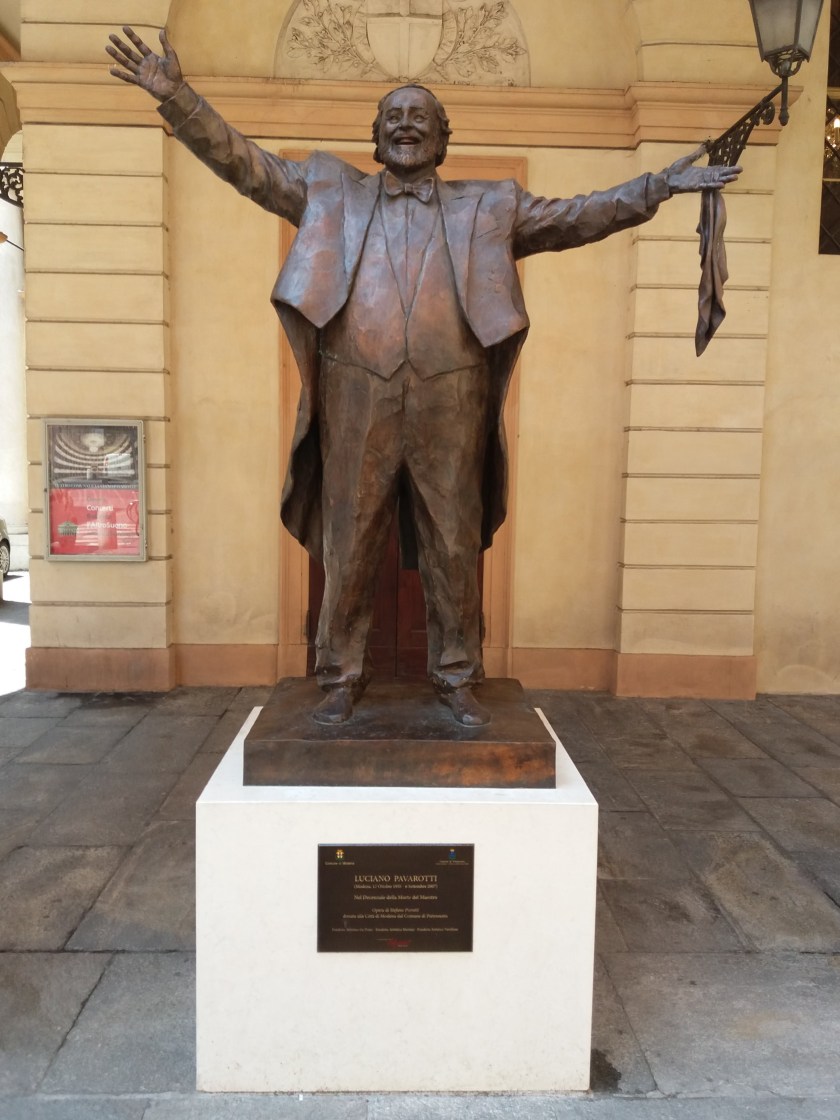
On Corso Canalgrande a group of middle-aged men stood in front of a statue singing Nessum Dorma. The statue was of a big man wearing a tail suit, it was Luciano Pavarotti. He was a local boy who did pretty well as a singer, although he never actually advertised Cornettos.
Just one Cornetto, give it to me
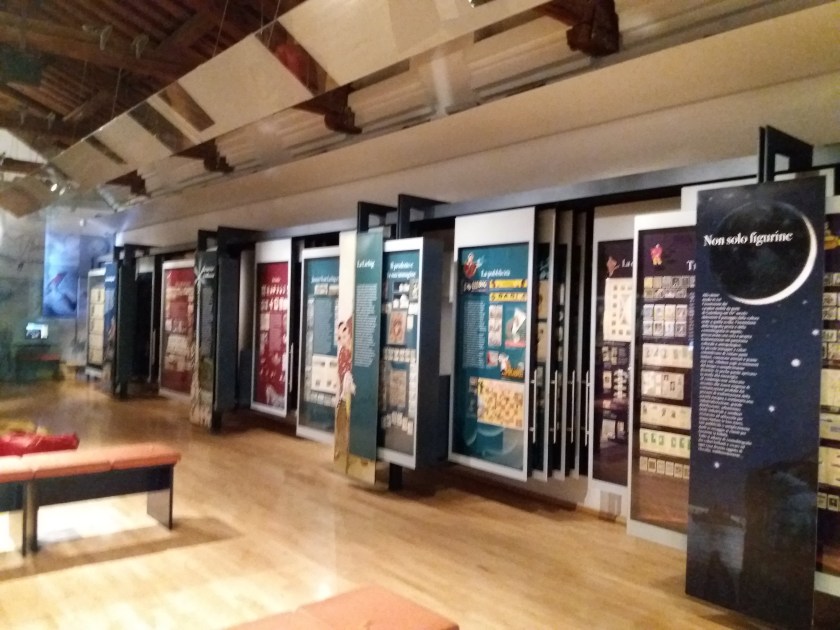
Close by the statue was the municipal library which also houses a museum of Figurina. I had never come across that word before, but it means small printed images of people. The museum was created by Signor Panini, the guy who sold sticker albums to the world. He clearly liked small printed images of people and sold gazillions of cards featuring footballers and pop stars to generations of children. It was a small museum, but worth a look around. One of the biggest collections was adverts for Liebig beef extract. Herr Liebig invented a method to turn cows into the liquid beef extract and built a big factory in Fray Bentos in Uraguay to make it. In the days before refrigerated ships, it was a way of turning meat into a product that could be shipped to Europe.
Figurina Museum
The tourist information office is in the ancient townhall in the main piazza of Modena. It has a very peculiar smell, because several square metres have been excavated to show archeology beneath. Consequently, the office smells strongly of soil and old walls, a bit unusual. The info told us that Modena is famous for Pavarotti, balsamic vinegar and the Ferrari museum, which I knew already.
The town hall is still home to civic functions, but also has a few historic rooms filled with old portraits, a huge Venetian chandelier and the famous Bucket of Bologna. It is safely enclosed in a thick glass case, they don’t want those sneaky Bolognaise stealing it back.
Modena Town Hall
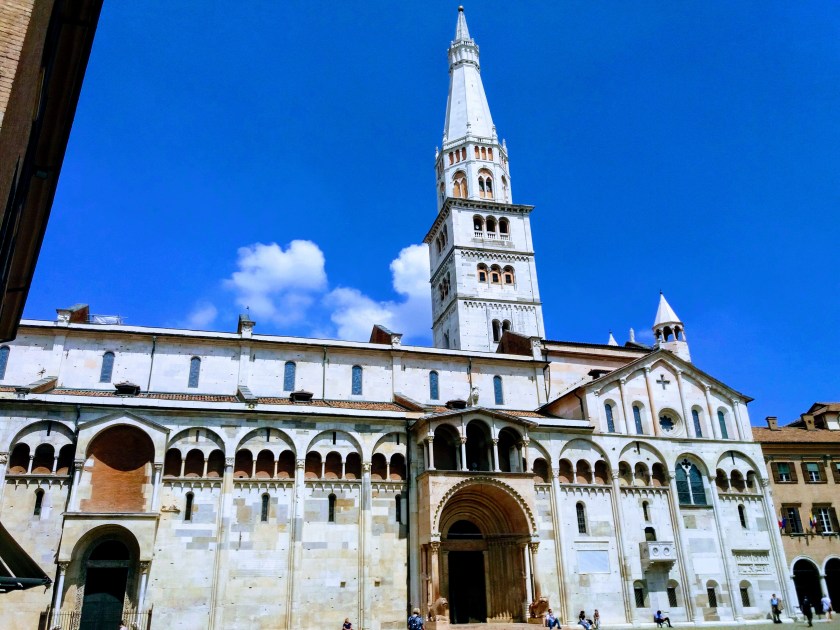
The other main attraction in the piazza is the Duomo, a Romanesque cathedral from the 12th century. It is clad in grey marble and has a soaring tower with a tall steeple. The cathedral is being restored, so the nave is full of scaffolding.
It has some exquisitely carved marble lions at the entrance, but the sculptor had obviously never seen an actual lion.
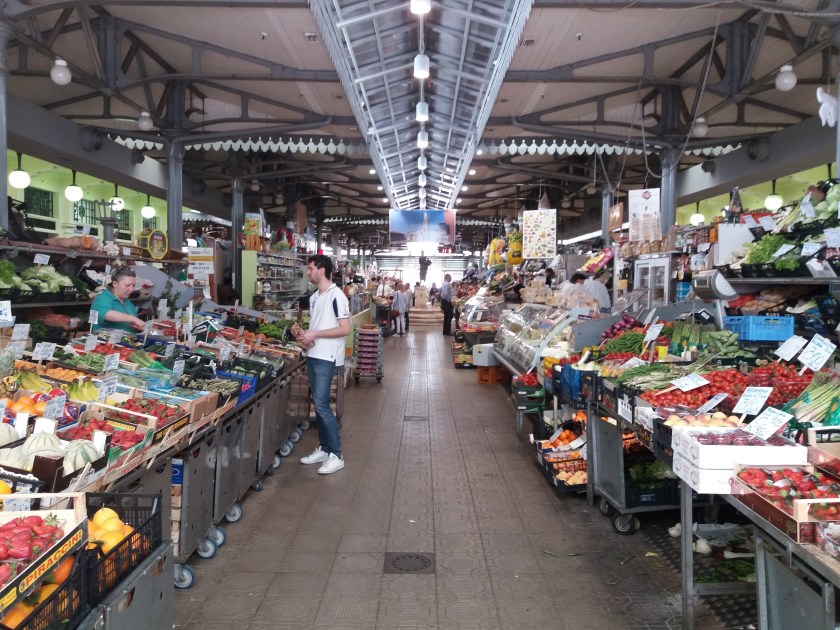
Modena has a superb indoor market with stalls selling fresh fruit, vegetables, meat, pasta, fish and everything looks so tasty!
Modena market
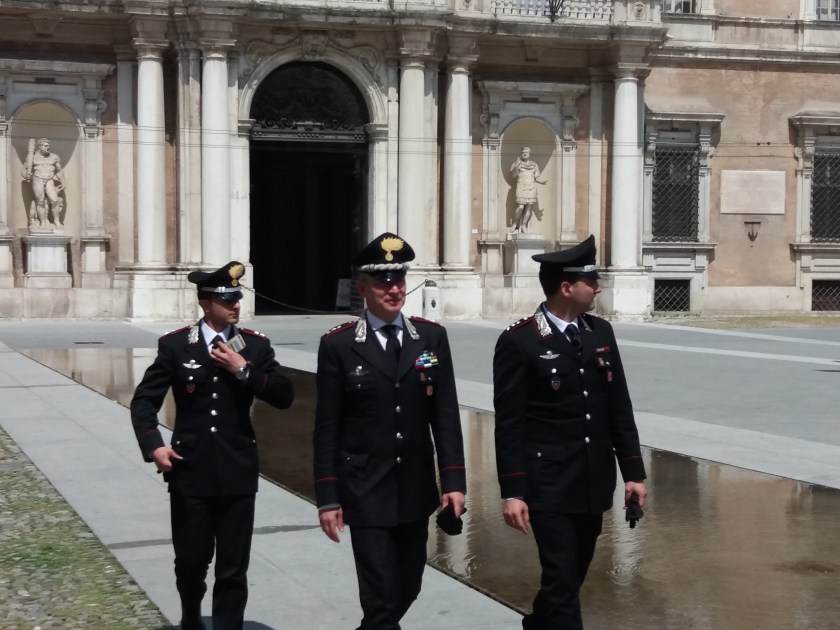
We stopped for an ice cream at a gelateria next to the Ducal Palace, a huge Baroque palazzo that was home to the Este Dukes of Modena between 1452 and 1859. It was lovely to look at while I licked my double scooper of lemon cream and ginger, mmmm. The palace is now a military academy, and while pretending to photograph the building, I snapped these officers. They looked very snappy, they are Italian after all!
We caught the train back to Bologna and collected our bags from a bike hire shop that doubles as a left luggage store. The airport bus took us out to catch our flight back to Heathrow, and to complete our adventure we took the 490 back home to Twickenham.
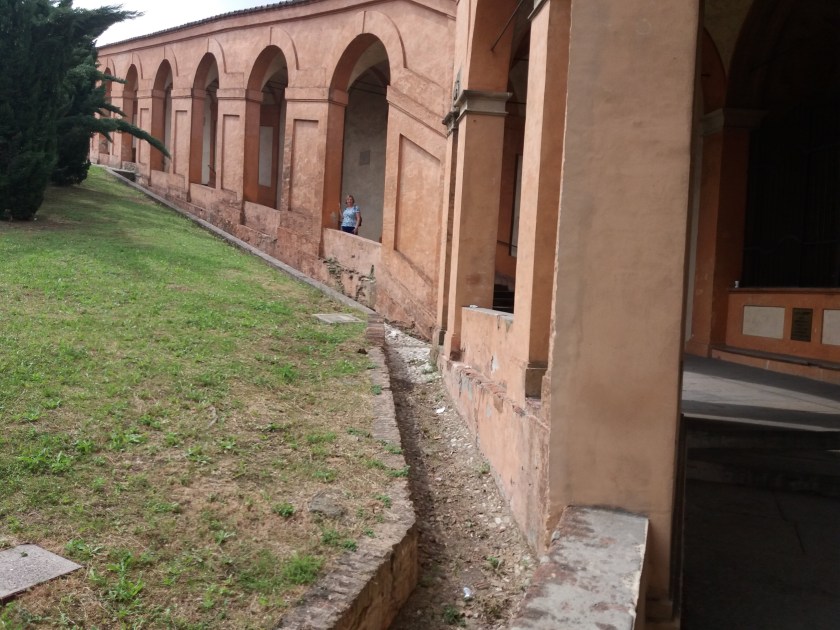
We scavenged the fridge for left-overs for breakfast; chopped apples and yoghurt, breadsticks with cream cheese and cherry tomatoes. A weird combination, but it worked quite well! Our hostess had recommended visiting the Sanctuary of San Luca, and early 18th-century Baroque church on a hill overlooking Bologna. The walking route took us through the city centre to the Saragossa gate, one of the gates in the city walls that were demolished in the 19th century. After the gate, a colonnade begins which goes on for 2.3 miles and is the longest in the world! The first part is flat and like most of Bologna’s colonnades is on the front of shops and houses. Then there are steps upwards to a bridge that crosses the road and the colonnade goes uphill on its own as a covered footpath. There are 666 arches in the colonnade, and it is a healthy climb to the church.
Julie in one of the 66archess
At the top is San Luca, a big terracotta coloured church which is a major destination for local pilgrims. Most of the old buildings in Bologna are painted in a shade of yellow or orange, there must have been a very good deal on those colours at the local Homebase. The church its self is not remarkable, but its location is, with wonderful views over the city.
Church of San Luca
The downward hike was quicker than the upward, and by then it was lunchtime. We stopped at a bistro for pasta and salad and got overcharged. Unfortunately, I don’t know the name of the crappy joint so I can’t slander it adequately in public.
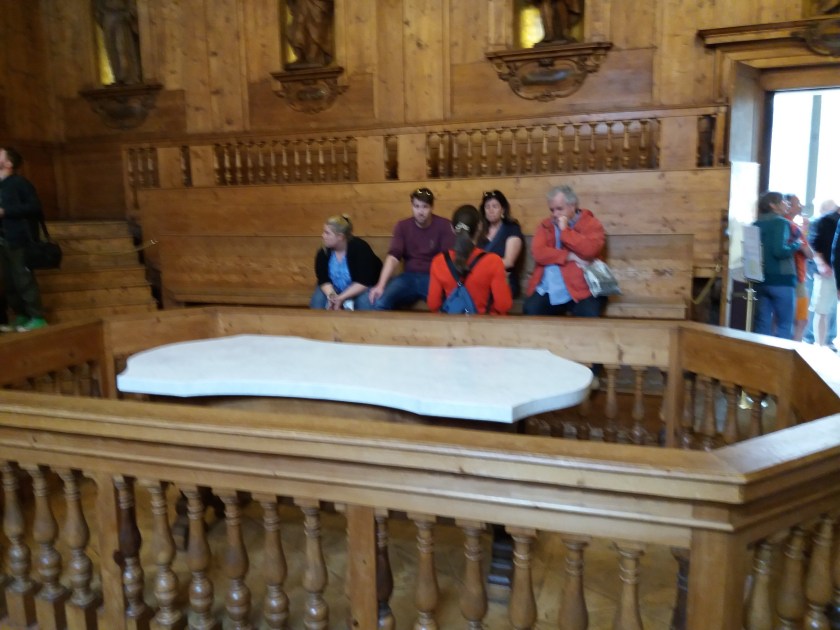
Our next stop was the Palazzo dell’Archinginnasio close to the Basilica, which was the first permanent home of the University. The main attraction is the Anatomy Theatre, complete with a marble slab for dissecting bodies. The room is a reconstruction, the original was bombed in WW2.
Dissecting slab in the Anatomy Theatre
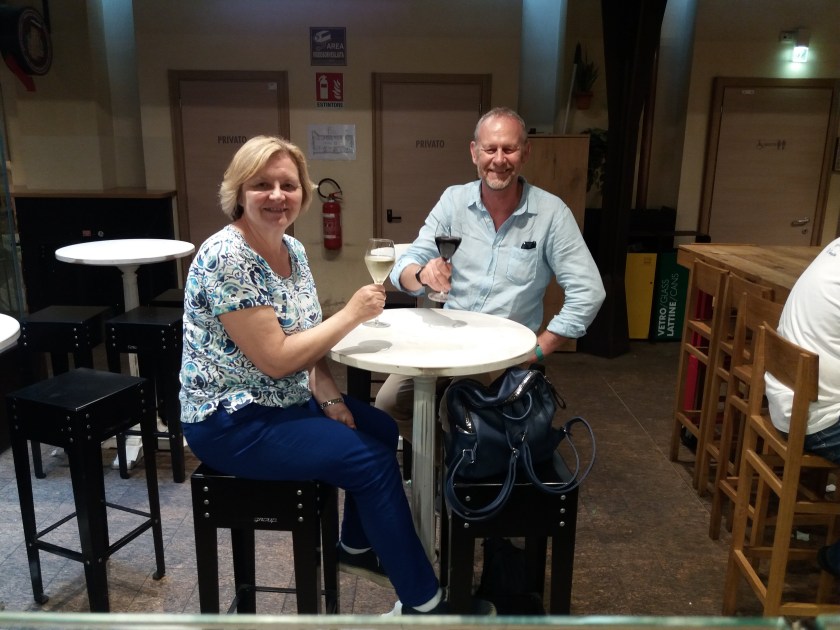
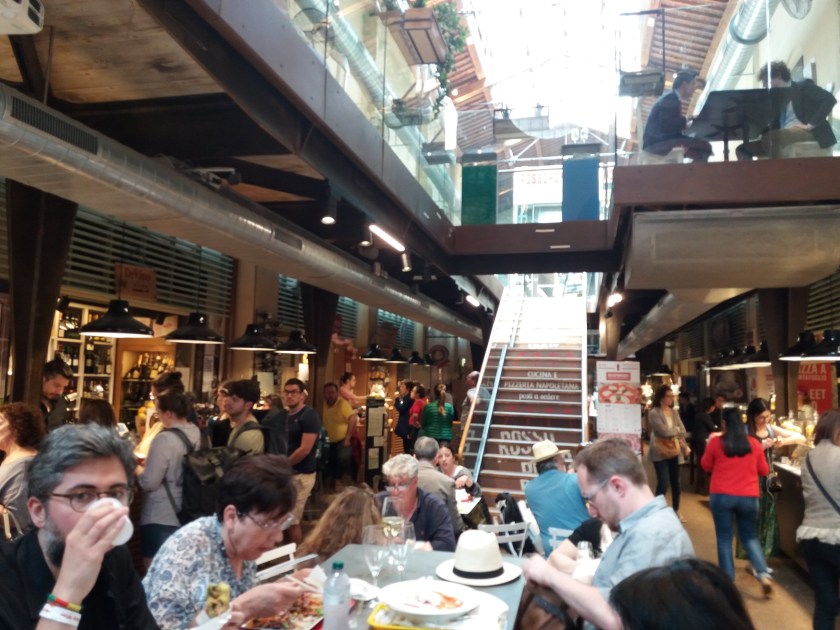
The route back to the flat took us through the Mercato di Mezzo, where we felt the need to support the local economy by drinking wine. I had Sangiovese and Julie had Pignoletto, the local fizzy wine which is just as good as Prosecco. I reckon the Prosecco bubble will burst as soon as Walkers start to make Prosecco flavoured crisps.
We took the train to Rimini on the Adriatic coast. It takes about fifty minutes in a comfortable high-speed train from Bologna station. The station was the location of a terrorist bomb that killed eighty people in 1980 perpetrated by the Red Brigade. The station clock remains at the same time as when the bomb exploded. It’s a sad reminder that Italy has had its share of terrorist incidents.
Rimini has fifteen kilometres of broad sandy beach and hundreds of hotels, it’s where Italians go for their holiday. The town itself is delightful as a destination, and in May it’s very quiet.
Bridge of Tiberius
The bridge of Tiberius is a complete Roman bridge started by the first Roman Emperor Augustus and finished by his successor Tiberius. It is over two thousand years old and still in use! Next to the bridge is a delightful district of colourful old houses, some of them decorated with murals. I was seduced by the gelateria and had the best ice-cream I have ever eaten.
Gelateria in Rimini, with the proprietor on the mural
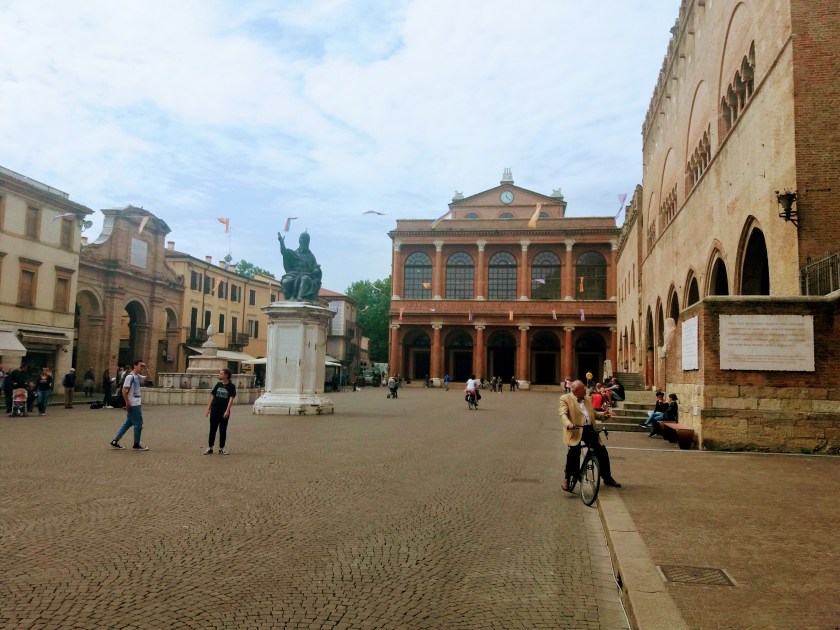
Rimini was the terminus of several Roman roads and was a walled town until the Fascists took them down. The central Piazza Cavour has three palazzos down one side and a vast Victorian theatre on another side, which is currently being renovated.
Piazza Cavour
The main street in Rimini is the Corso d’Augusto which is a pedestrianised shopping street with a very relaxed ambience. It has a market where Julie was able to buy a new bag becasue her old one was a bit scruffy. All my bags are a bit scruffy, a bit like me, but they still function. We stopped at a tourist cafe for a natural break. The loo was an undignified squat-and-drop, but when you gotta go you gotta go.
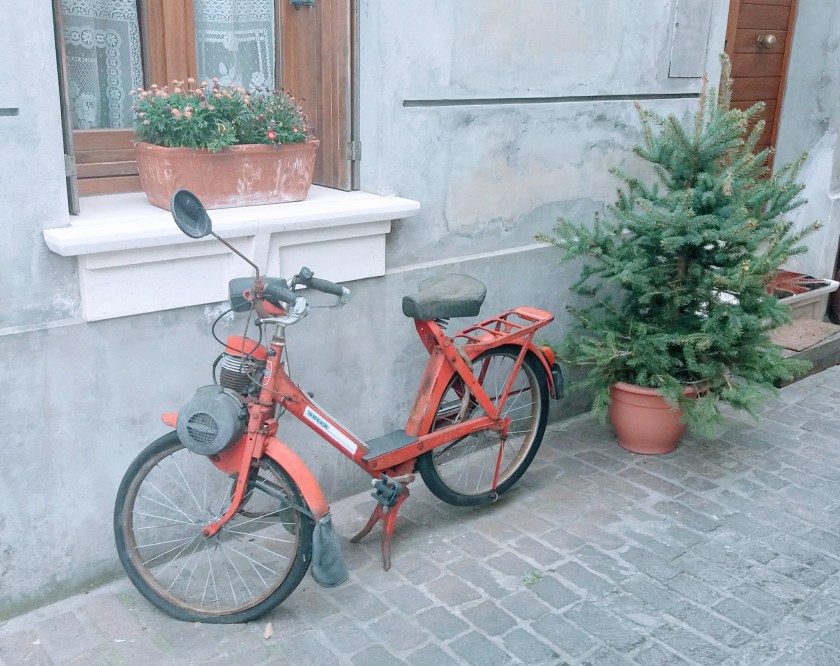
Ancient Solex moped – i haven’t seen one of these for forty years!
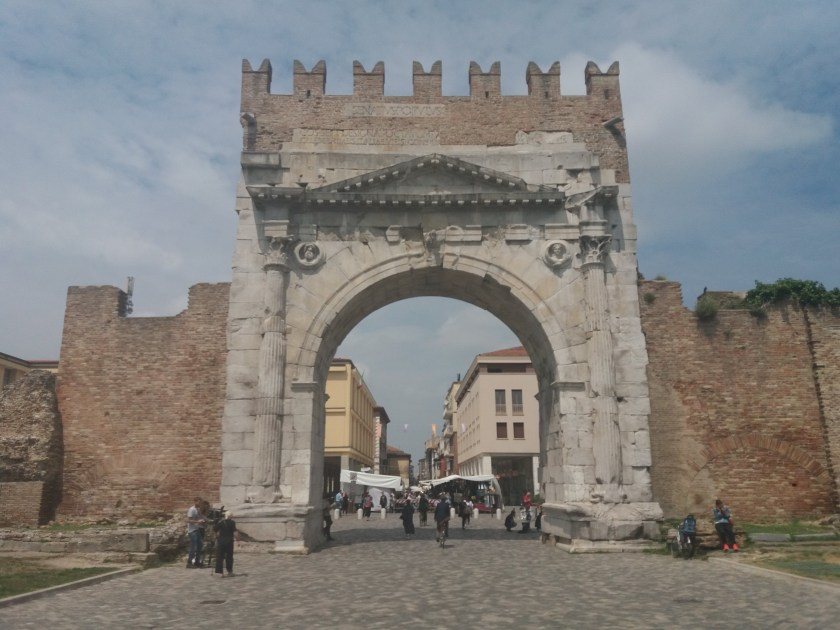
At the end of the Corsa is the Arch of Augustus, a Roman triumphal arch that once had a bronze statue of Big Gus on top of it. It’s the oldest of its type in the world and is big and impressive.
Arch of Augustus
Beyond the arch is a longitudinal park which goes to the beach. It is woody and shady, but you do have to look out for speeding cyclists sharing the footpath. The beach is hundreds of metres wide and is clean soft sand. There were very few people sunbathing, but there were sunshades and loungers for thousands. The season hasn’t started yet, but they are ready for the masses.
Its quiet here, too quiet
Julie had found a “reasonably priced” seafood restaurant on TripAdvisor, La Pisda E IL Mare. I looked it up on Google Maps and found it was forty feet away across the road, a very convenient coincidence! I found it impossible to resist the Frito Misti, seafood and sliced vegetables deep fried in batter, basically sophistication fish and chips.
Continuing along the seafront we reached the Porto Canale, which is only a few kilometres long and terminates just after the Roman bridge. It is the fishing port of Rimini with dozens of boats which harvest (and I’m guessing here) clams and mussels for the many seafood restaurants in the area. There’s also a lighthouse built in the early 18th century which doubled as a lookout for Turkish pirates that raided Rimini for slaves.
Our train was late, so we had an overpriced beer in a cafe near the station and waited another hour, bummer! But we had a very relaxing day in Rimini, which is a charming town.
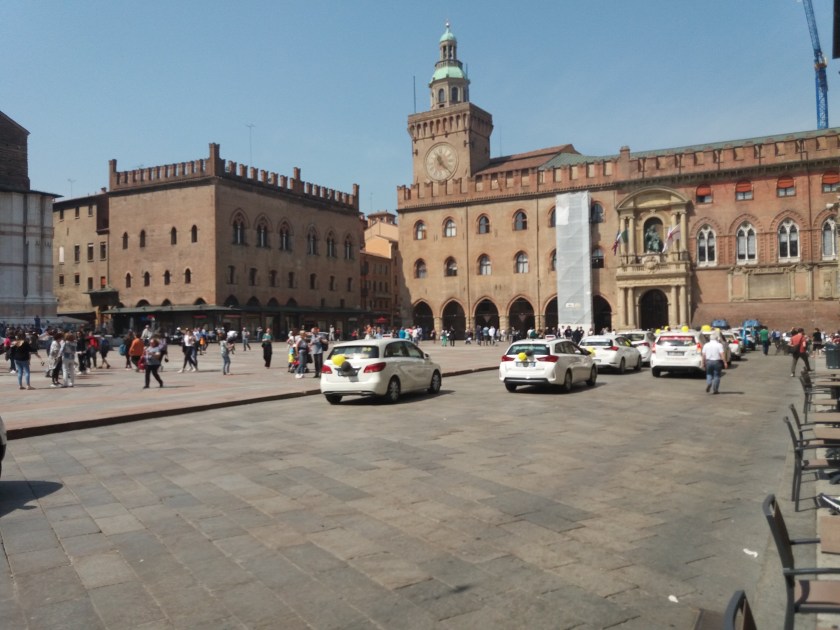
Our bedroom had external shutters, so it was very dark in the room and I slept very well. We had a cappuccino and a croissant (called a brioche in Italy) in the cafe in the street close to the flat and then set off to explore the Bologna. The commercial and cultural heart is Piazza Maggiore, a beautiful square surrounded by imposing brick medieval buildings. On our arrival, we saw lots of police in the piazza, and then heard lots of loud car horns and air horns. A procession of white taxis drove slowly into the square and parked outside the town hall. They were protesting about something, but I don’t know what! We were told that Uber is banned in Bologna, so it wasn’t about that.
Demonstrating taxi drivers in Piazza Maggiore outside the Palazzio D’Accursio
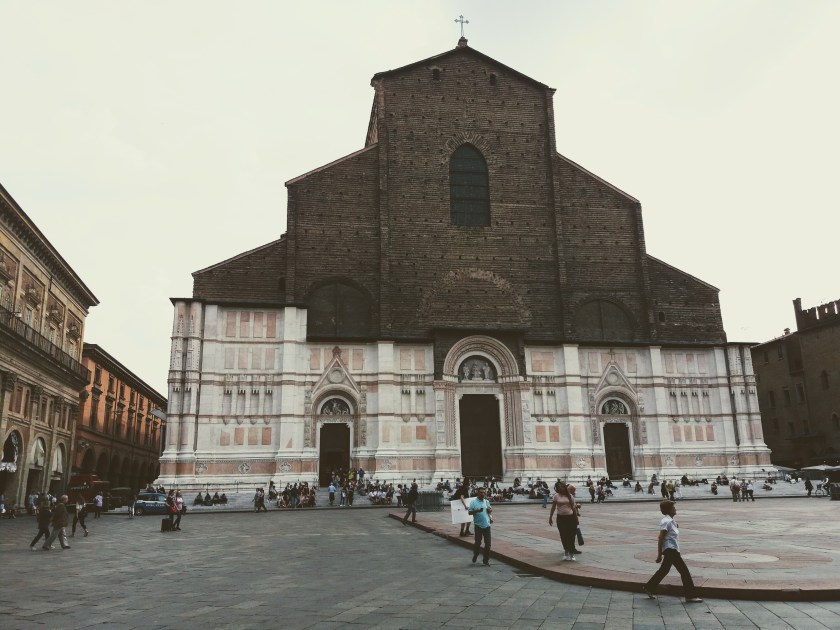
The Basilica of Saint Petronius is a huge church in the Piazza but is half finished. Originally it would have been bigger than St Peter’s in Rome, but the Pope took some of the funds to build the university. Consequently, the front is only half covered in marble, and the transept was never built. The interior is spacious and lined with twenty chapels and two organs, one of them from 1480.
The Palazzo D’Accursio is a huge palace which is now the town hall. Inside there are staircases which can be ridden up on horseback, but are not so easy to walk up on foot. It has some very grand staterooms with frescos and portraits of the great and the good of old Bologna. In an office the revolting taxi drivers were meeting local officials surrounded by media folk, so we kept clear of that.
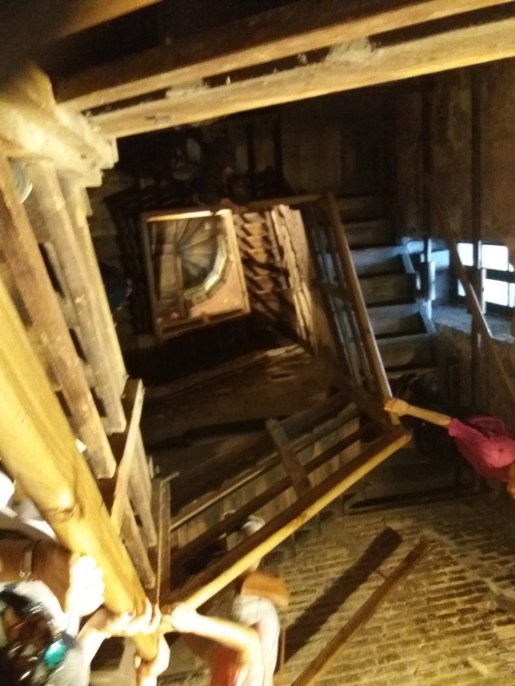
Horse staircase in the Palazzo – not enough light for a good picture
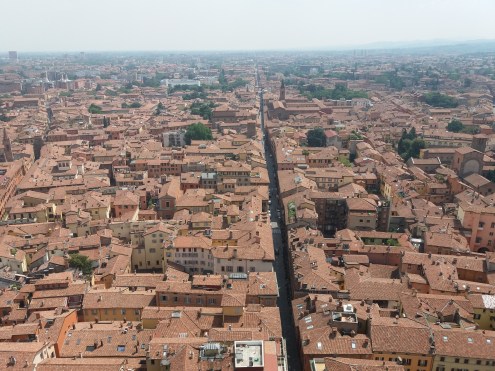
At 12.30 we climbed the 480 steps to the top of the Asinelli tower. It is a narrow wooden staircase all the way up, and it takes about ten minutes to climb. The view is magnificent and well worth the ascent. We got in behind a group of lively school students, and even they briefly stopped taking selfies to take photos of the wonderful views of old Bologna.
Admiring the view from the Asinelli towerVia Emilia – a Roman roadLooking down the tower
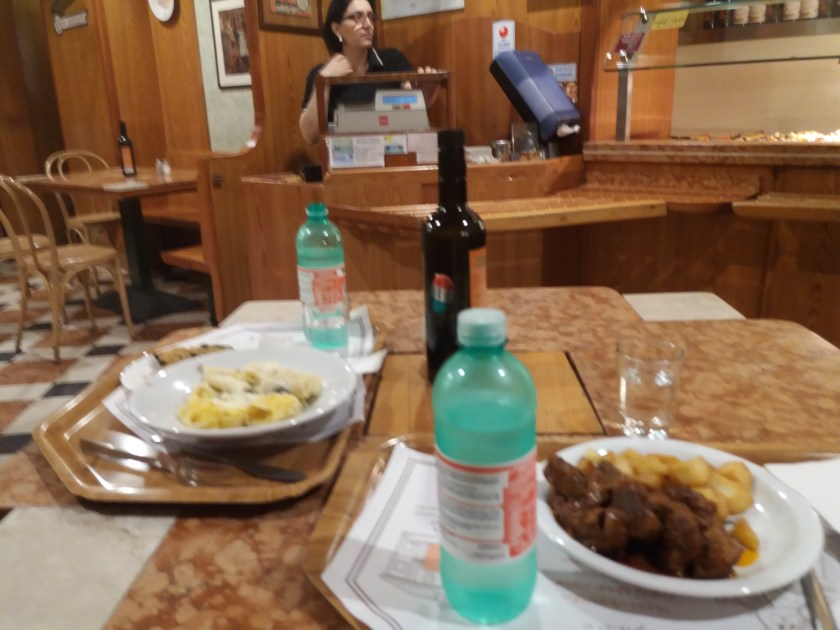
All those stairs gave us an appetite, so we explored the Quadrilatero district to find some lunch. It is a grid of bars, cafes and food shops near the Piazza, and is a real foodie heaven. There are shops full of handmade pasta, Parma ham, meringues, Parmesan, cakes, fancy bread – everything deliciously Italian. It was hard to decide which place to go in, so we randomly chose Tamburini, which is a self-service cafe, which was a very good choice. I had braised beef with sautéed potatoes, Julie had tortelloni and cannelloni, both were very very good.
Our lunch in Tamburini – next to the checkout
You could spend the whole day grazing in the Quadrilatero, but you would end up very fat and poor, not enviable conditions to be in. We explored the Piazza San Stephany with its Seven Churches, which are, in fact, four churches (still standing) all joined together into a single complex. Some of the buildings date back to Roman times, so it’s all terribly old and quiet and was good for an hour of peace and quiet.
part of San Stephano
Bust of a Turk looking through a porthole – weird!
Julie then wanted a drink at the nice bar in the square, but I didn’t want to spend five euros on 330 ml of lager. So she got the justifiably got the hump at my stingy attitude, but I eased her pain with a glass of sparkling wine in the Mercato di Mezzo for three euros – result! I saved two euros, which is the same amount I donated to St Stephano church to ensure my entry into heaven.
Mercato Di Mezzo
We returned to the flat for a rest, a breadstick and some San Miguel beer, I know it’s Spanish, but it is darned good. Thus replenished, it was time for an aperitif in Piazza Aldrovani. The Aperol Spritz came with a selection of snacks and we watched some drunken people at a table across the pavement, it was gently entertaining. Our evening was topped off by pizzas at Pizzeria al Rustica in Via San Vitale, accompanied by some Sangiovese wine. Not a sophisticated meal, but a tasty belt buster.
Google started bleating it’s alarm at 5.15 this morning, so early that the birds had only just rolled out of bed and were singing in a half-arsed way. After a quick shower and a smoked salmon sandwich (it needed eating up), we got our Bat Cab to T5 Heathrow. We have been using Bat Cabs for about twenty-five years, and stick with them because they are our Local Cab Company for Local People, and it also has a very cool name.
Terminal 5 is an enormous shed with many overpriced shops and some reasonably priced cafes, Pret always being our usual cafe of choice for buying a froffy coffee to get us revived. They can always create a cappuccino at a remarkable speed which is how I like it. Unlike Kew Gardens, where coffee in the Orangery is produced at the growing speed of a Quercus Robur. Our flight, BA0540, left on time and arrived two hours later in northeast Italy. The Alps glistened like an over-iced Christmas cake, and Italy looked lush and prosperous from thirty-four thousand feet.
The Alps
A taxi (€20) took us straight to our AirBnB in Via dell ‘Unione in central Bologna. A lady who knew very little English let us into the flat, which is probably more secure as Wormwood Scrubs. There is a heavy locked door onto the street, a locked iron gate with four bolts, another locked iron gate and finally the door to the flat, which is made of steel and is three inches thick. The interior of the flat is very modern and minimalist and newly decorated. It has two TVs, both of which show only Italian TV without anything in English. Even the English and US shows are dubbed in Italian. It’s a myth that Italian TV consists only of game shows hosted by Silvio Berlusconi where women take their clothes off, I checked every channel very carefully.
Via dell Union from our window
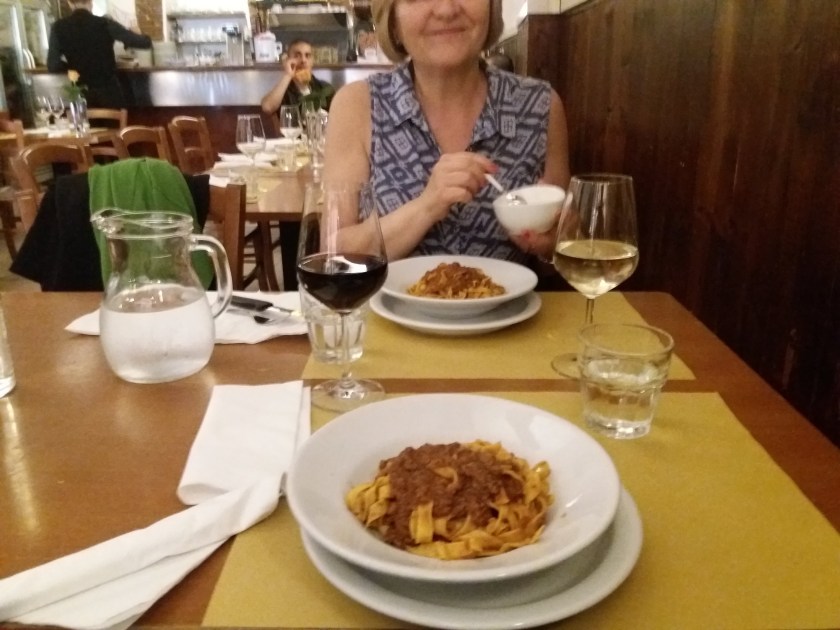
Our AirBnB host made us a reservation for lunch at Trattoria Broccaindosso, a short walk away. You can’t actually get Spag Bol in Bologna and come to that you can’t get Chilli Con Carne or Chicken Tikka Masala either. But you can get Tagliatelle Ragu, which is good, but disappointingly similar to the food I cook at home. But it was very good with a glass of red wine. The service was perfunctory, I think the waiter got the ‘ump because we only had one course.
Definitely NOT Spag Bol
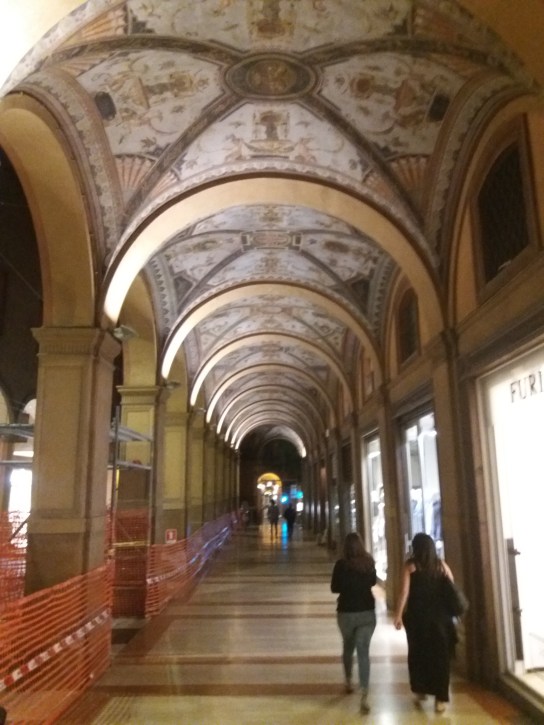
Bologna is famous for its porticos, most of the footpaths in the old city are covered by vaulted roofs supported by columns. There are forty kilometres of colonnades which protect pedestrians from the rain and sun. The city is known as Bologna The Fat, Bologna The Learned and Bologna The Red. It is acknowledged as the foodie capital of Italy, hence The Fat. It has the oldest university in the Western world founded in 1088 and is still swarming with students, which is why it is The Learned. The city is known for its Communist and Socialist city council, so that gives the name The Red.
Porticos on Via Farini
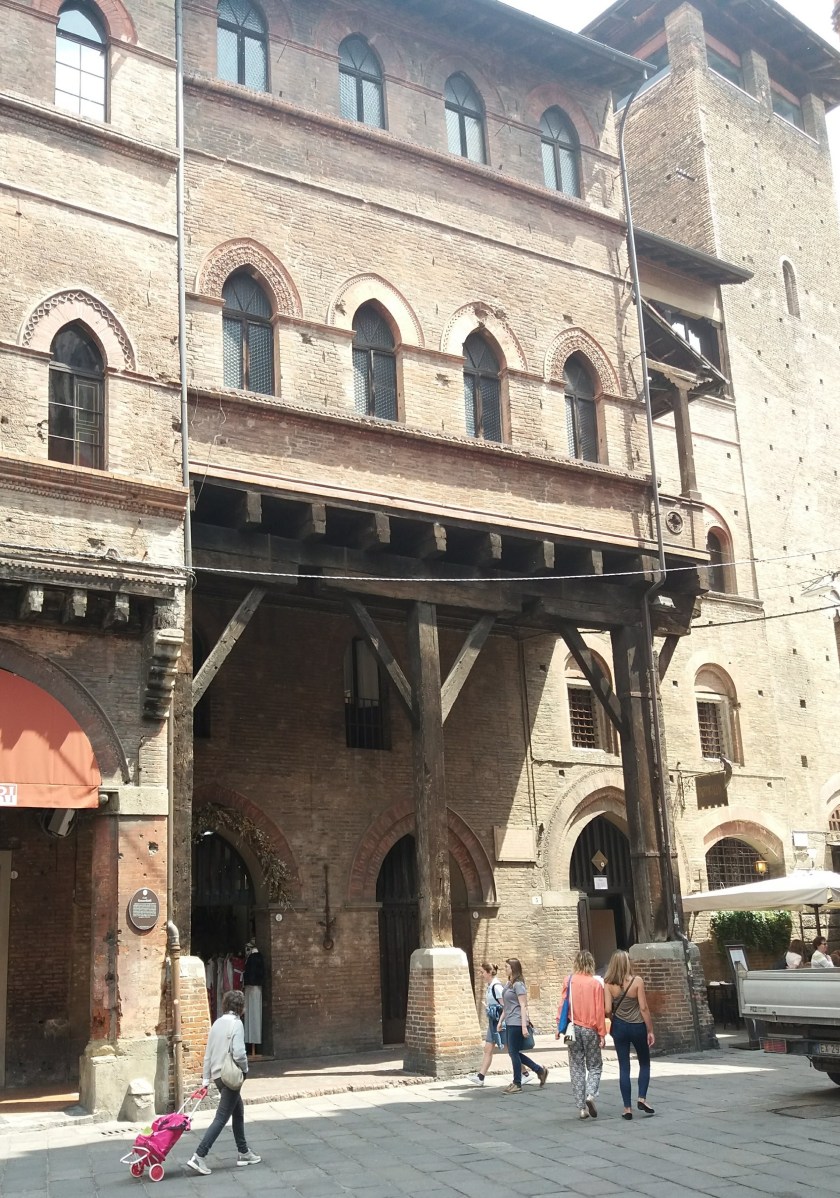
We were recommended Bologna by two sets of friends, and it didn’t disappoint us. The entire city centre is made up of 14th, 15th and 16th-century buildings, the architecture is wonderful. I walked around with my head up all the time, much to the annoyance of other pedestrians.
13th Century porticos on Casa Isolani
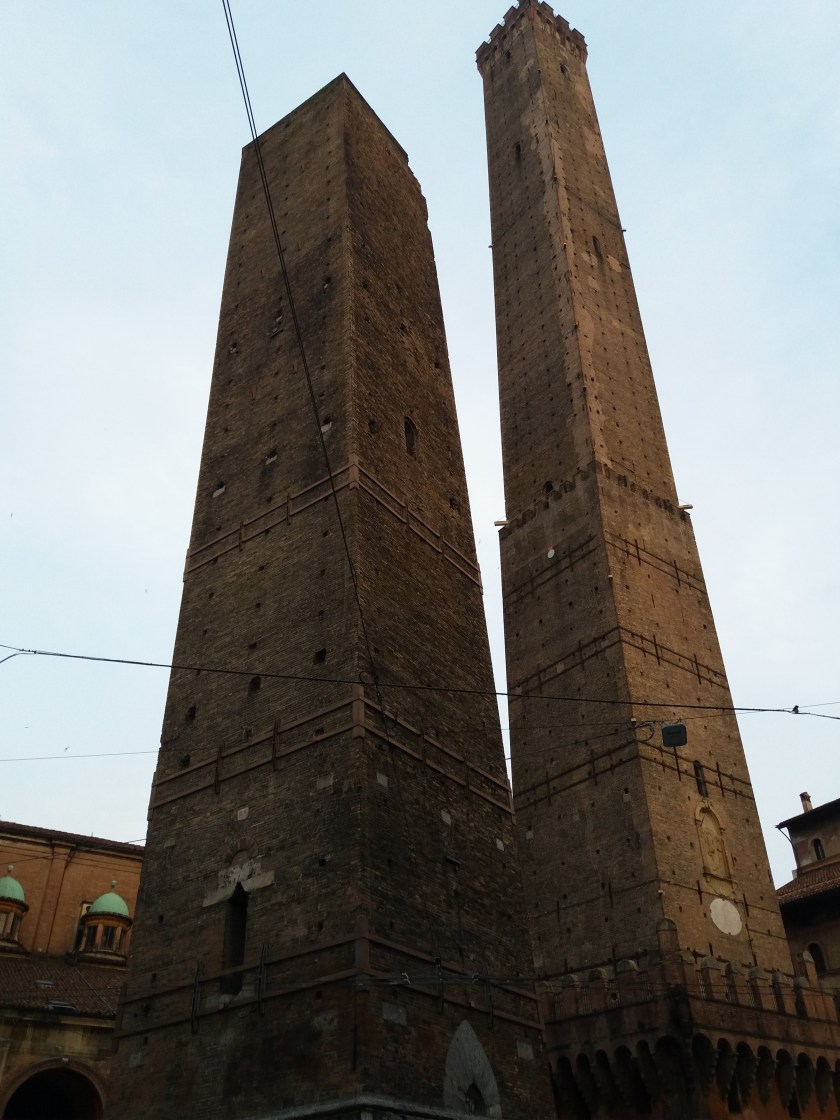
A waiter called Micky recommended some bars to us, so we went on a wild goose chase round central Bologna to try and find them. The only one we found had some sort of literary meeting going on, so we gave up the search and ended up in a bar near the Two Towers. Don’t bother looking for Gandalf and Frodo, these towers are just medieval big show-off phallus’s. In the early Middle Ages, there was competition between the noble families to see who could build the tallest brick tower. The Asinelli family won with a ninety-seven-meter monster tower, Mr Asinelli must have been very proud of his erection. It’s thought that there could have been a hundred of towers at one time, now only twenty or so remain.
The Two Towers
The smaller Garisenda tower is 47 metres tall and has a pronounced lean caused by subsidence.
The Caffe Zamboni near the foot of the tower offered any cocktail and a buffet dinner for ten euros, which was a good deal. It wasn’t cordon bleu (or the Italian equivalent), but it was quick and convenient. I had my first Aperol Spritz, and a damned fine drink it is too! It is an aperitif made of Aperol (a type of orangy vermouth), prosecco and a splash of soda water. The place was full of students who were just as pleased as we were to get a cocktail and as much food as you can eat for ten euros.
My holiday in Hurghada and on a Nile Cruise. The good, the bad, and the fat and ugly
Travelling to Egypt
Four AM is a shitty time to be woken up, especially if you have had a lousy night’s sleep worrying about getting up in time! But we had a plane to catch at Gatport Airwick to take us to Hurghada in Egypt for our winter break holiday. This is the third year we have gone away in January, after New Zealand in 2016 and Sri Lanka in 2017. Why Egypt I hear you ask? There is lots of sunshine and it’s very cheap I reply! Besides that, I will be able to visit some of the most ancient classical remains on Earth and get to drink as much Egyptian beer as I want (which isn’t much).
I scraped the ice off the car windscreen and we drove down the M3, M25 and M23 to the airport and left the car at Purple Parking, which is a couple of miles from the airport. After leaving our keys with some complete strangers, we got on a shuttle bus to the South Terminal.
After checking in our bags we had breakfast at the ‘Spoons in Gatwick South; a very tasty sausage, egg and bacon sandwich, a winning combination and our last taste of English food for two weeks.
We boarded the plane at 9 AM, then fly, fly, fly, fly and we were in Egypt half an hour earlier because we had a tailwind! Hurghada Airport is new, and mostly empty since most tourists are too scared to go to Egypt, sissies. But we are Stout Hearted Londoners who have lived with the threat of terrorism for a long time, who aren’t easily put off.
The Grand Resort
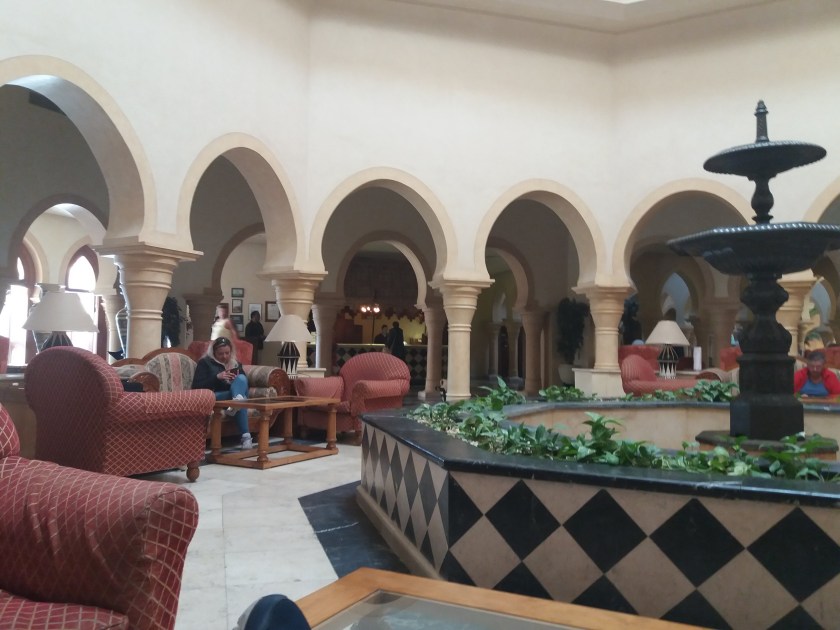
Hurghada is a strip of hotels along the Red Sea coast, mostly constructed in the last twenty years. It isn’t a beautiful place, but it does have very good weather and a blue sea most of the time, unlike Skegness. Skekky does have better sand and better chip shops than Hurghada, otherwise it’s at a disadvantage. The hotels are huge concrete buildings in middle eastern style, and ours -the Grand Resort- is painted a lovely terracotta pink colour. The interior main lounge is all columns and Islamic arches with stone floors, and quite enormous. There are hundreds of easy chairs and tables to accommodate guests for their main occupation of the day, sitting around staring at mobile phones and drinking the “free” drinks.
Central lounge in the Grand Resort
We went on an all-inclusive holiday, which means that all the food and drink is available on demand at no extra cost, result! It’s all fine and dandy as long as you are happy with Egyptian beer, wine and spirits, which tastes like stuff that was rejected by the Tesco Value range. But honestly, it tastes OK For washing down a seafood paella (without any noticeable seafood) and some of the brown bread rolls do look like dog turds.
Food is served in a huge buffet restaurant called the Mahara. There are stations where you can help yourself to salads, bread, hot meat and vegetable dishes. There is plenty of food available, but it is more like school dinners and restaurant quality food. I was told the fish is Sea Bass, but it definitely wasn’t. The “Indian Curry” was sliced beef in a curry-flavoured gravy, like something your mum might make from left-overs. There was plenty of fruit for dessert; oranges, mandarins, melon and weird hard pear-like things that turned out to be guavas. If you had space in your tummy, there were lots of brightly coloured cakes, which some of the larger visitors liked to pile onto dinner plates to ensure they got their money’s worth.
The Grand Resort
As I sit here typing, I have a “Tequila Sunrise” with a straw in it. It’s a fruity drink with some sort of spirit and ice in it, and it didn’t cost me £7, so I quite like it. In fact, I might have another when the waiter comes round again, just because I can.
Pool and the burger bar under the dome
After three nights in Hurghada, we got up at 4.30 to have breakfast and get on a coach to Luxor. We drove across the barren Eastern Desert to Qena, and then south through irrigated sugar cane fields to Luxor. They grow a lot of sugar in Egypt, about three million tons a year. They also eat a lot, consumption is twenty-two kilos per person every year, Egyptians love their sweet tea and syrupy cakes.
The Eastern Desert
The Nile Cruise
Luxor is a city of half a million people, and it has almost no rain at all and 4,000 hours of sunshine a year. In ancient times the city was called Thebes and was the capital of Upper Egypt. Upper Egypt is in the south of the country, and Lower Egypt is in the north, around the Nile Delta. Since the revolution after the Arab Spring of 2011, there has been a massive downturn in the tourist trade, and many people In Luxor are unemployed.
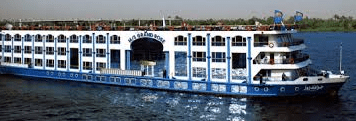
Our cruiser was the MS Grand Rose, a 2005 vintage ship with cabins for two hundred guests. Our cabin (407) was spacious and comfortable and on the fourth deck, so has great views of the river and over the banks. All the Nile cruisers are about the same size as the reception areas are halfway down the ship. When they stop at ports on the river, they sometimes sit side-by-side, up to five ships in a row. The furthest ships from shore are accessed by walking through the receptions of the others. They all float at the same level in the water (otherwise traversing the ships would be very awkward).
The Grand Rose had about a hundred and fifty passengers, and none of them looked like Hercule Poirot. They were mostly German, with a few Egyptian families and a dozen English people.
One of our compatriots from England is a loud lady in her sixties with a deep tan and blond hair, so I call her Donald Trump. Donald likes being the centre of attention and would always tell us all in great detail about the latest souvenir she had bought. I couldn’t give a monkey’s about her six bookmarks for a Euro, I doubt she can read long books anyway. Her husband didn’t say anything, the poor bugger couldn’t get a word in edgewise. He could enjoy a fag on deck, and let the verbal diarrhoea wash over him.
Our Egyptian guide on the ship from Red Sea Holidays was Ussama, a charming educated man from Cairo with a slightly strange English accent. I had to quietly correct him when he told us about Mark Antony and the Romanians. He guided us around all the ancient sites and patiently explained the statues and hieroglyphics.
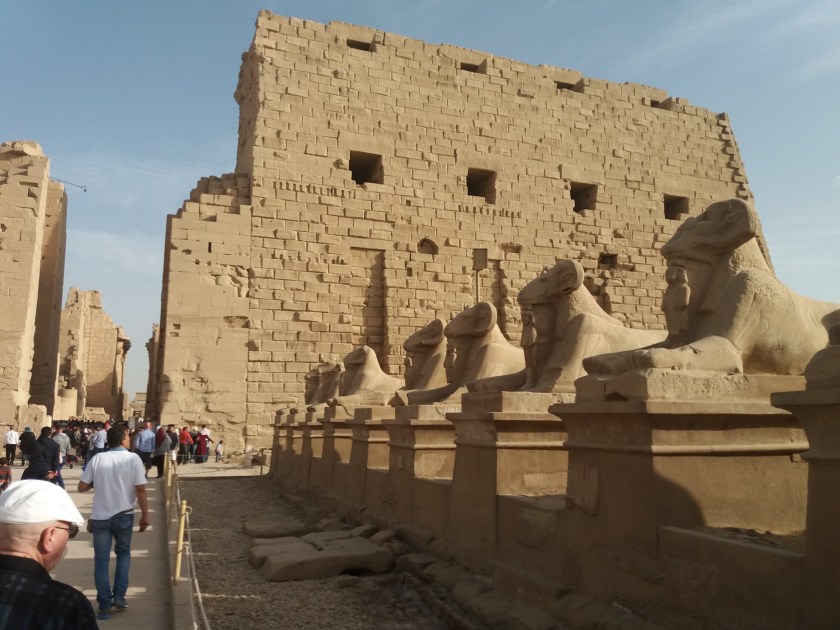
Avenue of Rams and the Pylon at Karnak
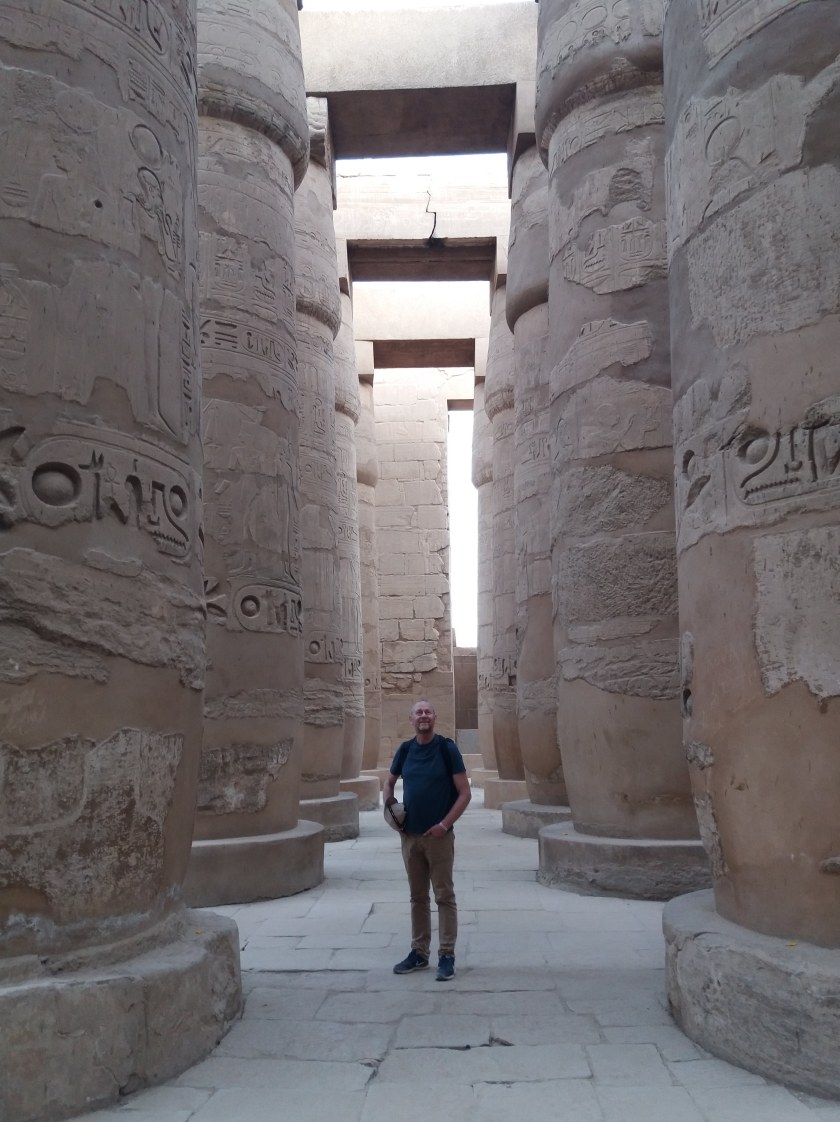
On our first afternoon and evening in Luxor, we saw the magnificent Karnak and Luxor temples. which are both monumentally awesome in their scale and beauty. The Hypostyle Hall in Karnak covers an area of 50,000 sq ft (5,000 m2) with 134 massive columns arranged in 16 rows. 122 of these columns are 10 meters tall, and the other 12 are 21 meters tall with a diameter of over three meters. The vast temple complex was constructed and added to over about fifteen hundred years from the Eighteenth Dynasty until the Ptolemaic Period.
The Hypostyle Hall at Karnak
Some of the ceilings that had remained in the shade still had their original paint on them, I don’t think Dulux will last for 3,500 years!
Nice paint job, I bet he used a roller
The Luxor temple, which is right in the city centre is floodlit at night, which added to its magical beauty. The site was packed with tourists, so we had to shuffle around the site.
Luxor Temple by night
As an added “bonus” our coach took us to a papyrus factory where we were given a quick demo on how papyrus paper is made, and the opportunity to buy a piece printed with Egyptian scenes. Not my kind of thing really, and that’s being very polite. Our own “Donald Trump” did buy a print, which I’m sure will go very well with her flying ducks on the wall and paintings of sunsets over Vesuvius.
In the evening we had dinner with two other couples from England, John and Sue and Edith and Melvin. They are all a bit older than us, but quite sociable and good fun. Melvin especially likes a cocktail and tells good stories. After dinner, there was an Egyptian show in the lounge. The belly dancer wasn’t very entertaining, but her band were really good, especially the bongo (don’t know the real name) player. The whirling Dervish show was great fun, and he didn’t even look dizzy when he finished.
However, I was really, REALLY pissed off when my new £2,500 dental implant fell out after dinner, leaving me once again with a gap in my front teeth.
The MS Rose has sixty-two cabins and two suites, and has a crew of ninety, so the guests are very well looked after. Our pink “fully inclusive” bracelets give us just about as much food and drink as we want. All the meals are buffets with a wide selection of salads, vegetables, meat dishes and cake, loadsa cakes. I can have wine, beer and cocktails whenever I want to, so showing resistance is quite tough. It would be easy to eat and drink far too much. Our waiter is a quietly efficient guy called Madami, who knows when to get me another glass of white wine.
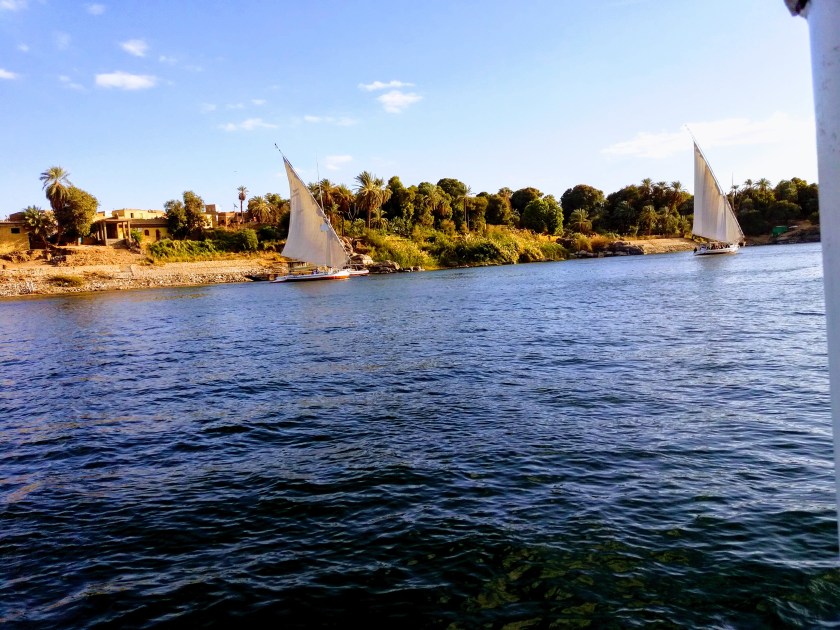
The Nile varies in width and has sandbanks and islands, so the pilot has to be skilled and know what he is doing. The green area alongside the river is only a mile or two wide, beyond that, there is a brown desert. Date palms line the banks, interspersed with fields of crops or meadows grazed by cattle, buffaloes, donkeys and goats. Occasionally a small skiff is seen crossing the river. One man rows the short (about eight feet long) boat with simple oars on a single those peg. There is plenty of birdlife; swallows, swifts, herons, egrets, hawks, crows. At Aswan there are many feluccas, a graceful sailing boat with lateen rigs whose origins date back to Roman times.
The guests are British, German, Russian and Egyptian, mostly middle and old aged, but there are some families with young children. The conversation in our group did tend to go towards aches and pains and the declines of old age. At that point, I make an excuse and go somewhere else. I may be heading that way myself, but don’t want to talk about it.
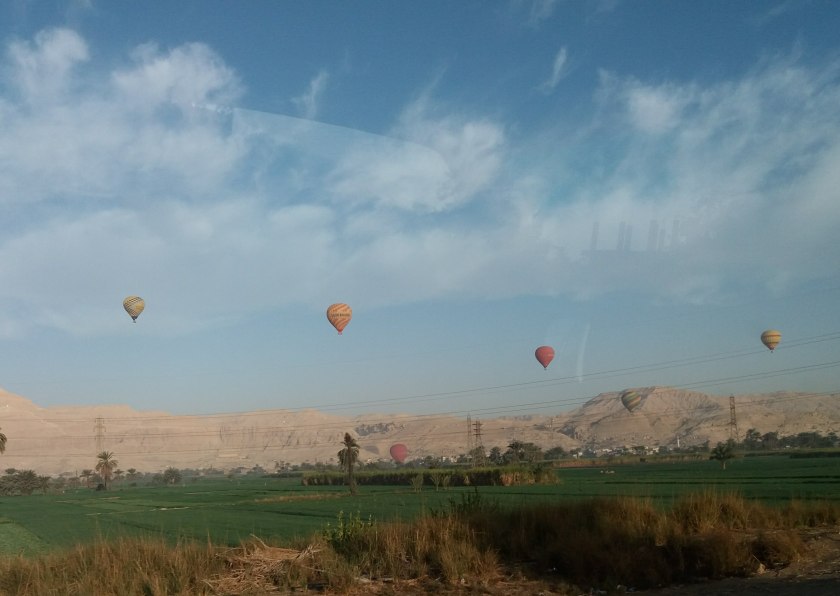
On our second day in Luxor, we visited the Valley of the Kings where many pharaohs were buried. As we arrived a flock of balloons was rising up into the cool morning sky.
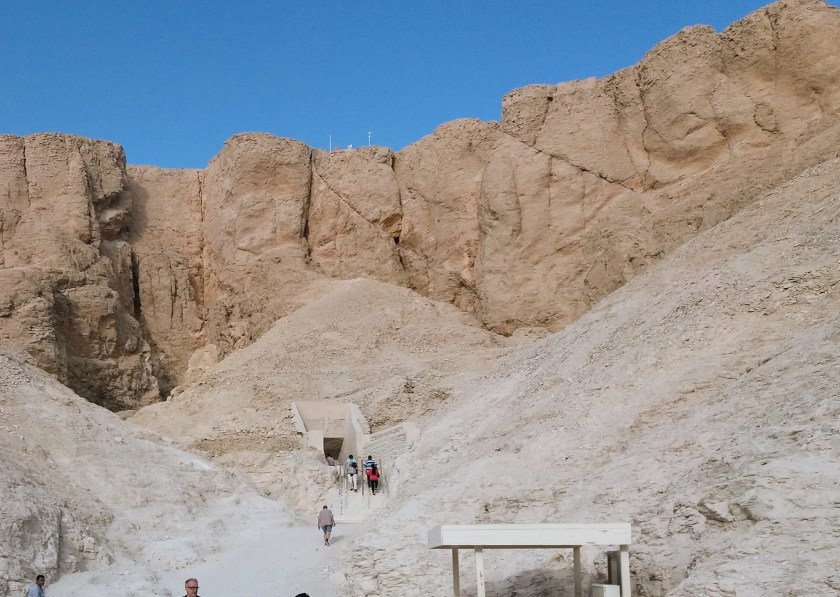
The Valley looks like a rough quarry, crumbling limestone hills covered with scree and without a single blade of grass. We got here very early, too avoid the crowds, it is one of the top tourist sites. in Egypt. There are a dozen or so entrances into the hillsides which lead into the tombs.
Tomb entrance, Valley of the Kings
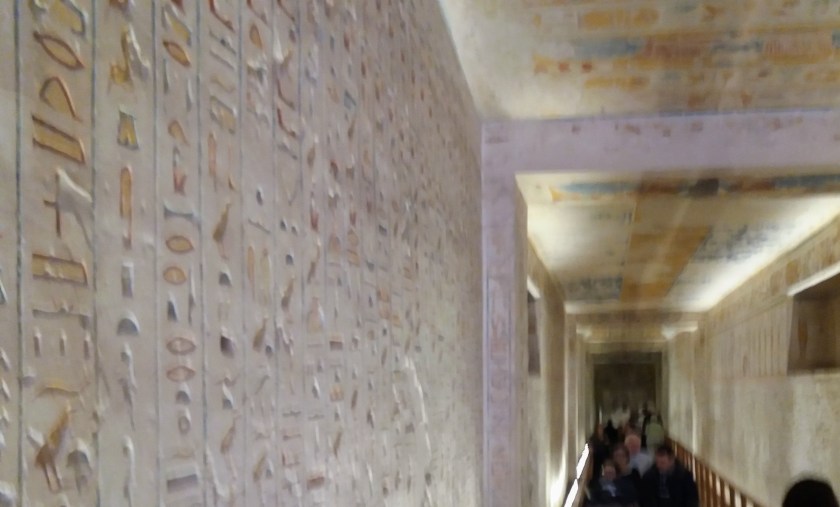
The walls of the passages are covered in colourful paintings and cartouches of hieroglyphics, still vibrant after three thousand years. I was very surprised that I could touch these ancient treasures without being shouted at, I think they need better protection. The sarcophagi in the tombs are massive coffins of granite from Aswan, but all treasures were stolen thousands of years ago. The notable exception, of course, is King Tutankhamun, whose tomb, complete with grave goods, was discovered by Howard Carter in 1922.
I sneaked a photo in one of the tombs to show the hieroglyphics cut into the plaster walls of the burial chamber.
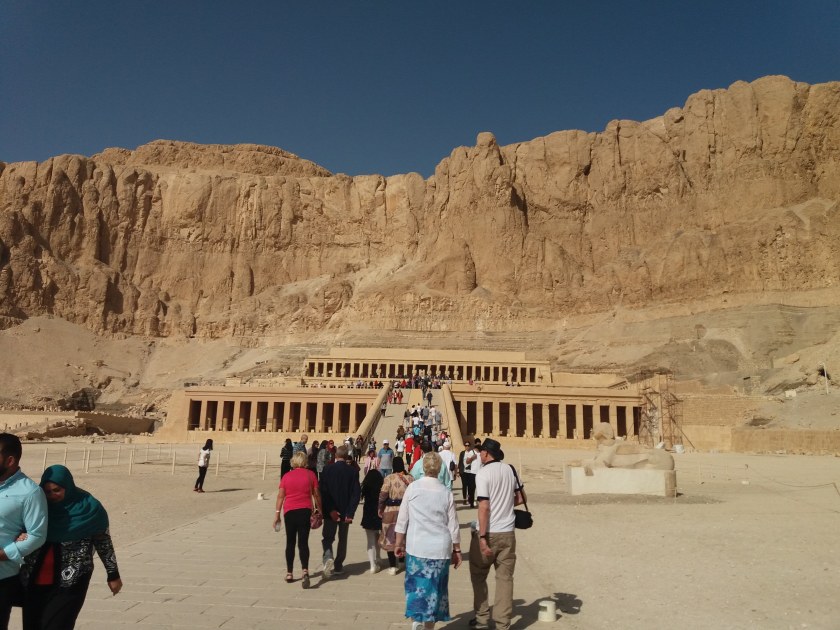
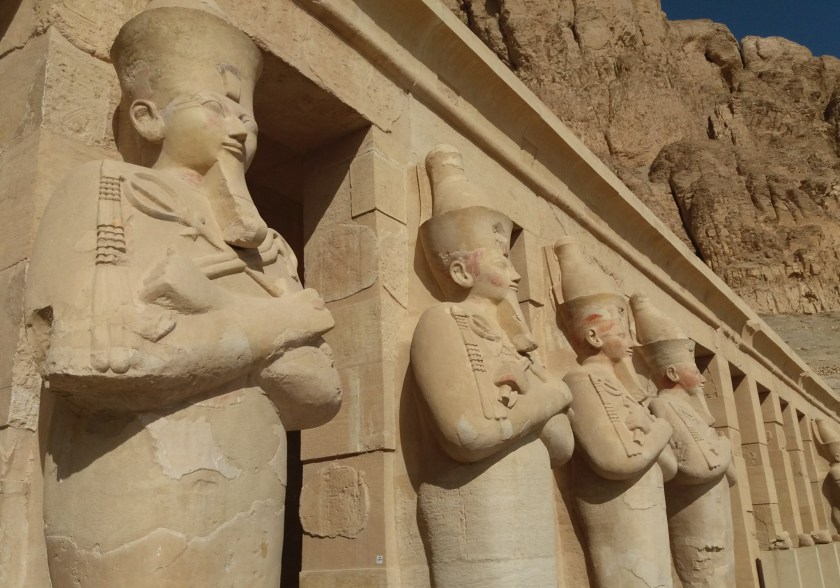
On the other side of the hill from Valley of the Kings is Queen Hatshepsut’s temple, which has been beautifully restored by the Polish Academy of Sciences. It has a collonaded front that looks beautiful from a distance, and it is still be reconstructed. Hatshepsut was a Queen who portrayed herself as a man so she could rule legitimately. She sent an expedition of ships to the Land of Punt, which is modern Somalia. The temple was the site of a massacre of fifty-seven tourists in 1997, so there is tight security with many policemen with Kalashnikovs.
Hatshepsut’s restored mortuary temple
Hatshepsut portrayed as a Pharaoh
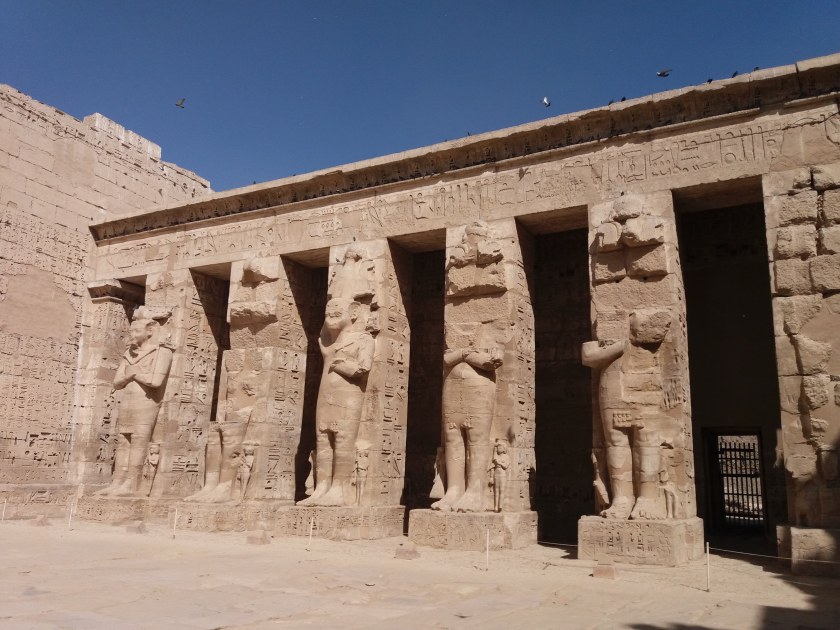
There are so many temples in Luxor (which is derived from the Arab word for the palaces) that you get a bit blasé about them. The Medinet Habu temple of Rameses III is not overrun with tourists like Karnak and Luxor, but is equally impressive, with towering pylons (monumental gateways) and hypostyles of huge columns. Because it was so quiet it is now officially My Favourite Temple in Egypt.
Julie and the goddess Sekmet at Habu
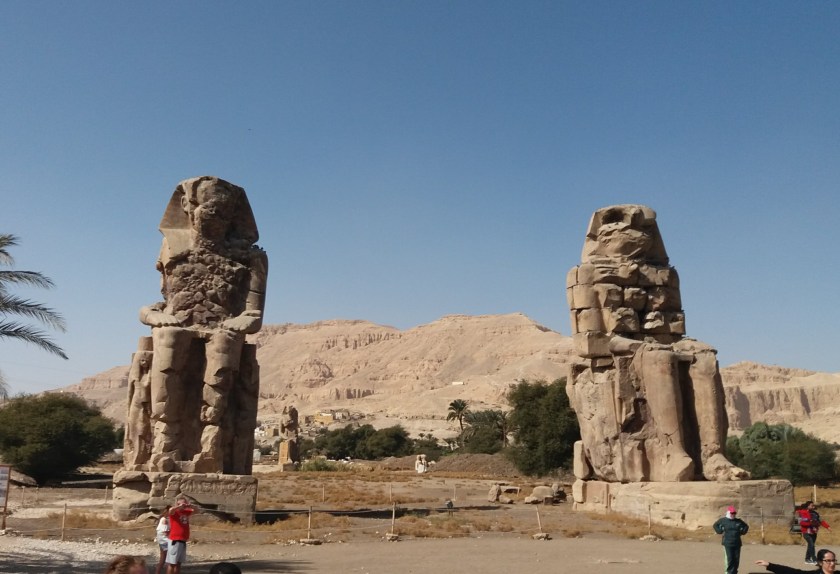
Our last stop on the east bank of the Nile tour was the Colossi of Memnon, two enormous granite seated figures of Amenhotep III that have attracted tourists since Roman times. They are quite eroded and cracked but are still awesome. The wind used to make the hum, but a Roman restorer filled in some cracks and they stopped singing.
The MS Grand Rose laid on a candlelit dinner for us in the dining room. The dining room is on the lowest deck, so our two feet are two feet below the water line. The first course was a small salad with a tiny piece of salmon. The next course was described as “pate with mushroom sauce” and turned out to be an oval of puff pastry with cream of mushroom soup over the top. The main course was a steak in a very peppery sauce with vegetables, which was really good. Finally, we moved to the bar on the fourth deck to choose from a big selection of cakes. That’s the time I really have to hold back and just have a few tiny syrupy ones or else I would end up like “Donald Trump’s” spud shaped husband.
Julie and another cruiser
We cruised through the night to Aswan in the far south of Egypt, where it borders Nubia. The Nubians are black people who have been neighbours and sometimes rivals of Egypt for thousands of years. In the 1960’s the Aswan High Dam was built to control the waters of the Nile and created Lake Nasser, the worlds largest reservoir.The lake displaced eight hundred thousand Nubians who had to be rehoused in Aswan and other cities. Britain and France had fallen out with President Nasser during the Suez crisis, so the dam was financed by the Soviets.
The dam is mostly made of rock and sand, which is described in the cross-section diagram as “muck”. Maybe the designer was from Yorkshire. It is surrounded by soldiers and missile batteries. If the dam was breached it could wash away a large part of Egypt!
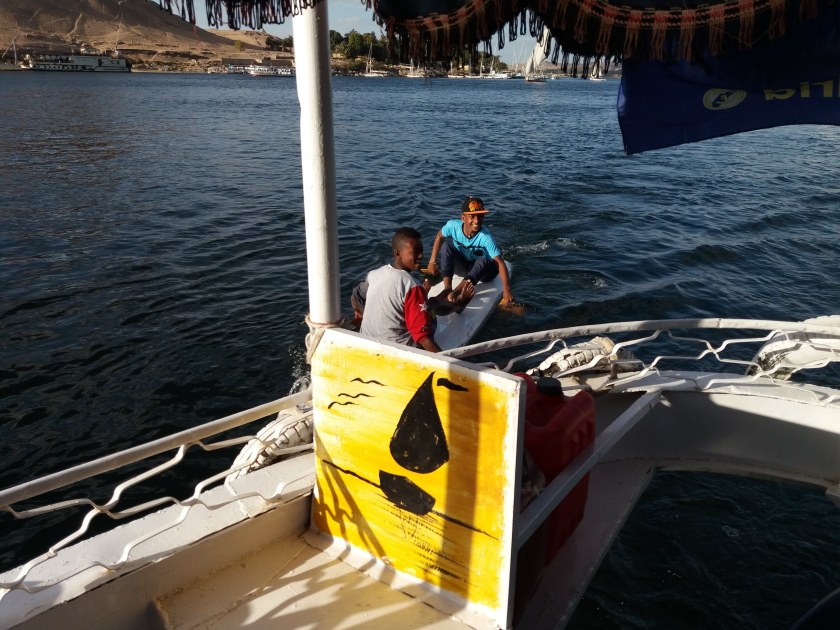
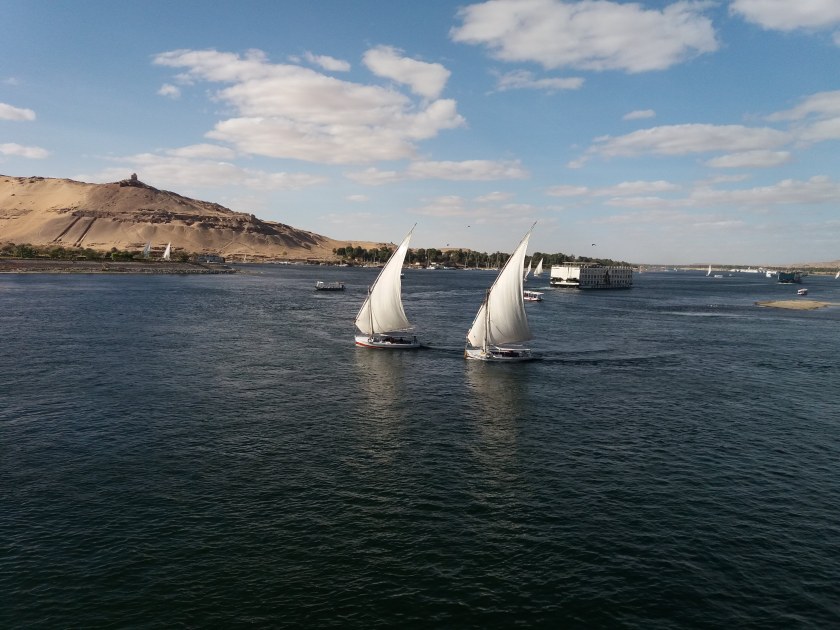
Aswan is a holiday destination for people from Cairo and Luxor, as well as attracting dozens of cruisers. It has a desert climate and is very sunny and warm. There are several big islands on the river, supporting modern hotels and ancient ruins. The Nile is cross-crossed by feluccas, small sturdy sailing boats with lateen sails that take tourists on trips. We took a short excursion on a motorboat and were joined by two boys paddling an old surfboard who sang songs to us. Usamma gave them a small tip and they paddled off as happy boys.
Aswan boys paddling to serenade us
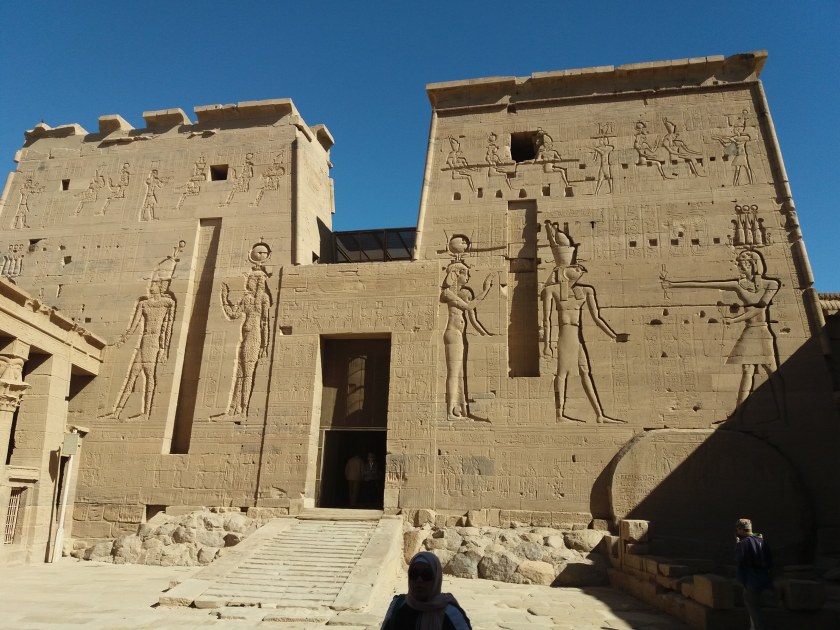
Our temple of the day was Philae, which was dedicated to the mother goddess Isis and her husband Osiris. It was inundated by Lake Nasser but was rescued by UNESCO, which dismantled the entire temple site and moved it to another island and rebuilt it. The work was amazing, you can’t see that it was rebuilt.
The pylons of Philae
I’m now in the hotel bar, sipping a G&T watching the sunset over Elephantine Island listening to “Everything I do, I do it for you”, it’s really very pleasant. Those felucca’s are really very photogenic.
Feluccas
On Friday most people got up in the middle of the night to go on a coach to Abu Simbel. A three-hour coach trip to another temple didn’t appeal, so I stayed in bed. My nemesis “Donald Trump” overheard us saying we were going to the Botanic Gardens on Kitcheners Island and tagged along with us. She brought along Jim who hasn’t been known to speak since she does the talking for the two of them. We haggled with a motorboat driver and got a trip over to the island, which was very popular with local tourists. There are a great variety of tropical trees with plenty of benches to sit in the shade, I was the only man in shorts on the island, they probably thought I was weird. Donald hardly paused talking to draw breathe, and it was all drivel. My wonderful wife is far more sociable than me and soaked it all up while I read the signs on every tree.
Botanic gardens on Kitchener’s Island at Aswan
Our last temple was at Kim Ombo, which was built and extended in the Ptolemaic and Roman periods. We went at 7.30 am, and it was really cold and remained cold until the middle of the afternoon! I had to wrap up well to read my Shardlake novel “Revelation” on the sun deck.
Ussama and Kom Obo temple
In the evening we had an Egyptian fancy dress party in the lounge. I bought a gallibaya and head dress from the shop on the boat, and think I haggled him down enough. He was probably rubbing his hands with glee when I left. I managed to get him down to £10 for the complete outfit, which I will probably never wear again! The Egyptians dinner was really good, and included falafels and roast lamb, very tasty.
Sheik N’Vac
It turned out that the English were the only people to dress up, the Germans, Russians and Egyptians chose not to. Consequently, we got picked on to do the party games and dancing in front of everyone else. You can always rely on an Englishman to put on a dress and make an arse of himself. I made myself an even bigger arse by trying to play snooker with a spud suspended by a string from my waist.
The last day on the boat was a slightly dull voyage from Esna back to Luxor, through the lock. We did get to go on the “bridge” I’ve had enough of cruising now, the novelty has worn off and I’m looking forward to more variety of food and things to do.
Leaving the lock at Esna
The Captain and Me
I got to sit next to the pilot of the boat, who steers it using a kind of joystick. He has to know all the islands, rocks and sandbanks in the Niles, it’s a very responsible job.
The staff have been very nice, especially Madami and Ragi the waiters and Ussama the guide. Ussama’s wife is about to have another baby and he is very excited about it.
The coach picked us up from the Grand Rose at 7.30 am at Luxor, another early start. The first hour and a half to Qena are alongside irrigation canals on embankments overlooking sugar cane fields. There were narrow gauge railways collecting cane to be taken to be crushed to be made into sugar. Our transfer guide on the coach told us that Egyptians eat twenty-two kilos of sugar each every year, and thirty percent of Egyptians have diabetes. The homes have reinforced concrete frames infilled with brick walls. Most have reinforcing bars poking out of the top so extra stories can be added to the homes in the future when their families get larger.Most of the men are traditionally dressed in grey or brown gellabyas with white turbans, the few women outside are dressed head to foot in black. Donkey carts loaded up with cane walk down the road, competing with lorries, tuk-tuks and motorbikes for space.
All the way to Qena there were road humps and police checkpoints slowing down the traffic. Elevated look-out posts by the roadside were occupied by bored young policemen with Kalashnikovs. At all the temple sites there were armed guards, and also at the riverside where the boats were moored. Many of the older guards were tubby and looked they couldn’t run a hundred metres and wouldn’t be much good in a fire-fight.
After Qena the road enters the Eastern Desert, a landscape of rocky hills and wadis filled with sand, washed down by the occasional rainstorm. Occasionally there is a Bedouin encampment of simple shacks with rusty pickup trucks. We stop for coffee and a toilet stop, local women brought donkeys, children and baby goats for us to photograph, they didn’t attract much attention from the tourists who were busting for a wee.
Our coach dropped us at the Grand Resort and we checked into our room. It’s huge, about five metres by six metres, with a sofa, to chairs a balcony and really crappy old Philips TV. It’s a CRT telly of the type that hasn’t been available in the UK for at least ten years. There’s a selection of German and Egyptian channels which aren’t any us to me. The only news is CNN, with stern shouty presenters telling us the latest about Trump and his latest antics. There is one film channel, so Julie was very happy to watch the second Hunger Games film.
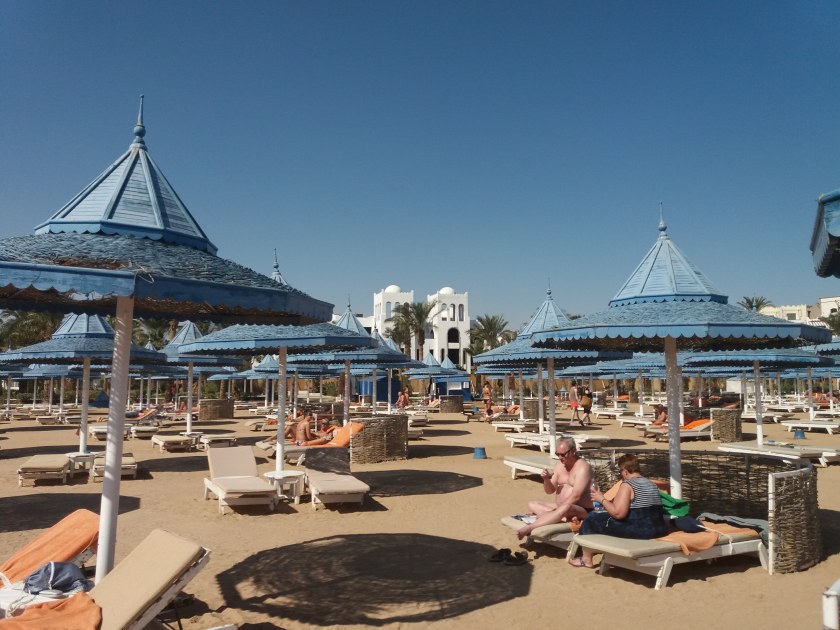
For our last few days in the Grand Resort we fell into a routine. We ate breakfast in the sunshine outside of the Maxim, getting in before eight before the hoards. After breakfast we went over to the beach to read our books on a sunbed on the gritty beach. Returning to the Resort, we had burger and chips in a little cafe by the pool, it makes a change to the regular buffet food. The sun went down at about four thirty, so we retreated inside after that.
In the evening we drank lousy cocktails in the lounge, watch a bit of TV and read our books some more.
The gritty beach
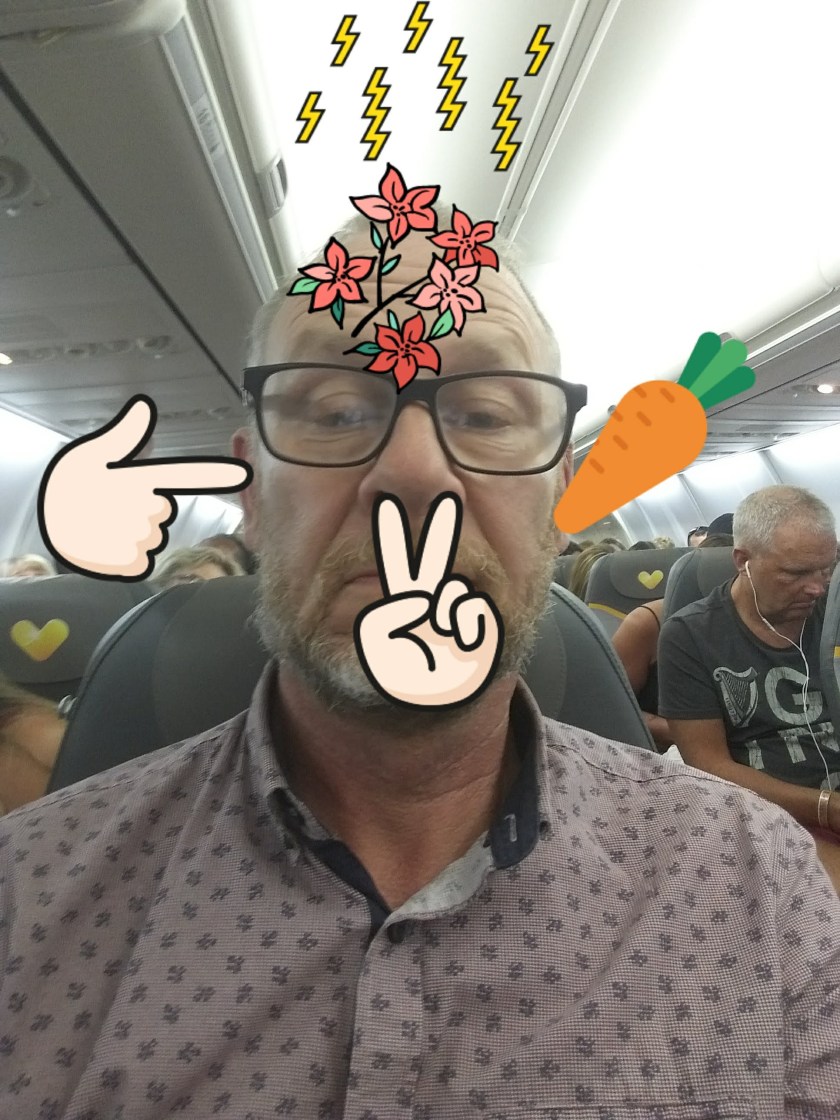
The flight back to Gatwick was pleasingly uneventful, and I entertained myself by finding features on my phone I didn’t know about before. Do you like my selfie?
I needed to be sure how to pronounce the name of the city I was staying in. I was saying Krakov, but I had heard alternative pronunciations. Our guide Maciej said that the locals say Krakuf, Germans say Krak-ow, and the French say Krakova. So take your pick, but I’m sticking with Krakov!
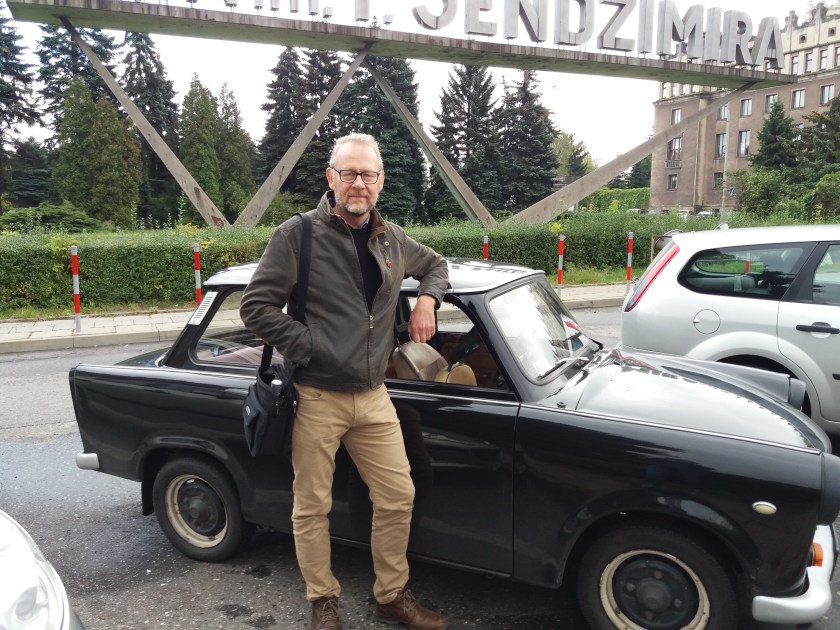
Maciej picked us up at 10.30 in his 40-year-old black Trabant. Inside it’s about the same size as an old mini but is noisier and smellier. The petrol tank is under the bonnet, not a good substitute for an airbag. It went surprisingly fast for a 2-stroke 600cc air cooled engine, but since it was mostly made of East German glass fibre, it’s quite light. Our guide came from an outfit called Crazy Guys, and they give conducted tours around Nowa Huta, the new town built next to Krakow to house workers for the enormous steelworks that was a gift from Stalin. It was built from scratch for 100,000 people, providing much-needed homes in post-war Poland. Many people moved from thatched wood and mud cottages into centrally heated flats with inside toilets and electricity, I’m sure they were very grateful. The flats were built to a high standard and faced with sandstone, which is a bit grimy today but the town is still impressive.
Tim and a TrabantMaciej our guide look under the bonnet
Nowa Huta (which means New Mill) is laid out with wide avenues and green areas and is connected to the rest of Krakow by tram lines. The main square is named after Ronald Reagan, who is fondly remembered in Poland for funding the Solidarity trade union which was very strong in Nowa Huta. These days the steel mill is owned by Arcelor Mittal, and has 3,000 workers, down from 40.000 in its hay day.
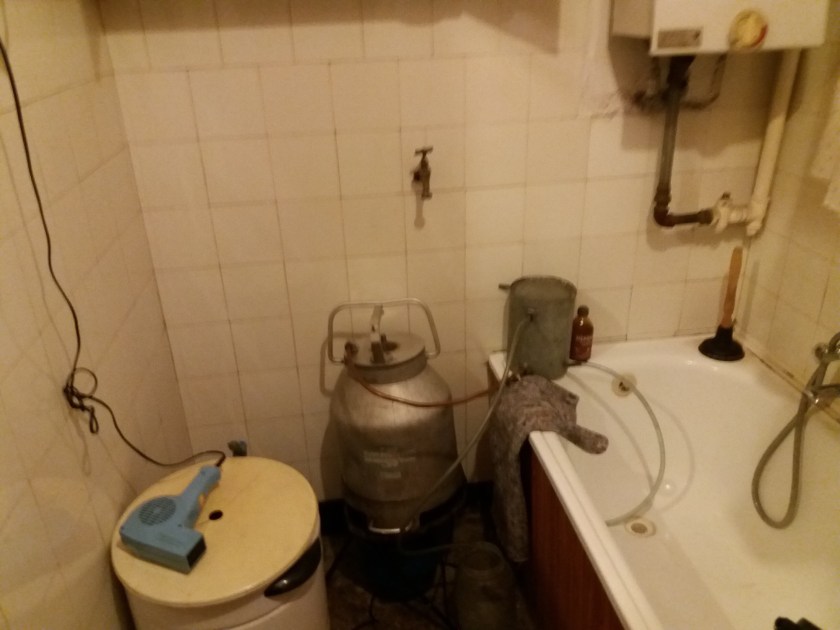
Maciej took us into one of the flats which the Crazy Guys rent out to show to tourists. The flat has polished wooden floors, central heating and is reasonably spacious; but often there would be three generations squeezed into each flat. An unusual domestic accessory was the still in the bathroom for making vodka. Maciej put on an old black-and-white propaganda video about the construction of the city and gave us a vodka and pickle to put us in the mood. He was a very knowledgeable guide who gave us a great insight into life under Communism.
Washing machine, vodka still and bath
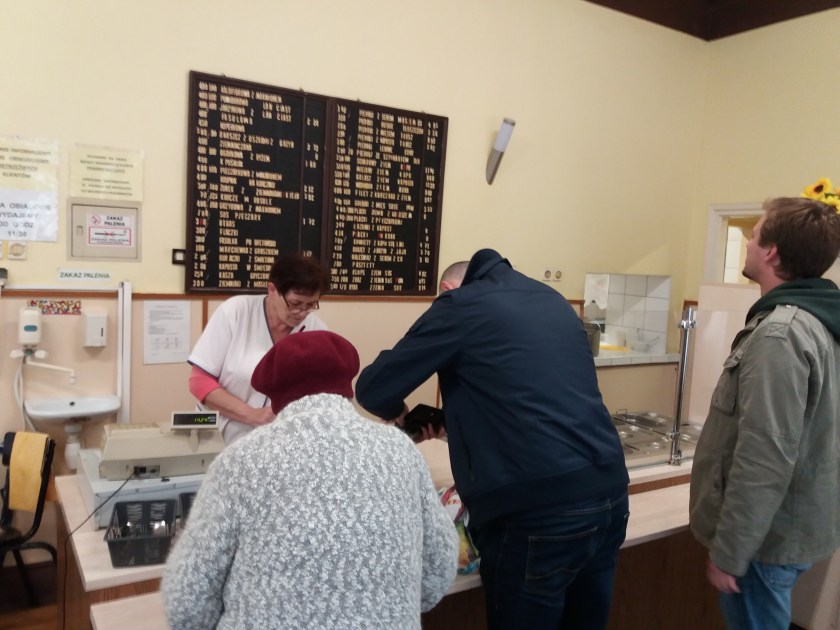
We went for lunch in a Milk Bar, which is a low-priced cafe for local people. I had some beetroot soup to start which was surprisingly sweet and tasty, and I followed that with some pork dumplings. After that hearty meal I was ready to go and make some steel! I loved the menu board with the little plastic letters in it. Four of us ate well for about 10 quid!
I loved the menu board with the little plastic letters in it, the Milk Bar look likem it hadn’t changed for 50 years! Four of us ate very well for about £10, what a bargain.
Milk Bar – you can anything you like from the menu
At the end of the tour we were dropped at the Barbican close by the Old Town and had a walk around some parts of it that we hadn’t seen so far. The Dorling Kindersley guidebook is brilliant for finding interesting streets that you wouldn’t come across if you were walking around randomly.
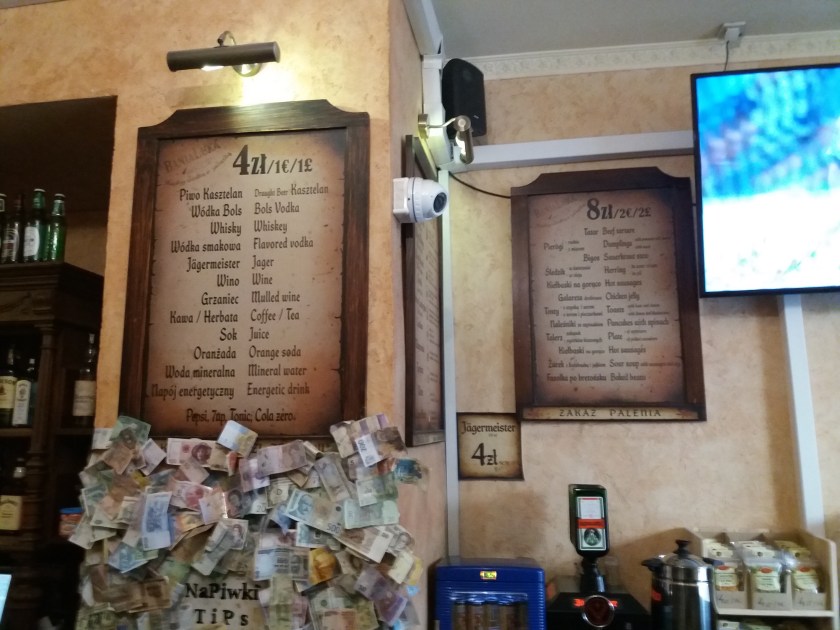
Julie (bless her) found a great bar called Banyaluka where all the drinks are 4 Zlotys (about 90 pence), so we had a shot, then a mulled wine, then a beer. It was a very relaxing bar.
Getting to the Wieliszka Salt Mines took a bit of faffing about. To get there we needed to get the tram to the railway station, and at the tram stop, a young lady with perfect English told us to get the number 18. The Krakow Glowny station is joined onto a huge shopping centre and we had to hunt around the maze to find the ticket office and the correct platform.
After much faffing and a couple of minor domestics we found the right train and were soon heading out of the suburbs on a new and very comfortable train to the mine. The mine was one of the first UNESCO World Heritage sites, and the Polish people are very proud of it. Since the 13th century, the salt mined at Wieliczka has been a steady source of income to the Polish Crown, providing the King with a third of his income.
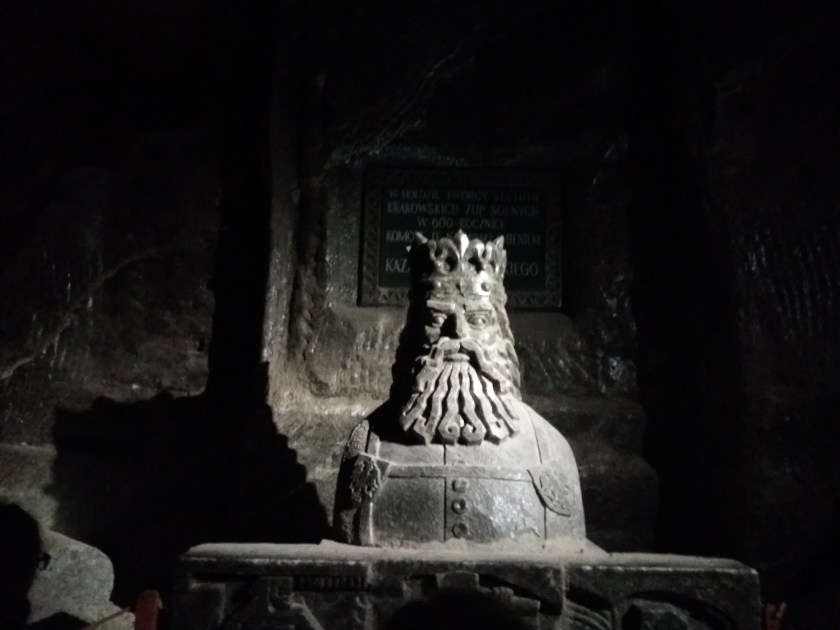
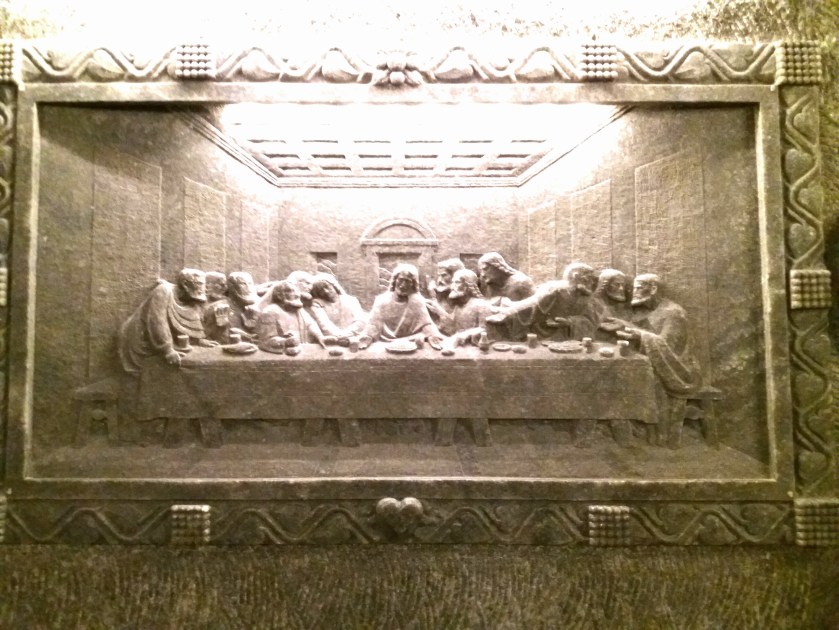
At 10.30 we entered the mine with Adrian, our English speaking guide. He was very good but stuck perfectly to his script, he wouldn’t have been much good at improv comedy. To get to the level that is set up for tourists, we had to walk 200 feet down a wooden staircase. Miners have been excavating the grey rock salt for over seven hundred years, so there are miles and miles of chambers, held up by tree trunks. It was cut out and taken away in barrels and barrel-shaped lumps of salt, both of which could be easily rolled along. Mining was very dangerous, so the miners were very religious, it was the only insurance they had. So miners carved out several chapels out of the salt where they could pray, and they are still in use today for weddings (if you have a couple of grand).
The Last Supper – pass the salt
At the end of the tour is a restaurant, where I had a bloody lovely goulash and fried potatoes. It is also 130 metres below ground, the deepest meal I have ever eaten. Naturally, it was well seasoned.
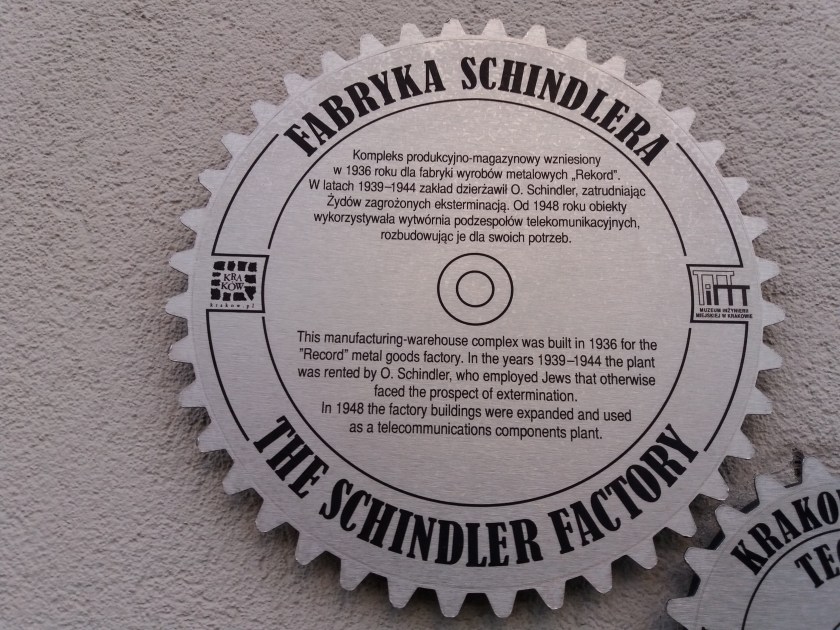
After lunch, we got the train back to Krakow and then a number 3 tram across the Vistula to Oscar Schindler’s factory. It is now a museum about the history of the Nazi occupation of Krakow. The story is inventively presented, but it is a not a comfortable experience. There were many atrocities and the Jewish population, 50,000 before the war, were almost all murdered. It is thought that Schindler may have saved 1,200 people by giving them work in his factory.
Ocar Schindler’s desk
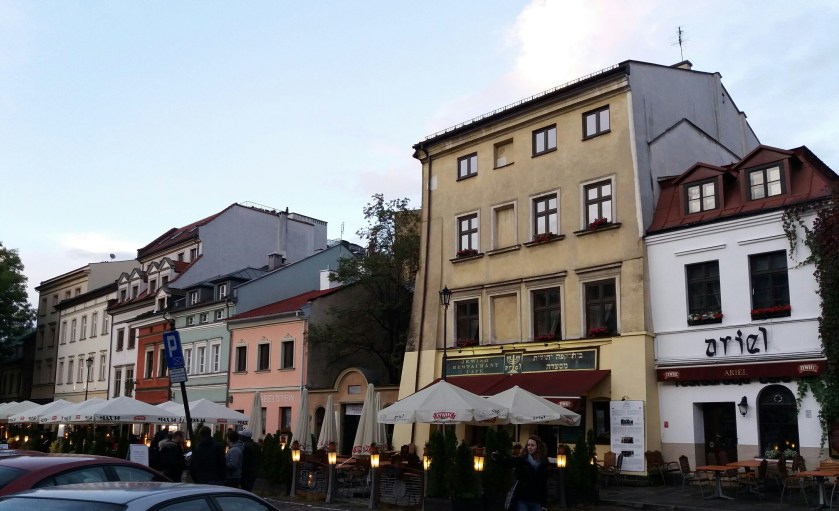
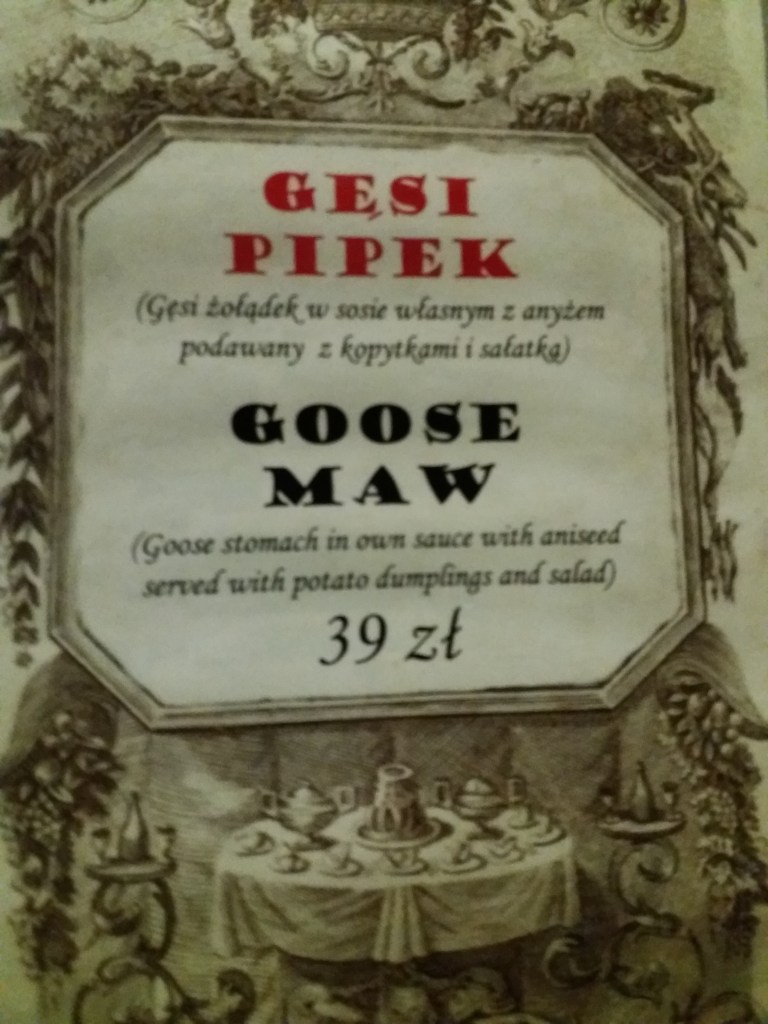
We walked back towards our flat over the river and through the area where the Jewish Ghetto used to be. At the centre is Jewish Square, which is lined with Jewish restaurants, and no bacon sandwiches. There was an opportunity to eat a delicious goose stomach, but I didn’t fancy it tonight.
Jewish Square
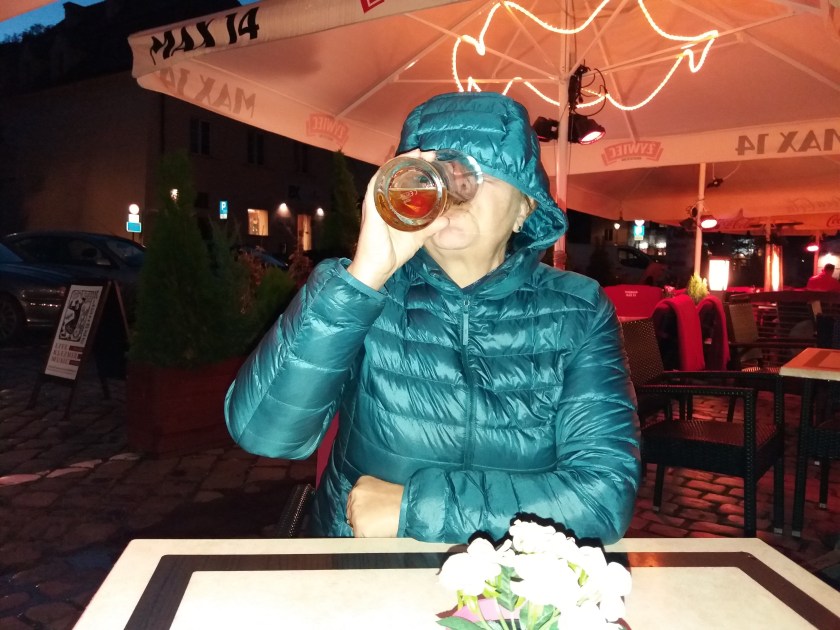
Julie Polish-ing off her Tyskie beerIf I was a rich man – I wouldn’t eat goose stomach
Being exhausted from too much culture, we had a beer and shivered at an outside table as it got dark. We ate dinner in a cafe on Krakowska street, I had bigos (beef stew with sausage and cabbage), beer and Julie ate pierogi. I’m getting a taste for Polish food, it reminds me of school dinners, good sold fare.
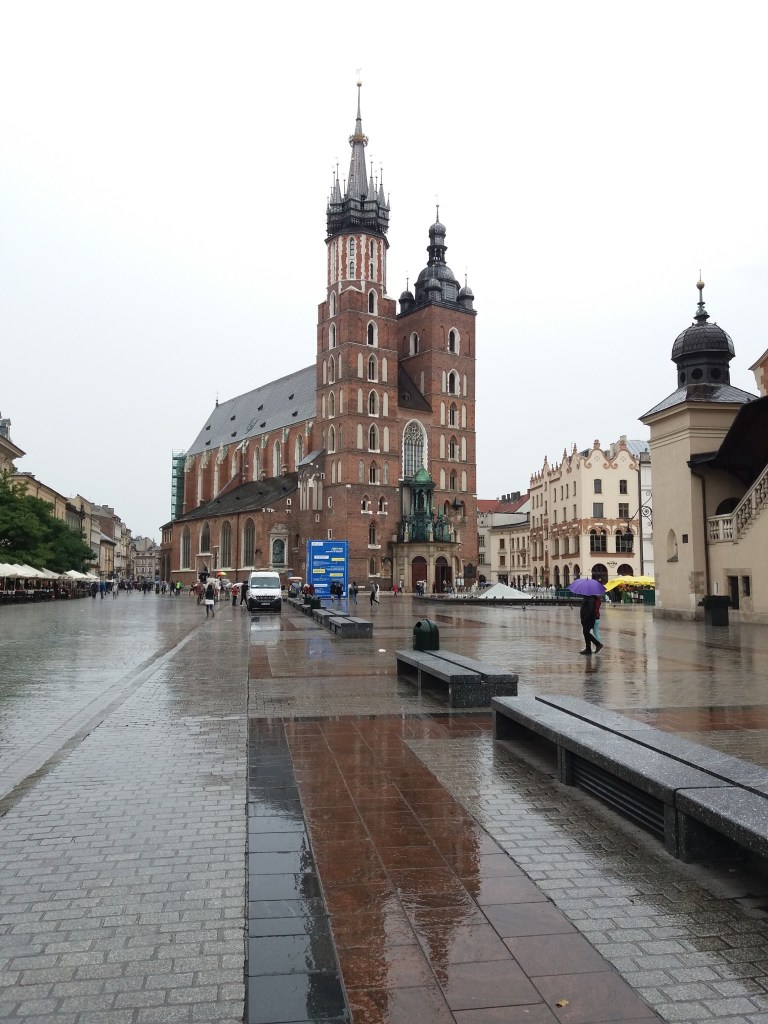
It was already raining when we left the flat, and Julie was annoyed that BBC Weather had lied to us AGAIN! Having got the lie of the land, we walked up Grodzka to the Market Square, the heart of the old city of Krakow. The Market Square (Rynke Glowny) is 200 metres square and was laid out in 1257 when Duke Boleslaw the Chaste (not a Monty Python name) gave Krakow its charter. It’s the biggest square in Europe, and is surrounded by beautiful historic buildings. I have seen a few ancient squares in Brugge, Bristol, Prague and Seville, and this is the best.
Cloth Hall in Rynek Glowny
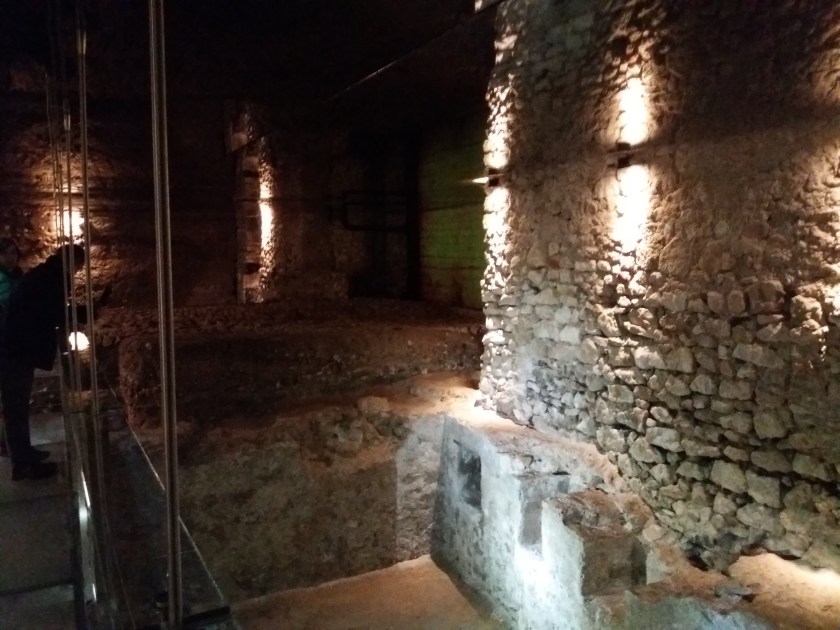
Sitting in the middle is the Cloth Hall, which looks like a Renaissance building, but is actually 19th century. The arcade down the middle is lined with souvenir shops selling wooden toys, hats and fridge magnets. I got a charming fridge magnet for 15 Zlotys, probably too much. But the best is hidden beneath. A decade ago the square was excavated and all sorts of amazing archeology was exposed. When the archaeologists has finished, a huge concrete slab was laid over it and the dig became Rynek Underground Museum.
It is a very high tech museum, with lots of touch screens and low lighting, so low that the written signs were hard to read. Layers of old streets and foundations are shown, and a whole row of medieval shops which were used by all the local traders and craftsmen. We spent several hours in there, it is a very different and fascinating museum.
Old shops in the Underground Museum
Emerging back into the square we walked a short way over the the Church of St Mary, which is a huge Gothic building with two towers at the front. Inside there is barely a square inch that is not decorated in some way. The highlight is the elaborately carved high alter, painted wooden statues and lots of gold leaf. We paid 10 zlotys to get in, but if we had been good Catholics we could have got on a different entrance to pray for nothing!
St Mary’s Basilica
All that culture left us very hungry, so we went to a tourist trap and ate some poor food. I had Bigos, which is supposed to be a stew, but it was cabbage with a few bits of meat and lots of bread. It filled a gap but wasn’t great food.
The castle and cathedral are on Wawel Hill at the edge of the old town overlooking the Vistula, which was a trading route to The North Sea. There wasn’t enough time to go inside any of the buildings, so we had a look around the courtyard and enjoyed the views over the city.
Wawel Castle
By then we had seen enough old buildings and paintings and it was cold and raining. Time to go and get a coffee and cake, something that Poland is very good at.
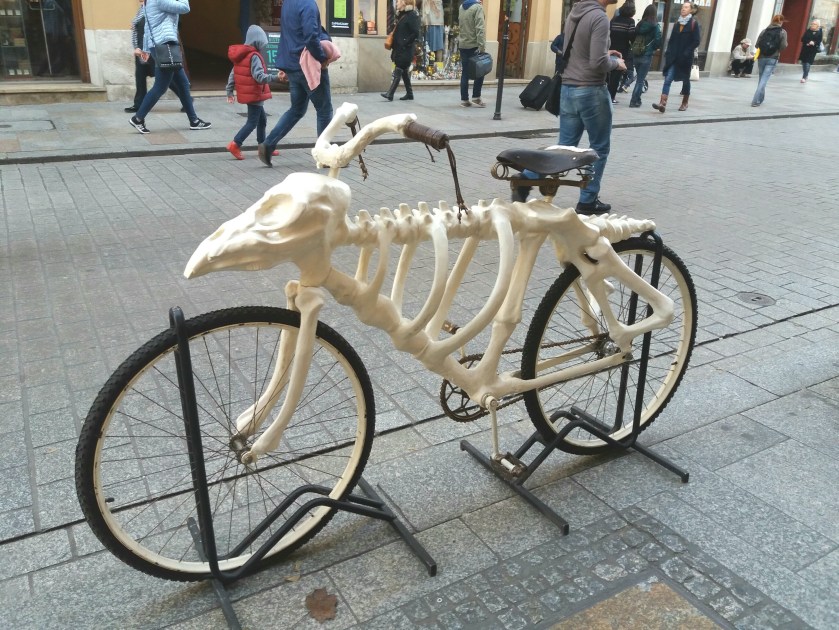
And finally, I found Fred Flintstone’s bike parked in the street.
Poland isn’t an obvious places to go for a short holiday, but it should be. I have been here about eight hours and I’m already very impressed by the sights, sounds and tastes of Krakow.
We flew by EasyJet from Gatport Airwick, which is 850 miles and took about two hours. Krakow is in the south of Poland near Slovakia, and is in the middle of the invasion route for armies over the last thousand years. The Poles did see off the Mongols in the 13th century, but to be fair they had arrived by pony from Mongolia, which is a very long way.
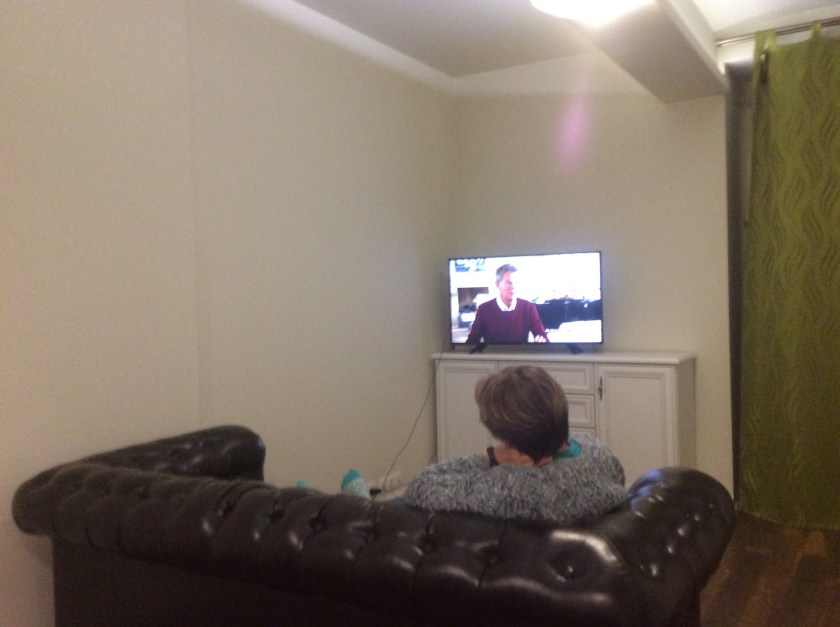
To enjoy some local colour, we took the bus into the Krakow Glowny where there is an enormous shopping centre. We ate at almost the first cafe we came to, and had a spicy soup in a Mexican place. It was like a runny chilli con carne, very tasty and sweat-inducing. Thus replenished, we hoofed it down Pawia street to the apartment we had rented on Sukiennisca close to the Vistula river. The flat is modern, comfortable and devoid of any decorative touches, but it did have loads of hot water and a very good telly!
Our accommodation
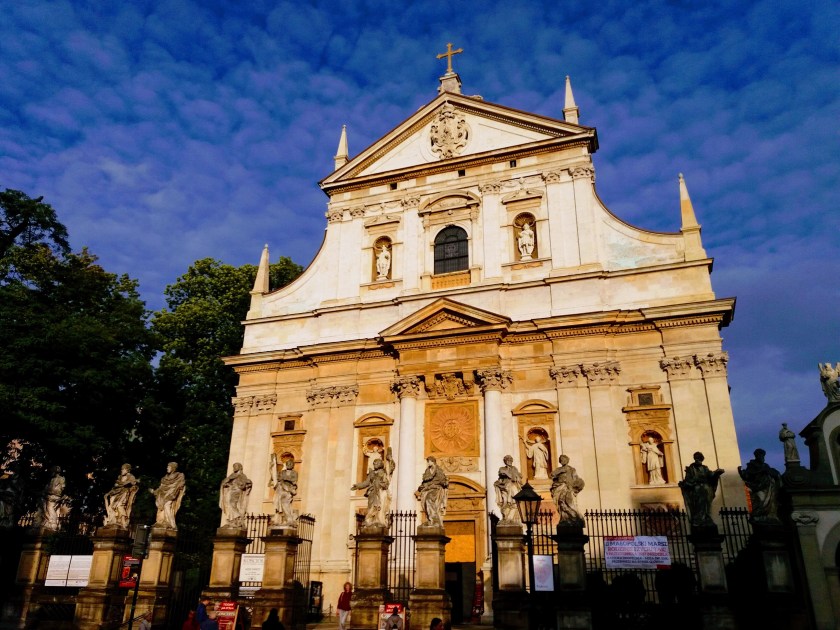
Its only five minutes walk to the Okol district which is at the foot of the hill where the castle sits. The main road is Grodzka, which is very popular with tourists, for good reason. It is full of beautiful old houses and churches, but also restaurants and shops. The Church of Saints Peter and Paul is a gorgeous Baroque edifice, like our own Saint Paul’s on a smaller scale.
St Peter and St Paul
By 6pm it was getting dark so we returned to the flat. The TV gave us a good selection of Polish TV, but Polish Masterchef didn’t keep my attention for long. I had brought and iPad and Chromecast, and by wrestling with the iPad and wifi managed to connect to Netflix. We watched “We’re the Millers”, which contrived to be both very funny and very filthy, a winning combination!
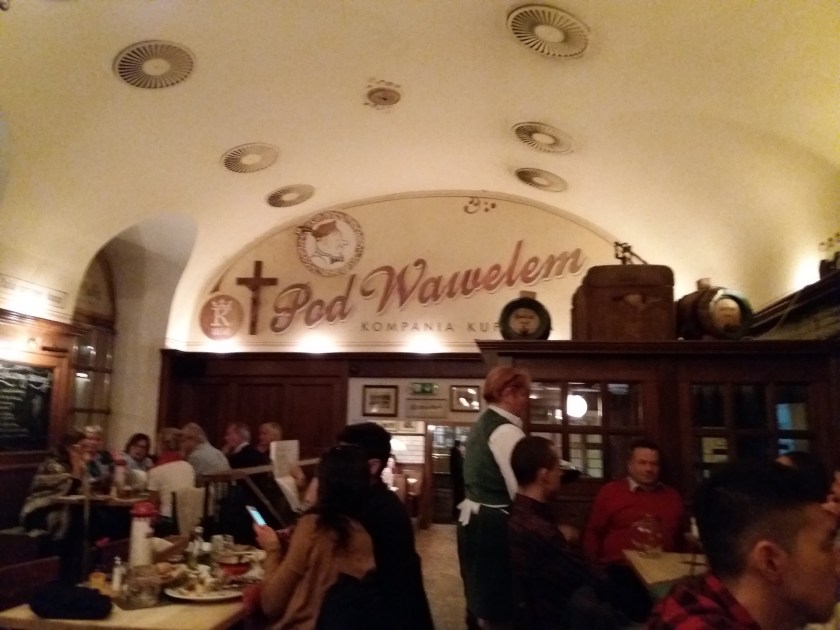
Julie had found a local restaurant called Pod Walwelem, which is close to the castle. It was big and noisy and busy. The waitresses looked like they were wearing Austrian dresses and carried the food and drink on large circular trays on their shoulder. I had pork pierogi (like ravioli) to start, which were very tasty, washed down with Tyskie beer. For my main meal I had the Soldiers Platter, which was a large plank covered with rice, fried potatoes, sauerkraut, and grilled chicken, liver, pork, bacon and sausage. It was a mixed grill on a massive scale! It took a while but I ate most of it apart from the very soft and squidgy blood sausage. As a digestif, we had lemon vodka, more lemon vodka then cherry vodka.
Pod Wawelem – belt buster restaurant!
I like Krakow, but I may eat myself to death by the end of the holiday!

























 timharnesstravels