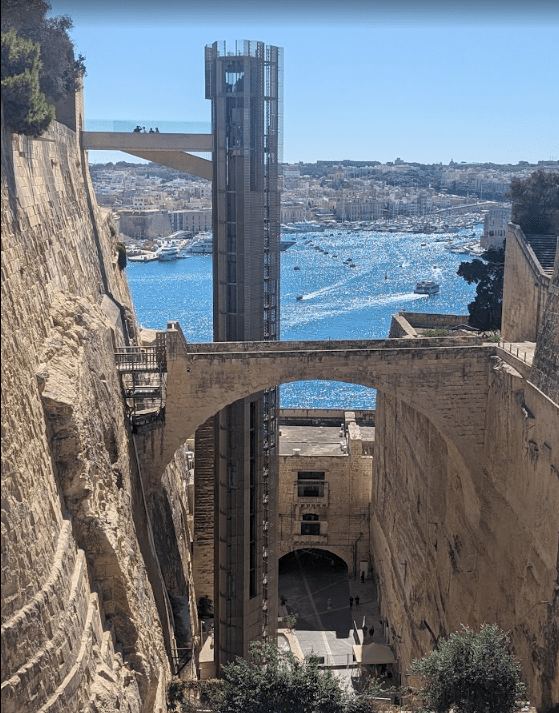
We left our flat in Triq L Argotti and walked along linear park called The Mall to the City Gate, the very grand entrance to Valletta. Turning right past the Parliament Building we walked through Upper Barrakka Gardens to get the lift down to the waterfront.
The Lift from Upper Barraka Gardens to the waterfront
At the Fast Ferry terminal we joined the queue for the ferry to Gozo, a big catamaran with room for hundreds of passengers.
It took 45 minutes of sailing along the east coast of Malta to reach the island of Gozo. From the harbour at Mgaar we took a 101 bus up to the small capital. In true Maltese style it has two names, the original name of Rabat and the Colonial name of Victoria.
Our flat has a great view of the Citadel a few hundred metres away, and is very conveniently almost next to Andy’s Supermarket, very handy for cold Cisk lager and other necessities.
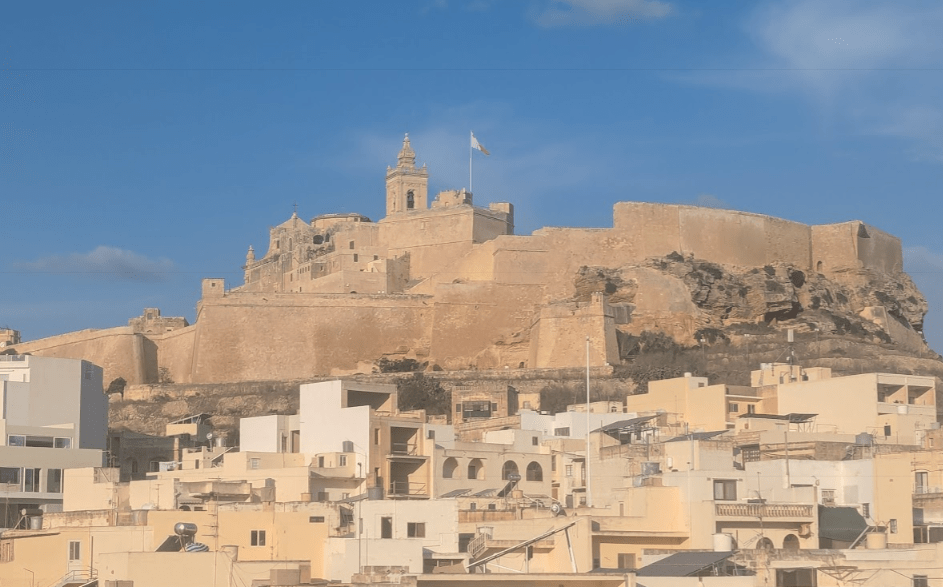
It’s a steep climb to the Citadel which is on a crag overlooking the town. It has been fortified in one form or another since the Bronze age. The current Il Kastell dates from the 15th century, but with considerable improvement by the Knights. The population suffered from raids by Turkish corsairs for hundreds of years, and the population of Rabat went into the citadel every night.
The Citadel of Rabat, as viewed from our terrace
Corsairs are maritime raiders who are licensed by a country, so Turkish corsairs attacked Christian settlements all around the Mediterranean on behalf of the Sultan. The corsair Dragut became Governor of Tripoli and was killed at the Great Siege of Malta. The Knights were Christian corsairs, and attacked Turkish shipping and took slaves. France Drake was an English corsair working for QE1, and making a few quid for himself. Pirates like Blackbeard only worked for themselves, and attacked all shipping.
The Citadel is big and impressive, and offers great views over the Gozo countryside. The cathedral looks a bit strange because the dome was never completed. The Maltese love a big church, honestly I have never seen so many huge Houses of God, He must be very pleased with his devout followers.
At the foot of the citadel walls is the oldest part of Rabat, with narrow quiet streets of pretty houses that look similar to those in Mdina and the other Rabat in Malta. The more modern parts of the town are made up of blocky flat roofed houses with quite rough roads and minimal footpaths, not very attractive. Our flat was on the fourth floor of a modern block, and the road to it had terrible footpaths, it was unpleasant to reach it by foot. The locals drive at about 40 mph around town, basically as fast as they can, and the traffic can be very busy.
Julie had a slightly upset tummy and didn’t want to eat, so I had a can of baked beans for dinner. Yummy.
Tuesday 23 September
We did our research in the guidebook and online and decided to try Ramla beach, allegedly the best beach on Gozo. The 102 bus took us through the outskirts of Rabat/Victoria , through Xewkija (no, I don’t know how to pronounce it) to a stop a few hundred yards from the beach. Maltese bus drivers seem to drive as fast as they can, so it can be quite exciting at times.
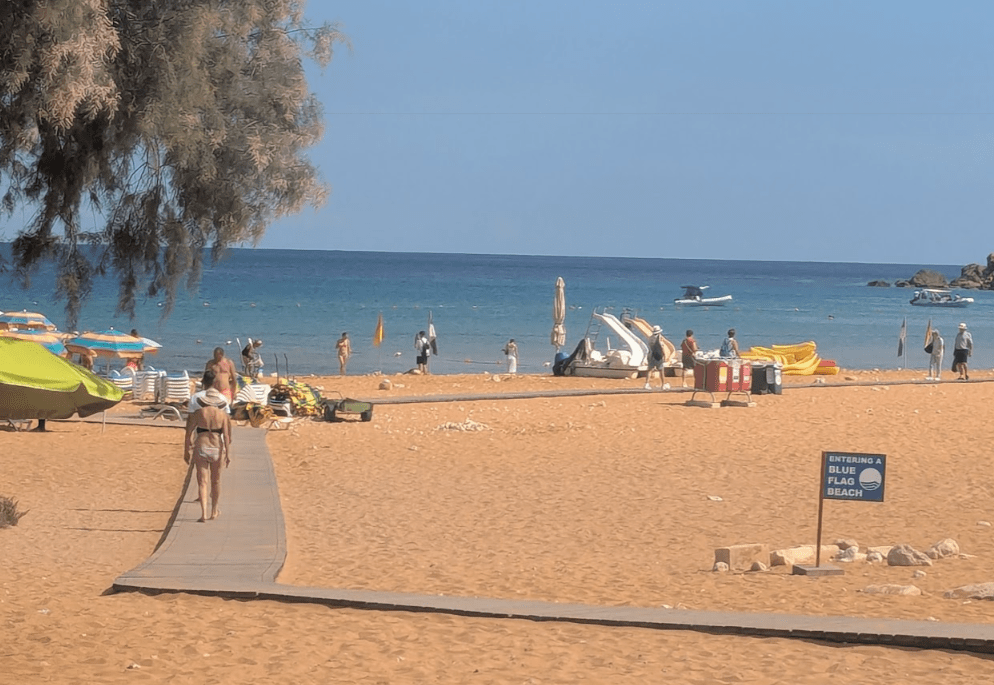
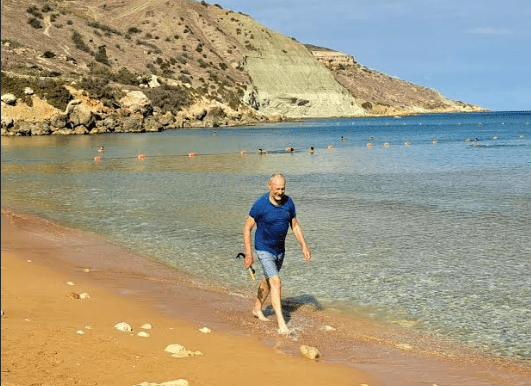
Ramla beach did not disappoint us, it is a wide stretch of soft orangy sand like you get in Devon. There are three cafes and some clean toilets, but the cafes don’t open until 11 and we arrived at about 9.20.
Ramla Beach
We got an umbrella and two recliners for 21 euros, worth the investment because it was Scorchio! The bed man carried them to the waters edge and we settled in for the day. It was gorgeous, a fantastic view of a calm blue sea and lovely warm water. I went snorkeling a couple of times and saw lots of small fish a few centimetres long, but nothing interesting.
Daniel Craig at Ramla Beach. Maybe.
It was great just reading our Kindles and phones, and passing comments on people who went past on the waters edge. Tattoos and unsuitable swimwear are always great topics for comments such as “ I would be very disappointed if one of my children came home with one of those on his/her leg” and “look at that costume, I have seen thicker dental floss”.
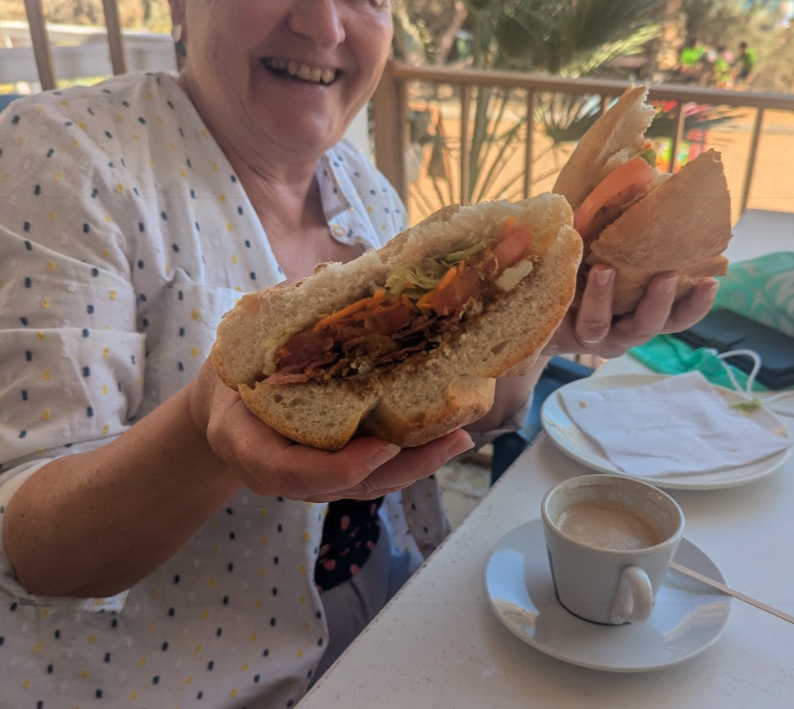
Just after 11 we got breakfast at Rosa’s cafe, we both had egg, bacon and fried onion Ftira. It’s basically a big bap which was enough for breakfast and lunch.
Julie and the Giant Sandwich
I would give Ramla beach top marks for quality and convenience. The returning bus to Victoria Bus Station felt like it was being driven by Lewis Hamilton, and took 17 minutes to get back.
After scoffing a delicious ice cream at Vanilla +, we discovered a shopping centre with a huge Greens Supermarket in the basement, the best shop I have come across in Malta.
The citadel is a delightful place to be at sunset when the sky is pink and you can see the sea at different sides of Gozo.
The Citadel by night
The Pjazza San Gorg in the old town is a a good place to go for dinner. There are several restaurants around the square in front of the Basilica San Gorg. Unfortunately it was bell ringing practice that night. The bells are great for the first 15 minutes, but after 50 minutes it was getting very irritating. There are two bell towers at the front of the cathedral with two guys swinging the “clangers”, but they weren’t swinging them in time, it just sounded like random bongs that went on and on and on.
Two bell towers and two out of time bells
Wednesday 24 September
Well it’s been an interesting day.
After consulting the guide book we decided to visit Marsalforn, which is a short bus ride away on the east coast. We caught the 310 bus in Capuchin Street and the bus tore along the rural road, slowing slightly in a village on the way.
Marsalforn is a resort town around a bay. There is a small sandy beach, lots of cafes and restaurants, and many many ugly blocks of holiday flats. It was very quiet, with and had an end of season vibe. However we found a nice spot on the beach and I went for a swim. The water was warm and there were lots of tiny fish, nice. A small group of ladies with hats on bobbed around in the sea together chatting for at least an hour. The water is very bouyant, so it takes no effort to just float.
But about three hours of Marsalforn was enough, so we went back to Victoria on the 310.
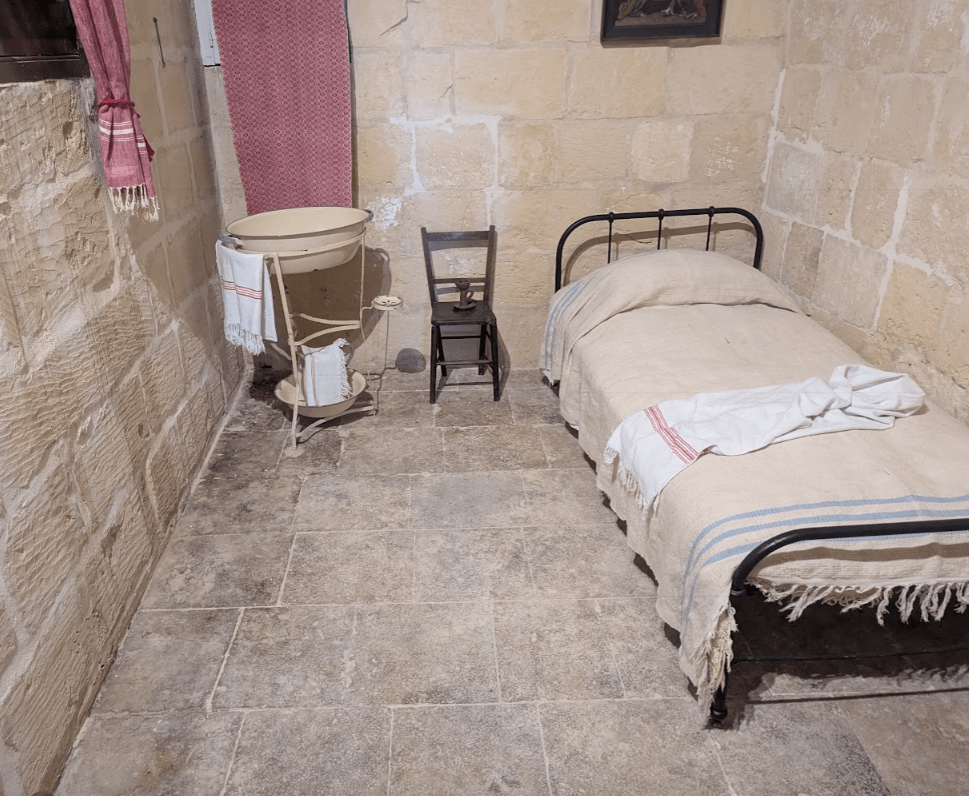
In the afternoon I went back to the Citadel and visited the Visitors Centre, the Old Prison, the Natural History Museum and The Historic House. You can get round all of them in about 90 minutes, and they are about as good as a small town museum in England, I would give them an E for Effort. The Historic House was the most interesting. It is a combination of five old dwellings with old furniture in it, like a low-rent National Trust house.
A “typical bedroom”, looks a bit shit to me
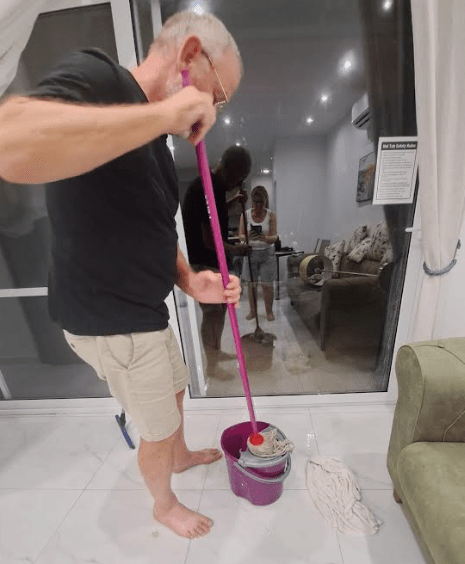
In the evening there was a thunderstorm, which was fun to watch on our terrace, until it started raining really really hard. The terrace flooded and then started coming in under the sliding windows. The lounge started filling up, so we got out the mop and bucket and towels to collect water off the floor. While Julie was mopping, I went out on the terrace and stamped on the drain until water started going down it. I think it was bunged up. After mopping 4 buckets (about 20 litres) of water off the floor of the lounge, the rain eased off.
Mopping the lounge during the storm
That’s never happened in and AirBnB before, normally they don’t leak in a big way.
Friday 25 September
A taxi picked us up from our flat, because we didn’t want to drag our bags up hill to the bus station. We took 09.45 fast ferry to Valletta and a 13 bus to Sliema. I have grown fond of the Maltese bus system, its efficient and 2.5 euros for every trip.
The Sliema Marina Hotel overlooking Marsamxett harbour is not luxuious, but it is convenient, on the waterfront close to the ferries.
Once we got settled in we walked across the peninsula to the massive Fort Cambridge development towards St Julian Bay. In places Sliema looks like Dubai, with massive blocks of modern flats overlooking the sea, and some of them cost over £2,000,000.
Fort Cambridge shopping centre
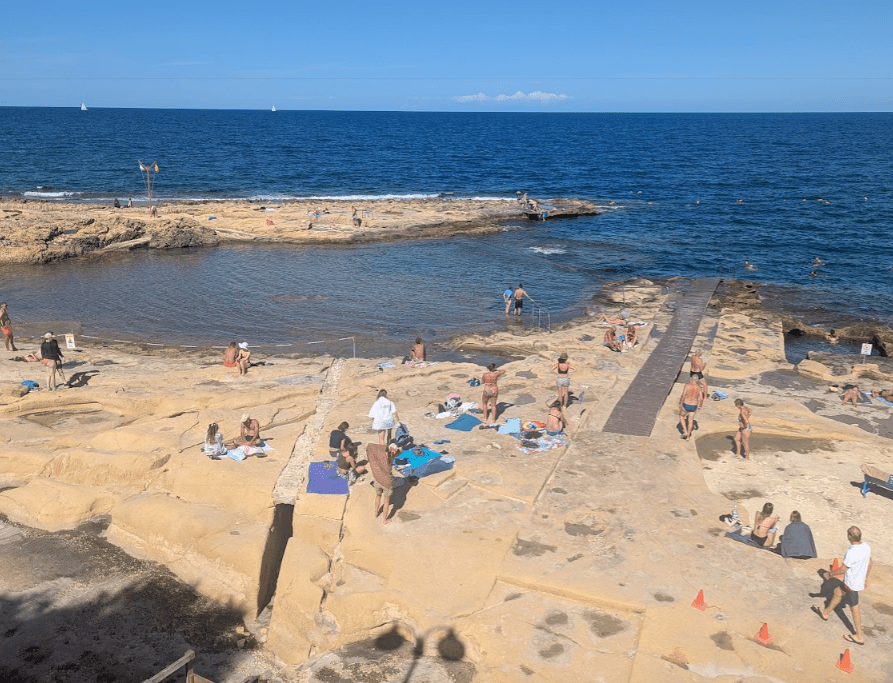
The seafront around St Julians Bay is very attractive, with lots of restaurants and bars facing the sea. There are also lots of bathing “beaches”, except there is no sand. You can sunbath on bare limestone ledges, and the walk (carefully) into the sea. I took a dip at Fond Ghadir, the sea was warm and slightly rough, but very pleasant to swim in. There were a few small fish, but nothing interesting.
Fond Ghadir “beach” there ain’t no sand
At the corner of Baluta Bay I took 10 seconds to look at a menu outside of a bar and a nice young man asked if I wanted a cocktail.
No you dirty minded bastard, not in that way!
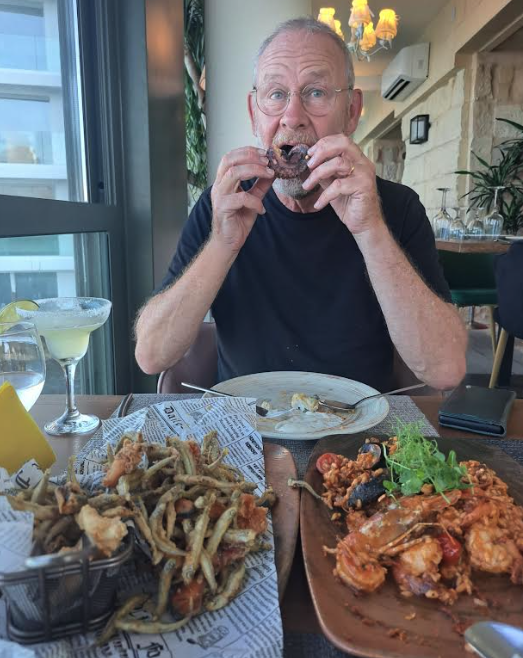
We were both easily persuaded and went into Piccolo Padre for 2 for 1 cocktails, and selected Margaritas. The food menu looked persuasively good, so I had Seafood Risotto and Julie had Frito Misto. There was enough food to feed 4 hungry pescatarians, and we needed more cocktails to wash it all down.
Fishy Feast
We left there intending to continue our tour of St Julians on a sunny afternoon.
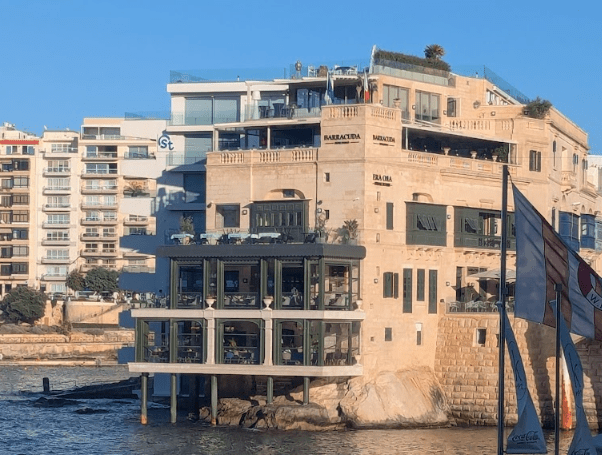
Piccolo Padre on the lowest floor
After several minutes hard walking we came across another bar overlooking the bay with a 2 for 1 offer. It was hot, we were thirsty, and at £4 a cocktail it was daft not t0. So we had a Mojito followed by a Long Island Ice Tea.
In a party mood by then, we walked onto Paceville, the throbbing heart of youth culture in the area. After about 5 minutes we decided we were at least 40 years too old and got the bus back to hotel.
Reasons to Visit Malta
It is easy to fly to
Its very hot and the sea water is warm
Everyone speaks English
The food is mostly Italian, but kebabs are widely available
The people are friendly
Its small but there is a lot of things to see and do
The weather has been consistently wonderful in Sicily, apart from the thunderstorm on the first day. So it has been very conducive to sitting in cafes, one of the many pleasures in going to Italy. Our first cafe was in Via Vitoria Emanuel, a very busy street where our flat is situated. It is in a big baroque mansion block, which has huge gates on the street and multiple gates to reach our staircase. The street is quite scruffy now and disfigured with graffiti, but would have been beautiful in its 18th century heyday.
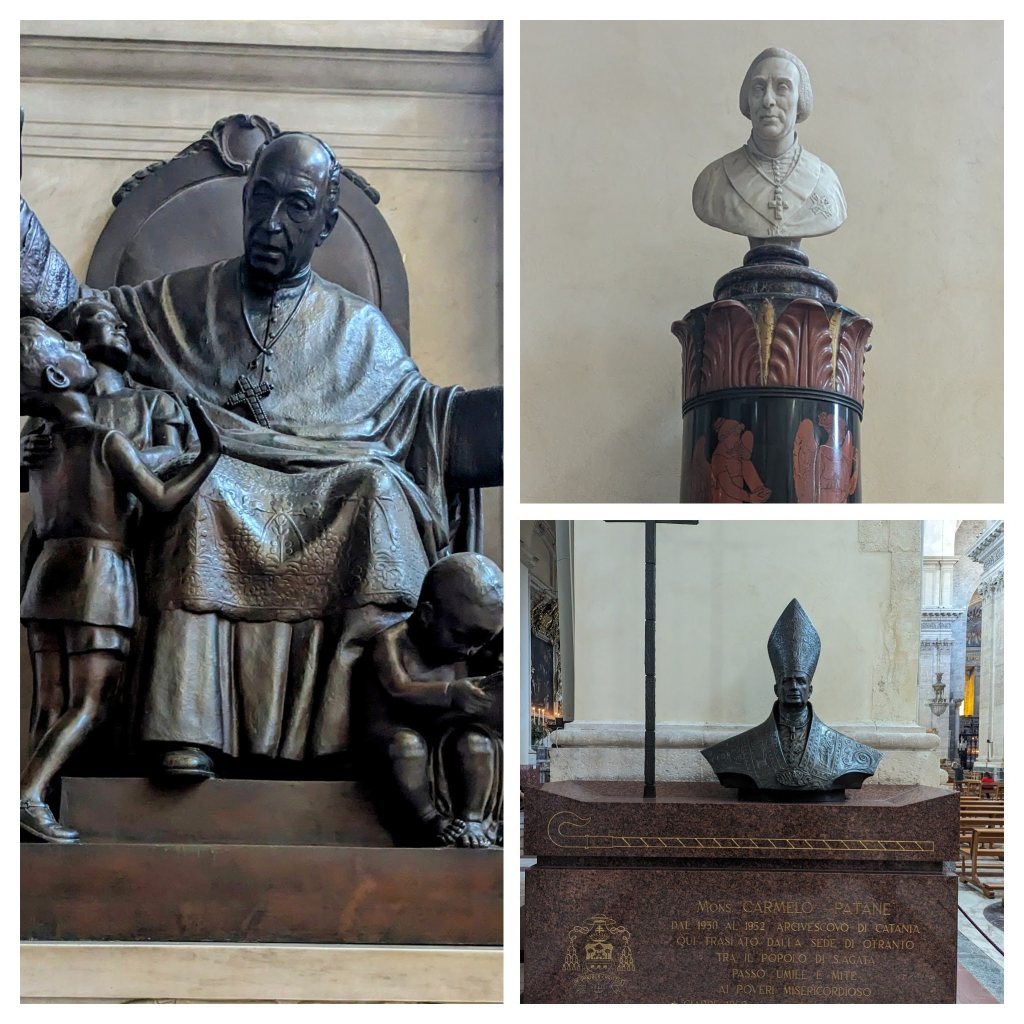
We had a cappucino and walked the short distance down to Saint Agatha’s cathedral in the plaza. It is attractive without being impressive, as cathedrals go. There were flashy memorials to various dead bishops, who I’m sure were all very humble, modest men.
Humble Bishops in the Duomo
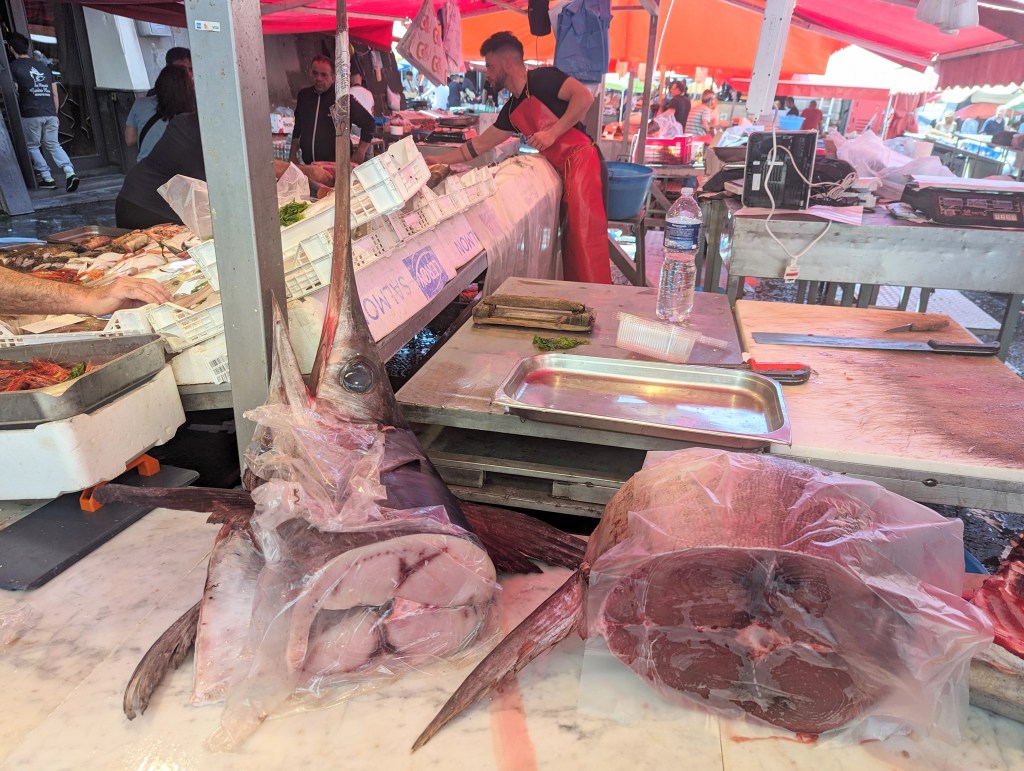
Just round the corner from the duomo is the fish market, which is quite an assault on the senses. There are dozens of stalls selling every type of Mediterranian fish, from tiny clams the size of a finger nail, to huge tuna and swordfish as thick as tree trunks. I have never seen such big fish being hacked to pieces by fishmongers with huge clevers. I wouldn’t get into a fight with one of those guys. There were plenty of stalls selling fresh oysters, and rows of restaurants selling seafood dinners. There appeared to be many more tourists (like me) taking photos than customers buying slabs of dark red tuna or swordfish for 10 Euros a kilo. The octopuses, squid and cuttlefish looked like deflated grey ballons on their marble slabs, when in life they are fantastic dynamic creatures of intelligence that can change their colour to blend in with their environment to hide from predators.
Mmm Swordfish
It was a short walk to Via Etnea, the main shopping street that runs from the cathedral towards Etna. After exhausting fish watching, we revived ourselves in a big cafe and drank Americano’s and watched people, always a good sport.
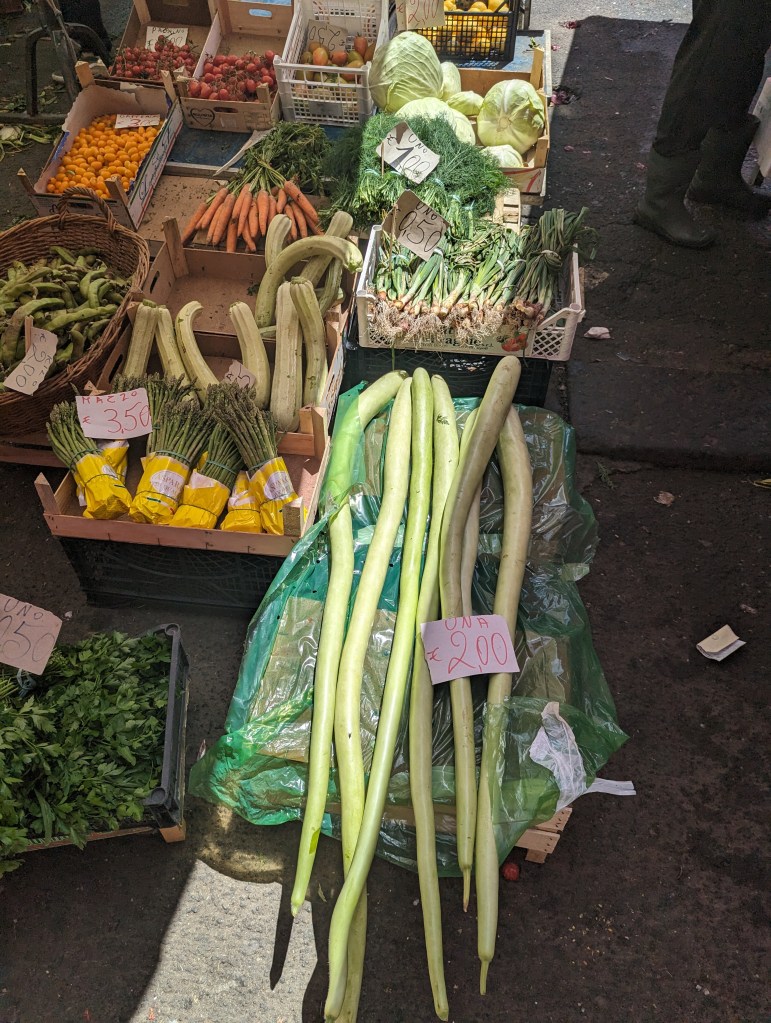
The fish market is compact and mostly fish, but close to the Piazza Stezicoro (where we met Ernesto yesterday) is the city’s main street market. It is the real living heart of the city, selling fruit, vegetables, meat, clothes, hardware and souvenirs. It is alive with the cries of competing stall holders trying to sell huge aubergines and radishes (I think) that are a metre long. As we shuffled our way through, we occasionally had to stand aside while a scooter came through loaded with ice for a stall. The fruit and vegetables were cheap and looked great, I think Rick Stein would be getting very excited if he was here.
Extremely long vegetables
At the end of the market was a street cafe called La Salumania, where we stopped for a panini and beer. It was possibly the best panini I have ever eaten, with crusty bread and a filling of bacon, salami and salad.
The world’s best paninis are served here
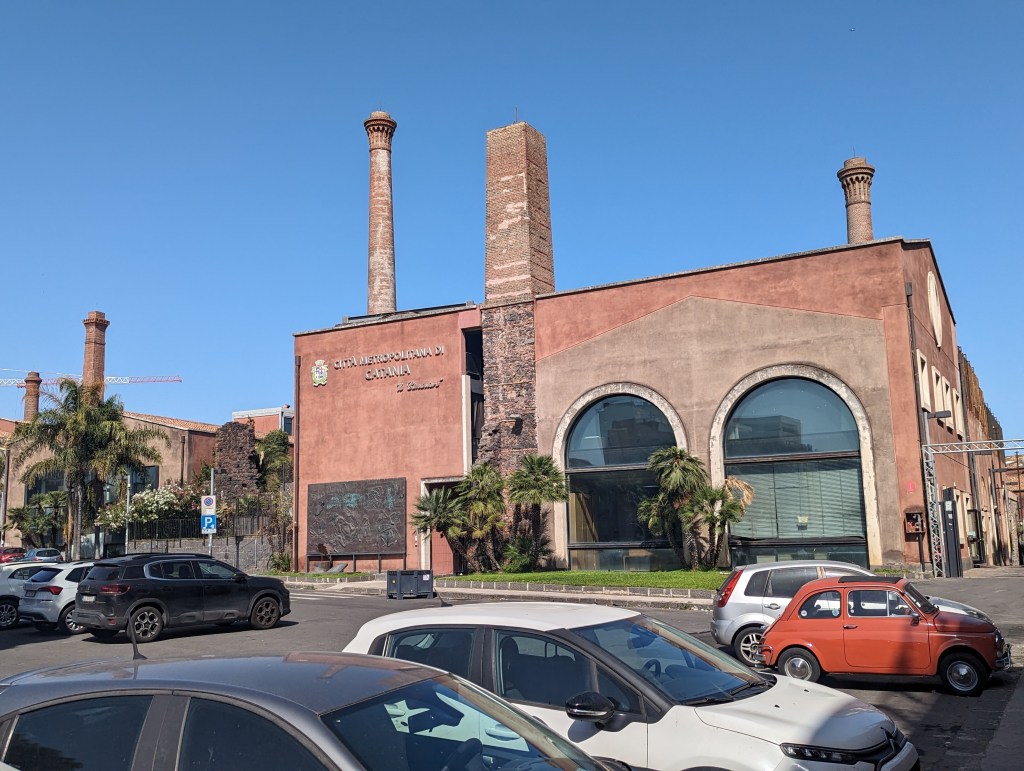
After lunch we ambled back to the flat for a little R&R. But what to do next? We had seen most of what was recommended in the Rough Guide and on Tripadvisor. A place we had seen was La Ciminiere, which was an old sulphur refining factory converted into a conference and cultural centre. It was about 15 minutes away on the coast near the bus station. It appeared to have had lots of money spent on it 30 years ago and is now rusting and looks dreadful, don’t go there. There just isn’t enough money in Catania to keep the city looking smart.
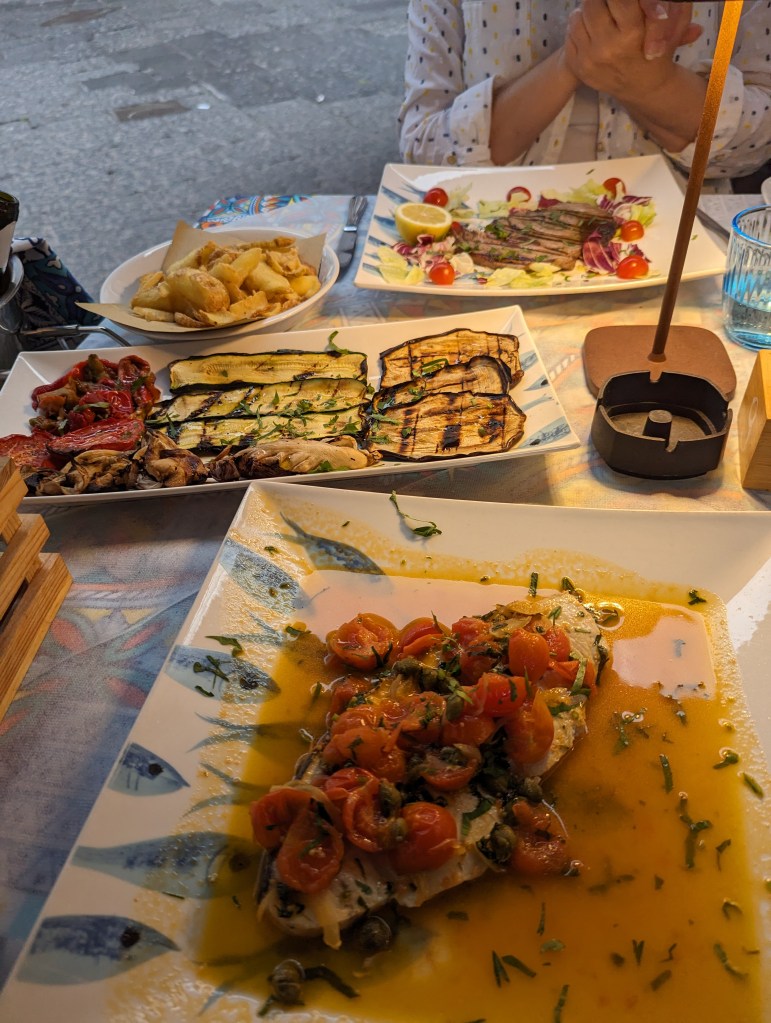
In the evening we went to Ciaru i Mari in Via San D’Orsolo, a seafood restaurant about 5 minutes walk from the flat. It was our second visit because it is such a good place. The staff speak excellent English and are very charming and helpful. I had swordfish (spada) and Julie had tuna (tonno), the best meal we have eaten in Sicily. Their chips were just awesome, and I am a very good judge of chips. The house wine was a Sicilian chardonnay for 15 Euros a bottle, bloody lovely. So I am now a very happy, and slightly drunk, boy.
Top Notch Fish and Chips
And finally, I saw this specialist butcher near the port. Anyone hungry?
The sun was shining this morning from the beginning of the day, so we got out of the flat early…ish. There were pants and socks to wash, so in the event we got out at 11, which is early for a holiday.
The Jehovahs were out on the street trying to convert people by just standing there with their leaflet stand. Quite honestly they could just as well have several cardboard cut-outs of varous versions of Doctor Who and achieve the same number of converts.
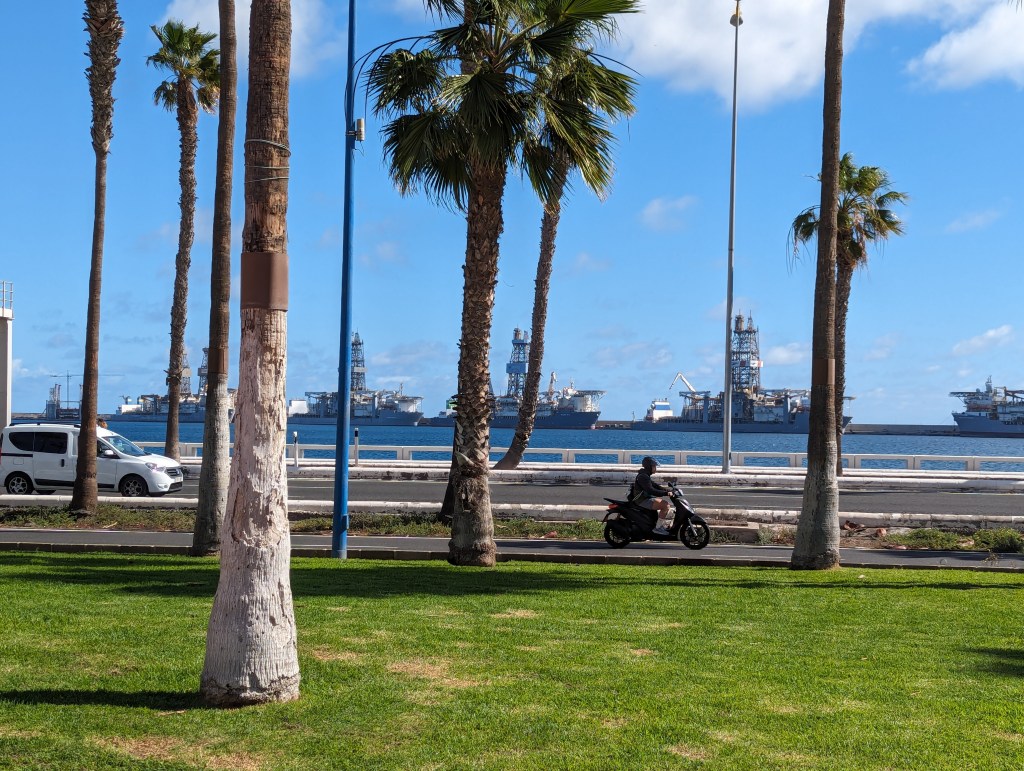
We walked for about 5 minutes to get to San Telmo Park, and decided we needed a coffee, its the only way to start the day in Spain. The park is opposite Puerto de la Luz, one of the biggest ports in Spain. They service floating drilling rigs at the port, and there were several lined up ready to get their spark plugs changed and timing belt adjusted.
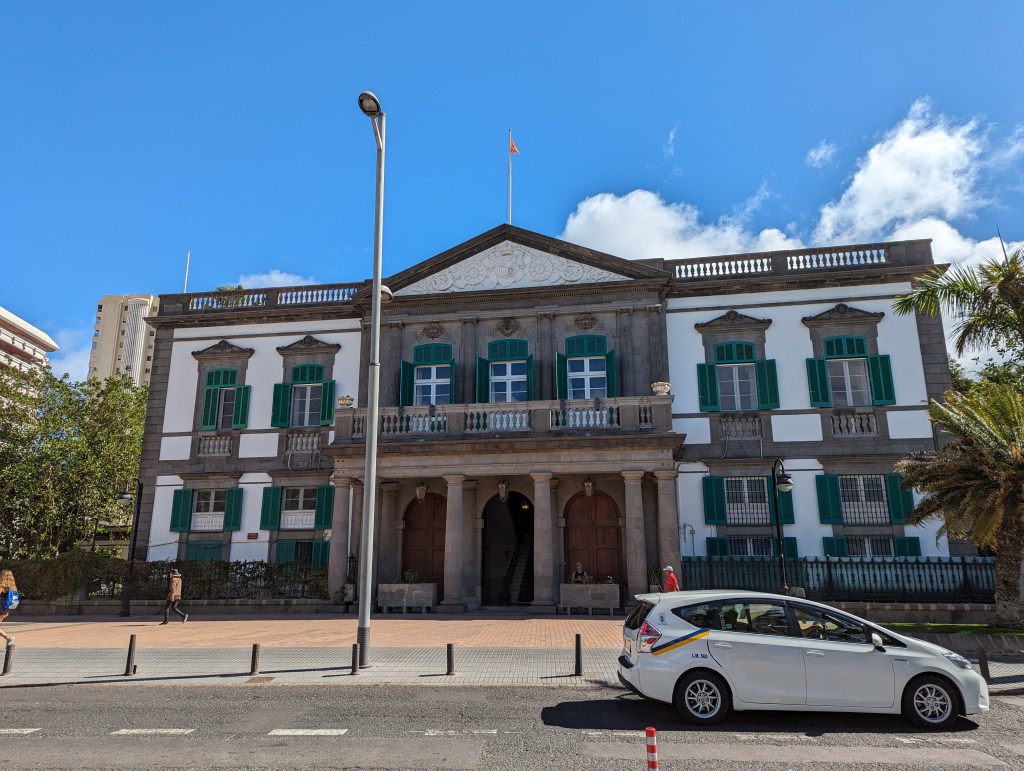
The park is close to the sea, but is overlooked by hills not far away. In Google Maps I looked up Mirador (viewpoint) and found Mirador de Schamann about 20 minutes walk away, so we headed up there. On the way we passed this interesting looking old building, which is the Canarian Naval Headquarters. I expect they are ready to vigorously fend off any English or Dutch pirates. But quite honestly the Spanish Navy hasn’t had much success since the Battle of Trafalgar.
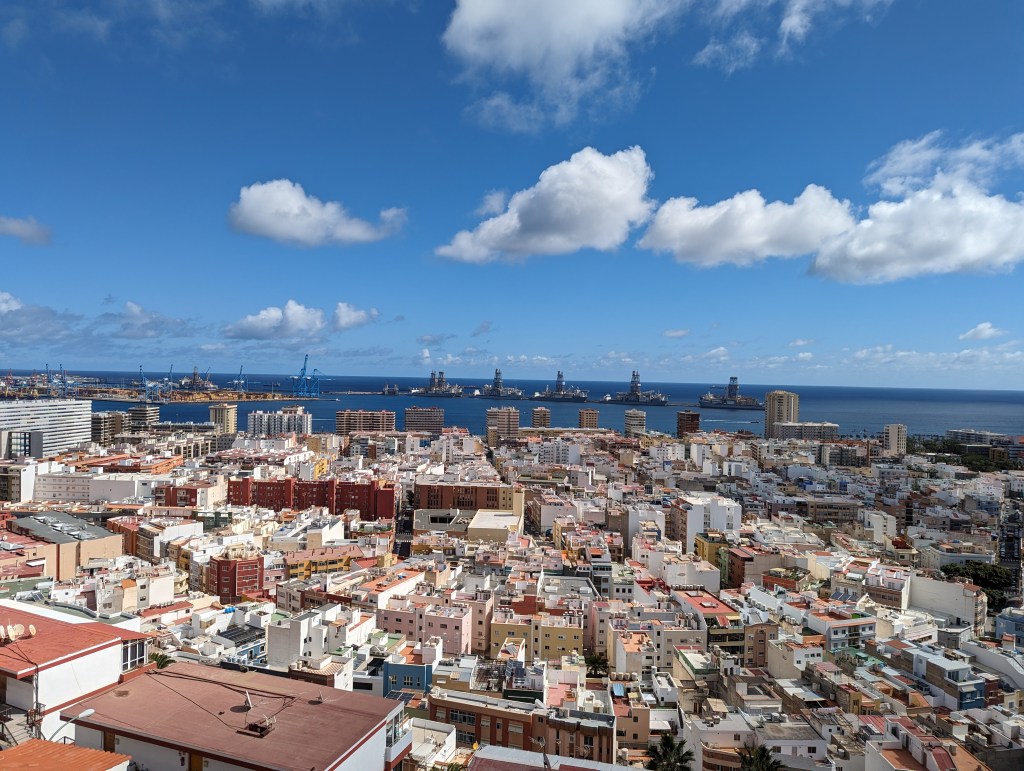
The view from the mirador was excellent, and the hike up the hill will hopefully negate the effects of the alcohol I will drink tonight. Notice all the drilling rigs in the port. Also you can see that the houses are all little boxes made of ticky tacky and they all look just the same.
We had lunch at the flat (bread/sardines/hummous/tomatoes/sangria) and in the afternoon had another explore of Triana. There are so many interesting streets and a plethora of restaurants.
Have I used the word plethora before? I don’t think so. Like Ithmus, it has a TH in the middle. My initials are TH, surely there is a mystical connection.
Anyway I digress, we mouched about looking at nice places and taking note of restaurants for this evening.
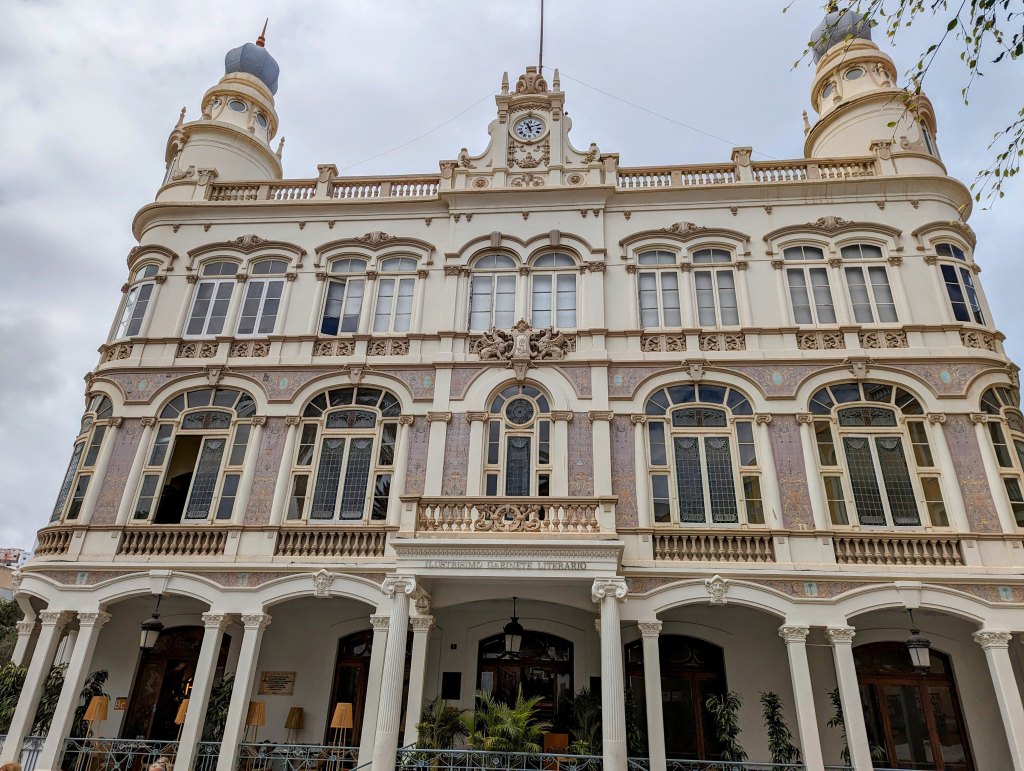
This is the Gabinete Literato, which is a cultural and scientific society a bit like our own Royal Society.
Inside it is equally lovely, and it has a restaurant that we might try out some time.
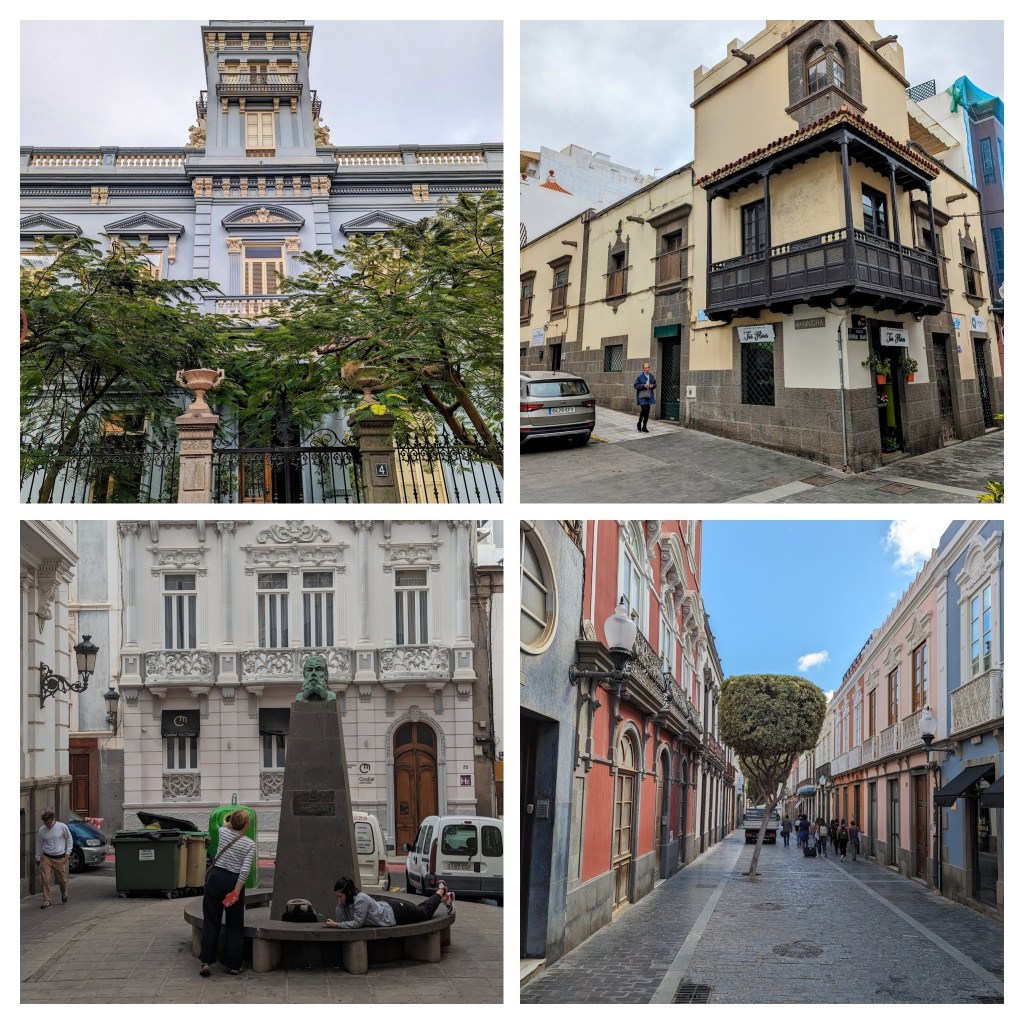
I took loads more pictures of pretty places, and have cleverly made them into a collage. Not only am I a master of unusual words with TH in them, but I also use collages in my work, I truly am a polymath (which also contains TH).
At 6.30 we met Dave and Jo in their hotel and walked them into Triana. We had a drink in one of the side streets running off Calle Triana, then went in search of a restaurant. They were either Inside Restaurants with no menu on the wall outside and linen table cloths (out of our league) or Outside Restaurants with affordable menus to peruse, but a bit drafty in the street.
Eventually our rumbling tummies overruled us and we found an Outside Restaurant near Plaza del Ranas (Frog Square). My chicken and wrinkled potatoes were very good, washed down with a hearty Rioja.
The north of Tenerife is a green and mountainous region, ideal for a winter holiday
Tenerife
January 2020
Tenerife, brown in the south, green in the north
Tenerife is the biggest island in the Canaries, a group of Spanish islands off the coast of Morocco in the Atlantic ocean. It is a volcanic island with an area of almost 800 square miles and a population of about about 900,00. In the centre of the island is a huge volcano called Mount Teide, which is 3,718 metres tall and is the highest mountain in Spain.
We went there because the Canaries are just about the only place you can fly to by EasyJet in January where it is warm, about 20 degrees centigrade on the coast.
Puerta de La Cruz
We chose to stay in Puerta de La Cruz in the north of the island because it is in the most verdant part of the island and there are plenty of places to visit close by. The south of the island is a desert, both physically and culturally. The south is sunshine and beaches and a Full English for breakfast. The north is sunshine, beaches, old towns and mountainous forests.
It takes about an hour to get there on the motorway from the airport in the south of the island. There is an airport in the north, but British airlines don’t fly there directly.
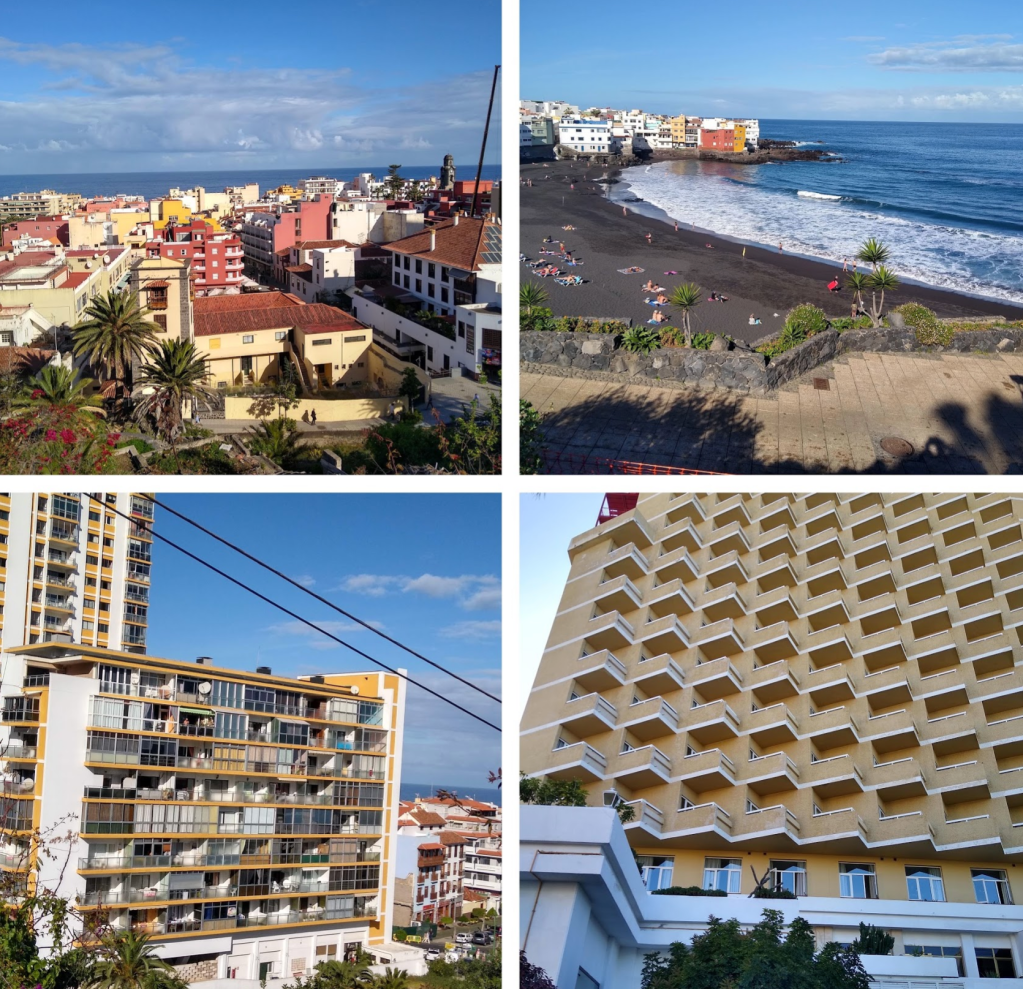
Puerta de la Cruz (I’ll refer to it as Puerta) is a very touristy town with a huge number of hotels and blocks of flats, but it does have a historic town centre and harbour. It’s easy to get La Laguna, Santa Cruz, La Oratava and Garachico by car or bus, so its central for all the northern towns. Loro Parque is in Puerto as well, which is the biggest single tourist attraction on the island.
We booked an Airbnb in the La Paz district which looked good on the map, near the city centre and close to the sea. In reality it was a thirty minute walk from the town centre, up a big hill, but it did have sea views. But there were plenty of restaurants and a supermarket close by, if we didn’t fancy the hike into town.
Puerto is very popular with German tourists, so if you enjoy Curry Wurst and lager, it’s an ideal destination. There are endless pizza restaurants, and plenty selling local Canarian and Spanish food. The local Dorada beer is really good and washes down fresh sardines very nicely.
Flats by our unused pool
Our flat had a sunny patio at the front and a shared pool which I didn’t use (but I should have). Unfortunately it was above a noisy cafe, where people were enjoying themselves very noisily, the bastards!
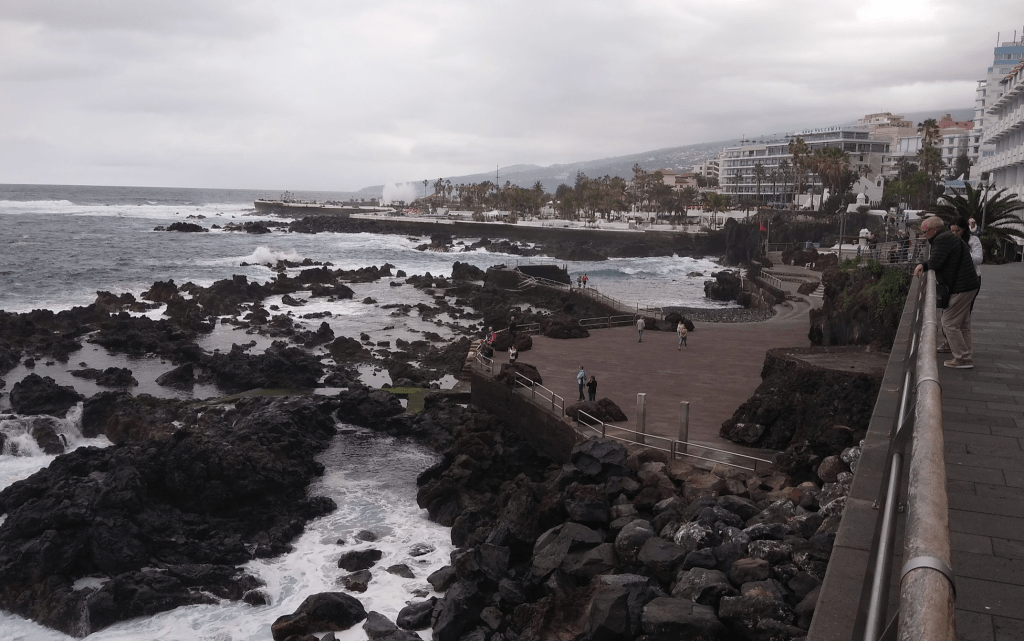
On the seafront there is Lago Martianez, which is an attractive group of seawater pools that I’m sure is lovely to lounge around if the weather is hot enough, but it was very gloomy and windy when we visited it.
Puerto seafront on a baaad day with waves battering the Lago Martinez
There is a small harbour (which was once the most important port on the island), and the main square, Plaza del Charco is close by which has many restaurants and bars.
Puerta has lots of flats, lots and lots
Botanic Gardens
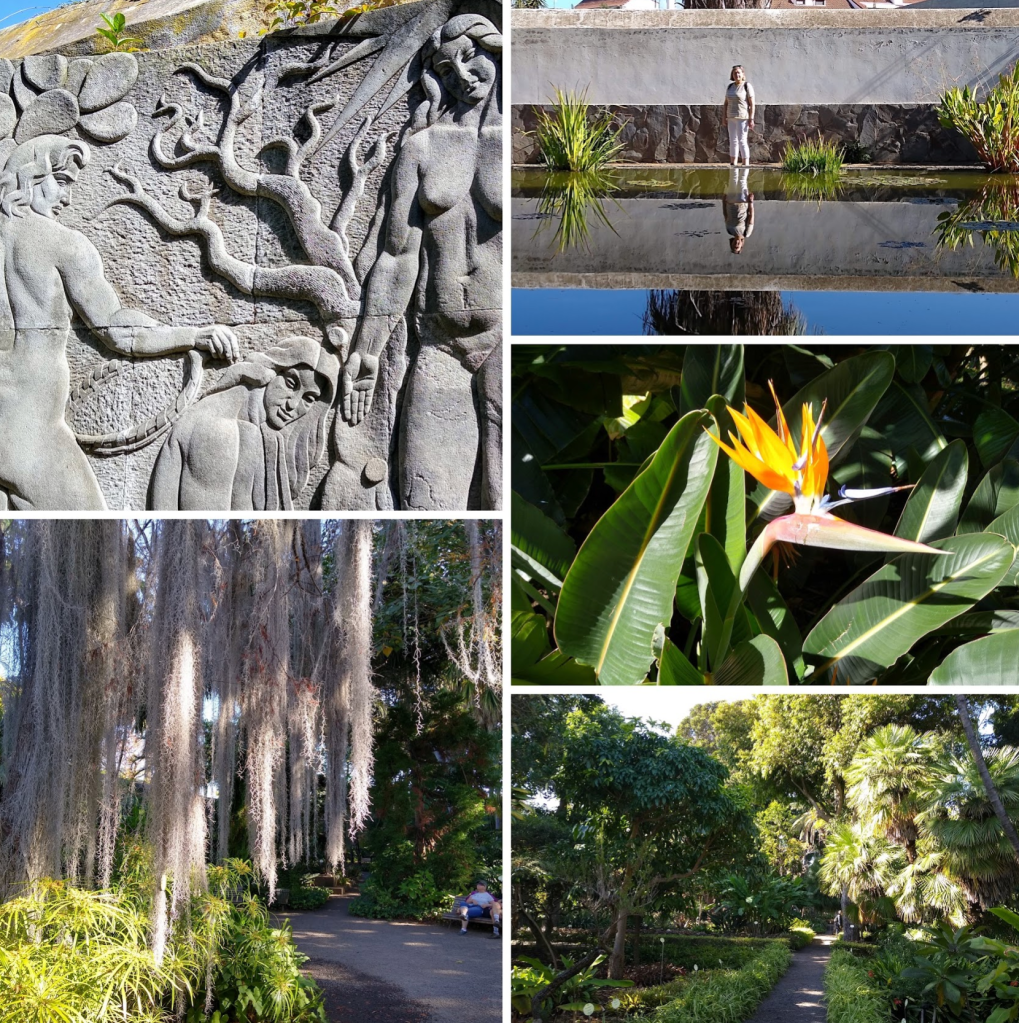
The Jardin Botanico is a beautiful oasis amongst all the blocks of holiday flats. It was founded in 1788 on the orders of King Carlos III to provide a place to cultivate species from the tropics. It’s small compared to Kew, but you can easily spend a couple of hours wandering around the neat paths which are roughly in a grid pattern.
I did wonder if visitors under sixty were barred at the gate by security men from Saga, but was pleased to see two young fellas looking at a palm tree with genuine interest.
Lord Howe Fig with adventitious roots
The most spectacular tree is a mighty fig from Lord Howe island in Australia. It has adventitious roots (remember that word for a pub quiz) growing down from the boughs, which take take root in the ground and become extra trunks to support the weight of the tree.
There are some magnificent Norfolk Island Pines, which I have never seen taller than twenty feet in other parks. The pines I saw in the Jardin had trunks four feet in diameter and I couldn’t see the top, real monsters! I get strangely excited about big trees, it is kind of wierd.
As well as amazing trees there are many palms, yuccas, streletzias and figs. But there was no cafe! What kind of public garden has no cafe? All the English visitors were is a state of shock and semi-starvation looking for tea and cake. Perhaps Brexit isn’t a mistake after all.
Mount Teide from the Jardin Botanico
La Oratava
We attempted to walk up the hill to La Oratava from the Jardin, but soon discovered that there were no footpaths and it felt a bit dangerous sharing the road with busy traffic. So we took the 345 bus to La Oratava bus station, which took seven minutes, a much better way to travel.
La Oratava is one of the oldest settlements in Tenerife, the area was inhabited by the Guanches people before the Spanish arrived, who lived in simple stone homes and caves. It is a very pretty town, with many historic houses and civic buildings built on the slopes climbing towards Mount Teide. There are great views of the sea and Puerta de la Cruz below, which used to be the port of La Oratava.
Houses in La Oratava
The tourist information provided a very useful map that we used to find our way round the historic parts, which go back to the sixteenth century. The old houses have big wooden doors and carved wooden balcony’s in the typical Canarian style. There is a small Botanic garden behind the Ayuntamiento (the town hall), but the nearby Jardin Victoria is outstanding, a terraced garden that climbs up the slope with a Masonic Mausoleum at the top.
Victoria Gardens with attractive visitors
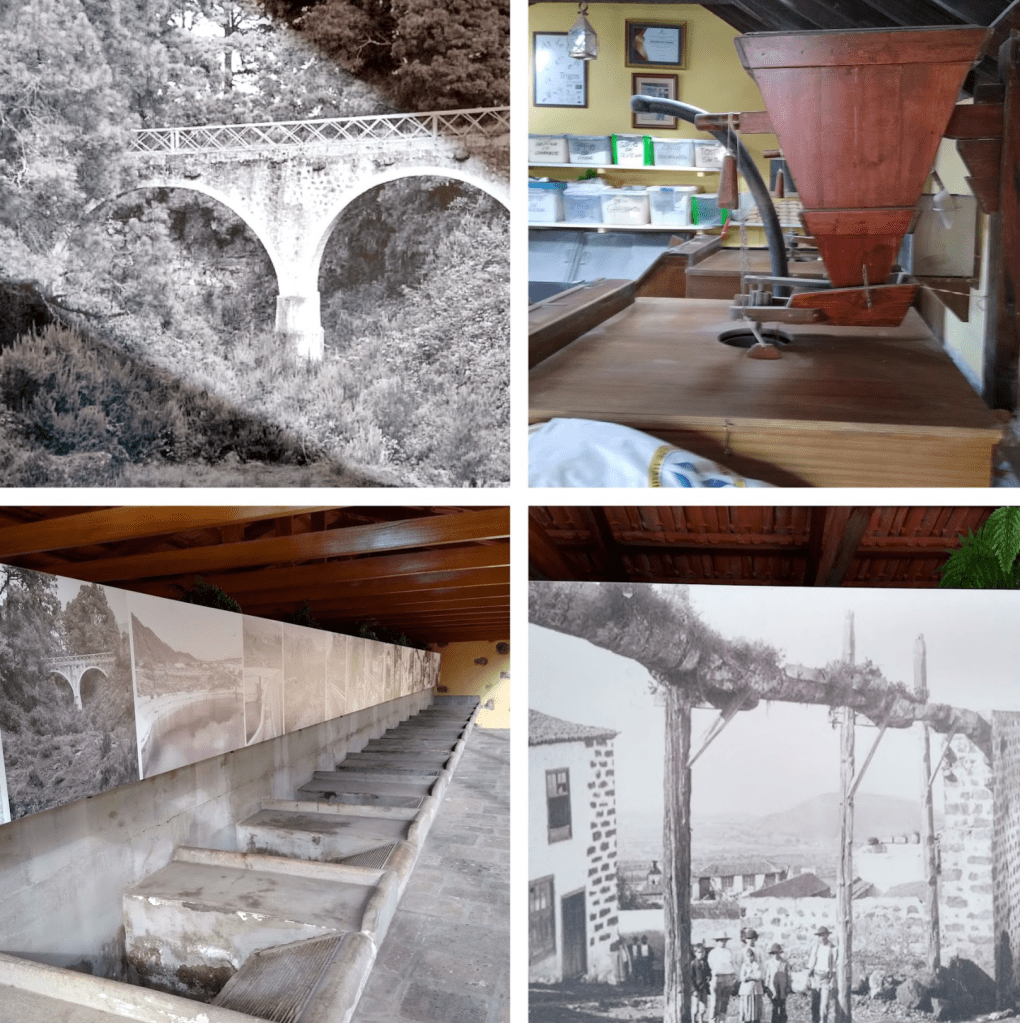
Near the Plaza de San Francisco some public laundry troughs have been restored. It’s close to an aqueduct which brought water down from the mountains. Next to it is the Molina de Chano, a mill which was powered by water but is now electrically driven. The mill produces Gofio, a flour made from toasted grains which was eaten by the Guanches and is still popular today.
Old laundry, Gofio mill and historic images of the aqueduct that supplied them with water
The streets of La Oratava are steep and cobbled, and the locals treat it as a rally course. It probably explains why we saw no English tourists on mobility scooters.
I would highly recommend La Oratava, there is a lot to see, and many great bars and cafes and surprisingly few tourists.
Scenic Drive Through Tenerife
A blogger said that one of the best drives on the island was from El Portillo to La Laguna, so we gave it a try. Julie drove the rented Polo and I navigated i.e. I did what Google told me to do.
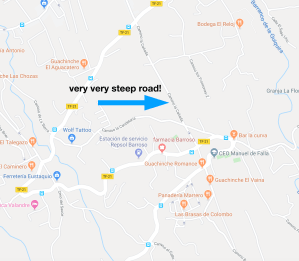
Stick to the TF 21
Our route was the TF21, which goes through La Oratava and then goes wiggly wiggly up the lower slopes of Mount Teide. It was incredibly windy, and Google took us up a stupidly steep hill (Camino La Canadas to be exact) to cut off a bend on the T21 to save a few miles. It was one of those “Oh Shit!” moments when we hoped nothing was coming down the hill. We crawled up it in first gear to rejoin the main road at the top. Google was sent to her room for being naughty, and after that, and we just used the map, old style.
We stopped at a cafe near Aguamansa for a coffee and met two cyclists from Hereford who were cycling from the sea up to the cable car, which at about 7,000 feet up. Nutters.
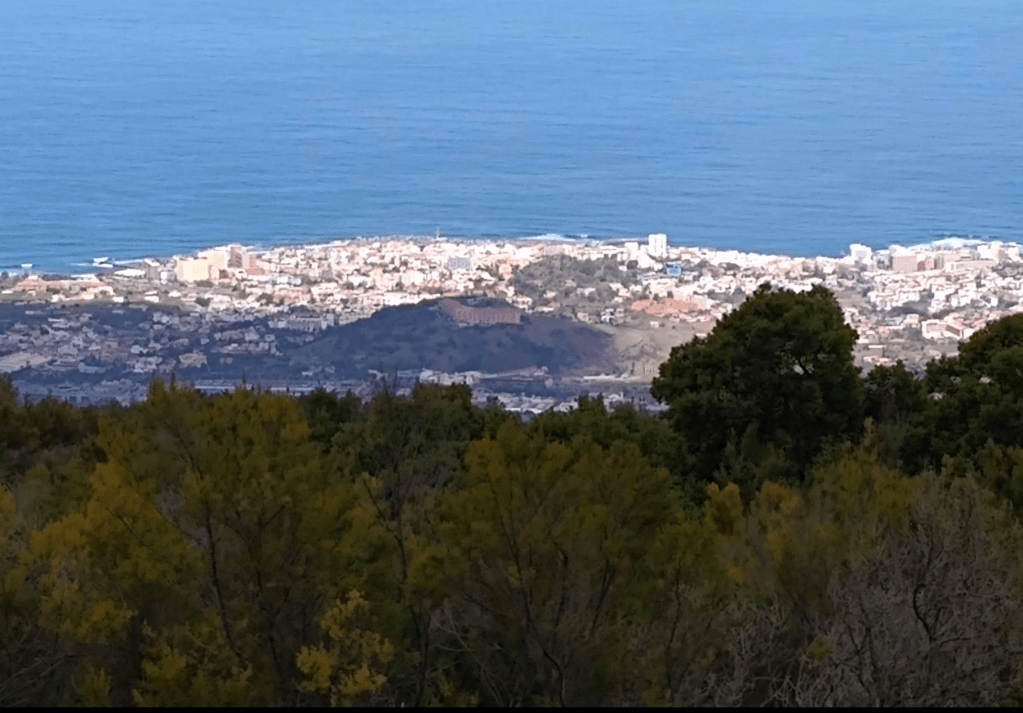
View of Puerta from the TF 21 raod
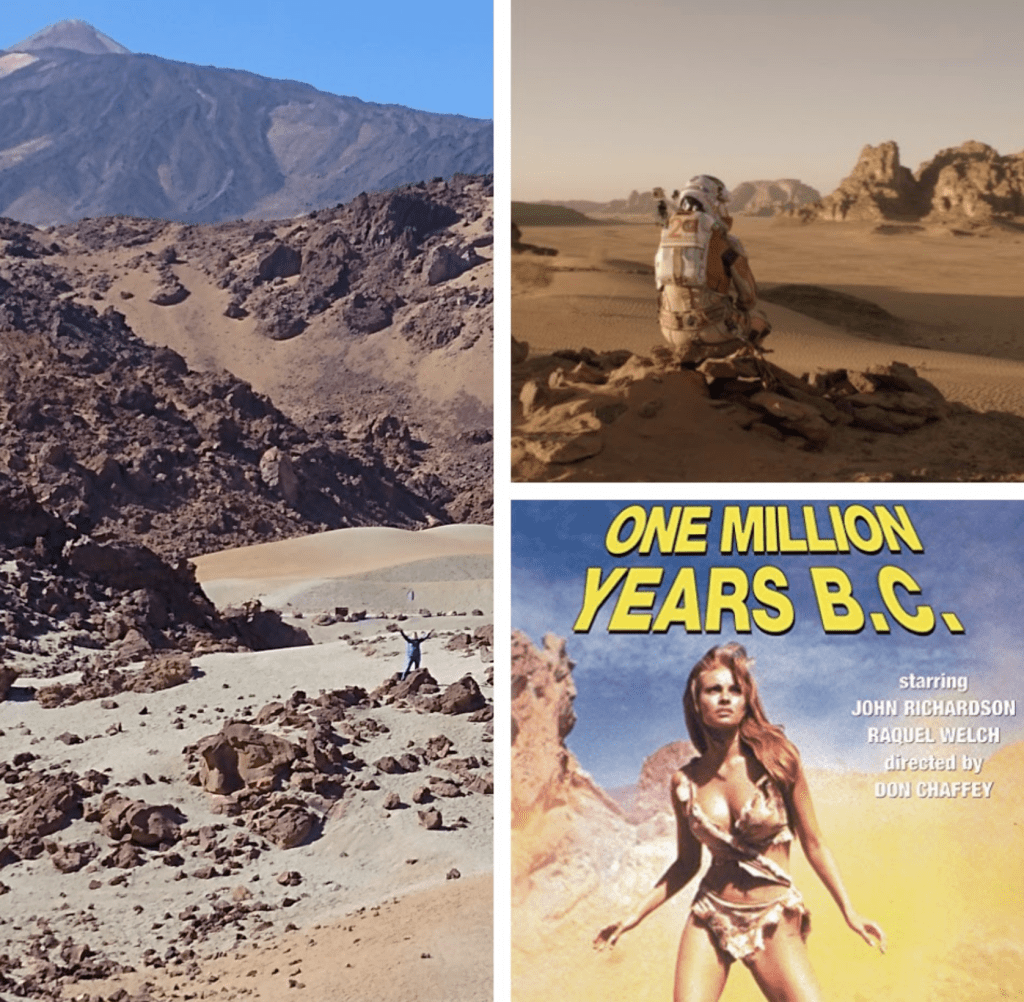
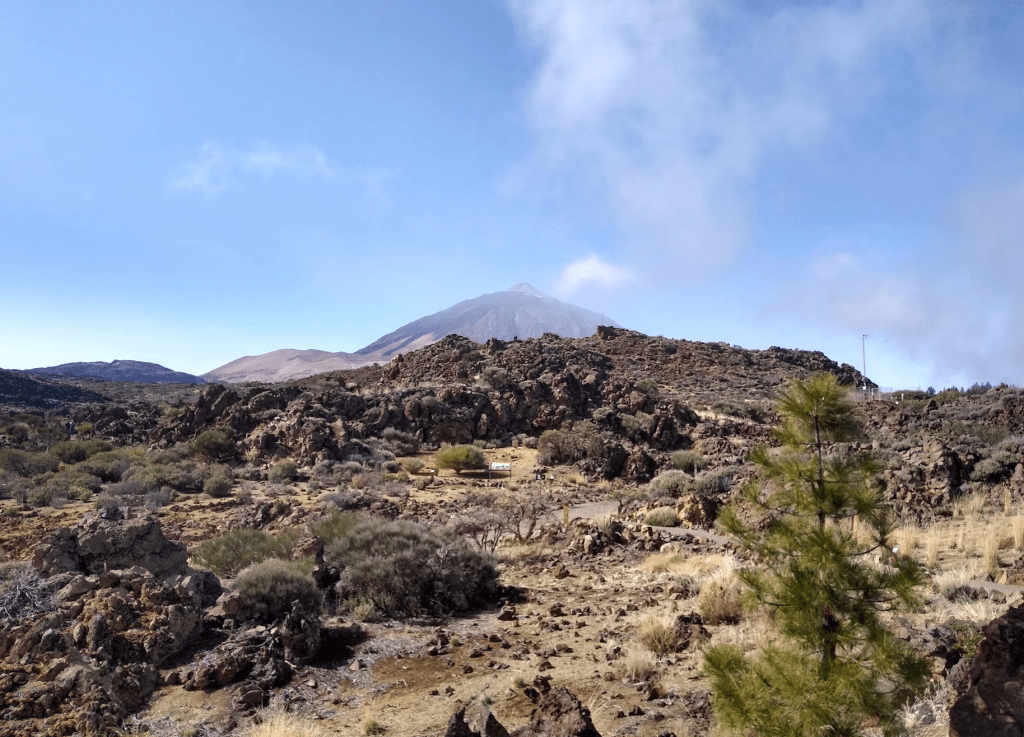
Once we were above the tree line (and the clouds) the landscape looked like a desert with scrubby vegetation. Further up it looked like the surface of Mars and I expected to see Matt Damon struggling in his space suit trying to get home. Raquel Welch encountered stop-motion dinosaurs here is the classic sixties SF movie “One Million Year BC”.
One of these people is me, one is Matt Damon and the other is Raquel Welch – work it out
The area surrounding Mount Teide (it rhymes with Lady) is the caldera of a previous massive volcanic eruption, it is very other-worldly.
Look out for dinosaurs!
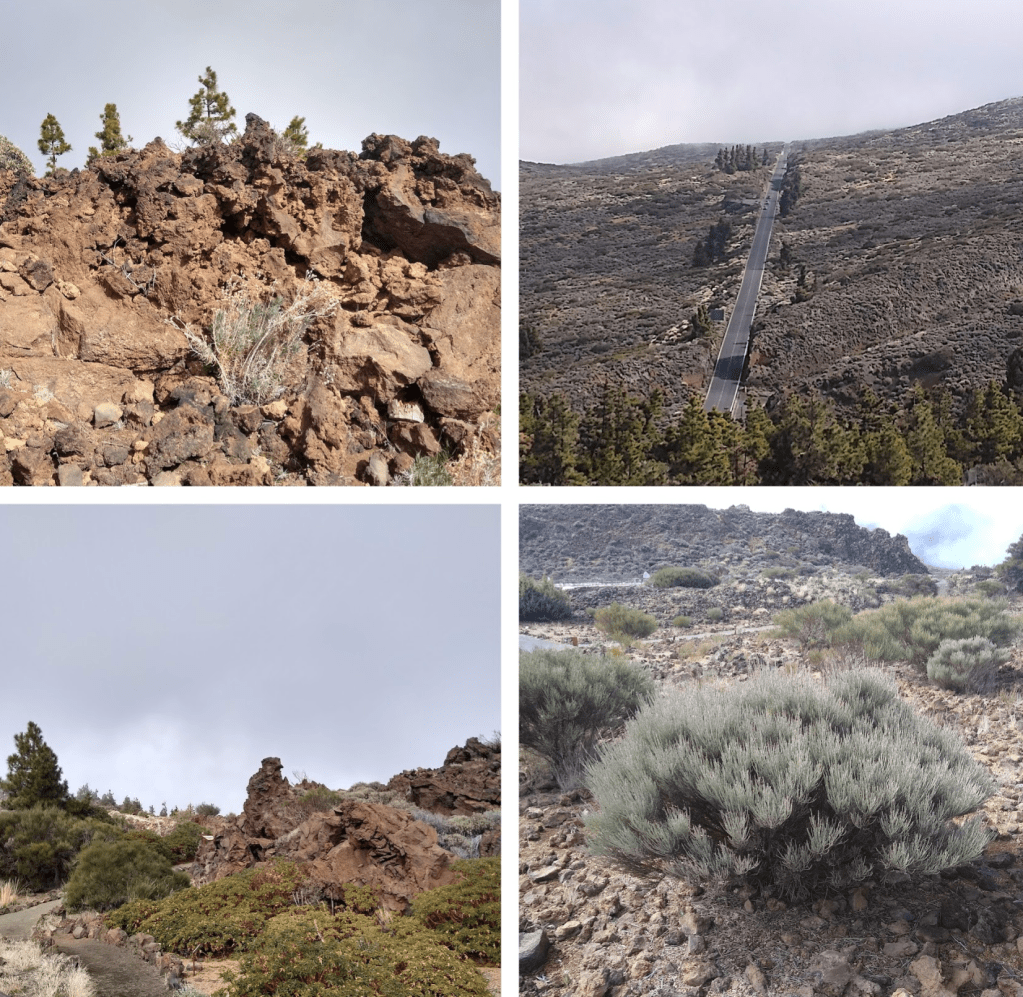
At La Portillo there is an excellent visitors centre with a “Botanic Garden” which is a series of paths between small hills of basalt and ash planted with all the local plants. It was beautifully sunny , there was no wind and not a sound to be heard, perfect silence. In the visitors centre there is a small museum about volcanoes and a film about the volcanic origins of Tenerife.
The botanic gardens at El Portillo
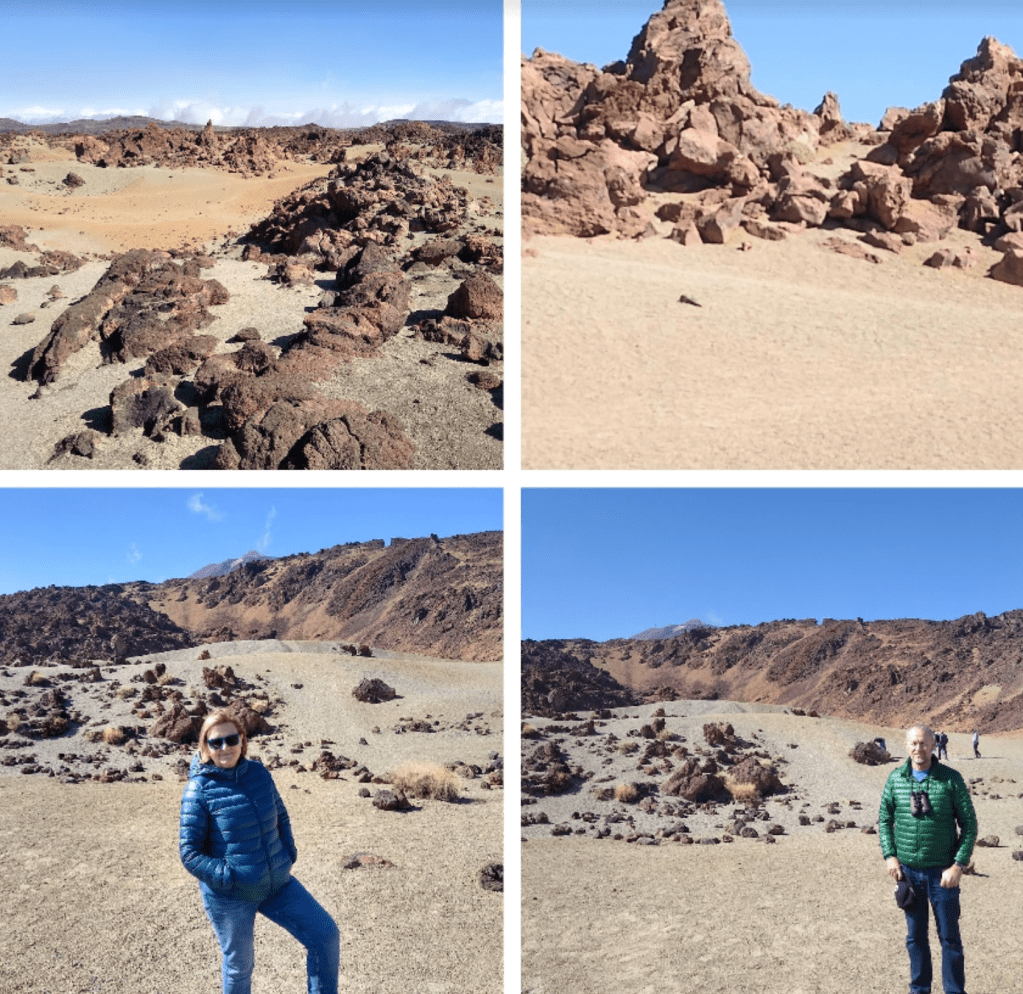
Further along the TF21 is Los Roques, which are big pinnacles standing up above the pumice plain surrounding Teide. There is also a Parador with a cafe and toilets, the only ones for miles around!
Martian landscape and two Martians
Clouds pouring over the mountains
The landscape is quite remarkable, with Teide towering up another fifteen hundred metres, with the cable car hanging onto the side of it. The rim of the caldera creates a circles of jagged hills surrounding Mount Teide. The clouds blowing from the east poured over the top of them into the caldera, it was so beautiful.
Cyclist at the Parador, he may have had devine assistance
The landscape is amazing, awesome and all that stuff, I was blown away by it’s magnificence. Cyclists take a perverse please in cycling up the mountain from the sea. It takes about four hours going up, and I’m sure the going down is much quicker!
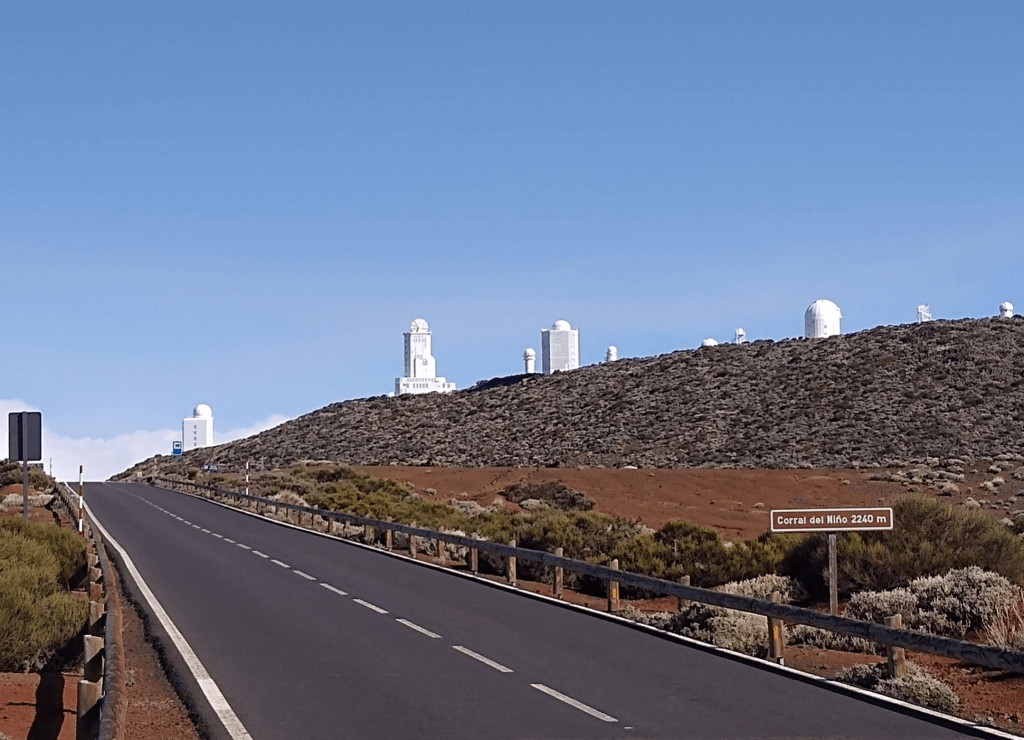
We drove back to El Portillo and took the TF24 towards La Laguna along the high spine of Tenerife. I passed the astronomical observatory with eleven different telescopes at about two thousand three hundred metres, with mostly clear skys.
Did you know that Brain May from Queen wants his ashes to be scattered there? True fact, you can Google it.
Brian May’s last resting place. Once he has died of course.
The views from the TF24 are supposed to be excellent both sides of the island, but all we saw was clouds below us. But it is a lovely winding road through pine and eucalyptus forests gradually down to La Laguna and the TF5 motorway back to Puerto de La Cruz.
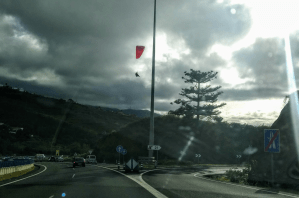
On the FT 5 on the way pack to Puerto, a para-glider flew over the motorway.Fortunately he didn’t hit the lamp post or the pine tree!
Loro Parque
According to TripAdvisor, Lord Parque is the No. 1 zoo in the world, which is quite a recommendation. It is also advertised on most of the buses and litter bins in Puerto, so it is a very big deal.
It was pricey to get in at 39 Euros, but we stayed there for over six hours and had a wonderful time!
Loro Parque means parrot park in Spanish, and there is a huge collection of them in cages and an huge aviary with an aerial walkway in which you can get close to the birds at feeding time. There is also a great collection of other creatures in a relatively compact area. It is beautifully landscaped and well maintained, with plenty of cafes with reasonably priced food and drink (which was a pleasant surprise).
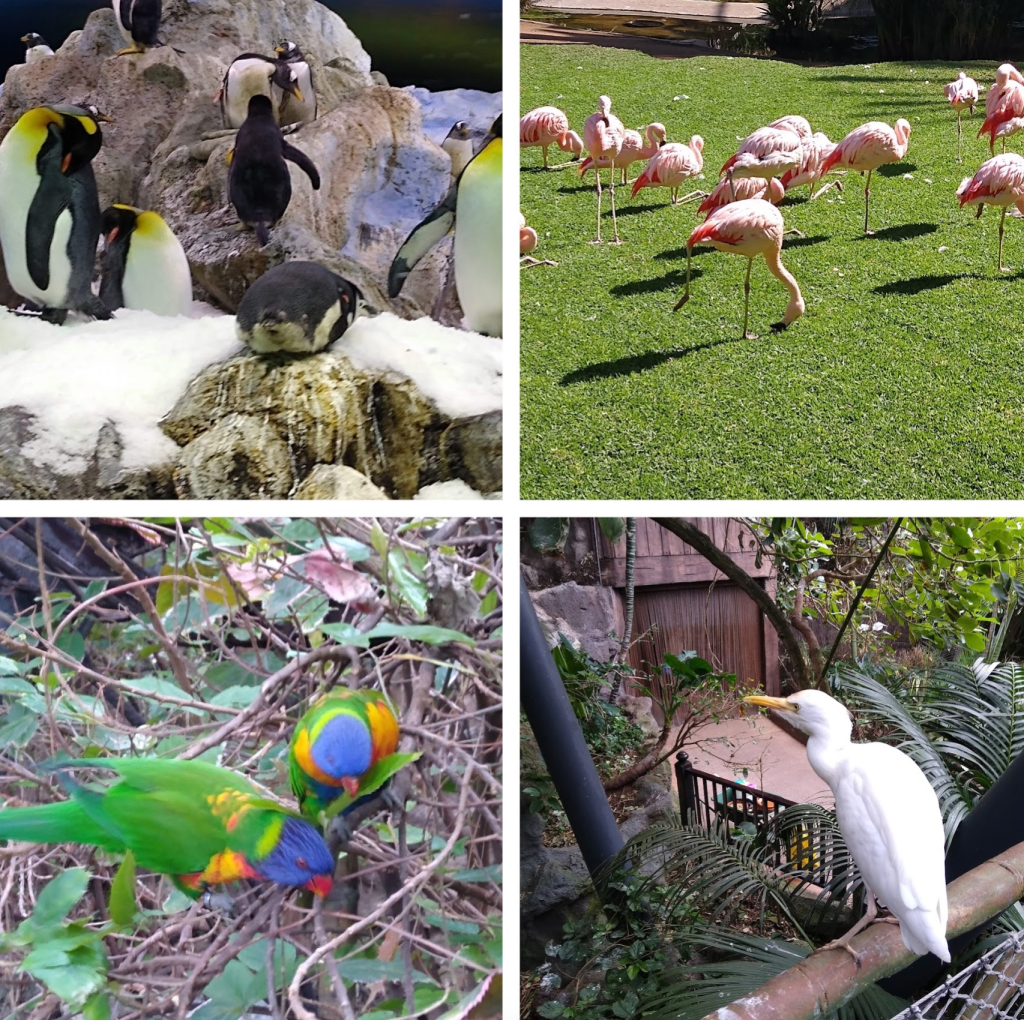
King Penguins, Flamingos, Parrots and an Egret
Giant Anteater, part-broom, part-vacuum cleaner
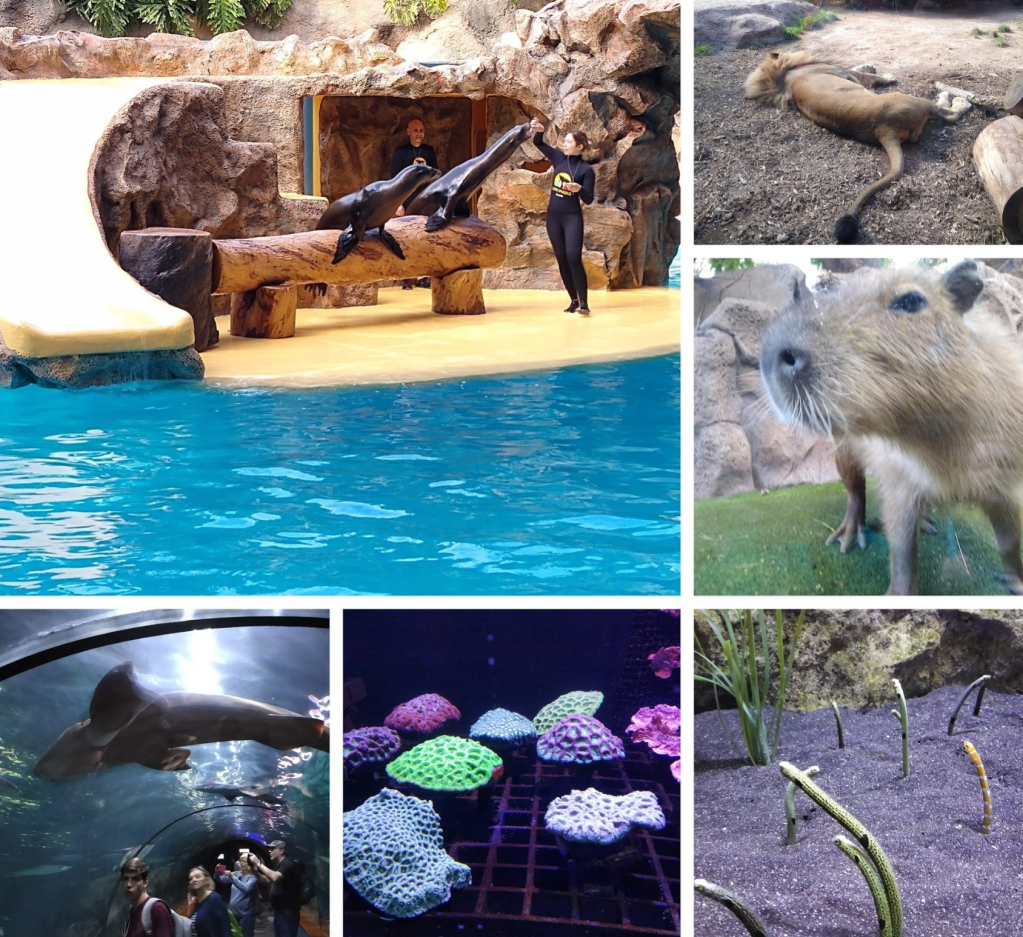
We made the most of the day and saw the Orca Show, the Parrot Show, the Dolphin Show and the Sealion Show, which were all good fun. The most lively performers were the leaping dolphins, but the Orcas made the biggest splash, soaking the people in the front rows. The big mammals and reptiles mostly just sat there and slept or watched us watching them. The Giant Anteater was very lively, and took the prize as the most bizarre looking creature.
Sea Lions, Sleeply Lion, Capybara, Shark, Coral being cultivated and Garden Eels
Penquin World, above and below water
Most zoos have a concrete pond painted white for the penguins. Loro Parque had a huge indoor environment for its collection with constant “Snow” falling from the ceiling and a slow travelator that took you around the enclosure, it was very clever. It was also very whiffy, you could smell the penguins fishy pong before getting into the enclosure.
The most impressive area for me was the huge aviary with a treetop walkway. We arrived at feeding time and saw parrots, cockatoos and egrets close up eating their rations of vegetables and seeds. They are very colourful and vocal, it was great getting so close up to them.
There is also an amazing aquarium with a tunnel beneath a tank of sharks, rays and groupers, it was like diving without all the annoying scuba business!
Loro Parque did live up to its reputation, and it was the best zoo I have been to. I understand all the ethical reasons for not having zoos, but I did enjoy it and felt slightly bad at the same time. But I have now seen Sea Lions, Penguins, Dolphins, Tortoises, Parrots, Orcas and Iguanas, so I don’t have to fly to the Galapagos. Think of all the air miles I am saving, I’m sure Greta Thunberg is proud of me.
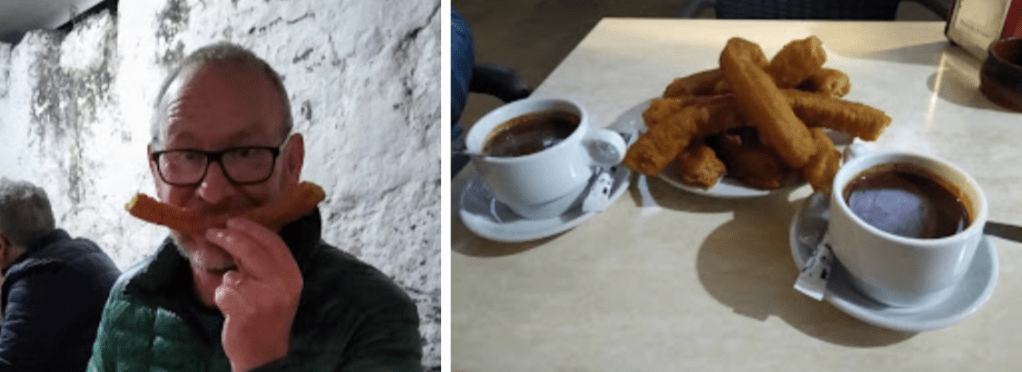
On our way back home we had some fish for dinner, followed by churros and hot chocolate at Churreria Perdomo. Churros are doughnut mixture extruded into hot oil to make long crisp cakey things. Fattening and delicious, ‘Food of the Gods!’
Mmm churros…
Anaga Park
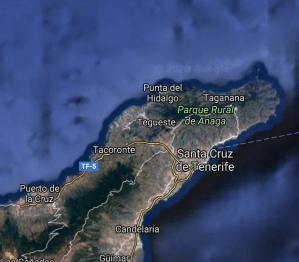
In the north west corner of Tenerife is the Anaga Park, a wild region of forested mountains almost a thousand metres high. The TF 12 road from La Laguna to the Visitor Centre at Cruz de Carmen is very windy and narrow. Passing the big tour coaches on the narrow road is quite nerve-wracking, but it’s worth the drive.
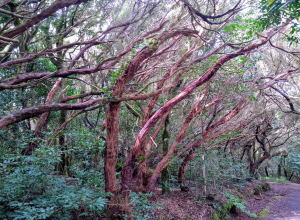
There are many different walks you can take from Cruz de Carmen, and we chose a five kilometre hike through the forest. The type of forest is called Laurisilva, an ecosystem that covered large parts of Europe before the Ice Ages, but now only found in fragments in Madeira and the Canaries. It’s a type of cloud forest of evergreen trees like laurels and heathers which grow to tree-size. It’s unusual and very cool, in both senses of the word!
Laurisilva forest
There are several Miradors in the area, view-points with parking. Close to the visitor centre you can look out over La Laguna, and at Zapata you can see the sea on both sides of Tenerife. You can watch planes landing at the Northern Airport. This airport used to be called Los Rodeos, and was where five hundred and eighty three people were killed when two Boeing 747 aircraft collided in fog in 1977, which remains the worst crash in history.
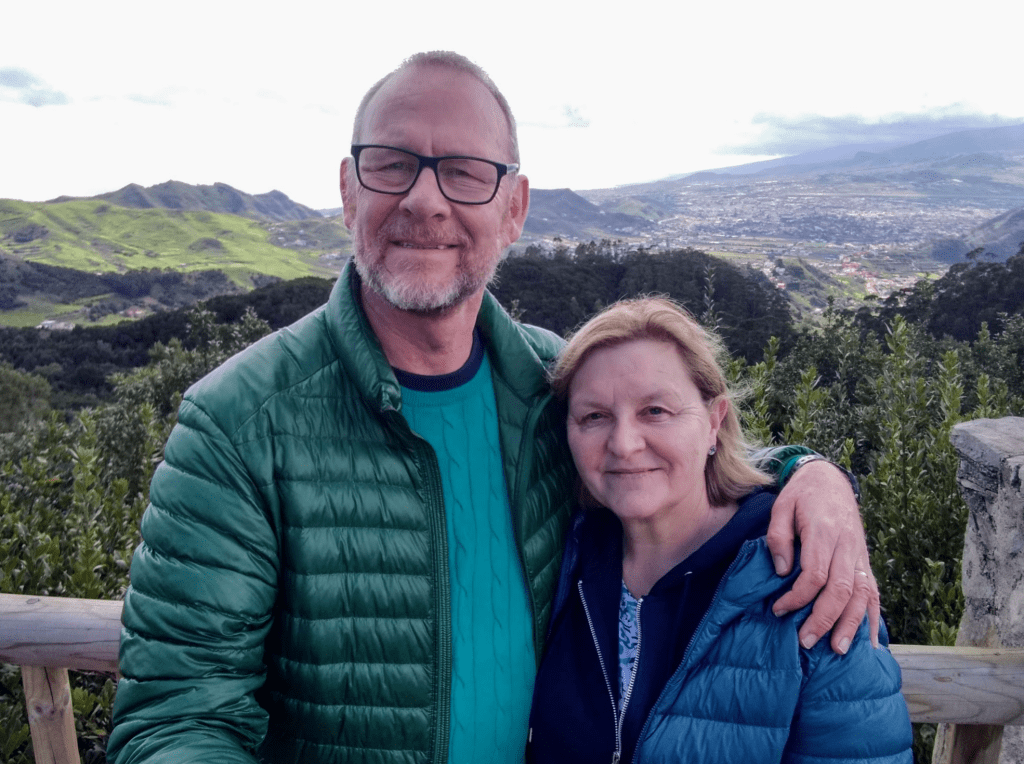
Zapata Mirador – me and Julie with La Laguna in the distance
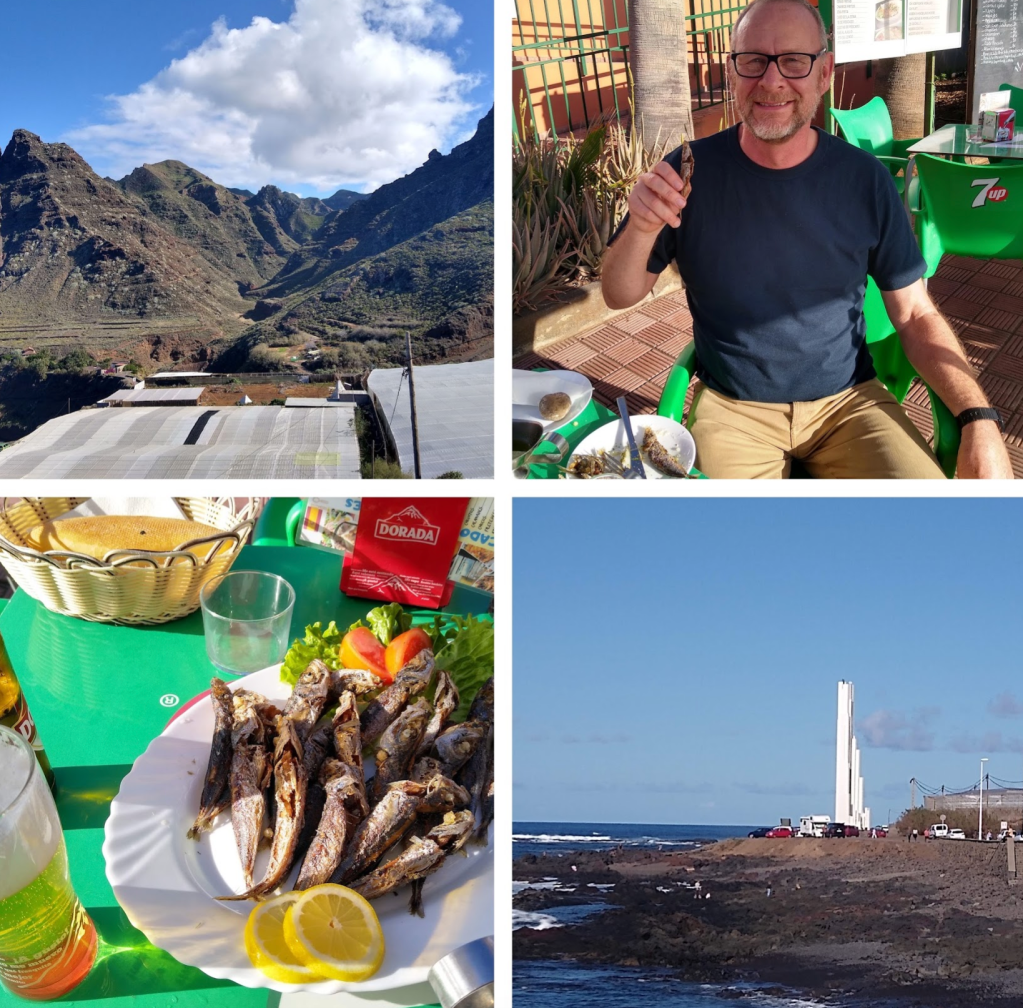
In the afternoon we drove down the mountain to Punta del Hidalgo on the north coast. It is best know for its modern lighthouse which is fifty metres tall and finished in 1992. The town itself is mostly holiday flats overlooking a rocky coast. There is a hiking trail from the coast all the way up to Cruz de Carmen.
There are a few restaurants on the sea front, and we parked ourselves in the sunshine for some beer (me) and Coke (Julie who was driving) and fresh sardines with wrinkly potatoes. Bliss.
Santa Cruz
There’s a line in “Withnail and I” from Richard E. Grant who pathetically exclaims, ‘We’ve gone on holiday by mistake”. I wanted to say that when we went to Santa Cruz, the capital of Tenerife instead of La Laguna.
It was a bit of an omnishambles day. The bus to La Laguna was late and full, so we stood all the way. The bus stopped at La Laguna tram station, but we didn’t realise where we were, so had an unplanned visit to Santa Cruz instead.
Brad Pitt’s helmet/concert hall
The capital has all the charm of Croydon on a wet Sunday. On the sea front is an enormous concert hall that looks like a Greek helmet, not a practical design I would imagine. I suspect the architect thought Brad Pitt looked rather cute in his helmet in “ Troy” and then fitted an auditorium into his concept.
Brad Pitt’s helmet (fnaar fnaar)
Next to the helmet concert hall is another set of lakes designed by Cesar Manrique, like the ones at Puerto. They would be lovely on a summers day, but it wasn’t sunny or warm when we were there. It was the only day I wore shorts, and it was bloody cloudy.
I was sulking a bit on that day, can you tell?
We wandered aimlessly until we found a pretty street (possibly the only one) with some restaurants in it. Bonvieda had lots of people and an interesting menu so we plonked ourselves down there and hoped for the best.
Iberian Secret and me waiting for dinner, being a bit sulky
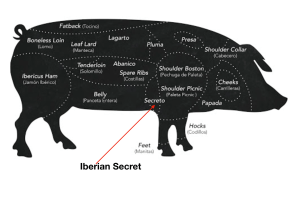
Maybe it just secretes in that region when it’s hot
An item on the menu stood out, Iberian Secret. Google gave a description as “armpit of a pig” which appealed to me. The delightful waiter recommended it, so I went for it. It was short strips of grilled pork on a bed of sauteed potatoes and apple, and it was unusual and quite tasty.
In a slight food coma after dinner, we went round the Museum of Nature and Man, which was all in Spanish and a bit underwhelming. It covers the natural history of the island and its archeology. The inhabitants of Tenerife before the Spanish arrived were the Guanches, who are thought to be related to Berbers. Inevitably the invaders killed them all, and the museum displays their pottery and mummified remains, which are quite gruesome. Not recommended after an Iberian Secret.
La Laguna
Having exhausted the limited delights of Santa Cruz we took the bus up the hill to La Laguna, the oldest town in Tenerife. It is set out on a grid of streets which they probably copied from Milton Keynes some time in the 16th century. There are lots of old buildings and bars, but on an overcast Sunday afternoon it wasn’t exactly hopping with Latin joy and exuberance.
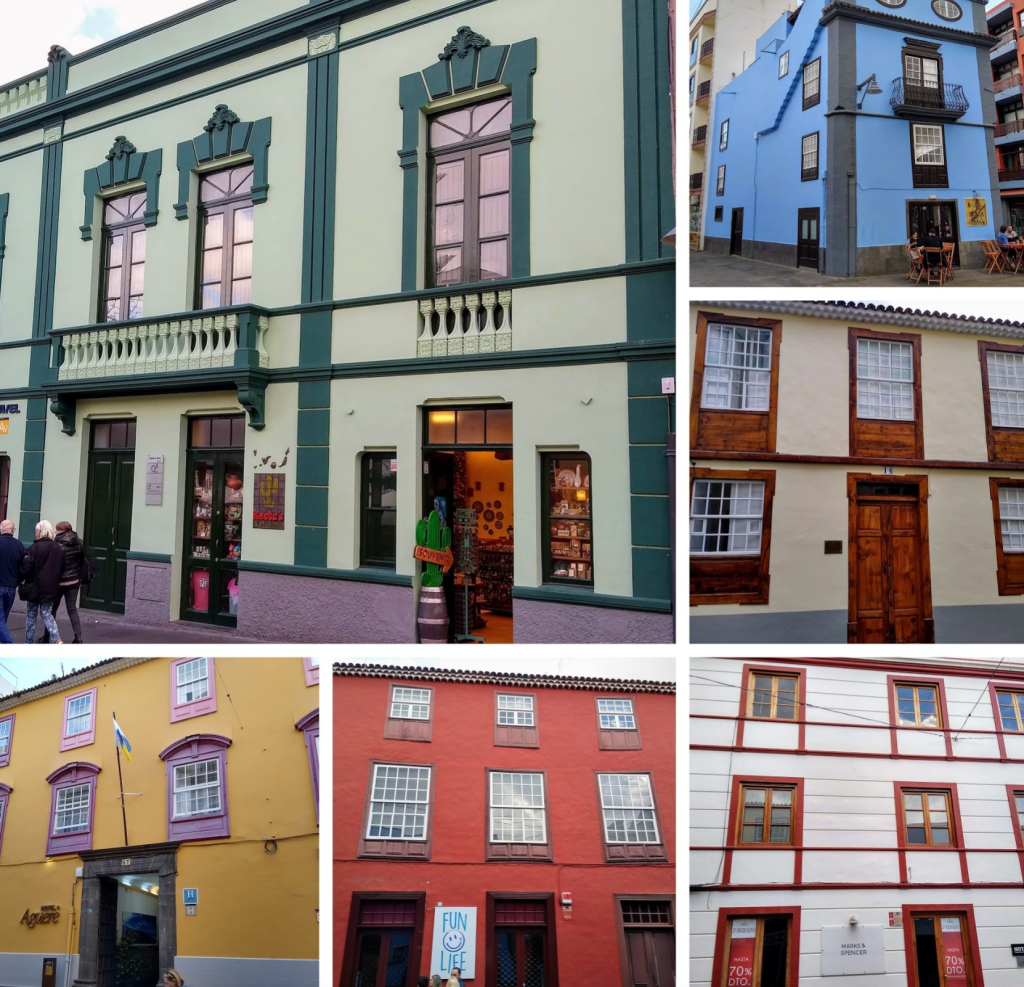
Multi-Coloured Cropped Shops in La Laguna
There are many colourful old buildings to enjoy, but I think our day had already peaked with Pigs Armpit.
Garachico
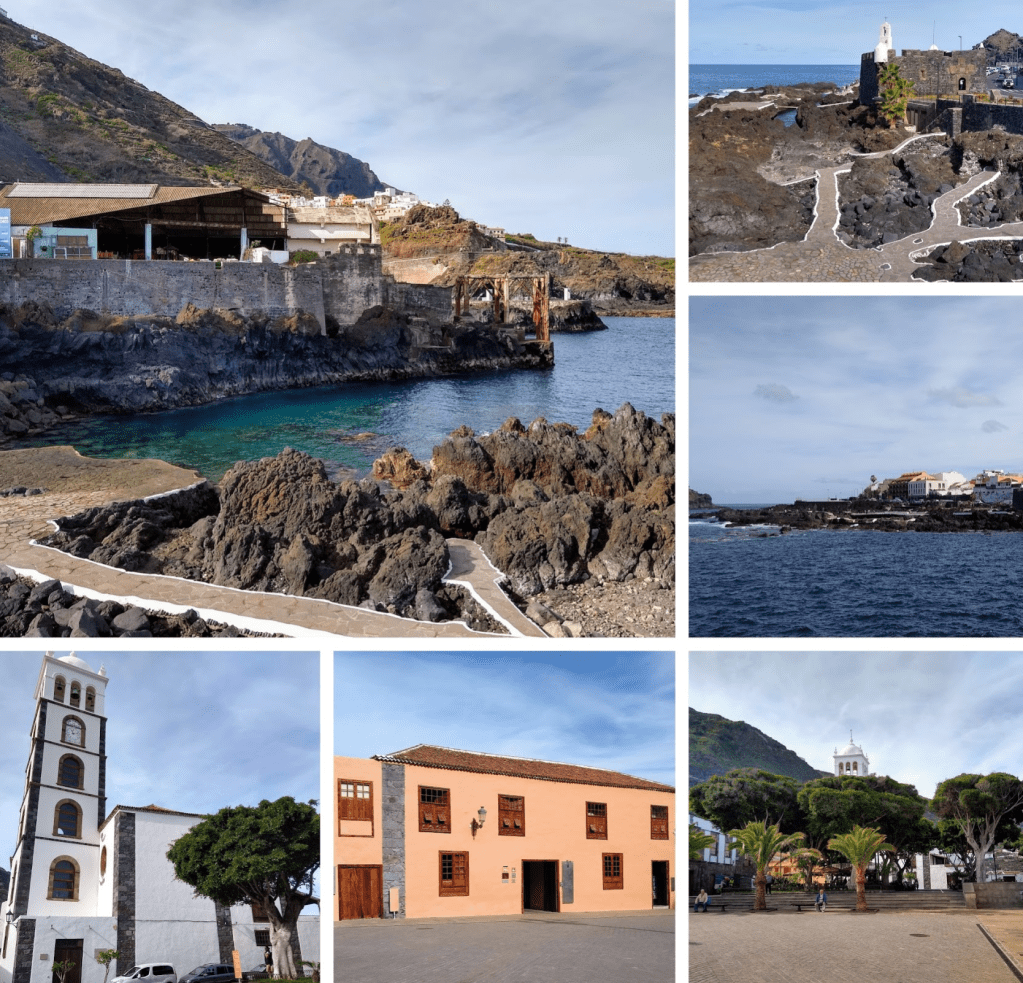
A thirty minute drive to the west of Puerto de la Cruz is Garachico. We got there early (10.20 am), before it started to fill up with coach tours and still retained its charm.
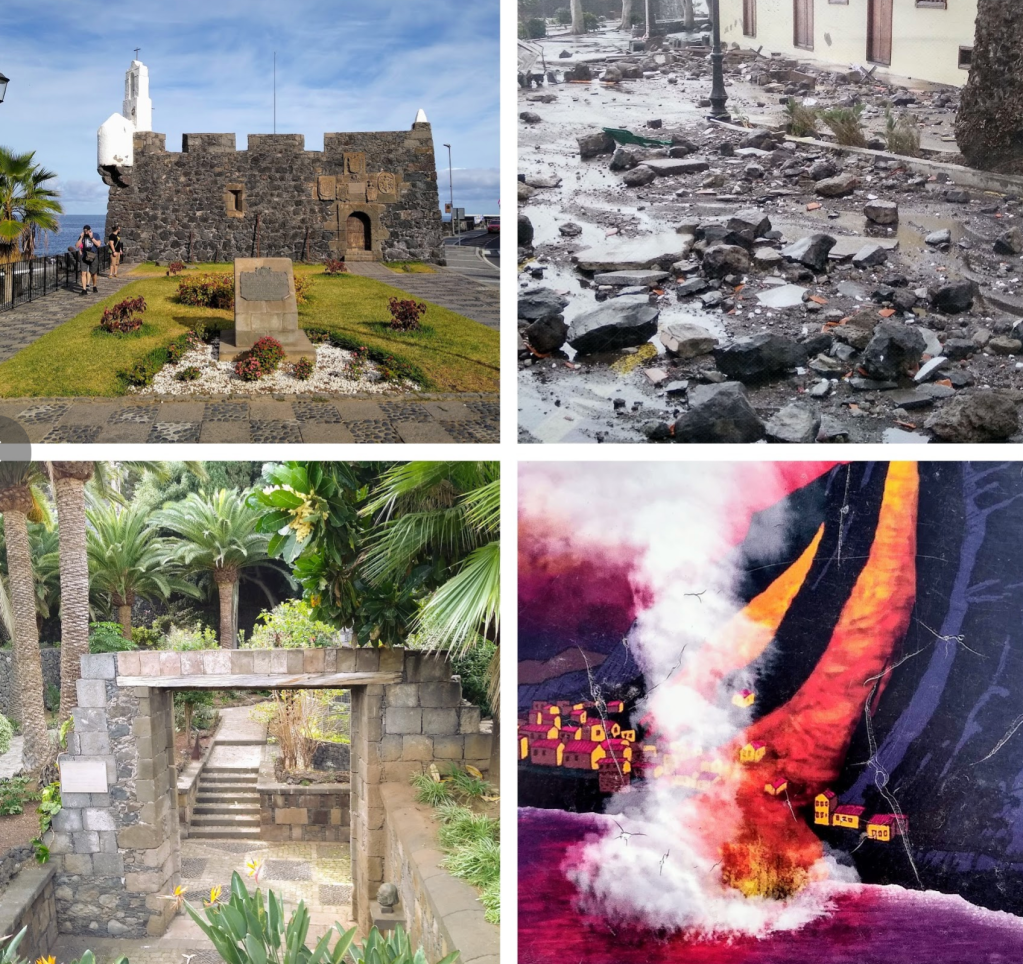
It is a very pretty small town on the coast which was once the most important port in Tenerife, shipping out sweet Malmsey wine to Europe and America. But on May 5th 1706 the Trevejo volcano erupted and poured lava into the harbour completely filling it and destroying its trade. Mostly the shipping moved to Puerto de la Cruz, and Garachico lost it’s leading role. The old gate to the port has been excavated and stands in a small but very pretty park. The old castle protecting the harbour was missed by the lava flow and still stands protecting the sunbathing area from pirate attacks.
Castle, storm damage in 2018, the old port gate and an illustration of the eruption
There is a lovely central square with a church and some grand buildings and cafes. The are some pretty narrow streets, and a seafront with seawater bathing and places to sun bathe. The town was bashed around a bit by storms a couple of years ago, but has recovered now.
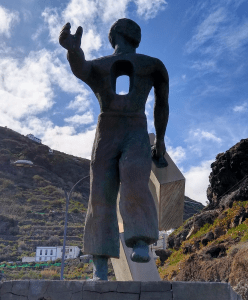
I left my heart, in Garachico
A few hundred metres up a hill to the west of the centre, is a look-out point with an unusual statue of a man carrying a suitcase and a hole in his chest. It is said to represent one of the many emigrant who left Garachico for Venezuala and left their hearts behind.
A Good Place for a Winter Holiday
We had a very good time in Tenerife for a week. Being ancient, we didn’t really sample the night life, but I’m sure there was plenty to do in Puerto at night. I took my Chromecast with me so settled on the sofa in the evening with Netflix, beer and snacks.
There are loads of things to do for a week in January. The weather isn’t really hot, but there were plenty of sunbathers on the beaches and even a few people swimming.
Best of all you can fly from Gatwick in the morning when it’s literally freezing, and be in warm sunshine just after lunch in Tenerife.











 timharnesstravels