Exploring Malta : A Tiny Island Rich in History – Part 3

Monday 22 September

So farewell Floriana.

We left our flat in Triq L Argotti and walked along linear park called The Mall to the City Gate, the very grand entrance to Valletta. Turning right past the Parliament Building we walked through Upper Barrakka Gardens to get the lift down to the waterfront.
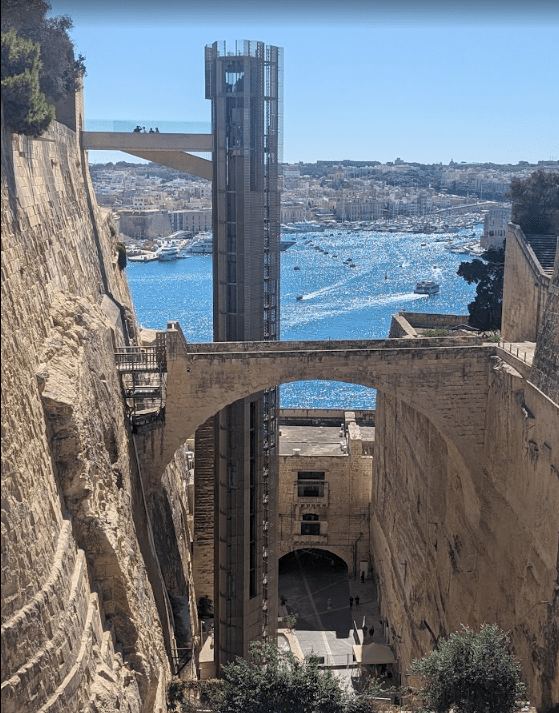
The Lift from Upper Barraka Gardens to the waterfront

At the Fast Ferry terminal we joined the queue for the ferry to Gozo, a big catamaran with room for hundreds of passengers.

It took 45 minutes of sailing along the east coast of Malta to reach the island of Gozo. From the harbour at Mgaar we took a 101 bus up to the small capital. In true Maltese style it has two names, the original name of Rabat and the Colonial name of Victoria.

Our flat has a great view of the Citadel a few hundred metres away, and is very conveniently almost next to Andy’s Supermarket, very handy for cold Cisk lager and other necessities.

It’s a steep climb to the Citadel which is on a crag overlooking the town. It has been fortified in one form or another since the Bronze age. The current Il Kastell dates from the 15th century, but with considerable improvement by the Knights. The population suffered from raids by Turkish corsairs for hundreds of years, and the population of Rabat went into the citadel every night.
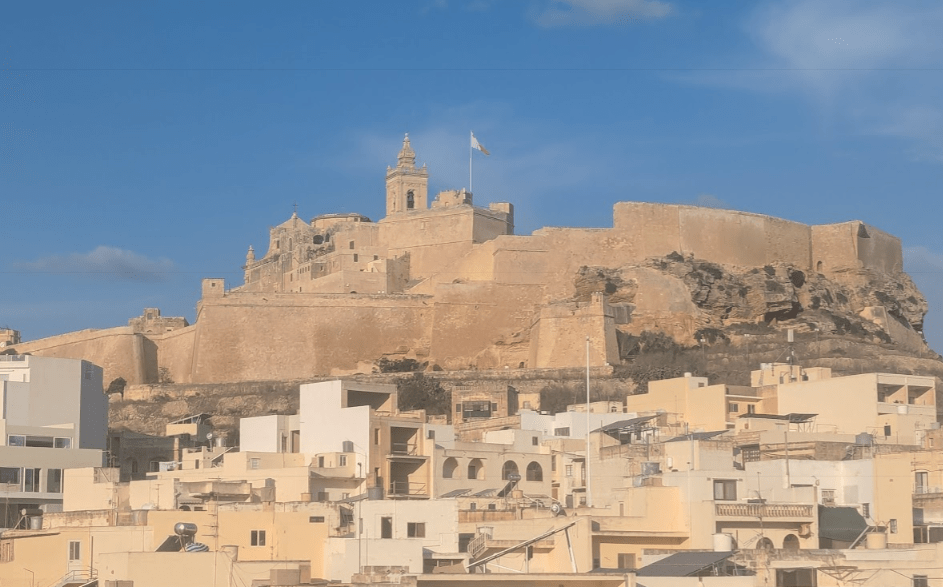
The Citadel of Rabat, as viewed from our terrace

Corsairs are maritime raiders who are licensed by a country, so Turkish corsairs attacked Christian settlements all around the Mediterranean on behalf of the Sultan. The corsair Dragut became Governor of Tripoli and was killed at the Great Siege of Malta. The Knights were Christian corsairs, and attacked Turkish shipping and took slaves. France Drake was an English corsair working for QE1, and making a few quid for himself.  Pirates like Blackbeard only worked for themselves, and attacked all shipping.

The Citadel is big and impressive, and offers great views over the Gozo countryside. The cathedral looks a bit strange because the dome was never completed. The Maltese love a big church, honestly I have never seen so many huge Houses of God, He must be very pleased with his devout followers.

At the foot of the citadel walls is the oldest part of Rabat, with narrow quiet streets of pretty houses that look similar to those in Mdina and the other Rabat in Malta. The more modern parts of the town are made up of blocky flat roofed houses with quite rough roads and minimal footpaths, not very attractive. Our flat was on the fourth floor of a modern block, and the road to it had terrible footpaths, it was unpleasant to reach it by foot. The locals drive at about 40 mph around town, basically as fast as they can, and the traffic can be very busy.

Julie had a slightly upset tummy and didn’t want to eat, so I had a can of baked beans for dinner. Yummy.

Tuesday 23 September

We did our research in the guidebook and online and decided to try Ramla beach, allegedly the best beach on Gozo. The 102 bus took us through the outskirts of Rabat/Victoria , through Xewkija (no, I don’t know how to pronounce it) to a stop a few hundred yards from the beach. Maltese bus drivers seem to drive as fast as they can, so it can be quite exciting at times. 

Ramla beach did not disappoint us, it is a wide stretch of soft orangy sand like you get in Devon. There are three cafes and some clean toilets, but the cafes don’t open until 11 and we arrived at about 9.20. 
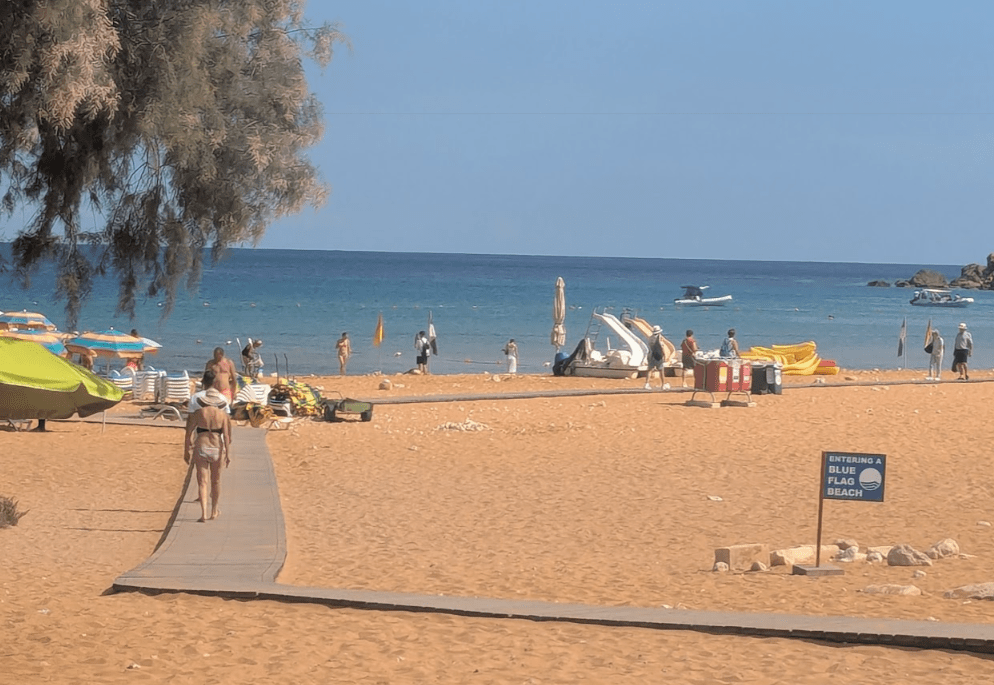
Ramla Beach

We got an umbrella and two recliners for 21 euros, worth the investment because it was Scorchio! The bed man carried them to the waters edge and we settled in for the day. It was gorgeous, a fantastic view of a calm blue sea and lovely warm water. I went snorkeling a couple of times and saw lots of small fish a few centimetres long, but nothing interesting.
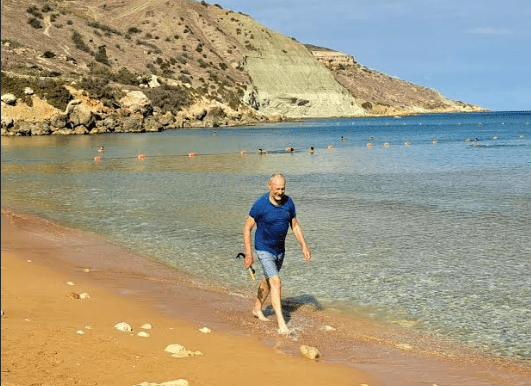
Daniel Craig at Ramla Beach. Maybe.

It was great just reading our Kindles and phones, and passing comments on people who went past on the waters edge. Tattoos and unsuitable swimwear are always great topics for comments such as “ I would be very disappointed if one of my children came home with one of those on his/her leg” and “look at that costume, I have seen thicker dental floss”.

Just after 11 we got breakfast at Rosa’s cafe, we both had egg, bacon and fried onion Ftira. It’s basically a big bap which was enough for breakfast and lunch.
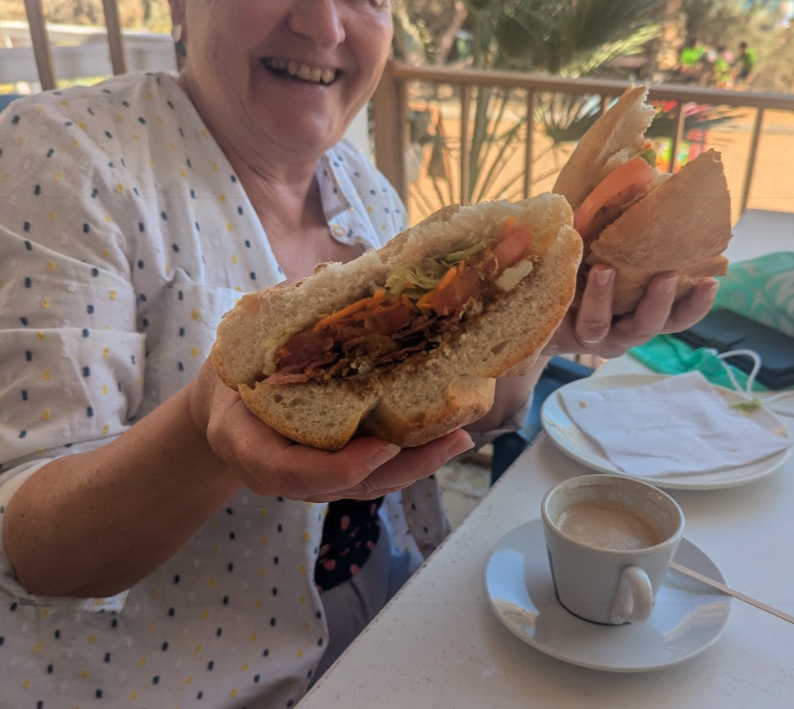
Julie and the Giant Sandwich

I would give Ramla beach top marks for quality and convenience. The returning bus to Victoria Bus Station felt like it was being driven by Lewis Hamilton, and took 17 minutes to get back.

After scoffing a delicious ice cream at Vanilla +, we discovered a shopping centre with a huge Greens Supermarket in the basement, the best shop I have come across in Malta.

The citadel is a delightful place to be at sunset when the sky is pink and you can see the sea at different sides of Gozo. 

The Citadel by night

The Pjazza San Gorg in the old town is a a good place to go for dinner. There are several restaurants around the square in front of the Basilica San Gorg. Unfortunately it was bell ringing practice that night. The bells are great for the first 15 minutes, but after 50 minutes it was getting very irritating. There are two bell towers at the front of the cathedral with two guys swinging the “clangers”, but they weren’t swinging them in time, it just sounded like random bongs that went on and on and on. 

Two bell towers and two out of time bells

Wednesday 24 September

Well it’s been an interesting day.

After consulting the guide book we decided to visit Marsalforn, which is a short bus ride away on the east coast. We caught the 310 bus in Capuchin Street and the bus tore along the rural road, slowing slightly in a village on the way.

Marsalforn is a resort town around a bay. There is a small sandy beach, lots of cafes and restaurants, and many many ugly blocks of holiday flats. It was very quiet, with and had an end of season vibe. However we found a nice spot on the beach and I went for a swim. The water was warm and there were lots of tiny fish, nice. A small group of ladies with hats on bobbed around in the sea together chatting for at least an hour. The water is very bouyant, so it takes no effort to just float.

But about three hours of Marsalforn was enough, so we went back to Victoria on the 310.

In the afternoon I went back to the Citadel and visited the Visitors Centre, the Old Prison, the Natural History Museum and The Historic House. You can get round all of them in about 90 minutes, and they are about as good as a small town museum in England, I would give them an E for Effort. The Historic House was the most interesting. It is a combination of five old dwellings with old furniture in it, like a low-rent National Trust house.
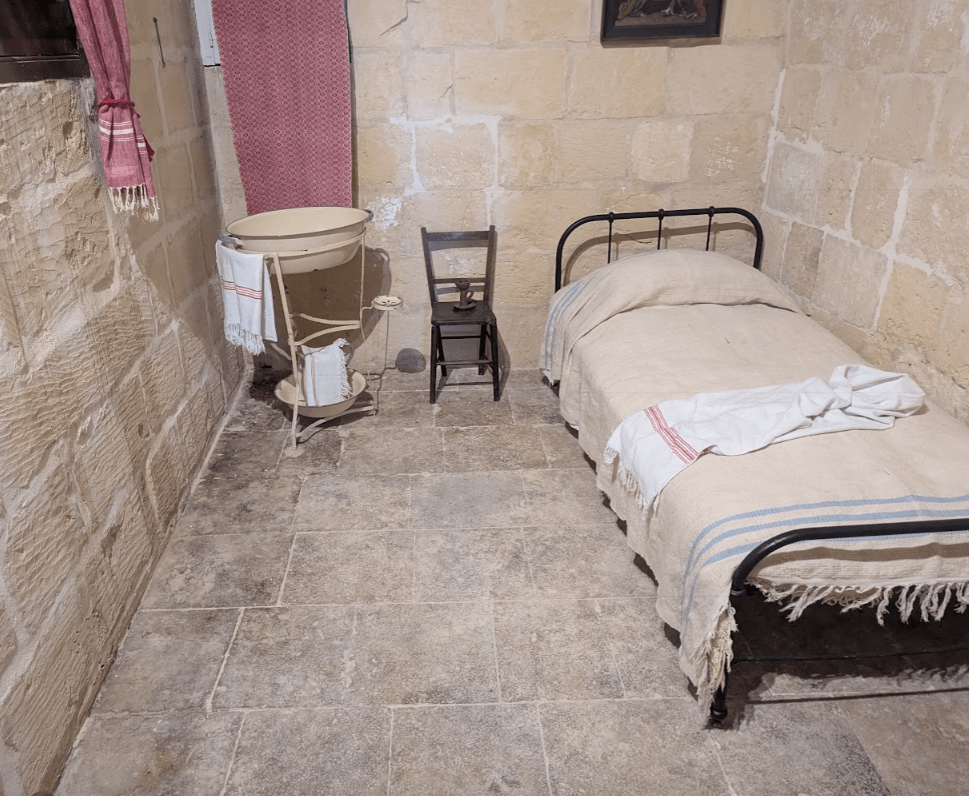
A “typical bedroom”, looks a bit shit to me

In the evening there was a thunderstorm, which was fun to watch on our terrace, until it started raining really really hard. The terrace flooded and then started coming in under the sliding windows. The lounge started filling up, so we got out the mop and bucket and towels to collect water off the floor. While Julie was mopping, I went out on the terrace and stamped on the drain until water started going down it. I think it was bunged up. After mopping 4 buckets (about 20 litres) of water off the floor of the lounge, the rain eased off.
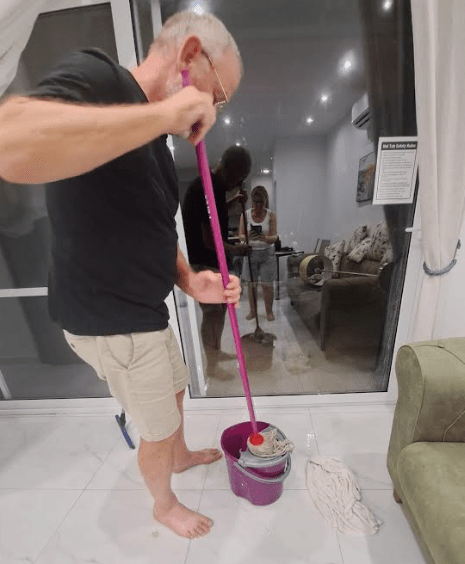
Mopping the lounge during the storm

That’s never happened in and AirBnB before, normally they don’t leak in a big way.

Friday 25 September

A taxi picked us up from our flat, because we didn’t want to drag our bags up hill to the bus station. We took 09.45 fast ferry to Valletta and a 13 bus to Sliema. I have grown fond of the Maltese bus system, its efficient and 2.5 euros for every trip.

The Sliema Marina Hotel overlooking Marsamxett harbour is not luxuious, but it is convenient, on the waterfront close to the ferries.

Once we got settled in we walked across the peninsula to the massive Fort Cambridge development towards St Julian Bay. In places Sliema looks like Dubai, with massive blocks of modern flats overlooking the sea, and some of them cost over £2,000,000.

Fort Cambridge shopping centre

The seafront around St Julians Bay is very attractive, with lots of restaurants and bars facing the sea. There are also lots of bathing “beaches”, except there is no sand. You can sunbath on bare limestone ledges, and the walk (carefully) into the sea. I took a dip at Fond Ghadir, the sea was warm and slightly rough, but very pleasant to swim in. There were a few small fish, but nothing interesting.
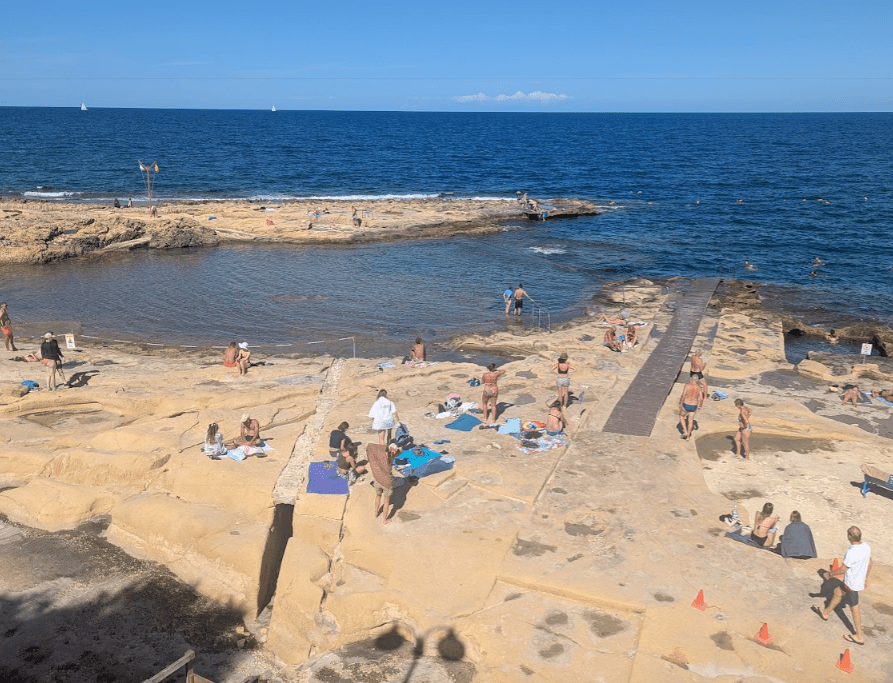
Fond Ghadir “beach” there ain’t no sand

At the corner of Baluta Bay I took 10 seconds to look at a menu outside of a bar and a nice young man asked if I wanted a cocktail. 

No you dirty minded bastard, not in that way!

We were both easily persuaded and went into Piccolo Padre for 2 for 1 cocktails, and selected Margaritas. The food menu looked persuasively good, so I had Seafood Risotto and Julie had Frito Misto. There was enough food to feed 4 hungry pescatarians, and we needed more cocktails to wash it all down.
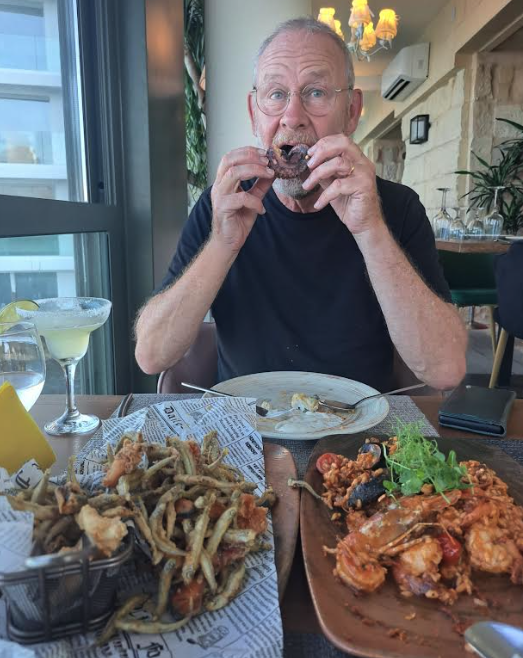
Fishy Feast

We left there intending to continue our tour of St Julians on a sunny afternoon.
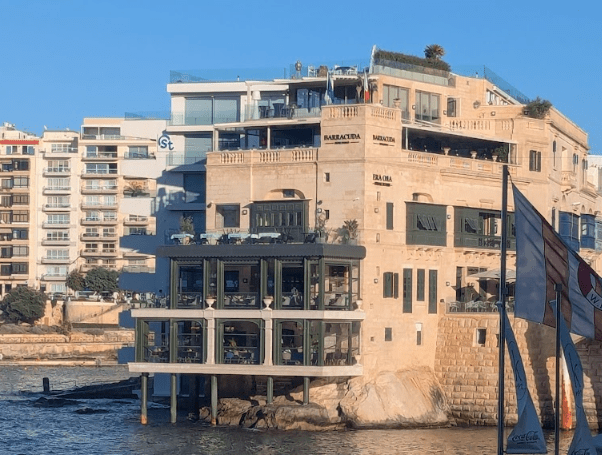
Piccolo Padre on the lowest floor

After several minutes hard walking we came across another bar overlooking the bay with a 2 for 1 offer. It was hot, we were thirsty, and at £4 a cocktail it was daft not t0. So we had a Mojito followed by a Long Island Ice Tea.

In a party mood by then, we walked onto Paceville, the throbbing heart of youth culture in the area. After about 5 minutes we decided we were at least 40 years too old and got the bus back to hotel. 

Reasons to Visit Malta

It is easy to fly to

Its very hot and the sea water is warm

Everyone speaks English

The food is mostly Italian, but kebabs are widely available

The people are friendly

Its small but there is a lot of things to see and do

The buses are great

The cocktails are cheap

The history is incredible

Valletta is a wonderful interesting lively city

There are a few great beaches

You might see Robbie Williams for nothing
Sicily 2024 – Catania’s Markets

Friday 24 May

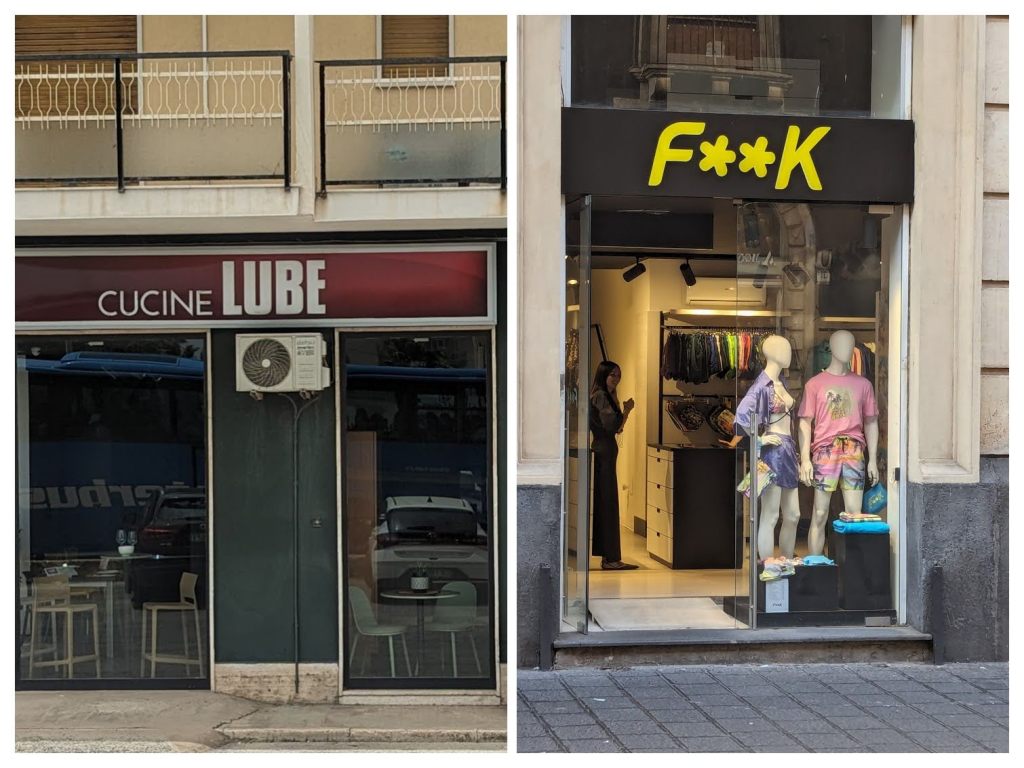
The weather has been consistently wonderful in Sicily, apart from the thunderstorm on the first day. So it has been very conducive to sitting in cafes, one of the many pleasures in going to Italy. Our first cafe was in Via Vitoria Emanuel, a very busy street where our flat is situated. It is in a big baroque mansion block, which has huge gates on the street and multiple gates to reach our staircase. The street is quite scruffy now and disfigured with graffiti, but would have been beautiful in its 18th century heyday.

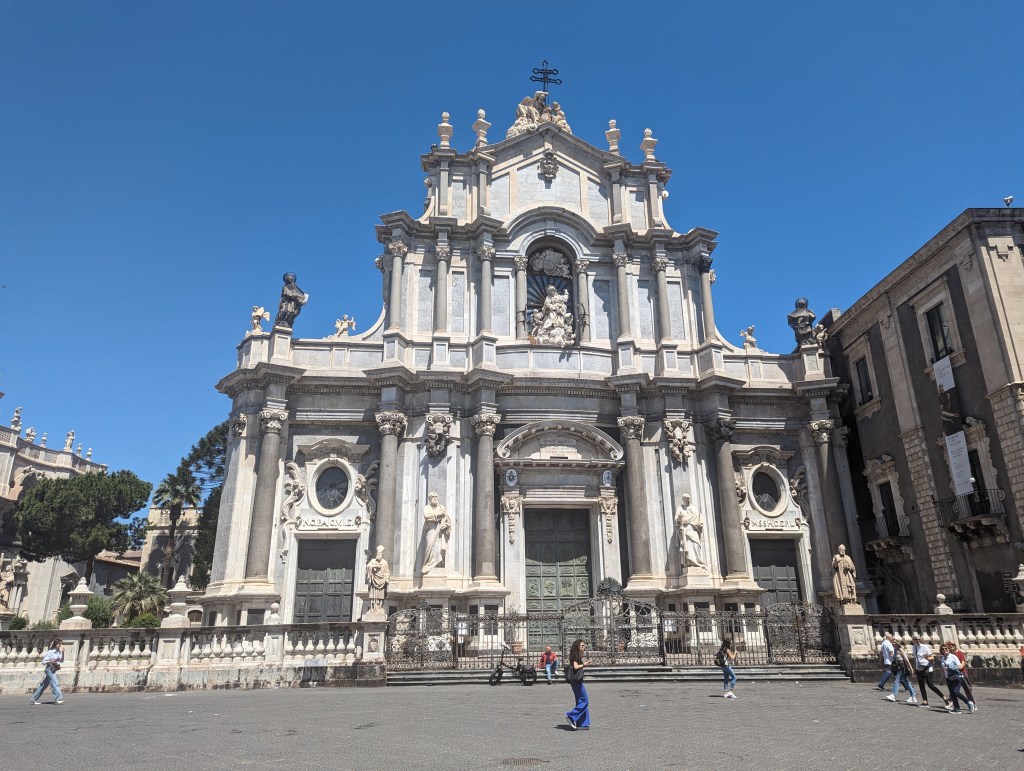
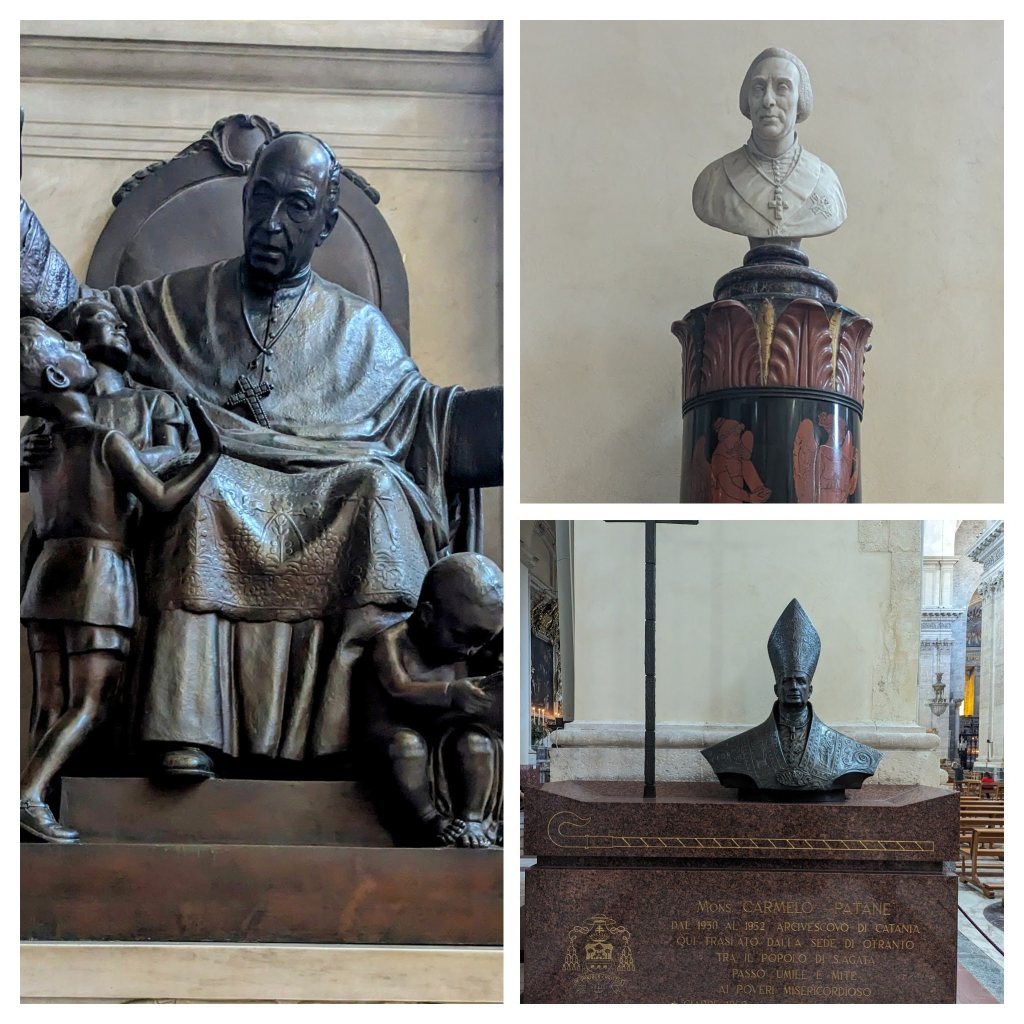
We had a cappucino and walked the short distance down to Saint Agatha’s cathedral in the plaza. It is attractive without being impressive, as cathedrals go. There were flashy memorials to various dead bishops, who I’m sure were all very humble, modest men.

Humble Bishops in the Duomo

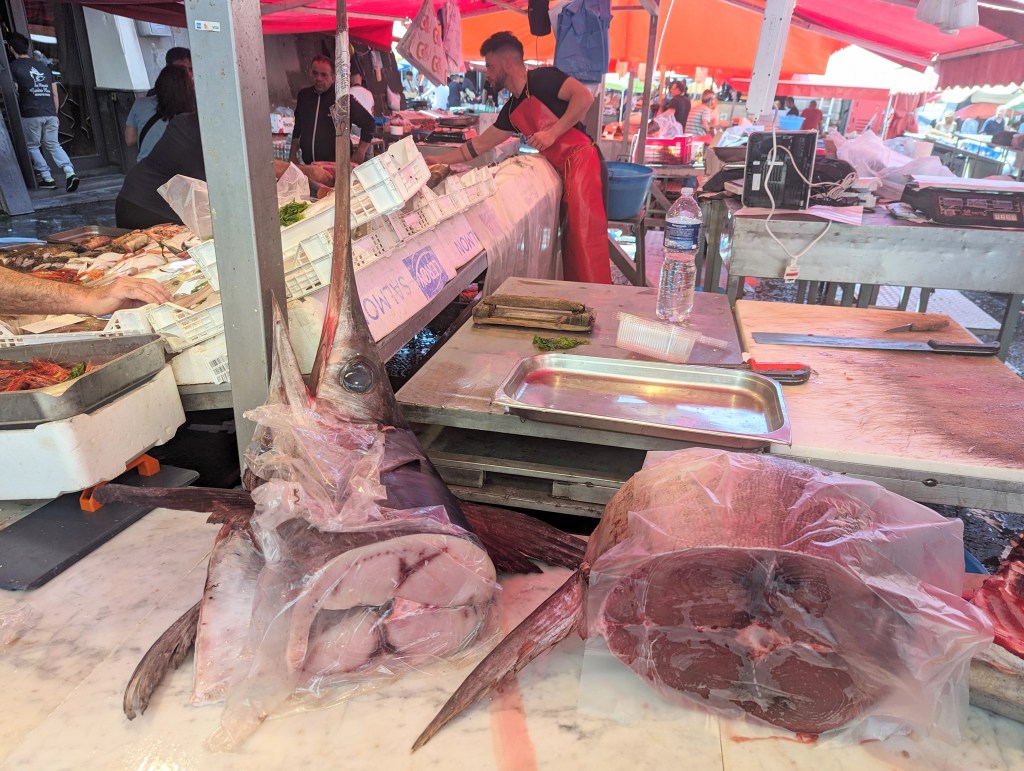
Just round the corner from the duomo is the fish market, which is quite an assault on the senses. There are dozens of stalls selling every type of Mediterranian fish, from tiny clams the size of a finger nail, to huge tuna and swordfish as thick as tree trunks. I have never seen such big fish being hacked to pieces by fishmongers with huge clevers. I wouldn’t get into a fight with one of those guys. There were plenty of stalls selling fresh oysters, and rows of restaurants selling seafood dinners. There appeared to be many more tourists (like me) taking photos than customers buying slabs of dark red tuna or swordfish for 10 Euros a kilo. The octopuses, squid and cuttlefish looked like deflated grey ballons on their marble slabs, when in life they are fantastic dynamic creatures of intelligence that can change their colour to blend in with their environment to hide from predators.

Mmm Swordfish

It was a short walk to Via Etnea, the main shopping street that runs from the cathedral towards Etna. After exhausting fish watching, we revived ourselves in a big cafe and drank Americano’s and watched people, always a good sport.

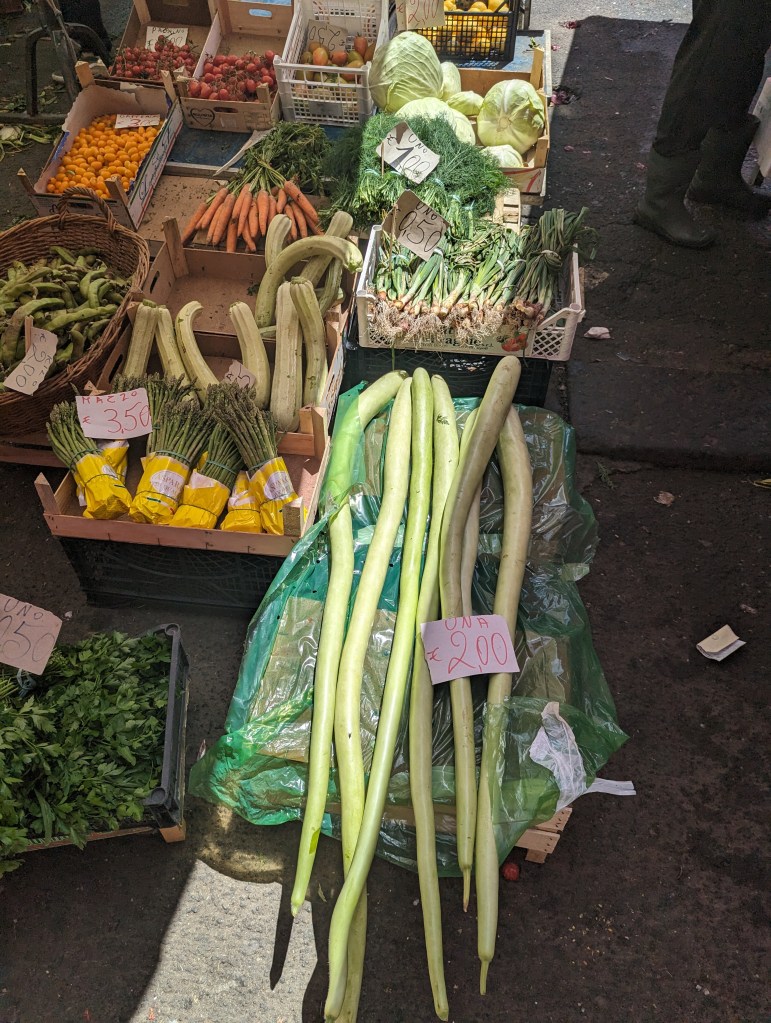
The fish market is compact and mostly fish, but close to the Piazza Stezicoro (where we met Ernesto yesterday) is the city’s main street market. It is the real living heart of the city, selling fruit, vegetables, meat, clothes, hardware and souvenirs. It is alive with the cries of competing stall holders trying to sell huge aubergines and radishes (I think) that are a metre long. As we shuffled our way through, we occasionally had to stand aside while a scooter came through loaded with ice for a stall. The fruit and vegetables were cheap and looked great, I think Rick Stein would be getting very excited if he was here.

Extremely long vegetables

At the end of the market was a street cafe called La Salumania, where we stopped for a panini and beer. It was possibly the best panini I have ever eaten, with crusty bread and a filling of bacon, salami and salad.

The world’s best paninis are served here

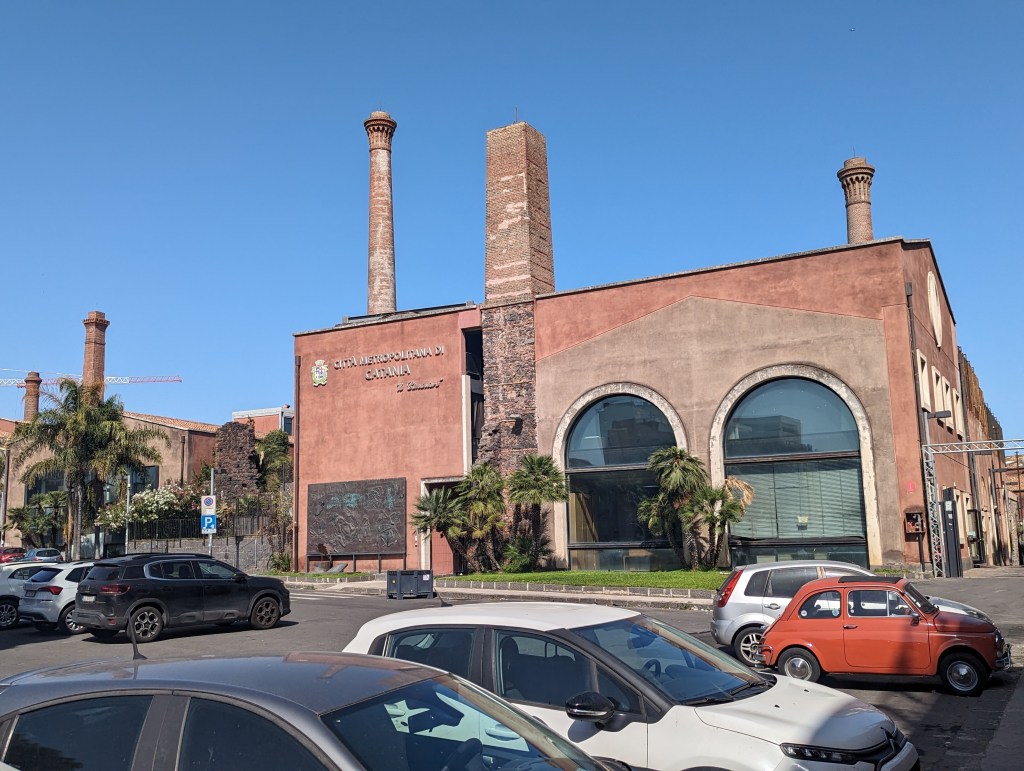
After lunch we ambled back to the flat for a little R&R. But what to do next? We had seen most of what was recommended in the Rough Guide and on Tripadvisor. A place we had seen was La Ciminiere, which was an old sulphur refining factory converted into a conference and cultural centre. It was about 15 minutes away on the coast near the bus station. It appeared to have had lots of money spent on it 30 years ago and is now rusting and looks dreadful, don’t go there. There just isn’t enough money in Catania to keep the city looking smart.

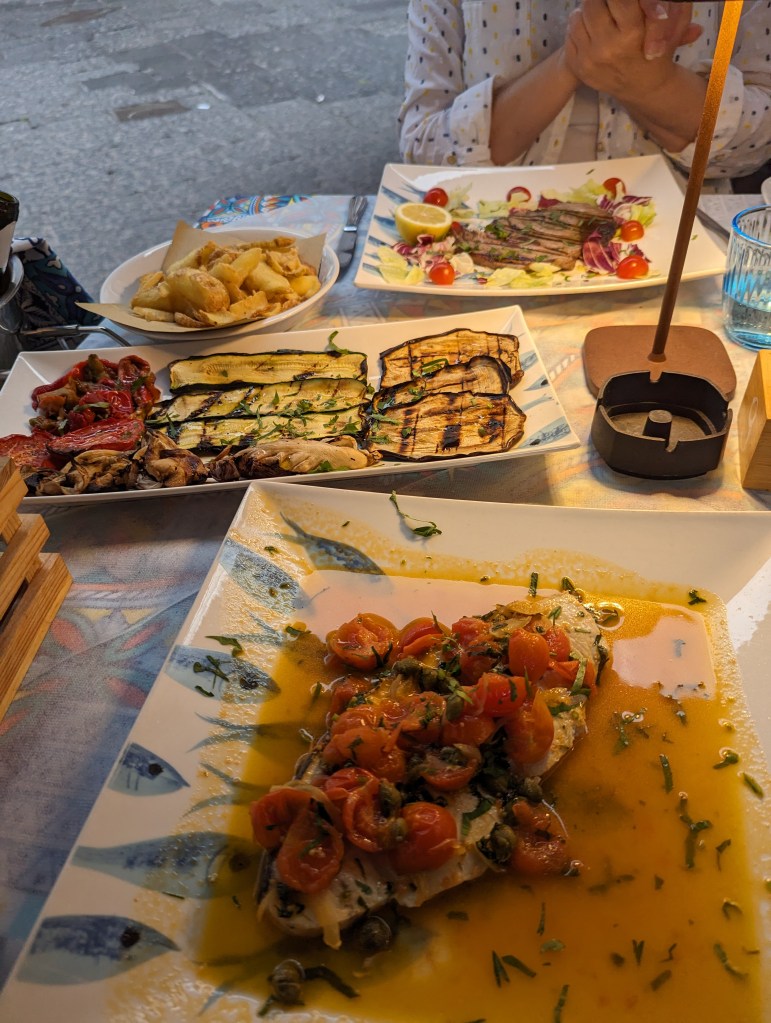
In the evening we went to Ciaru i Mari in Via San D’Orsolo, a seafood restaurant about 5 minutes walk from the flat. It was our second visit because it is such a good place. The staff speak excellent English and are very charming and helpful. I had swordfish (spada) and Julie had tuna (tonno), the best meal we have eaten in Sicily. Their chips were just awesome, and I am a very good judge of chips. The house wine was a Sicilian chardonnay for 15 Euros a bottle, bloody lovely. So I am now a very happy, and slightly drunk, boy.

Top Notch Fish and Chips

And finally, I saw this specialist butcher near the port. Anyone hungry?

Direct fron Blackpool…

Sicily 2024 – Mount Etna

Thursday 23 May

Expedition day today, the great ascent of the south face of Mount Etna. Most of the ascent was by mini-bus, and we didn’t get to the top, but it was further up than anyone else I know. Also we didn’t have Sherpas to carry our bags and I had to film everything myself on my phone.
We met our guide Ernesto by the Roman Amphitheatre that we sussed out yesterday. Five others joined us, a family from Toronto and a charming lady from Cape Town. It took a very pleasant hour of driving upward through pretty towns with narrow winding streets. Like all Sicilians, Ernesto drove like Mad Max trying to escape wild men in armoured quad bikes, very fast and with great confidence.

On the road to Etna

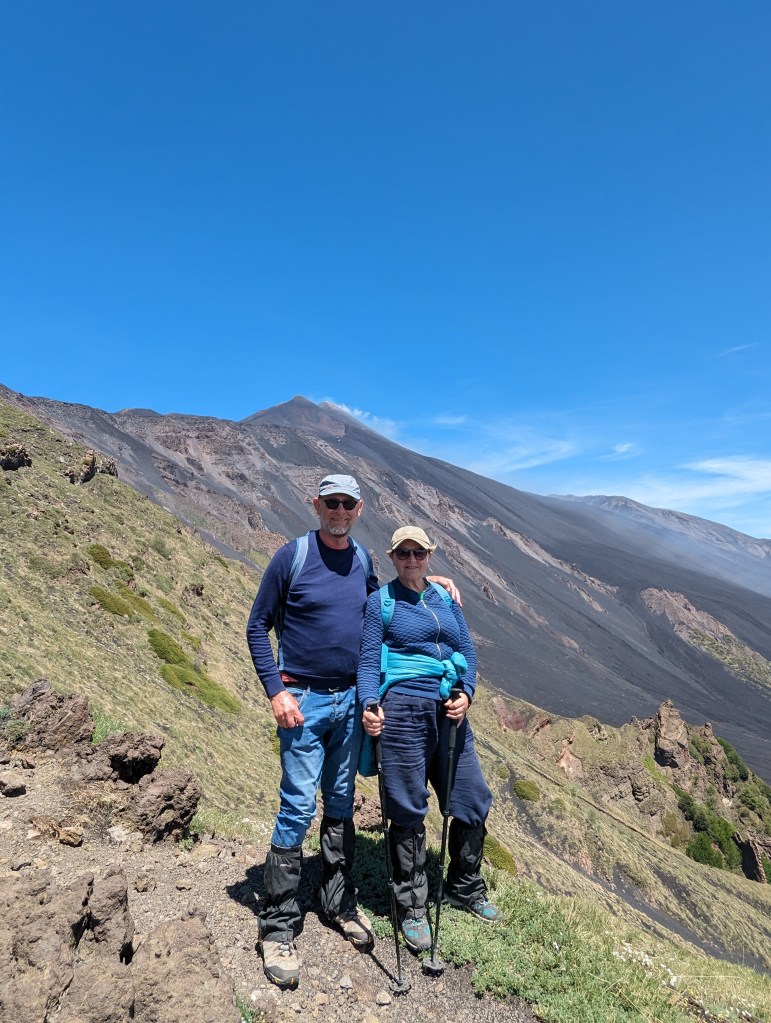
After an hour of zig zagging we reached base camp, Refugio Giovanni Sapienza. Ernesto takes his work as a mountain guide very seriously, and provided us with walking sticks (hiking variety, not broken leg variety) and gaiters. I have never worn gaiters before, but they are tight cuffs you wear round your calves to stop grit getting in your boots.

Then we walked up narrow tracks following Ernesto. The path was steep, narrow, and not solid underfoot. The surface was black volcanic cinders, surounded by cushions of attractive but spikey vegetation, definitly not for sitting on.

Ernesto leading the way

We plodded up and up and up until we got to the top of a ridge. We were treated to a fantastic view of the smoking summit of Etna, streaked with sulphure and a few patches of snow. Beneath us was the Val de Bove, an enormous expanse of black volcanic cinders hundred of metres long and wide covering a huge area of the slope of the volcano.

Val de Bove, its very black

At the top I found we had walked about a mile from the minibus. But it was all up hill, without Sherpas or complicated ladders n’shit.

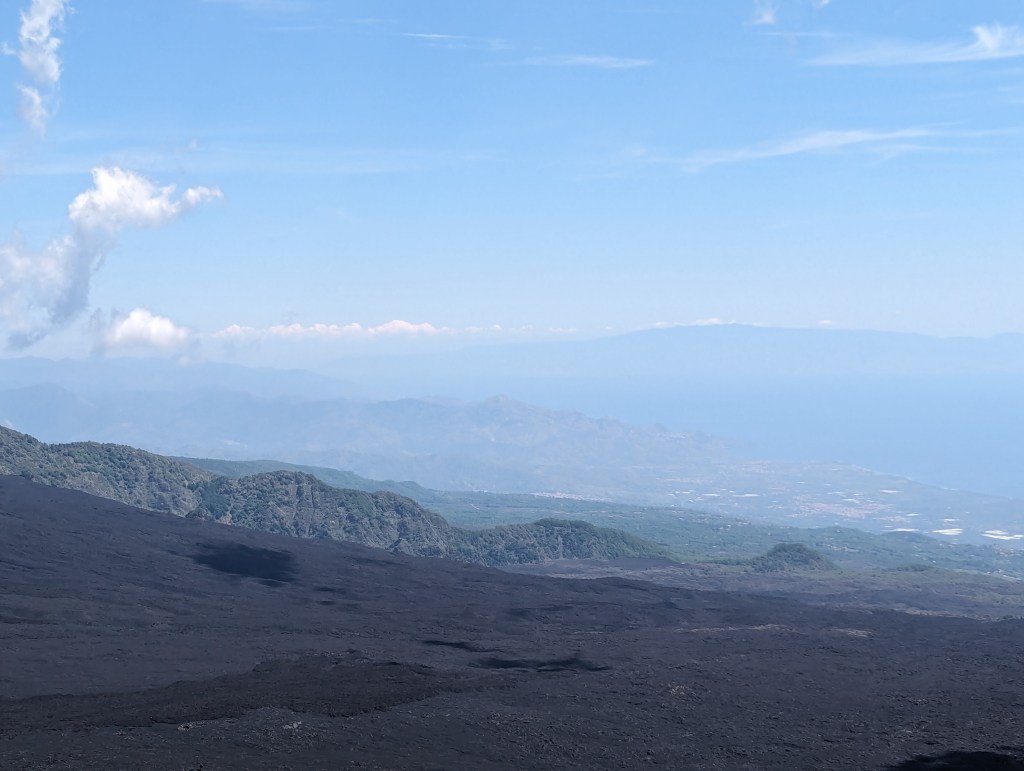
The descent was less arduous, and we looked over Catania far below all the time. The last big eruption was in 2001, and the lava flows destroyed the road where our van is parked. At one stage we trudged through thick soft black sand, like a Gothic Evil sand dune.

This year I will mostly be wearing Gaiters!

At the end I treated us both to a Magnum icecream, sadly they didn’t have the ones with nuts on the outside.

It was a slightly challenging hike because it was narrow and steep on the way up, but worth it for the fantastic views. It cost 62 Euros each, and I think it was worth it.

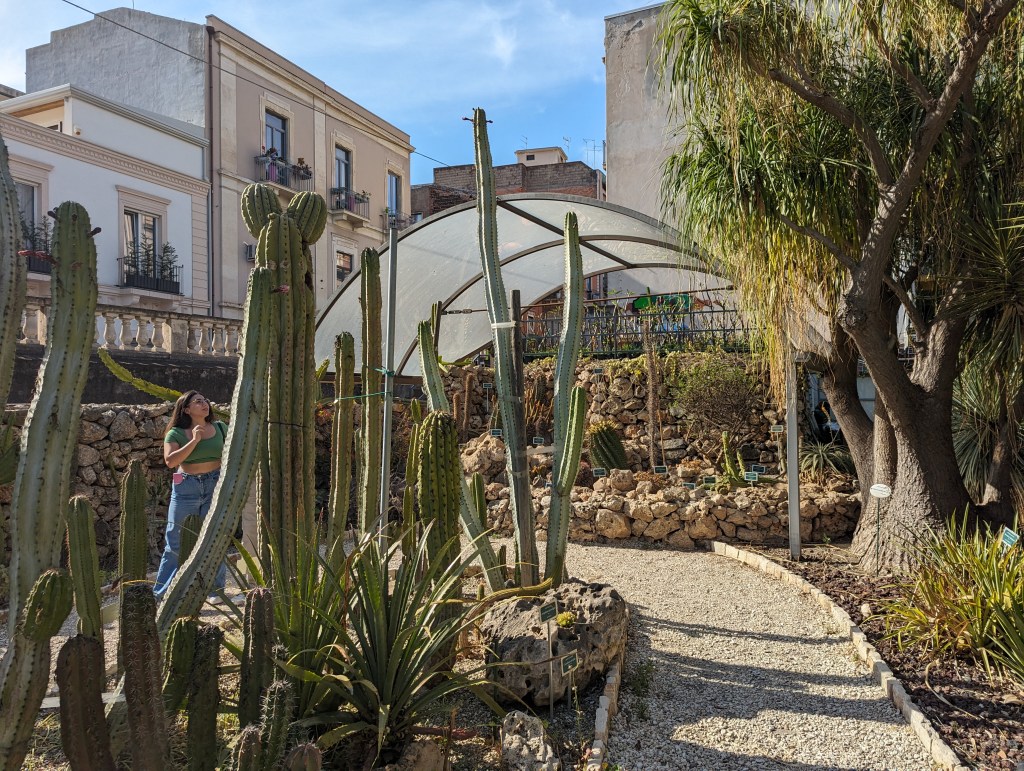
Back in Catania we went to the Villa Bellini gardens which are very pretty with a great view of the volcano. Just up the road (Etna) we visited the Ortico Botanico, which looked unloved in the same way that the castle in Ortigia is. I think Sicily just doesn’t have much money for public spaces, it’s one of the poorest parts of Italy.

Spikey stuff in the Ortico Botanico

And finally, some photos to prove that two and a half thousand years of civilisation doesn’t always work in Sicily.

Sicily 2024 – Catania

Wednesday 22 May

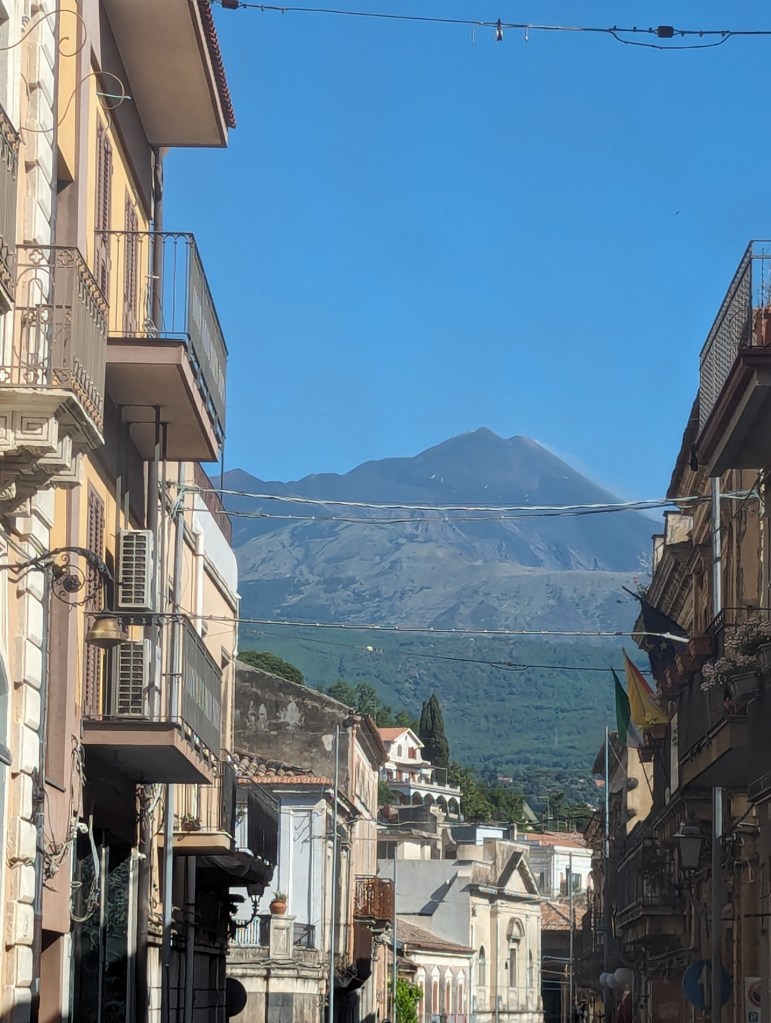
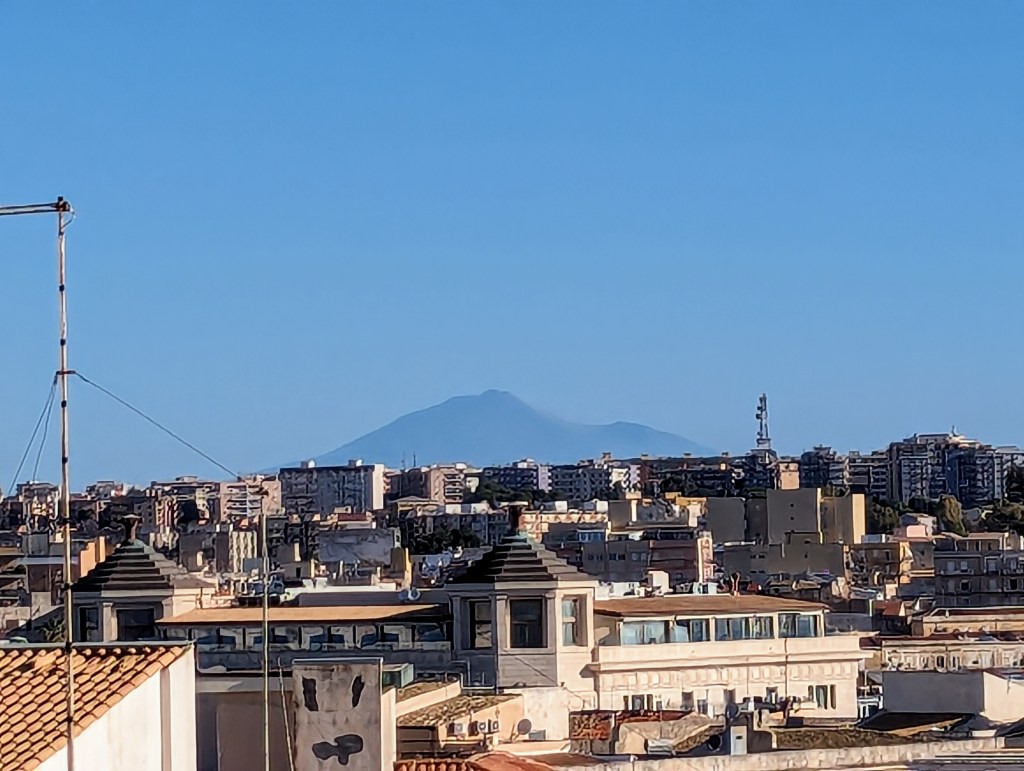
Ortigia was very lovely and I would highly recommend it for a short break. All the attractions can be reached by foot. In fact we walked about 10 miles yesterday, but wine aided our recovery and Nero D’Avolo in particular. This morning the air was very clear and we got our first view of Etna from the balcony, which was quite exciting for someone from Lincolnshire where the highest point is about 460 feet.

Etna from our flat in Ortigia

But Tempus does indeed Fugit, and we caught the train to Catania this morning. The 10.25 to Rome trundled along the coast taking about an hour to reach Sicily’s second biggest city. The route took us past oil refineries, a huge port (at Augusta) and Catania airport. I don’t think Michael Portillo will be making a film about it.

We tugged our suitcases for about 10 minutes to reach the next Airbnb, which was on the second floor of a fairly grand 19th century building. it’s quite possibly the best one we have stayed in, and we have stayed in over 50 since 2015. The furnishing is top notch, and the owner left us a selection of cakes in cellophane packets, luxury!
Catania is at the foot of Etna, and has suffered from eruptions and earthquakes over thousands of years. The city centre has been rebuilt in Baroque style, like Noto, but in black volcanic stone rather than yellow limestone. It gives the city a more dowdy feel, and looks like London 50 years ago when it was all black from the coal smoke.

It was lunch time by the time we left the flat, so we stopped at the nearest street cafe that our host had recommended. If they gave awards for the weight of food in a set lunch, this cafe would have won it. The first course was a huge slab of lasagna-ish. It was green and cheesy and enough to feed Tyson Fury on the night before he lost his fight. After battling through that, we got 2 huge meat balls with salad. They could have been beef, or donkey, horse or even camel for all I know. I ate both of mine, Julie could only manage one. Dessert was a tiny sort-of creme caramel in a short glass. After all of that I felt like Mr Creosote ready to explode!

Mystery meat balls and a massive slab of lasagna-ish

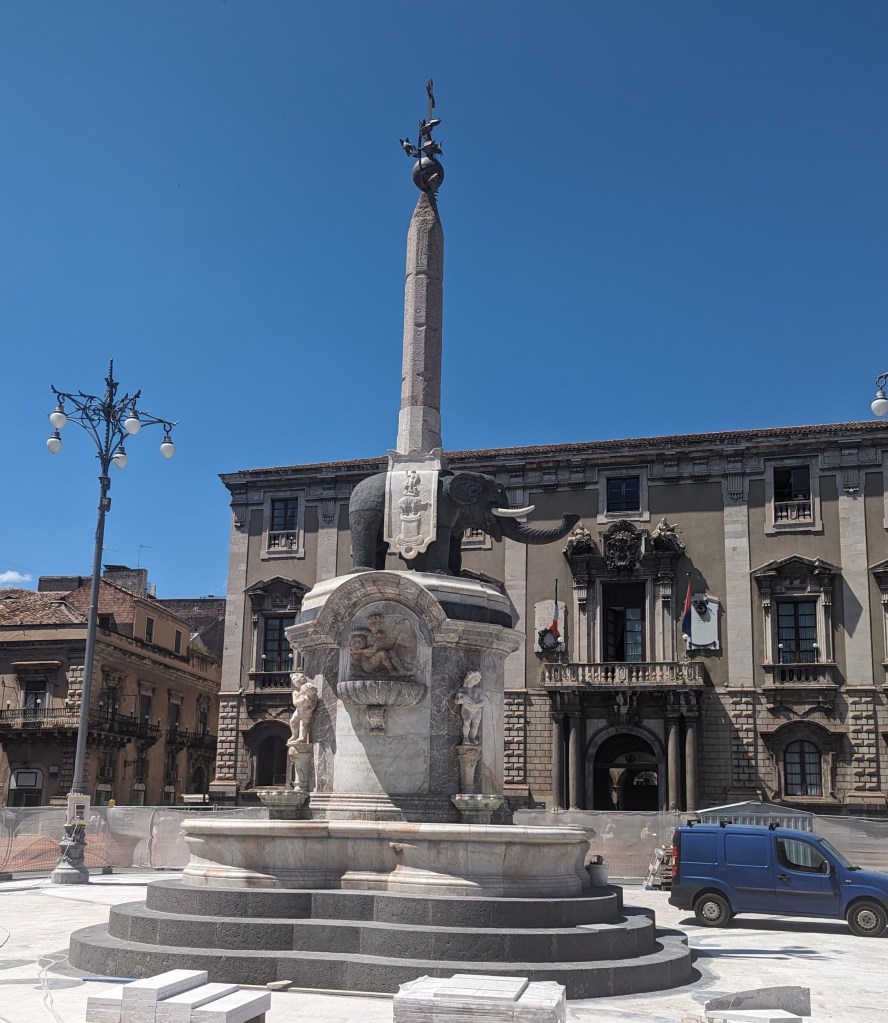
The Piazza del Duoma is a short walk from the flat, and in the centre is a stone statue of an elephant with an Egyptian obelisk on its back. It’s the symbol for Catania, and no dafter than the Liver Bird stuck on top a building in Liverpool.
Obolisk on an elephant

The Duomo is all very Baroque and the architect Sig. Vaccarrini clearly thought you couldn’t have too many statues or columns.

Go on, stick on another statue

The fish market was shut, so I missed out on all the dead scaley fauna, but we did have a walk to follow to see the highlights of Catania.

I could describe it all to you, but it’s easiest to sum it all up in two words: Baroque Churches. There are many of them, and once you have seen a few, they all start to look the same. Many of them have freakily realistic statues of dead Jesus, his mother and saints all painted in realist colours . There are banks of electric candles which will switch on if you put a Euro in the slot, and will automatically bump you up in the queue for heaven.

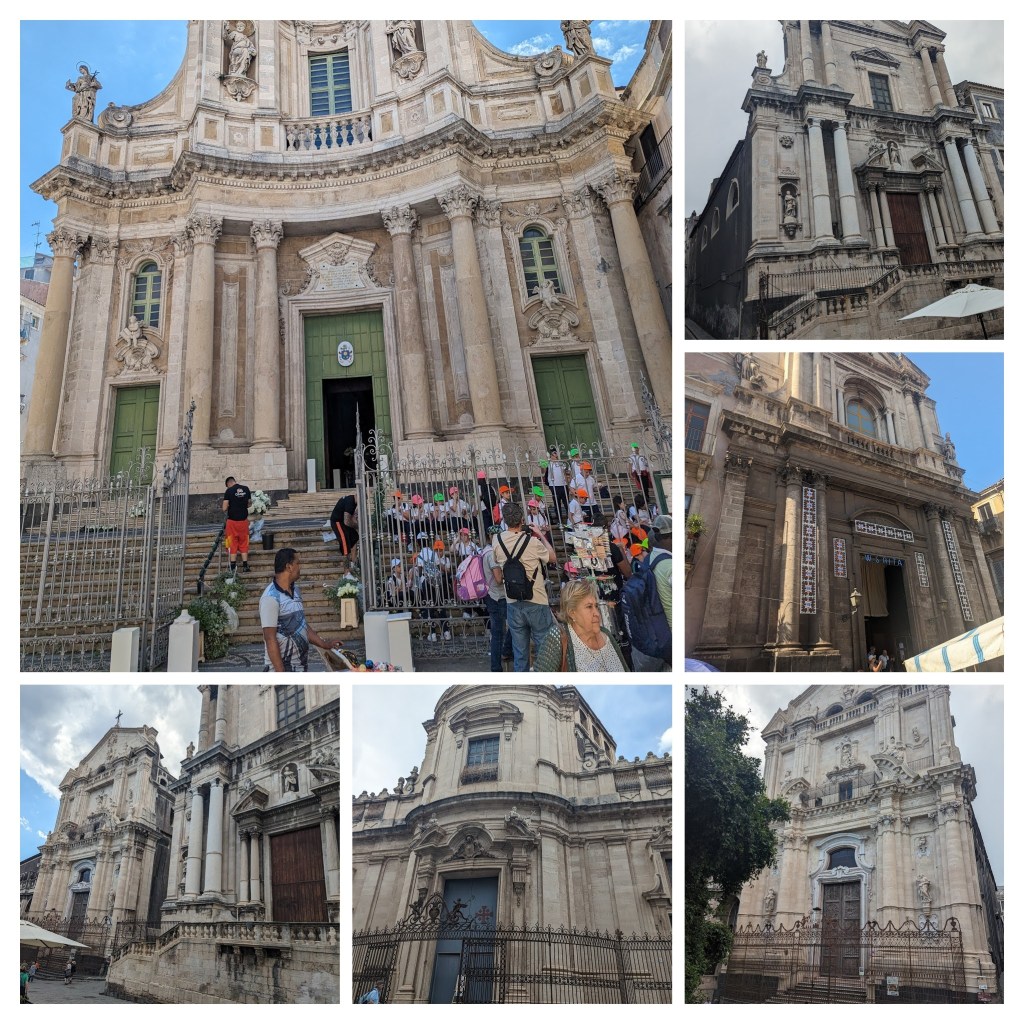
A Baroque-tastic selection of churches

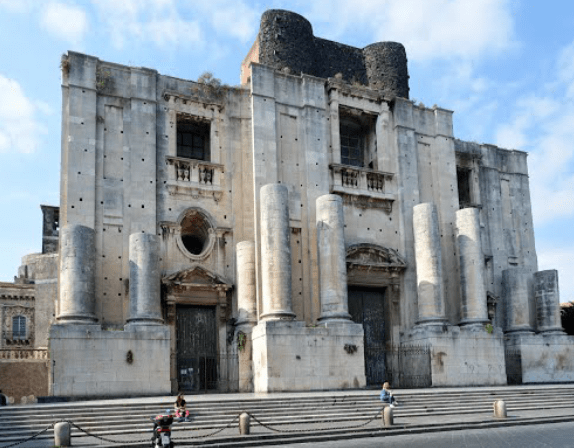
The biggest church is San Nicolo L’Arena, which is cathedral sized. Unfortunately the front facade was never completed, so it looks really weird on the outside. But churches commonly take hundreds of years to finish off, so maybe some billionaire pasta manufacturer will pay for it to be completed.

San Nicolo l’Arena

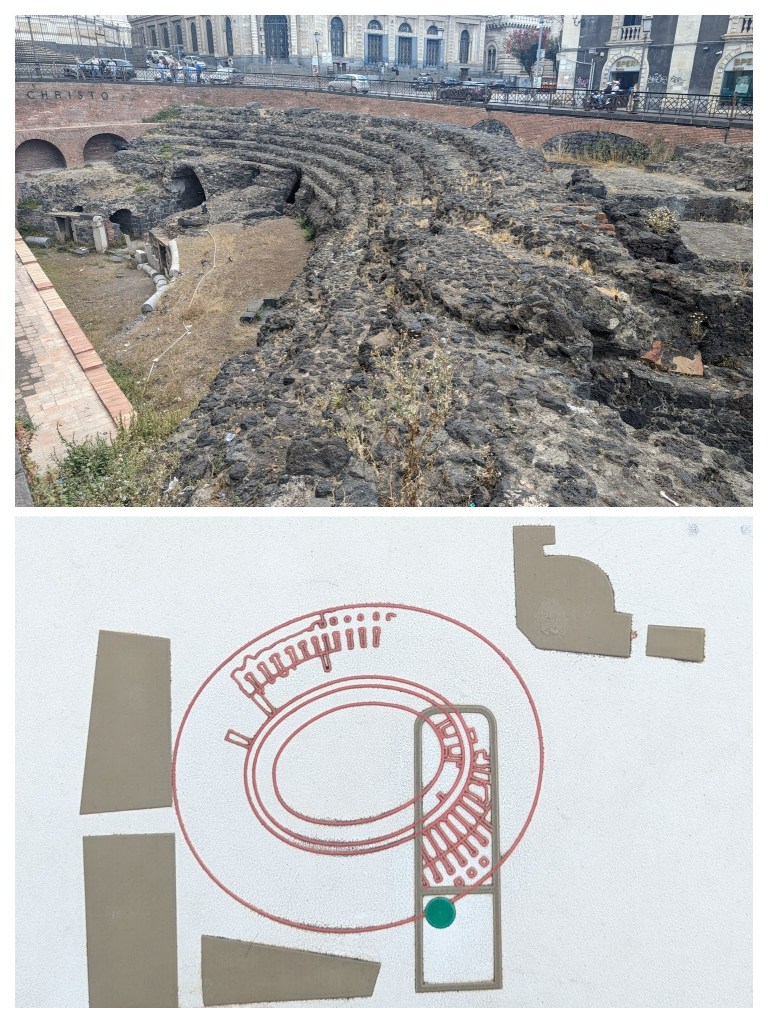
In the middle of the central shopping area is a pizza-slice of a Roman amphitheatre. Most of it is covered by the city, and only a fraction is on show. A sign said it would have held 15,000 people originally.
a slice of Roman amphitheatre

Just as we were getting a bit churched-out, we saw a fast food outlet and were able to have a McPiss, which was an immense relief. Our run of luck continued with the discovery of – Praise the Lord – a Lidl! So we were able to buy some food for dinner tonight and to take with us on our Etna trip tomorrow.

Sicily 2024 – Noto

Monday 20 May

Sicily has a long history, and for most of that time the primary means of transport was foot or horse. Consequently the Sicilian towns are not great places to drive around, we didn’t hire a car for our trip. So we are missing out on all the fun of being stuck behind tractors, driving round hair-pin bends up mountains and trying to find a parking place in a hill-top village.

The buses are regular and reasonably priced, but they are a bit slow. I have a thick Stephen King novel to read, so I can spare the time rattling along congested highways.

Today we went to Noto, which is about an hour to the south of Siracusa on a hill. Its origins go back to the Greeks, and has subsequently been occupied by all the many invaders after that. For a while it was part of the Kingdom of the Two Sicilies, a short lived 19th century kingdom. At the time, bizarrely, the Kingdom of Naples was also called the Kingdom of Sicily. When it amalgamated with yer actual Sicily it became the Kingdom of Two Sicilies.

There is a local Twickenham connection to this area. The daughter of King Ferdinand of the Two Sicilies, Princess Amilie, married Phillipe the Duc D’Orleans and lived in Twickenham in Orleans House. He later became King of the French and she became the Queen.

Anyway I digress considerably. Noto was destroyed by an earthquake in 1693 and was rebuilt in the Baroque style, and is mostly intact. This is in contrast to other Sicilian cities which were badly damaged by bombing in WWII. It is a UNESCO Heritage site, so you can’t add Velux windows or bi-fold doors to your Baroque palazzo.

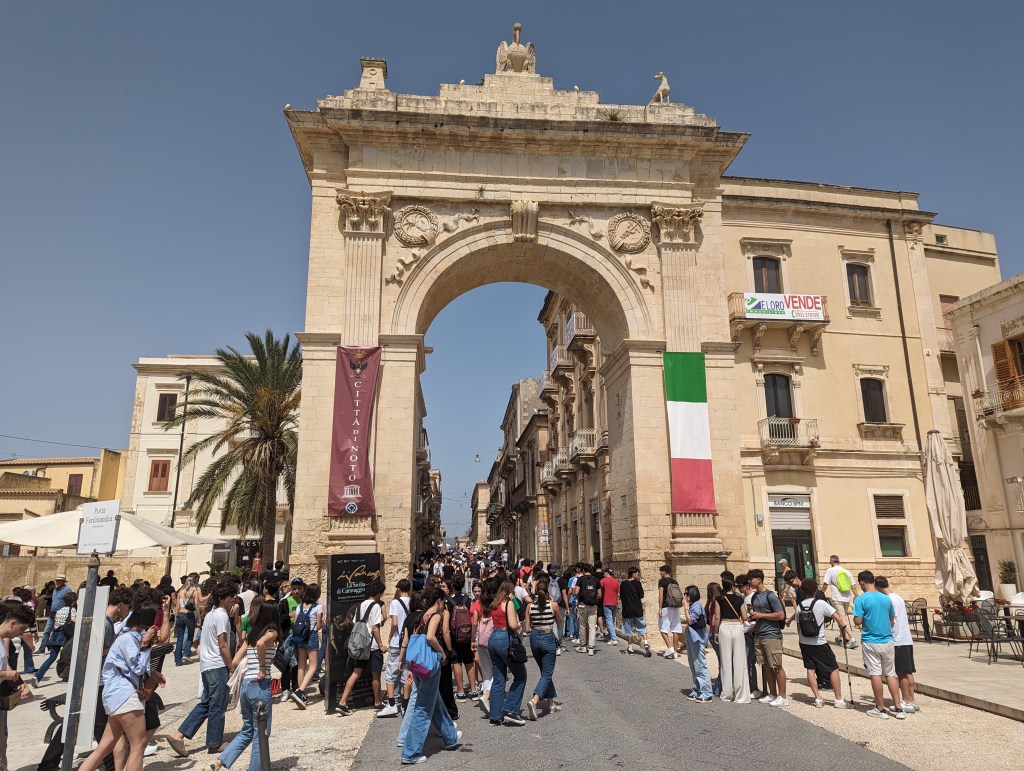
We arrived at the impressive entrance gate at the same time as about five million school kids moving like wilderbeest on the Serengeti. I’m sure Italians get lessons in how to talk over each other extremely loudly. Having a conversation appears to be a competitive event, and a sprint rather than a long distance race. The mass of kids were slowly ingested through the gate like a crocodile swallowing a herd of colourful squirrels.

Big gate with thousands of students

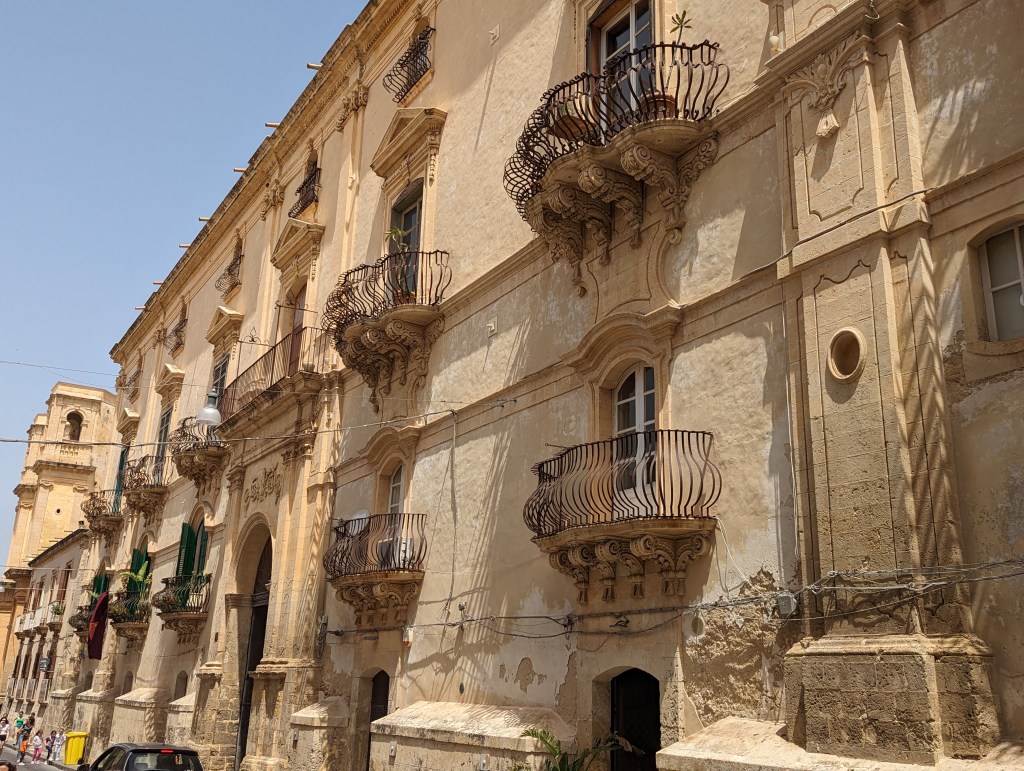
Once they had been swallowed we took a side street up from the main drag. The road was steep and lined with honey coloured houses with fancy balconies. I was convinced that there would be a spectacular view of the stunning countryside at the top. But there was just a big white concrete wall. What a bloody waste of energy.

They love a balcony in Noto

S0 we walked back down to the town centre on a footpath about two feet wide. When someone walked in the opposite direction with a dog it was a stare-off until I decided the dachshund looked vicious and stepped onto the road.

We stopped at a cafe and ordered a sandwich for me and a salad for Julie. Oh, and I had a Heineken, it’s my birthday still innit? I noticed that in the cafe opposite they had cones of fried seafood which smelled delicious, and I immediately got food envy. C’est la vie.

There was a kind of flower festival in the town, with displays made up of petals and coloured rice making pictures. That’s why there were so many school kids visiting. It is a well-known fact that kids adore floral displays.

Floral display- kids love ’em

I would imagine that the local pigeons and rats would make short work of the colourful displays, so maybe they mix the petals and rice with a hideous poison or guard them with marksmen on the rooftops.

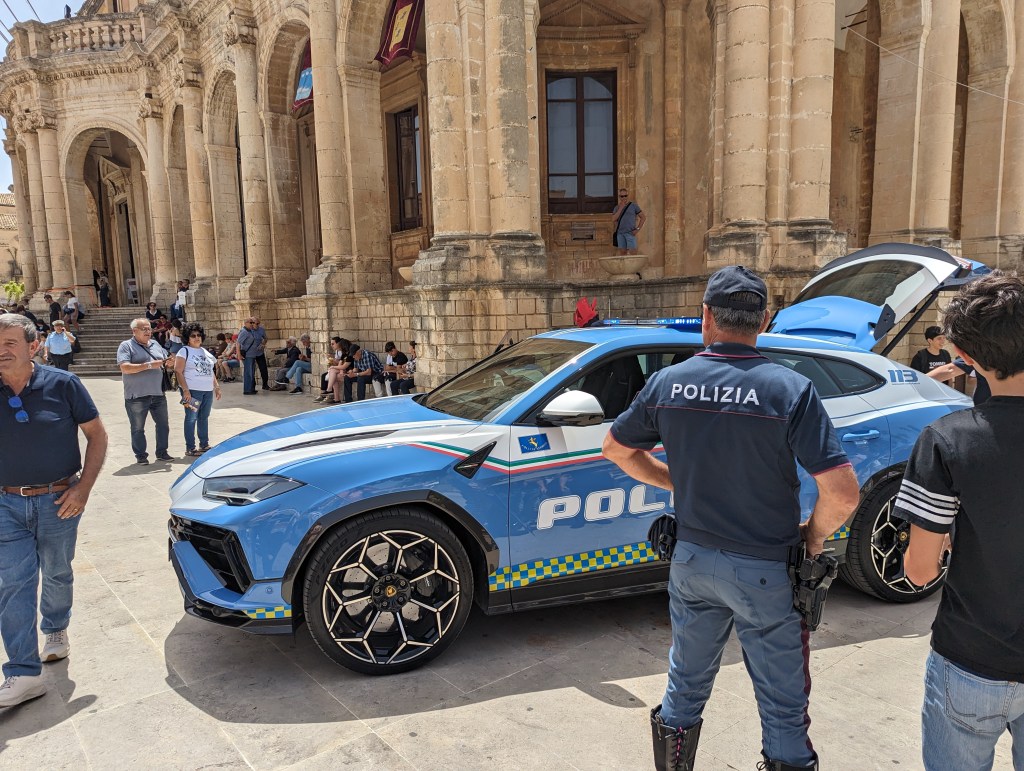
I heard a car revving extremely hard and noisily in the street. There were lots of Carabiniere standing around in their tight trousers and side-arms, so I expected them to arrest the miscreants. Then I saw that it was a police Lamborghini that was making the racket, fucking show-off.

Flash bastard coppers

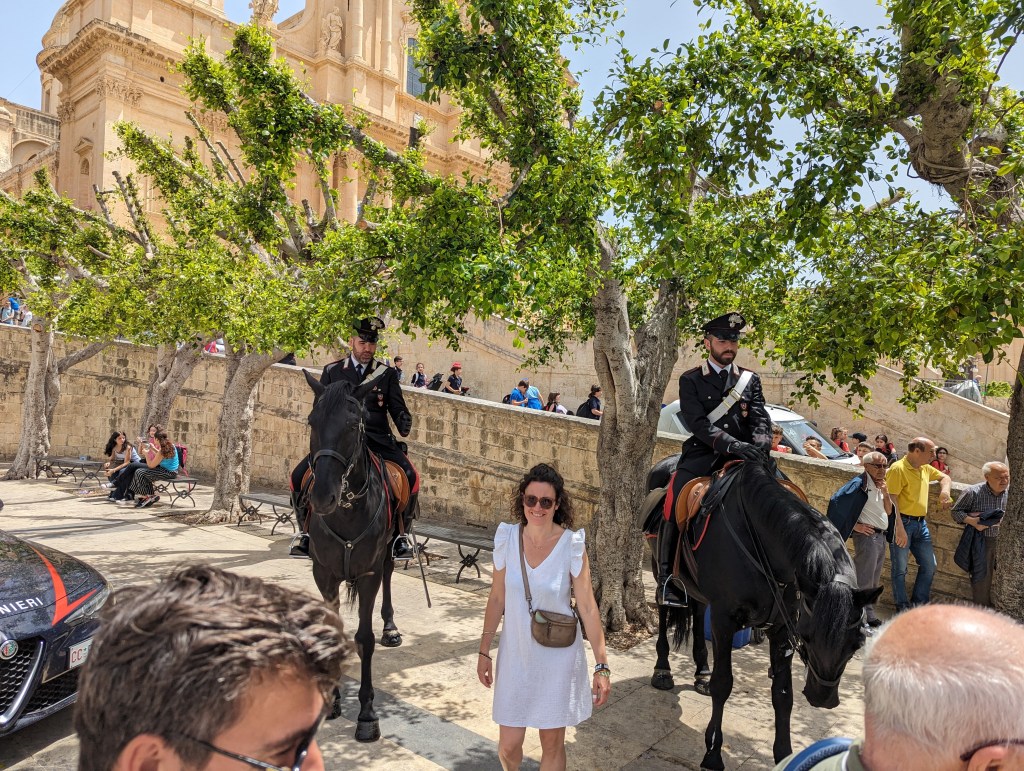
There were also some Carabiniere on horses letting people take selfies with them. I guess that would terrify any local Mafiosa thinking of selling cocaine amongst the floral displays.

Horse police for chasing down litter-bugs with sabres

The cathedral is very beautiful, and looks like it was built yesterday. Thats because quite a bit of it was built recently. The dome collapsed in 1996 due to unremidied structural weaknesses after an earthquake in 1990. Having seen how they build their houses in Siracusa, I’m not surprised.

Noto cathedral

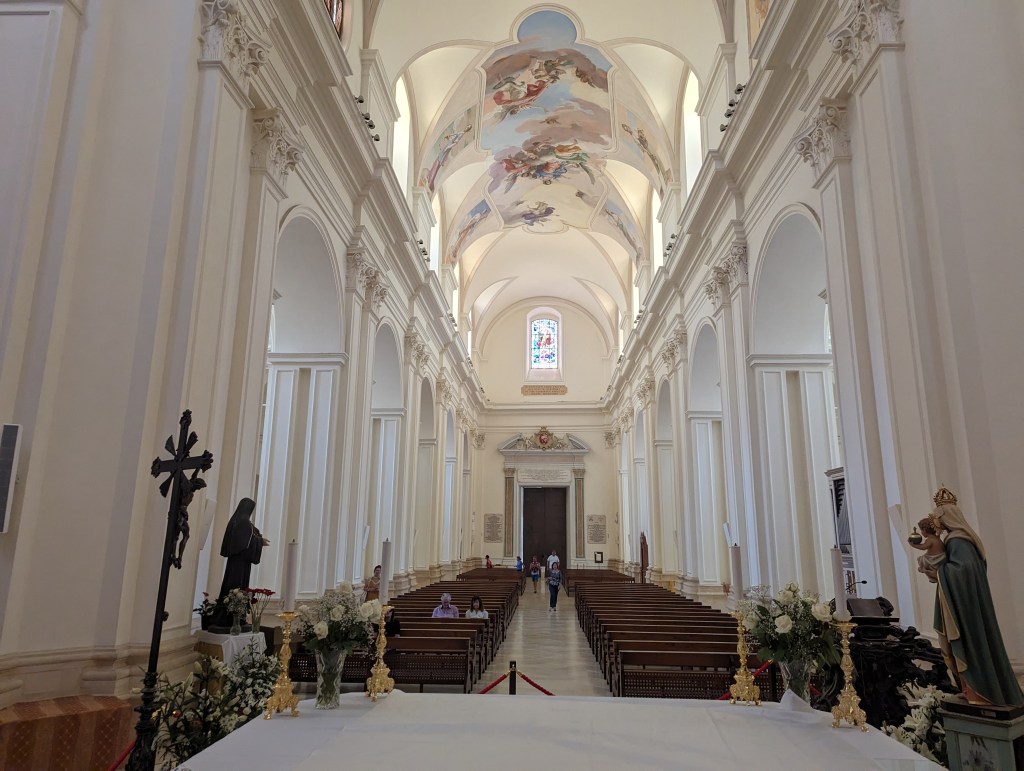
Anyway it is very lovely now, and worth a visit. Inside it is relatively plain compared to other Catholic cathedrals, but the ceiling paintings are very good. I’m always at a loss to describe paintings, my vocabulary for that stuff is very limited, and i guess that’s why I never became an art critic.

Magnolia interior, it was on offer in Wickes

Noto has many many places to buy gelato, and today I had a piccolo-sized cone with chocolate and pistachio scoops. In fact I still have some tasty remnants in my beard I can enjoy for the rest of the evening.

The return bus to Siracusa was quicker than the outgoing and I slept for a while. The seats are designed for small people, and I am not. So I dozed bolt-upright with my head lolling about like a puppet with a broken head string.

We bought beers and went to our roof terrace to enjoy the rest of the afternoon and watch the swifts zipping about over the rooftops.

Julie is busy choosing a restaurant for dinner tonight, we didn’t eat out last night because we were full of salty snacks. I am, of course writing this wonderful blog for your entertainment.

Siena Italy

Wednesday 27 September

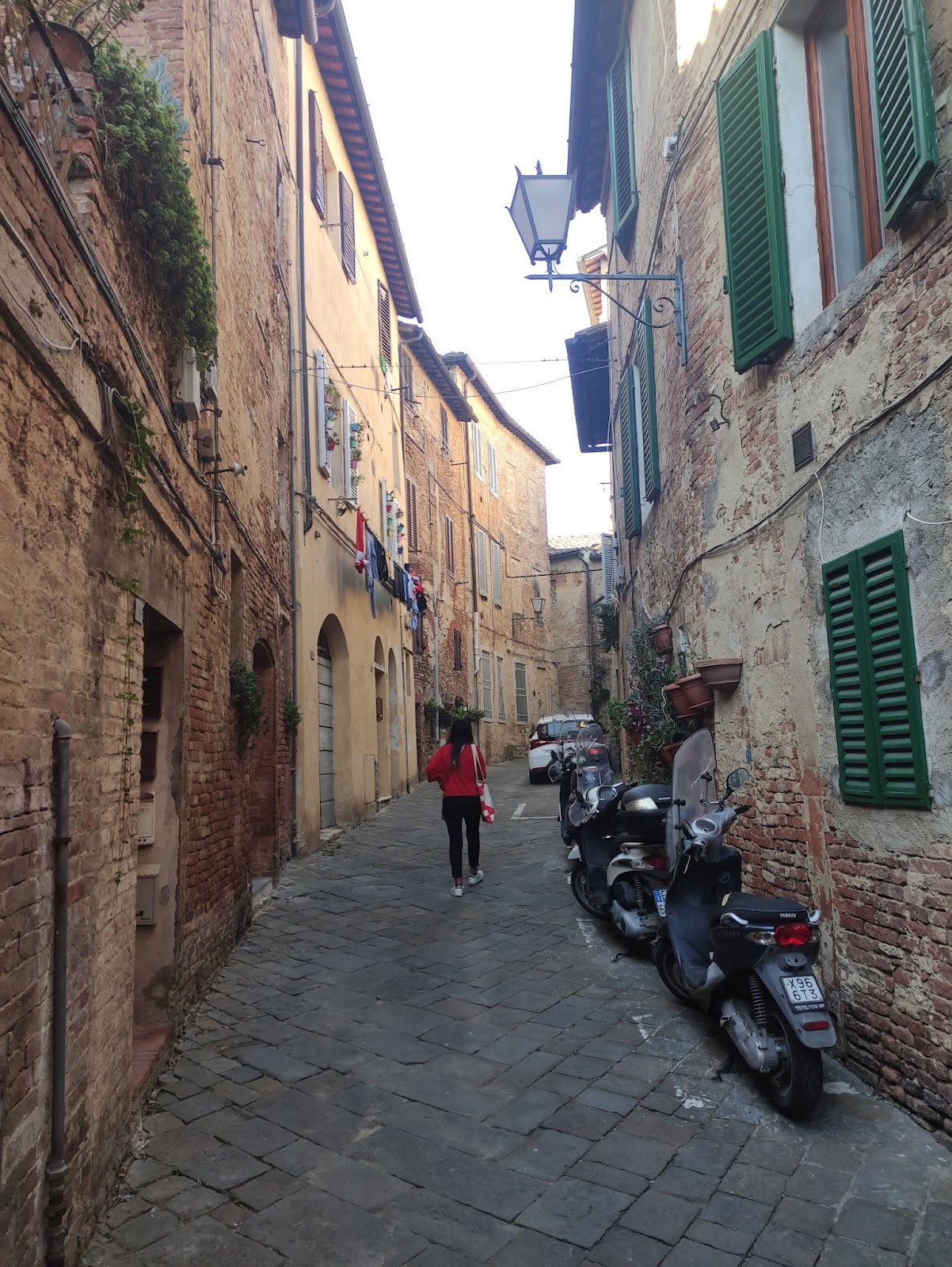
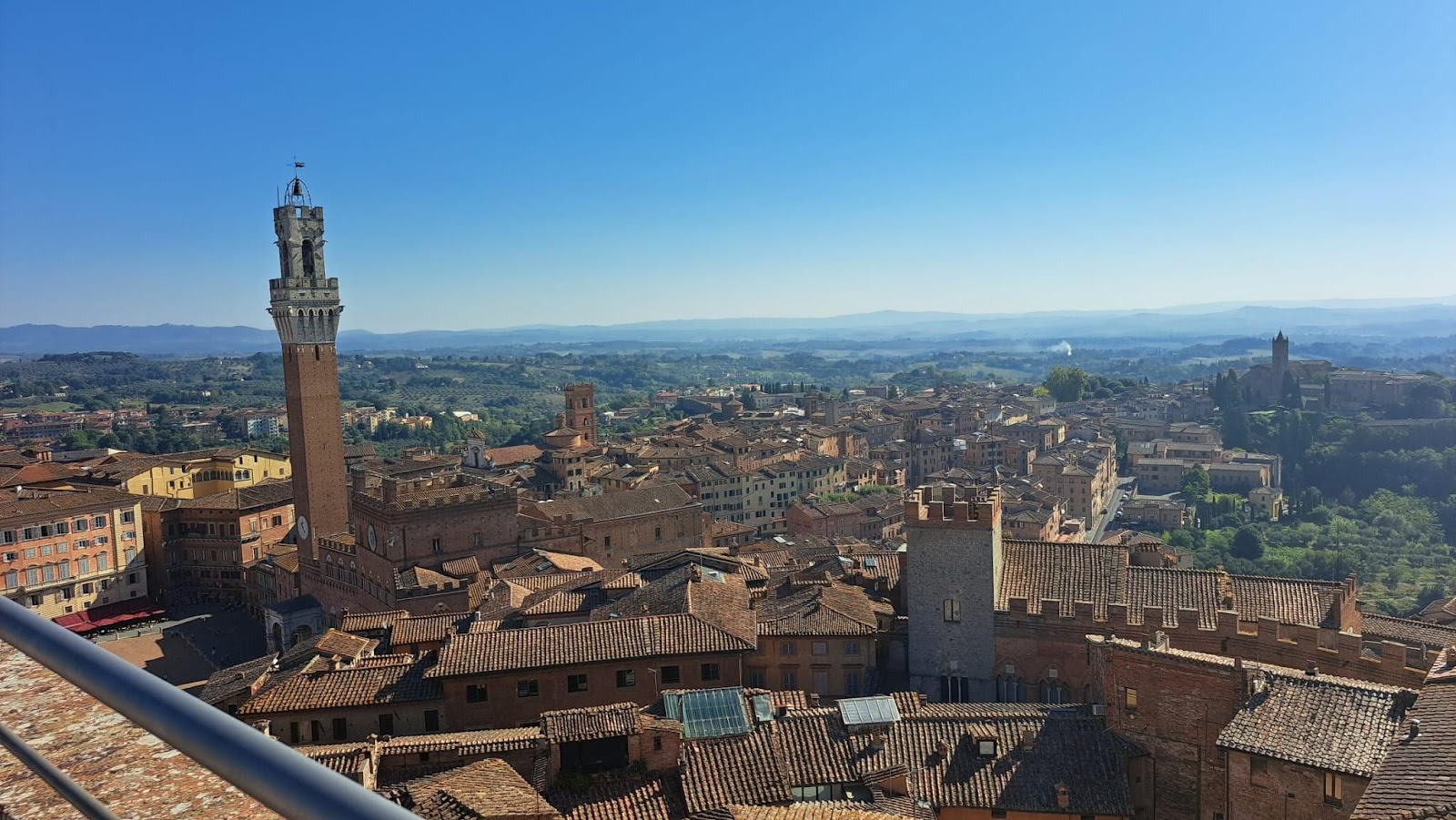
Siena was mostly built between the 11th and 14th century, then the Black Death hit in 1348 which arrested its development. It is situated on top of a hill, 320 metres above sea level in the midst of stunning Tuscan countryside. On our first full day we wandered around the narrow streets, awestruck by the beauty of the city. All of the buildings are brick or stone, and range from artisan’s apartment blocks to palazzos on piazzas and some enormous basilicas. I have seen a lot of old cities in Europe, and Siena  is the most awesome I have seen so far. The centre is entirely medieval, and the it’s like walking through a film set. There are no footpaths, just roads paved with black stone, so you regularly have to pin your back to the wall as a taxi or rubbish truck comes through.

The rubbish trucks and buses are small so that they can  get round the tight corners and along the narrow streets.

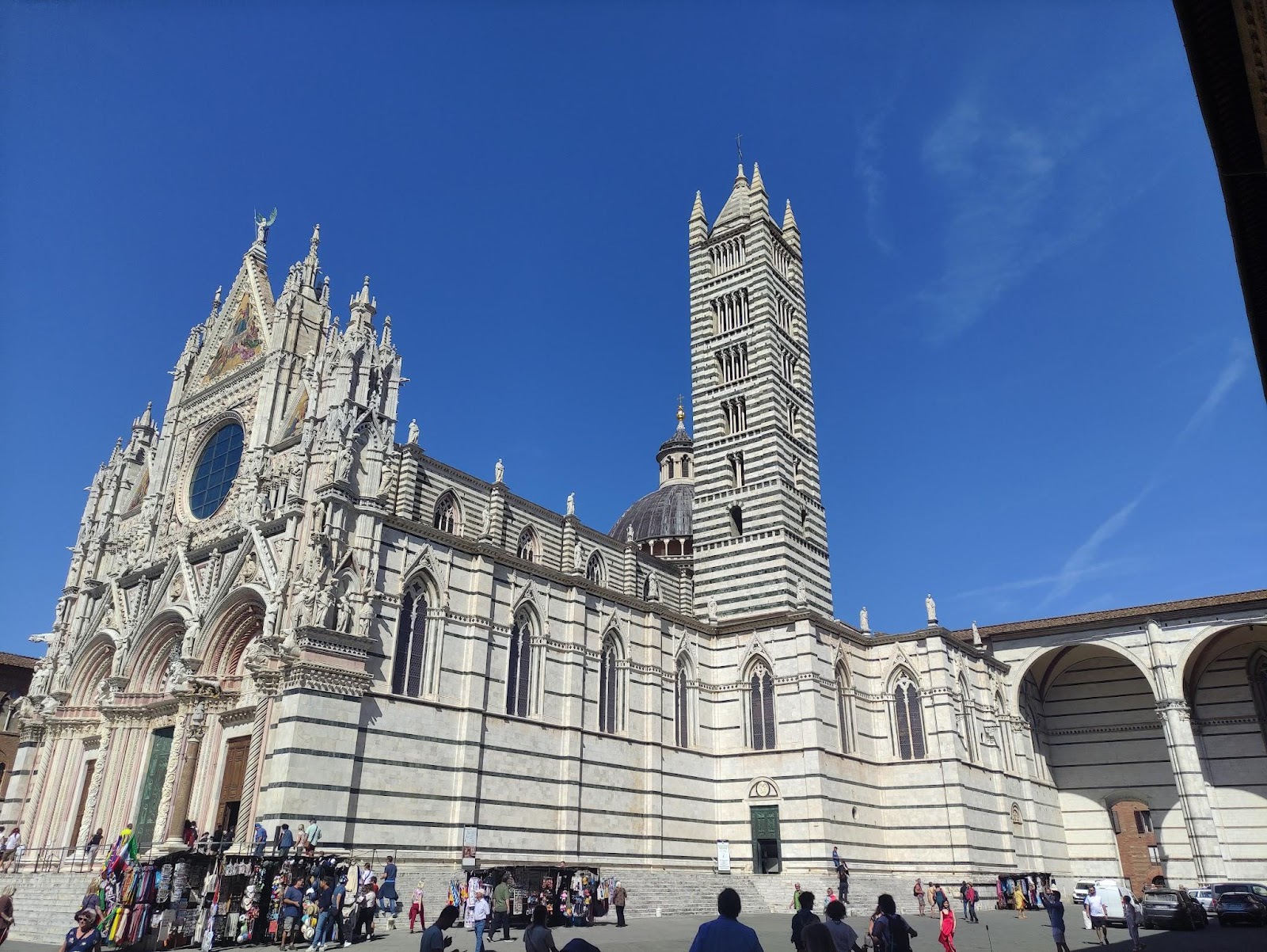
We bought the bumper bundle ticket for the cathedral, which would let us visit several different parts of it over 3 days.

The Duomo is clad in black and white striped marble, whereas the Florence Duomo is green and white and bigger. The interior is sumptuously  clad with marble, gold and rich frescoes on the walls. The floors are patterned in marble as well, I don’t know how they did that 700 years ago, they were very clever people! 

After a shit-load of culture what you do? You have a drink right behind the cathedral in the sunshine.

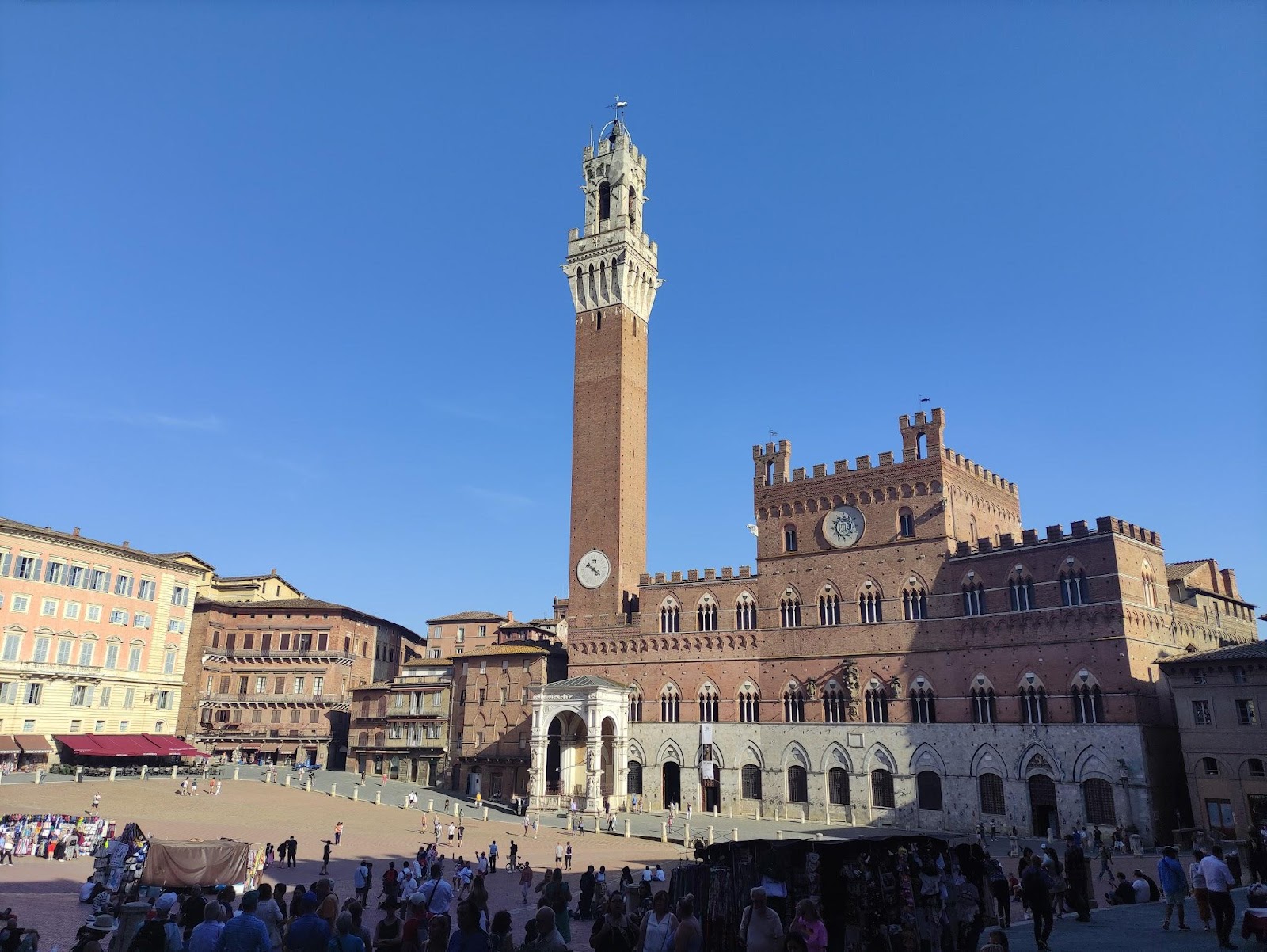
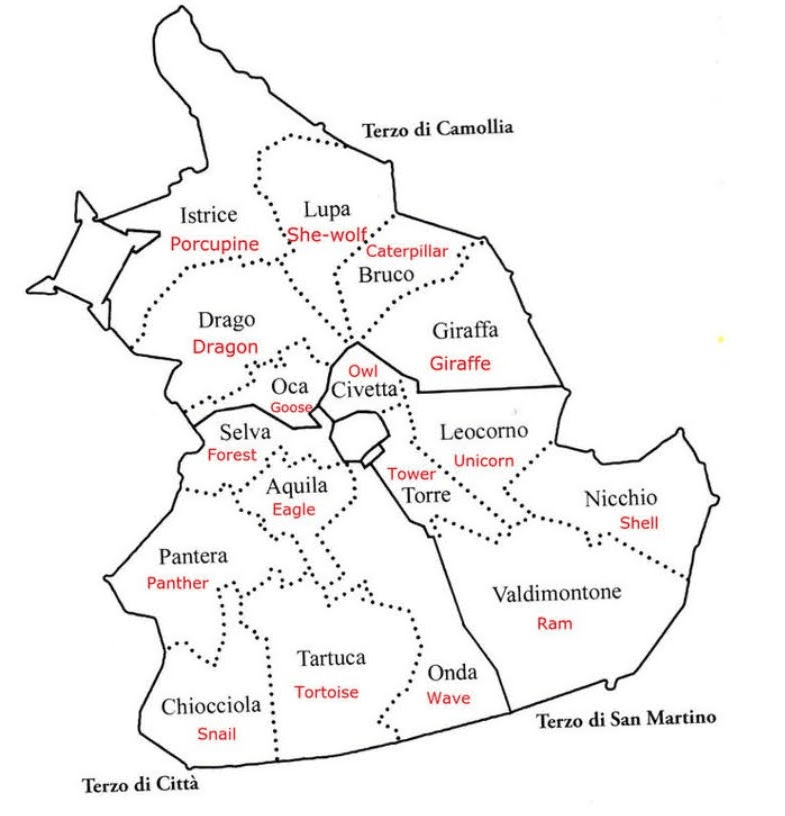
The Piazza del Campo is the central “square” in Siena, overlooked by the town hall with its great tower, the Torre del Mangia. The Campo is where the Palio horse race takes place every year on the 2nd July and 16 of August. Old Siena is divided into 17 contrada which compete for a silk flag. Out of the 17, only 10  are chosen by lottery to get a horse in the race.

The horses that the contrada get are also decided by lottery, so the competition is extremely intense.  Have a look at the BBC Reel video on YouTube, it’s very exciting.

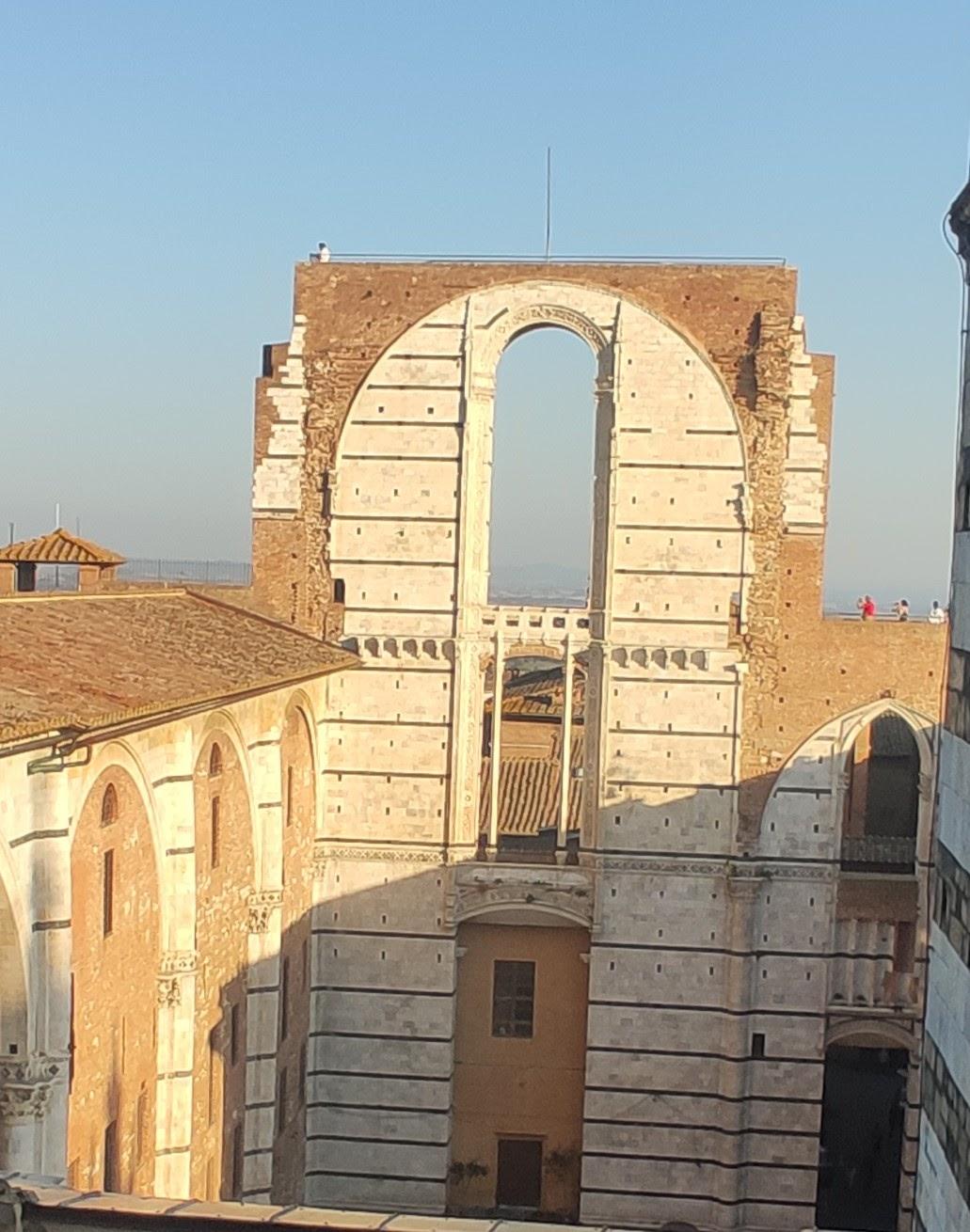
The second part of our Duomo trip was up just under the roof and below the bottom of the dome. We could see inside the cathedral, and had a splendid view of the city and the Facciatone. This was  an extension to the cathedral, then the Black Death came along and the builder found a better paying job somewhere else, leaving one big wall.

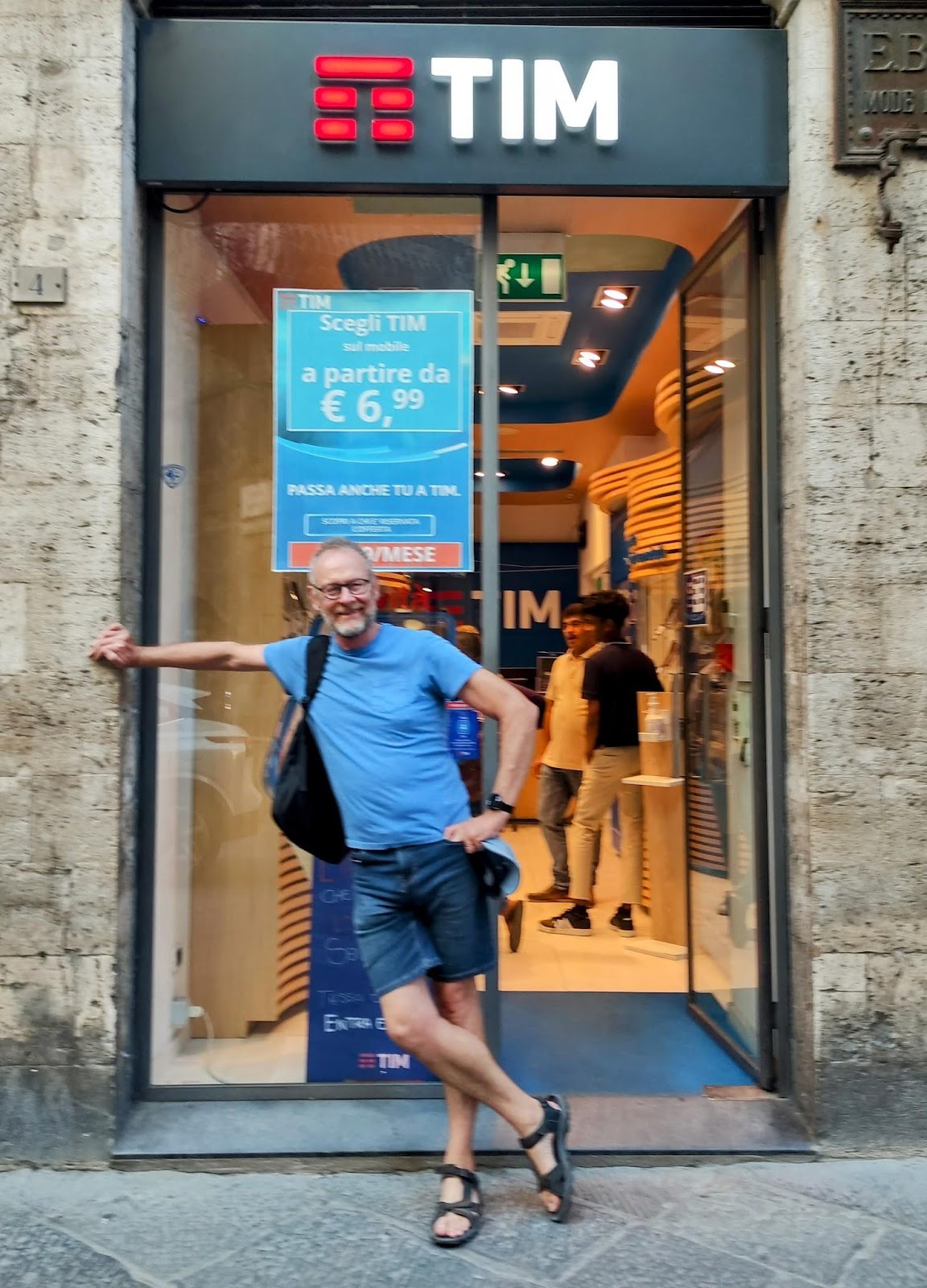
I managed to find a shop names after me. FACT I once stayed in TIM Hotel in Paris. I’m very popular.

Thursday 28 September

San Gimignano

San Gimignano came up on Google as a good place for a day trip from Siena by train, but it turned out to be simpler to go by bus.

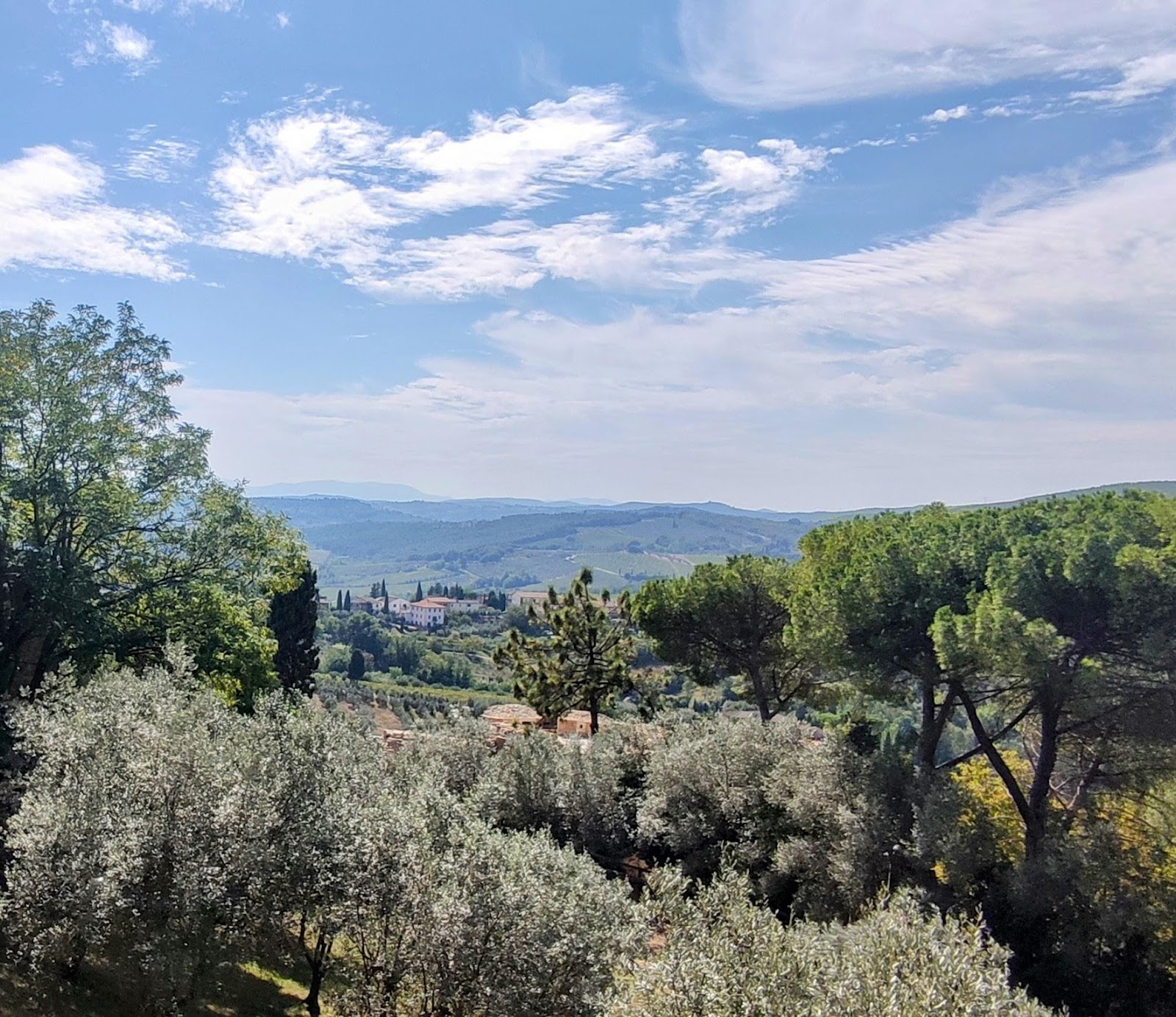
The bus took us through some lovely Tuscan countryside to a hilltop village taken straight from a Chianti bottle label, I expected some men in tights to ride out of the gates on horseback.

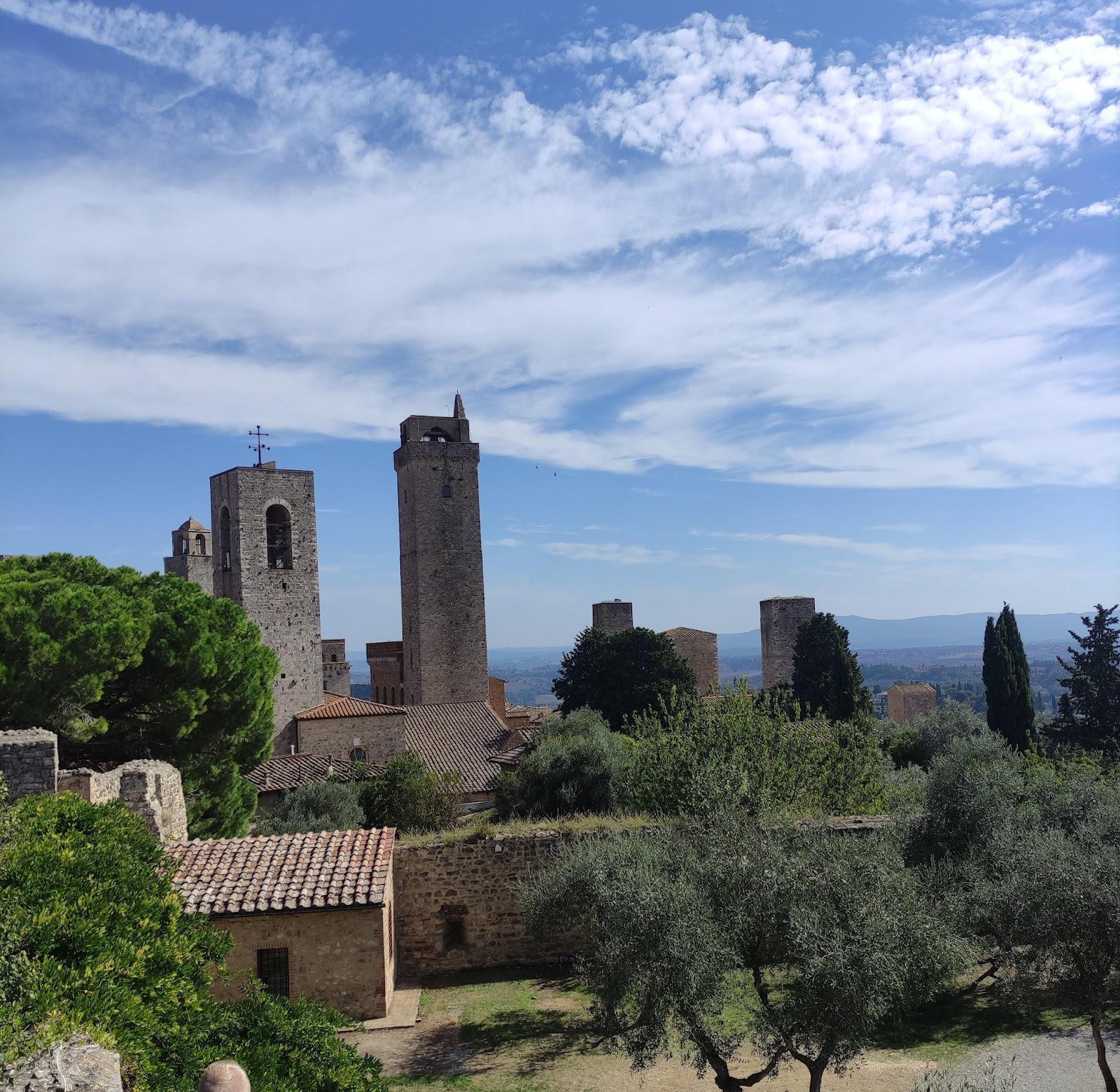
The town was doing well and thrived until the Black Death in 1348, then its development was stopped. It still has 7 great stone towers built by rival families in the town, and a good selection of Gothic churches. Because it is so remarkably pretty, it was swarming with other day trippers getting dinner party boasting points; “Have you been to San Gimignano? It’s absolutely fabulous, and the pasta with truffles is to die for’.

We wandered the narrow streets and admired the old houses and churches. There is a panoramic view over Tuscany which looked like the scene in Gladiator where Maximus is remembering his farm.

We watched it on Netflix the other night, it’s still a great film.

There was a market selling all the usual stuff; bags, hats, “truffle oil”, olive wood salad servers. But also a van selling pork sandwiches, which he carved from a large joint of rolled roasted pork. So we literally pigged out.

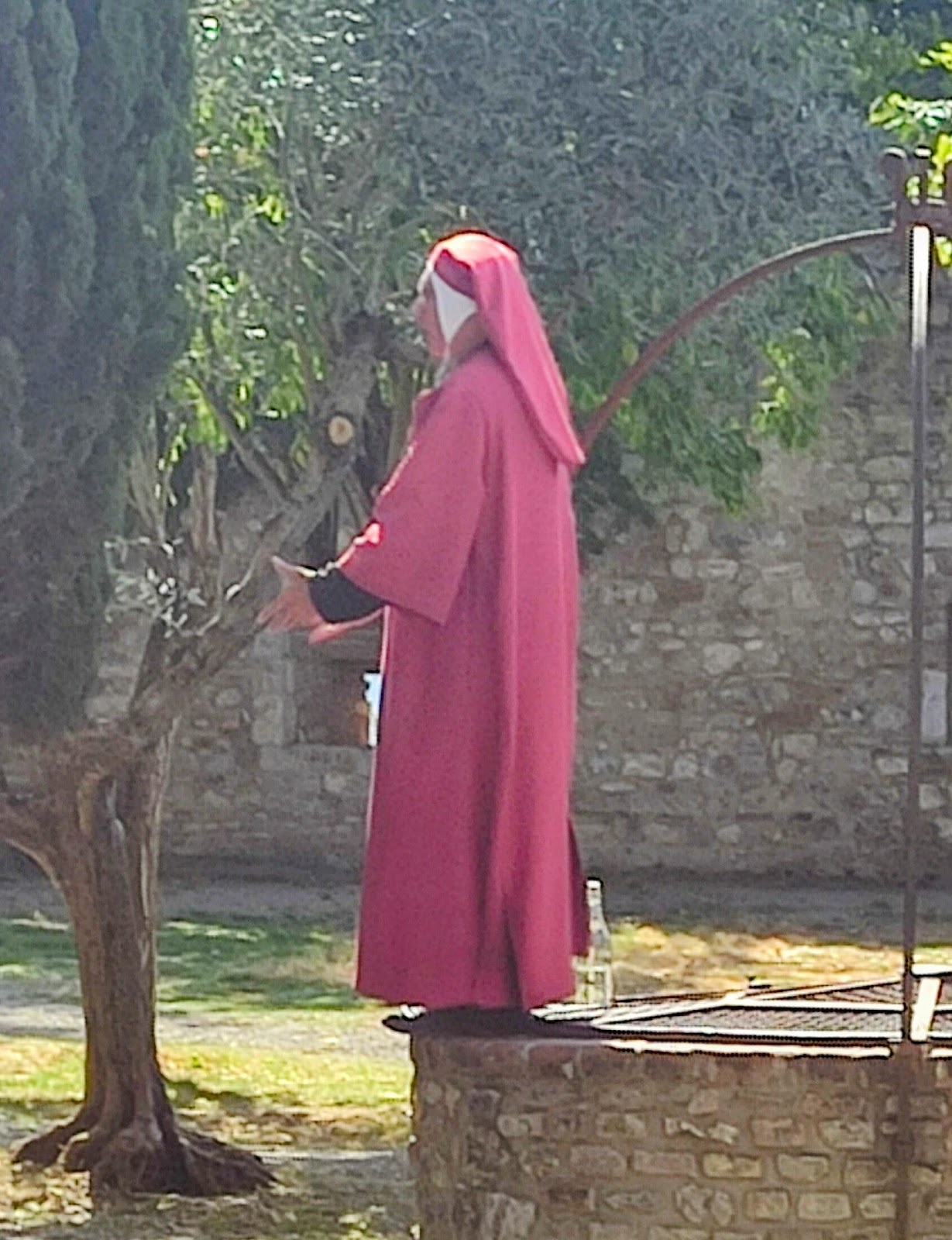
In the remains of a castle at the top of the town was a man dressed as Dante giving a speech from the Divine Comedy. He had the confident voice of a stage actor, but sadly his audience was almost non-existent. 

Every other night we cooked in the flat. Often there would be a  simple 2 ring electric hob, which was adequate for simple meals, usually featuring pasta and tuna. There was always wine with our meals, we are in Italy and it would be rude not to.

Friday 29 September

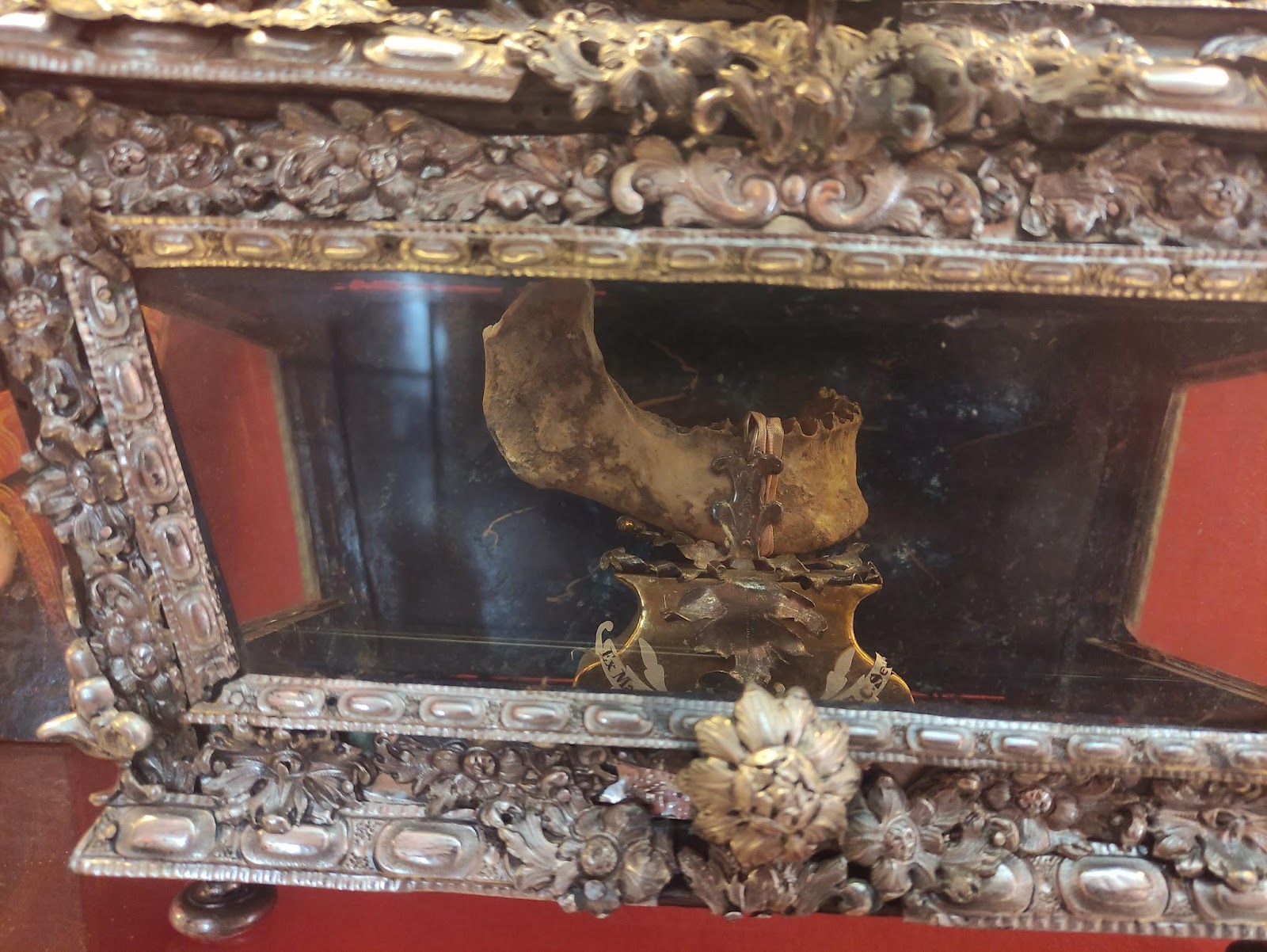
On our last day in Siena we used up the last parts of our Duomo ticket, which was valid for three days. The first part was a museum of treasures from the cathedral; paintings, sculptures, chalices and reliquaries. Reliquaries are just weird, they are fancy silver boxes that contain bits of dead saints; bones, teeth, jawbones, even complete skulls. Pilgrims would travel hundreds of miles to see a reliquary, and they made a lot of money for the churches. 

This is the jawbone of a dead saint, I think it’s revolting, but I’m not a Catholic.

The treasures are very limited in scope; Jesus, Mary, saints and the occasional bishop. Some of the statues had a very peculiar posture, but they were designed to be on the top of the cathedral looking down on the pilgrims below.

The “highlight” of the tour was the climb to the top of Facciatone, the very tall wall of unfinished cathedral extension. The last climb was up a narrow spiral staircase designed for people with smaller feet than me. Then when we got to the top the view was fantastic BUT the wall only came up to my waist. I did not like that at all, my guts were churning and my balls were tingling, so I sat down and hung onto the rail. The guide could see the fear in my face and kindly told me about what was in view. Julie took these photos, I didn’t want to let go of the rail!

There are many ancient winding streets in the old town, which have hardly changed in 700 years. On many of the walls are large iron rings, which I guess are used for tethering horses. On many streets there are flags on the wall signifying the different contrada. They are a vital part of the community and organise social events all year round for their members. We were staying in Selva, and the flag has an oak tree on it.

Verona Italy 2023

Friday 22 September

Verona Day 1

So farewell Salzburg, home of the Von Trapps and Mozart. The Von Trapps were a real family choir, but there story was embroidered considerably. But I did find a lonely goat turd high on a hill.

I’m now on the train between Innsbruck and  Brenner. It’s cool and rainy with very low cloud, which justifies us skipping Innsbruck and going straight to Verona.

 The first leg of the journey was east to Innsbruck, then we changed trains and headed towards Verona through the Brenner Pass. This is a combination of river valleys and long tunnels through the Tyrol Alps, lands which are the border between the German  and Italian speaking world and have been fought over for thousands of years. We were well into what is now Italy before the houses lost their alpine appearance, and cypress trees and vineyards appeared that gave the land an Italian look.

At Porto Nuovo station in Verona, Julie found our new accommodation on Google Maps, and we dragged our trolley bags through the city centre. Verona has existed for well over 2,000 years, and has buildings from every era. It was a 40 minute walk through the old city centre past the Roman arena.

Our accomodation was on the other side of the Adige river, which is the same raging torrent that goes through the Brenner pass.

After settling into our apartment on the second floor on a 16th century house, we walked back across Ponte Nuovo to find somewhere to eat at the nearest supermarket. Rounding a corner I heard someone shout 

“Tim!”

It was my mate Steve Lenczner from Fulham. I knew he was going to be in Verona, and it was pure chance that he was standing on his balcony as we walked past.

So we all went to Piazza del Erbe around the corner from Steve’s flat  and had Aperol Spritz, risotto and a little too much wine. A fantastic evening in a stunning location on a warm evening in Verona.

Saturday 23 September

Bloody hell I felt a bit rough in the morning, I think I have an overdose of fun (or red wine). Verona is all I had hoped it would be, a city that was one of the richest in Europe in the middle ages, that has mostly preserved its medieval city centre. The centre is made up of red brick palazzos and piazzas, and of course swarms of tourists. I wore shorts and a teeshirt and wore a cap to cover up my tender bonce, my appearance cried out TOURIST. I couldn’t compete with the local men in skinny legged suits, crisp white shirts and black ties. Even the coppers looked cool. 

The Castellvecchio is a castle built by Cangrande della Scalla, the local warlord,  in the 13th century. It was built next to the Adige river, and the bridge was also fortified to give him an escape route if the ungrateful locals rose up against him. The bridge stood for 600 years until retreating Nazis blew it up in 1945. A local architect Libero Cecchini masterminded the reconstruction which was completed in 1951, and it looks perfectly like the original.

I was fascinated (to a nerdy extent) by the construction of the walls of buildings, which were made of brick, old stone, rubble and river stones. But clearly they last longer than most modern buildings.

Crossing over the San Pietro bridge we could see that the Adige was in full turbulent flow beneath the bridge, no wonder there were no boats at all on the river.

Sunday 24 September

Close to where we were staying was a viewing sport called Castel San Pietro. The castel was an Austrian barracks from the first half of the 19th century when Austria ruled most of northern Italy. We walked up the steps rather than ride the funicular up the hill. I am a skiffer, not a softie! There was a fantastic view over  old Verona, a vista of red brick, tiled roofs and bell towers. The Austrians chose a good spot to house their soldiers.

On almost every corner there is a lovely palazzo or basilica to look at. There are many churches that you can walk in to enjoy the Renaissance art that covers the walls, and of course, the cool shade and peace.

In the afternoon we visited the Giardino Giusti, a 16th century palazzo and its gardens. It is still owned by the Giusti family, but its open to the public. It had 7 or 8 rooms full of old furniture and paintings, some going back to when it was built in the 16th century when the Scaglia and Hapsburgs dripped by to visit. One of the pictures on the wall was an old print of a 19th century regatta in France. I was amazed to see that it had skiffers on it wearing hooped shirts, like the ones we wear today at the Skiff Club

It has its original gardens, which are quite rare in fortified cities, no doubt it was a lovely place for passing aristos to enjoy a spritz on a hot afternoon. The gardens rise above the house, a great spot for a selfie with the palazzo behind us.

I wanted to see the city walls, and Julie didn’t. So I hiked up behind Giardino to the massive Austrian fortifications that surround the city. Only when I got there I found there are two walls, and I was walking between them, so for most of my walk I just saw walls. Not so interesting, but a good walk.

In the evening we went to the Tosca Bistrot and I chose Pastisado de Caval, horse stew. Well you don’t see it in London do you? It was just like beef stew, on a slab of polenta, tasty but unremarkable. Luckily it didn’t give me the trots..

Monday 25th September

Verona is very close to Lake Garda, which has got to be one of the most beautiful lakes in the the world! We got the train to Peschiera del Garda, a former fortress town at the bottom of the lake with huge walls. Those Austrians loved a big wall. 

The town itself was very busy, so we walked up the shore to find a shady bench and just chill and enjoy the views to the mountains and towns on the opposite shore. I was a bit tempted to have a swim, but the water was a bit murky, and the beach was stoney and hard to walk on.

The place was so exceptional, watching the lake was enough for most of the day. We did have a trip to Lidl to get lunch, boy do I love a good Lidl. Later on in the day we had a drink in a cafe and did more serious gazing over the lake.

In the evening we ate dinner in the flat, tuna salads feature regularly in our diet, followed by fruit and yoghurt and a bit of chocolate.